kottke.org posts about Elizabeth Kolbert
One of the countries with the best response to Covid-19 has been Iceland. The country didn’t lockdown nor do many people wear masks, but they have virtually eliminated the virus through a vigorous program of test, trace, and isolate that was coordinated by public-health authorities. Iceland’s numbers were high in the beginning (the virus was carried into the country from people returning from vacation) but they acted quickly and aggressively — Elizabeth Kolbert has the story for the New Yorker.
Möller pulled up a series of graphs and charts on her laptop. These showed that, per capita, Iceland had had more COVID-19 cases than any other Scandinavian country, and more than even Italy or Britain. There was an outbreak in a nursing home in the town of Bolungarvík, in northwestern Iceland, and one in the Westman Islands, an archipelago off the southern coast, which seemed to have started at a handball game. (In Europe, handball is a team sport that’s sort of a cross between basketball and soccer.)
“The numbers in the beginning were terrible,” Möller said. She attributed the country’s success in bringing the caseload down in part to having got an early start. The “trio,” along with officials from Iceland’s university hospital, had begun meeting back in January. “We saw what was going on in China,” she recalled. “We saw the pictures of people lying dead in emergency departments, even on the street. So it was obvious that something terrible was happening. And, of course, we didn’t know if it would spread to other countries. But we didn’t dare take the chance. So we started preparing.” For example, it was discovered that the country didn’t have enough protective gear for its health-care workers, so hospital officials immediately set about buying more.
Elizabeth Kolbert writing for National Geographic: There’s No Scientific Basis for Race — It’s a Made-Up Label.
“What the genetics shows is that mixture and displacement have happened again and again and that our pictures of past ‘racial structures’ are almost always wrong,” says David Reich, a Harvard University paleogeneticist whose new book on the subject is called Who We Are and How We Got Here. There are no fixed traits associated with specific geographic locations, Reich says, because as often as isolation has created differences among populations, migration and mixing have blurred or erased them.
She also observes that there’s more diversity in Africa than all the other continents combined (which is what happens when the rest of the world’s population is based on a relatively small population that left Africa 60,000 years ago).
In her book The Sixth Extinction, Elizabeth Kolbert warns that we are in the midst of the Earth’s sixth mass extinction of life, this time caused by humans.
Over the last half a billion years, there have been five mass extinctions, when the diversity of life on earth suddenly and dramatically contracted. Scientists around the world are currently monitoring the sixth extinction, predicted to be the most devastating extinction event since the asteroid impact that wiped out the dinosaurs. This time around, the cataclysm is us.
This is a mainstream view of humanity’s effect on the Earth flora and fauna…for evidence, you don’t need to look any further than all of the large mammal species that have gone extinct or are endangered because of human activity.
A more controversial take is offered by Chris Thomas in his recent book, Inheritors of the Earth: How Nature Is Thriving in an Age of Extinction. Thomas allows that there’s a “mini mass extinction” happening, but he also argues that the extreme evolutionary pressure brought by our increasing dominance of our planet’s ecosystems will result in a “sixth mass genesis”, a dramatic increase in the Earth’s biodiversity.
Human cities and mass agriculture have created new places for enterprising animals and plants to live, and our activities have stimulated evolutionary change in virtually every population of living species. Most remarkably, Thomas shows, humans may well have raised the rate at which new species are formed to the highest level in the history of our planet.
Drawing on the success stories of diverse species, from the ochre-colored comma butterfly to the New Zealand pukeko, Thomas overturns the accepted story of declining biodiversity on Earth. In so doing, he questions why we resist new forms of life, and why we see ourselves as unnatural. Ultimately, he suggests that if life on Earth can recover from the asteroid that killed off the dinosaurs, it can survive the onslaughts of the technological age.
Vox’s Ferris Jabr recently interviewed Thomas about his views. When asked about the “sixth mass genesis”, Thomas answered:
The history of life on Earth is a history of extinctions and ecological failures, but it is also a story of formation of new forms and spread of those new forms around the world. The net result has been a gain in diversity. In the human era we are seeing great losses, but we are also seeing all these biological gains of new animals and plants spreading around the world, new hybrids coming into existence. I am not saying there is yet a balance between the two. I accept the losses, but it is also scientifically, and in terms of our human attitudes to nature, extremely interesting to contemplate the gains simultaneously.
If the processes that are going on at the moment continue for a very long time, it is my expectation that the number of species on Earth will grow enormously. We are moving species of existing animals and plants back and forth across the world, so that they are all arriving in new geographic regions. We know when species have done this in the ancient past, they have turned into new species in those different regions. If you fast-forward a million years or a few million years, all of these introduced species that leave surviving descendants will have turned into new species. And that is going to generate many more species. We have effectively created a massive species generator.
That certainly does put an interesting spin on extinction and invasive species.
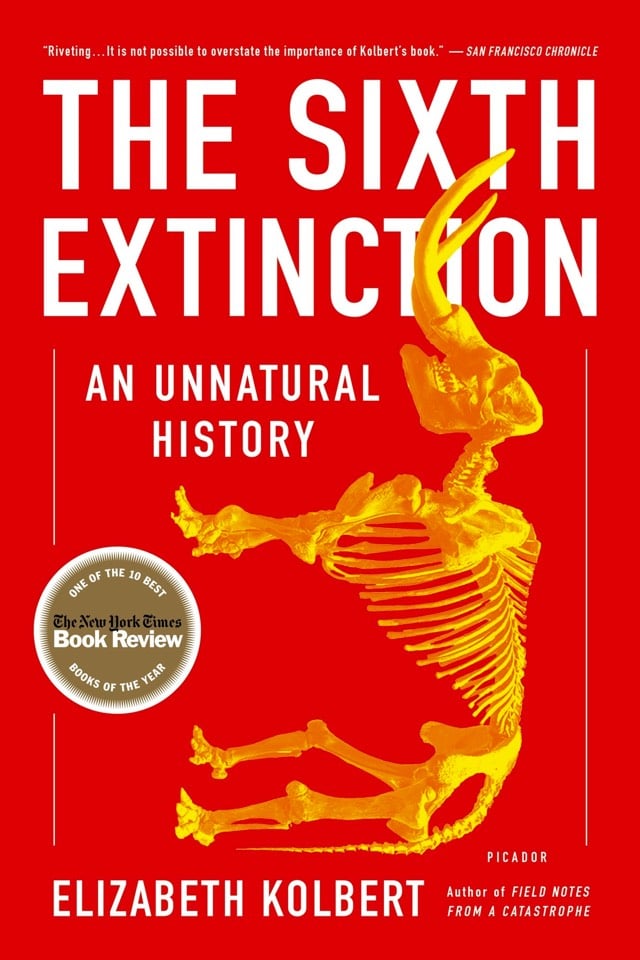
Vox has a list of all the 2015 Pulitzer Prize winners. I am especially pleased to see Elizabeth Kolbert win the general nonfiction category for The Sixth Extinction: An Unnatural History…I’ve been reading her writing on climate change and environmental issues in the New Yorker for years now.
About 250 million years ago, Earth suffered its fifth (and worst) mass extinction event. Nearly seventy percent of land species disappeared. And they got off easy compared to marine species. Are we headed for another mass extinction on Earth? I’m not ready to break that news. But something unusual is definitely going on and extinction rates seem to be speeding up. Here’s an interesting chat with Elizabeth Kolbert, author of The Sixth Extinction.
The worst mass extinction of all time came about 250 million years ago [the Permian-Triassic extinction event]. There’s a pretty good consensus there that this was caused by a huge volcanic event that went on for a long time and released a lot of carbon-dioxide into the atmosphere. That is pretty ominous considering that we are releasing a lot of CO2 into the atmosphere and people increasingly are drawing parallels between the two events.
Elizabeth Kolbert on yet another report which says that the future effects of anthropogenic climate change will be irreversible and catastrophic.
Promoting “preparedness” is doubtless a good idea. As the executive order notes, climate impacts — which include, but are not limited to, heat waves, heavier downpours, and an increase in the number and intensity of wildfires — are “already affecting communities, natural resources, ecosystems, economies, and public health across the Nation.” However, one of the dangers of this enterprise is that it tends to presuppose, in a Boy Scout-ish sort of way, that “preparedness” is possible.
As we merrily roll along, radically altering the planet, we are, as the leaked I.P.C.C. report makes clear, increasingly in danger of committing ourselves to outcomes that will simply overwhelm societies’ ability to adapt. Certainly they will overwhelm the abilities of frogs and trees and birds to adapt. Thus, any genuine “preparedness” strategy must include averting those eventualities for which preparation is impossible. This is not something that the President can do by executive order, but it’s something he ought to be pursuing with every other tool.
In linking to the piece, Philip Gourevitch notes:
This is simply the most important & urgent issue in our time & will be for as long as there is a foreseeable future
I wonder… what it’s gonna take for the world’s governments to lurch into action on this? Or will they ever? Years of iron-clad scientific consensus isn’t doing it. Sandy didn’t do it. Heat waves, wildfires, and floods seem to have little effect. The melting Arctic, ha! The risk to food and water supplies? Not really. For fun, here’s a Guardian piece from six years ago on 2007’s IPCC report, the same report Kolbert is referring to above.
Sea levels will rise over the century by around half a metre; snow will disappear from all but the highest mountains; deserts will spread; oceans become acidic, leading to the destruction of coral reefs and atolls; and deadly heatwaves will become more prevalent.
The impact will be catastrophic, forcing hundreds of millions of people to flee their devastated homelands, particularly in tropical, low-lying areas, while creating waves of immigrants whose movements will strain the economies of even the most affluent countries.
‘The really chilling thing about the IPCC report is that it is the work of several thousand climate experts who have widely differing views about how greenhouse gases will have their effect. Some think they will have a major impact, others a lesser role. Each paragraph of this report was therefore argued over and scrutinised intensely. Only points that were considered indisputable survived this process. This is a very conservative document — that’s what makes it so scary,’ said one senior UK climate expert.
It’s the same shit! It’s absurd.
In the New Yorker, Elizabeth Kolbert says that, “with the exception of the imperial offspring of the Ming dynasty and the dauphins of pre-Revolutionary France”, American kids might be the most spoiled kids in the history of the world. Strong words but not without merit.
How did parents in different cultures train young people to assume adult responsibilities? In the case of the Angelenos, they mostly didn’t. In the L.A. families observed, no child routinely performed household chores without being instructed to. Often, the kids had to be begged to attempt the simplest tasks; often, they still refused. In one fairly typical encounter, a father asked his eight-year-old son five times to please go take a bath or a shower. After the fifth plea went unheeded, the father picked the boy up and carried him into the bathroom. A few minutes later, the kid, still unwashed, wandered into another room to play a video game.
In another representative encounter, an eight-year-old girl sat down at the dining table. Finding that no silverware had been laid out for her, she demanded, “How am I supposed to eat?” Although the girl clearly knew where the silverware was kept, her father got up to get it for her.
In a third episode captured on tape, a boy named Ben was supposed to leave the house with his parents. But he couldn’t get his feet into his sneakers, because the laces were tied. He handed one of the shoes to his father: “Untie it!” His father suggested that he ask nicely.
“Can you untie it?” Ben replied. After more back-and-forth, his father untied Ben’s sneakers. Ben put them on, then asked his father to retie them. “You tie your shoes and let’s go,” his father finally exploded. Ben was unfazed. “I’m just asking,” he said.
In a New Yorker book review this week, Elizabeth Kolbert tears Levitt and Dubner a new one over the geoengineering chapter of SuperFreakonomics, calling the pair’s thinking on the issue “horseshit”.
Given their emphasis on cold, hard numbers, it’s noteworthy that Levitt and Dubner ignore what are, by now, whole libraries’ worth of data on global warming. Indeed, just about everything they have to say on the topic is, factually speaking, wrong. Among the many matters they misrepresent are: the significance of carbon emissions as a climate-forcing agent, the mechanics of climate modelling, the temperature record of the past decade, and the climate history of the past several hundred thousand years.
In an attempt to answer that question, Elizabeth Kolbert reviews a gaggle of books in this week’s New Yorker. (This is only part of the answer.)
According to what’s known as the Expensive Tissue Hypothesis, early humans compensated for the energy used in their heads by cutting back on the energy used in their guts; as man’s cranium grew, his digestive tract shrank. This forced him to obtain more energy-dense foods than his fellow-primates were subsisting on, which put a premium on adding further brain power. The result of this self-reinforcing process was a strong taste for foods that are high in calories and easy to digest; just as it is natural for gorillas to love leaves, it is natural for people to love funnel cakes.
Kolbert’s article is a good overview of the current popular views on obesity. Related: Scientists Discover Gene Responsible For Eating Whole Goddamn Bag Of Chips.
Climatologist James Hansen, who is the director of NASA’s Goddard Institute for Space Studies and the creator of one of the first climate models that predicted global warming, is convinced that the problem of climate change caused by humans is much more dire than is generally thought (subscribers only link; abstract).
Hansen has now concluded, partly on the basis of his latest modeling efforts and partly on the basis of observations made by other scientists, that the threat of global warming is far greater than even he had suspected. Carbon dioxide isn’t just approaching dangerous levels; it is already there. Unless immediate action is taken-including the shutdown of all the world’s coal plants within the next two decades-the planet will be committed to climate change on a scale society won’t be able to cope with. “This particular problem has become an emergency,” Hansen said.
Hansen is so adamant about this belief that he has begun participating in protests around the globe, an unusual level of activism for such a respected and high-ranking government official. The last sentence of the piece reads:
He said he was thinking of attending another demonstration soon, in West Virginia coal country.
Elizabeth Kolbert, the author of the piece above, reports that Hansen not only attended that demonstration but got arrested.
This week in the New Yorker, Elizabeth Kolbert tells us that up until modern times, there have been five big mass extinctions of life on Earth. Most biologists now agree that we are in the midst of the sixth big mass extinction, one caused by humans.
Currently, a third of all amphibian speicies, nearly a third of all reef-building corals, a quarter of all mammals, and an eighth of all birds are classified as “threatened with extinction.” These estimates do not include the species that humans have already wiped out or the species for which there are insignificant data. Nor do the figures take into account the projected effects of global warming or or ocean acidification. Nor, of course, can they anticipate the kinds of sudden, terrible collapses that are becoming almost routine.
See also a related audio clip by Kolbert, the Holocene extinction event, and colony collapse disorder.
The conventional theories in economics and politics contend that people act rationally. Elizabeth Kolbert reviews a pair of books that suggest that’s not really the case.
Some of these heuristics were pretty obvious — people tend to make inferences from their own experiences, so if they’ve recently seen a traffic accident they will overestimate the danger of dying in a car crash — but others were more surprising, even downright wacky. For instance, Tversky and Kahneman asked subjects to estimate what proportion of African nations were members of the United Nations. They discovered that they could influence the subjects’ responses by spinning a wheel of fortune in front of them to generate a random number: when a big number turned up, the estimates suddenly swelled.
Langstroth’s crucial insight — “I could scarcely refrain from shouting ‘Eureka!’ in the open streets,” he wrote of the moment of revelation — was the concept of “bee space.” He realized that while honeybees will seal up passageways that are either too large or too small, they will leave open passages that are just the right size to allow a bee to pass through comfortably. Langstroth determined that if frames were placed at this “bee-space” interval of three-eighths of an inch, bees would build honeycomb that could be lifted from the hive, rather than, as was the practice up to that point, sliced or hacked out of it. He patented L. L. Langstroth’s Movable Comb Hive in 1852. Today’s version consists of a number of rectangular boxes-the number is supposed to grow during the season-open at the top and at the bottom. Each box is equipped with inner lips from which frames can be hung, like folders in a filing drawer, and each frame comes with special tabs to preserve bee space.
So says Elizabeth Kolbert in an article about colony-collapse disorder, a bee disease that’s wreaking havoc on beehives and food production around the US. Bee space! I’m unsure whether similar research has been done to determine the proper “human space”, although the placement of houses in a suburb, tables in a restaurant, blankets at the beach, or social space in elevators might provide some clues as to the proper measurement.
But returning to the bees, a coalition of scientists working on the problem has found a correlation between bee deaths and Israeli acute paralysis virus. An infusion of bees from Australia in 2004 may also have contributed to the disorder’s development. Full details are available on EurekAlert.
Mayor Bloomberg’s plan for a “greener” and “greater” New York City includes congestion pricing for Manhattan south of 86th Street. “It’s naive to suppose that congestion isn’t itself costly. Sitting in traffic, a plumber can’t plumb and a deliveryman can’t deliver. The value of time lost to congestion delays in the city has been put at five billion dollars annually.”
Short Elizabeth Kolbert article on the conservative response to climate change. “The new argument making the rounds of conservative think tanks, like the National Center for Policy Analysis, and circulating through assorted sympathetic publications goes something like this: Yes, the planet may be warming up, but no one can be sure of why, and, in any case, it doesn’t matter — let’s stop quibbling about the causes of climate change and concentrate on dealing with the consequences.”
Having not ratified the Kyoto Protocol, the US is now refusing to work on its successor. Says Elizabeth Kolbert, “Without the participation of the United States, no meaningful agreement can be drafted for the post-2012 period, and the world will have missed what may well be its last opportunity to alter course.”





Stay Connected