kottke.org posts about Ernest Hemingway
In 1937, Ernest Hemingway devised a cocktail called Death in the Gulf Stream for dealing with hard times.
Take a tall thin water tumbler and fill it with finely cracked ice.
Lace this broken debris with 4 good purple splashes of Angostura, add the juice and crushed peel of 1 green lime, and fill glass almost full with Holland gin…
No sugar, no fancying. It’s strong, it’s bitter — but so is English ale strong and bitter, in many cases.
We don’t add sugar to ale, and we don’t need sugar in a “Death in the Gulf Stream” — or at least not more than 1 tsp. Its tartness and its bitterness are its chief charm.
More drinks should involve lacing broken debris with alcohol. So the next time you feel like Hemingway kicking this can…
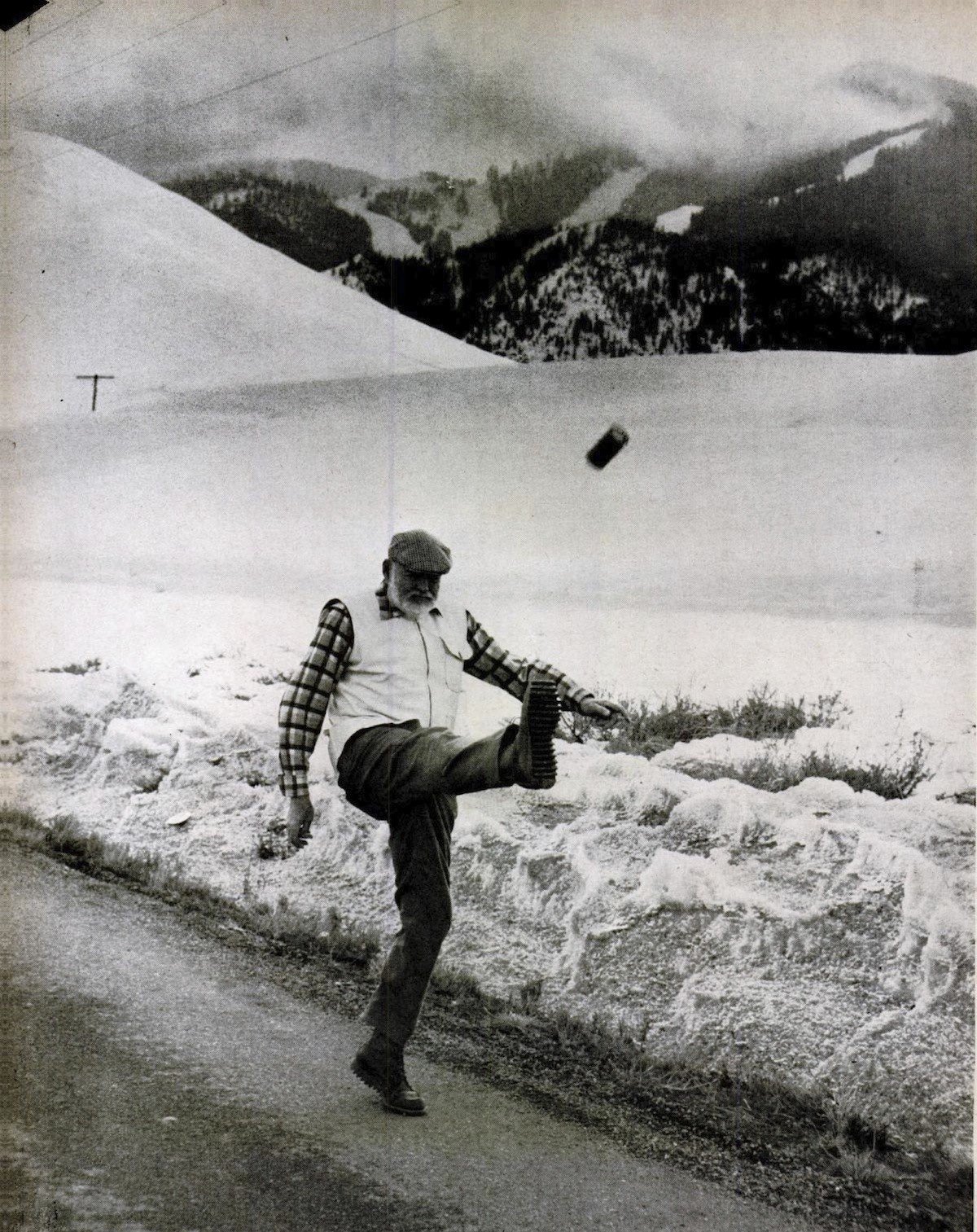
…you’ll have something to drink. (via rands in repose)
In the NY Times Magazine, Gideon Lewis-Kraus reports on Google’s improving artificial intelligence efforts. The Google Brain team (no, seriously that’s what the team is called) spent almost a year overhauling Google’s translate service, resulting in a startling improvement in the service.
The new incarnation, to the pleasant surprise of Google’s own engineers, had been completed in only nine months. The A.I. system had demonstrated overnight improvements roughly equal to the total gains the old one had accrued over its entire lifetime.
Just after the switchover, Japanese professor Jun Rekimoto noticed the improvement. He took a passage from Ernest Hemingway’s The Snows of Kilimanjaro, translated it into Japanese, and fed it back into Google Translate to get English back out. Here’s how Hemingway wrote it:
Kilimanjaro is a snow-covered mountain 19,710 feet high, and is said to be the highest mountain in Africa. Its western summit is called the Masai “Ngaje Ngai,” the House of God. Close to the western summit there is the dried and frozen carcass of a leopard. No one has explained what the leopard was seeking at that altitude.
And here’s the AI-powered translation:
Kilimanjaro is a mountain of 19,710 feet covered with snow and is said to be the highest mountain in Africa. The summit of the west is called “Ngaje Ngai” in Masai, the house of God. Near the top of the west there is a dry and frozen dead body of leopard. No one has ever explained what leopard wanted at that altitude.
Not bad, especially when you compare it to what the old version of Translate would have produced:
Kilimanjaro is 19,710 feet of the mountain covered with snow, and it is said that the highest mountain in Africa. Top of the west, “Ngaje Ngai” in the Maasai language, has been referred to as the house of God. The top close to the west, there is a dry, frozen carcass of a leopard. Whether the leopard had what the demand at that altitude, there is no that nobody explained.
Ernest Hemingway liked a good burger and had a specific recipe he wanted his staff to use when preparing meals. Using his instructions, Cheryl Lu-Lien Tan recently recreated the Hemingway burger.
Fingers deep, I kneaded. Fighting the urge to be careless and quick, I kept the pace rhythmic, slow. Each squeeze, I hoped, would gently ease the flavors — knobby bits of garlic, finely chopped capers, smatterings of dry spices — into the marbled mound before me.
I had made burgers before, countless times on countless evenings. This one was different; I wasn’t making just any burger — I was attempting to recreate Hemingway’s hamburger. And it had to be just right.
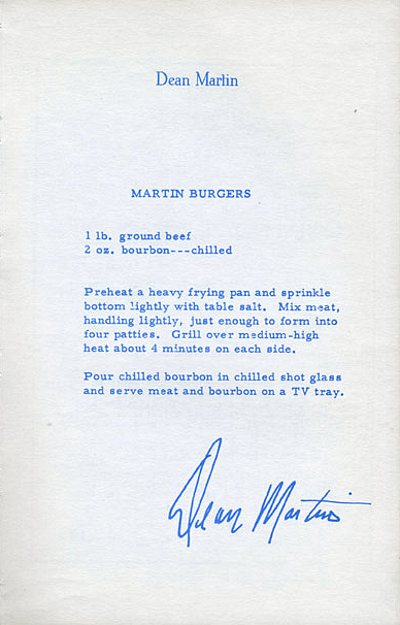
Surprisingly, with 11 different ingredients, Hemingway’s burger is not as stripped down as his prose. For a more minimalist burger, you have to turn to Dean Martin:
Frank Sinatra’s is perhaps even easier:
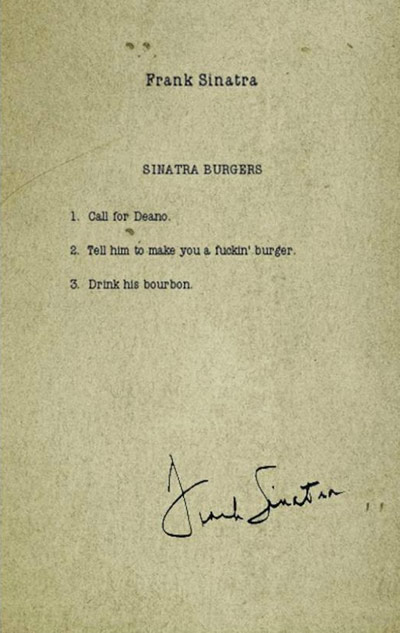
One thing is for sure: none of these gentlemen would cotton to the idea of the ramen burger, homemade or no. (via open culture)
The internet is going through a bit of a thing with standing desks right now, fueled by yesterday’s The Wirecutter article about them. One of the most famous standing desk enthusiasts was Ernest Hemingway.
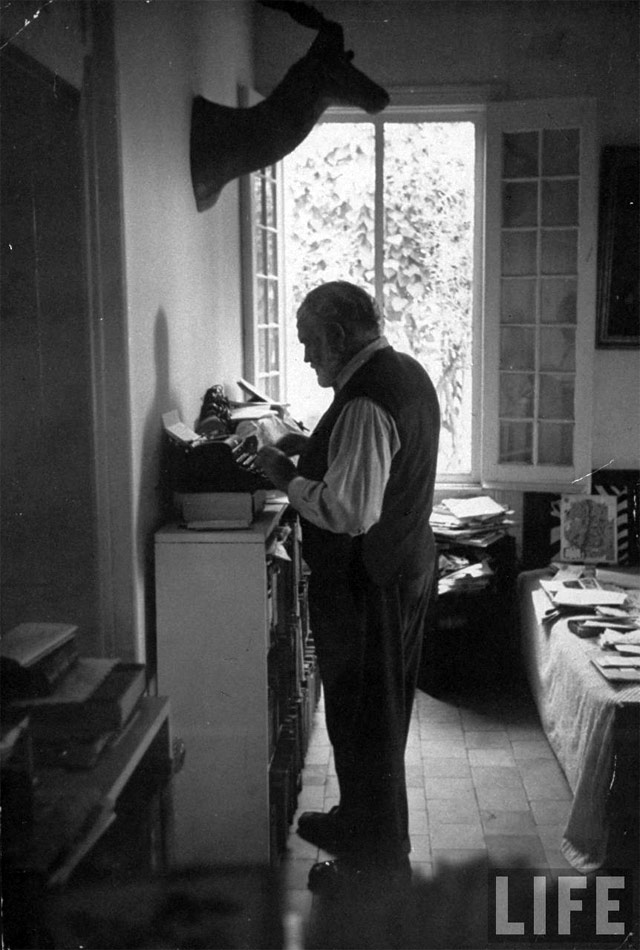
The introduction of this 1958 Paris Review interview with Hemingway briefly describes Papa’s upright working setup:
A working habit he has had from the beginning, Hemingway stands when he writes. He stands in a pair of his oversized loafers on the worn skin of a lesser kudu — the typewriter and the reading board chest-high opposite him.
Most articles I’ve seen on standing desks recommend anti-fatigue mats to help with foot pain, but of course Hemingway would go with the hide of an African antelope that he likely killed himself.
Other famous users of standing desks included Winston Churchill, Lewis Carroll, Donald Rumsfeld, Charles Dickens, Otto von Bismarck, Henry Clay, Thomas Jefferson, John Dos Passos, and Virginia Woolf. (thx, megnut)
In a 1935 piece for Esquire magazine entitled Remembering Shooting-Flying: A Key West Letter, Ernest Hemingway listed seventeen books that were among his favorites. They were so dear to him that he would rather read any of them for the first time again than have a yearly income of a million dollars. (That’s about $16.5 million/year in today’s dollars.) Here’s the actual passage from the article:
When you have been lucky in your life you find that just about the time the best of the books run out (and I would rather read again for the first time Anna Karenina, Far Away and Long Ago, Buddenbrooks, Wuthering Heights, Madame Bovary, War and Peace, A Sportsman’s Sketches, The Brothers Karamozov, Hail and Farewell, Huckleberry Finn, Winesburg, Ohio, La Reine Margot, La Maison Tellier, Le Rouge et le Noire, La Chartreuse de Parme, Dubliners, Yeats’s Autobiographies and a few others than have an assured income of a million dollars a year) you have a lot of damned fine things that you can remember. Then when the time is over in which you have done the things that you can now remember, and while you are doing other things, you find you can read the books again, and, always, there are a few, a very few, good new ones. Last year there was La Condition Humaine by Andre Malraux. It was translated, I do not know how well, as Man’s Fate, and sometimes it is as good as Stendhal and that is something no prose writer has been in France for over fifty years.
But this is supposed to be about shooting, not about books, although some of the best shooting I remember was in Tolstoi and I have often wondered how the snipe fly in Russia now and whether shooting pheasants is counter-revolutionary. When you have loved three things all your life, from the earliest you can remember; to fish, to shoot and, later, to read; and when, all your life, the necessity to write has been your master, you learn to remember and, when you think back, you remember more fishing and shooting and reading than anything else and that is a pleasure.
That creep can roll, man. See also Hemingway kicks a can. (via lists of note)
This photo was likely taken in Ketchum, Idaho, where Hemingway died and is buried. (via if charlie parker was a gunslinger)





Stay Connected