Stephen Hawking passed away back in March, but left us with a final book that just came out this week: Brief Answers to the Big Questions. There are 10 questions asked and answered in the book:
Is there a God?
How did it all begin?
Can we predict the future?
What is inside a black hole?
Is there other intelligent life in the universe?
Will artificial intelligence outsmart us?
How do we shape the future?
Will we survive on Earth?
Should we colonize space?
Is time travel possible?
Take the chapter on “Can we predict the future?”. Starting with regular astronomical events, it swiftly moves on to scientific determinism, quantum physics, hidden variables and Heisenberg’s uncertainty principle. Under the guise of a simple question, Hawking has managed to take the reader on a whistle-stop tour of the quantum world (bottom line: no we can’t predict everything). It’s a clever ruse. Ask a simple question and you’ll draw in readers who might otherwise not know they’d be interested in complex science.
John Boswell, aka melodysheep, created this tribute video for Stephen Hawking using the late physicist’s words drawn from a variety of different speeches and interviews. It begins:
I am very aware of the preciousness of time. I was given two to three years to live. I faced a life unable to properly communicate. Fortunately my mind was unaffected. While all around me people have passed the day deep in conversation, I have often been transported afar, lost inside my own thoughts, trying to fathom how the universe works.
I read the book on the plane on the way over. I was surprised, because I had been told that it was a book about theoretical physics and cosmology. But it was something much more than that. It was a work of literature.
He had done something strange and unusual and powerful. He had described himself and his own situation in terms of his science. Hawking’s greatest discovery — Hawking Radiation — was, in its own way, a tour de force. He was combining elements from general relativity, from quantum mechanics, and from thermodynamics in a new way. There’s something extraordinary about it, but what was most extraordinary about it is that here you have this entity, a black hole, from which nothing can escape. The gravitational field is so strong, surrounded by an event horizon. Nothing can escape from the black hole. Nothing inside that event horizon can get out.
What did Hawking show? Hawking showed that black holes are not entirely black. Radiation can escape from a black hole. He showed the mechanism through which this could occur.
At the same time, he’s telling you that he’s been condemned to this chair, to motor neuron disease, to ALS, and is really unable to talk. He’s lost his ability to speak, and now has to use a computer device, a clicker, a screen with a built-in dictionary and cursor. Despite the disease, he’s not trapped inside of himself. He’s able to communicate. He would always cite the famous line from Hamlet, “Bounded …”
“… in a nutshell, and count myself a king of infinite space.”
The whole thing is well worth a read. Like this bit about Hawking’s voice double:
Q: What was the process of working on the film with him like? Not all of those passages are from the book. Were you sending him questions?
A: Yes. He was writing answers, and some of the material was taken from lectures that he had given. Some of it was written for the film. I called him the first nontalking talking head. It became pretty clear that you had to assemble a dictionary of Hawking shots, but there’s no point in interviewing him for those, because it’s not synced. It’s a voice synthesizer. He gave us the voice synthesizer so we could just assemble his voice in the office in Cambridge, Massachusetts, which he insisted on calling “the pseudo-Cambridge.” There’s nothing like this project.
Q: Wait. He sent you the synthesizer so he could send you an answer and then you could feed it through the synthesizer to get the sound of his voice delivering the answer?
Stephen Hawking, who uncovered the mysteries of black holes and with A Brief History of Time did more than anyone to popularize science since the late Carl Sagan, has died at his home in Cambridge at age 76. From an obituary in The Guardian:
Hawking once estimated he worked only 1,000 hours during his three undergraduate years at Oxford. In his finals, he came borderline between a first- and second-class degree. Convinced that he was seen as a difficult student, he told his viva examiners that if they gave him a first he would move to Cambridge to pursue his PhD. Award a second and he threatened to stay. They opted for a first.
Those who live in the shadow of death are often those who live most. For Hawking, the early diagnosis of his terminal disease, and witnessing the death from leukaemia of a boy he knew in hospital, ignited a fresh sense of purpose. “Although there was a cloud hanging over my future, I found, to my surprise, that I was enjoying life in the present more than before. I began to make progress with my research,” he once said. Embarking on his career in earnest, he declared: “My goal is simple. It is a complete understanding of the universe, why it is as it is and why it exists at all.”
He went on to become his generation’s leader in exploring gravity and the properties of black holes, the bottomless gravitational pits so deep and dense that not even light can escape them.
That work led to a turning point in modern physics, playing itself out in the closing months of 1973 on the walls of his brain when Dr. Hawking set out to apply quantum theory, the weird laws that govern subatomic reality, to black holes. In a long and daunting calculation, Dr. Hawking discovered to his befuddlement that black holes — those mythological avatars of cosmic doom — were not really black at all. In fact, he found, they would eventually fizzle, leaking radiation and particles, and finally explode and disappear over the eons.
Nobody, including Dr. Hawking, believed it at first — that particles could be coming out of a black hole. “I wasn’t looking for them at all,” he recalled in an interview in 1978. “I merely tripped over them. I was rather annoyed.”
That calculation, in a thesis published in 1974 in the journal Nature under the title “Black Hole Explosions?,” is hailed by scientists as the first great landmark in the struggle to find a single theory of nature — to connect gravity and quantum mechanics, those warring descriptions of the large and the small, to explain a universe that seems stranger than anybody had thought.
The discovery of Hawking radiation, as it is known, turned black holes upside down. It transformed them from destroyers to creators — or at least to recyclers — and wrenched the dream of a final theory in a strange, new direction.
“You can ask what will happen to someone who jumps into a black hole,” Dr. Hawking said in an interview in 1978. “I certainly don’t think he will survive it.
“On the other hand,” he added, “if we send someone off to jump into a black hole, neither he nor his constituent atoms will come back, but his mass energy will come back. Maybe that applies to the whole universe.”
Dennis W. Sciama, a cosmologist and Dr. Hawking’s thesis adviser at Cambridge, called Hawking’s thesis in Nature “the most beautiful paper in the history of physics.”
Following his work in this area, Hawking established a number of important results about black holes, such as an argument for its event horizon (its bounding surface) having to have the topology of a sphere. In collaboration with Carter and James Bardeen, in work published in 1973, he established some remarkable analogies between the behaviour of black holes and the basic laws of thermodynamics, where the horizon’s surface area and its surface gravity were shown to be analogous, respectively, to the thermodynamic quantities of entropy and temperature. It would be fair to say that in his highly active period leading up to this work, Hawking’s research in classical general relativity was the best anywhere in the world at that time.
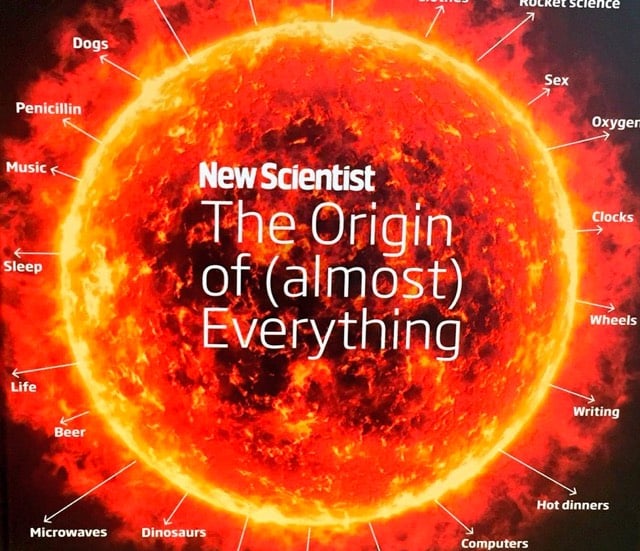
Together they take us on a whistle-stop tour from the start of our universe (through the history of stars, galaxies, meteorites, the Moon and dark energy) to our planet (through oceans and weather to oil) and life (through dinosaurs to emotions and sex) to civilization (from cities to alcohol and cooking), knowledge (from alphabets to alchemy) ending up with technology (computers to rocket science). Witty essays explore the concepts alongside enlightening infographics that zoom from how many people have ever lived to showing you how a left-wing brain differs from a right-wing one.
And Stephen Hawking wrote the foreword. You fancy, Jennifer Daniel!
Russian billionaire Yuri Milner, with the help of Stephen Hawking and Mark Zuckerburg, plans to launch a fleet of nano-probes1 toward a star close to our solar system, Alpha Centuri. The craft, outfitted with lightsails, will be pushed along to their destination in just 20 years by powerful lasers on Earth.
In the last decade and a half, rapid technological advances have opened up the possibility of light-powered space travel at a significant fraction of light speed. This involves a ground-based light beamer pushing ultra-light nanocrafts - miniature space probes attached to lightsails - to speeds of up to 100 million miles an hour. Such a system would allow a flyby mission to reach Alpha Centauri in just over 20 years from launch, and beam home images of possible planets, as well as other scientific data such as analysis of magnetic fields.
Breakthrough Starshot aims to demonstrate proof of concept for ultra-fast light-driven nanocrafts, and lay the foundations for a first launch to Alpha Centauri within the next generation. Along the way, the project could generate important supplementary benefits to astronomy, including solar system exploration and detection of Earth-crossing asteroids.
So, this is a time travel movie with Keanu Reeves (narrator) and Alex Winter (director), but it’s not Bill & Ted’s Excellent Adventure, Part 3? No, of course not. It’s actually a video about quantum chess featuring Paul Rudd, Stephen Hawking, and music from The Matrix. Like, WHAT?! If The Chickening hadn’t dropped earlier, this would be the oddest thing you’ll watch this week. (And it’s not quite clear, but the video appears to be an advertisement for a quantum chess game that’s launching on Kickstarter next week. Nothing about this makes any sense…) (via @gavinpurcell)
An Oscar presented to the actor who played him was just the latest honor presented to a man who has no shortage of amazing achievements. But Stephen Hawking’s most amazing — and mysterious — achievement could be the fact that he’s alive. From WaPo: How Stephen Hawking, diagnosed with ALS decades ago, is still alive.
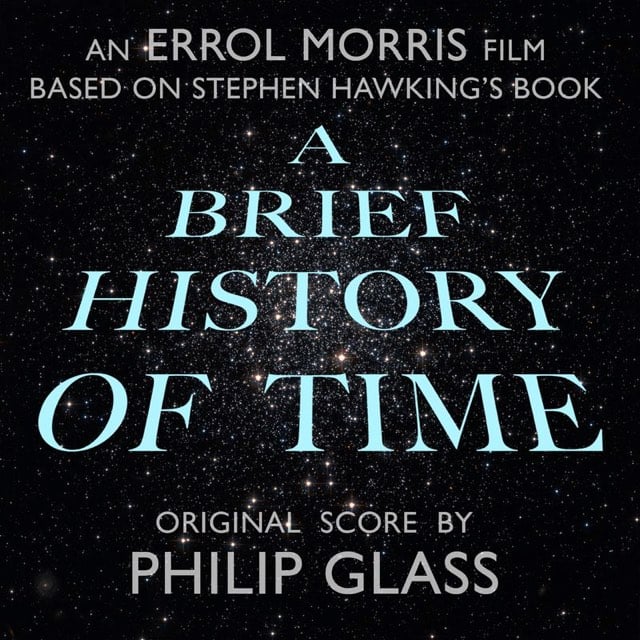
Philip Glass did the soundtrack for A Brief History of Time, Errol Morris’ documentary on Stephen Hawking, but it was never released as an album. Until earlier this month. Huzzah! Appears to only be available on iTunes — couldn’t find it on Amazon, Rdio, or Spotify — and I wish they’d done more with that cover. Bleh.
In this compelling memoir, his first wife, Jane Hawking, relates the inside story of their extraordinary marriage. As Stephen’s academic renown soared, his body was collapsing under the assaults of motor neurone disease. Jane’s candid account of trying to balance his 24-hour care with the needs of their growing family reveals the inner-strength of the author, while the self-evident character and achievements of her husband make for an incredible tale presented with unflinching honesty.
As promising as this looks, the Kanye in me needs to remind you that Errol Morris’ A Brief History of Time is the best film about Stephen Hawking of all time. OF ALL TIME.
Most physicists foolhardy enough to write a paper claiming that “there are no black holes” — at least not in the sense we usually imagine — would probably be dismissed as cranks. But when the call to redefine these cosmic crunchers comes from Stephen Hawking, it’s worth taking notice. In a paper posted online, the physicist, based at the University of Cambridge, UK, and one of the creators of modern black-hole theory, does away with the notion of an event horizon, the invisible boundary thought to shroud every black hole, beyond which nothing, not even light, can escape.
In its stead, Hawking’s radical proposal is a much more benign “apparent horizon”, which only temporarily holds matter and energy prisoner before eventually releasing them, albeit in a more garbled form.
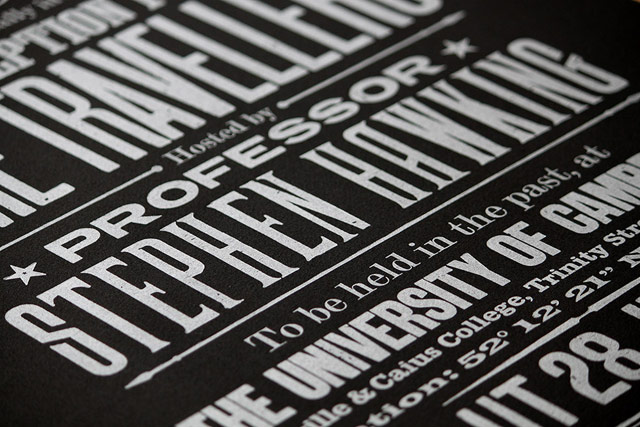
Steven Hawking came up with a simple and clever way of seeing if time travel is possible. On June 28, 2009, he threw a party for time travellers from the future…but didn’t advertise it until after the party was already over.
In an effort to improve the chances of the party invite being noticed by future generations, Peter Dean, working with approval from Hawking, has made this gorgeous hand-printed poster of the party invitation:
I have been fortunate in the director of the film, Errol Morris. He is a man of integrity, with a feeling for the issues. It would have been all too easy to have someone who would have concentrated on the more sensational aspects of my private life, and my medical condition, and who would have treated the science in a superficial way. A friend of mine, who has had several television programmes based on his work, was envious of how the scientific ideas came through on the film.
The sound and picture are poor, but the entirety of Errol Morris’ A Brief History of Time is available on YouTube.
Featuring music from Philip Glass, the film is a documentary about Stephen Hawking and his ideas about the universe. Morris recently stated on Twitter:
Yes. I plan to re-release [A Brief History of Time]. (It was never properly color corrected and is one of my best films.)
The film is difficult, if not impossible, to find on DVD and isn’t available on Netflix, Amazon Instant Video, or iTunes. And as far as I can tell, the soundtrack was never released either.
Claudia Dreifus of the NY Times scores a rare interview with Stephen Hawking. The ten questions were sent to him in advance and then he met with Dreifus in person to play his answers for her.
Q. Given all you’ve experienced, what words would you offer someone who has been diagnosed with a serious illness, perhaps A.L.S.?
A. My advice to other disabled people would be, concentrate on things your disability doesn’t prevent you doing well, and don’t regret the things it interferes with. Don’t be disabled in spirit, as well as physically.
Audio clips of some of his answers are available in the article’s sidebar. Interestingly, despite the advances in text-to-speech audio and upgrades to his writing hardware & software, Hawking’s voice remains the same.
In The Grand Design we explain why, according to quantum theory, the cosmos does not have just a single existence, or history, but rather that every possible history of the universe exists simultaneously. We question the conventional concept of reality, posing instead a “model-dependent” theory of reality. We discuss how the laws of our particular universe are extraordinarily finely tuned so as to allow for our existence, and show why quantum theory predicts the multiverse—the idea that ours is just one of many universes that appeared spontaneously out of nothing, each with different laws of nature. And we assess M-Theory, an explanation of the laws governing the multiverse, and the only viable candidate for a complete “theory of everything.”
If we want to travel into the future, we just need to go fast. Really fast. And I think the only way we’re ever likely to do that is by going into space. The fastest manned vehicle in history was Apollo 10. It reached 25,000mph. But to travel in time we’ll have to go more than 2,000 times faster. And to do that we’d need a much bigger ship, a truly enormous machine. The ship would have to be big enough to carry a huge amount of fuel, enough to accelerate it to nearly the speed of light. Getting to just beneath the cosmic speed limit would require six whole years at full power.
Maybe you’re tired of un-pop-music-like things being run through Auto-Tune, but I’m not quite there yet. This Auto-Tuned Carl Sagan mix is very nearly sublime.
Description of attending an amazing talk by Stephen Hawking. “In the beginning there’s a long pause. Really long. The applause dies down and then… crickets. For thirty seconds… a minute… two minutes. Then suddenly, Hawking’s synthesized voice: ‘Can you hear me?’ The climactic scenes of blockbuster movies are not as thrilling.”
Adriana: “I thought you might be interested in a post I wrote a while back about a former editor of Elle who communicated for the last year of his life via blinks”.






Stay Connected