The First Folio is a collection of 36 plays by William Shakespeare that was published in 1623. One of the most influential books ever published, only about 230 copies are known to have survived. The Victoria and Albert Museum has three copies, and in this video, they lead the viewer on a tour through one of them.
There are 36 plays by Shakespeare in this book and half of them had not been previously printed. So this book preserves really half of Shakespeare’s complete works — plays that would probably have been completely lost to us include the Tempest, Macbeth, Twelfth Night, many others that are among people’s favorites today.
I ran across this video this morning on Instagram and I haven’t stopped laughing about it, so I thought I’d share it with you. It’s an improv by Ross Bryant from a show called Game Changer in which he makes up a commercial for a new McDonald’s product: the Macbeth sandwich.
It’s perhaps a liiiittle bit of a softball prompt for Bryant, who is a member of The Improvised Shakespeare Company, but to pull it off, he needs to be fluent in both fast food advertising and Shakespeare. The accent, timing, and delivery are perfect — somehow in the space of a minute, he does two or three highbrow/lowbrow shifts and oh, just watch the damn thing. (via rachel lopez)
Patrick Stewart, displaying the Shakespearian acting chops that landed him the role of Captain Picard on Star Trek: The Next Generation, appeared on Sesame Street in 1996, performing a parody of Hamlet’s soliloquy with the letter “B”. Stewart never doesn’t give it his all when acting.
One of many cancellations due to the pandemic is the Public Theater’s annual Shakespeare in the Park performances. But for the next three weeks, PBS is streaming their Great Performances recording of last year’s Shakespeare in the Park production of Much Ado About Nothing for free on their site (embedded above, reviews here).
This bold interpretation of Shakespeare’s comedic masterpiece features Danielle Brooks (“Orange is the New Black,” Broadway’s “The Color Purple”) and Grantham Coleman (“Buzzer,” “The Americans”) as the sparring lovers Beatrice and Benedick. Tony Award winner Kenny Leon (“American Son,” “A Raisin in the Sun”) directs with choreography by Tony Award nominee Camille A. Brown (“Choir Boy”).
To whet your appetite, you can check out some of the highlights of the performance in this short video.
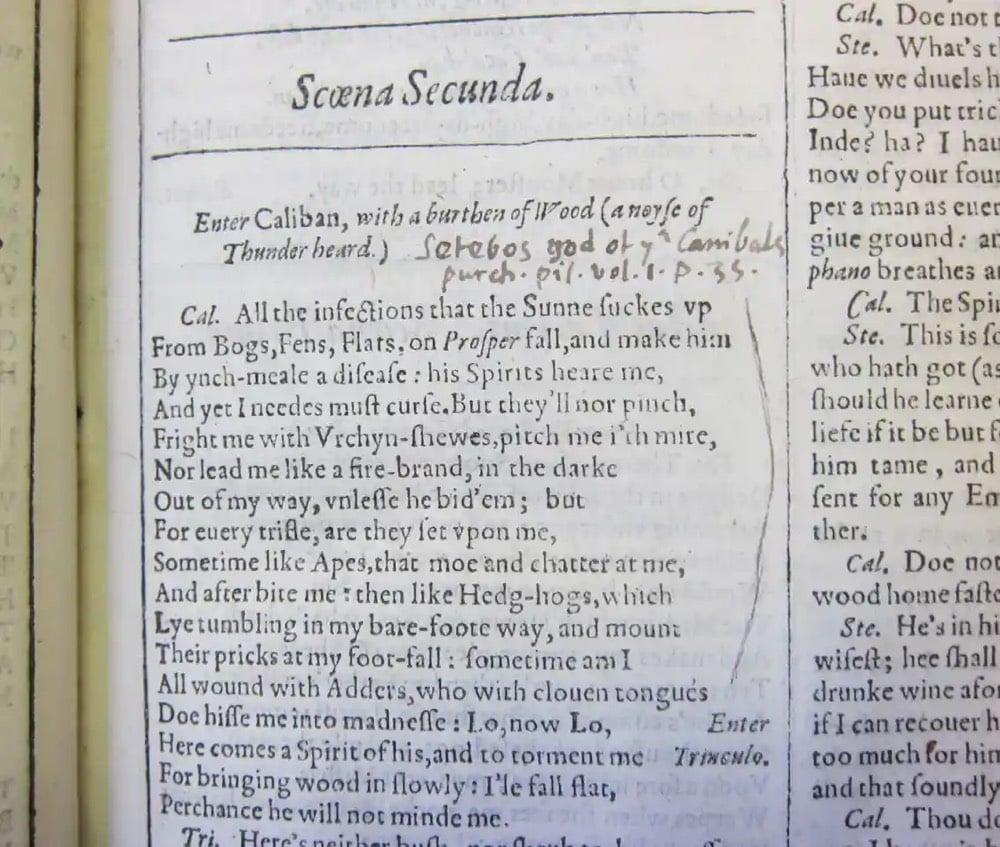
Based on handwriting analysis, Jason Scott-Warren, the Director of the Cambridge Centre for Material Texts, has discovered that a copy of Shakespeare’s First Folio from 1623 was owned by John Milton, author of Paradise Lost, who annotated it with copious notes.
It’s always annoying when someone tries to claim that they’ve discovered a lost literary artefact. I was myself a little bit brutal when, five years ago, we were treated to the supposed rediscovery of Shakespeare’s dictionary. In this as in other cases, there’s usually a lot of wishful thinking, plus copious spinning of the evidence to make it seem plausible, and elision of anything that doesn’t seem to fit. However, I’m going to make my own unwise pronouncement on the basis of just a few hours of research. I’m going to claim to have identified John Milton’s copy of the Shakespeare First Folio of 1623.
There already seems to be a consensus developing that Scott-Warren’s analysis rings true.
But he soon found that other scholars were agreeing with him. “Not only does this hand look like Milton’s, but it behaves like Milton’s writing elsewhere does, doing exactly the things Milton does when he annotates books, and using exactly the same marks,” said Dr Will Poole at New College Oxford. “Shakespeare is our most famous writer, and the poet John Milton was his most famous younger contemporary. It was, until a few days ago, simply too much to hope that Milton’s own copy of Shakespeare might have survived — and yet the evidence here so far is persuasive. This may be one of the most important literary discoveries of modern times.”
This American Life host and radio superpersonality Ira Glass went to see a play and came away more vexed than Claudius walking out of The Mousetrap in Elsinore.
@JohnLithgow as Lear tonight: amazing. Shakespeare: not good. No stakes, not relatable. I think I’m realizing: Shakespeare sucks.
So what’s going to happen? Will bespectacled literary nerds have to choose between Chicago’s adopted son Ira and our old friend Stratford Billy? That’s like Prince Hal having to choose between getting drunk with Falstaff and cleaning up his act for his dad the king!
Be not afraid, gentles — reporter Lois Beckett is on it, with a retelling of King Lear specially updated for Ira Glass’s post-Renaissance storytelling sensibilities. It’s This American Lear.
Update: Jesse Lansner did a second, extended Storify collection of “This American Lear,” including some of the other reactions to Glass’s and then Beckett’s tweets. On Twitter, Beckett called this “the director’s cut.”
Ran across one of my favorite little pieces of writing the other day: Sixty Men from Ur by Mark Sumner. It’s about how short recorded human history really is. The piece starts out by asking you to imagine if you view the history of life as the Empire State Building, all of human history is a dime on top.
Arthur M. Schlesinger, Jr., one the United States’ great historians, is less than two lifetimes removed from a world where the United States did not exist. Through Mr. Schlesinger, you’re no more than three away yourself. That’s how short the history of our nation really is.
Not impressed? It’s only two more life spans to William Shakespeare. Two more beyond that, and the only Europeans to see America are those who sailed from Greenland. You’re ten lifetimes from the occupation of Damietta during the fifth crusade. Twenty from the founding of Great Zimbabwe and the Visigoth sack of Rome. Make it forty, and Theseus, king of Athens, is held captive on Crete by King Minos, the Olmecs are building the first cities in Mexico, and the New Kingdom collapses in Egypt.
Sixty life times ago, a man named Abram left Ur of the Chaldees and took his family into Canaan. Abram is claimed as the founder of three great religions. A few lifetimes before that, and you’ve come out the bottom of that dime. You’re that close to it.
I was recently listening to a lecture by Kevin Kelly where he introduces the concept of touch generations, the idea of a list of people based on when one person died and when the next was born: one person is in the next touch generation of someone else if they were born when the other person died. So Galileo and Newton, while unrelated, are in successive touch generations because Newton was born the year that Galileo died. Essentially, it’s a way of connecting lifetimes across the years.
Speaking of inexpensive time travel, listen as David and Ben Crystal perform selections from Shakespeare in the original accent, as it would have been heard at the Globe in the early 1600s. (via @KBAndersen)
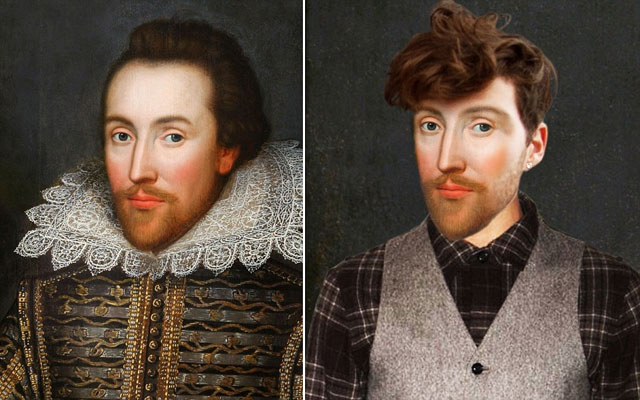
In this series of illustrations created for a British TV show, historical figures are depicted as they might look today. Shakespeare becomes a Williamsburg hipster, Henry VIII is Richard Branson-esque, and Elizabeth I is a cross between Tina Brown and Tilda Swinton.
Professors of Shakespeare — and I was one once upon a time — are blissfully unaware of the impending disaster that this film means for their professional lives. Thanks to “Anonymous,” undergraduates will be confidently asserting that Shakespeare wasn’t Shakespeare for the next 10 years at least, and profs will have to waste countless hours explaining the obvious. “Anonymous” subscribes to the Oxfordian theory of authorship, the contention that Edward de Vere, the 17th earl of Oxford, wrote Shakespeare’s plays. Among Shakespeare scholars, the idea has roughly the same currency as the faked moon landing does among astronauts.
Quite a bit is known about how English was spoken back when Shakespeare wrote his plays but productions of his plays using the original pronunciation (OP) are quite rare. Now a University of Kansas theater professor and his students are putting on a production of A Midsummer Night’s Dream in the OP.
“American audiences will hear an accent and style surprisingly like their own in its informality and strong r-colored vowels,” Meier said. “The original pronunciation performance strongly contrasts with the notions of precise and polished delivery created by John Gielgud, Laurence Olivier and their colleagues from the 20th century British theater.”
Meier said audiences will hear word play and rhymes that “haven’t worked for several hundred years (love/prove, eyes/qualities, etc.) magically restored, as Bottom, Puck and company wind the language clock back to 1595.”
“The audience will hear rough and surprisingly vernacular diction, they will hear echoes of Irish, New England and Cockney that survive to this day as ‘dialect fossils.’ And they will be delighted by how very understandable the language is, despite the intervening centuries.”
This means that in addition the 31,534 words that Shakespeare knew and used, there were approximately 35,000 words that he knew but didn’t use. Thus, we can estimate that Shakespeare knew approximately 66,534 words.
According to one estimate, the average speaker of English knows between 10,000-20,000 words.
It was of consequence, I should think; verily, it tied the room together, gather’d its qualities as the sweet lovers’ spring grass doth the morning dew or the rough scythe the first of autumn harvests. It sat between the four sides of the room, making substance of a square, respecting each wall in equal harmony, in geometer’s cap; a great reckoning in a little room. Verily, it transform’d the room from the space between four walls presented, to the harbour of a man’s monarchy.
Yep, it’s the entire screenplay. The Knave abideth, indeed. (thx, conor)
He added: “What we thought were the first plays by Shakespeare appeared anonymously in the early 1590s. It is inconceivable, however, that his first plays were the massive trilogy of Henry VI. Writers develop over time from simpler beginnings.”
For many people he is the round-headed bald man seen on the First Folio of his collected works but evidence was presented yesterday arguing that we should rethink this. Instead we should visualise Shakespeare as a rosy-cheeked, long-nosed man who was something of a looker.
The portrait appear to be in good condition and Shakespeare looks a lot like Joseph Fiennes, who played the Bard in Shakespeare in Love.
Which of the following works would you choose to be lost, if only three could be saved: Michelangelo’s Pieta, Shakespeare’s Hamlet, Mozart’s Don Giovanni, or Einstein’s 1905 paper on relativity? Not so sure I agree with the conclusion here…surely Einstein’s paper stands as a work unto itself, apart from the discovery it contains. Plus, maybe someone else (or a group of someone elses) wouldn’t have given us relativity as elegantly and usefully as Einstein did. (via 3qd)
How would Shakespeare do in Hollywood today? He’d be raking in the dough on royalties, but because most of his stories were based on previous work, he might not have been able to write them in the first place without being sued for copyright infringement.




Stay Connected