kottke.org posts about cycling
Meet Jackson Goldstone. He’s 6 years old, lives in British Columbia, and is already ripping it up on his bike. Here’s a video of him taking the long way around on his way to kindergarten:
Wow, if he keeps riding and improving, I wonder how good this kid could be? Ok, I’m funning you a little bit because that was several years ago and Jackson is starring in GoPro videos at the age of 10 and riding the hardest trails faster and better than many adult riders:
I mean, I think Jackson could really be world-class some da— Ha, more tricks! Jackson is actually 21 years old here in the present of 2025 and is actually now one of the best downhill mountain bikers in the world. Here’s the POV video from a recent win of his:
There are a couple of notable things about this video:
1. Watch the way he goes through a bunch of tree stumps at full tilt at ~1:10 by basically jumping over the whole thing with a couple of quick hops. Adjust the playback speed of the video to 0.5 or 0.25 to see how he does it. I’ve watched this like 10 times and it’s still bonkers.
2. And then at ~1:52, he screams through a tunnel and gaps directly onto a wooden berm — and you can hear how the crowd reacts. Here’s another view of that same gap and the rest of his run:
Other riders clear that gap too, but somehow not as big or direct as Jackson does it. I don’t actually know enough about mtn biking to know how Goldstone is doing what he’s doing, but if you want a hint, check out the “Bike Jesus” section of this video that starts at ~5:30:
3. Oh yeah, and just how ungodly fast he and the other riders are going past trees and through rocks and all sorts of other lurking assailants. Blimey.

In a piece for Vogue, Edith Zimmerman writes about trading one addiction for another: A Former Drinker Asks, Am I Addicted to Running?
And running is good. I don’t have to lie about it or hide it. It makes me happy, and it makes my life better. There are little parallels between running and drinking, though: I feel antsy, for instance, on days when I can’t run (that itch!). And I backpedal on the days I plan to rest — I’ll just go for a quick one right now and take tomorrow off instead. And I don’t understand the people — my friends — who run only once or twice a week. Why not more? Wouldn’t you want to do it every day?
Edith and I traded Insta memes this morning about running and mountain biking. I’ve been mtn biking for four years now but this year was the first time it felt urgent — every few days, I had to get out on the bike. And each time I did, I wanted to ride harder and faster and better. I pushed it so hard I almost died and didn’t ride for a month, during which period I wasn’t feeling apprehensive about getting back on the bike, I was impatient and antsy that I couldn’t. Since getting back to it, I’ve modified my approach — less aggressive, more life preserving — but the need to get out remains. I don’t know what I’m going to do this winter without it.


Adam DiCarlo takes photos of commuters (mostly bikers) as they exit the Williamsburg Bridge bike path on the Manhattan side and posts them to his Instagram account. (via @BAMstutz)
Hey folks. I crashed my bike this weekend and as such I’m a little banged up (neck & wrist injuries). I’m mostly fine but I don’t know how much desk/mouse/typing time I can manage today. I’m gonna give it a shot though because I need some distraction and something else to do besides watch TV, lay flat on my back, and listen to podcasts. If I tap out early today, now you know what’s up. ✌️
In a collaboration with Red Bull & Prada (uh, ok) and with the help of the Polish State Railways, Dawid Godziek rode a mountain bike on a ramps course on top of a moving train, performing tricks & flips between cars. The train and rider moved at the same speed in opposite directions, which made it seem as though, from the perspective of someone on the ground next to the train, that the rider is nearly horizontally stationary.
The result is trippy & counterintuitive and also a demonstration of Newton’s laws of motion & frames of reference. But since Godziek was not riding in a vacuum, there were some real world details to contend with:
We observed something interesting — the lack of air resistance. In theory, this could have made it easier, but the opposite was true. The air resistance creates a tunnel that somehow keeps me in a straight line and doesn’t allow me to shift right or left. Luckily on the recordings we had, the headwind gave me artificial air resistance, which helped me to get a feel for the flight on classic hops. On the tests, the wind was blowing weaker or in a different direction, making shooting tricks difficult. Not bad, right? We’re always complaining about air resistance, and when it wasn’t there, we found that it was impossible to fly without it.
See also Mythbusters shooting a soccer ball out of the back of a moving truck.
From British Pathé, a short film clip from 1928 of men racing on penny farthing bikes. See also clips from 1936 and 1937 races.
Most of the crowd seems to have come to see them fall off, but in the end it turns out to be such a great race that when they come round on the third lap, the excitement runs higher than the bicycle.
Oh and Penny Farthing Racing is Still a Thing.

I watched the men’s Olympic mountain biking race last week and something one of the announcers said caught my attention. She was describing the electronic shifters the cyclists use and then said that many of the competitors were also using an AI-controlled suspension system that automagically adjusted the level of suspension according to the terrain and rider preference.
I’d never heard of this before, so I poked around a little and found some reviews of the Specialized S-Works Epic 8, a bike that comes with an adaptive suspension system called Flight Attendant (and retails for $14,500). From a review in Mountain Bike Rider:
The S-Works is the first production bike to debut with the latest version of RockShox’s Flight Attendant Ai suspension. This uses sensors in the SID Ultimate fork, SIDLuxe Ultimate shock, Quarq XX SL power crank, XX SL rear mech and XX shifters to build a comprehensive ride ‘picture’. It then automatically switch the fork and shock between open, pedal and lock modes depending on incoming impacts, bike orientation, pre-emptive shift signals and rider referencing ‘effort states’.
And from Flow Mountain Bike:
Flight Attendant is comprised of two primary components: a fork module and a rear shock module. The fork module sits atop a special Charger damper that comes inside a Pike, Lyrik or Zeb, while the shock module is built into the piggyback reservoir of a Flight Attendant-specific Super Deluxe Ultimate shock. These two modules communicate wirelessly, and decide whether the suspension should be in one of three predetermined compression settings: Open, Pedal or Lock.
The system makes these decisions based on input provided by an array of sensors. Inside the fork and shock modules you’ll find an accelerometer and an inclinometer, which allows the bike to detect both bump forces and pitch. There’s also a sensor within the crank spindle to detect if you’re pedalling or coasting.
With this combination of sensors, Flight Attendant builds a picture of the terrain and the rider’s pedalling input. Based on that picture, it automatically adjusts the suspension to the ideal setting. Put simply, it’s designed to firm up the suspension to improve pedal efficiency on the climbs and along smoother terrain, while allowing the suspension to open up for the descents and on rougher trails. And all without your hands ever having to leave the grips.
And does it work? Again from Mountain Bike Rider:
In fact I’d actually say RockShox’s claimed 1.8% faster over a 90 minute event is an underestimation for most riders. Even XC GOAT Nino Schurter found the Flight Attendant changed modes over four times more often (1,325 switches rather than 300) than he normally would with a manual lockout. That experiment also ended in the first of several World Cup wins for SID Flight Attendant prototypes in 2023 including some by Victor Koretsky on a modified version of the previous Epic Evo.
A lot of that is MTB jargon but I hope you get the jist. What I couldn’t find is any evidence that Flight Attendant or any of the similar systems are actually using AI or machine learning to assist with these adjustments. I did find this article on Pinkbike about Shimano’s plans for a suspension system that a rider can train.
Automatic control of suspension itself is nothing new. Fox Live Valve, RockShox Flight Attendant and more recently, SR Suntour’s TACT suspension products have been automatically adjusting suspension damping, with varying levels of success, for a good number of years now. However, the programming behind the function of these products is relatively fixed. There is no scope for the rider to give the system feedback on its performance. It can’t “learn” what the rider’s preferences are.
It could be that the Olympic riders are using pre-market prototypes that use machine learning to adapt to individual rider preferences, but I don’t know. I’d love to hear from folks out there if you know any more details!
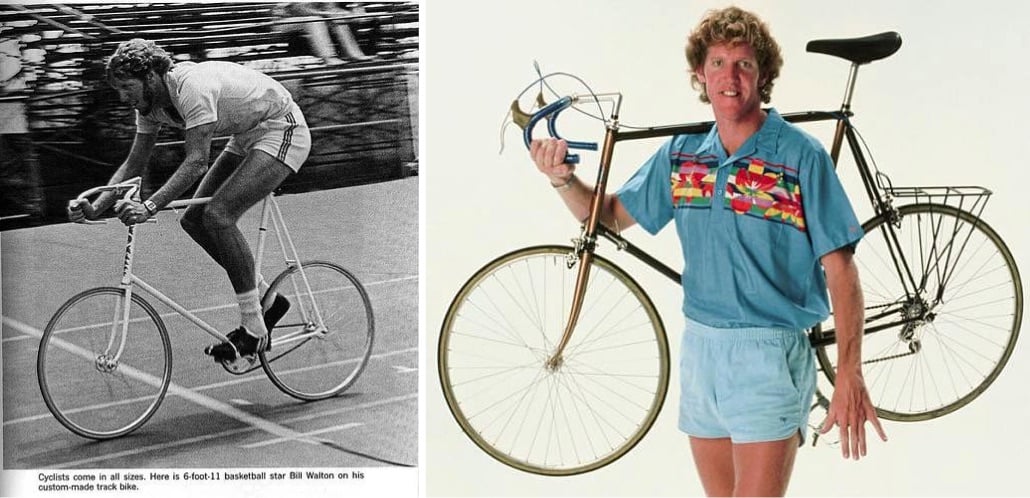
Former NBA player and TV sportscaster Bill Walton died on Monday at the age of 71. He was a quirky dude and as someone who’s been known to veer off onto seemingly unrelated tangents, I appreciated his oddball broadcasting style. Basketball was good for Walton but it also ruined his body. In response, he turned to biking to keep active and to get around.
I am the luckiest guy in the world because I am alive and I can ride my bike. It is the ultimate celebration of life when you go out there and are able to do what you can do. I have not been able to play basketball for 34 years. I have not been able to walk for enjoyment or pleasure or exercise in 41 years, but I can ride my bike.
In a brief clip of a talk Walton gave (at the University of Arizona, I believe, the custodian of Biosphere 2), he elaborated on how important his bicycle was to him:
I love my bike. My bike is everything to me. My bike is my gym, my church, and my wheelchair. My bike is everything that I believe in going on in the Biosphere. It’s science, it’s technology, it’s the future, engineering, metallurgy - you name it, it’s right there in my bike. My bike is the most important and valuable thing that I have.
Walton knew: the bicycle is low-key one of humankind’s greatest inventions:
By contrast, a person on a bicycle can go three or four times faster than a pedestrian, but uses five times less energy in the process. He carries one gram of his weight over a kilometer of flat road at an expense of only 0.15 calories. The bicycle is the perfect transducer to match man’s metabolic energy to the impedance of locomotion. Equipped with this tool, a person outstrips the efficiency of not only all machines but all other animals as well.
As one of the commenters on this post said, “Tailwinds and smooth asphalt forever, buddy.”
Danny MacAskill is known ‘round these parts for his jaw-dropping trials riding (I first posted about him 15 years ago) but this ride is a little bit different. MacAskill and four friends take to the local mountain bike trails around Inverness, Scotland on ebikes and have a grand old time. For me, listening to the banter was just as entertaining as watching the riding — it’s obvious they’re just out there having a blast.
P.S. I was also trying to calculate how fast I would die if I tried riding some of that stuff and the answer is “almost immediately”. Yiiiikes.
Well, Fabio Wibmer is very, very fast on his bicycle. Just about the first trick in here is Fabio successfully jumping the Lyon 25 Stair we learned about earlier this week. And, uh, he does something we didn’t see in that other video because if you make it to the end of the video, you’ll see he starts from the set of stairs going down to the Lyon 25 instead of starting on the flat like everyone else. Sheesh.
I also like how he takes the corner/curb at :50 and the stairs at 3:20 and the stairs at 5:15. Sheesh.
Trials rider and mountain biker Danny MacAskill is one of my long-running obsessions here — I first posted about him all the way back in 2009 and if there’s ever a kottke.org konference, you’d better believe MacAskill will be performing at it. Anyway, MacAskill recently visited San Francisco with Red Bull and explored some of that beautiful city’s most iconic locations on his bike. Wow, the tennis net ride at 2:45 — BONKERS.
This video is actually a trailer of sorts for a 4-episode series that’s available on Red Bull’s site:
Watch as Danny lands a host of new tricks — some five years in the making — in spectacular spots around San Francisco. Then go behind the scenes and learn what this deeply personal edit means to him.
Super Rider (another trials rider) also did a behind-the-scenes video with MacAskill where they go in-depth on the tennis court setup.
How do you steer a bike? You turn the handlebars to the left to go left, correct? Actually, you don’t: you turn the handlebars to the right to go left…at least at first. And also? Bikes don’t even need riders to remain upright…they are designed to steer themselves.
If you’d like to play around with your own bicycle geometries, try this web app for analyzing bicycle dynamics.
Professional road racing cyclist Lachlan Morton is attempting to complete the Tour de France this year. Except: He’s doing it entirely on his own, without teammates, support vehicles, and transportation from the previous day’s finish to the next day’s start (which might be dozens or even hundreds of miles apart). That means he’ll be riding an extra 1500 miles, climbing an additional 50,000 feet in elevation, shopping for his own meals, and still trying to beat the peloton to Paris. Here’s a quick explanatory trailer:
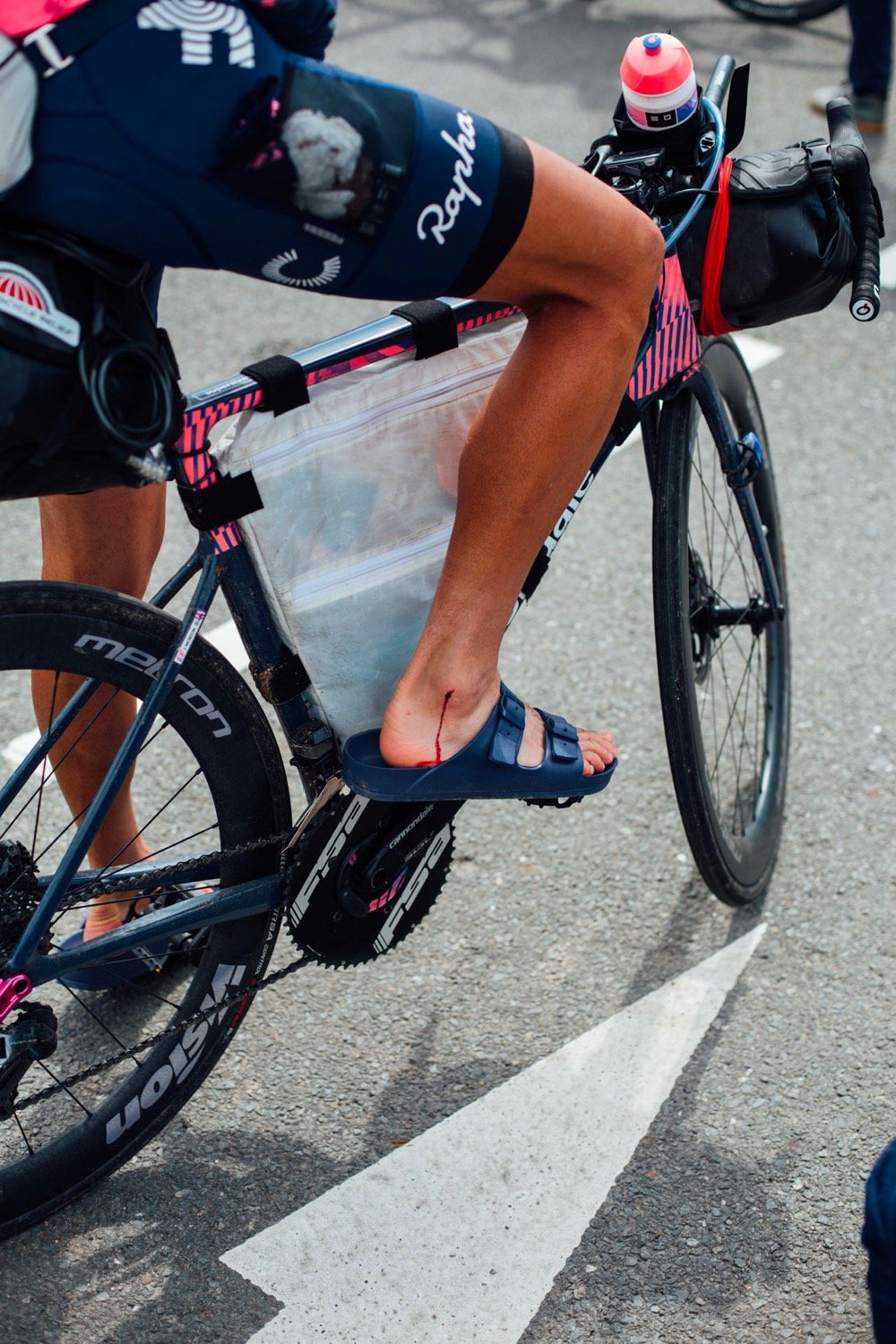
You can follow his progress on Rapha’s site and check out updates in this Instagram Story. He’s currently ahead of the peloton, even riding day four in Birkenstocks:
Ah, but — the day three press release had an ominous note in it. Right after telling us that Morton had “picked up a tub of couscous and a couple of bags of nuts for dinner” came the real kicker: our protagonist had a bad knee, and had bought new pedals to allow a switch to flat shoes.
So on day four, Morton set off with his new pedals and covered both stage four and stage five of the actual Tour de France — in a pair of Birkenstocks. Despite his sensible sandals, Morton managed to average the same speeds as the day prior, getting through the time trial in 1:17.
(via matt)
This person had the genius idea to take the regular tires off of his bike and replace them with huge circular saw wheels so that he could ride it on the ice. The build is pretty interesting, but you can skip to 4:27 if you just want to see the bike in action, including the failed first attempt — saw blades cut ice really well!
Bonus ice content: The Wonderful Sounds of Skating on Black Ice, The World’s Largest Ice Carousel, and How to Self-Rescue If You Fall Through Thin Ice.
Pro freestyle mountain bike rider Matt Jones wants to try a new trick, something no one has ever done before. In this video, you see him go through the entire process of bringing a new idea or invention into the world:
- The idea. It’s based on a previous trick but is more difficult; standing on the shoulders of giants. He suspects it’s possible, but doesn’t know for sure. Only one way to find out…
- The prototype. Jones takes a bike frame (no wheels, pedals, etc.) to the local swimming pool to do flips with it off the diving board. The price of failure is low, so it’s easy to try out all sorts of different things. The mad inventor is gawked at by the public but presses on.
- Visualization. Now that his body knows how it feels to perform the motion in the pool, he can perform the trick in his mind over and over again, syncing brain & body. He’s starting to believe.
- Trial and error. With the basics down, it’s time to tinker with all the different variables — over and over and over and over and over and over again. An airbag breaks his falls, enabling experimentation.
- Failure. You see Jones try this trick over and over again in the video and very few of them are successful — and I bet a lot more failure happened off camera. Hundreds of tries, hundreds of fails. This is the way.
- Self-doubt. The trial & error, failure, and self-doubt stages all overlap. You can see him struggling with this on top of the tower. He still believes but this trick is dangerous. Body and mind are battling hard.
- Success. It all comes together at last.
This was one of three new tricks that Jones wanted to do last year and you can see more of his progress and process with those in these three videos. (thx, matt)
Inspired by rock climbers, Danny MacAskill visits the Isle of Skye with his mountain bike to find an impossibly steep route down the Dubh Slabs. He is so far back in the saddle on some of the steepest stuff. I know high-end mountain bike brakes are on hair-triggers, but good God I wonder what MacAskill’s grip strength is… (thx, jeffrey)
This video is a lovely little rumination by Iancu Barbarasa “about collecting, cycling caps, art and design, personal connections and why it’s worth doing something for a long time, even if the benefits are not clear at first.”
Many think some people are special but usually those people just put a lot more time in it than others. This applies to sports, arts, almost everything. It’s worth doing something for a long time, even if the benefits are not always clear. Good surprising things come out of it. You also learn about yourself in the process.
His inspiration in doing the film was to “inform, delight, and inspire”:
I mentioned above Milton Glaser’s “inform and delight” definition of art. It’s brilliant, but I always felt something was still missing from it. So I’d say that art — and any creative’s work — should aim to “inform, delight and inspire”. Hopefully my film will inspire people to start something of their own, or share what they’re already doing with other people. That would bring joy to everyone, and there’s never too much of it.
You can check out Barbarasa’s cycling cap collection on Instagram. I have never been much of a collector, but my 22+ years of efforts on this site (collecting knowledge/links?) and my sharing of photos on Flickr/Instagram over the years definitely have resulted in some of the same benefits.
Trials rider Danny MacAskill (one of our favorite athletes around these parts) has recently started sharing some behind-the-scenes looks at some of the coolest tricks he’s done for his videos. The video above shows him trying to barrel roll his bike with a trailer attached, which he likens to “doing a rally [race] with a caravan on the back”. What’s fascinating is that it takes him forever to get the maneuver down, but once he does, he’s able to do it over and over again — “gradually, then suddenly” in action. You can see the finished product in his Danny Daycare video.
Two more behind-the-scenes videos he’s done so far: the backwards roll and the log slide (which also takes him forever to do but he’s then able to repeat three more times in a row).
Over a period of four years, Davis Vilums cycled every street in central London. A map and a time lapse of his journeys:
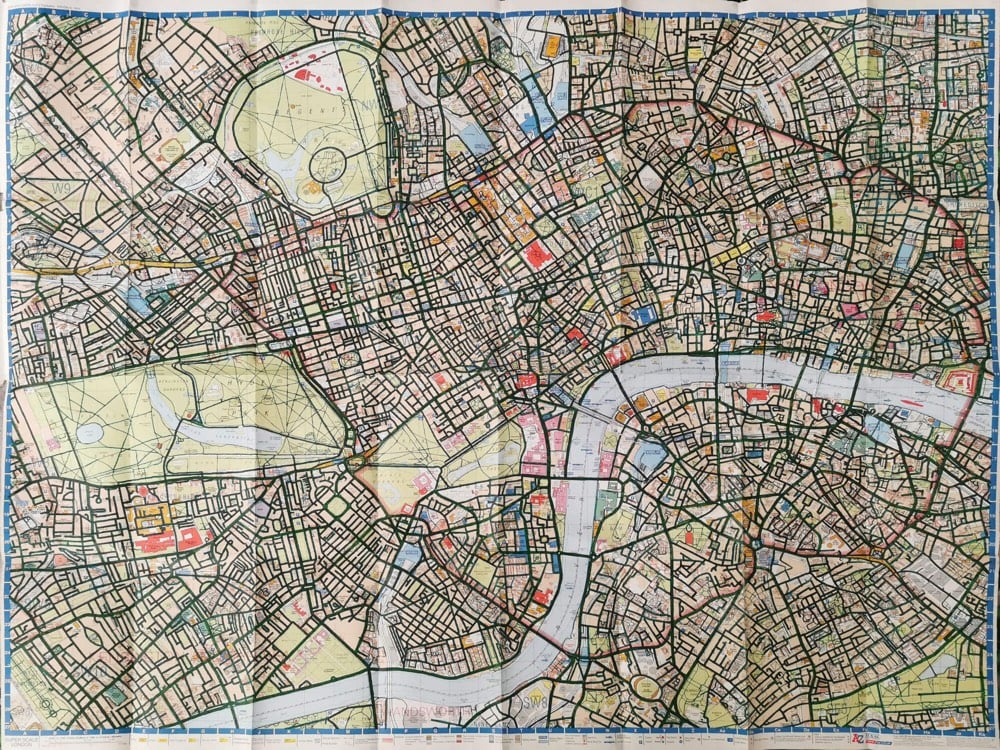
Including some irregular times off, overall it took me four years to visit every single road on the map. When I started this hobby, it took me 30 to 40 minutes to do the route. Later it expanded to 2 hours to get to the office when I tried to reach the furthest places on my map. One of the main goals was never to be late for work. From the beginning, I planned to visit not only the main roads but every single accessible mews, yard, park trail, and a path that was possible to go through. I used Endomondo app to have a proper record of my journeys and proof that I have been there. After every trip, I prepared my next route in Google maps where it was easy to adjust streets to the next ones and mark points to revisit if I missed something.
In a video that pokes a little bit of fun at the stationary cycling of Soulcycle and Peloton, trials rider Danny MacAskill joins the gym and practices his own unique brand of bicycle fitness. Stick around until the end to see some bloopers and some more stunts that didn’t make the cut.
You may remember my many posts about trials rider Danny MacAskill over the past decade (including Parkour On a Bicycle). Well, the new generation is coming up and in this video, Fabio Wibmer very kindly shows us around his native Austria, flipping, twisting, and flying off every conceivable obstacle. My favorite bit is either the escalator (~1:30) or the vehicular transfers (~5:10).
In this fun BMX video, Tate Roskelley uses all sorts of props — car tires, milk crates, trees, tennis balls — to perform all kinds of street tricks and stunts. Watch until the end…his last maneuver is probably the best. (thx, matt)
Remember trials rider Danny MacAskill, who I’ve been covering on kottke.org for over ten years somehow?! In his newest video, he turns babysitting a friend’s young daughter into a death-defying cycling adventure…an oddly tender death-defying cycling adventure somehow.
Stay tuned after the main action for a short making-of feature (no children were harmed, etc. etc.) in which we see Daisy riding a bike of her own!
In 1995, Fred Rompelberg set the record for the fastest speed on a bicycle: 167 mph. In September 2018, drafting behind the same custom-made dragster that Rompelberg used to set his record, Denise Mueller-Korenek smashed that record by almost 17 mph.
Mueller-Korenek mounted a specially equipped bike with a massive gear and tethered it to a race car, which then accelerated to 100-plus mph-the velocity necessary for the rider to turn over the cranks on her own volition. Then she unhooked from the car and stayed in the slipstream, smashing the pedals around to hit the highest speed possible under her own power.
Her speed on her final mile on the Bonneville Salt Flats was 183.93 mph. This short film from WSJ shows how Mueller-Korenek became the world’s fastest human on a bike. The salty maelstrom whipped up as she pushed past 180 is incredible. Tough. As. Nails.
This is a French film from 1915 that shows the evolution of the bicycle from 1818 to what is pretty much the rear chain-driven bicycle of today. The intertitles are in Dutch, but Aeon has helpfully translated them into English.
9. In 1878, Renard created a bicycle with a wheel circumference of more than 7 feet. Just sitting down on one of these was an athletic feat!
Open Culture shared a similar film made by British Pathé in 1937.
The competitors in standard course triathlons, which is the format used for the Olympics, have to swim nearly a mile, bike 25 miles, and run 6.2 miles. The men’s gold medalist at the 2016 Olympics finished with a time of 1 hour 45 minutes. The Ironman triathlon is much longer: a 2.4 mile swim, a 112 mile bike ride, and then you run an entire marathon (26.2 miles); the current world record for this distance is 7 hours 35 minutes.
The Quintuple Anvil Triathlon is five Ironman triathlons in five days, i.e. your basic total insanity.
Crushed by exhaustion, you may dream of a competitor’s head morphing into a Pokémon-like demon — and then open your eyes and still see it. The next day you will quit the race.
To fill your queasy stomach during your third 112-mile bike ride, you will discover the best way to eat a sausage-and-egg sandwich: shove it in your mouth and let it slowly dissolve.
After 500 miles on a bike, 10 in the water and more than 100 on foot, it will make perfect sense to grab a branch and a broomstick in a desperate bid to propel yourself — like a giant mutant insect — the last 31 miles. It will not be enough. You will collapse on the road.
Seasick, miles into the swim, you will vomit. Twice.
Neck cramps will attack so fiercely on the bike that your head will slump. You will go cross-eyed and nearly crash.
This reminds me of one of my favorite things I’ve ever posted, this story about ultra-endurance cyclist Jure Robic.
For one thing, Jure Robic sleeps 90 minutes or less a day when competing in ultracycling events lasting a week or more…and goes crazy, like actually insane, during the races because of it. Because he’s insane, his support crew makes all the decisions for him, an arrangement that allows Robic’s body to keep going even though his mind would have told him to quit long ago.
I’m also reminded of Ben Saunders and Tarka L’Herpiniere skiing/walking to the South Pole and back, covering a distance of 1795 miles in 105 days. That’s 17 miles a day for more than three straight months. And just this morning, I was thinking my chair was a little uncomfortable.
Update: So get this: the the Quintuple Anvil Triathlon is a mere trifle compared to the Triple DECA Iron in which competitors do an Ironman triathlon every day for 30 days. ASDFADASGRETHRYJH!!! I cannot even start to think about beginning to even with this. (via @ben_lings)
Trials rider Danny MacAskill busts out some more amazing tricks as he takes a mountain bike out for a ride in the area around Edinburgh. This could double as a tourism video for Scotland…the scenery almost steals the show here. (via @mathowie)
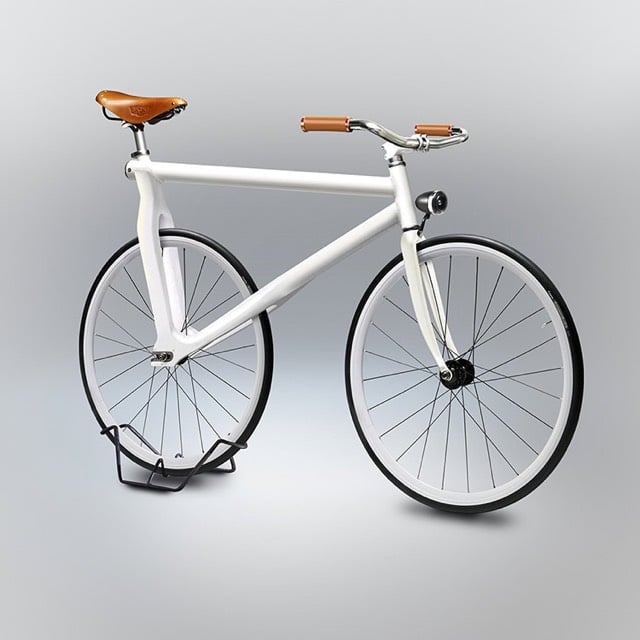
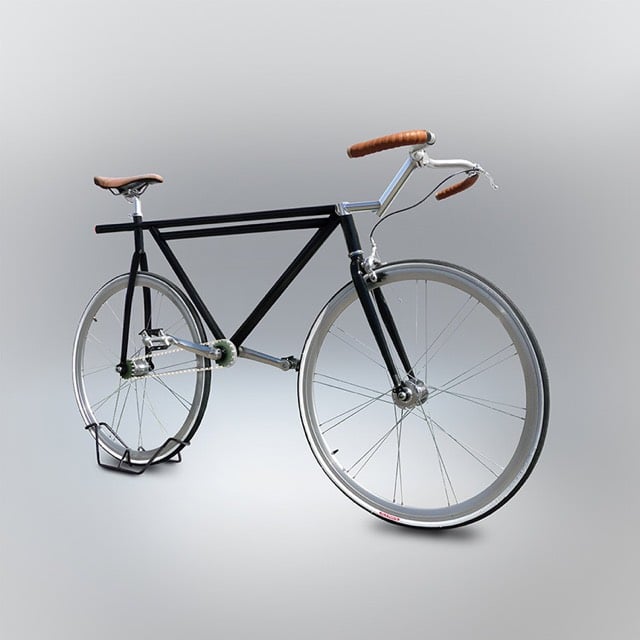
Velocipedia is a collection of drawings of bicycles paired with realistic renderings of what the real-life bikes would look like. Some of the sketches, drawn from memory, are not that accurate and result in hilariously non-functional bikes.
From the excellent collection of British Pathé videos on YouTube comes footage of a 1928 bicycle race on penny farthings aka the “boneshaker” aka those bikes with the big wheel in front. Here are a couple of contemporary penny farthing races. (via @sampotts)
Late last year, Todd Schneider did a big data analysis of taxi and Uber usage in NYC. This morning, he posted the results of a similar analysis for Citi Bike.
But unlike the taxi data, Citi Bike includes demographic information about its riders, namely gender, birth year, and subscriber status. At first glance that might not seem too revealing, but it turns out that it’s enough to uniquely identify many Citi Bike trips. If you know the following information about an individual Citi Bike trip:
1. The rider is an annual subscriber
2. Their gender
3. Their birth year
4. The station where they picked up a Citi Bike
5. The date and time they picked up the bike, rounded to the nearest hour
Then you can uniquely identify that individual trip 84% of the time! That means you can find out where and when the rider dropped off the bike, which might be sensitive information. Because men account for 77% of all subscriber trips, it’s even easier to uniquely identify rides by women: if we restrict to female riders, then 92% of trips can be uniquely identified.
Older posts





Socials & More