This piece by Cory Doctorow on TikTok’s enshittification (also available at Wired) contains some of the best and simplest descriptions of how online platforms like Amazon, Facebook, Uber, TikTok, Twitter, etc. evolve as they grow and then eventually die.
Here is how platforms die: First, they are good to their users; then they abuse their users to make things better for their business customers; finally, they abuse those business customers to claw back all the value for themselves. Then, they die.
…
This is enshittification: Surpluses are first directed to users; then, once they’re locked in, surpluses go to suppliers; then once they’re locked in, the surplus is handed to shareholders and the platform becomes a useless pile of shit. From mobile app stores to Steam, from Facebook to Twitter, this is the enshittification lifecycle.
The Amazon example he uses is really easy to follow. Early in the company’s history, the site used to be a great place to shop; their customers loved Amazon. But then Amazon’s sellers became their real customers and the user experience started to suffer. And now, much of the value generated by the users and customers goes to the shareholders (which, functionally speaking these days, means several dozen people who run hedge funds or large investment funds).
This strategy meant that it became progressively harder for shoppers to find things anywhere except Amazon, which meant that they only searched on Amazon, which meant that sellers had to sell on Amazon. That’s when Amazon started to harvest the surplus from its business customers and send it to Amazon’s shareholders. Today, Marketplace sellers are handing more than 45 percent of the sale price to Amazon in junk fees. The company’s $31 billion “advertising” program is really a payola scheme that pits sellers against each other, forcing them to bid on the chance to be at the top of your search.
Over at Techdirt, Mike Masnick riffed on Doctorow’s piece, arguing that enshittification, this playing of various parties against each other while siphoning off the value, is bad business because it focuses too much on short term gains.
Because maximizing revenue in the short term (i.e., in the 3 month window that Wall Street requires) often means sacrificing long term sustainability and long term profits. That’s because if you’re only looking at the next quarter (or, perhaps, the next two to four quarters if we’re being generous) then you’re going to be tempted to squeeze more of the value out of your customers, to “maximize revenue” or “maximize profits for shareholders.”
He uses early Amazon as an example of long-term thinking:
Once you go public, and you have that quarterly drumbeat from Wall Street where pretty much all that matters is revenue and profit growth. Indeed, it’s long forgotten now, but Jeff Bezos and Amazon actually were a rare company that kind of bucked that trend, and for a while at least, told Wall Street not to expect such things, as it was going to invest more and more deeply in serving its customers, and Wall Street punished Bezos for it. It’s long forgotten now, but Wall Street absolutely hated Amazon Prime, which locked in customer loyalty, but which they thought was a huge waste of money. The same was true of Amazon Web Services, which has become a huge revenue driver for the company.
They created a tremendous amount of value for their shareholders by playing the long game, which for whatever reason they aren’t willing to do anymore.
In the wake of Facebook’s lifeless demo of their metaverse vision, Clive Thompson asserts what many parents of young children already know: The Metaverse Is Already Here. It’s Minecraft.
The truth is, a thriving metaverse already exists. It’s incredibly high-functioning, with millions of people immersed in it for hours a day. In this metaverse, people have built uncountable custom worlds, and generated god knows how many profitable businesses and six-figure careers. Yet this terrain looks absolutely nothing the like one Zuckerberg showed off.
It’s Minecraft, of course.
The ability to tinker with the game so easily attracts players to it…something that companies like Facebook, who desire revenue-extracting control above all else, will be reticent to enable:
Minecraft is really easy to hack. On several levels! If you’re good with graphic design, for example, you could make skins that change the appearance of your character. You can use the game’s built-in scripting language to create custom devices. Or if you know a bit of coding, you can build mods that create entirely new objects in the game, or change the gameplay.
This hackability is part of why the game has remained so vibrant: Players are constantly revitalizing Minecraft, and inventing new things you can do inside it. Third-party folks build tools like skin editors, to make it easier for players to be creative.
As a piece of software, Minecraft isn’t open-source, but it’s very friable and gas-permeable around the edges. Mojang was willing to give their players a lot of control, and it’s part of why people are devoted to the game.
I could be wrong, but I honestly can’t imagine many of the big tech metaverses allowing this sort of Xtreme tinkerability.
I’ve seen all of this up close — both of my kids are Minecraft devotees, especially my son, who apparently is one of the better mobile-only players on The Hive (so! proud?). He’s had to navigate politics in guilds, both as a member and as a creator, and has formed friendships with kids from all over the world that are as real to him as any local relationships. He’s immersed in the media and economies created around the game, almost none of which were created by Mojang or Microsoft. But sometimes it’s still just the two of them, in a world created on one of their devices, building a cool world just because it’s fun.
In an opinion piece for the NY Times, Kara Swisher argues that Facebook’s Mark Zuckerberg “cannot hold on to such enormous power and avoid responsibility when things get tough”. She uses an analogy about a butcher shop to explain the problem at the heart of Facebook:
This week, I finally settled on a simpler comparison: Think about Facebook as a seller of meat products.
Most of the meat is produced by others, and some of the cuts are delicious and uncontaminated. But tainted meat — say, Trump steaks — also gets out the door in ever increasing amounts and without regulatory oversight.
The argument from the head butcher is this: People should be free to eat rotten hamburger, even if it wreaks havoc on their gastrointestinal tract, and the seller of the meat should not be the one to tell them which meat is good and which is bad (even though the butcher can tell in most cases).
Basically, the message is that you should find the truth through vomiting and — so sorry — maybe even death.
She goes on to say:
In this, Mr. Zuckerberg is serving up a rancid meal that he says he’s not comfortable cooking himself, even as his hands control every aspect of the operation.
This year, my personal challenge is around being thankful for the food I have to eat. I think many people forget that a living being has to die for you to eat meat, so my goal revolves around not letting myself forget that and being thankful for what I have. This year I’ve basically become a vegetarian since the only meat I’m eating is from animals I’ve killed myself.
Dorsey said he and Zuckerberg waited around 30 minutes for the goat to cook in the oven. Afterward, Zuckerberg believed the meal was ready and the two sat together to eat.
“We go in the dining room. He puts the goat down. It was cold,” said Dorsey in Rolling Stone. “That was memorable. I don’t know if it went back in the oven. I just ate my salad.”
Surreal. If all this were from the screenplay of a proposed The Social Network sequel, there’s no way this movie gets greenlit. (via daring fireball)
In a keynote address to the Anti-Defamation League, entertainer Sacha Baron Cohen calls the platforms created by Facebook, Google, Twitter, and other companies “the greatest propaganda machine in history” and blasts them for allowing hate, bigotry, and anti-Semitism to flourish on these services.
Think about it. Facebook, YouTube and Google, Twitter and others — they reach billions of people. The algorithms these platforms depend on deliberately amplify the type of content that keeps users engaged — stories that appeal to our baser instincts and that trigger outrage and fear. It’s why YouTube recommended videos by the conspiracist Alex Jones billions of times. It’s why fake news outperforms real news, because studies show that lies spread faster than truth. And it’s no surprise that the greatest propaganda machine in history has spread the oldest conspiracy theory in history- — the lie that Jews are somehow dangerous. As one headline put it, “Just Think What Goebbels Could Have Done with Facebook.”
On the internet, everything can appear equally legitimate. Breitbart resembles the BBC. The fictitious Protocols of the Elders of Zion look as valid as an ADL report. And the rantings of a lunatic seem as credible as the findings of a Nobel Prize winner. We have lost, it seems, a shared sense of the basic facts upon which democracy depends.
When I, as the wanna-be-gansta Ali G, asked the astronaut Buzz Aldrin “what woz it like to walk on de sun?” the joke worked, because we, the audience, shared the same facts. If you believe the moon landing was a hoax, the joke was not funny.
When Borat got that bar in Arizona to agree that “Jews control everybody’s money and never give it back,” the joke worked because the audience shared the fact that the depiction of Jews as miserly is a conspiracy theory originating in the Middle Ages.
But when, thanks to social media, conspiracies take hold, it’s easier for hate groups to recruit, easier for foreign intelligence agencies to interfere in our elections, and easier for a country like Myanmar to commit genocide against the Rohingya.
In particular, he singles out Mark Zuckerberg and a speech he gave last month.
First, Zuckerberg tried to portray this whole issue as “choices…around free expression.” That is ludicrous. This is not about limiting anyone’s free speech. This is about giving people, including some of the most reprehensible people on earth, the biggest platform in history to reach a third of the planet. Freedom of speech is not freedom of reach. Sadly, there will always be racists, misogynists, anti-Semites and child abusers. But I think we could all agree that we should not be giving bigots and pedophiles a free platform to amplify their views and target their victims.
Second, Zuckerberg claimed that new limits on what’s posted on social media would be to “pull back on free expression.” This is utter nonsense. The First Amendment says that “Congress shall make no law” abridging freedom of speech, however, this does not apply to private businesses like Facebook. We’re not asking these companies to determine the boundaries of free speech across society. We just want them to be responsible on their platforms.
If a neo-Nazi comes goose-stepping into a restaurant and starts threatening other customers and saying he wants kill Jews, would the owner of the restaurant be required to serve him an elegant eight-course meal? Of course not! The restaurant owner has every legal right and a moral obligation to kick the Nazi out, and so do these internet companies.
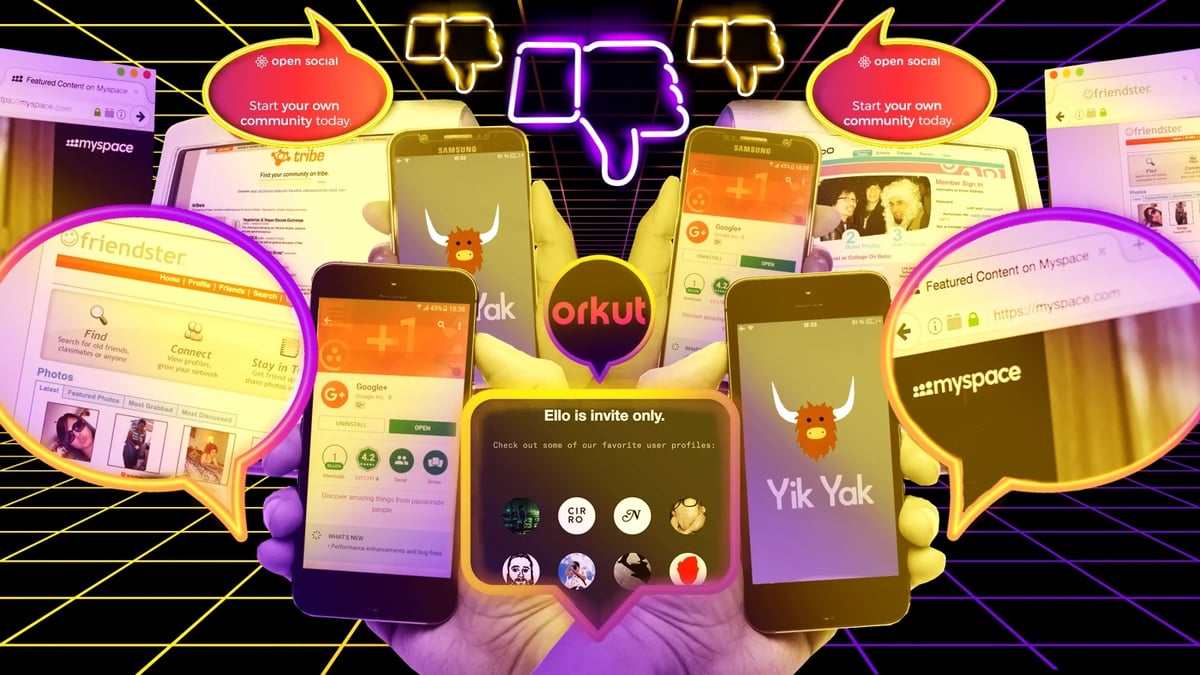
Gizmodo has a pretty cool theme this week: the Alternate Internet. Not, like, the internet where they play Stone Temple Pilots b-sides — although, cool idea. No, like, the internet of alternate universes, different pasts and futures, where things went differently and like, Yahoo doesn’t ruin all it touches. That’s my kind of party.
The story on alternate social media networks offers a nice media archaeology of all these sites; how they were covered and explained in the moment. Check out this explanation of Friendster in SF Weekly from August 13, 2003:
“Your induction into Friendster starts out innocently enough: You receive an e-mail invitation from a friend. It doesn’t cost anything to join, so you give it a whirl. You answer questions about your profession, favorite books, movies, music, and other interests, then upload a digital photo of yourself.
Thumbnail versions of your friends’ photos appear on your profile page like a collection of trading cards. Clicking on their pictures takes you to their pages, where you can see all of their friends, and so on. Even with only a few friends, you find that — through friends of friends — you suddenly have access to a social network of thousands of people.”
It’s a pretty common story what happened to all these sites; either they took the money, and got mismanaged, driving off whatever users they had in the first place, or they didn’t take the money, which meant they could never stay usable enough to support all of the users they were taking on.
A few other common threads: a fear of porn, other lewd behavior, and Yik Yak -style harassment. In short, it’s hard to make a social media site actually go big. You need money, a vanilla rep, ruthlessness, and more money. In the end, Facebook really was in the right place at the right time.
The one thing this doesn’t do is some deep left-field speculating, like, what if Google had seen what it had in Blogger to create Facebook before Facebook? Or Yahoo had figured it out with version X of whatever asset Yahoo had? There are social networks, real or latent, bigger than the social media graveyeard — some of the pieces are still here.
Meet Vincent LeVine. He’s the subject of “My Dad, the Facebook Addict”, a short documentary by his son Dylan. He started off using Facebook normally, keeping up with the news and chatting with friends, but evolved into a fierce meme warrior stocked with a “nuclear arsenal” of memes at the ready to destroy anyone who wants to come at him.
I can have a meme war with anybody and destroy them. And I’ve done it! People actually bail at the end and go, “Who is this guy? He’s got like every meme ever produced on the internet! He can knock us out with his memes!” And I do, I have tons of memes, I just keep memeing them to death until they just surrender because they just can’t do it anymore. They don’t have the memes that I have.
The NY Times has published a long piece about how Facebook has responded (and failed to respond) to various crises over the past three years: Delay, Deny and Deflect: How Facebook’s Leaders Fought Through Crisis. It does not paint a very flattering portrait of the company. This part is particularly damning (italics mine):
When Facebook users learned last spring that the company had compromised their privacy in its rush to expand, allowing access to the personal information of tens of millions of people to a political data firm linked to President Trump, Facebook sought to deflect blame and mask the extent of the problem.
And when that failed — as the company’s stock price plummeted and it faced a consumer backlash — Facebook went on the attack.
While Mr. Zuckerberg has conducted a public apology tour in the last year, Ms. Sandberg has overseen an aggressive lobbying campaign to combat Facebook’s critics, shift public anger toward rival companies and ward off damaging regulation. Facebook employed a Republican opposition-research firm to discredit activist protesters, in part by linking them to the liberal financier George Soros. It also tapped its business relationships, lobbying a Jewish civil rights group to cast some criticism of the company as anti-Semitic.
Are you fucking kidding me? Facebook paid to promote the right-wing & anti-Semitic conspiracy theory that George Soros pays protestors? Shame on you, Mark Zuckerberg, Sheryl Sandberg, and the rest of Facebook leadership team. Legitimizing this garbage actively hurts our democracy. On Twitter, The Guardian’s senior tech reporter Julia Carrie Wong gets at what is so wrong and different about this behavior:
There’s something about this Soros story that feels significantly different than the usual Facebook scandal. Most recent negative Facebook stories are issues relating to challenges of scale and a tendency toward passivity.
Facebook’s standard playbook is to admit that they made a mistake by being slow to react, remind us of their good intentions, then promise to do better. It’s the aw geez who woulda thought in the dorm room that we would have to deal with all these tricky issues defense.
This has been very effective for a company that still gets the benefit of the doubt. No one would ever suggest that Facebook *wanted* to bring about the ethnic cleansing of Rohingya or lynchings in rural Indian villages. They just were in a little over their heads.
But this Soros thing is different. This is no passive failure. It’s a malevolent action taken against groups who criticize Facebook for things that Facebook admits it has failed at. It takes advantage of and contributes to the most poisonous aspects of our public discourse.
What surprises me is that Facebook employees are still at their desks after finding that their company was actively attempting to discredit activists. No doubt some of them are shook. No doubt some of them will make public statements against their company’s policy. And those are needed. No doubt there will be internal spirited conversations within the company. And those are needed as well. But there won’t be a walk-out. I say this hours after the article was released. But I doubt that I’ll have to come back to this paragraph and revise it. I wish I wasn’t so sure of that. But I am.
Mr. Systrom, Instagram’s chief executive, and Mr. Krieger, the chief technical officer, notified Instagram’s leadership team and Facebook on Monday of their decision to leave, said people with direct knowledge of the matter, who spoke on condition of anonymity because they were not authorized to discuss the matter publicly.
In a press release, the pair explained their decision a little:
We’re planning on taking some time off to explore our curiosity and creativity again. Building new things requires that we step back, understand what inspires us and match that with what the world needs; that’s what we plan to do.
Facebook released a statement from CEO Mark Zuckerberg on Twitter (for some weird reason):
Kevin and Mike are extraordinary product leaders and Instagram reflects their combined creative talents. I’ve learned a lot working with them for the past six years and have really enjoyed it. I wish them all the best and I’m looking forward to seeing what they build next.
Sarah Frier’s piece at Bloomberg suggests the pair left because Zuckerberg and the mothership were meddling more and more with Instagram:
Kevin Systrom and Mike Krieger, who have been at the company since Instagram’s acquisition by Facebook in 2012, had been able to keep the brand and product independent while relying on Facebook’s infrastructure and resources to grow. Lately, they were frustrated with an uptick in day-to-day involvement by Zuckerberg, who has become more reliant on Instagram in planning for Facebook’s future, said the people, who asked not to be identified sharing internal details.
Without the founders around, Instagram is likely to become more tightly integrated with Facebook, making it more of a product division within the larger company than an independent operation, the people said.
For years, Systrom and Krieger were able to amicably resist certain Facebook product initiatives that they felt went against their vision, while leaning on Facebook for resources, infrastructure and engineering talent. A new leader may not be able to keep the same balance, or may be more willing to make changes that help the overall company at the expense of some of Instagram’s unique qualities.
Instagram is my favorite app by a mile — it eclipsed Twitter some time ago in that category — and might be the best mobile-native app ever. It is also, I believe, the future of Facebook Inc., a better product with a more favorable trajectory than the sprawling (and now heavily tainted) main FB service. I think Facebook would be doing Instagram and its users a real disservice if they folded it into the mothership instead of giving Instagram room to be the best service it can be on its own terms. This is a strangely conservative move on Zuckerberg’s part, an optimization where a higher degree of freedom and experimentation is called for. I guess we’ll see how this plays out.
This is the context for whatever dispute drove Systrom and Krieger’s resignation: not only do they not actually control their own company (because they don’t control monetization), they also aren’t essential to solving the biggest issue facing their product. Instagram Stories monetization is ultimately Facebook’s problem, and in case it wasn’t clear before, it is now obvious that Facebook will provide the solution.
My take is still that FB shouldn’t lean so heavily on Instagram for monetization. Even after many years, the service still has some growth and evolving to do to develop into the heir apparent Zuckerberg & his executive team is looking for. (thx, david)
The always pertinent Ben Thompson considers Apple and Amazon (plus Facebook and Google) and how they each focus on customers. He starts by wondering which of these companies has the best chance at hitting the one trillion market cap first. Focusing on the first two, he offers this interesting comparison.
I mean it when I say these companies are the complete opposite: Apple sells products it makes; Amazon sells products made by anyone and everyone. Apple brags about focus; Amazon calls itself “The Everything Store.” Apple is a product company that struggles at services; Amazon is a services company that struggles at product. Apple has the highest margins and profits in the world; Amazon brags that other’s margin is their opportunity, and until recently, barely registered any profits at all. And, underlying all of this, Apple is an extreme example of a functional organization, and Amazon an extreme example of a divisional one.
Two very different business operating in very different ways.
Both, taken together, are a reminder that there is no one right organizational structure, product focus, or development cycle: what matters is that they all fit together, with a business model to match. That is where Apple and Amazon are arguable more alike than not: both are incredibly aligned in all aspects of their business. What makes them truly similar, though, is the end goal of that alignment: the customer experience.
I’ll skip over much of his section on disruption and Clayton Christensen but if you don’t already know about his take on the matter, have a look at his thorough analysis of Apple vs the disruption theory. Basically, the theory doesn’t account for user experience and Apple manages to not overshoot the price customers want to pay because it understands the value its superior user experience provides.
Apple seems to have mostly saturated the high end, slowly adding switchers even as existing iPhone users hold on to their phones longer; what is not happening, though, is what disruption predicts: Apple isn’t losing customers to low-cost competitors for having “overshot” and overpriced its phones. It seems my thesis was right: a superior experience can never be too good — or perhaps I didn’t go far enough. (Emphasis mine.)
Thompson then looks at Amazon’s focus on custom experience, including an important aspect which Bezos explained in his most recent letter to shareholders.
One thing I love about customers is that they are divinely discontent. Their expectations are never static — they go up. It’s human nature. We didn’t ascend from our hunter-gatherer days by being satisfied. People have a voracious appetite for a better way, and yesterday’s ‘wow’ quickly becomes today’s ‘ordinary’. […] (Emphasis mine.)
What is amazing today is table stakes tomorrow, and, perhaps surprisingly, that makes for a tremendous business opportunity: if your company is predicated on delivering the best possible experience for consumers, then your company will never achieve its goal.
By focusing on user experience, Amazon is constantly aiming higher and never overshooting what customers want to pay, thus making itself very hard to disrupt.
He closes with Facebook and Google who are focused on advertisers, which makes them less (end)user focused and less popular.
Both, though, are disadvantaged to an extent because their means of making money operate orthogonally to a great user experience; both are protected by the fact would-be competitors inevitably have the same business model.
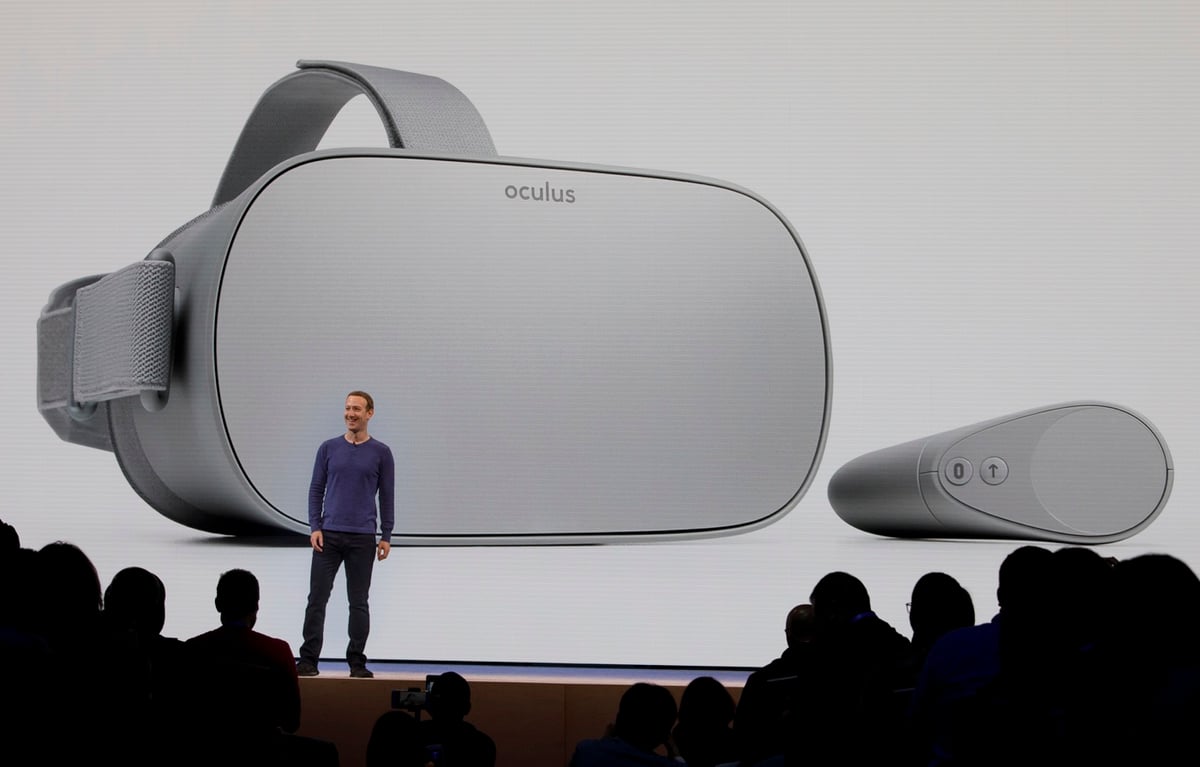
People at The Verge have taken the time to attend Facebook’s F8 and selected the five biggest announcements. Like more Instagram stories, a cheap Oculus Go headset (according to Fowler at the WashPo, it’s the one VR gadget you might buy), and Facebook dating.
Facebook will soon offer a dating feature that allows people to browse potential matches at inside groups or events you’re interested in attending. The feature will allow people to message each other using only their first names, and start conversations that are separate from the core Facebook or Messenger app.
I’m sure there will be no unintended consequences at all, since Facebook is always so reliably cautious about people and not breaking anything. Right?
[U]sing Instagram images that are already labeled by way of hashtags, Facebook was able to collect relevant data and use it to train its computer vision and object recognition models. “We’ve produced state-of-the-art results that are one to two percent better than any other system on the ImageNet benchmark.”
WhatsApp will also be getting some minor updates like group video calls and stickers, while CEO Jan Koum is heading out to collect rare air-cooled Porsches, work on his cars and play ultimate frisbee.
The only announcement I’m truly interested in wasn’t mentioned in the piece though; the “Clear history” functionality. Zuck posted about it himself.
In your web browser, you have a simple way to clear your cookies and history. The idea is a lot of sites need cookies to work, but you should still be able to flush your history whenever you want. We’re building a version of this for Facebook too. It will be a simple control to clear your browsing history on Facebook — what you’ve clicked on, websites you’ve visited, and so on.
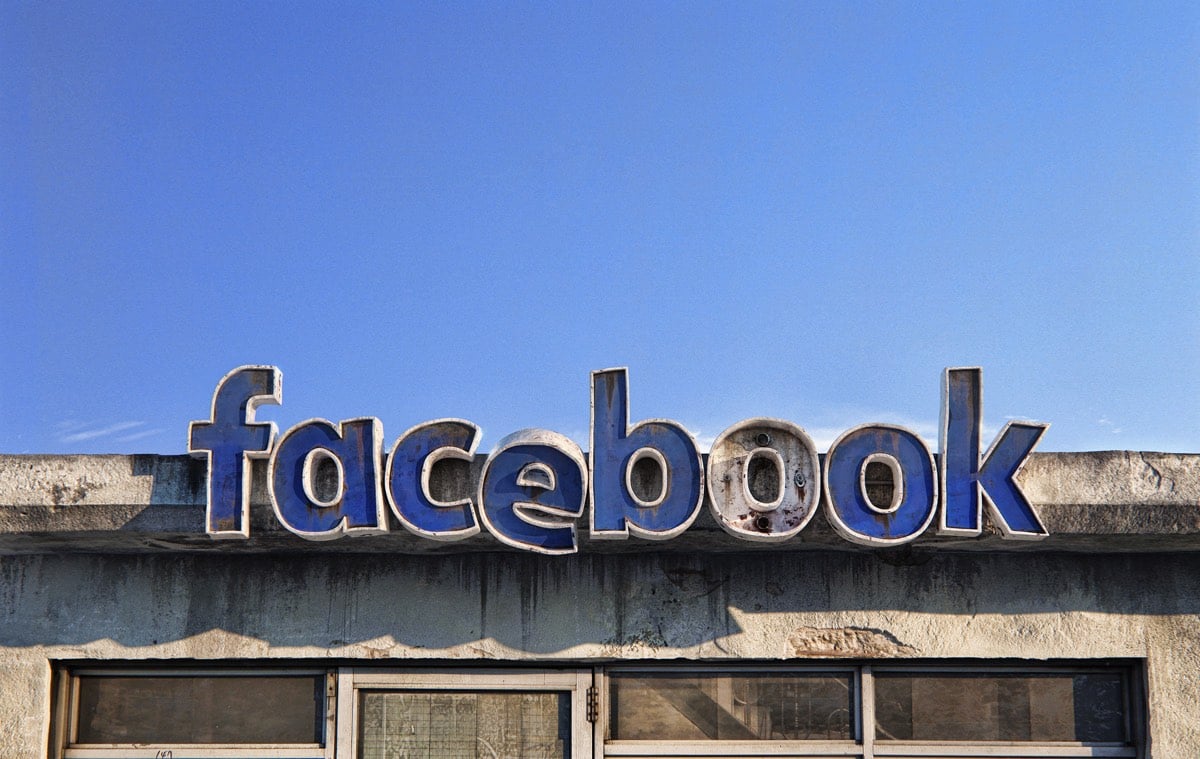
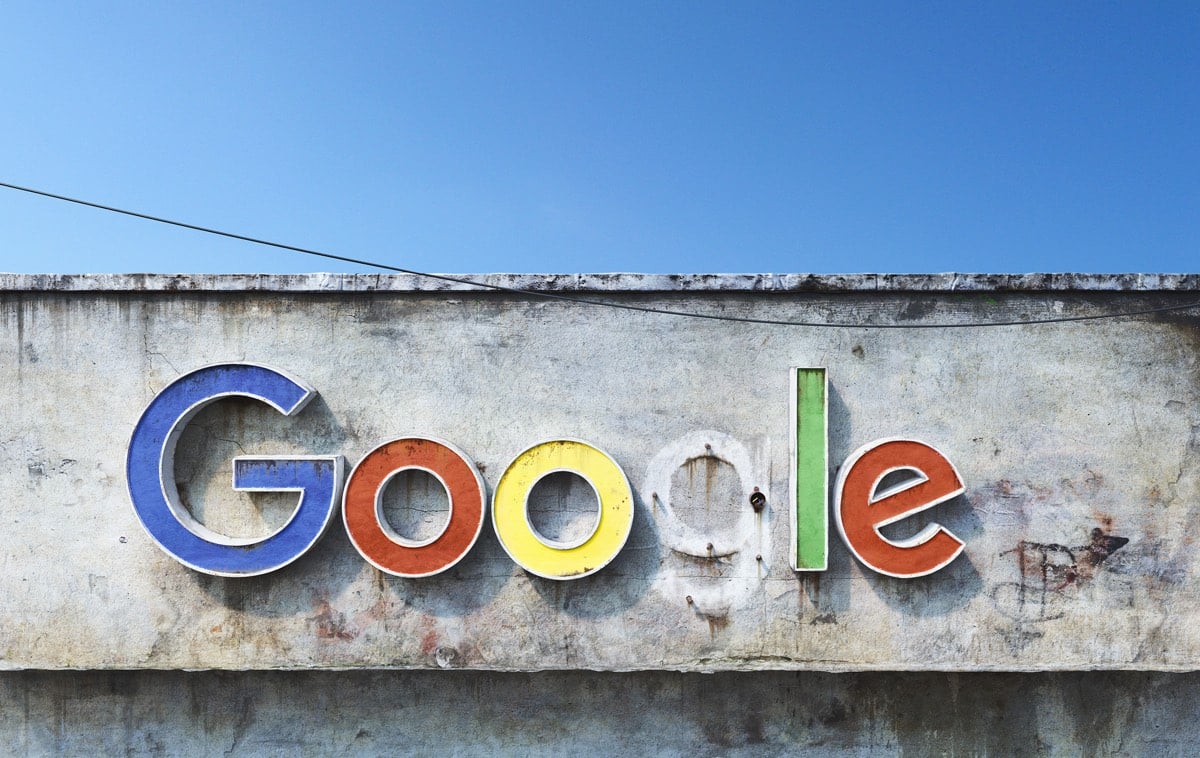
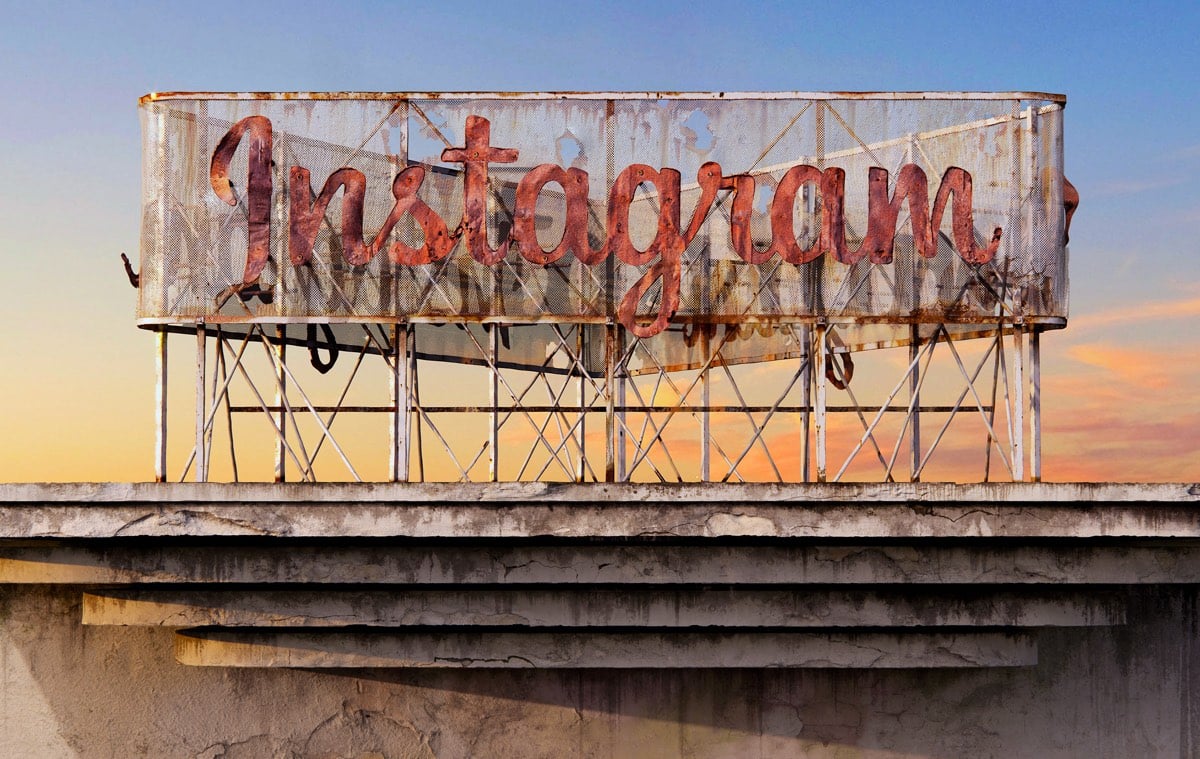
For a project called Social Decay, Andrei Lacatusu imagines what it would look like if big social media companies were brick & mortar and went the way of Blockbuster, Woolworth’s, and strip malls across America. These are really well done…check out the close-up views on Behance.
Literally, all you need to do: Type in web addresses. Use autofill! Or even: Google the website you want to go to, and go to it. Then bookmark it. Then go back every now and again.
Instead of reading stories that get to you because they’re popular, or just happen to be in your feed at that moment, you’ll read stories that get to you because you chose to go to them. Sounds simple, and insignificant, and almost too easy, right?
It’s only easy, and simple to do. As for why you should do it: It’s definitely not simple, nor insignificant. By choosing to be a reader of websites whose voices and ideas you’re fundamentally interested in and care about, you’re taking control.
And by doing that, you’ll chip away at the incentive publishers have to create headlines and stories weaponized for the purpose of sharing on social media. You’ll be stripping away at the motivation for websites everywhere (including this one) to make dumb hollow mindgarbage. At the same time, you’ll increase the incentive for these websites to be (if nothing else) more consistent and less desperate for your attention.
*head nodding vigorously* I mean, it’s a complicated situation. Facebook and Twitter are easily the best news/blog reading platforms ever invented, better than any RSS reader for most people. By putting most of the web’s information all in one place, they offer incredible speed and convenience, which is hard for people to ignore. I made this point in a footnote this morning: using Facebook instead of just bookmarks is compelling in the same way that shopping at Walmart instead of small-town shops was in the 80s. We blame Walmart for decimating small businesses, but ultimately, small town shoppers chose convenience and lower prices over the more local and diverse offerings from their neighbors. And for the past several years, readers have been doing the same thing in favoring Facebook. What Kamer is arguing is that readers who value good journalism, good writing, and diverse viewpoints need to push back against the likes of the increasingly powerful and monolithic Facebook…and visiting individual websites is one way to do that.
The scuttlebutt around the tech/media internet water cooler over the past few months is that Facebook CEO Mark Zuckerberg is going to run for President in 2020. This feeling has been fueled by Zuck’s goal for this year of visiting the remaining 30 or so US states that he has yet to visit and the way in which he’s been documenting his trips. Nathan Hubbard argues that Zuck actually has other things on his mind as he tours America:
Zuck isn’t running for President. He’s trying to understand the role the product he created played in getting this one elected.
Facebook has undergone two major evolutionary events in its history, both of which were driven by what Zuck saw as existential threats.
The incredible revenue growth in mobile (probably the greatest biz execution of our generation) helped Facebook survive a platform shift.
And the fearless acquisitive streak of Instagram, WhatsApp and others helped Facebook survive a shift in how we communicate and organize.
Zuck woke up on Nov 9th acutely aware that FB had facilitated a new shift he didn’t foresee or understand; that’s terrifying to a founder.
He’s the head of product. So he’s ventured out into the world beyond his bubble to do field research and inform how FB will evolve again.
I am also sympathetic to the argument that Zuckerberg doesn’t need to run for President because he’s already the leader of the largest group of people ever assembled in the history of humanity (aside from possibly the British Empire). Facebook doesn’t possess many necessary qualities of a sovereign country, but it also has many advantages that countries don’t. Zuckerberg is already among the world’s most important people and with Facebook still growing, he could one day soon be the most powerful person in the world.
Last week (approx. May 7-14), I stopped using social media for an entire week. I logged out of all the sites and deleted the apps from my phone. I didn’t so much as peek at Instagram, which is, with Twitter and old-school Flickr, probably my favorite online service of all time. I used Twitter as minimally as I could, for work only.1 I didn’t check in anywhere on Swarm. No Facebook. As much as I could, I didn’t use my phone. I left it at home when I went to the grocery store. I didn’t play any games on it. I left it across the room when I went to bed and when I worked.
Many people have given up social media and written about it — the digital equivalent of the “Why I’m Leaving New York” essay — but since I didn’t write about leaving New York, I’m going to do this instead.
I used to be very good about using my phone and social media appropriately. More than a decade of working on kottke.org taught me how to not be online when I wasn’t working (for the most part). I tried super hard not to use my phone at all around my kids and if I was out with friends, my phone stayed in my pocket.2
Almost a year ago, after 13+ years in the city, I moved from lower Manhattan3 to rural Vermont. It’s beautiful here. I live in a house in the country surrounded by horse pasture and there’s great skiing in the winter. The nearest town is only five minutes away by car; it has a two-screen movie theater, a handful of restaurants (none of which are typically open after 10pm), two grocery stores, but nowhere to get a proper donut, sushi, or bowl of ramen. (The nearest ramen is an hour’s drive away.) While I was writing this post yesterday afternoon, the power in my house went out and didn’t come back on for three hours, forcing a delay in publication. It’s been difficult to meet people. Folks here are nice, but they mostly remind me of the people in the small town I grew up in (aka why I moved to the city in the first place). I work from home at a desk in my bedroom and some days, the only beings I’ll talk to are Siri, my landlord’s horses, and some days, my kids and their mom.
Social media, mostly through my phone, has been an important way for me to stay connected with friends and goings on in the wider world. But lately I’d noticed an obsessiveness, an addiction really, that I didn’t like once I became fully aware of it. When I wasn’t working, I was on my phone, refreshing Instagram, Twitter, and Facebook repeatedly in an endless series, like a little old lady at Caesar’s Palace working several slot machines at the same time. And I couldn’t stop it — my phone was in my hand even when I was trying to concentrate on my kids, watching a movie, or reading a book. So, I quit for a week to see what would happen. It’s not a super-long time period, but here’s what I noticed:
- Once I’d set my mind to it, it was pretty easy to go cold turkey. Perhaps my Twitter usage and keeping up with the news for kottke.org acted as a nicotine patch, but I don’t think so. Instagram was the toughest to stay away from, but I didn’t crack once.
- As the week went on, it was more and more evident that it wasn’t so much social media as the phone that was the problem. Even now, a few days after the conclusion of my experiment, I’m leaving my phone at home when I go out or across the room when I’m doing something. I’m going to try hard to keep this up.
- Buuuut, when you have kids, there is no such thing as giving up your phone. There’s always the potential call from their school or their mom or their doctor or another parent regarding a playdate or or or. I spend enough time online at my computer for work that I could mostly do without my phone, but with kids, that’s not really an option.
- Not a single person noticed that I had stopped using social media. (Not enough to tell me anyway.) Perhaps if it had been two weeks? For me, this reinforced that social media is actually not a good way to “stay connected with friends”. Social media aggregates interactions between loved ones so that you get industrialized communication rather than personal connection. No one really notices if a particular person goes missing because they’re just one interchangeable node in a network.
- My no-social week, for a variety of reasons, was probably the shittiest week I’d had in more than a year. Total emotional mess. Being off social media didn’t make it any better, but I doubt it made it worse. Overall, it was probably a good thing I wasn’t subjecting my friends and followers to self-subtweets and emo Instagram Stories…I was already scoring enough own goals without social media’s help.
- So, what did I do instead? I wish I could say that I had loads of extra free time that I used to learn Spanish, clean my house, catch up with old friends, cook delicious meals, and finish a couple work projects. Perhaps if shittiest week ever hadn’t been happening, I would have done some of that. Still, I did end up going to bed early every night, read a couple books, and had more time for work and dealing with kid drama.
After the week was up, I greedily checked in on Instagram and Facebook to see what I had missed. Nothing much, of course. Since then, I’ve been checking them a bit less. When I am on, I’ve been faving and commenting more in an attempt to be a little more active in connecting. I unfollowed some accounts I realized I didn’t care that much about and followed others I’ve been curious to check out. Swarm I check a lot less, about once a day — there was a lot of FOMO going on when I saw friends checked in at cool places in NYC or on vacations in Europe. And I’m only checking in when I go someplace novel, just to keep a log of where I’ve been…that’s always fun to look back on.
Mostly, I’ve resolved to use my phone less. Being on my phone was my fidget spinner…this thing that I would do when there was nothing else to do or that I would use to delay going to bed or delay getting out of bed in the morning. Going forward, I’m going to be more mindful about its use. If nothing else, my hands and thumbs might start feeling better.
Yeah, I did not stop using Twitter. Ideally I would have, but Twitter is a huge source of information for this here website and I couldn’t afford to give it up without ditching work for a week, which I did not want to do because I wanted to maintain my normal schedule. But I didn’t look at Twitter on my phone, didn’t reply to or fave any tweets, muted some non-news/link accounts I follow, and limited my usage to “business hours”.↩
Still one of my favorite tweets is from Scott Simpson: “My new standard of cool: when I’m hanging out with you, I never see your phone ever ever ever.”↩
Haha, you’re getting a mini leaving NYC essay anyway. Suckers!↩
O’Reilly’s lengthy description of the principles of Web 2.0 has become more fascinating through time. It seems to be describing a slightly parallel universe. “Hyperlinking is the foundation of the web,” O’Reilly wrote. “As users add new content, and new sites, it is bound into the structure of the web by other users discovering the content and linking to it. Much as synapses form in the brain, with associations becoming stronger through repetition or intensity, the web of connections grows organically as an output of the collective activity of all web users.”
Nowadays, (hyper)linking is an afterthought because most of the action occurs within platforms like Facebook, Twitter, Instagram, Snapchat, and messaging apps, which all have carved space out of the open web.
That strategy has made the top tech companies insanely valuable:
In mid-May of 2007, these five companies were worth $577 billion. Now, they represent $2.9 trillion worth of market value! Not so far off from the combined market cap ($2.85T) of the top 10 largest companies in the second quarter of 2007: Exxon Mobil, GE, Microsoft, Royal Dutch Shell, AT&T, Citigroup, Gazprom, BP, Toyota, and Bank of America.
In 2007, I wrote a piece (and a follow-up) about how Facebook was the new AOL and how their walled garden strategy was doomed to fail in the face of the open Web. The final paragraph of that initial post is a good example of the Web triumphalism described by Madrigal but hasn’t aged well:
As it happens, we already have a platform on which anyone can communicate and collaborate with anyone else, individuals and companies can develop applications which can interoperate with one another through open and freely available tools, protocols, and interfaces. It’s called the internet and it’s more compelling than AOL was in 1994 and Facebook in 2007. Eventually, someone will come along and turn Facebook inside-out, so that instead of custom applications running on a platform in a walled garden, applications run on the internet, out in the open, and people can tie their social network into it if they want, with privacy controls, access levels, and alter-egos galore.
The thing is, Facebook did open up…they turned themselves inside-out and crushed the small pieces loosely joined contingent. They let the Web flood in but caught the Web’s users and content creators before they could wash back out again. The final paragraph of the follow-up piece fared much better in hindsight:
At some point in the future, Facebook may well open up, rendering much of this criticism irrelevant. Their privacy controls are legendarily flexible and precise…it should be easy for them to let people expose parts of the information to anyone if they wanted to. And as Matt Webb pointed out to me in an email, there’s the possibility that Facebook turn itself inside out and be the social network bit for everyone else’s web apps. In the meantime, maybe we shouldn’t be so excited about the web’s future moving onto an intranet.
What no one saw back then, about a week after the release of the original iPhone, was how apps on smartphones would change everything. In a non-mobile world, these companies and services would still be formidable but if we were all still using laptops and desktops to access information instead of phones and tablets, I bet the open Web would have stood a better chance.
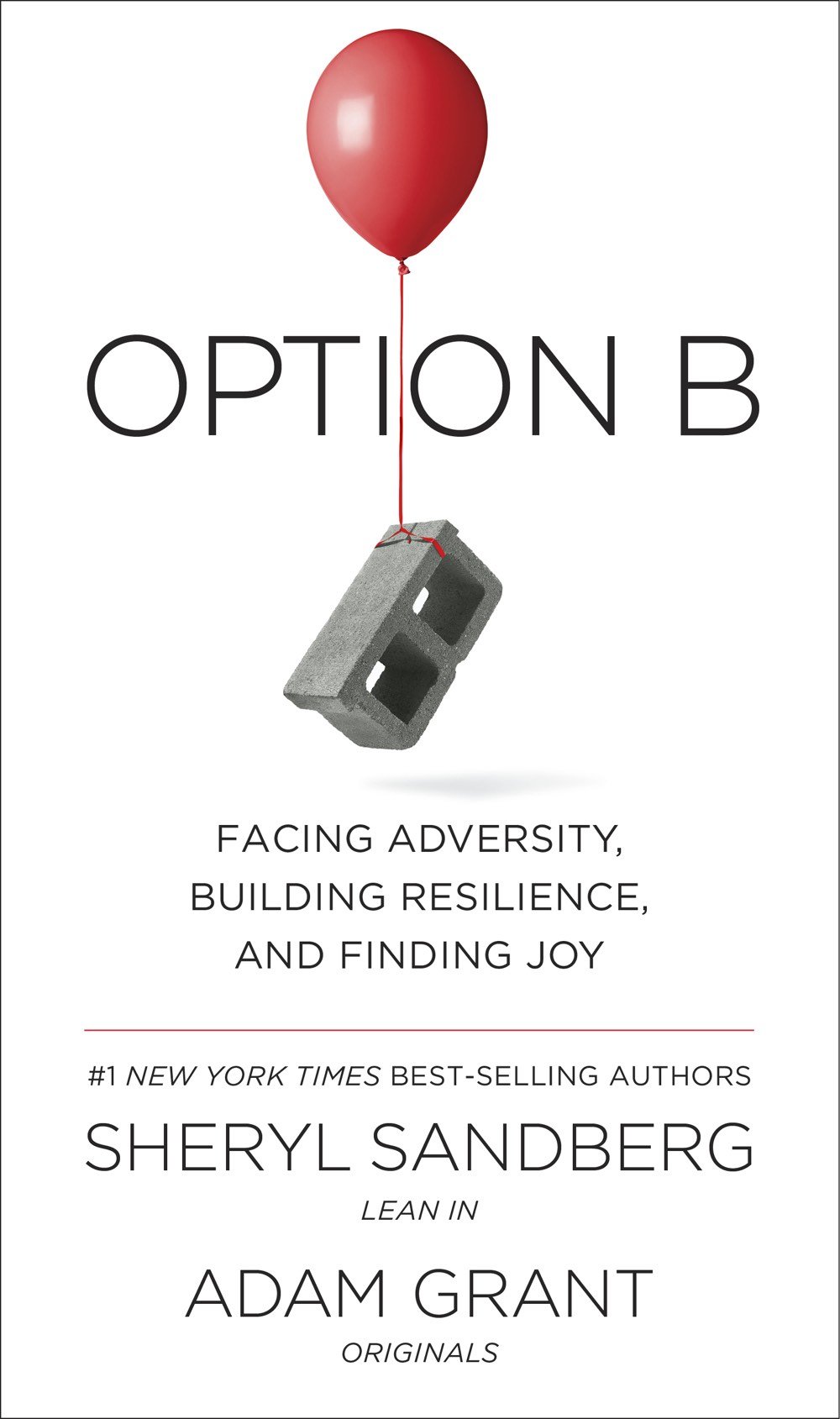
Two years ago, Facebook COO and Lean In author Sheryl Sandberg lost her husband to an unexpected death. The loss left her bereft and adrift. Grieving hard, she struggled to figure out how to move forward with her life. The result of her journey is a book co-authored by Adam Grant called Option B: Facing Adversity, Building Resilience and Finding Joy.
After the sudden death of her husband, Sheryl Sandberg felt certain that she and her children would never feel pure joy again. “I was in ‘the void,’” she writes, “a vast emptiness that fills your heart and lungs and restricts your ability to think or even breathe.” Her friend Adam Grant, a psychologist at Wharton, told her there are concrete steps people can take to recover and rebound from life-shattering experiences. We are not born with a fixed amount of resilience. It is a muscle that everyone can build.
Option B combines Sheryl’s personal insights with Adam’s eye-opening research on finding strength in the face of adversity.
Jessi Hempel’s piece on Sandberg is a good overview on the book and that period in her life, particularly in relation to Sandberg’s return to work and how that changed leadership & communication at Facebook.
Every year in late May, Facebook gathers its policy and communications team for a day-long retreat. Employees fly in from satellite offices in Germany, say, or Japan. It’s a chance to address problems, and set strategy for the year to come.
Sandberg always speaks, but that year Caryn Marooney, who was then in charge of technology communications, remembers everyone told her she could skip it. She insisted on coming anyway. As 200 people looked on, she began telling the group what she was going through, and how it was. “There were a lot of tears. It was incredibly raw, and then she said, “I’m going to open it up to Q and A,” Marooney remembers. People spoke up.
Talking about her situation allowed Sandberg — and the entire team — to move past it and transition into a productive conversation. Having acknowledged the proverbial elephant in the room, they could all focus on the work at hand. “I think people think that vulnerable is soft, but it’s not,” said Marooney, as she described Sandberg’s tough approach to business questions that followed. “It was a blueprint of what we saw from Sheryl going forward.”
Sandberg has also started a non-profit “dedicated to helping you build resilience in the face of adversity — and giving you the tools to help your family, friends, and community build resilience too.”
One afternoon, I sat down with my kids to write out “family rules” to remind us of the coping mechanisms we would need. We wrote together that it’s O.K. to be sad and to take a break from any activity to cry. It’s O.K. to be happy and laugh. It’s O.K. to be angry and jealous of friends and cousins who still have fathers. It’s O.K. to say to anyone that we do not want to talk about it now. And it’s always O.K. to ask for help. The poster we made that day — with the rules written by my kids in colored markers — still hangs in our hall so we can look at it every day. It reminds us that our feelings matter and that we are not alone.
When it was introduced in January 2014, Paper signaled the beginning of a design renaissance at Facebook. The look and feel of the app were orchestrated by Mike Matas, whose design firm Push Pop Press was acquired by Facebook in 2011. Paper was notable for the novel animations it used to guide you through the app - tap on a link and it would unfold like a letter; pull down on the story and it would fold back up, returning you to the feed.
They say the app is shutting down on July 29th, but my news feed has already stopped updating.
I love Paper. The look and feel of the app is amazing; it’s still one of the best apps ever for reading things online. Paper was the only way I read Facebook…I guess I’ll either d/l the Facebook app or stop reading?
In five years time Facebook “will be definitely mobile, it will be probably all video,” said Nicola Mendelsohn, who heads up Facebook’s operations in Europe, the Middle East and Africa, at a conference in London this morning. Mark Zuckerberg, Facebook’s CEO, has already noted that video will be more and more important for the platform. But Mendelsohn went further, suggesting that stats showed the written word becoming all but obsolete, replaced by moving images and speech.
“The best way to tell stories in this world, where so much information is coming at us, actually is video,” Mendelsohn said. “It conveys so much more information in a much quicker period. So actually the trend helps us to digest much more information.”
Maybe this is coming from deep within the literacy bubble, but:
Text is surprisingly resilient. It’s cheap, it’s flexible, it’s discreet. Human brains process it absurdly well considering there’s nothing really built-in for it. Plenty of people can deal with text better than they can spoken language, whether as a matter of preference or necessity. And it’s endlessly computable — you can search it, code it. You can use text to make it do other things.
In short, all of the same technological advances that enable more and more video, audio, and immersive VR entertainment also enable more and more text. We will see more of all of them as the technological bottlenecks open up.
And text itself will get weirder, its properties less distinct, as it reflects new assumptions and possibilities borrowed from other tech and media. It already has! Text can be real-time, text can be ephemeral — text has taken on almost all of the attributes we always used to distinguish speech, but it’s still remained text. It’s still visual characters registered by the eye standing in for (and shaping its own) language.
Because nothing has proved as invincible as writing and literacy. Because text is just so malleable. Because it fits into any container we put it in. Because our world is supersaturated in it, indoors and out. Because we have so much invested in it. Because nothing we have ever made has ever rewarded our universal investment in it more. Unless our civilization fundamentally collapses, we will never give up writing and reading.
(And my god — the very best feature Facebook Video has, what’s helping that platform eat the world — is muted autoplay video with automatic text captions. Forget literature — even the stupid viral videos people watch waiting for the train are better when they’re made with text!)
Nothing is inevitable in history, media, or culture — but literacy is the only thing that’s even close. Bet for better video, bet for better speech, bet for better things we can’t imagine — but if you bet against text, you will lose.
Kurzgesagt’s newest video is about all the stolen video content on Facebook and the social network’s continued indifference to and profit from content creators, particularly small and independent creators.
Facebook just announced 8 billion video views per day. This number is made out of lies, cheating and worst of all: theft. All of this is wildly known but the media giant Facebook is pretending everything is fine, while damaging independent creators in the process. How does this work?
According to a recent report from Ogilvy and Tubular Labs, of the 1000 most popular Facebook videos of Q1 2015, 725 were stolen re-uploads. Just these 725 “freebooted” videos were responsible for around 17 BILLION views last quarter. This is not insignificant, it’s the vast majority of Facebook’s high volume traffic. And no wonder, when embedding a YouTube video on your company’s Facebook page is a sure way to see it die a sudden death, we shouldn’t be surprised when they rip it off YouTube and upload it natively. Facebook’s algorithms encourage this theft.
What is Facebook doing about it?
They’ll take the video down a couple days after you let them know. Y’know, once it’s received 99.9% of the views it will ever receive.
In the New Yorker, Matthew J.X. Malady writes about finding his deceased mother standing outside her house on Google Street View and, more generally, when technology clumsily reminds us of loved ones who are no longer with us.
When I reached my mother’s house, that all changed. First, I noticed that a gigantic American flag had been affixed to the mailbox post at the corner of the driveway. That was new. Then I spotted the fire pit in the front yard that my mom and her husband, my stepfather, used for block parties, and the grill on the patio, and my mom’s car. And then there she was, out front, walking on the path that leads from the driveway to the home’s front door. My mom.
At first I was convinced that it couldn’t be her, that I was just seeing things. When’s the last time you’ve spotted someone you know on Google Maps? I never had. And my mother, besides, is no longer alive. It couldn’t be her.
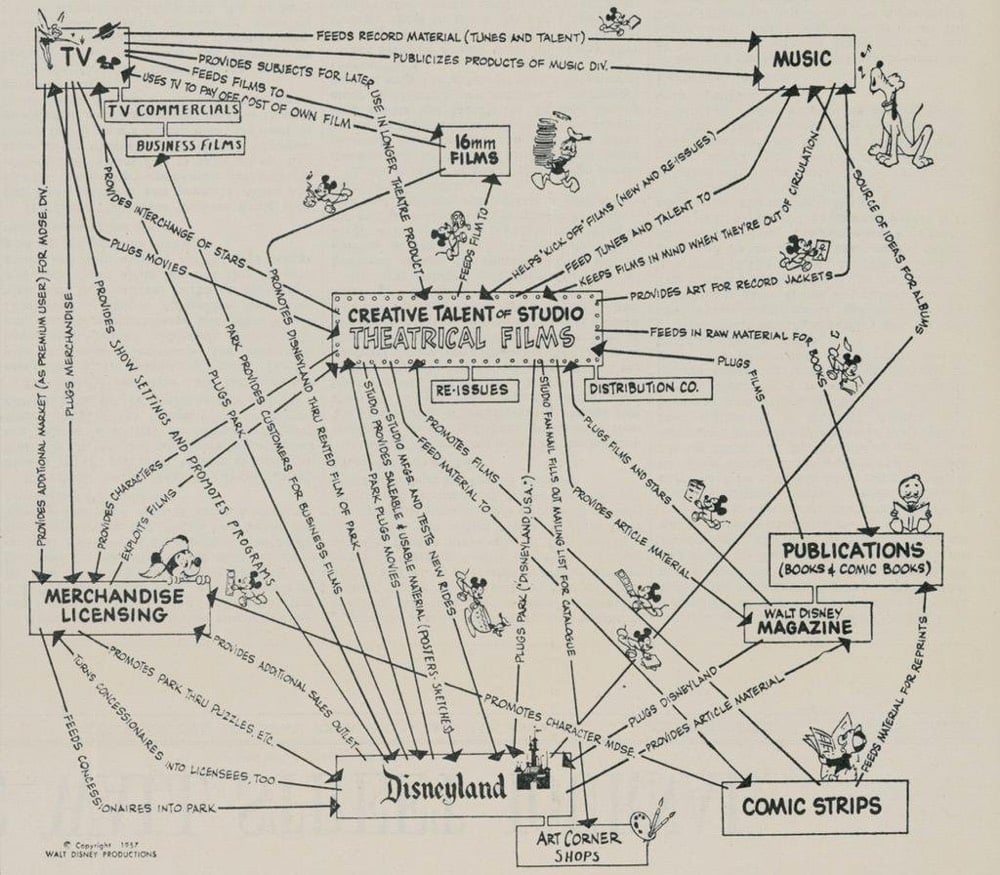
The boxes on the chart have changed, but since the appointment of Bob Iger as CEO, Disney has seemingly doubled down on Walt’s old strategy with their increased focus on franchises.
Disney’s dominance can be boiled down very simply to one word: franchises. Or rather, an “incessant focus on franchises” in the words of former Disney CFO Jay Rasulo.
“Everything we do is about brands and franchises,” Rasulo told a group of financial analysts last September. “Ten years ago we were more like other media companies, more broad-based, big movie slate, 20 something pictures, some franchise, some not franchise. If you look at our slate strategy now, our television strategy, almost every aspect of the company, we are oriented around brands and franchises.”
Franchises are well suited to extend across multiple parts of a big business like Disney, particularly because it’s a repeating virtuous cycle: movies drive merchandise sales and theme park visits, which in turn drives interest for sequels and spin-offs, rinse, repeat, reboot.
I wonder if more tech companies could be using this strategy more effectively. Apple does pretty well; their various hardware (iPhone, iPad, Mac), software (iOS, OS X), and services (iCloud, App Store, iTunes Store) work together effectively. Microsoft rode Office & Windows for quite awhile. Google seems a bit more all over the place — for instance, it’s unclear how their self-driving car helps their search business and Google+ largely failed to connect various offerings. Facebook seems to be headed in the right direction. Twitter? Not so much, but we’ll see how they do with new leadership. Or old leadership…I discovered Walt’s chart via interim Twitter CEO Jack Dorsey.
Hi, everybody! Tim Carmody here, guest-hosting for Jason this week.
On Monday, I tried to list some reasons why OKCupid’s self-acknowledged experiments on its users didn’t seem to be stirring up the same outrage that Facebook’s had. Here at the end of the week, I think I was largely right: fewer people are upset, the anger is more tempered, and that has a lot to do with the reasons I gave. But one reaction I didn’t expect is that some people took it as saying that I wasn’t upset by what OKCupid did, or that people shouldn’t be as upset by it.
What OKCupid did has actually made me madder and madder as the week’s gone on, but for reasons that are different from other people’s. I think this is pretty important, so I’m going to try to explain why.
Let’s start with the Facebook “social contagion” study. Most Facebook critics focused on the people who were the subjects of the study, for good reasons. Did these users give consent? Can terms of service count as consent for an academic study? Should they have been informed of the study afterwards? Is Facebook responsible for any harm these users might have suffered? Is an increase or decrease in engagement really a sign that users’ emotions were affected? How else has Facebook attempted to influence its users, or might try in the future? These are all good questions.
But what if you flip it around? What if you weren’t one of the subjects whose moods Facebook was trying to study, but one of their friends or family? What if you were one of the people whose posts were filtered because your keywords were too happy, too angry, or too sad?
It’s a small thing, but I haven’t seen anybody discuss the Facebook emotion study from the perspective of authors of the filtered posts.
I think there’s no way to know whether the Facebook study may have harmed people who weren’t being studied. And even though the TOS basically says that users give Facebook permission to do whatever they want not only with the users’ data, but all of their friends’ too, you can’t call that consent with a straight face. (This is just another reason that software terms of service are a rotten legal and ethical basis for research. They just weren’t built for that reason, or to solve any of those problems.)
So Facebook didn’t just mess around with some of its users’ feeds, hoping to see if it might mess around with their feelings. It used some of its users’ posts in order to do it. Arguably, it made them complicit.
To be clear, filtering posts, giving preference to some and not others, is how Facebook’s newsfeed algorithm always works. Facebook users have been complaining about this for a long time, especially brands and news organizations and other companies who’ve built up their subscriber counts and complain that hardly anybody ever sees their posts unless they pay off Facebook’s ad department. And Facebook makes no guarantees, anywhere, that they’re going to deliver every message to every user who’s subscribed to it. Readers miss posts all the time, usually just because they’re just not looking at the screen or reading everything they could see. Facebook isn’t certified mail. It’s not even email. All this is known.
However.
We all buy in to Facebook (and Twitter, and OKCupid, and every other social media network), giving them a huge amount of personal data, free content, and discretion on how they show it to us, with the understanding that all of this will largely be driven by choices that we make. We build our own profiles, we select our favorite pictures, we make our own friends, we friend whatever brands we like, we pick the users we want to block or mute or select for special attention, and we write our own stories.
Even the filtering algorithms, we’re both told and led to assume, are the product of our choices. Either we make these choices explicitly (mute this user, don’t show me this again, more results like these) or implicitly (we liked the last five baby pictures, so Facebook shows us more baby pictures; we looked at sites X, Y, and Z, so we see Amazon ads for people who looked at X, Y, and Z. It’s not arbitrary; it’s personalized. And it’s personalized for our benefit, to reflect the choices that we and the people we trust have made.
This is what makes the user-created social web great. It’s the value it adds over traditional news media, traditional classified ads, traditional shopping, everything.
This is why it really stings whenever somebody turns around and says, “well actually, the terms you’ve signed give us permission to do whatever we want. Not just the thing you were afraid of, but a huge range of things you never thought of.” You can’t on one hand tell us to pay no attention when you change these things on us, and with the other insist that this is what we’ve really wanted to do all along. I mean, fuck me over, but don’t tell me that I really wanted you to fuck me over all along.
Because ultimately, the reason you needed me to agree in the first place isn’t just because I’m using your software, but because you’re using my stuff. And the reason I’m letting you use my stuff, and spending all this time working on it, is so that you can show it to people.
I’m not just a user of your service, somebody who reads the things that you show it to me: I’m one of the reasons you have anything that you can show to anyone at all.
Now let’s go back to the OKCupid experiment. Facebook didn’t show some of its users posts that their friends wrote. But at least it was a binary thing: either your post was shown, just as you wrote it, or it wasn’t. OKCupid actually changed the information it displayed to users.
You can pick nits and say OKC didn’t change it, but rather, just selectively repressed parts of it, deleting photos on some profiles and text on others. But if you’ve ever created a profile on any web site, you know that it’s presented as being a whole ensemble, the equivalent of a home page. The photos, the background, the description, the questions you answer: taken altogether, that’s your representation of yourself to everyone else who may be interested. It’s the entire reason why you are there.
Now imagine you’re an OKCupid user, and you strike up a conversation with someone or someone strikes up a conversation with you. You assume that the other person has all of your information available to them if they’re willing to look at it. That’s the basis of every conversation you have on that site. Except they don’t. The profile that OKCupid has implicitly promised they’ll show to everyone who looks at it has been changed. The other person either doesn’t know what you look like (and assumes you can’t be bothered to post a photo) or doesn’t know anything else about you (and assumes you can’t be bothered to write anything about yourself.) Both of you have been deceived, so the site can see what happens.
This is why I question the conclusion that OKC users who were only shown profiles with pictures are shallow, because their conversations were almost as long as the ones who were shown full profiles. This is how I imagine those conversations going:
Rosencrantz: So what do you do? Guildenstern: Um I work in marketing? Rosencrantz: That’s great! Where did you go to school? Guildenstern: I went to UVA Guildenstern: Wait a minute are you some kind of bot? Rosencrantz: What makes you say that? Guildenstern: You keep asking me questions that are in my profile, did you even read it Rosencrantz: I’m looking at it right now, why didn’t you answer any of the questions Guildenstern: lol I guess you can’t read nice pic though goodbye
That’s a high-value interaction by the OKC researchers’ standards, by the way.
This is also why I don’t have much patience with the idea that “The worst thing could have happened [with the OkCupid testing] is people send a few more messages, and maybe you went on a date you didn’t like.” (Rey Junco told this to ReadWrite to explain why he thought Facebook’s study was worse than OKCupid’s, but you see versions of this all over.)
First, going on “a date you didn’t like” isn’t a frivolous thing. It definitely incurs more material costs than not seeing a Facebook status. And bad (or good) messages or a bad or good date can definitely have a bigger emotional impact as well.
More importantly, though, don’t make this just a question about dates or feelings, about what somebody did or didn’t read and what its effect on them was. I don’t care if you think someone making a dating profile is a frivolous thing. Somebody made that. They thought the company hosting it could be trusted to present it honestly. They were wrong.
So this is the problem I see not just with Facebook and OKCupid’s experiments, but with most of the arguments about them. They’re all too quick to accept that users of these sites are readers who’ve agreed to let these sites show them things. They don’t recognize or respect that the users are also the ones who’ve made almost everything that those sites show. They only treat you as a customer, never a client.
And in this respect, OKCupid’s Christian Rudder and the brigade of “and this surprises you?” cynics are right: this is what everybody does. This is the way the internet works now. (Too much of it, anyway.) It doesn’t matter whether your site is performing interventions on you or not, let alone publishing them. Too many of them have accepted this framework.
Still, for as long as the web does work this way, we are never only these companies’ “products,” but their producers, too. And to the extent that these companies show they aren’t willing to live up to the basic agreement that we make these things and give them to you so you will show them to other people — the engine that makes this whole world wide web business go — I’m not going to have anything to do with them any more. What’s more, I’ll get mad enough to find a place that will show the things I write to other people and tell them they shouldn’t accept it either. Because, ultimately, you ought to be ashamed to treat people and the things they make this way.
Rudder says some of the negative response “is my own fault, because, y’know, the blog post is sensationally written, for sure.” But he doesn’t back off of that tone one bit. In fact, he doubles down.
Alex Goldman: Have you thought about bringing in, say, like an ethicist to, to vet your experiments?
Christian Rudder, founder of OkCupid: To wring his hands all day for a hundred thousand dollars a year?… This is the only way to find this stuff out. If you guys have an alternative to the scientific method, I’m all ears.
I think he maybe should have just written the blog post and left it alone.
Update: University of Maryland Professor of Law James Grimmelmann say that not only were OKCupid’s and Facebook’s studies unethical, but they were illegal.
Most of the resulting discussion has treated this as a story about ethics. Which it is — and the lapses of ethical judgment shown by Facebook and OkCupid are scandalous. But the ethics are only half of the story. What Facebook and OkCupid did wasn’t just unethical. It was illegal. A common assumption is that even if research laws ought to apply to private companies, they don’t. But that assumption is false. Facebook and OkCupid are bound by research laws, and those research laws quite clearly prohibit what they did.
And it’s not little stuff either! To test its matching algorithms, OKC has selectively hidden users’ profile images, their profile text, and even told pairs of users they were a good match when the algo said they weren’t, and vice versa.
In short, Facebook may have hid stuff from you, but OK Cupid might have actually lied to you.
But… nobody’s really upset about this. Or if they are, they’re mostly just upset (or dryly observing, it’s hard to tell) that other people aren’t upset.
Why? I have some theories:
It’s early yet. It took the Facebook story some time to steep before it really picked up steam.
OKC users are less likely to be troubled by this sort of thing than Facebook users are. And people get more upset when they feel like they personally might have been messed with. Hilary Parker pointed out that non-online daters are less likely to get upset on online daters’ behalf: even if you don’t actively look down on OKC users (and many do), you might be more likely to think they got what they deserved. OK Cupid has a history of disclosing these kinds of numbers, and there’s a laissez-faire attitude towards users gaming accounts for their own purposes.
We trust Facebook in a way we don’t trust OKC. Facebook is the safe baby internet, with our real friends and family sending us real messages. OKC is more internet than the internet, with creeps and jerks and catfishers with phony avatars. So Facebook messing with us feels like a bigger betrayal.
OKC’s matching algorithm may be at least as opaque as Facebook’s news feed, but it’s clearer to users that site matches and views are generated using an algorithm. Reportedly, 62 percent of Facebook usersweren’t aware that Facebook’s news feed was filtered by an algorithm at all. (That study has a small sample size, but still, we can infer that lots of Facebook users have no idea.)
The results of OKC’s experiments are less troubling. Facebook’s study showed that our posting behavior (and maybe our feelings) were pretty susceptible to manipulation without a whole lot of effort. OKC’s results seemed more complimentary. Sure, lots of people on dating sites are shallow, and sometimes you may have ended up in longer conversations than you might like with incompatible people, but good matches seem to find a way to connect no matter what OKC tells us! So… the algorithm works and I guess we can trust what they tell us? My head hurts. (Jess Zimmerman adds that part of the Facebook intervention was deliberately designed to cause harm, by making people unhappy, at least as mediated through their posts. The difference here depends on whether you think trying to match you up with someone incompatible might be causing them harm.
The tone of the OKC post is just so darned charming. Rudder is casual, self-deprecating. It’s a blog post! Meanwhile, Facebook’s “emotional contagion” scholarly paper was chillingly matter-of-fact. In short, the scientism of the thing just creeped us the fuck out.
This is related to the tone issue, but OKC seems to be fairly straightforward about why it performed the experiment: they didn’t understand whether or how their matching algorithm was working, and they were trying to figure that out to make it better. Facebook seemed to be testing user’s emotional expressions partly to solve a scholarly dispute and partly just to see if they could. And most of the practical justifications folks came up with for the Facebook study were pretty sinister: tricky folks into posting more often, into clicking on ads, into buying stuff. (Really, both experiments are probably a mix of product testing and shooting frogs for kicks, but the perception seems to be different.)
The Facebook study had an added wrinkle in that academics were involved in designing the study and writing it up. This raised all sorts of factual and ethical issues about university institutional review boards and the responsibility of the journal’s editors and publishers that don’t seem to be relevant here. I mean, maybe SOMEbody should be veryifying that experiments done on human subjects are ethical, whether it’s in a university, medical, or government context or not, but it’s not like someone may have been asleep at the switch. Here, there is no switch.
Maybe we’re all just worn out. Between Facebook, this, Uber ratings, and god knows what, even if you’re bothered by this kind of experimentation, it’s more difficult to stay angry at any one company. So some people are jaded, some people would rather call attention to broader issues and themes of power, and some people are just tired. There’s only so many times you can say “see? THIS! THIS is what I’ve been telling you about!” or “I can’t believe you’re surprised by this” before you’re just like, ¯\_(?)_/¯.
I don’t agree with all of these explanations, and all of them feel a little thin. But maybe for most of us, those little scraps of difference are enough.
Update: Here’s a tenth reason that I thought of and then forgot until people brought up variations of it on Twitter: Facebook feels “mandatory” in a way that OKCupid doesn’t. It’s a bigger company with a bigger reach that plays a bigger part in more people’s lives. As Sam Biddle wrote on Twitter, “Facebook is almost a utility at this point. It’s like ConEd fucking with us.”
Raffi Khatchadourian’s long piece on the construction of the International Thermonuclear Experimental Reactor (ITER) is at once fascinating (for science reasons) and depressing (for political/bureaucratic reasons). Fusion reactors hold incredible promise:
But if it is truly possible to bottle up a star, and to do so economically, the technology could solve the world’s energy problems for the next thirty million years, and help save the planet from environmental catastrophe. Hydrogen, a primordial element, is the most abundant atom in the universe, a potential fuel that poses little risk of scarcity. Eventually, physicists hope, commercial reactors modelled on iter will be built, too-generating terawatts of power with no carbon, virtually no pollution, and scant radioactive waste. The reactor would run on no more than seawater and lithium. It would never melt down. It would realize a yearning, as old as the story of Prometheus, to bring the light of the heavens to Earth, and bend it to humanity’s will. iter, in Latin, means “the way.”
But ITER is a collaborative effort between 35 different countries, which means the project is political, slow, and expensive.
For the machine’s creators, this process-sparking and controlling a self-sustaining synthetic star-will be the culmination of decades of preparation, billions of dollars’ worth of investment, and immeasurable ingenuity, misdirection, recalibration, infighting, heartache, and ridicule. Few engineering feats can compare, in scale, in technical complexity, in ambition or hubris. Even the iter organization, a makeshift scientific United Nations, assembled eight years ago to construct the machine, is unprecedented. Thirty-five countries, representing more than half the world’s population, are invested in the project, which is so complex to finance that it requires its own currency: the iter Unit of Account.
No one knows iter’s true cost, which may be incalculable, but estimates have been rising steadily, and a conservative figure rests at twenty billion dollars — a sum that makes iter the most expensive scientific instrument on Earth.
I wonder what the project would look like if, say, Google or Apple were to take the reins instead. In that context, it’s only $20 billion to build a tiny Sun on the Earth. Facebook just paid $19 billion for WhatsApp, Apple has a whopping $158.8 billion in cash, and Google & Microsoft both have more than $50 billion in cash. Google in particular, which is making a self-driving car and has been buying up robots by the company-full recently, might want their own tiny star.
But back to reality, the circumstances of ITER’s international construction consortium reminded me of the building of The Machine in Carl Sagan’s Contact. In the book, the countries of the world work together to make a machine of unknown function from plans beamed to them from an alien intelligence, which results in the development of several new lucrative life-enhancing technologies and generally unites humanity. In Sagan’s view, that’s the power of science. Hopefully the ITER can work through its difficulties to achieve something similar.
Several of the businesses I found used WhatsApp for messaging…browse via Instagram, arrange to buy via WhatsApp. Very low cost, more flexible than SMS, cross-platform, no giant social network appendage to deal with (e.g. Facebook/Twitter), and it’s not email. And, the thing that struck me, WhatsApp (and Instagram) being used for financial/business transactions. Services teens use for social grooming are certainly interesting and important (after all, teens’ social grooming is how, eventually, we end up with more teens), but when you’ve got something being used in all sorts of places all over the world as a social tool *and* a marketplace, you’ve got yourself a platform and that is potentially very valuable.
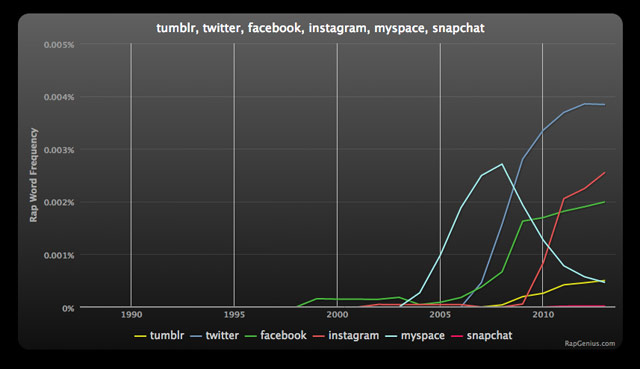
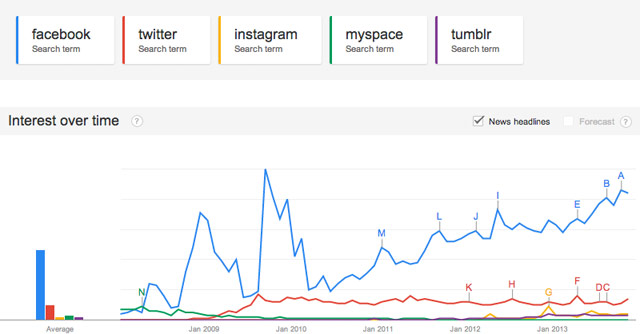
And here’s the graph for general search terms. (I excluded Snapchat from the Google graphs because Google wouldn’t allow 6 search terms at a time…it barely showed up in either case.) Twitter rules the rap roost, but Facebook demolishes everyone in general and news search traffic.
Based on the site’s growth rate, and the age breakdown of their users over time, there are probably 10 to 20 million people who created Facebook profiles who have since died.
That’s an incredible number; most tech startups would kill (well, not really but maybe…) for that many alive users.





Stay Connected