



Divers
“Divers documents the restless anticipation of walking to the platform’s edge and the fleeting serenity found in jumping.” Lovely. Just lovely. (via colossal)

This site is made possible by member support. 💞
Big thanks to Arcustech for hosting the site and offering amazing tech support.
When you buy through links on kottke.org, I may earn an affiliate commission. Thanks for supporting the site!
kottke.org. home of fine hypertext products since 1998.
Beloved by 86.47% of the web.
“Divers documents the restless anticipation of walking to the platform’s edge and the fleeting serenity found in jumping.” Lovely. Just lovely. (via colossal)
Nature does its thing so quickly sometimes that you have to slow it down to appreciate the beauty and power of it. This is a video of a kingfisher plucking fish out of the water, with views from both above the water (which catches the dive and takeoff) and below the water (which shows the efficient grab of the fish). The underwater view is amazing…I’d never seen that before.
I don’t know that there’s much to say about this…it’s the world’s fastest land animal moving in slow motion, muscles rippling, legs moving in concert, etc. It’s beautiful and mesmerizing — time kinda stopped for me while I was watching it.
Here’s what a whirring helicopter blade looks like, from the perspective of a GoPro strapped to the blade. The video is in slow motion — shot at 240 fps and displayed at 30 fps. Here’s what the blade looks like in flight and upside-down while doing a flip. (via clive thompson)
In trying to explain what you’re about to see here, I cannot improve upon the Dr. Adrian Smith’s narration at the beginning of this video:
But sometimes I think the most useful thing I can do as a scientist is to point the fancy science cameras at some moths flapping their wings in front of a purple backdrop. I mean, whose day isn’t going to be better after watching a pink and purple rosy maple moth flying in super slow motion? This is a polyphemus moth, a gigantic species of silk moth. What you are seeing, like all the rest of the clips in this video, was filmed at 6,000 frames per second.
Most of the moths in the video are delightfully fuzzy and chonky — if these moths were birds, they’d be birbs. Shall we call them mopfs?
The rest of Smith’s AntLab videos are worth looking through — I’ve previously posted about his slow motion videos here. (via aeon)
Gymnast Simone Biles won her 7th US Gymnastics Championship this past weekend, further cementing her status as the world’s best gymnast and one of the most dominant athletes of all time in any sport. In her floor exercise routine on the first day of the competition, Biles absolutely nailed a triple double — that’s three twists while doing two backflips. Timothy Burke took the footage and slowed it down so that we can see exactly what’s going on in the air. And, Jesus, I was NOT prepared for what I saw. The two handsprings that set up the final move are beautiful slowed down, leisurely even. But then Biles launches herself impossibly high into the air — like absurdly and spectacularly high — and starts twisting and flipping at a speed that seems fast even for slow motion. And the landing — it’s like she was standing there all along, waiting for the rest of her spirit to join her. Watching the routine at regular speed makes you appreciate the move even more.
In reaction to this move, NBA head coach Stan Van Gundy, who has seen his fair share of elite athletes doing amazing things over the years, exclaimed: “How is that even humanly possible?” As if to preemptively answer him and everyone else watching, the sparkly leotard that Biles wore during her routine had a picture of a goat sown into it because she is the GOAT.

See also Who Could Jump Higher on a Trampoline, LeBron James or Simone Biles? (via the kid should see this)
Update: Physicist David Young analyzes Biles’ triple-double:
Assuming her rotation rates around each axis remain constant, to get three full flips in would require an extra 0.65 seconds, which requires a launch speed of 22.6 miles per hour, all other things being equal. This is not possible, even if we assume her max launch speed is 18 miles per hour, which is apparently her top sprinting speed.
However, if she could do three full flips, she would also be able to get in one-and-a-half more twists at her current rotation rate! What would this even be called?! What might be more likely would be to try to gain an extra half twist so that she would take off facing left and land facing right, still only completing two full flips.
(thx, donny)
Research biologist Adrian Smith, who specializes in insects, recently filmed a number of different types of flying insects taking off and flying away at 3200 frames/sec. Before watching, I figured I’d find this interesting — flying and slow motion together? sign me up! — but this video was straight-up mesmerizing with just the right amount of informative narration from Smith. There’s such an amazing diversity in wing shape and flight styles among even this small group of insects; I had to keep rewinding it to watch for details that I’d missed. Also, don’t miss the fishfly breaking the fourth wall by looking right at the camera while taking off at 6:07. I see you, my dude.
Smith has previously captured flying ants in slow motion and this globular springtail bug that spins through the air at more than 22,000 rpm. (via moss & fog)
Popped popcorn kernels are like snowflakes: no two are alike. If you watch popcorn popping at the ludicrously slow speed of 100,000 fps, you can see these individualized forms flowering into existence. Pro tip: turn off the upbeat music on the video and supply a mellower soundtrack of your own — slow motion video requires meditative music.
See also How to Make Popcorn Using a Blow Torch & Hair Dryer. (via moss & fog)
The kids and I were talking about how slow motion video works the other day, so I was happy to see this new video from Phil Edwards detailing how the technique works and its history in cinema, from Eadweard Muybridge to Wes Anderson and from Seven Samurai to The Matrix.
I am an unabashed fan of slow motion; you can check out dozens of slow motion videos I have posted over the years, including this video of Alan Rickman dramatically drinking tea.
Optical Arts conceived this video as a “live action musical animation” of cups, plates, and glasses smashing and un-smashing accompanied by the toccata section of Johann Sebastian Bach’s famous organ piece, Toccata and Fugue in D Minor. I thought it was fully CGI at first (as The Morning News reported), but then I found the making of video on the project page and it’s not — they filmed all the glasses and dished smashing at extremely high speeds between 1000 and 5000 frames/second on Phantom cameras.
I don’t know about you, but this video is what it looks like inside my head lately. Smash smash smash! (via the morning news)
MOCEAN is a mesmerizing short film by cinematographer Chris Bryan of ocean waves crashing and surging in slow motion.
The feeling of jumping off the rocks in the dark by myself just to capture the very first rays of light hitting the ocean without another sole in sight is unexplainable, its one of the most amazing feelings ever, its like my own personal therapy.
Bryan worked as a cinematographer on the BBC’s Blue Planet II. Distracting URL watermark aside, I could have watched footage like this for another hour, especially of waves from underneath the water.
In this slow motion video clip from a BBC program called Secrets of Bones, you can see how a pigeon takes off so quickly. Pigeons can accelerate from 0 to 60 mph in about 2 seconds, straight up from the ground. A look at its skeleton reveals short, thick bones, an absolute necessity for an animal generating that much power in such a short time. (via the kid should see this, back from its summer hiatus)
NVIDIA trained a deep learning framework to take videos filmed at 30 fps and turn them into slow motion videos at the equivalent of 240 or even 480 fps. Even though the system is guessing on the content in the extra frames, the final results look amazingly sharp and lifelike.
“There are many memorable moments in your life that you might want to record with a camera in slow-motion because they are hard to see clearly with your eyes: the first time a baby walks, a difficult skateboard trick, a dog catching a ball,” the researchers wrote in the research paper. “While it is possible to take 240-frame-per-second videos with a cell phone, recording everything at high frame rates is impractical, as it requires large memories and is power-intensive for mobile devices,” the team explained.
With this new research, users can slow down their recordings after taking them.
Using this technique and what Peter Jackson’s team is doing with WWI footage, it would be interesting to clean up and slow down all sorts of archival footage (like the Zapruder film, just to choose one obvious example).
Data artist Josh Begley edited together a 5m30s video of every concussion suffered in an NFL game this year. I was barely able to get through this…I had to pause a couple of times. From an article about the video at The Intercept:
The NFL has done a masterful job at mainstreaming the violence of the game, so that fans and spectators don’t feel too bad about what’s actually happening out there. No single word has protected the NFL from the true costs of this violence more than “concussion.” That word puts a protective barrier between us and what’s really going on out on the field.
It’s not a headache. It’s not “getting your bell rung.” You don’t have a bell. It’s a traumatic brain injury. Every single concussion is a new traumatic brain injury. In addition to the torn ACLs and MCLs, in addition to all of the horrible broken bones, the NFL diagnosed at least 281 traumatic brain injuries this season. And no document has ever quite displayed the horror of it all like “Concussion Protocol,” a film by Josh Begley and Field of Vision.
The backwards slow-mo technique is a bit off-putting at first, but as Greg Dorsainville noted in the video’s thread:
If it was in forwards it would be like any big hits package you see in an espn highlight show where we celebrate the football and hit and not mourn the result of the moment: a human in pain, disorientation, and slowly killing themselves.
Having big second thoughts on watching the Super Bowl this weekend, karma offsets or no. (via @harmancipants)
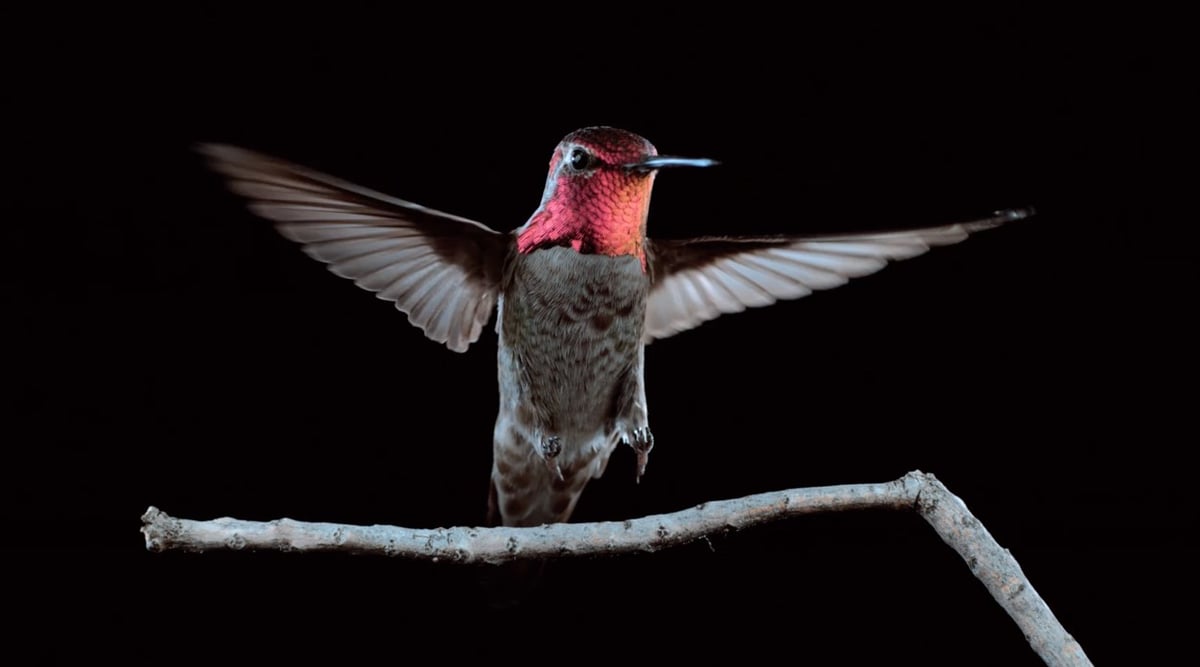
National Geographic photographer Anand Varma recently took some slow motion videos of hummingbirds in flight. Incredible footage. It always amazes me how still their heads and bodies are while their wings beat furiously. Here’s National Geographic’s feature on using high-speed cameras to uncover the secrets of hummingbird flight.
World’s smallest birds is just one of several distinctions that hummingbird species claim. They’re the only birds that can hover in still air for 30 seconds or more. They’re the only birds with a “reverse gear”-that is, they can truly fly backward. And they’re the record holders for the fastest metabolic rate of any vertebrate on the planet: A 2013 University of Toronto study concluded that if hummingbirds were the size of an average human, they’d need to drink more than one 12-ounce can of soda for every minute they’re hovering, because they burn sugar so fast. Small wonder that these birds will wage aerial dogfights to control a prime patch of nectar-laden flowers.
Fun facts: some hummingbirds can beat their wings 100 times in a second and can sip nectar 15 times per second. I also like the locals’ name for the Cuban bee hummingbird, the world’s smallest bird: zunzuncito (little buzz buzz).
Socials & More