




After playing around with Apple's new Safari web browser for a bit, I am underwhelmed. To the many observations that others have made already (Mark Pilgrim, Matt Haughey, Ben & Mena Trott, Todd Dominey), I will add that the browsers I've seen in the past couple years have added little bits and pieces of useful innovation here and there (Mozilla's tabs, for instance), but none have the complete package of useful features, adherence to HTML & CSS standards, interface niceties, customizability, stability, and speed. Nice as proofs of concept, but none as complete as Netscape 1.1 was in its time.
Safari is still in beta so it might be unfair to criticize too much, but Apple missed an opportunity to innovate the browser in a truly useful way. A web browser is a tool for people to get information from the web. Much recent effort has gone into developing other interfaces through which to do just that. With Watson, Sherlock, and NetNewsWire, you "browse" the web for specific kinds of information with interfaces custom built for each task.
Why the distinction between regular web browsing and web browsing using specialized interfaces for structured data? Using Watson to find movie times is great, but it means having a separate application running...and for ticket purchases, it dumps me back into a web browser anyway. Apple's Sherlock app offers functionality similar to Watson. Why not merge Sherlock and Safari into one application? Whither Sherfari?
I've whipped up a few rough mockups to demonstrate how this would work.
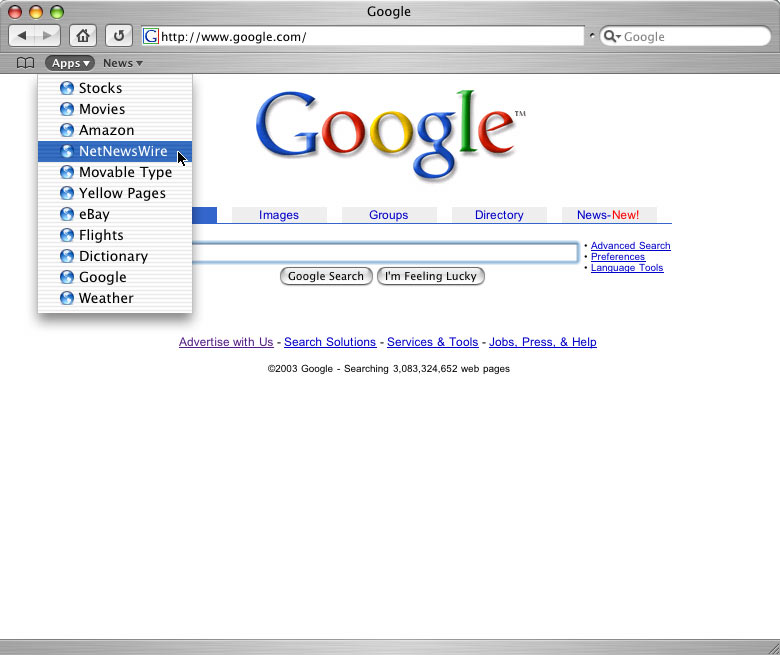
Figure 1 (bigger) shows the current interface for Safari with the addition of an "Apps" button. Ideally this would be a permanent graphical button like the bookmarks button. The apps menu would contain a list of Sherfari applications like Flights, Stocks, Movies, etc.
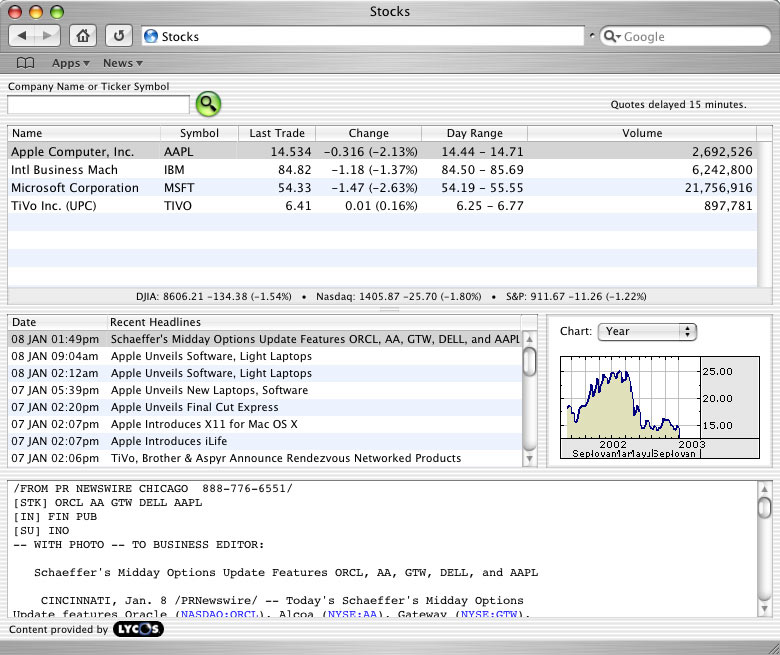
Figure 2 (bigger) shows the Stocks application loaded into the browser window after being selected from the Apps menu. It works just like it would within Sherlock with a fast, customized interface for looking up stock quotes, viewing charts, and reading related headlines.
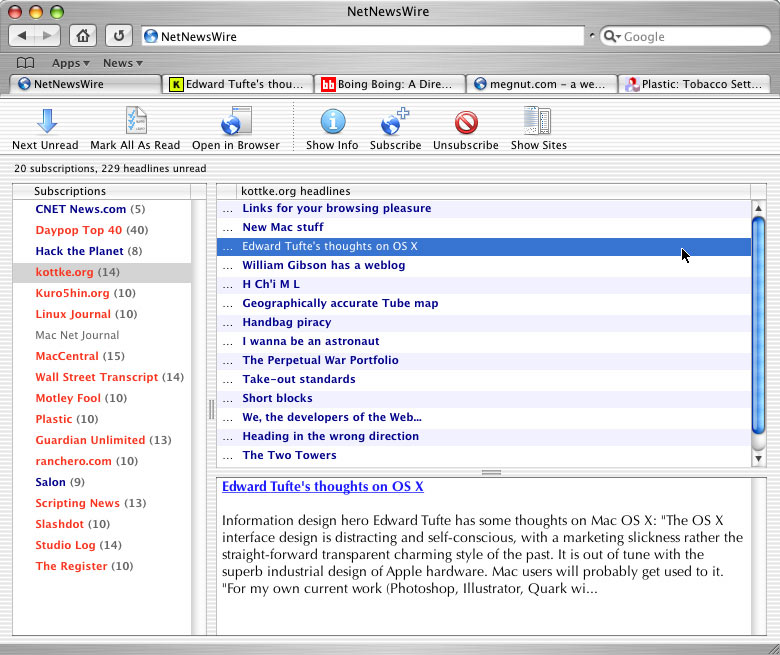
Figure 3 (bigger) shows NetNewsWire loaded into the browser window after being selected from the apps menu. Clicking on links in the NetNewsWire app would open those pages in new tabs in the browser. It would be worth the effort for Apple to allow developers to write their own Sherfari apps for tasks that use structured web data. NetNewsWire is an obvious candidate. Ben and Mena could write a app to allow people to post to & manage their Movable Type weblogs. Yahoo! could provide a maps app. How about an app from Amazon for browsing their store? (Watson has something like this.)
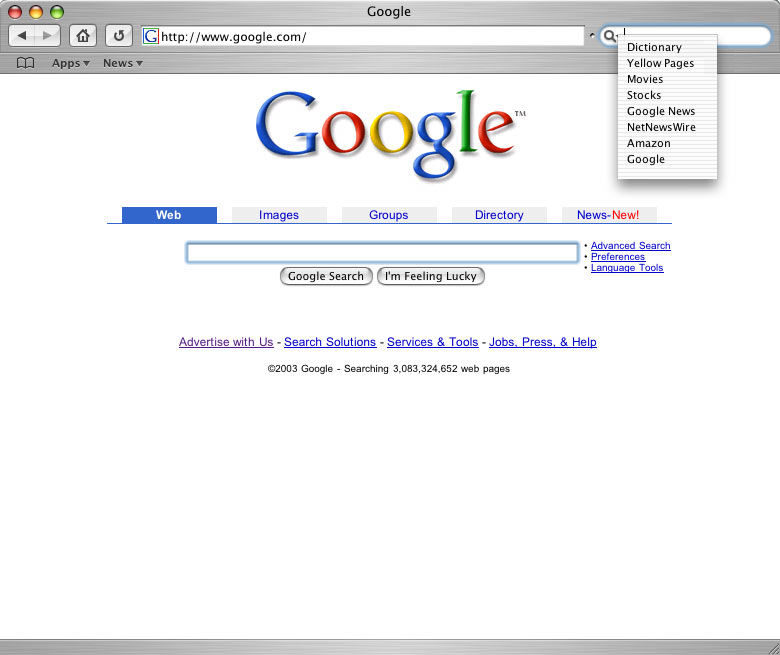
Figure 4 (bigger) shows how Safari's Google search box could be extended (a la Andre Torrez's Nutshell). The default search would be Google, but you could select other searches as well, either web searches or searches using the Sherfari apps. Selecting "Google News" and then doing a search would load the results page from Google News into the browser window. Selecting "Movies" would load the Movies app into the window with that movie selected.
This keeps all the activity commonly referred to as "web browsing" in one place. Assuming Apple would also add the capability for tabbed browsing, the Safari/Sherlock combo would be a powerful one. The generic web browser part would allow people to load up any old web page while the applications would allow them to quickly take care of frequent tasks through custom interfaces without the need to load potentially heavy or hard-to-use web pages.
Come on Apple, don't just give us another browser. Give us something that's so damn useful that we'll wonder how we ever did without it.
Personally, I prefer to simply organize my bookmarks bar into pull-down groups (blogs, forums, entertainment, reference, etc.) with sites that I want to visit regularly. (Apple is touting this as a new feature, however Internet Explorer's Favorites Bar functioned exactly the same way.)
That being said, I understand the value of giving apps the most functionality possible (without bloating them) so as to appeal to the widest audience. I think merging Sherlock and Safari is a fine idea, as long as the Sherlock functionalities are invisible unless you want to see them. The same for tabbed browsing, especially given the number of people I've seen saying they reported the lack of that feature as a bug. (If I had a nickel for every post I saw that said that...)
On a different note, I asked you about this in e-mail, Jason, but I realize you're still not caught up with it, so I'll pose the question here. What of Apple's claim that Safari complies with all the standards, yet Safari incorrectly displays a 1-pixel dotted CSS border as a dashed border? This problem also plagues IE for Windows. Since your site makes use of the 1-pixel dotted border, I imagine you have a vested interest in this.
I've often wished Apple would spin some deal with the AMG, possibly in the form of a Sherlock channel that could interact with iTunes, but ideally something integrated into iTunes itself. If you're listening to a song in iTunes, an info panel would display data from AMG: review, other albums by that artist, albums that artist had played on, similar artists etc. If you had those tracks/albums locally, you could get to them that way.
Mom and Pop wouldn't need NetNewsWire or care, particularly, about flight times or UPS tracking. Added features that I don't need (necessarily) are what drive me away from MS Entourage and toward apps like Mail.
Assuming an open plug-in architecture, the trick would be building in default functionality that people will really use while avoiding featuritis. Beyond that, adding additional applets as needed (MT, NetNewsWire, etc.) should be as simple as possible.
This all kind of sounds a bit like OpenDoc, no?
(now, i'm not so good with lingo, so don't jump on me for getting things slightly out of order...)
ATG.com speaks of "portlets" in one of their white papers...i think the idea is similar...easily accessible and customisable tools for users to get what they want...be it stocks, emails, forums, blogs, news, etc., etc...
i've read somewhere (can't remember now though) that ebay and amazon are working on mini-apps which function much in the same way. except, i don't think a standard reader or browser has been created to run them - maybe the apple browser could be the standard? who knows...
i've also recently read a much too detailed account by a few developers discussing these same issues...really, it began as a conversation about flash mx and it's app making abilities...and proceeded to more general concepts in what people could potentially achieve...
i think it's clearly another logical browser evolution (or maybe for an email type app)...i can only wonder that it wouldn't be here now if we weren't in the duldrums with tech research/dev/spending...jv
It's one of the reasons I've stuck with Opera despite the problems some website have with it. Once you've used Opera not being able to open links in a background tab or use mouse gestures just feels clumsy.
With both things in mind, it is really too bad that Apple didn't go with a Mozilla-based browser (Chimera works just fantastic, and it has tabs) and not only integrated Sherlock, NewNewsWire and Watson*, but let people add (and build) their own modules with Mozilla's standards. It would give Safari a distinct advantage in that it would have complete integration and could be ever-expanded.
*And why not add 'mood music' to iTunes, i e Dylan for nytimes.com and some elevator music for amazon.com.
Most of the stuff you want can be built right into the browser now. What is a Java applet if not a way of building an application inside a browser?
I also have to disagree with your desire. Once you have an operating system with good memory management and a good environment there is no real problem with having a huge number of applications "running" and why bloat out apps with a feature that is already done somewhere else. I don't need NetNewsWire in my browser - I have a background process that accumulates all the feeds and loads them onto a web page ready for the server on my machine to give to me. The same goes with Sherlock, I breathed a huge sigh of relief when the new "Find" came into MacOS - it's simple and does the one job easily. I find it no problem that a large number of my small applications force me back into the web browser to see web pages - after all that's it's job.
Remember one of the aphorisms to come out of the early Unix innovators -- "Do one thing and do it well"
Tony Williams
It was a smart choice if you think that the most used word for describing Netscape is some variation of "bloat"
Apple is following your lead, but it started with other applications, have you seen how the iLife applications interact with each other? =)
The concept of having everything tabbed and organised within one window is a good idea, but what say the browser acts as a visual "hub" to the user for these elements, while they can also run as their own programs, started by the user in a seperate window if they so desire? For instance, what Norton do with SystemWorks - a collection of apps, unified in a central menu, and accessible that way if one so desires, but also accessible on an individual basis.
That way you could have the unified interface that Jason is proposing, but still have the more "desirable" individual programs.
Well, for now. I think the thing Jason is getting at is that the information from the web shouldn't necessarily be confined to one place.
One of the 50 trillian apps in my Applications folder is WeatherPop. You know it, you love it. It is weather outside of the browser, thus it's information outside of the browser. And, while the freebie version does send me back to the browser (something I find annoying), a similar program called Meterologist doesn't; I can have the whole forecast in a menu.
That concept, to me, is a lot more user-friendly than having to jump to a browser just to check if it's going to rain Thursday.
To wit, though, I rarely use Sherlock. It's cumbersome for me to go to another app just for movie times when Mozilla is open all the time. But if Safari let me do something like search movies using Sherlock straight from the search box... that would be pretty useful. Let me customize the search, too - I want to add php.net, and Google News.
And finally, it's fine to "do one thing and do it well", but remember that the user doesn't necessarily have to know that the program is doing just one thing.
In any event, Safari is a nice enough browser (for beta), but besides its look, there isn't much that'll keep me from Mozilla for now.
While Jason's suggestions might be accomplished without bloat, is it an appropriate priority? I'd rather see the Safari team focusing on speed, more speed, and rendering accuracy. (With a dash of even more speed.) Basic functionality needs to be enhanced as well: e.g. more robust preferences.
I launch Watson at login. It is always there in the background, read for me to use one of its handy features. With a click and a drag on the the dock icon I have instant access to the module I want. I fail to see a compelling advantage to having that click and drag occur within Safari.
My personal dream scenario: Let Apple provide a lean, snappy, standards-compliant browser for "basic" users. Let OmniWeb build on the open source WebCore with elegant advanced features for "Power" users.
Keeping such a client thin would not be that hard since all the Sherfari apps would share the same API. Safari is 7.1 MB and Sherlock is 11.8 MB...combining them crudely would yield a 18.9 MB app, less than both IE 5.2 and Chimera. Weeding out the shared code would probably bring it under 14-15 MB, maybe more.
Mom and Pop wouldn't need NetNewsWire
This is an important point, because Sherfari *is* a browser for regular folks. Look at the most common activities on the web (aside from IM and email): general browsing, reading the news, checking stocks, buying books/clothes/etc., using reference materials, Googling anything & everything, yellow pages, etc. Take the 6-8 most important ones and make them default Sherfari apps...the rest available for d/l as add-ons.
** Sorry Scottish, but using Watson to look up movies -- especially if you don't know what movie you want to see, where you want to see it, or when -- is *way* faster and easier than using a web site.
A great number of Unix apps have bloat too, and nearly all of them evolve to the point of being able to send mail for some reason... Emacs can do so many things that it is like an operating system too.
I think that the UNIX philosophy, "do one thing, and do it well," is still a valid design goal.
I would take this a step further. UNIX is more efficient and effective when you have a galaxy of small, efficient applications working together (via pipes and/or filehandles), not big ones that try and do all the heavy lifting on their own.
Also, aside from the UI, a lot of what you what Jason seems to want could be accomplished with an RSS channel in Watson/Sherlock. I think Chimera/Mozilla and NetNewsWire interoperate very well, although I often find myself pressing the right arrow key in Chimera thinking it will "knock me back a pane" into NetNewsWire.
Using your Movie example, I went to Karelia.com and downloaded the latest Watson. I ran it, clicked "Movies", entered my Zip code and the list of movies popped up.
What I saw was a clickable list of theaters, or the ability to list by movie, get showtimes, and descriptions, and view previews
Other than the previews, which don't really interest me much, I did a speed comparison at
showtimes.hollywood.com and there was little, if any, difference in terms of speed. From earlier visits, the site knew my Zip code and distance preferences through, I assume, cookies.
Moreover, Watson told me that Adaptation, a movie I desperately want to see, wasn't playing within 50 miles. Hollywood.com correctly found four theaters showing it. The same thing for 25th Hour, another movie I want to see. In both cases the theater six miles from my house is showing them, and has been since their open.
I've just taken a tour of the rest of Watson and find nothing there that works better than raw web. The ebay tool may be nice, but the rest don't seem to add anything that I can't get on raw websites.
As to whether they should be integrated, I'm very much a one app, one function guy. It's app bloat that makes me avoid Mozilla and run Chimera.
What makes more sense to me is not to throw Safari and Watson/Sherlock in a box, play some romantic music, and use whatever offspring they produce. How about a standardized interface where structured web "tools" could plug in to the browser. Not like normal browser plugins, a more generic interface for communicating gui and results back and forth, with the browser doing the web traffic handling. That way, Karelia could modify watson to "Plug In" to the browser for those that want it.
If Apple wants to add Sherlock features to the browser, I'd rather have them do it like the new iApps work together, rather than making Safari a single 20 MB app.
That's exactly what I'm talking about. It doesn't have to be Watson or Sherlock...they are just easy examples for talking about this.
It makes far less sense to integrate any of the iApps (with the exception of iMovie and iDVD--I still can't figure out why those two are separate programs) than it does to integrate Safari and Sherlock. They deal with very separate forms of media, whereas Safari and Sherlock have a common purpose: get information from the world wide web.
That said, is nobody else riled up about Safari crapping on the CSS 1-pixel dotted border?!
I only use Sherlock 1 on Mac OS 9 and never use Sherlock 3 on Mac OS X at all. What use is Sherlock- or movies.com, for that matter- if you don't have a ZIP code?
Mind you, I never drank the NNW *or* tabbed windows kool-aid either. Maybe I'm just a luddite.
i guess there's no need to pay employees to bug test things when the public is more than willing to...
1. How about the opposite route -- incorporating HTML display and browser features in Watson, Sherlock, NetNewsWire, etc.?
In other words, HTML display and browsing could be done from any app that displays web data.
This makes more sense to me. And note that WebServicesCore is available for Cocoa developers to add HTML display. (And of course Gecko can be used instead.)
2. On the surface it sounds simple to make NetNewsWire a plugin or applet. But one of the first issues to come up would be -- what do you do about all of NetNewsWire's menus? And keyboard shortcuts?
You'd have to shoe-horn it to get it to fit into another app. I'm not saying it's impossible, but NetNewsWire is bigger (in the UI sense) than just an applet.
The browser is a proxy for a UI, fed data by a series of "verbs" or method calls that return information. The one nice part that people miss in web based apps is the "refreshing" of data. If somone would implement floating frames (like IFRAMES in IE) and double-buffered refresh we could have your manna from heaven.
The thing that will make Web Service versions happen before "real" plugins written as Cocoa apps is the perception that programming in a compiled language is harder than scripting, thus people will be stopped before they get started.
What we need is some C#/Mono integration in Safari.
You can't predict whether users will want to consolidate to gfew windows or spread out to many -- the same user might want to work in each of these ways at different times. So consolidating in a single window isn't necessarily the answer. And if I have multiple windows, why do I care if they belong to different apps, as long as I can quickly move between them?
Key here is that the rendering engine should be a shared library, so each app doesn't duplicate a multi-megabyte memory footprint for it.
Yes, this IS reminiscent of OpenDoc. More's the pity -- the ideas there were great!
it seems to me the main reason for comming out with safari is to start removing microsoft from the mac. with osX then safari, keynote, and iLife it seams to me apple is trying to go for the gold. a lot of average users are still using I.E. i think it's still the most commen browser out there in the consumer ie non geek dept. as a replacement for i.e. i think safari does just fine. no hopfully apple takes its criticism to heart and tweaks a few things.
As for tabs, I'm missing them but wouldn't be surprised if they were purposely left out. One of the new ideas that people aren't really talking about is SnapBack, which can be similar to using tabs. I usually use tabs when I'm browsing through weblogs and want to head off on tangents but still want to read all of the original post at some point. So you use the SnapBack, it's kind of like temporary bookmarks. I think people would have been less likely to give SnapBack a try with tabs available. I think the tabs will still make into the browser eventually, the Apple developers probably just wanted introduce people to a new browsing paradigm.
Revision...
Personally, I've always found apps like Watson, Sherlock, and NetNewsWire useless. I find it much simpler to just go to whatever website I need. Kottke? www.kottke.org. It's not that hard.
But seriously, if I need Kottke and I need Kottke now, then I visit kottke.org and forget about everything. I decline sleep and food to get my Kottke fix. I ignore other web sites and go straight for Kottke. I suppose if one browser took me to kottke.org faster than another browser, I'd use it. Speed to kottke.org is all that matters to me. I wish that people would start measuring success in terms of Kottke. It is a mistake to ignore Kottke or the importance of kottke.org.
Obey the Kottke!
I thought about that. When I used HomeSite on Windows for editing HTML, it was useful to have IE built right into HS so that I could flip back and forth between edit & preview modes without switching to a browser and hitting reload...especially when I was working with several documents at once.
For some apps, like iTunes for instance, this would make good sense. You don't need to play MP3s in your web browser (that has nothing to do with accessing the web). But providing a little browser within iTunes to display album information (a la WinAmp on the PC) makes sense because it relates to the music you're listening to.
Perhaps news reading is a different enough activity from web browsing to warrant a separate app. I dunno. But it feels like it isn't.
But one of the first issues to come up would be -- what do you do about all of NetNewsWire's menus? And keyboard shortcuts?
Right. That's the tough bit that I completely glossed over and ignored. Definitely a challenge. It would require some thought and redesign and maybe it couldn't be done at all. Maybe an app like NNW would need to stand on its own.
What does everyone think about Safari supporting structured interfaces using XUL and the like? Based on some of the discussion here, it sounds like this would in the direction being discussed.
I'm not up on all the technology involved here...does anyone have an answer to this? How did Apple implement their bookmark library? Couldn't the technology they are using for that be used to build structured interfaces for web services apps?
People seem to be discussing features at the expense of speed, as well as GUI/usability matters.
A matter of chronology seems important to mention:
We had browsers. Then we had Watson - which I think is brilliant because it's fast. I use it twice a day for O'Reilly news and VersionTracker. Not all services are equal: Yahoo directory searches are much faster with Watson than with a browser; the Google search on the other hand, is pointless because switching apps takes longer than going to google.com in the browser (where one is most liable to be). And yet, it's astonishing how much faster Watson is compared to a browser on a data structured site like Amazon, because the detailed information is not presented until you have found what you are looking for! (No ads, no images, no tables, no web page!)
Pardon the tangent: Chronology...
After Watson came the new Sherlock. As a desktop search tool, the new Finder-based search is indeed far superior to Sherlock (Again, due to speed of using it. For example, even if OS X were slower than OS 9, it's faster to use because you can switch to a new app and do something else whenever the spinning disc comes up.) Sherlock is now a pale comparison of Watson with very few services. So Watson seems a better model (it's just that Apple's version of Watson is called Sherlock).
I think Watson and Safari (WatSafari) would be ideal. From Watson, I see what *else* the web can be. WatSafari seems the next logical step because it is presenting internet information in the fastest, most efficient way, according to the type of information, and the needs of the user. Do you want to browse or search? Watson and Safari both browse and search, but they do it in different ways. Why have an app to look at information in one way, and another app to look at the same information another way?
Finally, Jason's proposition would kill Sherlock; give Watson some space to differentiate itself (for people who don't want to use Safari/Sherfari); and allow Safari to differentiate and deliver something compelling to the browser world.
Am
*Case in point: dif·fer·en·ti·ate - my OS X spell check service doesn't seem to be working; I tried OmniDictionary (open new app) which couldn't find it's server; then I cut and pasted the word into Watson's Reference service dictionary (It's always open). I could have gone to dictionary.com too. Either way, OmniDictionary is great until I started using Watson - at which point, it doesn't seem so handy to have as specialized an app as OmniDictionary for a service which in Watson is but a small subsection of the Reference service.
(Sorry about the length.)
"The Sherlock channel architecture uses XML and supports the use of the JavaScript and XQuery languages for writing script code. Developing your channel interface requires Interface Builder with the Sherlock palette installed."
Applescript could be used as a glue for the various tools.
I am too, an we ought to do something about it!
Let's inform Dave!
ps. just opened a new blog..
I'd much rather slice and dice in my kitchen with a Chef's knife than a Swiss Army knife.
The last thing I want is a bloatware browser.
Additionally, one of the things I really love about Apple's applications is that they're simple, usable, and powerful. Microsoft applications, on the otherhand, are overpowered by their interface, widgets all over the place "look you can do this, and this, and this, and this..." not that I'd ever want to, or actually would, but it's there "just in case."
Give me simple, usable, and powerful any day of the week. I'll take my Safari, NetNewsWire, Mail, and iCal as separate applications every day of the week. I don't want to do Sherlock like things from Safari. I don't want to browse my hard drive from Safari either. I want a killer, fast, and standards compliant Web browser -- and that, my friends is Safari.
I would much prefer if the web becomes more of a way to retrieve info that can be display on your computer in different form depending on what it is. A good example - as someone already said - is WeatherPop that download the weather in a simple menu. Easy to work with, it doesen't even look like an application.
I've never used Tabs in Chimera, but I do use Snapback all the time.
K.I.S.S. is the way to go... IMHO.
Oh, and I'm disappointed Safari isn't called CyberDog X, but that's just me ;-)
Oh wait ... that's called an operating system.
It sounds like many people do lots of stuff on the web, that requires a browser, so that's open a lot, and being such bloatware as they are, then on a slow computer with not much memory, then to open anything else is a pain. So, they want function x to be integrated with the browser. However, this makes that browser that much more bloated and slower.
Make some diversity, you know i can use safari for internet browsing and othe programs to read my RSS Headlines.
But as a developer, you don't just go to the end of the road. It is a step-by-step evolution of software.
You can't pack every desired feature into version 1.0, or in this case a beta version. It takes real time, from real programmers, not photoshoppers.
I would like to think this makes a difference, but as a developer writing web applications I just don't care. Does it work/look right in IE? That's all that matters. Too much noise, not enough signal.
Ever heard of the term "condescending prick"? I assume you're trying to make a point here. Perhaps next time you should just make it without the attitude.
Instead of a button it uses the URL line.
Type "GG:search terms" to get a google search window
"GGL:stuff" does an I feel lucky google search taking you to the first result.
GGI: google images
GGG: google groups
fm: freshmeat
sf: sourceforge
dict: mirriam webster's site
ths: thesaurus from mirriam webster
acro: acronym database
Those are just some of the webpages you can pull up instantly. And its extendable (of course it isn't perfectly simple but it can be extended. The hard part is formatting the search term into the URL).
Better yet, in the whole KDE system there is a key combination which brings up a dialog box to enter a command to run. (Alt-F2). Usually you can just type in the name of a program and it will be invoked. This can be much faster than the menu system.
But you can also type in a URL or one of the extended URL types and a browser window will launch automatically.
This Web Shortcuts feature is the biggest reason I stay with KDE over the other Linux desktops.
It's amazingly useful to have at your fingertips. One keystroke combo to open the box and type in the request.
Why have a separate google only box? Why not have it generic and extendable? And why not combine it with the URL line? One keypress to move the cursor to the URL line and any query you want is off and running.
It's not a bad start to harnassing the combined power of Safari and Sherlock or Watson, but it works.
A simple killer feature or two wouldn't hurt, but something actually useful and non-bloat-like-ish.
Something like MacNewz.com -- a list of the headlines from your favorite bookmarked sites on a single page?
I agree, but the design of the bookmarks in Safari looks a lot like iTunes to me.
I agree with Brent. No developer wants their app to be defined by another context. We're already ridiculously constrained by the platform vendor. And, it makes getting people to pay you for your work all the more difficult.
http://www.usercreations.com/spring/
http://www.usercreations.com/weblog/
http://www.usercreations.com/spring/images/1press.jpg
"I also don't understand what all the hubub about tabbed browsing (a la Mozilla) is."
For those of us cursed with glacial dial-up connections, tabbed browsers are a godsend (I'm a devotee of Chimera). I read a lot of articles online, and it's wonderful to be able to scroll to the bottom of the first page of a twelve-page piece, and load the other pages in the background while I'm still reading Page One.
The beauty of loading all the pages of an article is that it's easy to jump from page to page without waiting for them to load again.
Tabs also let me avoid window-clutter, and I NEVER have more than one browser window open. I can see at a glance all the sites I have loaded without resorting to the window menu, or cycling through open windows with Command-tilde (yeah, yeah, I know it's the "backtick" key).
We need a new browser that embraces web services at its fullest.
WebCore
WebCore is the framework developers can use to add Safari’s HTML renderer to their applications. There’s a pretty good chance NetNewsWire will use this. Step one for me will be to get it working with a simple test app.
I agree with meg that it's frustrating the conversation is so focused on backend limitations to jk's idea - but maybe it's a complement to kottke that so many programmers come here to read his ideas about what the UI should look like. :)
I still like that Safari is so lean, though it's not on my dock (I only have 6 apps on my dock, so it's exclusive company). But if Safari had tabs I'd switch. If RSS feeds (exactly as NNW presents them, plz!) was elegantly integrated into Safari's bookmarks, I'd be ecstatic, and I hadn't ever imagined that possibility before the above screenshots. Thanks, Jason.
John Gruber has posted a well-reasoned critique of Sherfari on his site. He concludes that I got it all wrong.
Brent Simmons on incorporating Safari's HTML rendering engine into NetNewsWire.
Dennis wonders why Kottke and Megnut are two different weblogs. The answer probably has something to do with the Unix development philosophy.
Anil wants a desktop application that uses SOAP, XML-RPC, and WSDL to build web services interfaces on the fly. And you thought I was crazy.
Mena Trott: "During the keynote, when Jobs was introducing Safari, I, in all honesty expected him to say 'And this is Bookmarks! And this is the microcontent browser! And one more thing, this is how you post to your weblog.' The union of all these tools just makes sense."
More linkbacks via Technorati, Daypop, and Blogdex.
When you're browsing, you're looking at stuff. Document browsers are cool. It sounds like we're asking how well browsers can "do stuff", in addition to looking at it. I think they can do some stuff, but there are problems to scaling up into full applications.
Pure browser-based apps:
-- UI and clientside logic downloaded each use, in some cases after each server-refresh (!)
-- vulnerable to disparities of browsers in use (!!!)
-- most browsers are stateless, so live-refresh is hard
-- difficulty working offline (caching not controllable)
-- privacy issues: you can browse to any site, but how will they not remember as much about you as you'd like your application to remember?
"Rich internet applications" (Flash, eg):
-- UI and clientside logic downloaded once per session; data can refresh without retransmission of UI and logic
-- single predictable player used across multiple platforms and browsers
-- live data-pulls are easy
-- difficulty working offline
-- privacy still restrictive; sandbox approach used
Standalone applications (Watson, Sherlock, VB, Director):
-- UI and logic persist across sessions (they live on your drive)
-- personalized data can be shared across apps, because you own the apps (no browsing to sites of indeterminate trustworthiness!)
-- much easier to work offline, even across sessions, because the app controls its own cache
A document browser can be fast, lightweight, and relatively anonymous. You're viewing other people's content. As we start customizing that content to the audience perspective, though, the balance starts to shift more and more towards letting them control their preferences and data. If you're monitoring five stocks, should that choice be held on their server, or your machine? If you're in an auction, should you interests be "out there" or under your control? If an application holds all your travel plans, shouldn't it be controlled locally right on your own device?
I see a big difference between browsing the documents others offer, and actually doing things on your own. The same device might do both, and the same operating system might do both, but I'm not sure that the same application is needed to do both.
--
Related topic: What happens when data actually is divorced from its original presentation? How do you know how many people read your RSS feed? What happens when Yahoo finds its stock quotes scraped for data? Will advertisers have a beef when other people can get the news stories they subsidize without ads? I'm not sure we've worked through the legal and ethical issues on data-mining yet...?
NetNewsWire in a browser: In what ways do these differ? keyboard shortcuts, other?
http://www.nuwance.com/newsmonkey/
http://rss.granato.org/
Amelia brought up that great point about scraping being slow, and xml-formatted feeds being faster. I think we'd also see speed if we aggregated on a single server, so you could cache massaged incoming feeds from several users before customizing them for each delivery. (Multiple clientside calls, particularly for marked-up data, can be a big slowdown.)
Related: text-browsing vs RIA vs standalones, more on task-oriented search apps, and I'll reference this thread in my blog, too.
This is generally not the case. New features usually impact performance directly and they always impact performance indirectly because of the distraction.
Sherlock/Watson functionality should definitely *not* be added to Safari. Even non-optimized browser interfaces to the tasks Sherlock addresses are adequate for most users. There's no reason, for example, that a movie site couldn't remember your zip and show a comprehensive, well-formatted listed of nearby movies on one page. Further, DHTML, JavaScript, et.al. enable the constuction of more robust browser interfaces. In fact, it would be possibly to create decent approximations of Sherlock/Watson using current browser technologies.
Viridian's pro-tab message is odd. S/he could do everything s/he proposes with a tab-less browser save "NEVER have more than one browser window open" of which I am not clear on the benefit. Mac user god-like embrace of tabs in the browser represent the relatively poor window management in MacOS (compared to Windows). Tabs turn a browser more into an "app" where instead browsing should disappear into the OS/window mgr.
The question you need to ask is, "Why aren't there any web pages that are as easy to use as Sherlock?" And the answer is, as usual, that Apple is just very good at designing user interfaces. But designing these web sites wouldn't make it any extra money (unless maybe it made them a part of .mac) so there's no motivation.
less is more and more is less.
clean lines. simple, fast.
There has been some headway made lately in understanding how Safari uses WebCore, but it will be awhile now before you start seeing it used in non-Apple apps. That is, unless Apple decides to release WebKit (which more closely fits the description you give to WebCore above), but that doesn't seem to be forthcoming.
Nevermind the industry that has grown around software development... do you really want one compnay to make all your apps (*cough*microsoft*cough*)?
Also, you'll still be clicking around separate windows. Sure tabs are sweet for websurfing, but I quite enjoy having my Photoshop, Safari adn BBEdit open in separate windows. "Yeah but they could all be based in the same app... youc an still have separate windows!" Uhuh... yeah one big app that "loads modules" as needed... Sounds pretty much like the paradign we already have, no? One big app (the OS) that loads modules as needed (Apps)... Sound familiar? If anything, this exactly what Mac OS has always done, and what MS has tried desperately to do also. Apps are tool modules.
Besides, we have to deal with content first. And filesystems.. etc... Is this not what we are hearing whispers of already? "Every client a server, every server a client"... "The semantic Web"... think of the effect such technology has for the "desktop". Rich metadata, local Google searching (ahem, Zoe?).
Oh and pssst... Apple's doing it already. Look at all the pieces of OS X, and wonder at the grand scheme unfolding beofre us.
Cheers. :D
Why is this not integrated into the Finder? I'm mean, adding Sherlock channels is great and all, (provided it doesn't slow things down) but don't you think they should be improving the Finder? Granted its beta, so we will see what happens. But I would be nice to see some basic web browsing (Safari), image management (iPhoto), web services (Sherlock/Watson) inside a better Finder.
"hyatt is smart.
less is more and more is less.
clean lines. simple, fast."
I totally agree
This thread is closed to new comments. Thanks to everyone who responded.


