



A Thousand Years of Nonlinear History
This dense book took me forever to read in bits and bites on the subway and during lunch. Covers too much ground to summarize here, perhaps after a re-read.

This site is made possible by member support. 💞
Big thanks to Arcustech for hosting the site and offering amazing tech support.
When you buy through links on kottke.org, I may earn an affiliate commission. Thanks for supporting the site!
kottke.org. home of fine hypertext products since 1998.
Beloved by 86.47% of the web.
This dense book took me forever to read in bits and bites on the subway and during lunch. Covers too much ground to summarize here, perhaps after a re-read.
Visible Workings is dedicated to the “error -5000” error message.
A neophiliac feedback loop amplifies new ideas regardless of merit.
Smart dust: the particles of dust that could be watching you.
iStorm is Hydra with integrated drawing and chat. trying it out now
Collaborative notes on Stewart’s play + social software talk.
Collective notes (via Hydra) of Meg’s talk on the margins of the writable web.
The Anatomy of a Large-Scale Hypertextual Web Search Engine.
Greg Elin had the best idea at the LazyWeb as Competitive Sport BOF last night. He wants a way to dump calendar items, tasks, and the like out of his calendaring system (iCal, Outlook, etc.) and have those items display as ads on the web sites that he visits. So, when he goes to Slashdot, a banner ad tells him to stop for orange juice on the way home. When he goes to news.com, there’s an ad telling him that his mother’s birthday is coming up.
In a later conversation, Matt Haughey outlined a proof-of-concept approach to the problem. He’d use Mozilla to override the stylesheet, strip out the current ads, and plug in his own ads, which would be created by pulling them out of iCal and using a Perl or PHP graphics program in conjunction with a local web server to serve them on the fly.
Greg said he would be willing to pay a small amount for this service, and I bet quite a few other people would as well.
Dean Allen launches Textbox hosting system using TextPattern.
Meg’s PowerPoint presentation From the Margin of the Writable Web.
Raph Koster - Current and future developments in online games.
Tim Bray outlines some problems with RSS (RSS readers antisocial software?).
The current buzz around social software reminds me of the excitement around web services last year. Another similarity: both are new names for old practices. Web services have been around for almost as long as the web, and social software has been around for awhile as well. The new monikers allow people to talk about old concepts as if they were new, a useful practice in breaking old bad habits…as long as we don’t forget the past too much. (A la Alan Kay’s presentation this morning, particularly Douglas Englebart’s demonstration of the mouse and video-collaboration.)
Rael Dornfest, cult leader and cloner, is not a man to be crossed. I saw him just now, pounding on some hapless nerd near the coffee pots after the guy suggested that Clay is our new leader. You’d think an ambassador to aliens from the other side of the galaxy would be a little more relaxed.
Spring, an innovative desktop for people, places, and products.
Alan Kay showed us a pre-alpha demo of some software (called Open Croquet, I think) written in Smalltalk and Squeak. The collective collaboration of Hydra + Star Trek’s Holodeck + The Matrix. It looks like what he’s done is create an OS based not on applications but on objects, which makes a bit of emergence possible (which, if you’re drinking the Kool-Aid here at Etech, is a good thing). Quite impressive.
RealVideo of Alan Kay’s The Computer Revolution Hasn’t Happened Yet presentation at a conf in 1998.
Doug Engelbart 1968 Demo of the mouse and about 50 different other things.
Seymour Papert, inventor of the Logo programming language for kids.
Looking ahead to what’s on tap for today at Etech, there’s Alan Kay — inventor of the Smalltalk programming language — talking about why the computer revolution hasn’t happened yet, Macromedia’s Kevin Lynch on personal interfaces, the all-powerful Clay Shirky (all hail Clay, for he is our God!) talks about the group getting in its own way in social software, Coates on UpMyStreet, Gillmor on Journalism 3.0, warblogging, Meg on weblogs and a little RSS controversy, Kapor on Chandler, Data Mining Social Cyberspaces, Mr. Stewart Butterfield on how games and social software are the same ass thing (well, maybe not exactly), nanotech, and social software in school reform. Whew!
Not to mention the BOFs: user experience and etech, a LazyWeb free-for-all, and web geoblogging. If your brain is not full by the end of the day, you’re not trying hard enough.
BBC News producer Stuart Hughes will be calling into the warblogging panel today.
Scene: The Open Source Cafe.
Man: Waiter, there’s a fly in my soup.
Waiter: Sir, it’s not a bug, it’s a feature.
Conferences are great for dorky jokes that no one should ever utter and under no circumstances should post to their weblog.
Cory’s notes on wireless routing and multi-hop architectures.
My Trip to Liberty City. awesome narrated video of someone navigating the virtual world of Grand Theft Auto as a tourist
Matt Webb’s notes on the Gonzo Collaborative Mapping the Semantic Web.
Prelinger Archives is a collection of movies that you can download and use for free.
Brewster Kahle is currently speaking about the Internet Bookmobile. It’ll be downstairs after the session and you can get your own book printed. Donations for the continued operation of the Bookmobile are appreciated.
Update: My photos of the Bookmobile. (Journalists and others: feel free to use the photos with attribution. Thanks!)
During his talk on Biological Computing, Eric Bonabeau mentioned that to run experiments with ants, they need to starve them to get them to do anything. There’s a push to starve the ants, as it were, with the DMCA, the Broadcast Flag, Patriot II, plugging the analog hole and the like. At some point, this is going to result in some pretty hungry ants. What happens then?
Amazon + news headlines = a book list based on current events.
Maceij’s semantic blog search engine. uses 1-year old data but it works
You can tell this conference is bottom up rather than top down when digerati Esther Dyson and Howard Rheingold are sitting on the floor in the packed O’Reilly presentation. Could you imagine Alan Greenspan sitting on the floor of some financial conference?
Hydra lets people work on documents together via Rendezvous. Right now, 5-7 people are taking collaborative notes in the same document on Eric Bonabeau’s talk on Biological Computing. With the permission of the other participants, I’ll either post or link to the resulting document here. (Ok, here are the notes we (there were 7-10 of us) took during the session. Oh, and here it is with Hydra’s color coding intact.)
Update: there’s now a chat as well…using Hydra as a ad hoc chat system. Hydra just connects with a place for people to plop in text. Very little imposed heirarchy which makes it very flexible (what Howard was talking about this morning in urging developers to “create tools that amplify collective action”).
Some screenshots of New Blogger. is it ok to be underwhelmed by this?
Digitalconsumer.org is protecting fair-use rights in the digital world.
Some key points from Howard Rheingold’s keynote on Technology Innovation and Collective Action:
- Developers: create tools that amplify collective action
- Are we going to be consumers (passive) or users (active)?
- We need to fight to remain users.
- Reputation systems are crucial.
- In building software, learn from the past and buildin room for future innovators
- The design of defaults is important. (The idea that simple is very usable, but make it hackable for power users and developers.)
Extensive notes on the 1st amendment of the US Constitution.
Ben, Mena, and Anil announce TypePad:
TypePad is an upcoming hosted service providing powerful tools for creating full-featured weblogs. Built in response to the needs of webloggers, online diarists and writers, TypePad harnesses the power of Six Apart’s popular Movable Type personal publishing system into a turnkey service, suitable for beginners and experts alike.
Think of it with Blog*Spot, except with MT handling the content management bit. Drooooool….
Piracy is Progressive Taxation and Other Thoughts on the Evolution of Online Distribution. by Tim O’Reilly
I’m here at Etech and I’m experimenting with an event-oriented weblog. Participants at the conference using the WiFi network who visit www.kottke.org/index.html will get a special Etech page. The Etech page has quick conference links at the top, my current status so that people can find me if they wish, a little more space in the sidebar for the remaindered links, as well as some aesthetic tweaks. Folks not at the conference will still get the normal front page and can view the Etech page here. Now, how do I encorporate Confab into the mix?
Smarter, Simpler, Social: An introduction to online social software methodology.
A little light reading: Matt Webb’s dense roundup of last year’s Etech.
Download Mosaic 1.0 for the PC in celebration of its 10th birthday.
Building on one of last year’s conference darlings, Danny O’Brien’s Panopticion, Ludicorp is demoing Confab. Taking advantage of the formation of the transient geographic group interacting in both real and virtual spaces here at Etech,
Confab is an ad-hoc conversation space mapped to the conference facility’s floorplan which allows you to discuss and debate sessions live with other attendees, make contacts, send instant messages and create conversations to plan group meetings and activities.
A crude Matrix, if you will, for finding friends, not enslaving humanity to harvest their energy**.
** Although if you’re an introvert like myself, that’s what extroverts do…suck all the energy out of us for their own evil purposes.
Hardware hacking with Bunnie Huang, X-box hacker. Etech notes by Cory
There’s a panel about warblogging at Etech…featuring exactly zero actual warbloggers. Weblog pundits talking about warblog pundits talking about media pundits talking about the war? I’m getting dizzy…
No Man’s Land (metacritic) is a French film about the Bosnian War. Slight correction: it’s a comedy about the Bosnian War. The film reminded me a bit of Dr. Strangelove with the simultaneously serious & lighthearted treatments of a weighty subject. There was even a homage or two to Kubrick’s masterpiece. Highly recommended.
Scott Berkun says that conferences are what you make of them:
I’ve seen many folks take conferences way too seriously. I find that I learn much better if I’m having fun, and enjoying the people I’m with. I can’t do that if I’m fixated on getting to every session on time, or not staying out too late, or trying to achieve any specific objective. If I’m relaxed and enjoying my time away from the office, I’m more open to new ideas and approaches for what to do when I get back. I believe strongly that this is the primary reason my employer is sending me: to learn. Therefore, it’s my job to figure out what kind of environment and state of mind I need to be in to best facilitate that objective.
No Man’s Land is a French film about the Bosnian War. Slight correction: it’s a comedy about the Bosnian War. The film reminded me a bit of Dr. Strangelove with the simultaneously serious & lighthearted treatments of a weighty subject. There was even a homage or two to Kubrick’s masterpiece. Highly recommended.
Google’s search results peg out at ~1000. When did this happen?
I love the current escalation in the battle of the search engines. Since Google came out of nowhere a few years ago and ate all the other search engines for lunch, the response from that camp has been less than impressive. With their recent efforts, Yahoo! and Ask Jeeves have finally figured out what it is that makes Google so successful (and Microsoft wants to take a stab at it too).
It’s the user experience, stupid.
Advances on the internet and the web are typically heralded as technology-driven. Robert Morris from IBM argued last year at Etech 2002 that — and I’m paraphrasing from memory here — most significant advances in software are actually advances in user experience, not in technology. Mosaic was not an advancement in technology over TBL’s original browser. Blogger is a highly-specialized FTP client. IM is IRC++ (or IRC for Dummies, depending on your POV). The advantages that these applications offered people were user experience-oriented, not technology-oriented.
Google’s success in the search space due to their focus on user experience has lent significant credibility to this way of thinking, so much so that their competitors are now scrambling to catch up on those terms. As someone who deals with user experience professionally, it’s great to see this happening.
Along the lines of Dave Eggers’ great rant about selling out, Jim Derogatis compares manufactured pop star Avril Lavigne with her less “phony” colleagues:
Midway through a sold-out show at the UIC Pavilion Saturday night, Avril Lavigne played a spirited cover of Green Day’s “Basketcase.”
A comparison between the two pop-punk acts is revealing.
According to the standards employed in the punk-rock underground and adopted by many critics, one of these acts is “real” and one is “phony.” But while the differences are interesting to note, in the end they don’t matter a bit.
The show that Lavigne performed here on her first wide-scale tour was as musically accomplished, emotionally rousing and satisfying overall as any I’ve seen by Green Day, Blink-182, Sum 41 or any of their “more authentic” pop-punk peers.
Ask Jeeves beefs up engine as competition in search space heats up.
I’m off to SF for O’Reilly Emerging Tech Conference on Tuesday. I’m going against the grain this year by taking my iBook along, “blogging” in “realtime”, and taking digital photos of people. If there’s a box, I am out of it. If you’re attending as well, stop by and say hello…I’ll be the guy with the iBook and digital camera.
Can’t write. Playing Enigmo. If you ever want to step outside again, don’t download this game. I went to bed last night with little water droplets cascading behind my eyelids. It’s only available for OS X, and it’s a variation of The Incredible Machine (basically the game version of this Honda commercial). I gotta go…sweet Lady E is calling my name….
(And, as usual, there’s always Collapse, Snood, mini-golf, and Bejeweled.)
A company called Firebird published a game in 1986 called Chimera. Ha!
Meg and I went to see La Traviata last night at the Metropolitan Opera House. It was a lot of fun. The music, singing, sets, and costumes were amazing…and people actually yell “Bravo!” while cheering.
The Opera House itself, however, leaves a lot to be desired. It was built in the 60s as part of Lincoln Center, a center for the arts that pillaged other parts of the city of their arts venues and plopped them all in a massive complex on the Upper West Side. What were architects and interior designers thinking back in the 60s? Everything is fine when the house lights are down and the stage is alive with color and song, but as soon as the lights go on, I feel as though I’m sitting in the opera house equivalent of a 60s suburban living room. No sense of grandeur, no awe, just a design that didn’t age well at all and a big spiky chandelier that looks like the spaceship that Jor-El stuffed Superman into just before Krypton exploded.
Saddam and Iraqi Information Minister villain action figures (with pink dress).
Adding anti-metadata to your web site. I’ll refrain from making a dorky metadata/anti-metadata annihilation joke
I just had a horrible, horrible thought. What if books had advertising in them? Not product placement in the story like “quoth the raven, eat at Burger King”, but real honest-to-goodness ads every three or four pages, just like in magazines. Publishers could print two versions of every title:
1. A normal version of the book at the current regular price; let’s say $36 for a hardcover.
2. A version with advertising that costs, oh, 50-75% less than the normal version. That same hardcover would cost $9-18. The ad version of the same book in paperback might go for only $4.50.
Supported by advertising, publically available texts like Jane Austen’s Pride and Prejudice, Charles Dickens’ A Tale of Two Cities, or Jonathan Swift’s Gulliver’s Travels could be free. Free books!
Financial issues aside, I believe the world is a better place without advertising absolutely everywhere. But if advertising makes books more affordable — and in some cases absolutely free — and therefore accessible to more people, it’s hard to argue that it wouldn’t be a good idea.
Renamed Firebird browser running into problems with new name.
I’ve having a little trouble with all the righteous indignation worked up by journalists (and webloggers who fancy themselves as journalists, an affectation that’s at once cute and annoying) about Eason Jordan’s account of how CNN handled reporting from Iraq. The general consensus, summarized neatly by Dan Gillmor, is that “CNN should have left the country. It was not worth keeping a bureau open if the only way to do so was to make so many ethical and moral compromises.” The NY Times itself has a follow up article discussing some of the criticism. (More on Google News)
The reality is that exchanging access for information is a time-honored tradition among journalists, so much so that it can be considered a best practice. The embedded journalists in Iraq are a good example. Should they not have been there because they can’t report their exact locations, U.S. troop movements, etc.? Could you imagine how fast political reporting would dry up if reporters in D.C. reported absolutely everything they knew about? No one would talk to them ever again.
Tech journalists get all sorts of information about new products, buy outs, and the like that they can’t report for fear of losing access. If Microsoft flies you out to Redmond to play with all their new toys (some of which you get to take home) and you report on something they specifically asked you not to, you might not get invited back next time. Repeat that with three or four big companies and you’re out of a job.
Then there’s the issue of withholding information to save people’s lives. Glenn Reynolds blasted Jordan’s decision to withhold information in Iraq, but just three weeks ago, he criticised the BBC for publishing too much information about Salam Pax, the Baghdad blogger, and said “if [Salam] turns out to have been killed by Saddam’s goons, I’m going to very publicly blame the BBC.” Seems to me that if CNN had reported all the information it had known and had gotten several people killed in the meantime, they’d be under fire for that by the same folks. Whatever.
Lastly, where the hell was everyone else in Iraq, reporting all these atrocities? Where was FoxNews endangering the lives of their Iraqi employees’ families to get the truth out at all costs? Where was Rush Limbaugh sticking his neck out to topple Saddam’s regime with the truth? Out of your chairs, pundits. It’s hard to make the tough choices when you’re sitting comfortably on the sidelines. Could you make a decision to air a news report knowing that it will directly cause the brutal torture and death of someone’s entire family?
Obtaining and then reporting on information is a gray, muddy process. As much as we’d like to believe that journalists and journalism should be completely objective, the world doesn’t work like that. Compromises are necessary. Based on what I’ve read, my personal feeling is that CNN was put in a very difficult position in Iraq and did the best they could in reporting what was available to them given the circumstances. I join Mr. Jordan in expressing relief that these stories can finally be reported.
Phoenix browser renamed Firebird. insert sports car joke here
For some years now, we web designers have been operating with a rough idea of exactly what it is we do. By mimicking the practices of other disciplines, sharing knowledge via web sites & mailing lists, reading industry magazines, following design gurus, and a whole lot of making it up as we go along, we’ve managed to get quite a bit done. That said, in order to move forward, there’s tremendous value in concisely presenting all that we’ve learned in one place, and that’s exactly what Jesse James Garrett has done with The Elements of User Experience (Amazon link).
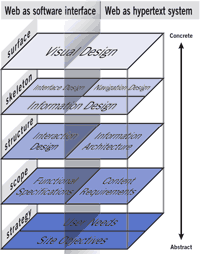
And he does this without pushing a trademarked process or holding himself up as a guru with all the answers. Instead, he simply describes the process that web designers have been using to get things done. I say “simply”, but that word belies the clarity and thoroughness of the book in its description of user experience design. One of the book’s most valuable contributions is the explanation of exactly how the various specialties fit into the larger process. Information design, information architecture, visual design, interface design, interaction design; they’re all represented in Jesse’s model of user experience design (shown at right).
Highly recommended for anyone involved in web design and developments, especially for managers and technical folk to get an idea of what us designers actually do. Here’s chapter 2 of the book in PDF format to get you started.
There are two chief types of buildings: ducks and decorated sheds.
News.com has a special report on the 10th anniversary of Mosaic 1.0.
Manor House is a new reality show in the style of Frontier House coming to PBS in April.
17,000 people trying to out-joke each other about pancakes…what does that sound like?.
In trying to determine which MetroCard has the best value for its holder, Grant has done some great analysis of the various options (PDF) for the New York City subways and buses. After reading Barbara Ehrenreich’s Nickel and Dimed: On (Not) Getting By in America, this reason for people not buying the 30-day unlimited card for $63 even though it’s the best value rings true:
For some folks, being in a position where they don’t have the full price of a 30-Day Unlimited MetroCard on them, and won’t until payday, is so common as to almost be a non-story, yet it is often rarely mentioned. Even when people know they should buy the unlimited card because the per-ride cost would be cheaper, they simply can’t. They don’t have the capital.
In the book, Ehrenreich observed many people who were living month-to-month in motels because they couldn’t afford the lump sum payment (1st & last month’s rent and security deposit) for an apartment even though it would have been much cheaper in the long run. Grant’s MetroCard analyses and suggestion of establishing a MetroCard fund — into which you put a couple of bucks a day for the purpose of purchasing a 30-day unlimted ride card each month — are excellent. I wonder…what’s the best way of getting this information into the hands of the people who need it most?
Tickets go on sale this week for the Field Day Festival being held on Long Island on June 7-8. The lineup includes Radiohead, The Beastie Boys, Royksopp, Sigur Ros, and Interpol…which is killing me because I can’t go due to a previously planned trip. Khan!!!!!!
Some unintentional editorializing by the Google News computer program:

Excellent.
Don Norman, author of The Design of Everyday Things, has mixed feelings about Edward Tufte:
Tufte is often wrong about what constitutes good communication. Indeed, I am surprised he likes the Napoleon map so much because it has, in his terms, superfluous chart chunk - those drawings of soldiers. This is indeed an excellent graphic, but much of his work does not have this character.
Tufte is not the only statistician who has addressed the problems of representing graphical material. In my opinion, Bertin is the best.
Tufte preaches. I entered into a discussion with him about this once and tried to present some experimental data that one of my students had collected. he refused even to look at it. That is, it isn’t that he looked at the data and disagreed with the interpretation or even the collection— that would be permissible. No, he refused even to look.
Rosecrans Baldwin & Andrew Womack
Dave Sifry
Rebecky
Dan Chan
Jeremy Hedley
Heather Champ
Paul Hammond
Patrick C
Dean Allen
Ben and Mena Trott
Michael Stillwell
Redrick deLeon
Eric Snowdeal
Maciej Ceglowski
Joshua Schachter
Rael Dornfest
Andy Baio
Update: No one on this list actually owes me $20. It’s a list of people whose online contributions I’ve been particularly enjoying lately.
Eason Jordan, an executive at CNN, tells the world what they couldn’t report about Iraq over the last two decades:
For example, in the mid-1990’s one of our Iraqi cameramen was abducted. For weeks he was beaten and subjected to electroshock torture in the basement of a secret police headquarters because he refused to confirm the government’s ludicrous suspicion that I was the Central Intelligence Agency’s Iraq station chief. CNN had been in Baghdad long enough to know that telling the world about the torture of one of its employees would almost certainly have gotten him killed and put his family and co-workers at grave risk.
We take freedom of the press for granted here in the US, but in many places in the world, both the value and consequences are significant.
My umbrella has a button. When that button is pushed in conjunction with a properly timed flick of the wrist, the umbrella flies open from its cocoon to its full-use position in half a second. It’s just an umbrella but I feel like a badass Arizona gunslinger skinning his Colt six gun when I get that wrist flick right. It’s all I can do not to yell, “Reach for the sky, you yella bellies!” Us 9-to-5ers have to take our excitement where we can get it.
More evidence that Google is not a search engine company:
Danny Sullivan, who edits SearchEngineWatch.com, estimates that Google, with about 100,000 advertisers, is a “several-hundred-million-dollar” business. He may be guessing low. The newly revived search site Ask Jeeves, which carries ads from Google and pockets a portion of the fees, forecasts revenues of about $100 million this year. It operates around 13 million searches per day, compared with Google’s 200 million. It’s impossible to do a direct comparison, but Google clearly could be a $1 billion company soon.
If it’s wrong of me as a 29yo man to lust after Keira Knightly, I don’t wanna be right.
Financial planning for when your military spouse is deployed.
Visa is now offering a Titanium credit card. We can only imagine the marketing meeting that led to this:
Head of marketing: “Alright, we need a new credit card. Something for 99th percentile of the wage-earning population.”
Marketing flunky #1: “Isn’t that what the Gold card is for?”
Head of marketing: “Gold isn’t exclusive enough these days. We need a metal with more cachet.”
Marketing flunky #2: “We’ve got Platin…”
Head of marketing: “Platinum’s no good either. Too many Platinum-level products these days. They’ve cheapened the whole thing. Anyone can get a Platinum anything.”
Marketing flunky #1: “How about Diamond?”
Head of marketing: “Good, good. But not a metal and De Beers would sue our ass.”
Lawyer: (nods)
Marketing kiss-ass: “Plus, Diamond has that whole carbon connotation. We don’t want people associating their premium credit card with pencil lead.”
Marketing flunky #2: “Lead? I thought we were talking about carbon?”
Everyone: (blink)
Marketing flunky #1: “You said premium just now. How about that?”
Head of marketing: “That was just an expression. God, think harder.”
Flunkies: “Ummmm…”
Head of marketing: “OK, does *anyone* here know *anything* about science? What’s better than platinum?”
Designer: “My computer is made of titanium. It’s pretty solid. And the screen is huge. Have you seen that commercial with Mini Me and…”
Everyone: “Titanium! Of course! That’s the answer!”
Designer: “That word’s gonna look great on a brushed metal background.”
Head of marketing: “It sure wil…wait, who let him in here?”
 Sometime in the recent past, well-regarded design firm Cooper redesigned their web site and logo. I like the new site, but there’s something odd about the logo. It comes off as uneven somehow. The “c” seems out of place next to the smooth “o”s and “p”, and the way the bar in the “e” leads right into the upward curve of the “r” makes the whole thing look like it’s about to takeoff.
My viewing frequency of Iron Chef has
waned since moving to NYC, mainly because I’ve seen many, if not most, of
the shows. Plus, there’s only so many times you can watch Chen cook shark
fin. To fill the void, I’ve been watching Monster Garage and Junkyard Wars,
both of which are like Iron Chef with power tools & ratchets.
I’m especially keen on Junkyard Wars because it reminds me of working in the
garage with my dad as a kid. Fixing cars mostly, but also pretty much
anything that needed fixing. Dad’s garage worked a lot like the show; he had
a vague idea about what he wanted to accomplish, I was there to help with
the scavenging, and there was a garage full of junk with which to complete
the task. Unlike the show, we were only competing with ourselves and several
trips to the nearest hardware store for supplies were usually necessary.
I was a regular Rube Goldberg in my scavenging duties. My dad would tell me
that we needed to put this doowacky together with this other conifter, and I
would scoot off to all corners of the garage, returning with six different
widgets and a plan for utilizing them all in an intricate process to
accomplish the goal. I would own at Junkyard Wars.
My favorite story about Dad’s garage happened when I was in high school. I
mentioned to my dad that my friend Ken was having some car trouble. My dad
suggested he bring the car over and Ken showed up some days later with his
blue Ford Tempo. After listening to the engine & transmission and
peering under the hood, he decided the problem lay with the
bendix. Disappearing into the garage, he emerged a few minutes later
carrying said bendix, not something usually found in your typical garage. “I
knew I had a Ford bendix in there somewhere,” he said. A couple hours of
labor later, and damned if the weird noise and transmission problems weren’t
completely fixed. He probably even had a few bendixes leftover in that
garage somewhere for use on some future ailing Ford.
Moore Lies: truth and justice in reporting on Michael Moore.
ALL Micheal Jackson For Those That Mispell Michael. Where’s the page for all those that misspell mispell?
A weblog dedicated to the use of the command line tools curl and wget.
Find cross streets and nearest subway stops for Manhattan addresses on avenues.
The Difference Dictionary. supplement to a novel by William Gibson and Bruce Sterling
I didn’t think much of this article (as it features some muddled analysis by Jakob Nielsen), but the title — “How the web makes ‘desk-chair generals’ of us all” — put me in mind of something I read in Tom Standage’s The Victorian Internet about war and technology.
The Crimean War was the first conflict in which the telegraph was utilized, both by the armies in the field and by reporters sending news of the conflict back home. Instead of taking weeks for news from the front to reach home, it happened in a matter of hours. Two things happened (stop me if this sounds familiar):
For the first time, French and British governments could communicate directly with commanders on a distant battlefield. This was further bad news for [British commander in chief] General Simpson, who was so exasperated by trivial inquiries from his incompetent superiors in London that he is said to have complained that “the confounded telegraph has ruined everything.”
-and-
The telegraph was to cause further complications when it was used to send reports to London from the front revealing the chaotic nature of the campaign. The war was very badly organized, and although public sentiment in Britain was in favor of military action, there was widespread exasperation at the government’s mismanagement, spelled out in dispatches from the front line by the Times’s reporter William Howard Russell.
With today’s technology (Internet, sat phones, etc.), the intertwingled feedback loop between the front and the public and the government is so short and tightly coupled that the loop has almost vanished entirely. I don’t think that makes us all desk-chair generals, but it sure feels like it sometimes.
I keep misspelling “bulletin” over and over and over again….
I love the last bit of this piece by Mark Cooper that I’m quoting it extensively:
The responsibilities of the peace movement are far too weighty to be squandered in sputtering and ultimately politically irrelevant feel-good acts of blocking traffic or ripping down fences at military bases. As war breaks out, the peace movement must engage even more deeply, not marginalize itself. It must exert what influence it can muster to limit and constrain the exercise of American military power and to do all possible to prevent this conflict from becoming a prelude to endless war. But even more immediately, it’s the peace movement that must actually hold the Bush administration to its promises of liberating Iraq. The peace movement should take an active role in debating and trying to shape the post-Saddam outcome by fighting, first of all, for a thorough roll-up of the Ba’ath regime, for indictment and prosecution of Hussein and his gang, for the fullest democracy possible, respect for the Shiahs and Kurds, for a postwar government that respects human rights. That formula includes an authentic U.S. and international commitment to fund reconstruction and development. And let’s not forget the Bush-Blair promise to finally get serious about the Palestinians.
At the time of the O.J. trial, I wrote that resentful white Westside Yuppies would have actually been disappointed if Simpson had been convicted, as that would rob them of their self-righteous indignation. Let’s do a reality check. If you’re in the peace movement and your secret hope is that an arrogant George W. Bush will get his comeuppance in Iraq, that the war will go awry and that it will sink into a bloody I-told-you-so quagmire, then you better have a long, soul-searching meeting with yourself. This is not Vietnam, where the U.S. intervened to support a tinpot dictatorship against an indigenous revolution. This time the U.S. is intervening — perhaps for all the wrong reasons — against a dictatorial regime a dozen times worse than that of Nguyen Thieu’s. As American tanks roll into southern Iraq, we should hope that they will, in fact, be met with rice and roses and then go right on to Baghdad to finish off Saddam. To the Iraqi people who must now cower under our bombs and missiles and pray to God to be spared, we owe them at least that perk — and much, much more.
via glfstrm
“Blogshares is a fantasy stock market for weblogs.” The idea is that people can buy stock in different weblogs which are valued by inbound links. It seems that a few folks have put some of their hard-earned fake money down on this old grey bright yellow-green mare and are taking a beating:
Oh and I got burned on kottke.org. I bought 5 shares of it for like $14.50, it shot up to almost $15, and now it’s down to like $2.10. What’s up with that Jason??
-and-
I lost seventy-five, eighty bucks on Kottke sometime today; I knew the P/E was too high! I knew I shoulda sold! So I did what any good, self-deprecating investor would do; I bought a few more shares.
Come on guys, do some research! I’m a horrible buy right now. Quote from last Monday’s post about my new job: “Postings may be light (and email replies will be really light) as I get adjusted to the new routine.” No postings = fewer inbound links. Plus, there’s a war on and I don’t talk much about the war. No war = fewer inbound links. Result: my own mini .com bust.
This is the most un-Nick-like thing I’ve ever seen Nick do. and Mark, you passed up the opportunity to coin the word “blogul” (say BLOW-gul)?
Washington Post Wins Three Pulitzers. Is it journalism or marketing when your headline trumpets the awards your newspaper won?
Dan Gillmor on how the permanent war on terrorism means permanent suspension of civil liberties:
Liberties ebbed and flowed in America’s past. Leaders curbed liberties, with the public’s often ignorant endorsement, in times of crisis. But the rights tended to come back when the crises ended.
The fabled pendulum of liberty may not swing back this time. Why?
For one thing, the damage that one evil or deranged person or group can cause has grown. Even if America somehow persuades all Islamic radicals that we are a good and just society, there will still be some evil and deranged people who will try to wreck things and lives in spectacular ways. In other words, the “war on terrorism” can’t possibly end.
In thinking about this issue and what the U.S. gov’t is doing here (whether it’s deliberate or not), and I keep coming back to George Orwell. This is straight out of 1984. War is peace. If you want a stable country, you limit civil liberties. No freedom, no sudden movements, no free thinking, no chance of things getting out of control. How do you do that? Wage war full time. Too busy fighting to worry about freedom. The few control the many through their own fear and patriotism. Brilliant and scary.
Print out your stock quotes on toilet paper or browse recipes on an Internet-enabled cutting board.
The NY Times has a short interview with Joanne Tucker, an ex-BBC reporter who is now a managing editor at al-Jazeera (English version), an Arabic news channel:
Q. What is it like to have your daily routine interrupted by a courier who walks in and says, “Package from a Mr. bin Laden”?
A. There was definitely a buzz. It was totally exciting that this newsroom in the middle of Doha, Qatar, that was a complete unknown in 1999 was catapulted into this. Bin Laden was saying pretty radical, clash-of-the-civilizations type things that were no different in intellectual thrust than Bush’s comments about a crusade. We felt it was history in the making. I was there in April when we received a very professionally edited videotape — it was of one of the hijackers giving his farewell-to-the-world speech. It was visual proof that one of the people on the planes was a hijacker. The pressure — the pleas not to air it — was amazing. “This will be bad for Arabs. It’s probably fabricated,” they said. But the channel withstood the pressure.
I love that al-Jazeera exists and is able to broadcast its news and biased perspective all over the world, just like CNN, BBC, the NY Times, or Indymedia do with their biased perspectives. Ideally, all of these news sources would try to be unbiased as they could — or at least be more open about their bias — but the option of seeing things from all these different perspectives is better than not. The idea that hacking al-Jazeera’s web site is pro-US or pro-democracy is ridiculous and childish. If we’re going to let Fox News spew U.S. propaganda, we should let al-Jazeera go with the Arabic propaganda. The U.S. should be for freedom of the press everywhere in the world, not just within our borders.
And don’t even get me started on Akamai’s decision to discontinue services to al-Jazeera or the NYSE barring al-Jazeera’s journalists from the trading floor. Pathetic.
Beyond the browser bundle includes Watson, NetNewsWire, and Spring.
M: Unsurprisingly, she loves cotton candy as well.
Ja: And pixie sticks?
Ju: No, pixie sticks are too sour.
The current issue of Digital Journalist has lots of material on the war in Iraq:
We have been fortunate to have direct access to photographers in Iraq, who are embeded with soldiers, on their own, aboard navy vessels, etc. This month we highlight their work and have published their personal experiences. Furthermore, we have coordinated with seven of the best photo agencies and media outlets such as the New York Times, Newsweek, Reuters, AP, AFP, Corbis, and Getty Images to bring their best war photographs to our audience.
There are excellent photo galleries from Agence France Press, AP, Corbis, Getty, Newsweek, The New York Times, and Reuters.
Proving only that he hasn’t talked to an actual software developer in a coon’s age, Larry Ellison predicts that Linux is going to eventually eat Microsoft for lunch. On the desktop, except for a few dedicated followers of the Church of Apple and Unix-lovin’ software developers, Microsoft owns this space and will for a long time.
In developer land, having been recently reintroduced to the ins and out of Microsoft development, I’m reminded how differently Unix developers and Microsoft developers approach software development. If Unix development philosophy is small pieces loosely joined, Microsoft’s philosophy is big chunks tightly coupled. Microsoft developers aren’t going to suddenly jump ship to a completely different platform and way of developing…there’s a lot of friction and inertia there (not to mention Microsoft’s considerable marketing efforts) that will tend to prevent that.
Paul Nixon took all the band names from the recent music post and compiled them into a neat text file:
Downside of this list: Little to no context to the musician or musical style is given on this list. Some context may or may not be gathered from reading the actual commentary. Also, formatting and duplication errors abound.
Organizational note: The alphabetized list ignores the “The” bands by alphabetizing the band based on the second word in the name (e.g. White Stripes, The). Unfortunately trying to alphabetize the band “The The” ended in a vicious, never ending cycle from which I have yet to escape.
Above quote is from this post.
I love MT, but that replace button right next to the search button is not good.
Microsoft wants to provide search engine with better user experience than Google. good luck with that, fellas.
Bloom status map for the cherry blossoms at the Brooklyn Botanic Garden.
The Secrets of Drudge, Inc.. although the success of Drudge is not easily reproducible


Socials & More