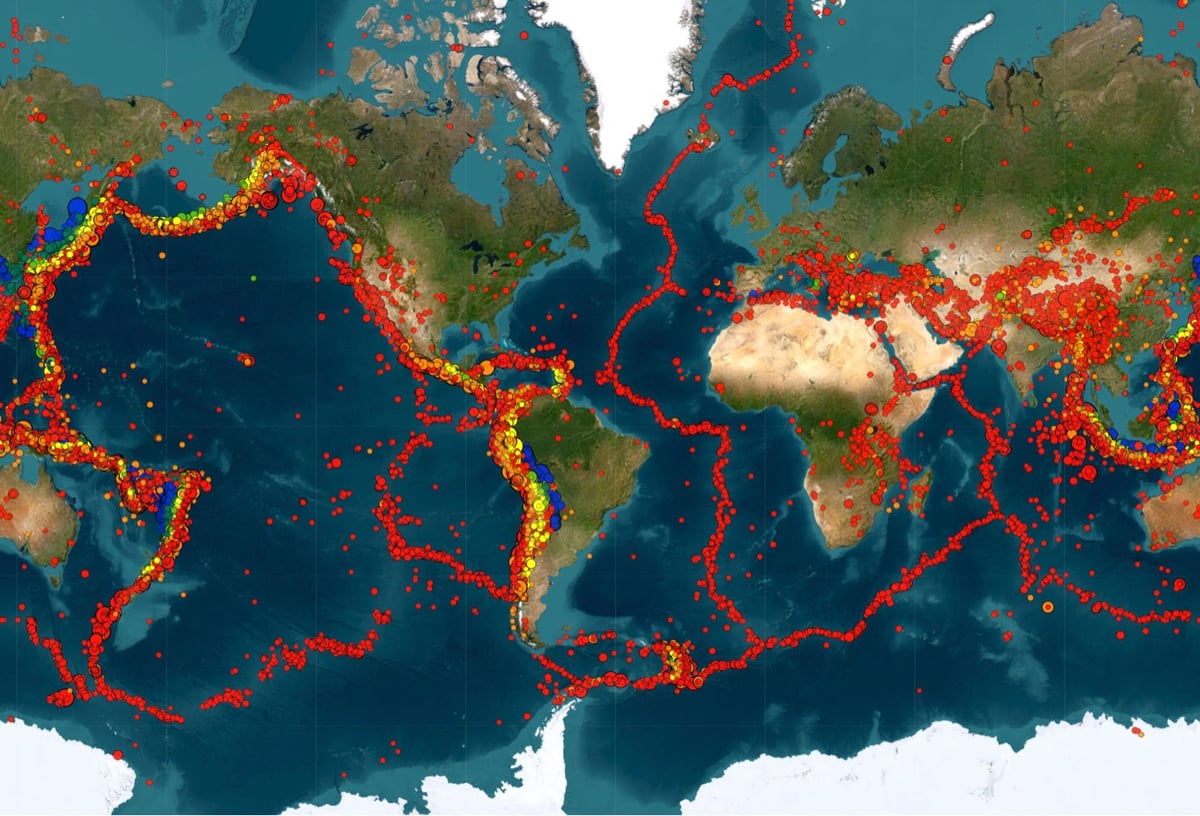
This site lets you track the International Space Station, the Space Shuttle (when in orbit), and all sorts of other satellites in relation to their position over the earth with a familiar Google Maps interface. Very cool.
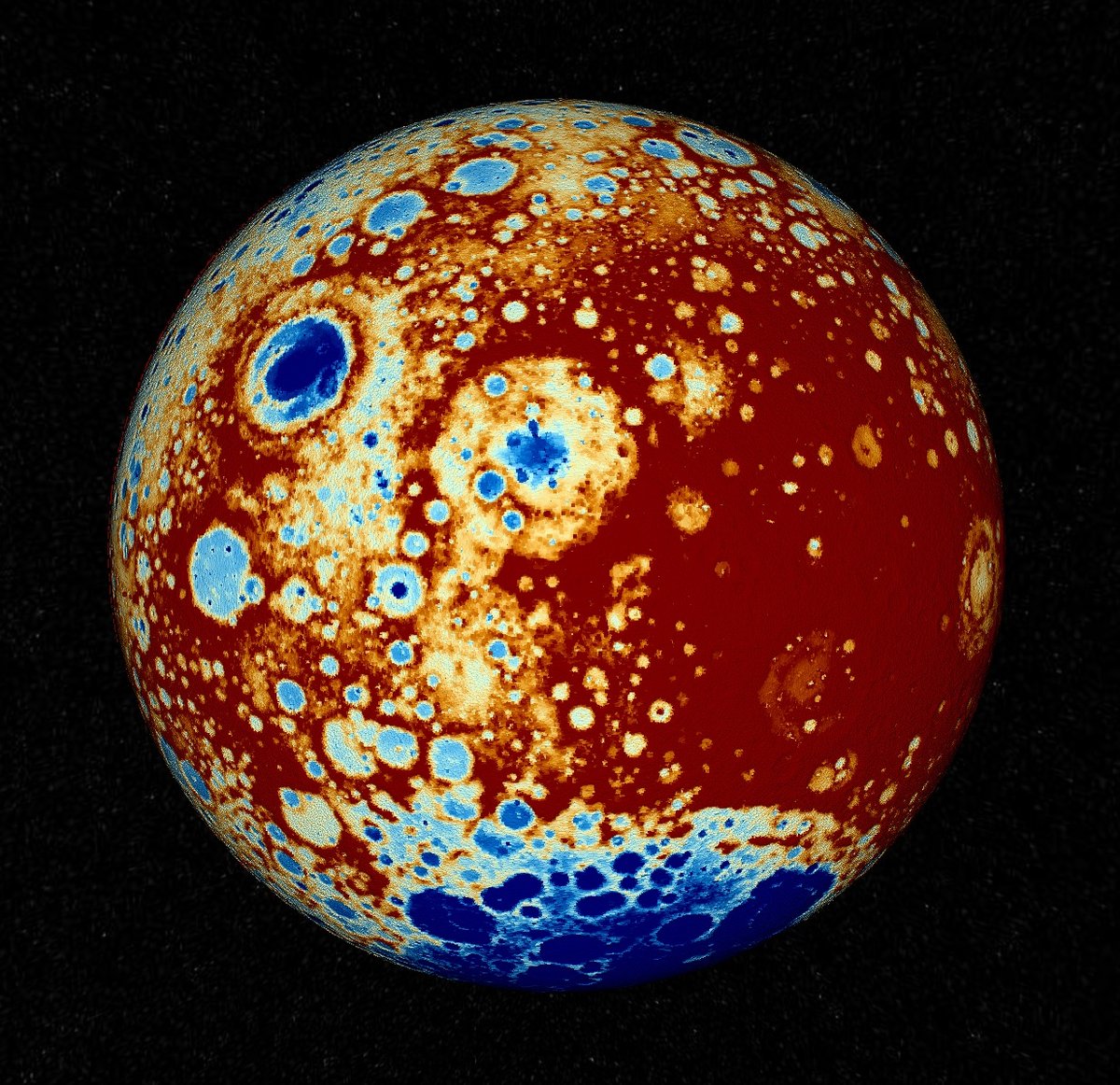
Perhaps most exaggerated of all though has to be the images that are typically given to show the accumulation of "space junk" -- remnants of space flights and defunct satellites, etc. In this image each pixel represents approximately 114 miles; so a piece of debris the size of a car is marked with a point the size of Long Island -- easily a 6 order of magnitude exaggeration.
(via mike)
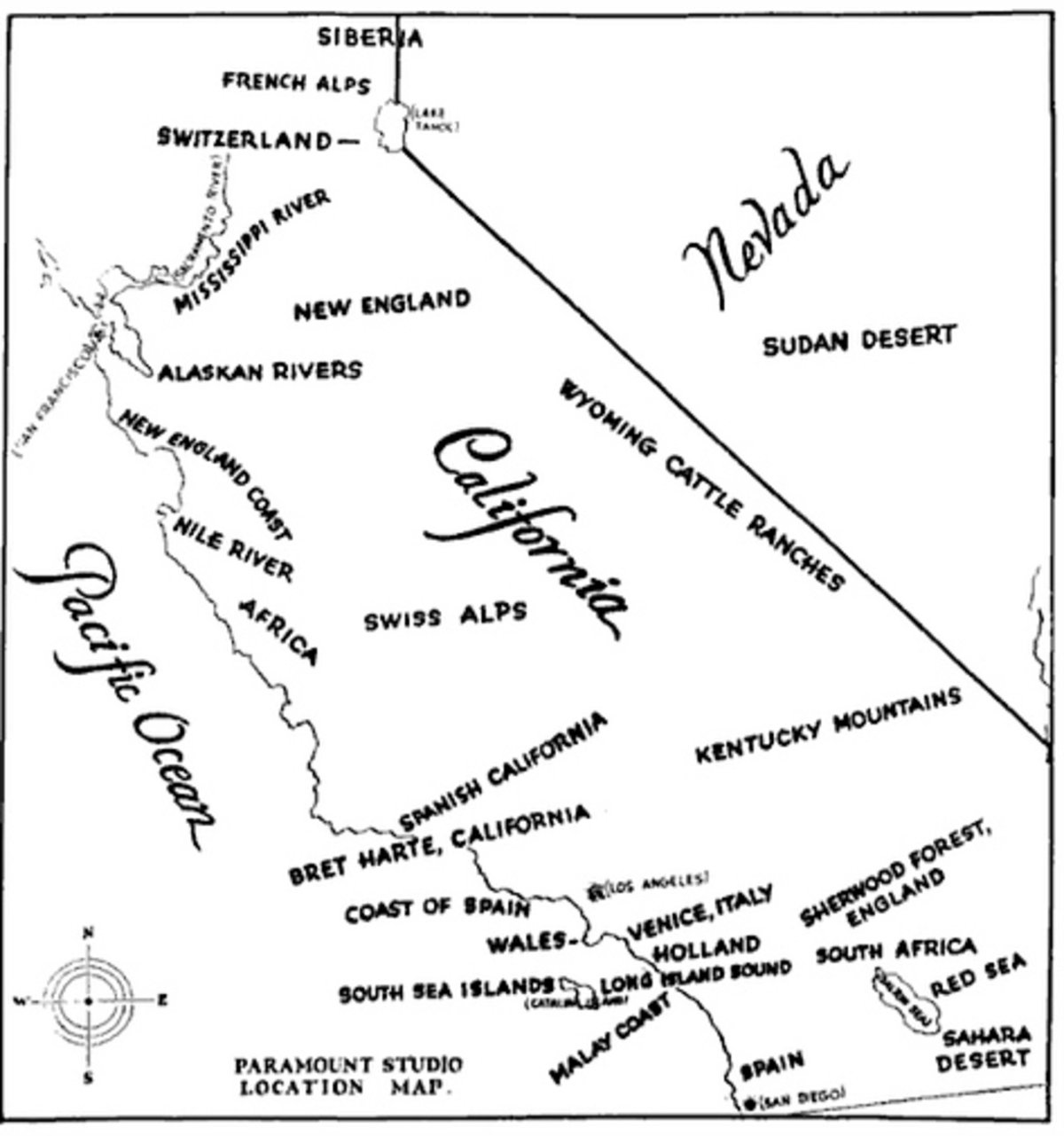
Mark Simonson notes that the period typography in the Indiana Jones movies is pretty good, except for that used on Indy's travel maps.
In Raiders of the Lost Ark (1981) which is set in 1936, we see ITC Serif Gothic (designed in 1972). The wide spacing feels right, and it does have an art deco feel, but it's 1970s art deco.
For my London peeps: a map of the lost rivers of London.
I wish this map of current US gas prices factored out the taxes included in the pump price. It seems like what the map mostly shows is the differences in taxes between states (PDF map) and not, for instance, how the distance from shipping ports or local demand affects prices. (via what i learned today)
Alan Taylor has collected the longest drives that Google Maps will give driving directions for.
It turns out there are multiple "longest drives", because the Google Maps World is partitioned (many countries don't support driving directions), and sometimes ferries are included, and sometimes they are not.
The longest he's found so far is from the Aleutian Islands to the tip of Newfoundland, a distance of over 7,200 miles. You can drag the path around to make it a lot longer (more than 11,000 miles) but that's cheating.
(Today is Ben Fry day on kottke.org. Apparently.) All Streets is a map of the US with all 26 million roads displayed on it. The best part is that features like mountains and rivers emerge naturally from the road system.
No other features (such as outlines or geographic features) have been added to this image, however they emerge as roads avoid mountains, and sparse areas convey low population. The pace of progress is seen in the midwest where suburban areas are punctuated by square blocks of area that are still farm land.
Here are a few technical details of how the map was made.
The newest version of Google Earth includes 3-D photorealistic buildings, sunlight (with shadows on those realistic 3-D buildings), and a Spiderman-esque swooping action. Here's a "photo" I snapped of downtown San Francisco.

You can just see the 3-D photorealistic Golden Gate Bridge peeking up in the background. See some more examples at Google's LatLong blog.
Google Earth now displays location-specific news from the NY Times.
I read a lot of news by surfing the Internet, as do many of my colleagues and friends, and I've always dreamed of a way to browse news based on geography. What's happening in Paris today? What are the top headlines in Japan?
Interesting timelapse visualization of fatalities in Iraq since March 2003. Turn your sound on...after awhile, it starts to sound like machine gun fire. Note: fatalities are non-Iraqi only...it's likely the whole screen would be flashing if those were included. (thx, mark)
Gorgeous maps and infographics by Stefanie Posavec that map the literary geography of Jack Kerouac's On the Road.
The maps visually represent the rhythm and structure of Kerouac's literary space, creating works that are not only gorgeous from the point of view of graphic design, but also exhibit scientific rigor and precision in their formulation: meticulous scouring the surface of the text, highlighting and noting sentence length, prosody and themes, Posavec's approach to the text is not unlike that of a surveyor. And similarly, the act is near reverential in its approach and the results are stunning graphical displays of the nature of the subject. The literary organism, rhythm textures and sentence drawings are truly gorgeous pieces.
The sentence drawings are really worth checking out.
A fantastic pair of maps, courtesy of Strange Maps:
- A map of the area covered by Neil Armstrong and Buzz Aldrin on their Apollo 11 moon walks, superimposed on a soccer pitch for comparison purposes.
- The same map, superimposed on a baseball diamond.
Update: Here's a look at the traverse map overlaid on the moon's surface.
Update: For all you conspiracy theorists out there, LVHRD superimposed the traverse map onto a Universal Studios soundstage.
Google Sky is like Google Earth for the, er, sky. The historical constellation drawing overlay is very cool.
P.S. I starting sobbing like a little baby when I saw this.
Design and the Elastic Mind
On view at MoMA through May 12, 2008: Design and the Elastic Mind.
In the past few decades, individuals have experienced dramatic changes in some of the most established dimensions of human life: time, space, matter, and individuality. Working across several time zones, traveling with relative ease between satellite maps and nanoscale images, gleefully drowning in information, acting fast in order to preserve some slow downtime, people cope daily with dozens of changes in scale. Minds adapt and acquire enough elasticity to be able to synthesize such abundance. One of design's most fundamental tasks is to stand between revolutions and life, and to help people deal with change.
I was surprised at how many of the show's ideas and objects I'd seen or even featured on kottke.org already. But getting there first isn't the point. The show was super-crowded and I didn't have a lot of time to look around, but here are a couple of things that caught my eye.
Michiko Nitta's Animal Messaging System (AMS), part of a larger project she did called Extreme Green Guerillas. The basic idea of the AMS is to use the radio ID tags worn by migratory animals to send messages from place to place. Nice map.
Molecubes are self-replicating repairing robots. Video here.
And I've been looking for Brendan Dawes' Cinema Redux project for several months now...most recently I wanted to include his work in my time merge media post.
Using eight of my favourite films from eight of my most admired directors including Sidney Lumet, Francis Ford Coppola and John Boorman, each film is processed through a Java program written with the processing environment. This small piece of software samples a movie every second and generates an 8 x 6 pixel image of the frame at that moment in time. It does this for the entire film, with each row representing one minute of film time.
For more, check out the online exhibition (designed by Yugo Nakamura and THA Ltd, the folks behind FFFFOUND!). Thanks (and congratulations!) to Stamen for hosting a tour of the exhibition.
1. See a map of the world made out of musical notes.
2. Now, listen to the map.
Update: I misread the text associated with the second link...the music does not correspond to the notes on the map. But anyone wants to give it a shot, send along an MP3 of your recording. (thx, bill)
The fellow/lady behind the excellent Strange Maps blog is doing a book, The Atlas of Strange Maps. In my mind, I have pre-pre-ordered this book...I hope it gets the well-designed cover it deserves.
In a map of the Republik van Nieuw Nederland, Paul Burgess imagines that the Dutch never gave up their New World possessions and a republic formed centered around New Amsterdam.
New Amsterdam never gave way to New York. The Dutch kept the whole of their North American colony out of the hands of the perfidious English, in fact. New Netherland today constitutes a thriving Republic stretching from the Atlantic coast to Quebec, dividing New England from the rest of the United States.
See also Melissa Gould's map of Neu York, which imagines Manhattan as a post-WWII Nazi possession.
Web Trend Map 2008 Beta, which is basically 300 influential web sites mapped onto a Tokyo train map. It's very pretty, but once again, kottke.org gets no love.
Update: A general trend map for 2008, this one modeled on the Shanghai subway map. (via mass custom., thx maaike)
Stamen teamed up with MySociety to produce some lovely travel-time maps of London. My favorite is the interactive travel + housing prices map:
Next, it is clearly no good to be told that a location is very convenient for your work if you can't afford to live there. So we have produced some interactive maps that allow users to set both the maximum time they're willing to commute, and the median house price they're willing or able to pay.
The commute time slider makes a lovely Mandelbrot-esque pattern as you pinch the times together. (via o'reilly radar)
Map of the world where the size of the countries correspond to how much oil they have. On this map, the Middle East is just The Middle.
Click on world cities on a map to test your traveler IQ. Africa = nearly random clicking for me although I would have done better had I not misread Swaziland as Switzerland.
This post about the carbon footprint of wine contains an interesting map at the bottom. It's a map of the US with a line splitting the country in two. West of the line, it is more carbon efficient to drink Napa wine while to the east of the line it is more carbon efficient to drink French Bordeaux. You can almost see the coastline of the eastern and Gulf states struggling westward against the trucking route from California. The Vinicultural Divide?
19.20.21 (19 cities in the world with 20 million people in the 21st century) is a nice site for an effort to undertake "a five-year study that will encompass all aspects of the phenomenon of supercities" but the real attraction are the maps of the world's largest cities through time (Menu/10 Largest Cities). In 1000, the largest city in the world was Cordova, Spain and by 1500, 4 of the top 10 were in China and one was in Nepal. (via snarkmarket)
Subway map geeks rejoice:
Transit Maps of the World is the first and only comprehensive collection of historic and current maps of every rapid-transit system on earth. Using glorious, colorful graphics, Mark Ovenden traces the history of mass transit-including rare and historic maps, diagrams, and photographs, some available for the first time since their original publication. Transit Maps is the graphic designer's new bible, the transport enthusiast's dream collection, and a coffee-table essential for everyone who's ever traveled in a city.
Found out about this from Boing Boing, where Cory has a quick review.
A tshirt featuring a subway map representation of the human gastrointestinal system. (thx, sami)
Update: Oh, and I plumb forgot the Threadless Metropolitan Cardiac Authority tshirt. (thx, sam)
A gorgeous wall-sized map showing the precise territory of the United States by Bill Rankin, proprietor of Radical Cartography. Check out some of Rankin's other recent work.
Update: Oops, that didn't take long. RC is a little slow right now because everyone's trying to d/l the 3.8 MB png file of the map. Maybe check back a little later?
A neat comparison of butcher's diagram of cuts of beef and a map of Manhattan. It looks like I live in Chuck Shortribs or maybe Brisket. See also the front cover of Rats by Robert Sullivan.
Timelapse animated map of the NYC subway that shows the order of the subway lines being built. See also the history of the NYC subway, photos of the IRT's first stations, and if you really don't have anything else to do for the next hour or so, an extensive trove of historical NYC subway maps.
Statetris: "Instead of positioning the typical Tetris blocks, you position states/countries at their proper location." There are versions for the US, Africa, Europe, the UK, and more.
Get Lost is a collection of maps of downtown Manhattan drawn by a variety of artists.
A must-see for football fans: NFL TV distribution maps. Check out what football games will be on in which parts of the country.
A list of resources for my recent dive into the deep end of an infinite pool. Wikipedia page. Search inside @ Amazon. A Reader's Companion to Infinite Jest. Reviews, Articles, & Miscellany. The Howling Fantods! A scene-by-scene guide. Hamlet. Act 5, Scene 1. Infinite Jest online index. Wiki from Walter Payton College Prep (incl. timelines, chars, acronym list, places, etc.). Chronological list of the years in Subsidized Time. Notes on What It All Means. Character profiles by Matt Bucher. Character guide. Vocabulary glossary. Various college theses on IJ. Elegant Complexity: A Study of David Foster Wallace's Infinite Jest (sadly not out until Nov). Not entirely unrelated: map of the overworld for The Legend of Zelda, which I've started playing again on the Wii. Suggestions welcome, especially looking for a brief chronological timeline of the whole shebang, something like the chronologically sorted version of this but covering more than just when the scenes themselves take place.
Update: Just to be clear, this is my second time through the book. (Last time was, what, 4 years ago?) Trying to make more of a study of it this time.
Update: Suggestion from Ian: "Get 3 bookmarks. 1 for where you are reading, 1 for the footnotes, 1 to mark the page that lists the subsidized years in order." I'm currently using two bookmarks...will get a third for the sub. years list.
I've been keeping up with the latest iPhone news but I haven't been telling you about it...partially because my poor pal Merlin is about to pop an artery due to all the hype. Anyway, it's Friday and he's got all weekend to clean that up, so here we go. The big thing is a 20-minute guided tour of the device, wherein we learn that there's a neat swiping delete gesture, you can view Word docs, it's thumb-typeable, the earbuds wires house the world's smallest remote control, Google Maps have driving directions *and* traffic conditions, and there's an "airplane mode" that turns off all the wifi, cell, and Bluetooth signals for plane trips. It looks like the iPhone will be available online...here's the page at the Apple Store. What else? It plays YouTube videos. iPhone setup will be handled through iTunes: "To set up your iPhone, you'll need an account with Apple's iTunes Store."
Artist Eve Mosher is drawing a chalk line around Brooklyn and lower Manhattan that denotes the encroachment of the ocean if it were to rise 10 feet above the current sea level. There's a web site for the project, including a progress blog. See also Flood Maps.
A map of the lakes and rivers underneath the Antarctic ice sheet. Referring page is here. (via pruned)
Pirate myths uncovered: they never said "arrr", there was no plank walking, and no treasure maps. The "arrr" and the pirate accent "originated with Robert Newton, the actor who played Long John Silver in the movies and on TV through much of the 1950s".
The Inglehart-Welzel Cultural Map of the World scores the world's countries on two axes of cultural values...from "traditional" to "secular-rational" and from "survival" to "self-expression". (via strange maps)
I'm sure this functionality is coming, but when using the new Street View feature in combination with driving directions on Google Maps, I want a play button that drives me from the starting point to my destination, showing me the street-level view along the way.
outside.in just launched a new maps feature that shows the physical locations that people are blogging about. Here's the last few months of places I've talked about on kottke.org. I like the pie charts that show how exclusive a place is to a particular blog. (Disclosure: I'm an advisor to outside.in.)
Stamen delivers another lovely project: Trulia Hindsight. It's an animated map of the US which shows new home construction over a period of years "with an eye towards exposing patterns of expansion and development". As you might expect, the growth of a city like Las Vegas is interesting to watch. More on the project from Stamen and on the Trulia Hindsight blog.
New Google Maps feature: Street View. Just place your little guy on a street on the map and up pops a 3-D panorama of what you'd see on the street. For instance, here's a view into oncoming traffic on the Brooklyn Bridge. Only major US cities are supported for now. I remember Amazon's A9 came out with something like this a couple of years ago, but Google's implementation of it is fantastic. (thx, mark)
A "story map" distributed to guests of a wedding that shows the possible occupational, relational, and recreational relationships between guests to be used as a conversational cheat-sheet. Reminiscent of Mark Lombardi's network maps. Better larger. (via gulfstream)
Another kind of Tube map: which seating/standing positions in the carriage are the best and which are the worst? "Everyone knows the prime seats and standing spots, and people jostle for supremacy when the doors open, especially at the depot, when the train is empty."
Timelapse video of a map showing Civil War battles and movements...four years of war in four minutes. The video was produced by Harvest Moon Studio for the Abraham Lincoln Presidential Library and Museum.
Projected climate map of Europe in 2071. The map is a bit confusing...the cities are placed on the map according to their projected new climate, not their geographical location. So, in 2071, Berlin will find itself in the same climate as circa-2007 North Africa.
A map of online communities. Notable features include the Blogipeligo, the Bay of Trolls, the Sea of Memes, and the Viral Straits. (thx, kayhan)
Designer Eddie Jabbour is on a mission to make a new NYC subway map. The NY Times recently had a piece of Jabbour's efforts. The new map reminds some of Massimo Vignelli's 1972 classic map: too abstract for its own good. Here's Vignelli talking about his map in an outtake from Helvetica and some background on the controversy surrounding it.
Typographic map of London. That is, a map made of type (like Paula Scher's paintings) not a map of typography in London. (via moon river)
Big Box Watch is a map that displays future big box store openings in the US. The site currently tracks Best Buy, Home Depot, Ikea, JCPenney, Kohl's, Lowe's, Target, and Wal-Mart.
Last 100 posts, part 7
It's been awhile since I've done one of these. Here are some updates on some of the topics, links, ideas, posts, people, etc. that have appeared on kottke.org recently:
Two counterexamples to the assertion that cities != organisms or ecosystems: cancer and coral reefs. (thx, neville and david)
In pointing to the story about Ken Thompson's C compiler back door, I forgot to note that the backdoor was theoretical, not real. But it could have easily been implemented, which was Thompson's whole point. A transcript of his original talk is available on the ACM web site. (thx, eric)
ChangeThis has a "manifesto" by Nassim Taleb about his black swan idea. But reader Jean-Paul says that Taleb's idea is not that new or unique. In particular, he mentions Alain Badiou's Being and Event, Jacques Derrida, and Gilles Deleuze. (thx, paul & jean-paul)
When I linked The Onion's 'Most E-Mailed' List Tearing New York Times' Newsroom Apart, I said "I'd rather read a real article on the effect the most popular lists have on the decisions made by the editorial staff at the Times, the New Yorker, and other such publications". American Journalism Review published one such story last summer, as did the Chicago Tribune's Hypertext blog and the LA Times (abstract only). (thx, gene & adam)
Related to Kate Spicer's attempt to slim down to a size zero in 6 weeks: Female Body Shape in the 20th Century. (thx, energy fiend)
Got the following query from a reader:
are those twitter updates on your blog updated automatically when you update your twitter? if so, how did you do it?
A couple of weeks ago, I added my Twitter updates and recent music (via last.fm) into the front page flow (they're not in the RSS feed, for now). Check out the front page and scroll down a bit if you want to check them out. The Twitter post is updated three times a week (MWF) and includes my previous four Twitter posts. I use cron to grab the RSS file from Twitter, some PHP to get the recent posts, and some more PHP to stick it into the flow. The last.fm post works much the same way, although it's only updated once a week and needs a splash of something to liven it up a bit.
The guy who played Spaulding in Caddyshack is a real estate broker in the Boston area. (thx, ivan)
Two reading recommendations regarding the Jonestown documentary: a story by Tim Cahill in A Wolverine Is Eating My Leg and Seductive Poison by former People's Temple member Deborah Layton. (thx, garret and andrea)
In case someone in the back didn't hear it, this map is not from Dungeons and Dragons but from Zork/Dungeon. (via a surprising amount of people in a short period of time)
When reading about how low NYC's greenhouse gas emissions are relative to the rest of the US, keep in mind the area surrounding NYC (kottke.org link). "Think of Manhattan as a place which outsources its pollution, simply because land there is so valuable." (thx, bob)
NPR did a report on the Nickelback potential self-plagiarism. (thx, roman)
After posting about the web site for Miranda July's new book, several people reminded me that Jeff Bridges' site has a similar lo-fi, hand-drawn, narrative-driven feel.
In the wake of linking to the IMDB page for Back to the Future trivia, several people reminded me of the Back to the Future timeline, which I linked to back in December. A true Wikipedia gem.
I'm ashamed to say I'm still hooked on DesktopTD. The problem is that the creator of the game keeps updating the damn thing, adding new challenges just as you've finally convinced yourself that you've wrung all of the stimulation out of the game. As Robin notes, it's a brilliant strategy, the continual incremental sequel. Version 1.21 introduced a 10K gold fun mode...you get 10,000 gold pieces at the beginning to build a maze. Try building one where you can send all 50 levels at the same time and not lose any lives. Fun, indeed.
Regarding the low wattage color palette, reader Jonathan notes that you should use that palette in conjunction with a print stylesheet that optimizes the colors for printing so that you're not wasting a lot of ink on those dark background colors. He also sent along an OS X trick I'd never seen before: to invert the colors on your monitor, press ctrl-option-cmd-8. (thx, jonathan)
Dorothea Lange's iconic Migrant Mother photograph was modified for publication...a thumb was removed from the lower right hand corner of the photo. Joerg Colberg wonders if that case could inform our opinions about more recent cases of photo alteration.
In reviewing all of this, the following seem related in an interesting way: Nickelback's self-plagiarism, continual incremental sequels, digital photo alteration, Tarantino and Rodriquez's Grindhouse, and the recent appropriation of SimpleBits' logo by LogoMaid.
World map of where Wal-Mart gets its products. China dominates, Russia and most of Africa doesn't exist, and Europe is tiny. (via fakeisthenewreal)
Detailed hand-drawn Dungeons and Dragons dungeon map. See also maps drawn from memory.
Update: The map is not from Dungeons and Dragons but from the "original mini-computer" version of Zork, then called Dungeon. (thx, everyone in the world)
A French map shows that the Portuguese were the first Europeans to discover Australia in the early 1520s, almost 250 years before Captain Cook claimed them for Britain. "'The Vallard cartographer has put these individual charts together like a jigsaw puzzle. Without clear compass markings its possible to join the southern chart in two different ways. My theory is it had been wrongly joined.' Using a computer Trickett rotated the southern part of the Vallard map 90 degrees to produce a map which accurately depicts Australia's east coast."
The must-see link for today is Social Explorer. Jump right to the maps section or to the New York City % White 1910-2000 and the the New York City % Black 1910-2000 slideshows. Running the shows forward, you can see blacks settling into Harlem, Brooklyn, and Queens and then spreading out from there. I wish it were slightly easier to make slideshows, but it's still really fun to play around with all the maps. (via vsl)
Wikipedia has a series of maps showing the political and social boundries of the world in 2000 BC, 1000 BC, 500 BC, 323 BC and so on.
Maps drawn from memory
The first time I saw a world map drawn from memory was at Christopher Fahey's apartment. I forget how long it took him to draw, but it was remarkably accurate and fairly large (a few feet across). Ever since then, I've kept an eye out for other hand-drawn maps (you know what they say: if you can't do, collect). Via waxy this morning comes the From Memory Flickr group. My favorites from the group are this map of the male human body and a fanciful drawing of the solar system, both by Ellis Nadler:
Mapping.com has links to several maps from memory drawn by grade- and middle-school children; this world map by a 7th grade class is not too shabby. I'm struck by how much some of these world maps from memory resemble world maps drawn in the 16th and 17th centuries, like this Dutch map from 1689. All the parts are (mostly) there...it's just that everything is a little wrong-sized and slightly skewed.
Lori Napoleon collects "personal maps" from various people. This tactical guide for nourishing yukio includes directions to the owner's house, outlines of the two different keys (outside door, inside door), and what to feed the cat and when.
Also slightly related is the Fool's World Map, a deliberately addled world map prompted by a question asked of the map-maker by a Texan: "How many hours does it take to go to Japan by car?"
Update: Despite having featured his work on kottke.org late last year, I completely forgot about Stephen Wiltshire's super-realistic drawings from memory. Here's video of Stephen drawing Tokyo from memory and Rome from memory. (thx, matt)
Update: Christopher Fahey uploaded a photo of his world map drawn from memory.
If Strangemaps wasn't such a reliable source, I'd think this was a hoax. A small part of East Germany lives on in the Caribbean. Cuba gave the tiny island to the GDR in 1972 while on a state visit to East Berlin and it wasn't mentioned in the German unification treaties. Commenters on the thread have found satellite images of the island in question, including this one.
New Google Maps features
Not sure when these features were added, but Google Maps now displays public transportation stops (NYC subway, the T in Boston, the L in Chicago) and building outlines for metropolitan areas. Here's a shot of the West Village in NYC:

Tiny but useful improvements. (thx, meg)
World map of driving orientations. "An estimated 66% of people worldwide live in right-hand side countries, and 72% of all distances are completed while driving on the right side of the road."
Dumb interface, but here are some neat maps of global fish catch locations, mostly tuna. For example, on these maps you can see the dramatic increase of purse seine fishing from 1964-1998. (thx, spencer)
Map of the Land of Oz. "Oz is completely surrounded by deserts, insulating the country from invasion and discovery. The isolation may be splendid, it is not total: children from our world got through, as well as the Wizard of Oz and the more sinister Nome King. To prevent further incursions, Glinda created a barrier of invisibility around Oz."
Google mixes their chocolate and peanut butter to map out locations found in books on Google Maps. Check out the maps for Around the World in Eighty Days or War and Peace (near the bottom of the page). More information about this project here.
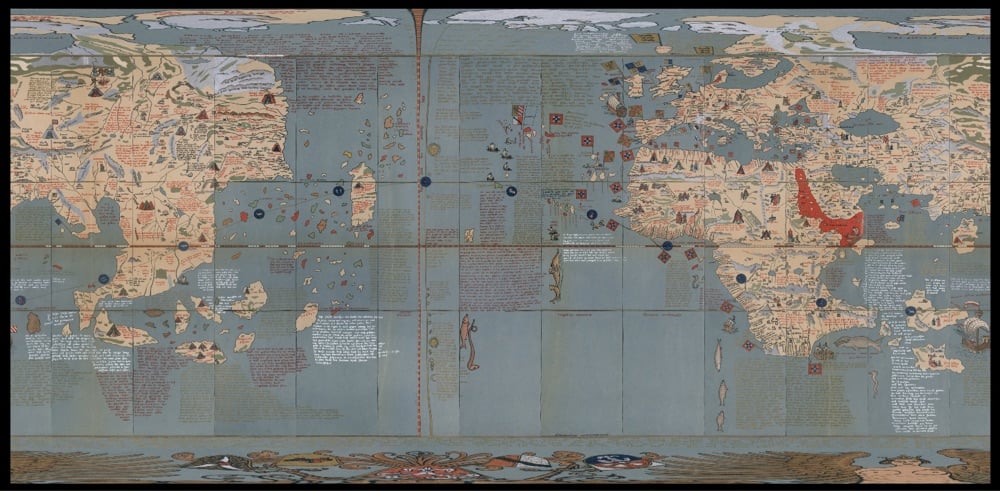
Strange Maps post about the Vinland Map, a document proported to have been drawn in the 15th century from a 13th century map. The Vinland Map depicts an unknown land across the Atlantic Ocean called Vinland which some think is the part of North America visited by the Vikings in the 11th century.
2007 trend maps
A pair of trend maps for 2007, both based on subway maps. The top one depicts the top online companies/brands & how they're connected while the bottom one deals with ideas (with the River of Consciousness standing in for the Thames).
Both maps were found in this article about internet predictions in 2007. I don't know about you, but I find these types of maps fun to look at, but completely inscrutable informationally speaking. Surely there's a more enlightening way to present this information than in Tube map form.
A tourist map of Gotham City. Gotham resembles "Manhattan below 14th Street at 11 minutes past midnight on the coldest night in November".
The Orthodox and other observant Jews living within this 'home' are permitted certain actions outside their literal homes -- pushing a stroller to the synagogue, carrying keys, walking a dog on a leash -- that would otherwise be forbidden on the Sabbath.
Prewalking: walking down the subway platform so that when you board the train, you'll be close to the exit or transfer point when the train reaches its destination.
Update: Photo of the Way Out -> tube map, which marks which side of the train to exit from and where exits/transfers are for each station. (thx, tom)
Update: Exit maps are available for the Toronto and Toyko subways. (thx, adam)
Test yourself: how well can you pick out countries on a map of the world? I got a 59 my first time through...better than I thought I would do. (via plasticbag)
NFL TV distribution maps: where in the US certain football games are broadcast...a visual representation of why you'll almost never see a Vikings game in Maine. (via fakeisthenewreal)
The Time-Gun Map of Edinburgh "was produced in 1861 to show the time taken for the sound of the one o'clock gun to travel from Edinburgh Castle to different parts of Edinburgh and Leith". (via moon river)
Historical maps on Google Earth
Google Earth recently added some maps from the David Rumsey Historical Map Collection to their software, so you can just click them on and off on the globe. Included are a US map from 1833, a 1680 map of Tokyo, Paris from 1716, and a world map from 1790. I spent some time exploring the map of New York from 1836. Here's a screenshot of the southern tip of Manhattan with the present-day buildings turned on:

A larger version is available on Flickr. Google Earth continues to be a fantastic software product. It's almost more of a game than an atlas or educational program...so much fun.
Related: I did a project using Google Earth called Manhattan Elsewhere and made a scrollable, zoomable version of Viele's Map of Manhattan.
From Strange Maps, a great new blog I stumbled across the other day, comes a map originally done by the Boston Globe of the 10 regions of American politics.
Genealogy of Influence: "a graph of biographical entries at Wikipedia with connections denoting creative influence between philosophers, social scientists, writers, artists, scientists, mathematicians". Reminds me peripherally of Simon Patterson's The Great Bear (a print of which is hanging behind me right now).
Proposal for a new map of the Middle East that cuts along cultural/religious boundaries rather than current national boundaries. Here's the accompanying article.
Twisty Table
One of the coolest little gadgets at PopTech is Onomy Labs' Twisty Table. This one is round and it's got a satellite map of the world projected on it. When you spin the table, the map zooms in and out and tilting the table scrolls it. Here's a photo of the table in action at Foo Camp.
Netlag: infovisualization of the world made of exterior web cams over time. So as the day goes on, you can see Europe light up, then the eastern seaboard of the US, then the western US, and so on.
Breathing Earth is a map of the earth that shows, in realtime, births, deaths, and carbon dioxide consumption of the world's countries. Mesmerizing to watch. (via snarkmarket)
The Ghost Map is a book about:
- a bacterium
- the human body
- a geographical map
- a man
- a working friendship
- a household
- a city government
- a neighborhood
- a waste management system1
- an epidemic
- a city
- human civilization
You hooked yet? Well, you should be. As the narrative unfolds around the 1854 London cholera epidemic, author Steven Johnson weaves all of these social, geographical, and biological structures/webs/networks into a scientific parable for the contemporary world. The book is at its best when it zooms among these different scales in a Powers of Ten-like fashion (something Johnson calls The Long Zoom), demonstrating the interplay between them: the way the geography of a neighborhood affected the spread of a virus, how ideas spreading within a social context are like an epidemic, or the comparison between the organism of the city and the geography of a bacterial colony within the human colon. None of this is surprising if you've read anything about emergence, complexity, or social scale invariance, but Johnson effectively demonstrates how tightly coupled the development of (as well as our understanding of) viral epidemics and large cities were across all of these scales.
The other main theme I saw in the book is how inherently messy science is. Unlike many biographies, The Ghost Map doesn't try to tie everything up into a nice little package to make a better story. The cholera epidemic and its resolution was sloppy; there was no aha! moment where everyone involved understood what was going on and knew what had to be done. But the scientific method applied by John Snow to the situation was solid and as more evidence became available over the years, his theory of and solution to cholera epidemics were revealed as actual fact. Johnson reminds us that that's how science works most of the time; science is a process, not a set of facts and theories. During the recent debate in the US over evolution and intelligent design, I felt a reluctance on the part of scientists to admit to this messiness because it would give an opening to their detractors: "haha, so you admit you don't know what's going on at all!" Which is unfortunate, because science is powerful in its nuance and rough edges (in some ways, science is what happens at the margins) in helping us understand ourselves and the world we live in.
[1] Had Mark Kurlansky written this book, it would have been called "Shit: How Human Effluence Changed the World". ↩
Gothamist Maps uses Google Maps to pinpoint news alerts (fires, robberies, car accidents, etc.) on a map of NYC. Pretty cool.
It's that time of year again in the Northern Hemisphere: the leaves are changing. Here's a map of the peak foliage times for the US. The Northeast had better get a cold snap soon or the leaves will be as lackluster as last year.
EarthWallpapers is a collection of desktop wallpaper taken from Google Maps satellite photos. This one's my new desktop.
The National Park Service has made some of their map symbols and patterns (lava/reef, sand, swamp, and tree) freely available for download in PDF and Illustrator formats. (via peterme)
Flickr just launched an interface to geotag your photos. Geotag = situate your photos on a map.
Exhibition at the Science, Industry and Business Library in NYC: Places & Spaces, Mapping Science (thru Aug 31). An online exhibition is also available or browse all the maps.
Income distributions for various US cities for the purpose of testing the "donut" hypothesis, "the idea that a city will create concentric rings of wealth and poverty, with the rich both in the suburbs and in the 'revitalized' downtown, and the poor stuck in between." The hypothesis is valid for older cities, but in newer ones, "one finds 'wedges' of wealth occupying a continuous pie-slice from the center to the periphery". (via moon river)
The Mannahatta Project is constructing maps of what Manhattan was like in 1609, before its "discovery" by Henry Hudson. "The Mannahatta Project will help us to understand, down to the level of one city block, where in Manhattan streams once flowed or where American Chestnuts may have grown, where black bears once marked territories, and where the Lenape fished and hunted." See also The Viele Map of Manhattan.
Michael Frumin tried to get some NYC subway data from the New York City Transit Authority through Freedom Of Information Legislation for a project he wanted to do, but they denied his requests. "Given a database of anonymized Metrocard 'swipes' over some small period of time, Frumin imagined that a multitude of explorations could be embarked upon. Below is a concept sketch for one specific project idea -- a visualization, for each station in the system, of the range of locations in the city that people travel to from that area." Nice Minard-esque prototype map.
Sarah Trigg's work combines geographic maps with biological forms. "The explorer system [in colonial North America] caused the Native American system to change its normal functioning, much like cancer cells do to normal cells." More here. (via moon river)
The Viele Map of Manhattan was made in 1865 and shows the original boundaries and waterways of the city. Here's a thumbnail view (with prints for sale) and the David Rumsey Map Collection has a zoomable version that you can explore. (thx, meg)
Update: Took me forever this morning, but I cobbled together a high-res version of the Viele map from the PITA Java applet on the Rumsey site. Warning: the image is quite large (9859 x 3115, 8.6 Mb) so it might crash your browser if you attempt to look at it...better to save it to a local drive and open it up in an image viewer.
Update: Here's a simple zoomable/scrollable version (a la Google Maps) of the high-res image that I whipped up with Zoomify. Thanks to Aaron for the suggestion.
So many New Yorkers retire to Florida, it makes sense to see what Manhattan looks like next to Miami. See also my Manhattan Elsewhere project, a map mashup featuring the island of Manhattan visiting Chicago, Boston, San Franciso, etc.
My friend Maciej found this map of NYC divided into sections that contain the same populations as other American cities. The page containing the image says it's from an unknown "City of New York publication". Anyone know where it's from or where to get a better copy? Email me.
Some Tour de France fans have mapped the entire route of the 2006 Tour in Google Earth. (via airbag)
Manhattan Elsewhere
A few months ago, I found a map online (which I cannot for the life of me relocate and I'm keen to find it again...any ideas? it's from Bill Rankin's The Errant Isle of Manhattan...see update below) of Manhattan pasted next to Chicago, as if the island had taken up permanent residence in Lake Michigan. Recently I decided to explore the unique aspect of Manhattan's scale with a series of similar maps of places I've been to or lived in: Boston, Chicago, Minneapolis, San Francisco, and Barron, WI (my hometown). Manhattan Elsewhere is the result.
Depending on your vantage point, Manhattan seems either very big or very small. On complete map of the New York City area, Manhattan is dwarfed in size by the other four boroughs and surrounding megopolis. But for someone on the ground in Manhattan, the population density, the height of the buildings, the endless number of things to do, and the fact that many people don't often leave their neighborhoods, much less the island, for weeks/months on end makes it seem a very large place indeed. This divergence sense of scales can cause quite a bit of cognitive dissonance for residents and visitors alike.
For the top image, I used the Google Maps representations of Manhattan and Chicago to create a composite map. In the bottom image, I used Google Earth's 3-D views to create a approximate view of Manhattan from Chicago. In all cases, Manhattan is to scale with the other cities. Click through for larger images and other cities.
Update: The map on which Manhattan Elsewhere is based was done by Bill Rankin, who runs the excellent Radical Cartography site, and is part of The Errant Isle of Manhattan project. He also did maps for Boston, SF, Door County, WI, Philly, and Los Angeles (look at how gigantic LA is!), which I completely forgot about. He also made more of an effort than I did to connect the roads. (thx, zach)
Colorfully intricate maps of language distributions. The Asian and African maps are quite complex. (via moon river)
Google Maps + Fast Food shows all the the McDonald's, Burger Kings, Wendy's, and Jack in the Boxes in the US on a scrollable, zoomable map. Here's lower Manhattan + parts of Brooklyn and New Jersey. (Alternate plurals of Jack in the Box: Jacks in the Box or Jack in the Boxen?)