For the first time ever, a Michelin Guide reviewer knowingly sits down to a meal with a journalist, New Yorker writer John Colapinto. The resulting article is pretty interesting; here's my favorite bit:
Le Bernardin was one of only four restaurants in New York (along with Jean Georges, Thomas Keller's Per Se, and the now defunct Alain Ducasse at the Essex House) that earned three stars in the debut issue of the Michelin guide, and it has held on to its three stars ever since. Ripert estimates that revenues increased by eighteen per cent when the first guide came out, but the pressure to hold on to his stars has also escalated.
An 18% increase? Assuming that Le Bernardin was already booked solid before the guide came out and expenses remained constant, that means that the same number of diners generated that increase...presumably Michelin Guide readers spend more on dining than even Le Bernardin regulars do. Margins on Manhattan restaurants, even the fancy ones, generally aren't that large...an 18% increase is insane.
Update: A slight clarification. I fudged the 18% revenue increase into an 18% increase in profits...which isn't the case. But since I'm assuming that the revenue increased was generated by the about same number of customers and that most of the expenses (rent, staff, etc.) stayed the same, the profit margin had to increase by some significant amount (for a Manhattan restaurant). And if those new customers ordered more tasting menus or more expensive bottles of wine, I would assume that the profit margin on those items are higher than average as well. So, my guess is that if you asked Eric Ripert if Le Bernardin's profit margin increased after the Michelin Guide came out, he would answer in the affirmative...but it wouldn't be an 18% increase.
I was all fired up to make eight from-scratch servings of ramen last night after looking through the Momofuku book, but ulitmately the book is a Trojan horse for enticing people into the restaurants. As in: "Konbu? 5 pounds of meaty pork bones? Fuck that, let's just go to Noodle Bar."
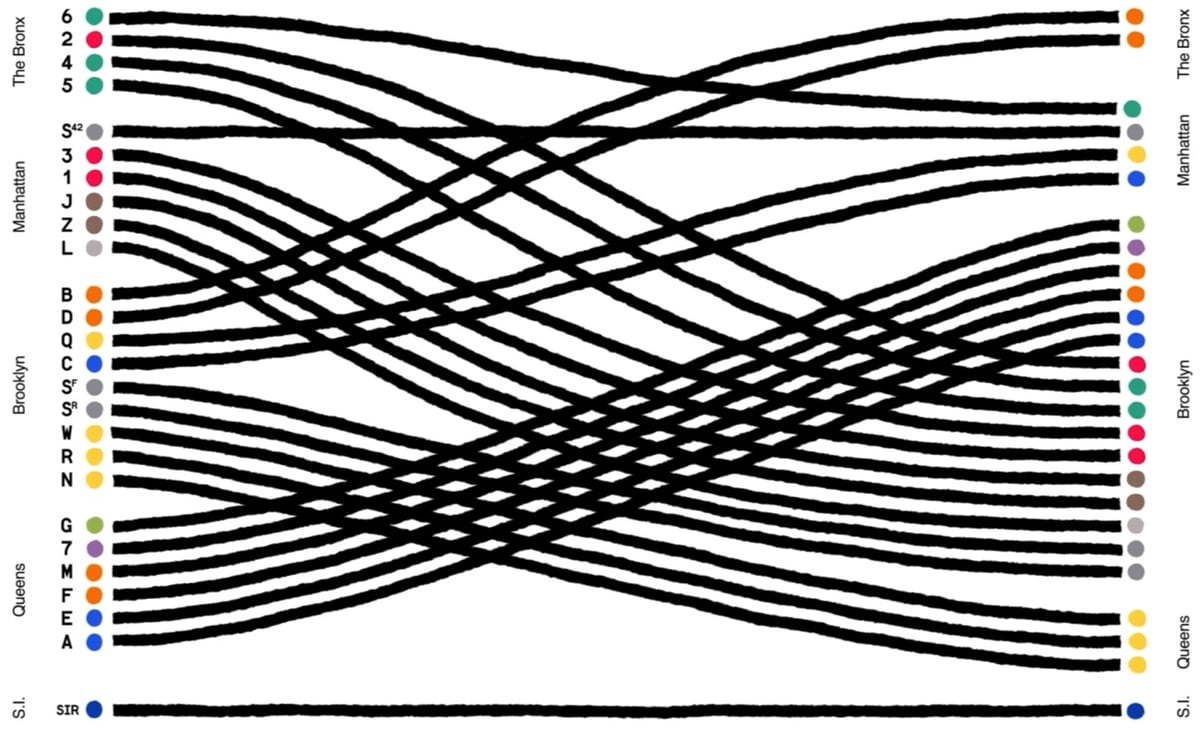
This was my present to my nephew for his 3rd birthday. He loves, loves, loves the subway so my sister asked me if I could make a custom map with all the places that mean something to him on the poster.
Upon tasting it, my immediate thoughts are mayo, ketchup, a little yellow mustard, a hint of garlic and paprika, perhaps a touch of cayenne pepper, and an elusive sour quality that I can't quite pinpoint. It's definitely not just vinegar or lemon juice, nor is does it have the cloying sweetness of relish. Pickle juice? Cornichon? Some other type of vinegar? I can't figure it out. This was going to take a little more effort.
Totally doing this for dinner one of these nights. We'll probably cheat on the ground beef...we've got some Pat LaFrieda patties stockpiled in the freezer.
In 1954, New York City forcibly evacuated a town on Governors Island and, for whatever reason, buried under several feet of dirt. Recently, while building a park, the buried town was discovered and now they are excavating it.
According to one of the archaeologists that was on site to answer questions, there was a single factory in town during the 1900's, which manufactured snow (remember, it was the 1950's, and year-round snow was difficult to come by back then).
Update: Oh, poop. This is some sort of art thing or something. I should not be posting things at 10:45pm. Calling it a night.
Fuck, it's worth a watch even if you have seen it ten times. Eisenberg's, Manganaro Foods, Keens, Le Veau d'Or, this show is like my NYC gastro-playbook. Watch it, love it, live it.
Nice fluffy towels
Believing in yourself
Finding a lost twenty in your coat pocket
Prince Edward Island
Coming home after being away for a while
Submarines
Supermodels
A kiss in the rain
He doesn't like paying rent, but he does like living in Manhattan. So what does he do? He lives in a van down by the river, literally. I spent a few hours with Jimmy and let him speak his mind.
A truly maddening article about the NYC school system and its interactions with government and the teacher's union.
These fifteen teachers, along with about six hundred others, in six larger Rubber Rooms in the city's five boroughs, have been accused of misconduct, such as hitting or molesting a student, or, in some cases, of incompetence, in a system that rarely calls anyone incompetent.
The teachers have been in the Rubber Room for an average of about three years, doing the same thing every day -- which is pretty much nothing at all. Watched over by two private security guards and two city Department of Education supervisors, they punch a time clock for the same hours that they would have kept at school -- typically, eight-fifteen to three-fifteen. Like all teachers, they have the summer off. The city's contract with their union, the United Federation of Teachers, requires that charges against them be heard by an arbitrator, and until the charges are resolved -- the process is often endless -- they will continue to draw their salaries and accrue pensions and other benefits.
It is actually pretty amazing how well the oven works. The first thing we made after pizza was a roasted chicken. I just can't describe how amazing it was. Not to mention the pizzas. They cook in about 90 seconds, and when I pulled the first one out of the oven, and the backyard smelled like a pizzeria, we knew all the work was worth it.
Mark and I work in the same office and it's nice to hear that his daily phone conversations about stucco, stucco suppliers, stucco styles, and stucco application techniques have resulted in success.
After a lengthy stare down, the maitre d' shows you to your table. Once seated, you must adhere to two conditions: you will cook your own meal with your own ingredients, and no photography. If you refuse these terms, you will be warned that a crushing defeat will soon be brought down upon your soul. Don't give in, though; stick to your guns (to coin a phrase), and ask calmly for a menu. But don't press your luck by asking for water. This is very important.
Friday, August 14th at 1pm marked the opening event of the Midtown Games: Olympics, and was attended primarily by the city's punch-drunk, heat-stroked interns. With the blare of a foghorn the crowd closed in like a shield, trumpets sang out "Eye of the Tiger" and five swimmers in Speedos and caps leapt into the burbly water of a decorative fountain to swim its 50 metres or so in elegant racing style.
In Lower Manhattan, my computer screen fizzled and the air conditioner cut off. While walking back to Brooklyn over the Manhattan Bridge I heard the following rumors: 1) The power's out in the entire country; 2) The power's out in the entire country and all of Canada; 3) There was an explosion and somebody's definitely behind this but I don't know who. (The last one was from a cop.)
I reach 18th Street. Some shops are open, most are not. The ice cream shop is doing good business. The owner of a bodega has barricaded the door with shelves of food and stands watch with his employees.
Serious Eats made a short documentary (~9 min.) about the Union Square Greenmarket and one of the farmers who brings his goods to the market every week.
At the beginning of the 20th century, the idea of moving walkways was in vogue. After successes in Paris and Chicago, plans were drawn up for a three-speed moving sidewalk across the Brooklyn Bridge to alleviate traffic on the crowded bridge.
With the Brooklyn Bridge walkway, Schmidt upped the ante. This time he envisaged a loop system at each end of the bridge, with a series of four ever-faster walkways. Passengers moved from one to another until finally taking a seat on the benches aboard the fastest, which whisked them across the bridge at 16 km/h [~10 mph]. Because the system ran constantly, there would be no waiting and little momentum lost on stops and starts.
At best, it would take 167 inbound lanes, or 84 copies of the Queens Midtown Tunnel, to carry what the NYC Subway carries over 22 inbound tracks through 12 tunnels and 2 (partial) bridges. At worst, 200 new copies of 5th Avenue. Somewhere in the middle would be 67 West Side Highways or 76 Brooklyn Bridges. And this neglects the Long Island Railroad, Metro North, NJ Transit, and PATH systems entirely.
Kinda puts the subway in perspective, doesn't it? And don't miss the map at the bottom that shows the size of the parking lots needed for all those cars.
Of Wrestling with Moses, the story of how Jane Jacobs took on Robert Moses and his plans for two Manhattan freeways, Tyler Cowen says:
The parts of this book about Jacobs are splendid. The parts about Moses are good, though they were more familiar to me. I believe there has otherwise never been much biographical material on Jacobs's life.
Writing about the city remained her passion. She often went up to the rooftop of her apartment building and watched the garbage trucks as they made their way through the city streets, picking the sidewalks clean. She would think, "What a complicated great place this is, and all these pieces of it that make it work." The more she investigated and explored neighborhoods, infrastructure, and business districts for her stories, the more she began to see the city as a living, breathing thing -- complex, wondrous, and self-perpetuating.
The NY Times has named their replacement for outgoing restaurant critic Frank Bruni: current Times editor Sam Sifton. This is good news for me...I look a bit like Sifton; if I'm mistaken for him and incur favorable treatment at restaurants because of it, I won't complain.
This is a documentary about vogueing, and the extremely refined and detailed aesthetic sensibilities it reflects, shot in New York City around Chelsea, the Meatpacking District, and Harlem in the mid- to late-80s. The city has changed in dramatic ways since then, to say the least. The characters of the film are complete outsiders with, at the same time, a deep understanding of the world they are outside of.
Manhattan is the national capital of disparate subcultures of the skinny: Aspiring models. Nightclubbing hipsters. Gay men with the time and money to chisel their physiques at the gym. Park Avenue society matrons who remain preternaturally slender into their 70s, the "social X-rays" satirized by Tom Wolfe.
When 2/3 of the American population is considered outside the normal range when it comes to their BMI, how long will it be before the standards are modified to reflect the new norms?
Gothamist's Jake Dobkin attended a public discussion of "Rules for City Issued Press Credentials" in NYC today and took some good notes. The proposed new rules address some inconsistencies in the city's issuing process...in particularly the denial of press passes to bloggers and other online publications.
Restrictions limiting press passes to certain mediums will be removed -- in the future, online, offline, on-air, etc. will all be treated equally. To qualify for a press pass, the journalist or journalism organization will need to provide six clips from the last 24 months showing news-gathering activity that would merit a press card -- that would include live reportage from police and fire scenes, public assemblies, government press conferences, or similar events.
Public dollars helped create Central Park in the 1850s. And public responsibility dictates that we transform this underutilized asset into something we so desperately need today. Manhattan Airport will prove New York City no longer allows it's vestigial prewar cityscape to languish in irrelevance but instead reinvents these spaces with a daring and inspired bravado truly befitting one of the world's great cities. The moment is now.
And about those special Central Park landmarks?
Under the current plan the Imagine mosaic and Strawberry Fields will be preserved however they will be located indoors within the main terminal concourse. Tavern on the Green will be given the option of applying for a franchisee lease in the concourse food court.
GVSHP first proposed the street co-naming in 2006 shortly after Jacobs' death; the proposal was approved by the local community board and the City Council, and then sat in limbo for 2 1/2 years.
Also, the townhouse that Jacobs lived in on the street is for sale. (thx, meg)
Exit Strategy NYC is an iPhone app that tells you where to get on the subway train so as to be in an optimal position when you get off.
Taking the 1 train uptown to 28th street? Get on right behind the middle conductor. Need to transfer to the L at Union Square from the N downtown? Ride in the 1st car. Detailed diagrams eliminate the guesswork and frustration from your ride, making your subway trip easier and faster.
There will also be one large meal, a free picnic in Central Park where eight chefs will each contribute a dish to what Luc Dubanchet, the founder of Omnivore, calls a "bento box performance." Then there will be a series of demonstrations at the Alliance Francaise, master classes held by an impressive roster of French and American chefs (the final program is still being decided).
The MTA is trying to sell the naming rights to the Atlantic Ave subway stop in Brooklyn to Barclays, a London bank. If approved, other rights may be sold as well. Yes, let's make the NYC subway even more confusing than it already is, although I'm sure the MTA will come up with some reason that cramming "Domino's® Breadbowl Pasta™ Station" onto a map makes more sense than "23rd Street".
On the other hand, a casual study of the NYC subway map reveals the following brand names already in use:
Rockefeller Center
Columbia University
JFK Airport
Museum of Natural History
Lincoln Center
Hunter College
Yankee Stadium
Aqueduct Racetrack
Times Square
Herald Square
NY Aquarium
World Trade Center
Brooklyn Museum
Mets
But, without exception, station names are derived from nearby landmarks: streets, airports, schools, stadiums, squares, parks, etc.
A pair of related articles from the New Yorker last week. The first is a Talk of the Town piece on a water-pistol ambush game played by the students at a New York City private school.
Willis Cohen was finally killed through no fault of his own. He woke up one day and, as usual, hopped a neighbor's fence and exited through another house. He caught a livery cab on Amity Street and headed north to the Heights. He knew he was in trouble when his driver refused to raise the windows. A member of the Gaisford team shot him in the chest through the cab's passenger-side window as he pulled up to the school.
The second is a piece by John Seabrook is about David Kennedy and his approach to reducing gang-related murder through a combination of community support and "one strike and everyone's out" policy.
At the initial call-in, Victor Garcia was the first to speak. He told the young men that he loved them, that they had value to their community, and that he knew they were better than their violent actions implied. Afterward, Chief Steicher addressed them, thanking them for coming, and making it clear that "this is nothing personal." He then delivered the message: "We know who you are, we know who your friends are, and we know what you're doing. If your boys don't stop shooting people right now, we're coming after everyone in your group."
Without too much trouble, you could imagine either of these excerpts appearing in either article. A curious editorial decision to run them in the same issue.
Geeking Out sounds interesting, but I can't go. Perhaps you'd like to?
This month, we'll be discussing the interaction between science and religion with speakers including: astrophysicist and Is God a Mathematician? author Mario Livio; psychologist Paul Bloom, the author of Descartes' Baby; and The GOD Part of the Brain author Matthew Alper, one of the founders of the field of neurotheology. The work of local artists will be on display as well.
Geeking Out will be held Thursday, June 18th, at 7:30 pm (doors open at 7:00 pm) at the JLA Studios art gallery on 63 Pearl St in the DUMBO neighborhood of Brooklyn. Admission is FREE. Drinks will be available. Please spread the word and bring your friends.
While many organic dairy farmers who supply big producers have been suffering in the recession, Mr. Hesse says demand for their milk and cream has been growing and that they'd like to start selling in more markets. He's also thinking about producing yogurt and ice cream.
The minimum investment is $1000 and the notes offer 5-7% interest.
The reception was an incredibly fun time. We had planned to stage the mission for more than one couple, but Frank and Raff were just too perfect. They stayed for over an hour and completely yes-anded everything we threw at them. There were moments where it felt like we actually did all know each other and you sort of forgot you were "acting."
But for some New Yorkers, a vegetable-filled rooftop is far more conceivable and practical than moving to the country. Novak agrees. "When these farmers go in and lecture these inner city kids about dairy farming in upstate New York, it's in one ear and out the other. But I can tell them, I have two farms in the city," and they can take the subway and come help on the weekends.
The New York Transit Museum has developed an extensive online version of their The Future Beneath Us exhibit, featuring eight NYC-area underground projects that are currently under development. The exhibit is on display in two Midtown locations until July 5. (thx, michael)
The Hudson's main current has, for all of recorded history, clung to lower Manhattan's edge, skimming along the West Side. Battery Park City, built in the seventies, juts out into that flow, and since then, the current has been cutting a new channel, out toward the center of the river. That current is scraping mud off the top of the Lincoln Tunnel where it never did before; the underwater traffic tubes have lost 25 percent of their soil coverage in some spots. If the tubes ever became exposed, they would be at risk for shifting, cracking, and terrorist threats.
In addition to greater safety and access for pedestrians and cyclists, the project hopes to improve car traffic flow through the areas.
- Traffic lights with up to 66% more green time - Significant travel time improvements on Sixth and Seventh Avenues - Faster bus speeds for 70,000 daily riders
Here's a rendition of how Times Square will look after the work is completed in August.
Hopefully this change will become permanent and the city can plant some trees there as well. Imagine, trees in Times Square! Lots more information is available on the DOT site.
I really like the subway travel time heatmaps on Triptrop NYC.
Put in an address and you get a map of how far away everything is using the subway. 15 minutes, forty minutes, two hours -- all set up with nice little colors. That's pretty easy, I think. Triptrop can help you find a convenient place to live. It's also a nice way to tell your friend to stop inviting you to the purple part of the Bronx, or to prove that the G isn't actually that bad.
In his spare time, between aerobic eating and the requisite gym time to burn it all off, he has managed to produce a memoir of his lifelong, complicated relationship with food. Recognizing that the book is certain to seriously compromise his ability to be a spy in the land of food, Frank picked this as a natural time to move on. He will be turning in his restaurant-critic credentials when his memoir, "Born Round: the Secret History of a Full-Time Eater," is published in late August.
Sad to see him go...I liked Bruni as a reviewer. But how long can the Times continue to expect their critics to remain anonymous? Savvy restaurateurs often knew when Bruni was in the house and it remains unclear whether a known reviewer is a biased reviewer.
Option 1: Two tickets to Tuesday night, June 30, Mariners at Yanks, cost for just the tickets, $5,000.
Option 2: Two round-trip airline tickets to Seattle, Friday, Aug. 14, return Sunday the 16th, rental car for three days, two-night double occupancy stay in four-star hotel, two top tickets to both the Saturday and Sunday Yanks-Mariners games, two best-restaurant-in-town dinners for two. Total cost, $2,800. Plus-frequent flyer miles.
The result, after much whacking, is, I think, compelling, but you'll have to see for yourself. The general idea it that the history of subway ridership tells a story about the history of a neighborhood that is much richer than the overall trend. An example, below, shows the wild comeback of inner Williamsburg, and how the growth decays at each successive stop away from Manhattan on the L train.
The CBC has a clip of Jane Jacobs talking about Toronto and Montreal from 1969. In it, she makes the distinction between the two urban organizational forces at work in Toronto, a sort of "civil schizophrenia": the vernacular spirit ("full of fun") and the official spirit ("stamp out fun"). I also found a video on YouTube about Robert Moses and his difficulties with Ms. Jacobs which concludes with a cheeky update of Arnold Newman's iconic photo of Moses.
This is a little bit brilliant. Here and There are a pair of maps of Manhattan that start from an on-the-street viewpoint and curl up as you gaze uptown or downtown until you see the rest of the island from a traditional "flat map" view.
As the model bends from sideways to top-down in a smooth join, more distant parts of the city are revealed in plan view. The projection connects the viewer's local environment to remote destinations normally out of sight.
Prints are available. This is like a 3-D version of the spider maps for London buses, in which a local street grid relays information about the immediate vicinity while the surrounding schematic shows connections to the rest of the system.
Update: Ooh, these science illustrations from NISE use a similar technique to simultaneously show the internal and external structure of their subjects.
These illustrations show familiar objects across ten orders of magnitude-from familiar aspects down to the level of their constituent atoms. Vast scale differences are usually shown through separate images (e.g., the Eames' Powers of Ten). This illustration employs the artistic convention of perspective-typically used by landscape painters-to show multiple scales in one frame.
It's one thing to become a New Yorker; it's so much weirder to become a New Yorker that all the other New Yorkers know.
Lauren Hutton wasn't going to stay in NYC at all:
I was supposed to meet a friend in New York, and we were going to take a tramp steamer to Tangier. It was going to cost $140. Once I got there, my plan was to take a bus for ten cents to the outskirts of town and see elephants and rhinoceroses and giraffes. I was as ignorant as a telephone pole.
The first night I moved here, I met Madonna. She walked up to me at the opening of Club USA with a lollipop and a beer, and she was like, "Hmmm, you look cute." And I was like, "You're Madonna!" I'm like, This is New York. Wow.
Danny Meyer eventually realized he should be in the food business:
I entertained all the time, hosting lovely brunches where I would go out and source the best cheeses and pates I could find, which was a big deal for a 22-year-old back then.
Nick Denton moved here from San Francisco:
I finally decided to come here after 9/11. The foreign press was full of love letters to New York. Writers like Martin Amis were waking up and thinking, "Oh my God, we almost lost it!" I know it sounds sentimental, but no one would ever write a love letter to San Francisco.
My wife and I decided to move here after a visit in early 2002, which visit was influenced by some of the same writing Nick refers to. All these people writing so passionately about a place, it must be pretty special. We decided to check it out. But more specifically, we moved here so that Meg could start a company with Nick.
While the company didn't work out so well, moving here was one of the best decisions we've ever made. We picked the smallest apartment on the fifth floor of the crappiest building on one of the best blocks in NYC. I sporadically freelanced for Gawker and a few other companies but didn't find a full-time job until about 6 months in. But a pleasant walk home down tree-lined streets, good light into our small bedroom, an apartment layout suited perfectly to our furniture, and the intense immensity of the city made all the difference.
Everything was still new and exciting to us. Your first year in New York is great because there's so much you think you and your friends discovered, like "a great little burger place called Corner Bistro" or "the best corn in the world at this place Cafe Habana."
Ha! Meg and I discovered "these great cupcakes at this place called The Magnolia Bakery" shortly after moving here.
I met one of Ricky's partners, Zach Klein, through Nick Denton (him again!); we had brunch together one Satuday morning shortly before their New Yorker piece ran. The meal probably couldn't have gone much worse. I'd just had all four of my wisdom teeth pulled the day before, so I was all bloody and jacked up on Vicodin, trying to eat salad even though I don't care for it very much and wasn't that hungry anyway, and wondering why in the hell Nick wanted me to meet this guy who ran a joke and boobs site for college kids. After recovering my health and senses, I eventually met Ricky, Josh, and Jakob and got to go to a couple of those fantastic parties. The cabinet of crystal was indeed weird. (thx, andy)
It will be high, it will be long, and it will be outdoors in a very recognizable location that he does not want revealed quite yet -- arrangements are not final.
Also, the New Yorker has a story in this week's issue (subscribers only) about Alain Robert, another Frenchman with a thing for tall buildings.
Robert is a vertical tourist. He has traversed the planet on a dogged, gutsy tour of the world's high-rises and, then, its jail cells and holding pens. Of the world's ten tallest buildings, he has climbed five. Most of the remaining half are in China, which he has been banned from entering since 2007, when he climbed the Jin Mao Tower.
Banh Mi Saigon Bakery, one of my favorite places to get my lunch on, gets a shout-out in the NY Times. The bread is really fantastic. I'm intrigued by the sandwich at Silent H called the Greenpoint:
Elsewhere in Brooklyn, where authenticity is not as strictly enforced, Vinh Nguyen has created a succulent banh mi at Silent H called the Greenpoint: a tribute to the area's many traditional Polish butcher shops. Instead of cha lua, smooth pork terrine, he lays on Krakowska kielbasa, a smoked sausage. "That smokiness and pepperiness makes perfect sense on a banh mi," he said. "I would be a fool to ignore these great traditional products being made in my neighborhood."
In 1879, Brooklyn papermaker Robert Gair developed a process for mass producing foldable cardboard boxes. One of the paper-folding machines in his factory malfunctioned and sliced through the paper, leading Gair to the realization that cutting, creasing, and folding in the same series of steps could transform a flat piece of cardboard into a box.
Gair's box, a cheap, light alternative to wood, became "the swaddling clothes of our metropolitan civilization," Lewis Mumford wrote. Eventually, the National Biscuit Compnay introduced its first crackers that stayed crispy in a sealed paper box, and an avalanche of manufacturers followed. Gair expanded to ten buildings on the Brooklyn waterfront. Massive migration from Europe to the United States created a manufacturing workforce in Brooklyn, to curn out ale, coffee, soap, and Brillo pads -- and Gair made boxes right beside them.
Gair's concentrated collection of buildings eventually led the area between the Brooklyn and Manhattan Bridges to be called Gairville. That area is now known as Dumbo and, in addition to tons of residential space, the neighborhood is home not to manufacturing but to architecture firms, web companies, and other creative industries.
The Gair Company's most iconic building was also its last: the Clocktower Building, also known as Gair Building No. 7. I tracked down several of the other Gair buildings and put them on this Google Map.
This was true for me, at least, while I was making these; Hand erasing buildings through SoHo, TriBeCa, and the LES was an eery experience as I tried to imagine what these places would really look like if my brush was a bulldozer.
An organization called FIGMENT is building an 18-hole mini golf course on Governors Island and they are accepting design proposals through March 31 from artists, designers, and other would-be mini golf course builders.
The Challenge: Design and construct a single hole for this mini golf course, following the theme "City of Dreams." Designs will be judged and selected on creativity, structural integrity, playability, feasibility, adherence to theme and budget.
Drain (1975) MTA and unknown artists Mixed Media on Metal and Concrete
Describing the irresistibility of natural urges, and situated thematically near the restroom, this drainage grate offers deliverance. Consequently, here lies an indeliable yellow nitrogen stain, as evidence of the passings of hundreds, if not thousands of strained commuters. Each straphanger, surreptitiously seeking relief, has helped create this totally organic, revolutionary art piece.
5. Fill in the Harlem River, which separates Manhattan and the Bronx. The Harlem River did not become a navigable waterway until 1895, when the Army Corps of Engineers dredged a shipping canal that provided direct passage for vessels from the East River to the Hudson. Nineteen years later, the creek that had served as the northern boundary of Manhattan was filled in, leaving the neighborhood of Marble Hill, still technically part of Manhattan, physically attached to the Bronx.
In a bid to avoid the wrecking ball, Venturi's Lieb House is traveling by barge from the New Jersey coast to the north shore of Long Island. During the two-day trip, the house will journey through the Atlantic Ocean, across New York Harbor, up the East River, and into Long Island Sound -- a distance of about 75 miles, as the seagull flies.
The floating house will be shown in an upcoming documentary about Venturi, his wife, and their architectural practice. (thx, ed)
The NY Times has a nice interactive map showing the results from a city-wide poll that asked New Yorkers to evaluate how they feel about crime, education, the 311 service, and dozens of other things. Correlation is not causation but you can almost see the broken windows theory in effect here...high crime areas generally seem to correlate with neighborhoods that have graffiti, subpar trash pickup, and are unclean.
Today, the Transportation Department has gotten serious about biking, and in just three years, the agency has painted bike lanes (good), constructed bike lanes separated by parked cars (great) and bike lanes separated by medians or barriers (the best) and installed bike signals, bike signs and many bike symbols painted on the street.
Sullivan also notes that because of this increased use, pedestrians and car drivers (usually natural enemies) now share a dislike of bikers who run red lights, ride on sidewalks, weave through traffic, and blow through busy crosswalks. He offers four ways that bikers can improve their perception with the public.
NO. 1: How about we stop at major intersections? Especially where there are school crossing guards, or disabled people crossing, or a lot of people during the morning or evening rush. (I have the law with me on this one.) At minor intersections, on far-from-traffic intersections, let's at least stop and go.
Suggestions for pedestrians (don't cross against the light when a bike is coming, don't stand in the bike lane while waiting to cross the street, etc.) and cars (don't park in the bike lane, don't wait to turn in the bike lane, etc.) would be helpful too.
The clip shows an analysis of the plaza of the Seagram Building in NYC and what makes it so effective as a small urban space.
A busy place for some reason seems to be the most congenial kind of place if you want to be alone. [...] The number one activity is people looking at other people.
The video was adapted from a book of the same name by William H. Whyte, who is perhaps most well known as the author of The Organization Man. The video is largely out of print -- which is a shame because that clip was fascinating -- but I found a DVD copy for $95 (which price includes a license for public performance). (via migurski)
Due to the quirks of the NYC-area bridge toll system, truckers traveling between New Jersey and Long Island often take the Verrazano Bridge on the way into town (for free) but cut across downtown Brooklyn and lower Manhattan and out via the Holland or Lincoln Tunnels (for free) on the way out of town to avoid the steep toll on the Verrazano, creating a daily truck tsunami in areas of the city that aren't equipped to handle it. (thx, david)
A Continuous Lean found some great Life magazine photos of Sherman Billingsley, the owner of a famous NYC nightclub called The Stork Club, which club was frequented by celebrities, artists, and the well-to-do from 1929 to 1965. In the photos, Billingsley is pictured at his club giving secret hand signals to his assistant while sitting with guests.
Closeup of Stork Club owner Sherman Billingsley [with his] palm up on table, one of his signals to nearby assistant which means "Bring a bottle of champagne," while sitting w. patrons over his usual Coca Cola, in the Cub Room.
Billingsley's signals cleverly allowed the club to provide seamless good service to his favored patrons while also letting him be the bad guy with less favorable customers without them knowing it. Billingsley went on to be the third base coach for the Yankees in the late 60s. (Untrue.)
The doorbell rang at seven p.m. at the family house in Fort Lee, New Jersey, right across the Hudson River from Manhattan. "I opened the front door and there was Marlon Brando, James Caan, Morgana King [who played Don Corleone's wife], Gianni Russo [who played Don Corleone's son-in-law, Carlo], Al Ruddy [the film's producer], and my uncle Al [Lettieri]," recalls Gio. "We all went downstairs into the family room, where the table was set and where we had the pool table and the bar."
Hannah Emily Upp suffers from dissociative fugue, "a rare form of amnesia that causes people to forget their identity, suddenly and without warning, and can last from a few hours to years", which caused her to disappear from her usual life for three weeks until she was found floating, alive, in New York Harbor.
Its most famous sufferer is the fictional Jason Bourne, the secret agent made flesh on film by Matt Damon. The Bourne character takes his name from Ansel Bourne, a Rhode Island preacher who suffered the earliest recorded case of the condition when he was en route to Providence in 1887. The preacher continued to Norristown, Pa., where he opened a store and lived with another family, until one day he "woke up."
Although it seems counterintuitive, officials believe the move will actually improve the overall flow of traffic, because the diagonal path of Broadway tends to disrupt traffic where it intersects with other streets.
The streets will become pedestrian malls instead. Love this.
Which is safer, the Wild West or present-day New York City? A look at the murder statistics shows that you were less likely to be killed in the notorious cowboy towns of the 1870s and 80s than in NYC today.
In Abilene, Ellsworth, Wichita, Dodge City, and Caldwell, for the years from 1870 to 1885, there were only 45 total homicides. This equates to a rate of approximately 1 murder per 100,000 residents per year.
By contrast, the 2007 murder rate in NYC was 6 per 100,000 residents and Baltimore's was 45 per 100,000 residents. (via david galbraith)
At 5:40am I was jolted out of sleep by a noise. BANG. BANG. BANG. BANG. BANG. I raced outside, I looked down, I saw the black car with its door open. I saw another car next to it. I saw the body in the middle of the street. I stood. I gawked.
In a notice pasted on a wall inside the front door [of his video store], he wrote, "We hope to find a sponsor who can make this collection available to those who have loved Kim's over the past two decades." He promised to donate all the films without charge to anyone who would meet three conditions: Keep the collection intact, continue to update it and make it accessible to Kim's members and others.
Gothamist reports that a small memorial service was held for beloved NYC veggie peeler salesman Joe Ades on Saturday afternoon in Union Square.
As an answer to questions of how Joe's legacy of unique salesmanship would be carried on, Ruth answered "My father always told me that my inheritance would be forty cartons of peelers, and it was. He left them all to me. I'm going to go home and practice on some potatoes, and then come out to his old spot on 17th and Union Square West and show all of you."
His children also said that two days before he died, Joe received his US Citizenship.
In Rockefeller Center Ho!, published in the Talk of the Town section of the Feb 11, 1956 issue of the New Yorker, John Updike described the discovery of a path from the Empire State Building to Rockefeller Center that didn't make use of 5th or 6th Avenues. Instead he cut through building lobbies, parking lots, and underground passages on his way through the thicket of Midtown's tall buildings.
Recently a pair of New Yorker staffers set out to discover if Updike's journey could still be made and brought back photographic evidence.
A stingy parking attendant refused to let us pass through his gate to Fortieth Street. Faced with no other option, we offered to pay the half-hour fee to park a car; his bemused manager finally let us through without charge.
Many who work in Midtown use shortcuts like these on especially cold days (like today) to minimize the time spent outside while walking from the train or bus. I only worked up there for a couple of years, but I still learned a cut-through trick or two.
Mayor Bloomberg held a press conference today to address the mysterious maple syrup smell sporadically experienced by New Yorkers since 2005. The cause? Fenugreek seeds.
The source of the odor was a plant in North Bergen, N.J., which processes seeds of the herb fenugreek to produce fragrances.
NY Times food critic Frank Bruni notes that in this down economy, it's easier to get reservations and deals at even the hottest restaurants as they struggle to remain profitable. And the service is less haughty.
"The attitude that a number of places used to have, they don't have that anymore," Ms. Rappoport said, her tone of voice communicating equal measures bewilderment and relief. "That attitude of 'we're doing you a favor,' that frosty condescending attitude -- I don't find that anymore. And I've experienced that change over and over again." Servers, she said, make double- and triple-sure that her table has everything it needs. Managers circle back to the table more often than ever to ask, with new urgency, if everything's O.K.
For opportunistic diners, there are at least three big advantages to this trend.
1. Great food at relatively reasonable prices.
2. Dining opportunities at great but previously unavailable restaurants at good times.
3. The chance to become a highly valued regular at your favorite restaurant. If they're doing things right and you support them when times are tough (visit often, tip well, etc.), they'll gratefully reward you in better times with reservations at prime times, VIP treatment, and dishes "courtesy of the chef".
Joe Ades, the gentleman vegetable peeler salesman familiar to all who roamed the streets of Manhattan, died on Sunday. He was 75.
Ms. Laurent said she sometimes went to look for him at the end of the day, but he would have packed up and left after selling out. She could tell where he had been. "He cleaned up really well," she said, "but still there were these little shreds of carrots that said, 'I was here.'"
None of this myth busting denigrates the fact that Ades was a charming and charismatic New York character. But if, in future, Ades is remembered as an aristocratic, fancy suited, upper-class English dandy that hawked vegetable peelers as an ironic hobby, that would be wrong and actually less interesting.
Peter Stuyvesant was the director-general of the New Netherlands colony from 1647 to 1664, when the Dutch lost it to the British and New Amsterdam became New York. When Stuyvesant arrived in New Amsterdam, he brought a pear tree with him and planted it on his farm, which encompassed much of what is now the East Village. After a trip to Amsterdam following the English takeover of the colony, Stuyvesant returned to his farm in New York, where he lived until his death in 1672.
His pear tree persevered. As Manhattan's grid sprang up around it, the tree remained bearing fruit on the corner of 13th Street and 3rd Avenue. Here's a stereoscopic photo of the tree from the 1860s.
In 1867, over 200 years after the tree was planted, the last known living link to the Dutch rule of Manhattan was felled by a vehicle collision. The NY Times ran a short piece about the death of the tree: Untimely End of the Stuyvesant Pear-Tree.
The well-known pear-tree planted by Gov. Stuyvesant, and which has stood for two centuries, came at last to a sudden demise during the latter part of last week. This old and famous tree stood on the corner of Thirteenth-street and Third-avenue, in a circular enclosure of iron railing, erected, we believe, by Mr. Wainwright, a descendant of the old Dutch Governor. It had its traditions, though it was less renowned than the famous Charter Oak of Connecticut, but like that old tree, it had been made the subject of many a sketch. Its decay was marked year by year in the declining average of its blossoms, but it was not considered beyond bearing before the occurrence of an accident which cleft the ancient trunk in twain. The destruction of this old landmark is stated to have resulted from a collision of vehicles, one of which was thrown against the tree with sufficient force to break it down. Laborers were engaged in removing the limbs and trunk yesterday, which were proclaimed obstructions to travel.
N.B. From what I can tell from my research, the plaque may be wrong about the date that the tree was planted. It states that Stuyvesant brought the tree back with him after the English took control of New Amsterdam in 1664 whereas most other sources on the matter indicate that Stuyvesant brought the tree with him when he came to assume control of the colony in 1647.
Newcomers suddenly realize either that the city is not working for them or that they are inexorably becoming part of it, or both. They find themselves walking and talking faster.
The subway begins to make sense. Patience is whittled away; sarcasm often ensues. New friends are made, routines established, and city life begins to feel like second nature. In other words, newcomers find themselves becoming New Yorkers.
First the videos. Someone visiting the Bronx Zoo caught the plane on video, flying low in the sky just after the bird strike. A Coast Guard video monitoring station got a shot of the plane just after it splashed down...you can see the spray from the impact flying in from the left of the video just after the 2:00 mark.
Soon after the plane hits, the camera zooms in and you can see just how quickly people get out and onto the wings. And then this video shows it most clearly:
Look how low and level and steady Sully guided that thing in! Amazing!
The life raft attached to the plane was upside down in the river, just out of reach. Mr. Wentzell turned and found another passenger, Carl Bazarian, an investment banker from Florida who, at 62, was twice his age. Mr. Wentzell grabbed the wrist of Mr. Bazarian, who grabbed a third man who held onto the plane. Mr. Wentzell then leaned out to flip the raft. "Carl was Iron Man that day," Mr. Wentzell said. "We got the raft stabilized and we got on." A man went into the water, and the door salesman and the banker hauled him aboard. He curled in a fetal position, freezing.
The Times also comes through with the 3-D flight graphic I asked for the other day but they upped the ante with a seating chart of the plane where you can click on certain passengers' seats to read their thoughts. Mark Hood in seat 2A described the landing:
When we touched down, it was like a log ride at Six Flags. It was that smooth.
The mayor gave Sully the key to the city for landing the airplane safely into the Hudson River but surely he deserves more...like a job in the Obama administration as the Secretary of Transportation (no offense to Mr. LaHood).
This pilot ran out of altitude and airspeed but not ideas. He did a great job of flying, and as a CAPTAIN, he has shown why he wears the four bars!!!
This is an example of quiet professionalism, training, skill, and bravery. Our craft usually goes unnoticed many times a day, but today, we saw our best work!!!
I remember once going to collect my dad after he'd landed his plane in a farmer's field in an emergency. Of course, it was a much smaller plane -- they're a lot easier to land without engines and glide well. That and he was accustomed to landing amongst the corn and hay...we had a grass strip cut out of the field behind our house that he used all the time.
A US Airways plane bound for Charlotte just crashed into the Hudson River after aborting its takeoff from LaGuardia Airport. It's still sitting in the river, slowly sinking with people standing on the wings being rescued by ferries. Photos on Flickr.
Update: Here's a screenshot from a flight tracker showing the altitude of the flight....1800, 2800, 3200, 2000, 1600, 1200, 1300, 400, 300... The flight tracker has since taken the data offline.
Update: Some media coverage at NY Times, CNN, and Gothamist. From the CNN article:
The plane approached the water at a gradual angle and made a big splash, according to a witness watching from an office building. "It wasn't going particularly fast. It was a slow contact with the water that it made," said the witness, Ben Vonklemperer. "It appeared not to have landing gear engaged. This was bigger than a puddle-jumper or sea plane. It was a silver aircraft and it basically just hit the water," Vonklemperer added.
Gothamist reports that the plane is being towed to Chelsea Piers.
Update: The NY Times has this helpful map:
Also, an office mate (from Buzzfeed) just got back from checking out the plane and he said by the time he got to the river, the plane had past Christopher St. and when he left, it was pretty close to Canal St. and "moving amazingly fast". (thx, scott)
In 1963, an Aeroflot Tupolev 124 ditched into the River Neva after running out of fuel. The aircraft floated and was towed to shore by a tugboat which it had nearly hit as it came down on the water. The tug rushed to the floating aircraft and pulled it with its passengers near to the shore where the passengers disembarked onto the tug; all 52 on board escaped without injuries. Survival rate was 100%
The first recorded birdstrike happened in 1908 to Orville Wright, no more than a few months after the first powered planeflights.
Surely years and not months... (thx, mike)
A live shot on the TV just now (6:00pm) reveals that the plane is now down at the Battery and they look like they're trying to secure it or haul it out of the water (likely the former).
Here are a pair of articles from 2002 on street fashion photographer Bill Cunningham, who currently plys his trade for the NY Times. (I love Cunningham's On the Street dispatches.) The first is Bill on Bill, where the photographer recalls how he got interested in fashion and photography.
As a kid, I photographed people at ski resorts -- you know, when you got on the snow train and went up to New Hampshire. And I did parties. I worked as a stock boy at Bonwit Teller in Boston, where my family lived, and there was a very interesting woman, an executive, at Bonwit's. She was sensitive and aware, and she said, "I see you outside at lunchtime watching people." And I said, "Oh, yeah, that's my hobby." She said, "If you think what they're wearing is wrong, why don't you redo them in your mind's eye." That was really the first professional direction I received.
He taught me how to tell a story with pictures and that it didn't always involve the best image. I'd say to him, "But isn't this a better photo?" And he'd say, "Yes, child, but this photo tells the story better." For him, it wasn't about the aesthetics of photography. It was about storytelling.
Both articles mention that Cunningham got his first street photography into the Times when he shot a photo of the famously reclusive Greta Garbo walking on Fifth Avenue. I couldn't find Cunningham's Garbo photo anywhere online so I tracked down the Times article and found only this poor scan:
Here's another shot Cunningham made that same day which didn't end up in the paper (Garbo's got her hand over her face). Interestingly, street photos of Garbo were not particularly rare. Here are a selection from the 1980s, including several that feature Garbo in similar clothing. Many of them were taken by creepy paparazzo Ted Leyson, who stalked Garbo for more than 10 years in NYC. Leyson took what is believed to be the last photo of Garbo before she died in 1990.
Even in Manhattan, abandoned buildings can still be found. Jake Dobkin took some photos of an abandoned school in Harlem.
This building looked like it had been empty for twenty years. Trees were growing out of the floors and poking out of dozens of holes in the roof. All the windows were gone, and the floors that weren't covered with snow were thick with dust and the skeletons of dead pigeons. There wasn't any evidence of human habitation -- no footprints, homeless encampments, or graffiti.
He also found an abandoned ballroom, also in Harlem.
It was September 29th; exactly two months from the Saturday of Thanksgiving break and one of the few times I would be able to make the trek up to New York to dine at Per Se. I would have to call to make the reservation at Per Se at exactly 10 A.M today if I had any hope of getting that Saturday reservation. The only problem? I had school.
I sat patiently in my 9:30 - 10:25 science class as the clock neared 10. Very strategically, at exactly 9:57, I innocently asked to use the bathroom. I walked, no sprinted to the bathroom down the hall. I scrolled down my contact list until I reached Per Se, then dialed, and waited...
You remember the episode where Carrie spills the cappuccino because she's looking after the dog and has lost the manuscript with a description of oral sex with the Russian and then oh my God she bumps into Big who she hasn't seen since that time with the martini olives and the hemorrhoids? Well, if you look to the right, that's the cafe, and it's like oh my God bad hair dog blow job cappuccino hell. You remember that of course.
Oh, just one more excerpt:
I suppose a vibrator might be an impulse buy, and buying yourself one in front of 50 strangers with whom you then have to share a bus journey might be considered the height of liberated insouciance. But buying a sex aid because some actress has faked an orgasm on TV with it is evidence that there's more wrong with your social life than can be fixed by a dildo.
Update: The inbox consensus seems clustered around the opinion that this train is running on the contemporary 4/5/6 line. Here's a 1904 map which shows the then-IRT line in question (in red). At 42nd St, the line runs crosstown to Times Square and then up the 1/2/3. (thx jason et al.)
Locations of interest in New New York (with photos), the setting for the events of Futurama in the year 3000. Includes Citihall, Taco Bellevue Hospital, Little Bitaly, the Metropolitan House of Opera, Original Cosmic Ray's Pizza, and Commander Riker's Island Jail. (thx, anthony)
Eat me daily rounds up a recent AIGA event about food. The most interesting tidbit came from Matteo Bologna's speech. Bologna designs restaurants, most notably for Keith McNally (Pastis, Balthazar, Morandi, Schillers, etc.).
Really fascinating was what he and McNally did for Pastis -- it doesn't actually have a visual brand. McNally wanted the restaurant to look like it had been in the neighborhood for years, so Bologna constructed this narrative of a family that had maintained the restaurant for a century, and each generation some element gets updated or redesigned, but without going for consistency or even style. The result is completely different-looking signage, awnings, menus, wine lists, checks... everything uses a different palette, type set, but its essential Frenchiness ties everything together. It's an anti-brand.
The name of the restaurant is thus a play on pastiche in addition to being named after the French aperitif. (via eater)
"Like so many restaurants across New York City, Saigon Grill was run on the backs of its workers," Mr. Cuomo said in a statement. "These workers allowed the business to thrive, and in exchange they were allegedly cheated out of wages, fined for ridiculous reasons" and, he said, "pulled into a painstaking ploy to cover it all up."
I photographed each corner just as I found it, almost always as seen from its diagonally opposite corner. Some of the photographs have no people and no traffic, others are completely dominated by people or even, in some instances, by traffic; the majority are somewhere in between. Most of the photographs simply show what people were doing on the corner when I got there: crossing the street or waiting to cross it, shopping, hanging out, riding a bicycle, and so on -- in short, doing what people do at almost any street corner anywhere in Manhattan.
The food truck man, Mr. Samolis, said he often gives free food to inmates who are released from Rikers with no money.
"They get released at 6 in the morning with nothing but a $2 MetroCard the jail gives them," he said. "So I'll give them a coffee and an egg sandwich, on credit. I know they're never going to pay it back, but I feel bad for them."
Initial designs show a glass-curtained tube with cutaways spiraling up and around the facade to reveal segments of terraced verdure, like cultivated patches on the side of a steep alpine slope. "We didn't just fill up the tower," the architect says. "We've taken space away [from the apartments] to create the gardens," which are actually balconies tucked within the envelope. "It's as if nature has come back into the city," he says.
For the BOk building, Yamasaki reprised the scheme of a Twin Tower at almost exactly half the scale: 52 stories and 667 feet tall, to the Twin Towers' 110 floors (1,362 and 1,368 feet). It has 31 steel perimeter columns per side, to the Twin Towers' 59, producing the same eye-boggling vertical lines on each face. (As Jean Baudrillard noted of the more famous pair, well before its destruction, it is "blind," with no side presenting a facade.) The BOk, too, has a bilevel lobby, whose height is matched by arched windows. But the arches are big and round, like a child's plain wooden building blocks, rather than the Venetian Gothic ogees that, in the World Trade Center, flowed directly into the perimeter columns.
For Berkshire bees, quitting time is about 5 pm. New York City bees, they work harder and longer. And as you can see, we're here before 7 am, and these bees are already starting to work, whereas the country bees won't be opening the doors till about 9 am. And these city bees will still be hard at work at 7 tonight! Maybe it's because it's warmer here or maybe it's the city lights. Whatever it is, they definitely work longer hours.
But in New York, bees are reprobate and illegal. They appear in the City Health Code's Section 161.01, along with an enormous list of animals "naturally inclined to do harm or capable of inflicting harm," lumped in with the truly ferocious/impractical-polar bear, cougar, alligator, whale-and a menagerie of the truly obscure. Actively encouraged by almost every other self-respecting cultural capital, the common honey bee, according to Health Department logic, must be banished along with binturongs, sea kraits, coatimundis, numbats and zorilles.
Graves has been at this awhile...a NY Times article called him the "Johnny Appleseed of New York beedom" in 1999.
All right, but why beekeeping? "After you do it, everything else in life is calm," said Mr. Solomon, the investment banker. "Let me tell you, 40,000 bees will teach you the power of concentration and patience."
As if this plethora of signs were not enough, the subway system also had a bewildering variety of other porcelain enamel and hand-painted signs. The porcelain enamel signs, either hung from the ceiling or posted on the walls, were directional as well as informational. The directional signs included those on the outside of the station entrances as well as those intended for the corridors and platforms underground. Many of the informational signs warned against criminal, dangerous or unhealthy behavior: no peddling wares, no leaning over the tracks, no crossing the tracks, no smoking, no spitting. The directional and informational ones were made by Nelke Veribrite Signs and the Baltimore Enamel Company, while the behavioral ones were the product of the Manhattan Dial Company. Most were lettered in some form of sans serif capitals-regular, condensed, square-countered, chamfered, outlined-though some were in bracketed or slab serif roman capitals. They were usually white letters on a colored background (often dark green for the IND and dark blue for the IRT and BMT), yet many were also black on a white background. There was no house style.
What is to modern eyes a beautiful disorder of tiled text and hand-painted enamel became an embarrassing shambles in the 70s and 80s. It was only in late 1989 that Helvetica became the official typeface for New York City subway system signage...about 20 years too late to prevent the current signage from looking dated.
Silver Towers is the first post-war urban renewal superblock development in New York City to be landmarked. While such urban renewal projects rarely receive high marks for design, Silver Towers is considered a watershed moment for one of the late 20th century's most respected and influential architects. The design won awards from the American Institute of Architects and the City Club, was dubbed "one of ten buildings that climax an era" by Fortune Magazine, and was cited as a basis for which Pei received the 1983 Pritzker Prize -- the most prestigious award for architects -- for his body of work up to that time. Landmarking Silver Towers not only helps preserve an eminently livable place and honors a great work of architecture, but it also acknowledges the importance of our city's past efforts to create affordable housing and public art.
These may or may not be great buildings, but that whole complex is just this big sucky void between the Village and Soho that no one can get rid of now. Blech.
Dark Days is a documentary released in 2000 about a group of homeless people living in an abandoned Manhattan railway tunnel.
When he relocated from London to Manhattan, Marc Singer was struck by the number of homeless people he had seen throughout the city. Singer had befriended a good number of New York's homeless and later, after hearing of people living underground in abandoned tunnel systems, he met and became close to a group of people living in The Freedom Tunnel community stretching north from Penn Station past Harlem. After living with them for a number of months, he decided to create a documentary in order to help them financially. The film's crew consisted of the subjects themselves, who rigged up makeshift lighting and steadicam dollies, and learned to use a 16mm camera with black & white Kodak film. Singer himself had never been a filmmaker before, and saw the production of Dark Days as a means of gaining better accommodation for the residents of the tunnel.
Revolving Hotel Room is an art installation comprising three outfitted, superimposed turning glass discs mounted onto a fourth disc that all turn harmoniously at a very slow speed. During the day the hotel room will be on view as part of the Guggenheim's theanyspacewhatever exhibition, which runs from October 24, 2008-January 7, 2009. At night, the art installation becomes an operative hotel room outfitted with luxury amenities.
A federal judge has awarded $4.6 million in back pay and damages to 36 delivery workers at two Saigon Grill restaurants in Manhattan, finding blatant and systematic violations of minimum-wage and overtime laws.
We live right around the corner from one of the SGs and have avoided eating there despite the decent and close Vietnamese food. The fired workers were out in front of the place protesting for months and months...it's great to see hard work pay off like that, particularly when the protestors probably couldn't actually afford to be out there.
With Benny, Mr. Lewis went on to say, "we embraced a hybrid between home-schooling and unschooling. It's not structured, it's Benny-centric, we follow his interests and desires, and yet we are helping him to learn to read and do math." They read to him hours every day. "It's about trying to find things we both enjoy doing," Ms. Rendell said, "rather than making myself a martyr mom. The terror of home-schooling is you have to be super on all the time, finding crafty things to do."
Whenever I rode the subway with my two older boys, I tried to hold on to their hands at all times. In the process, I developed a special move. I think anyone who saw it must have been impressed.
I would hold the boys' hands as we briskly made our way out of the station, then, just as we reached the turnstiles, I would let go. We would pass through the turnstiles simultaneously, and so smoothly that the boys' hands would still be up in the air when we got to the other side, where I would grab their little fingers again in one fluid motion. (Requires practice.)
This slim booklet has been sitting on my bookshelf for ages, and I finally decided to give it a shot yesterday. Here is New York is amazing book, perhaps the most succinct and apt description of New York City ever put on paper. In the hands of E.B. White, NYC is at once a city of inches and multitudes, of loneliness and excitement, of riches and squalor, of permanence and transience. The particulars of the city have changed, as White himself admits, but the first half of the book could well have been written yesterday instead of 1949. With apologies to Mr. White and his publishers, an extended excerpt:
New York blends the gift of privacy with the excitement of participation; and better than most dense communities it succeeds in insulating the individual (if he wants it, and almost everybody wants or needs it) against all enormous and violent and wonderful events that are taking place every minute. Since I have been sitting in this miasmic air shaft, a good many rather splashy events have occurred in town. A man shot and killed his wife in a fit of jealousy. It caused no stir outside his block and got only small mention in the papers. I did not attend. Since my arrival, the greatest air show ever staged in all the world took place in town. I didn't attend and neither did most of the eight million other inhabitants, although they say there was quite a crowd. I didn't even hear any planes except a couple of westbound commercial airliners that habitually use this airshaft to fly over. The biggest ocean-going ships on the North Atlantic arrived and departed. I didn't notice them and neither did most other New Yorkers. I am told this is the greatest seaport in the world, with six hundred and fifty miles of water front, and ships calling here from many exotic lands, but the only boat I've happened to notice since my arrival was a small sloop tacking out of the East River night before last on the ebb tide when I was walking across the Brooklyn Bridge. I heard the Queen Mary blow one midnight, though, and the sound carried the whole history of departure and longing and loss. The Lions have been in convention. I've not seen one Lion. A friend of mine saw one and told me about him. (He was lame, and was wearing a bolero.) At the ballgrounds and horse parks the greatest sporting spectacles have been enacted. I saw no ballplayer, no race horse. The governor came to town. I heard the siren scream, but that was all there was to that -- an eighteen-inch margin again. A man was killed by a falling cornice. I was not a party to the tragedy, and again the inches counted heavily.
I mention these merely to show that New York is peculiarly constructed to absorb almost anything that comes along (whether a thousand-foot liner out of the East or a twenty-thousand-man convention out of the West) without inflicting the event on its inhabitants; so that ever event is, in a sense, optional, and the inhabitant is in the happy position of being able to choose his spectacle and so conserve his soul. In most metropolises, small and large, the choice is often not with the individual at all. He is thrown to the Lions. The Lions are overwhelming; the event is unavoidable. A cornice falls, and it hits ever citizen on the head, every last man in town. I sometimes think the only event that hits every New Yorker on the head is the annual St. Patrick's Day parade, which is fairly penetrating -- the Irish are a hard race to tune out, and they have the police force right in the family.
And a smaller bit from near the end of the piece:
The subtlest change in New York is something people don't speak much about but that is in everyone's mind. The city, for the first time in its long history, is destructible. A single flight of planes no bigger than a wedge of geese can quickly end this island fantasy, burn the towers, crumble the bridges, turn the underground passages into lethal chambers, cremate the millions. The intimation of mortality is part of New York now: in the sounds of the jets overhead, in the black headlines of the latest edition.
White was referring to the nuclear threat from the Soviet Union but he could easily have been talking about 9/11, or even the current financial crisis threatening to take down one of the city's most prominent institutions.
Yesterday he came down and remarked that it was the anniversary of the wreck of the Maine. He explained that he knew it because the ship had been blown up on his birthday and that he was 15 yesterday.
At once the girls began to tease him. They told him that on such an occasion he desereved a kiss, and every one of them vowed that as soon as office hours were over she would kiss him once for every year that he had lived. He laughingly declared that not a girl should get near him, and was teased about it all day.
As 4:30 o'clock came, and the boy's work was over, the girls made a rush for him. They tried to hem him in, and he tried to break their line. Suddenly he reeled and fell, crying as he did so.
"I'm stabbed!"
A blade used for scraping ink was in Millitt's breast pocket and caused the mortal wound. (thx, amid)
"I dedicate myself to consuming all sorts of ideas," says Shopsin, an avid reader and Internet crawler. "Eventually something inside me, probably skewed by my erotic feelings about breasts and things like that, assembles a product and just shoots it up." For example, a recent item on the food blog Serious Eats about foods on a stick led to the State Fair combo plate: corn-dog sausage, s'mores pancakes and chicken-fried eggs. New dishes are printed on the menu the same day: "I spent almost $3,000 on toner in the last three months," Shopsin says.
The Metropolitan Life Tower is located on the east side of Madison Square Park at 1 Madison Avenue. It has quietly become one of my favorite buildings in the city; I find myself peering up at it whenever I'm in the area. (I took a photo of the building while in line at the Shake Shack last spring...it's a lovely color in the late afternoon light.) Inspired by a photo posted recently to Shorpy that shows the tower under construction -- and before the addition of the building's iconic clock -- I did some research and discovered three things.
Two. The NY Times ran a story in December 1907 about the eventual completion of the structure and how it would take over as the world's tallest building, surpassing another then-unfinished building, the Singer Tower. In the era before widely available air travel, the building's vantage point was remarkable.
The view from the top was of a new New York. No other skyscrapers obstructed the vista in either direction. Passing the green roof of the Flatiron Building, the gaze literally spanned the Jersey City Heights and rested on Newark and towns on the Orange Mountains, fifteen miles away.
To the southward the skyscrapers bulked like a range of hills in steel and mortar, the Singer tower rising in the midst, a solitary watch tower on a peak. This hid the harbor, but to the left beyond the bridges, reduced at this height to gray cobwebs, the eye caught the sunlight on the sea -- a long strip of shimmering silver beyond Coney Island and the Rockaways.
Three. Star architect Daniel Libeskind is allegedly working on an addition to the Metropolitan Life Building, an addition that by some accounts would reach 70 stories. You can guess how I feel about the prospect of one of those residential glass monstrosities literally and emotionally dwarfing the existing 50-story clock tower, Libeskind or no. Of course, the Metropolitan Life Tower may never have become so iconic had Metropolitan Life's plans for a 100-story tower one block north not been scrapped because of the Great Depression. They only finished 32 floors of that building, which today houses the celebrated restaurant, Eleven Madison Park.
One of the most popular events of the annual New Yorker Festival is Calvin Trillin's food-oriented walking tour of SoHo, Greenwich Village, Chinatown, and Little Italy. According to the New York Times, one of the tour's favorite destinations is Banh Mi Saigon Bakery, also one of my top lunch destinations.
Standing outside, dipping his roll into peanut sauce, he said he liked to eat standing up. "If I couldn't eat in a four-star restaurant again, it would mean nothing to me," he said. "But if someone said I couldn't eat any more cilantro, I would be very upset."
So the list will not include affronts that are merely aesthetic. To be included, buildings must either exhibit a total disregard for their surrounding context or destroy a beloved vista. Removing them would make room for the spirit to breathe again and open up new imaginative possibilities.
Penn Station, Madison Square Garden, and the Javits Center are deservedly included.
Luckily, the Academy of Motion Picture Arts and Sciences had a print of The Godfather that was in perfect condition. (This was the approved master print that Technicolor stored with the academy when the film was complete. It had never been shown in a theater.) So, when Harris & Co. did the digital color correction, they could use this print as a reference. They also worked side by side with Allen Daviau, a brilliant cinematographer who, in turn, consulted by phone with Willis himself. (Harris is a stickler for this sort of thing. When he restored Hitchcock's Vertigo, he asked Jaguar to send him a color chip from the 1957 model of one of its cars -- the same car that Kim Novak drove in the film -- so that he could match the shade of green exactly.)
Their clients were coming to them for a mix of escape and encouragement. As Jean, a New Yorker and a 35-year-old former paralegal turned "corporate escort" (her description) told me, "I had about two dozen men who started doubling their visits with me. They couldn't face their wives, who were bitching about the fact they lost income. Men want to be men. All I did was make them feel like they could go back out there with their head up."
"I told my doorman that if he sees anyone suspicious with a water pistol, then he's not to let them in the building," Mr. Deane said. He shaved the beard he wore for the picture his pursuer is carrying. He is considering borrowing a wheelchair to use as part of a disguise. By Friday evening, he had logged four kills; he was one of 16 players left. "I've been walking around like a crazy person," he said, "wondering when they're going to get me." His wife, who works promoting nightclubs, is very patient about the whole thing.
Oh, and people use umbrellas as shields! The final day of StreetWars is today. (Tried to work in a "don't make me go all Evian on your ass" joke but failed. (Or did I?))
Sterling Cooper, as every fan with a pause button knows, is at 405 Madison Ave., an address that...does not exist. If it did exist, it would be where a bank of Chase ATMs is now, not the ideal spot to spend the morning, but don't worry, soon it will be 11:30 and time for your first cocktail.
One place the article doesn't mention is Lutèce, the fancy French place frequented by the bigwigs in the show. It closed in 2004. (thx, jake)
If they came to Lutèce, if they came to my kitchen, yes. I would not go out. If they asked me to go to Chicago to do a fund-raising dinner, it was, "No." If they asked me to come to give me a prize or whatever, I said, "Only on Sundays, when I'm not in the kitchen." I was sort of a slave to my restaurant. And my wife too. I don't say it was right. Today, I maybe say it was wrong. Years ago, in Paris, we had no money. But when we were more comfortable, maybe twenty years later, I said, "Simone, you know, you've paid your dues and everything, I buy you whatever you wish." I was thinking to buy her a ring or a necklace or something like that. "Whatever you wish, tell me." She looked at me and said, "Take me to a movie." For twenty years, I hadn't taken her to a movie. I woke up. I said, "Oh my God, what did I do to my wife?"
And finally but wonderfully, a timeline of food in NYC. The first McDonald's opened here in 1972 and Starbucks in 1994. Hanger steak was big in 1990.
We've just added comprehensive transit info for the entire New York metro region, encompassing subway, commuter rail, bus and ferry services from the Metropolitan Transit Agency (MTA), the Port Authority of New York and New Jersey, New Jersey Transit and the City of New York.
One feature I'd like: a quick at-a-glance comparison of the three travel methods (walking, subway/train, driving) to see which is going to take less time.
Photographer Jay Maisel bought the building at 190 Bowery 42 years ago for $102,000. Covered by graffiti and assumed by many to have been abandoned for years, it's matured into a single family home with 6 stories, 72 rooms, 35,000 square feet, an estimated value of up to $70 million and three residents.
When my parents visited New York, I gave them a tour of my favourite scents in the shop. This took some time: the accords include clever riffs on the smell of rubber, from the intoxicating Inner Tube to a just-short-of-noxious Rubber Cement. Equally impressive is Wet Pavement, which strikes me as wearable, even pretty. Burning Leaves is startlingly alluring, and Ink smells so authentic that I held up the bottle to show my mother that the fluid was clear and not an indelible blue. Roast Beef is predictably revolting, but still a must-smell. My mother lingered over In the Library, a blend that Christopher describes as "First Edition, Russian and Moroccan Leather, Binding Cloth and a hint of Wood Polish".
Unsurprisingly, Brosius also created the Demeter line of fragrances, featuring scents like Creme Brulee, Wet Garden, Funeral Home, Dirt, and Sugar Cookie.
In the last 25 years, the city's population has increased by a million people, and another million will be here 25 years from now. The question is not whether to make room for them but how. We could, in theory, rope off most of Manhattan to new development and push new arrivals to the city's fringes. Had we done that years ago, we would have created a museum of shabbiness. Even doing so now would keep the city in a state of embalmed picturesqueness and let the cost of scarce space climb to even loonier heights than it already has. In its 43-year existence, the Landmarks Preservation Commission has tucked more than 25,000 buildings under its protective wing, which seems about right. Protect every tenement, and eventually millionaires can no longer afford them.
If you can't take all the text, read it Playboy-style...there are over fifty great before-and-after photos of various new buildings around town, just keep scrolling down.
For a few examples of those we can't ... well, we've received calls from people wondering who won "American Idol," or what the daily lottery numbers were. We've had people ask us why pets can't be claimed on income tax returns, how many planets there are, and whether we can provide various out-of-state ZIP codes. My personal favorite is the call we received by someone asking how to boil a chicken.
If you've spent any time at all walking around Manhattan, you've likely run across Joe Ades, the English gent hawking vegetable peelers at the top of his lungs on a bit of sidewalk. An occasional part of his current routine is a laminated copy of a profile of him that Vanity Fair published in May 2006. No surprise: Ades is a character.
Mayhew and the patterers might have been surprised at just how far Joe has taken this gent thing. At the end of each day he returns with his gear to a commodious three-bedroom apartment on Park Avenue, the home that he shares with his present wife, Estelle. (In spite of the polished ways of the patterers, their typical abode was the "vagrant hovel.") Then it's out again for an early dinner in a style unheard of in London Labour. Six nights a week, accompanied by Estelle, he hits some of the biggest-name restaurants in town-Elio's, Jean Georges, Milos, Centolire. He never has trouble getting a table. In the soft light his hands glow pink from the half-hour hot-water-and-nailbrush treatment he performs as part of his evening toilette.
Looking west down 42nd Street. Taken with the pocket-sized Kodak Zi-6 from Park Avenue, the part that's elevated and goes around Grand Central. Music by Philip Glass from Koyaanisqatsi. It's amazing how good Glass' music is that some schlub can take a video of a busy Manhattan street using a pocket-sized camera and it comes out feeling like it's a clip from the film. Leitmotif, anyone?
Came out looking pretty good. The major issue I have so far with the Zi6 is the lack of image stabilization...it's pretty jittery, even with a steady hand. But it was $180 and it fits in my pocket so I can't complain too much.
Joel Spolsky, popular tech writer and founder of Fog Creek Software, has an article in the September 2008 issue of Inc. called How Hard Could It Be: How I Learned to Love Middle Managers. In it, Spolsky details how he came to the idea of building a small company where middle management was unnecessary. He took particular inspiration from an article he read about a GE plant.
It was about a General Electric plant in Durham, North Carolina, that made jet engines, and it offered a portrait of the perfect work environment: a factory that had more than 170 employees but just one boss. All the engine technicians reported directly to the plant manager, who did not have the time or the inclination to micromanage. There was no time clock, and people set their own schedules. Pay was egalitarian (there were only three pay grades), and workers who assembled the engines could switch tasks each day so their jobs were not monotonous. The result? In terms of quality, the plant was nearly perfect. Three-quarters of the engines it produced were flawless, and the remaining 25 percent typically had only a slight cosmetic defect.
The no-management rule worked at Fog Creek for a time but as the employee count crept up, cracks appeared in the system. Employees became disgrunted, in part because of a perceived lack of availability of the only two members of management, the CEO (Spolsky) and the president. To fix the problem, Fog Creek established a small layer of middle management.
First, we eliminated the need to get both me and Michael in the room. You have a question? I'm the CEO. Talk to me. If I want to consult with Michael, that's my problem, not yours. Second, we appointed leaders for two of the programming teams -- in effect, creating that layer of hierarchy that I had tried to avoid.
And frankly, people here seem to be happier with a little bit of middle management. Not middle management that's going to overrule the decisions they make on their own. Not symbolic middle management that only makes people feel important. But middle management that creates useful channels of communication. If my job is getting obstacles out of the way so my employees can get their work done, these managers exist so that, when an employee has a local problem, there's someone there, in the office next door, whom they can talk to.
Given his inital progressive approach to building a company, I'm surprised that Spolsky didn't try something a bit different. For instance, Adaptive Path is structured using an advocate system. AP co-founder Peter Merholz explained the system to me via email.
It's a way of avoiding typical management structures, where you have people reporting up a hierarchy. Our current structure has two levels... Executive management, and everyone else. That "everyone else" doesn't report to the executive management. Instead, the report to one another through the advocate system. Each employee has an advocate. An advocate is like a manager, except they don't tell you what to do. They are there to help you achieve what you want, professionally. Employees choose their own advocates. They simply ask someone if they would be their advocate.
Merholz allows that what the advocacy system doesn't help with is communication across the organization -- the very problem that was plaguing Fog Creek -- and would likely work best alongside a light layer of middle management. But with the right guidelines and some slight changes, I believe it could work well in a company of 20-30 employees.
The Grey Dog's Coffee restaurants -- there are two locations in Manhattan -- use a slightly different system of rotating management. Co-owner David Ethan explains.
From a historic perspective, I like to think that it's one of the few truly bohemian places left in New York City, just based on the way we run it, like a commune. The management system here is that everybody manages. In order to work here you have two tries to show you can manage the place and if you can't, you're fired. Everybody manages about one shift a week and everybody's equal. People work hard for each other. I don't want to let you down because tomorrow it will be me. And I think they enjoy the responsibility of running a New York City restaurant. They get to pick the music, set the vibe, the lighting, everything. And they're all pretty laid back, so it's got a bohemian nature.
Running a restaurant each day and operating a software development company are quite different (for one thing, having a new boss every week wouldn't work at a company like Fog Creek), but rotating managers on a project-by-project basis might work well. (BTW, I think Adaptive Path at one point rotated the presidency of the company through each of the founders in one-year chunks.)
Pentagram's organizational structure provides a third possible way of avoiding a traditional system of middle management...although probably less germane to the Fog Creek situation than the previous two examples. The company is composed of several loosely connected teams that operate more or less autonomously while sharing some necessary services. Pentagram partner Paula Scher explained the system in her book, Make It Bigger.
As a design firm Pentagram's structure is unique; it is essentially a group of small businesses linked together financially through necessary services and through mutual interests. Each partner maintains a design team, usually consisting of a senior designer, a couple of junior designers, and a project coordinator. The partners share accounting services, secretarial and reception services, and maintain a shared archive. Pentagram partners are responsible for attracting and developing their own business, but they pool their billings, draw the same salary, and share profit in the form of an annual bonus. It's a cooperative...
She goes on to add:
Pentagram's unique structure enabled me to operate as if I were a principal at a powerful corporate design firm while maintaining the individuality of a small practitioner.
Working small with the resources of a bigger firm, that's the common thread here. I imagine there are many more similar approaches but these are a few I've run across in the past couple of years.
This is late notice and who knows if there are even tickets left, but David Simon and several cast members of The Wire (Carver, Daniels, Gus, Lester, and the Bunk) will be discussing the show in NYC tonight in a Museum of the Moving Image program.
During the first decades of the 20th century, the AMNH posed its T. rex bones in an upright position, propped on its tail. Skeletons were broken, some bent and others removed altogether so that it looked like the "marauding predator" people thought they were. And also so that it didn't look too diminutive in the large exhibition hall. Natural history as a function of architecture: it had to reach high up to the ceiling, fill up all that space, loom large over the crowds.
"I think it's absolutely changed travel habits in the New York region, and it's been a boon for the economy as well," said Andrew Albert, who represents transit riders on the board of the Metropolitan Transportation Authority. "Where once you might have used it more sparingly because you had a finite number of trips, you're more likely to take a trip during your lunch break, go shopping perhaps or go to dinner somewhere," he said.
Update:Mike Frumin notes that the Times excluded from their graph an important piece of information: the break-even point of the 30-day MetroCard. I used to get a monthly card but now pay by the ride because I don't take the subway everyday anymore and would therefore find myself in Frumin's "losing $$$$$" zone.
I locked in a price of two dollar signs and shook again. Up came the Morgan Dining Room, and off went an alarm in my head. Isn't the Morgan Dining Room a lunch place that's closed most nights? I called to make sure, and, sure enough, got a recording.
Urbanspoon is more of a beginning than an end, unable to factor in, for example, whether the restaurant it's recommending books up a month in advance (Babbo, for example) or often has long waits (Momofuku Ssam Bar). That's a troublesome shortcoming in New York, where competition for seats in the most popular places is fierce.
A chaperone on one of Arthur's school trips told me something he overheard when all the kids were neatly lined up in rows of two. The girl holding Arthur's hand asked him, "Have you heard of Peter Pan?" "No," he replied, "have you heard of Metro North?"
She said the city was spending $700,000 to create the string of blocklong plazas from 42nd to 35th Streets. That includes painting the bike lane green, buying the chairs, tables, benches, umbrellas and planters and applying a coat of small-grained gravel mixed with epoxy onto the pedestrian areas, which will set them off from both the street and the bicycle path.
Looks like Bloomberg is going ahead with his battle against Manhattan car traffic without Albany's help. I can think of several more areas that could benefit from a full or partial closure...Bleecker St would make a great pedestrian mall, as would any number of streets in Chinatown. So would St. Mark's in the East Village. And while we're at it, close all the streets in Central Park to cars (except the transverses).
According to The Waiter, eighty percent of customers are nice people just looking for something to eat. The remaining twenty percent, however, are socially maladjusted psychopaths. Waiter Rant offers the server's unique point of view, replete with tales of customer stupidity, arrogant misbehavior, and unseen bits of human grace transpiring in the most unlikely places. Through outrageous stories, The Waiter reveals the secrets to getting good service, proper tipping etiquette, and how to keep him from spitting in your food. The Waiter also shares his ongoing struggle, at age thirty-eight, to figure out if he can finally leave the first job at which he's truly thrived.
At considerably more lofty establishments, though, formal family meals take place shortly before lunch or dinner service, giving staff members time to both relax and rev up before their long and arduous shifts. It's a simple concept, and as I discovered while hopping from one acclaimed New York restaurant to the next, if you're lucky to work somewhere that serves caramelized, blanched, or poached vegetables, rather than "bloomin' " ones, you're in for a real treat.
I was wondering the other day what the family meal is like at a place like Alinea, where the kitchen doesn't have a lot of traditional cooking implements. Does everyone just get a spoonful of powdered pork chops and 15 minutes at the pea soup IV drip station at some point during the evening? (via eater)
Family meal was green salad with vinaigrette; baked potatoes with sour cream, chives, bacon, and a bacon and eggs mayo; blanched broccoli; carrot cake with cream cheese frosting; and a huge tub of iced coffee. I also brought a box of assorted Chinese pastry snacks from Richwell Market in Chinatown - including pastry-wrapped thousand-year-old egg.
Until recently, newsstand operators owned their stands and paid the city $1,000 for two-year licenses. In 2003, the city enacted Local Law 64, which required owners to give up their stands but allowed them to operate city-owned structures at no cost. In 2006, the city signed a contract with the Spanish conglomerate Cemusa to build 3,300 bus shelters, 300 newsstands and 20 public toilets.
More photos are available on Barrett's web site. One of these new stand just went up by my office and has all the personality of a block of concrete. The new stands are also super tall so that the cashier towers over the customer, creating a weird impersonal dynamic and, for those of below average height, a need to stretch to hand your money over.
The southern wall of the Grand Concourse, facing 42nd Street, has semicircular grills high up, with small curlicued spaces like those in a leafy tree. Many of those spaces act like the aperture of a pinhole camera, reflecting an image of the sun that, when it reaches the floor, will be 8 to 12 inches wide. The smaller grill spaces will produce dimmer but sharper solar images on your paper.
It's enough to give a tugboat captain angina. So when Bob Henry, captain of the Rachel Marie, who is in charge of towing Smithson's island, looked out across the East River Thursday afternoon and saw another piece of conceptual art gaining on him, he did not view the development kindly.
I've not been paying enough attention to Bill Cunningham's street fashion photography slideshows. Each week, Cunningham goes out on the streets of NYC to find out what people are wearing. Even better than the photos are his enthusiastic descriptions of what he's found.
Two bits of news about the High Line and its impending park.
1. Curbed has new renderings of what the park is going to look like. Here's phase 1 (Gansevoort St. to 20th) and phase 2 (21st to 30th). They're calling it a park but from the drawings it seems more like a glorified sidewalk.
Since Ms. Harrison started the Gramercy Park Block Association in 1994, after her son was attacked and beaten up in front of their apartment building at 34 Gramercy Park, she has effectively remade the area in her own image.
She has added to a list of regulations (no dogs, no feeding of birds, no groups larger than six people, no Frisbees or soccer balls or "hard balls" of any kind) that, in turn, have served to dictate how the park is - and is not - used. Most recently, she helped pave the way for Zeckendorf Realty to redevelop a 17-story Salvation Army boarding house on the south side of the park, and for the company's plan to convert the 300 rooms into 14 floor-through apartments plus a penthouse duplex. The company would not confirm the transaction.
What a bunch of elitist horseshit. Ms. Harrison sounds like a Grade A wanker. (via anil)
A fancy Manhattan restaurant opened by famed chef Jean-Georges Vongerichten features on its menu a dish called "Sea Urchin Bukkake". It, er, comes with "all the condiments of bukkake". (I could go on, but that's a good place to stop.)
It isn't possible to quantify the extent to which society and culture are indebted to Bohemia. In every age in every successful country, it has been important that at least a small part of the cityscape is not dominated by bankers, developers, chain stores, generic restaurants, and railway terminals. This little quarter should instead be the preserve of -- in no special order -- insomniacs and restaurants and bars that never close; bibliophiles and the little stores and stalls that cater to them; alcoholics and addicts and deviants and the proprietors who understand them; aspirant painters and musicians and the modest studios that can accommodate them; ladies of easy virtue and the men who require them; misfits and poets from foreign shores and exiles from remote and cruel dictatorships. Though it should be no disadvantage to be young in such a quartier, the atmosphere should not by any means discourage the veteran.
Finally, one day last fall, more than a year after they moved in, Mr. Klinsky received a letter in the mail containing a poem that began:
We've taken liberties with Yeats to lead you through a tale that tells of most inspired fates iin hopes to lift the veil.
The letter directed the family to a hidden panel in the front hall that contained a beautifully bound and printed book, Ms. Bensko's opus. The book led them on a scavenger hunt through their own apartment.
And it wasn't an easy hunt either.
In any case, the finale involved, in part, removing decorative door knockers from two hallway panels, which fit together to make a crank, which in turn opened hidden panels in a credenza in the dining room, which displayed multiple keys and keyholes, which, when the correct ones were used, yielded drawers containing acrylic letters and a table-size cloth imprinted with the beginnings of a crossword puzzle, the answers to which led to one of the rectangular panels lining the tiny den, which concealed a chamfered magnetic cube, which could be used to open the 24 remaining panels, revealing, in large type, the poem written by Mr. Klinsky.
Yesterday, New York raised the tax on cigarettes by $1.25. With the previous taxes, the city tax of $1.25, and the variable pricing one sees at retail outlets around the city, people are now paying somewhere between $8 and $12 for a pack of cigarettes in NYC. Some smokers are understandably upset about the price but how does it compare to other enjoyments? If smoking a single cigarette takes five minutes and at $10 & 20 cigarettes per pack, smoking costs a smoker $6/hour. Some other NYC diversions, priced roughly by the hour:
Ice skating in Central Park: $4.25/hr
Yankees game (cheap seats): $5/hr
Smoking: $6/hr
Visit to MoMA: $8/hr
After-work drinks: $10/hr
Movie w/popcorn & soda: $11/hr
Dinner @ McDonald's: $11/hr
Dinner @ Daniel: $85/hr
Helicopter tour of NYC: $600/hr
Spitzer-grade call girl: $1000+/hr
For reference, NY State minimum wage is $7.15/hr. (Digg this?)
I was told that everyone in the NYC online media scene needs to read this NY Times Magazine cover story by and about former Gawker editor Emily Gould and her oversharing problems. I was less than halfway through when I realized I'm not part of that scene, if I ever was. So, the outsider's perspective: Gould's story is a familiar one, well-written, and rings with truth in places with regard to microcelebrity and the difficulty of learning how much to share online.
A really nice remembrance of Florent, a beloved meatpacking district restaurant set to close its doors next month, by the people who knew the restaurant best.
The first time I went to Florent I had been out very late at night with some friends and we were looking for somewhere to go for breakfast at about, you know, 3:30 or 4 o'clock in the morning. We went down there and it was very dark and we came onto Gansevoort Street and the restaurant was lit up and it looked - it looked almost like a mirage. It felt magical.
The article is not just a history of Florent but also of a Manhattan and New York City that is all but gone. Says Calvin Klein:
It was alive with real downtown character types who dressed every which way: from straight, creative types of all ages, young and old, to transvestites, to probably local prostitutes. It was downtown. It was real downtown. That's when they were cutting meat all night long. And that was during the Studio 54 days. We were young and we were having a lot of fun and we were out all night. And we'd end up in the meatpacking district, at the clubs. You went to Florent after the clubs.
He uses long exposures, then shakes the camera while the shutter is still open, causing colors to blur and lights to streak. "I'm not recording what is really happening, but it's something like what the brain is seeing late at night, especially if maybe you're drunk or very excited," he said. "I like that hour between 3 and 4 in the morning when desperation sets in, when you see all the anticipation of going out starting to fade. The masks drop and everybody realizes the night is not going to be everything they were hoping for."
[New Yorkers] make less separation between private and public life. That is, they act on the street as they do in private. In the United States today, public behavior is ruled by a kind of compulsory cheer that people probably picked up from television and advertising and that coats their transactions in a smooth, shiny glaze, making them seem empty-headed. New Yorkers have not yet gotten the knack of this. That may be because so many of them grew up outside the United States, and also because they live so much of their lives in public, eating their lunches in parks, riding to work in subways. It's hard to keep up the smiley face for that many hours a day.
And here's how New Yorkers deal with celebrities:
Another curious form of cooperation one sees in New York is the unspoken ban on staring at celebrities. When you get into an elevator in an office building and find that you are riding with Paul McCartney -- this happened to me -- you are not supposed to look at him. You can peek for a second, but then you must avert your eyes. The idea is that Paul McCartney has to be given his space like anyone else.
Do a bunch of local New York things: Hang out in Central Park, Explore Brooklyn, wear black, enjoy the free WiFi in Bryant Park (use the bathroom there -- nice). Attend a lecture at the 92nd ST Y, go to Chinatown in Queens. Buy junk at a street fair, and eat street meat (don't ask). Have a cigar at the Grand Havana Room (members only). Catch an author speak at a Barnes & Noble (use the bathroom while you are there).
Eventually I hope to write up my How To Be A Pedestrian In NYC guide, a companion to my rules for the NYC subway, only a bit more helpful and less ranty.
Bicyclists drive me nuts. In Philadelphia, as in cities across this great country, bicyclists routinely flout the law, riding on the sidewalk when it's convenient and holding up traffic in the street whenever possible. I can count on one hand the number of times I have seen a bicyclist at a stop sign or even a red light, or wait behind a car that is correctly stopped at such an intersection. Instead, the man or woman on the bicycle will weave between parked, stopped, and moving cars to gain a fractional advantage. Yet if an automobile so much as grazes a bicycle lane, all hell breaks loose.
One day last year at the Watchung Deli, at the request of a student from a nearby school, Ben Gualano piled mac-and-cheese onto a chicken cutlet sub with barbecue sauce and bacon, squeezed it shut somehow, and the Benny Mac was born... It's a full-body experience -- like a mud bath, but with extra ooze. One taster said afterward, "There was bacon in there?"
You may remember that I'm a sandwich fan. For dinner last night, I had a surprisingly good turkey sandwich of my own making (the little bit of onion and the pepper was the secret) and have made friends with a particularly good meatball hero and a banh mi near the office. My present sandwich life is entirely satisfying.
Free Richard Dawkins! (That's free as in lecture, not free as in spring from jail.) Each year in honor of Harvey David Preisler, a lecture is given and this year's will be delivered by Richard Dawkins on May 3 @ 9am at The New York Academy of Sciences.
The lecture is entitled "The Purpose of Purpose," and Professor Dawkins will make himself available for a question/answer period afterward. If you are in the New York City area (or can be on Saturday), I urge you to attend.
As noted the lecture is free; all you need to do is RSVP in the comments of this thread.
"Water," Batali says. "Water is huge. It's probably one of California's biggest problems with pizza." Water binds the dough's few ingredients. Nearly every chemical reaction that produces flavor occurs in water, says Chris Loss, a food scientist with the Culinary Institute of America. "So, naturally, the minerals and chemicals in it will affect every aspect of the way something tastes."
Update: That legendary tap water was supposedly responsible for NYC-style bagels as well until Finagle A Bagel founder Larry Smith drove some Boston tap water to NYC and compared bagels made with the water from the two cities.
"There was absolutely no difference between them," Smith reported. "What makes the difference is equipment, process and ingredients."
There are a lot of variables for such a simple food. But these 3 FAR outweigh the others:
1. High Heat 2. Kneading Technique 3. The kind of yeast culture or "starter" used along with proper fermentation technique
All other factors pale in comparison to these 3. I know that people fuss over the brand of flour, the kind of sauce, etc. I discuss all of these things, but if you don't have the 3 fundamentals above handled, you will be limited.
At the same time, I don't think the cooks look at me as a real community member. I'm not that cozy paternal figure. I'm always doing different things, and it creates this atmosphere where the cooks are on the balls of their feet. They're thinking, Where's he going next, what's happening next? There's a little bit of confusion. I think that's good. It's hard to articulate, because you think of the kitchen as very organized; and, like I said, the more control you have, the better. But a little bit of chaos creates tension. And that creates energy and passion, and it tends to make you season something the right way or reach for something that would add this, that, or the other thing.
The other chefs are Alice Waters, Grant Achatz, and Wylie Dufresne. The one thing they all talked about is the importance of open sight lines, both between the dining room and kitchen and among the chefs in the kitchen.
For weeks my boy had been begging for me to please leave him somewhere, anywhere, and let him try to figure out how to get home on his own. So on that sunny Sunday I gave him a subway map, a MetroCard, a $20 bill, and several quarters, just in case he had to make a call.
No, I did not give him a cell phone. Didn't want to lose it. And no, I didn't trail him, like a mommy private eye. I trusted him to figure out that he should take the Lexington Avenue subway down, and the 34th Street crosstown bus home. If he couldn't do that, I trusted him to ask a stranger. And then I even trusted that stranger not to think, "Gee, I was about to catch my train home, but now I think I'll abduct this adorable child instead."
Upon telling the story to others, she encountered some resistance:
Half the people I've told this episode to now want to turn me in for child abuse. As if keeping kids under lock and key and helmet and cell phone and nanny and surveillance is the right way to rear kids. It's not. It's debilitating -- for us and for them.