For the Atlantic, Bianca Bosker writes about a trove of paintings supposedly by Jean-Michel Basquiat that were discovered in a storage locker, ended up in a museum, and then seized by the FBI as fakes. As the owner of a pretty-convincing-but-probably-fake Basquiat purchased at a Mexico City flea market (that is also painted on cardboard), I read this story with great interest.
Science promises to be a neutral and exacting judge, though in reality forensics aren’t always much help either. Technical analysis can rule out an artwork — pieces from the trove of purported Pollocks with which Mangan was involved were exposed as forgeries after researchers found pigments that postdated the artist’s life — but it can’t rule it in as definitively by the artist in question. Some forgers will submit their handiwork for forensic testing so they can see what flags their pieces as counterfeit, then adjust their methods accordingly. Scientific techniques are also far less useful for contemporary artists like Basquiat, who relied on materials that are still available and for which the margin of error on many tests is wide. When the collector in Norway sent a painting he’d purchased from Barzman to be carbon-dated, the test revealed that the cardboard could be from either the 1950s or the 1990s.
What does it matter if art is authentic?
Our obsession with artworks’ authenticity can in part be traced back to what’s known as the “law of contagion”: Pieces are thought to acquire a special essence when touched by the artist’s hand. Yet the intense distaste for forgeries reveals a dirty secret about our relationship with art, which is that we tend to fixate on genius and authorship more than the aesthetic qualities of the work we claim to value so highly. The writer Arthur Koestler, in an essay on snobbery, goes so far as to argue that when judging a work, who made it should be considered “entirely extraneous to the issue.” What matters more, he argues, is what meets the eye.
When I see art in person or visit historic places, I often think to myself that I am standing where the artist or famous personage once stood — and it makes me feel something. I’m not sure if it has anything to do with magic though.
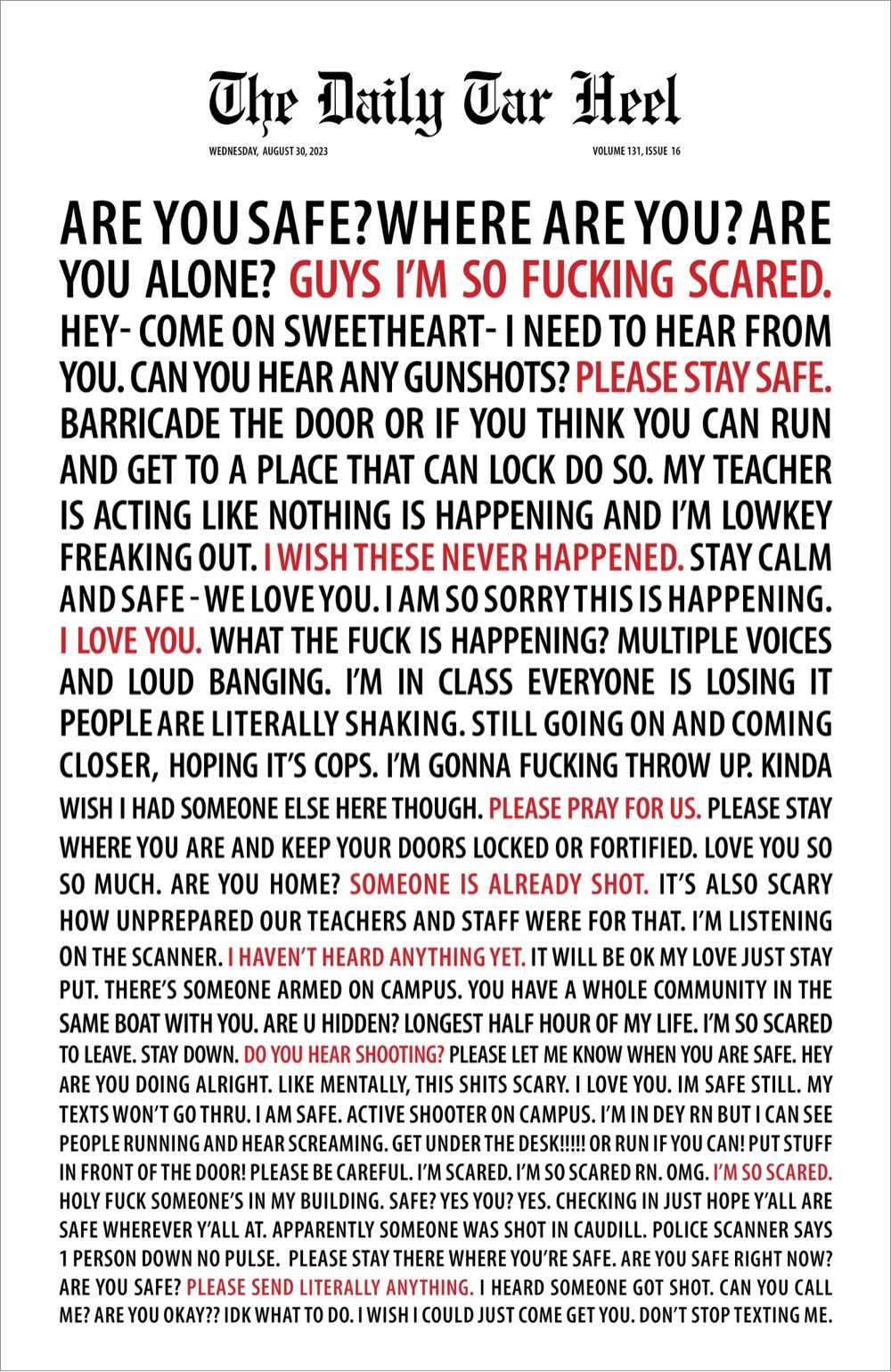
Yesterday, there was yet another school shooting on a college campus, this time at the University of North Carolina at Chapel Hill. A UNC graduate student walked into a classroom building and murdered a science professor with a gun. The campus was on lockdown for hours. The front page of The Daily Tar Heel today consists of text messages sent to and from students during the lockdown:
An incredible and powerful design — on Mastodon, Steve Silberman called it “the tombstone of democracy, courtesy of the NRA”. As a nation, we’ve spent more than 20 years and trillions of dollars fighting the “War on Terror” but won’t do a damn thing about the self-imposed terrorism of gun violence. The people sending and receiving those texts — they are TERRIFIED. And this happens regularly in the US, in pre-schools and on college campuses alike. We are a sick nation.
Yesterday, a Washington DC grand jury indicted Donald Trump for “for conspiring to defraud the United States, conspiring to disenfranchise voters, and conspiring and attempting to obstruct an official proceeding”, aka trying to steal the 2020 presidential election. Heather Cox Richardson lays it out in plain English:
The Trump team used lies about the election to justify organizing fraudulent slates of electors in Arizona, Georgia, Michigan, Nevada, New Mexico, Pennsylvania, and Wisconsin. Allegedly with the help of Republican National Committee chair Ronna McDaniel, they attempted to have the legitimate electors that accurately reflected the voters’ choice of Biden replaced with fraudulent ones that claimed Trump had won in their states, first by convincing state legislators they had the power to make the switch, and then by convincing Vice President Mike Pence he could choose the Trump electors.
When Pence would not fraudulently alter the election results, Trump whipped up the crowd he had gathered in Washington, D.C., against Pence and then, according to the indictment, “attempted to exploit the violence and chaos at the Capitol” to overturn the election results. “As violence ensued,” the indictment reads, Trump and his co-conspirators “explained the disruption by redoubling efforts to levy false claims of election fraud and convince Members of Congress to further delay the certification based on those claims.” On the evening of January 6, 2021, the indictment alleges, Trump and Co-Conspirator 1 called seven senators and one representative and asked them to delay the certification of Biden’s election.
The indictment makes clear that Donald Trump and his accomplices planned to seize power by force and then maintain that power through the mass murder of American citizens by their own military.
That sounds pretty serious — here’s what the indictment says:
On the afternoon of January 3, Co-Conspirator 4 spoke with a Deputy White House Counsel. The previous month, the Deputy White House Counsel had informed the Defendant that “there is no world, there is no option in which you do not leave the White House [o]n January 20th.” Now, the same Deputy White House Counsel tried to dissuade Co-Conspirator 4 from assuming the role of Acting Attorney General. The Deputy White House Counsel reiterated to Co-Conspirator 4 that there had not been outcome-determinative fraud in the election and that if the Defendant remained in office nonetheless, there would be “riots in every major city in the United States.” Co-Conspirator 4 responded, “Well, [Deputy White House Counsel], that’s why there’s an Insurrection Act.”
And this:
Also on January 4, when Co-Conspirator 2 acknowledged to the Defendant’s Senior Advisor that no court would support his proposal, the Senior Advisor told Co-Conspirator 2, “[Y]ou’re going to cause riots in the streets.” Co-Conspirator 2 responded that there had previously been points in the nation’s history where violence was necessary to protect the republic. After that conversation, the Senior Advisor notified the Defendant that Co-Conspirator 2 had conceded that his plan was not going to work.
HuffPost explains who Co-Conspirator 4 is (top Trump DOJ official Jeffrey Clark) and what the Insurrection Act is all about. Co-Conspirator 2 is John Eastman, one of Trump’s lawyers.
Trump and his team were going to unlawfully (and immorally, I would argue) seize power and quell protests with military force by claiming there was a rebellion against the government or that public safety was at stake. Whether the military would have gone along with it (if Pence had chosen to play his part) is unknown, but it’s pretty incredible how close we came to the United States very quickly devolving into a dictatorship. This fucking traitor must be held accountable for his crimes and must not ever be allowed anywhere near any public office in the United States ever again.
Update: Updated the post to add a second passage from the indictment about the use of state violence to quell protest.
There is no patience for simple mistakes or room for addressing how bigotry colors even the most innocuous interactions. There is no regard for due process. People who deem themselves judge, jury and executioner walk among us, and we have no real way of knowing when they will turn on us.
I will be thinking about Jordan Neely in particular for a long time. I will be thinking about who gets to stand his ground, who doesn’t, and how, all too often, it’s people in the latter group who are buried beneath that ground by those who refuse to cede dominion over it. Every single day there are news stories that are individually devastating and collectively an unequivocal condemnation of what we are becoming: a people without empathy, without any respect for the sanctity of life unless it’s our own.
Actually, my first article of warning was published in “The Wall Street Journal” on January 4, 2001. I saw evil because I heard evil. Putin was telling us what he was. All we had to do was listen. When Putin said that there was no such thing as a former KGB agent, I knew Russia’s fragile democracy was in danger. When Putin said that the collapse of the Soviet Union was the greatest geopolitical catastrophe of the 20th century, I knew Russia’s newly independent neighbors were at risk. And when Putin talked at the Munich Security Conference in 2007 about a return to spheres of influence, I knew he was ready to launch his plan. It was the language from the Molotov-Ribbentrop Pact, 1939. The language Hitler and Stalin used to divide Europe. And a year later, in 2008, Putin invaded the Republic of Georgia. 2014, Ukraine.
It’s a paradox, isn’t it? Dictators lie about everything they have done, but often they tell us exactly what they’re going to do. Just listen. Anyone who is surprised at Putin’s war crimes in Ukraine must not be aware about his long record, beginning with the Second Chechen War in Grozny more than two decades ago. Vladimir Putin has been a war criminal from the start.
When he was talking about the problem with compromising with authoritarians, I was reminded of a phrase I’ve heard in a couple of different contexts recently: meeting a racist halfway on their views is still racism; meeting a fascist halfway on their views is still fascism. As Rebecca Solnit put it in an article about the 2020 election: “Who the hell wants unity with Nazis until and unless they stop being Nazis?” Meeting a brutal authoritarian halfway, Kasparov is arguing, is still tyranny.
Building on the lessons of World War II, Ukrainians are trying to save their art and other important cultural artifacts from destruction during Russia’s invasion. When an invader repeatedly tries to deny the cultural distinction of a people for decades and even centuries, like Russia has done with Ukraine, saving buildings and statues and paintings can be of great importance.
Because under the 1954 convention, “damage to cultural property means damage to the cultural heritage of all mankind”. So attacks on cultural heritage are a considered war crime. But treaties can only do so much. In the years since, conflicts around the world have rendered immeasurable damage to cultural heritage. A lot of it intentional. Like the Taliban’s destruction of the Bamiyan buddhas. And Isis’ attacks on ancient sites all over Syria.
“That cultural heritage is not only impacted, but in many ways it’s implicated and central to armed conflict. These are things that people point to that are unifying factors for their society. They are tangible reflections of their identity.”
And Putin has made it clear that identity is at the ideological center of Russia’s invasion: “I would like to emphasize again that Ukraine is not just a neighboring country for us. It is an inalienable part of our own history, culture, and spiritual space.”
“He thinks that we don’t really exist and they want to destroy all the signs of our identity.”
BTW, regarding the destruction of the museum that housed works by Maria Prymachenko at the start of the video: according to the Ukrainian Institute, the works were saved from burning by local residents.
In the early 1930s, desiring the bountiful wheat harvests of its farmlands to sell to Europe and wanting to subjugate its people, Soviet dictator Joseph Stalin carried out a genocide in Ukraine that killed millions and hid it behind the guise of food shortages. It’s known as the Holodomor.
In Ukraine, it’s become known as “the Holodomor,” meaning “death by starvation.” It was a genocide carried out by a dictator who wanted to keep Ukraine under his control and who would do anything to keep it covered up for decades.
In the 1930s, Soviet leaders under Joseph Stalin engineered a famine that killed millions as they sought to consolidate agricultural power. In Ukraine, they used additional force as they sought to clamp down on a burgeoning Ukrainian national identity. There, at least 4 million died. As hunger spread among residents, Stalin spearheaded a disinformation campaign to hide the truth from other Soviet citizens and the world. So many Ukrainians died that officials had to send people to resettle the area, setting off demographic shifts that last to this day.
The details of the atrocities committed against the people of Bucha, Ukraine by Russian soldiers are more horrifying than language has words for. Luke Mogelson and photographer James Nachtwey are reporting for the New Yorker from Bucha as loved ones and volunteers try to make sense of the destruction. Note: the descriptions and photos in this piece may be disturbing (but IMO, we cannot turn away from this). This is one of the tamer paragraphs:
On the far side of a stretch of railroad tracks, two elderly women had been killed in their house. One lay in the doorway, another in the kitchen. Both were bundled in heavy winter coats. Neighbors said that they had been sisters, both in their seventies. Their small house was filled with hardcover books, and they did not own a television; it was impossible not to imagine their quiet, literary life together before it was annihilated. In the only bedroom, two narrow mattresses were pushed together and covered by a single blanket.
As the Russian advance on Kyiv stalled in the face of fierce resistance, civilians said, the enemy occupation of Bucha slid into a campaign of terror and revenge. When a defeated and demoralized Russian Army finally retreated, it left behind a grim tableau: bodies of dead civilians strewn on streets, in basements or in backyards, many with gunshot wounds to their heads, some with their hands tied behind their backs.
The Western response has been far broader than most experts anticipated, and threatens to throw the Russian economy into chaos. Yet there’s a catch. Absent significant domestic reforms in the West — reforms that should have been enacted long ago — sanctions targeted at the oligarchic and official figures close to Russian President Vladmir Putin risk inflicting little more than a flesh wound on Russia’s imperial kleptocracy.
Rampant financial anonymity in places like the U.S. makes it relatively easy for powerful rich people to evade sanctions. A Russian oligarch may have multimillion-dollar mansions in Washington, D.C.; or multiple steel plants across the Rust Belt; or a controlling stake in a hedge fund in Greenwich, Connecticut; or an entire fleet of private jets in California; or an array of lawyers setting up purchases at art houses around the country. And all of that wealth can be hidden-perfectly legally-behind anonymous shell companies and trusts that are enormously difficult to penetrate.
If Western policy makers hope to hold Putin’s cronies truly accountable, sanctions will have to be paired with pro-transparency reforms that can disassemble this web of secrecy. Western governments should start by ending anonymity in shell companies and trusts; demanding basic anti-money-laundering checks for lawyers, art gallerists, and auction-house managers; and closing loopholes that allow anonymity in the real-estate, private-equity, and hedge-fund industries. That is, if the sanctions are to retain their bite, the entire counter-kleptocracy playbook needs to be implemented-immediately.
In this entertaining and informative video, Oliver Bullough, who has written a pair of books on money laundering (Moneyland and the forthcoming Butler to the World) takes us on a tour of London while telling us how “the most efficient scaled-up money laundering system in the world” has helped Russia’s oligarchs hide their billions and keep Putin in power. Bullough also wrote about the UK’s role in laundering oligarch money recently in The Guardian.
Russia is a mafia state, and its elite exists to enrich itself. Democracy is an existential threat to that theft, which is why Putin has crushed it at home and seeks to undermine it abroad. For decades, London has been the most important place not only for Russia’s criminal elite to launder its money, but also for it to stash its wealth. We have been the Kremlin’s bankers, and provided its elite with the financial skills it lacks. Its kleptocracy could not exist without our assistance. The best time to do something about this was 30 years ago — but the second best time is right now.
We journalists have long been writing about this, but it is not simply overheated rhetoric from overexcited hacks. Parliament’s intelligence and security committee wrote two years ago that our investigative agencies are underfunded, our economy is awash with dirty money, and oligarchs have bought influence at the very top of our society.
Ahh, the 80s — when children were given much more freedom than today, an autonomy that two Irish boys used in 1985 to travel from their house in a Dublin suburb all the way to New York City — via two trains, a ferry, and then stowing away on a JFK-bound 747, with nothing more than a few coins in their pockets.
When the boys arrived at John F. Kennedy International Airport, in New York, they tried to bypass a security checkpoint with a sly bit of street smarts, saying to the officer, “Our ma’s just behind us.” It aroused suspicion, but the pair ran when the airport official turned his head away. They then spent a few hours in the airport before wandering outside, astounded by yellow cabs and lofty skyscrapers. A policeman, Kenneth White, stopped them and asked where they were headed. After they lied to White about how they were meeting their mother at the center of town, White pressed further, and Byrne and Murray admitted that they were alone. White radioed for a supervisor, and Sergeant Carl Harrison came to assist him. After more questioning, the two boys were placed in the back of an N.Y.P.D. car and driven to a precinct, where they were held in a room for several hours — they eventually confessed what they had done. After calling other overseas jurisdictions and the boys’ parents, the police officers fed the boys chips and soda, and unloaded their own guns and let the boys play with the firearms. Air India put Byrne and Murray up in a gigantic suite at a five-star hotel and plied them with McDonald’s and movies. “I was never in a hotel before, so it was brilliant,” Murray says. The next day, the security guards who were tasked with supervising the boys asked them why they had come. Byrne and Murray told the officials that they wanted to meet the character B. A. Baracus from “The A-Team.” The guards then brought the boys on sightseeing tours throughout the boroughs, gave them some cash, and bought them “I Love New York” T-shirts.
What a story! It’s wonderful to hear the two men talk about their now long-ago adventures with a mischievous twinkle in their eye — and the old footage of Dublin, Heathrow, and NYC is a great accompaniment.
A Chinese man who was abducted from his family when he was four years old recently found his mother by drawing a map of his village from memory and posting it online. From The Guardian:
Thirty years ago, when Li Jingwei was four years old, a neighbour abducted him from his home village in China’s Yunnan province and sold him to a child trafficking ring.
Now he has been reunited with his mother after drawing a map of his home village from his memories of three decades ago and sharing it on a popular video-sharing app in the hope that someone might be able to identify it.
“I’m a child who’s looking for his home,” Li said in the video. Unable to recall the name of his village or his address, Li’s recollection and reconstruction of the village’s key features - including a school, a bamboo forest and a pond - proved crucial.
“I knew the trees, stones, cows and even which roads turn and where the water flows,” Li said in an interview with the Paper, a Chinese media outlet.
When I first read this story, I was interested in the incredible drawn-from-memory map but now I’m wondering about what kind of relationship Li has with the people who arranged to have him abducted (which the article calls his “adoptive parents”??!?) (via the morning news)
This animated documentary about how Israeli Mossad agent Zvi Aharoni tracked down and captured Nazi war criminal Adolf Eichmann in Argentina 15 years after WWII ended is really fantastic.
The rare film to win festival prizes as both a documentary & as an animation, Randall Christopher’s The Driver is Red is a stunning showcase for his minimalist pen and ink art and for his grand aim to increase public awareness of WWII history (which he perceives to be rapidly fading from the consciousness of younger generations). Should he succeed in that noble aim however, the reason will be that he has taken a potentially dry historical record and transformed it into an imaginative and unabashedly cracking spy thriller.
Told through the experience of Israeli Mossad agent Zvi Aharoni, the film documents the discovery and capture of Adolf Eichmann, the senior Nazi official largely responsible for organizing and executing the Holocaust. Hidden for 15 years half a world away, and living under an assumed identity, Eichmann is tracked down by Aharoni and the agent, with a small team in tow, must design and execute a strategy for Eichmann’s capture and extradition.
This piece by Wright Thompson on how the murder of Emmett Till has been remembered and forgotten is a difficult, compelling, and important read. The story centers around the still-little-known barn where Till was tortured and murdered by a group of several white men in 1955.
But the way Till’s name exists in the firmament of American history stands in opposition to the gaps in what we know about his killing. No one knows, for instance, how many people were involved. Most historians think at least seven were present. Only two were tried: half brothers J. W. Milam and Roy Bryant. Another half brother, Leslie Milam, was there that night too. He lived in an old white farmhouse a few dozen steps from the barn, next to where Jeff Andrews’s house now stands.
In 1955 an all-white, all-male jury, encouraged by the defense to do their duty as “Anglo-Saxons,” acquitted J. W. Milam and Roy Bryant. Because the defendants couldn’t be tried again, they got paid to make a confession to a national magazine — a heavily fictionalized account stage-managed by their lawyers — and Leslie Milam and his barn were written out of the story. Ask most people where Till died and they’ll say Money, Mississippi, the town where Till whistled at Bryant’s wife outside the family’s store. An Equal Justice Initiative monument in Montgomery says Money. Wikipedia does too. The Library of Congress website skips over the barn, which is just outside the town of Drew, about 45 minutes from the store.
I learned about the barn last year and have since made repeated visits, alone and with groups, once with members of Till’s family. Over and over, I drove from my home in the Mississippi hill country back into the gothic flatland where I was born. The barn’s existence conjures a complex set of reactions: It is a mourning bench for Black Americans, an unwelcome mirror for white Americans. It both repels and demands attention.
This is an incredible video investigation by the NY Times of the January 6th attack on Congress by terrorists, rioters, and supporters of Donald Trump. They analyzed hundreds of videos, police bodycam footage, and police communications to reconstruct a minute-by-minute account of the Capital breach.
Most of the videos we analyzed were filmed by the rioters. By carefully listening to the unfiltered chatter within the crowd, we found a clear feedback loop between President Trump and his supporters.
As Mr. Trump spoke near the White House, supporters who had already gathered at the Capitol building hoping to disrupt the certification responded. Hearing his message to “walk down to the Capitol,” they interpreted it as the president sending reinforcements. “There’s about a million people on their way now,” we heard a man in the crowd say, as Mr. Trump’s speech played from a loudspeaker.
The call and response didn’t stop there. We found evidence of his influence once the violence was well underway. In one moment, a woman with a megaphone urged rioters to climb through a broken window by asking them to “stand up for our country and Constitution” — echoing the language in an earlier tweet from Mr. Trump. In another, as the police were pushing to clear the mob off the building, a rioter screamed at officers: “I was invited here by the president.”
It is astonishing to me how close we came to having a hostage or assassination situation with members of Congress and the Vice-President — like literal seconds and minutes away — and how is this not the only topic of conversation over the past 6 months in our country? And not only that, it’s clear that we’re not really going to do anything about it, aside from beefing up Capitol security and imprisoning some of the insurrectionists. This isn’t over — as the video’s narration states near the end: “The forces that brought them there have not gone away.”
On Wednesday evening, in the presence of two outside witnesses, Texas killed Quintin Jones. Two journalists who were to bear witness to the execution for the public were not called into the prison by officials who somehow “forgot” to do so:
Absent were two journalists who had been scheduled to attend the execution but whom prison officials said they had accidentally failed to summon.
Before he died, a video director for the NY Times recorded a short video of Jones’ last words to the public, in which he thanked everyone for helping him be a better person and even asked viewers to consider the trauma that death row prison guards endure in the course of doing their jobs. A separate statement of his last words was recorded by prison officials:
“Love all my friends and all the friendships that I have made,” Mr. Jones said, according to those state prison records. “They are like the sky. It is all part of life, like a big full plate of food for the soul. I hope I left everyone a plate of food full of happy memories, happiness and no sadness.”
Then he said, “I’m done, warden.” He was pronounced dead at 6:40 p.m.
That same day, Governor Abbott, who is a member of the so-called “pro-life” Republican party, signed a law that bans abortions in Texas after a fetal heartbeat can be detected, which is before many women are even aware they are pregnant.
Quintin Jones murdered his aunt in 1999 and is scheduled to be executed on May 19, 2021. He admits his guilt, his family has forgiven him, and in this video, he shares his thoughts about personal growth & death and asks Texas governor Greg Abbott to spare his life.
During his 21 years on death row, Quin has been the epitome of a prison success story. He entered at an unimaginable low, as lost as a soul can be. And through prayer, sobriety, reconciliation with his family, and longstanding correspondence with pen pals, he has found a way to lead a meaningful life, and even to enhance the lives of others. The victim’s family — who is also Quin’s family — has forgiven him.
Emotionally, intellectually, and psychologically, human beings are ships of Theseus — we are not the same people at 30 as we were at 20 or will be at 40. The death penalty is immoral, full stop. The sooner our system of retributive justice is replaced with restorative justice, the healthier and safer our communities and society will be.
After Vladimir Putin, dictatorial leader of Russia for over 20 years now, had seemingly insulated himself against losing power through control of the media, law, elections, and the wealthy allies, a lawyer named Alexei Navalny began to expose the corruption in Putin’s regime with a series of posts to his blog and on YouTube. Navalny continued his investigations, gaining public popularity and running for public office. Putin imprisoned him and tried to have him killed. This Vox video explains in more detail why Putin wants Navalny dead.
This video interview with two former inmates (Five Mualimm-Ak and Terrence Slater) about their experiences in solitary confinement is, well, I was going to says “sobering” but it’s not sobering. It’s fucking infuriating and upsetting. Just to pick one moment, here’s Mualimm-Ak’s answer to “How do you maintain a sense of who you are?”:
You don’t. You live off of your memories because you have nothing else to accumulate to move forward. And then you end up having this short-term memory disorder which is a part of you the consequences of being in solitary where you can’t keep one train of thought for too long. And then you’re dropped off in 42nd Street-Times Square, the biggest tourist spot in the world, with 20 million commuters. It’s a sensory overload.
Being confined in a 6x9-foot cell for almost 30 years, with very limited contact with other humans or physical exercise, surely has consequences on one’s overall health, including the brain. King knew that solitary confinement was changing the way his brain worked. When he finally left his cell, he realized he had trouble recognizing faces and had to retrain his eyes to learn what a face was like. His sense of direction was also messed up, and he was unable to follow a simple route in the city by himself. It is as if his brain had erased all those capabilities that were no longer necessary for survival in a cell no bigger than the back of a pick-up truck.
A couple of things from the video that merit your attention. The first is Hell Is a Very Small Place, a book of stories by people who are now or have been in solitary confinement. And second, Mualimm-Ak started an organization called Incarcerated Nation Network “an abolition alliance network dedicated to transforming the prison industrial complex & ending torture” — join me in sending a donation to them? (via open culture)
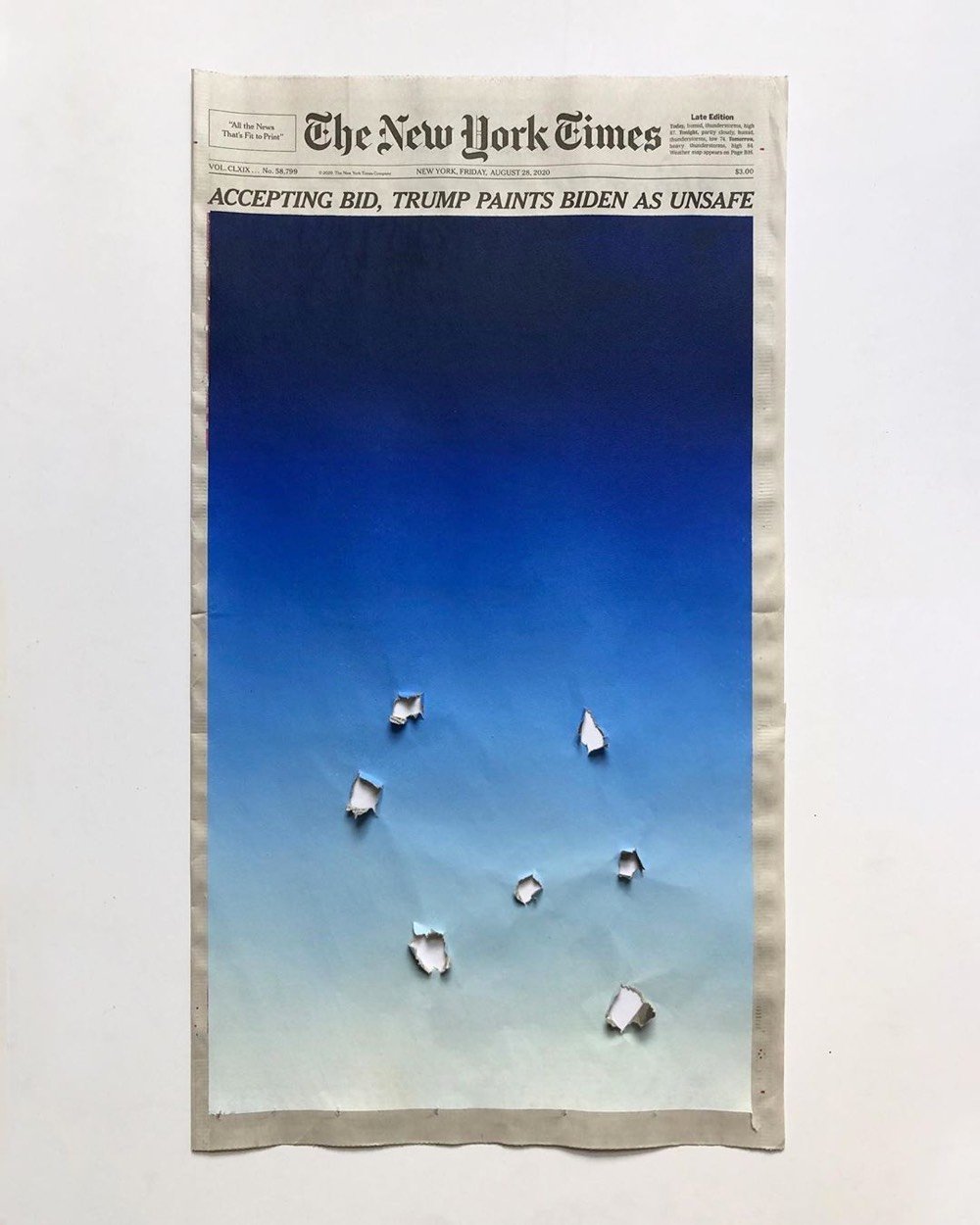
To pass the time during the pandemic, artist and designer Sho Shibuya has been painting sunrise views from his apartment using the front page of the NY Times as a canvas and posting them to Instagram. But he’s also done special editions, like the one above honoring Jacob Blake, the seven holes in the paper representing the seven bullets fired at Blake’s back by a Kenosha police officer trying to murder him. The juxtaposition with that headline is… something.
Four years to the day after Colin Kaepernick kneeled during the national anthem of an NFL preseason game to protest the oppression of Black people in the United States, the Milwaukee Bucks refused to play their NBA playoff game and set off an NBA-wide strike, as well as strikes by teams in the WNBA, MLB, and MLS. They were reacting to the attempted murder of Jacob Blake by a Kenosha police officer on Sunday and the subsequent inaction by officials to take any disiplinary action against the officer.
The shooting prompted numerous N.B.A. players and coaches to express frustration and anger that the various measures they have been taking for weeks to support the Black Lives Matter movement, such as kneeling during the national anthem and wearing jerseys bearing social justice messages, were having little impact. Some also began to question, as the Nets’ star guard Kyrie Irving did in June before the 2019-20 season resumed, whether providing entertainment through basketball was actually diverting public attention away from the broader social justice movement.
Fueled by that frustration, Milwaukee’s players stunned league officials by organizing Wednesday’s boycott, a walkout that had virtually no precedent in N.B.A. history.
Milwaukee’s George Hill gave a glimpse of the Bucks’ mind-set on Monday when he openly questioned whether the league’s return had successfully amplified the players’ messaging.
“We shouldn’t have even come to this damn place to be honest,” Hill said. “I think coming here just took all the focal points off what the issues are.”
I am not going to stand up to show pride in a flag for a country that oppresses black people and people of color. To me, this is bigger than football and it would be selfish on my part to look the other way. There are bodies in the street and people getting paid leave and getting away with murder.
You can see why the players believe that little has been done to address this state of affairs — there’s definitely more awareness now, but substantive change is not happening.
Update: A previous version of this post referred to the players’ walkout as a boycott (following the Times’ language). While boycott is technically accurate, it is generally used to refer to consumers withholding their purchase power as a protest. Strike is a more exact word to use in a situation where workers are withholding their labor (even though the players are not demanding concessions from their employers), so I updated the post to reflect that. (thx, david)
The American system of law enforcement is so deeply embedded into our national psyche that if you find the idea of defunding or abolishing the police challenging, I don’t blame you. But imagine calling an ambulance because a loved one was having trouble breathing or was suffering a stroke and, instead of the expected trained paramedics, a man with a gun showed up. Not great, right? As Jamie Ford explains in this thread, that was not unusual in America until recently.
Until the 70s, ambulance services were generally run by local police and fire departments. There was no law requiring medical training beyond basic first-aid and in many cases the assignment of ambulance duty was used as a form of punishment.
As you can imagine, throwing people with medical emergencies into the back of a paddy wagon produced less than spectacular health outcomes. Now imagine how much worse it became when disgruntled white police officers were demoted to ambulance duty in black neighborhoods.
Emergency care was mostly a transportation industry, focused on getting patients to hospitals, and it was dominated by two groups: funeral homes and police departments. Call the local authorities for help and you’d likely get morticians in a hearse or cops in a paddy wagon. If you received any treatment en route to the hospital — and most likely you did not — it wouldn’t be very good. At best, one of the people helping may have taken a first-aid course. At worst, you’d ride alone in the back, hoping, if you were conscious, that you’d survive.
Pittsburgh’s Freedom House Ambulance Service changed all that, ushering in a new era of much improved medical care for communities around the US.
Together the two men hashed out a plan: Hallen would raise the money, Safar would contribute his medical expertise, and together they would design advanced ambulances and teach paramedics to provide care on the scene of an accident or emergency. It would be a pioneering medical effort, and Hallen, who was white, suggested another first. The Falk Fund was committed to mitigating racism, and Hallen wanted to staff the service with young black men from the Hill. He hoped that empowering individuals long deemed unemployable would be a source of pride in the black community, a symbol of equality, and a signal that bigoted notions about the black people of Pittsburgh standing in their own way were nonsense.
To help with recruitment, Hallen and Safar partnered with an organization called Freedom House Enterprises, a nonprofit dedicated to establishing and supporting black-run businesses in the city. Freedom House handled staffing for the fledgling ambulance service and recruited the first class of paramedics, including Vietnam veterans and men with criminal records.
So this is a great instance in which armed and untrained police officers have been relieved of a particular responsibility and replaced with specially trained personnel, resulting in a greatly improved outcome for members of the community. If you want other examples, just think about how odd, unhelpful, and dangerous it would be for our communities if the police showed up — armed with a loaded weapon — to collect your garbage, to put out fires, to inspect restaurants, to fix potholes, or to deliver the mail. No, we have sanitation workers, firefighters, public health inspectors, municipal maintenance workers, and postal workers to do these jobs — and they’re all trained in the ins and outs of their particular disciplines.
With these examples in mind, instead of armed personnel handling a wide variety of situations for which they are often not trained, it becomes easier to imagine traffic patrols conducting transportation safety stops, social workers responding to domestic disputes, special crisis centers assisting rape victims, mental health counselors helping people behaving erratically in public, housing guides finding homeless folks a place to stay, student safety coaches helping struggling students navigate school, unarmed personnel responding to property crime, and drug addiction counselors helping drug users stay safe. These are all areas where American communities have applied policing by default, like a flimsy bandaid. It’s ineffective, expensive, and dangerous, and communities should think seriously about supporting and funding alternatives that will be more effective, cheaper, safer, and produce better outcomes for everyone.
In a piece for Essence, prison industrial complex abolitionists Mariame Kaba and Andrea Ritchie challenge us to consider whether arresting and prosecuting the police officers who killed Breonna Taylor (or George Floyd or Elijah McClain) will result in justice.
Beyond strategic assessments of what is most likely to bring justice, ultimately, we must choose to support collective responses that align with our values. Demands for arrests and prosecutions of killer cops are inconsistent with demands to #DefundPolice because they have proven to be sources of violence not safety. We can’t claim the system must be dismantled because it is a danger to Black lives and at the same time legitimize it by turning to it for justice. As Angela Y. Davis points out, “we have to be consistent” in our analysis, and not respond to violence in a way that compounds it. We need to use our radical imaginations to come up with new structures of accountability beyond the system we are working to dismantle.
Noting that “turning away from systems of policing and punishment doesn’t mean turning away from accountability”, Kaba and Ritchie argue that use of a reparations framework would be more effective in delivering justice to Taylor’s family and in preventing future killings and violence by police.
Under a reparations framework Breonna’s family — and all of us — are also entitled to more than an individualized response to what is a systemic problem. We are entitled to immediate cessation of the actions that caused her death — no knock warrants, to be sure, but also short knock warrants, and dangerous drug raids in all their forms. And all of us are entitled to non-repetition, an end to the conditions that produced her death, including an end to the drug war that killed her, and the forces of gentrification that brought police into her neighborhood. It is long past time for an approach to drug use that saves lives instead of ending them — whether in a raid or in a cell — and a reckoning with the ways in which economic policies are driving deadly policing practices.
For children growing up during the era of mass incarceration, seeing armed officers in their schools is commonplace. Federal grants have supported more and more cops in schools. Federal programs like the Community Oriented Policing Services (“COPS”) have provided millions of dollars to hire and train local police, including police in schools.
Police officers do not have specialized training in adolescent or childhood development. They are not mental health experts, social workers with licensed degrees, psychologists, or school counselors. They are not educators. To be clear, school resource officers are career law enforcement officers, with arresting authority, and a license to carry a weapon. Police officers patrol school hallways just like they do city streets. More than one and a half million students attend schools with an SRO, but no counselor.
There are better, safer, and cheaper alternatives. In 2016, Intermediate School District 287, a school west of the Twin Cities with a high concentration of students with special needs and mental health needs that can result in behavior issues, replaced their school resource officers with Student Safety Coaches. The Student Safety Coaches specialize in mental health, restorative justice, de-escalation, and building positive relationships with their students. Arrests decreased by 80 percent in the pilot school after implementation of the program.
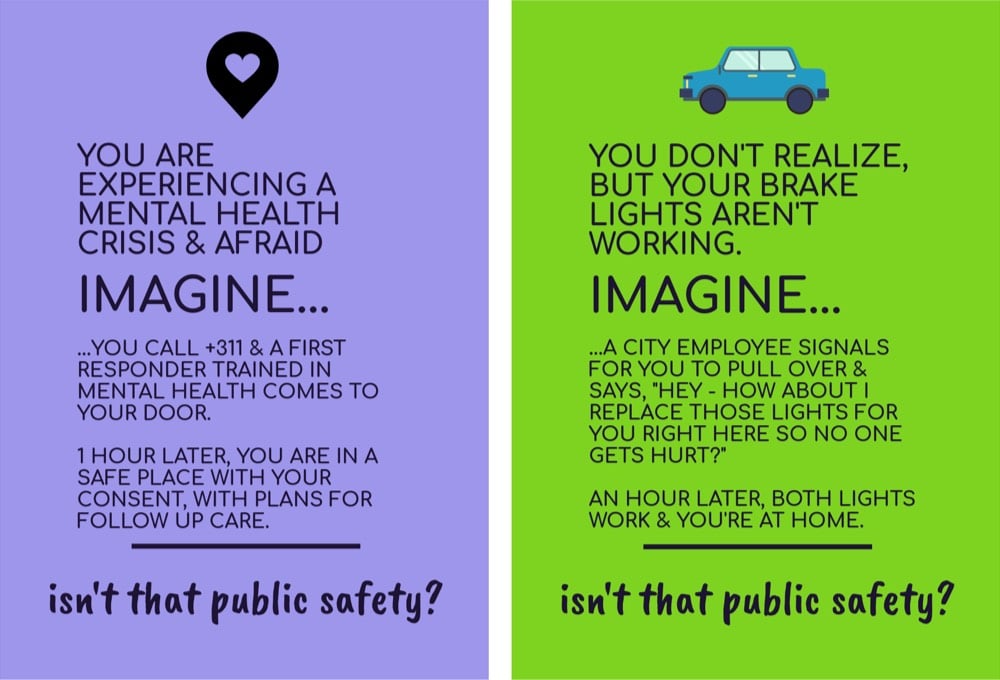
The common, and commonsense, thread through all of these proposals is to replace armed, untrained responders who make difficult situations less safe with people & organizations that are specifically trained to help people in distress or crisis.
For What the police really believe, Vox’s Zack Beauchamp interviewed several former police officers and policing experts to find out how police think of themselves, their jobs, and the communities they are supposed to be protecting and serving.
Police officers across America have adopted a set of beliefs about their work and its role in our society. The tenets of police ideology are not codified or written down, but are nonetheless widely shared in departments around the country.
The ideology holds that the world is a profoundly dangerous place: Officers are conditioned to see themselves as constantly in danger and that the only way to guarantee survival is to dominate the citizens they’re supposed to protect. The police believe they’re alone in this fight; police ideology holds that officers are under siege by criminals and are not understood or respected by the broader citizenry. These beliefs, combined with widely held racial stereotypes, push officers toward violent and racist behavior during intense and stressful street interactions.
I have rape-colored skin. My light-brown-blackness is a living testament to the rules, the practices, the causes of the Old South.
If there are those who want to remember the legacy of the Confederacy, if they want monuments, well, then, my body is a monument. My skin is a monument.
Netflix has put When They See Us, Ava DuVernay’s 4-episode mini-series about the Central Park Five, in front of their paywall for free viewing. Here’s the trailer:
In recent weeks as antiracism and anti-police violence protests continue around the country, the movement to defund and abolish policing in America has rapidly gained momentum. As Black communities have asserted for decades, people have begun to wonder in earnest what purpose police serve. They’re asking when there’s a problem in our communities, do we really need a person with a gun showing up to solve it? What would a system oriented around public safety look like if it was designed from scratch rather than just piling more responsibility onto and funding into increasingly militarized and unaccountable police departments?
There are a lot of resources out there about police abolition right now, so here are some that I’ve found helpful in understanding it.
Alex Vitale’s The End of Policing, which came out in 2017, is a well-reviewed critique of modern policing.
This book attempts to spark public discussion by revealing the tainted origins of modern policing as a tool of social control. It shows how the expansion of police authority is inconsistent with community empowerment, social justice — even public safety. Drawing on groundbreaking research from across the world, and covering virtually every area in the increasingly broad range of police work, Alex Vitale demonstrates how law enforcement has come to exacerbate the very problems it is supposed to solve.
In contrast, there are places where the robust implementation of policing alternatives—such as legalization, restorative justice, and harm reduction — has led to a decrease in crime, spending, and injustice. The best solution to bad policing may be an end to policing.
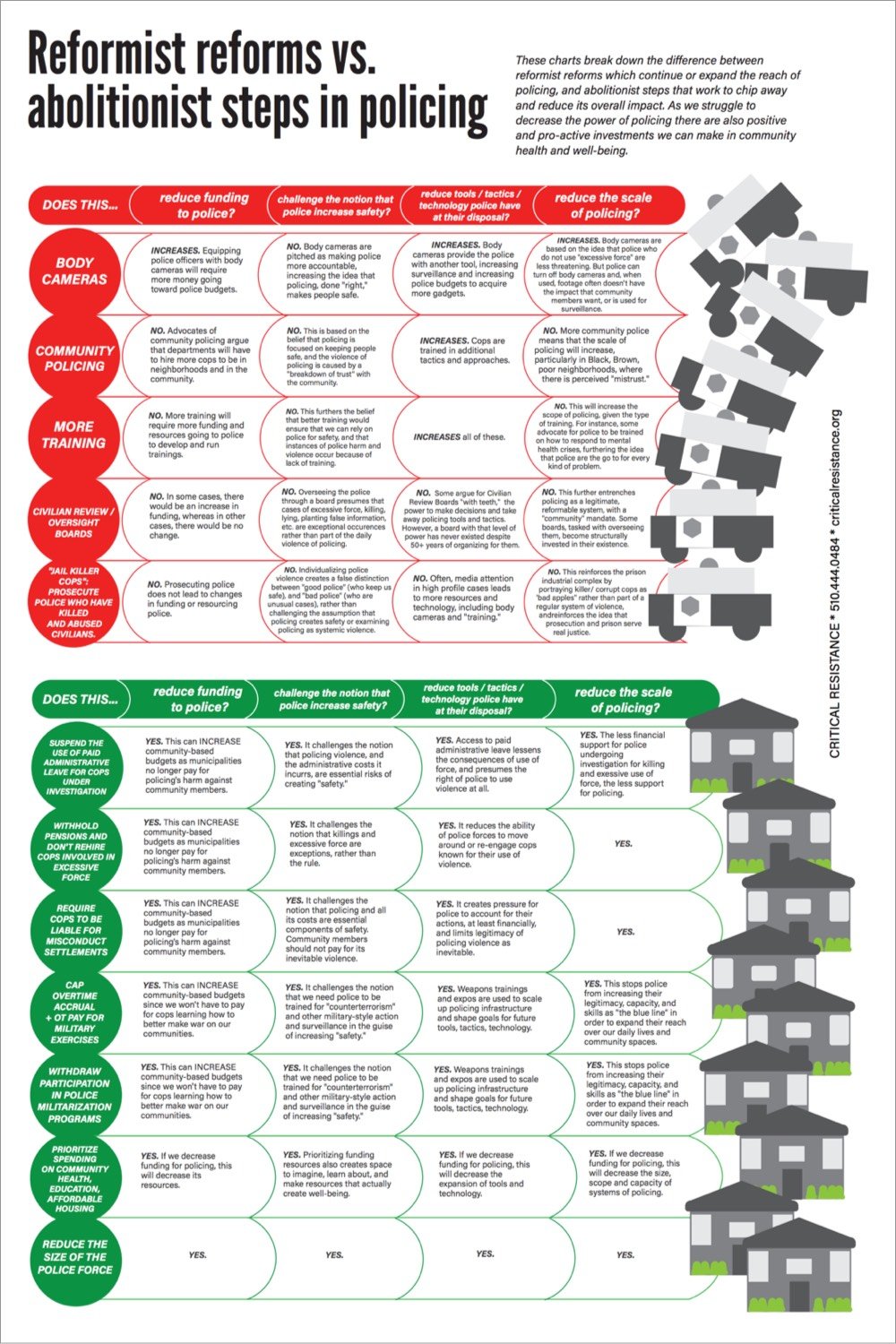
This does not mean that no one should articulate or fight for reforms. However, those reforms must be part of a larger vision that questions the basic role of police in society and asks whether coercive government action will bring more justice or less. Too many of the reforms under discussion today fail to do that; many further empower the police and expand their role. Community policing, body cameras, and increased money for training reinforce a false sense of police legitimacy and expand the reach of the police into communities and private lives. More money, more technology, and more power and influence will not reduce the burden or increase the justness of policing. Ending the War on Drugs, abolishing school police, ending broken-windows policing, developing robust mental health care, and creating low-income housing systems will do much more to reduce abusive policing.
We should understand policing as the most coercive form of state power … and the reason is that policing has historically and inherently been at the root of reproducing fundamental inequalities of race, class, and immigration status. Trump, the police, ICE — this is just a continuation of a history of exclusion and repression going back to the exclusion of Chinese immigrants in the 19th century, Texas Rangers driving out Mexican landholders and indigenous populations to make room for white settlers, the transformation of slave patrols and urban slave management systems into what became Jim Crow policing in the South and ghetto policing in the North. Police have historical origins in relation to both the formation and disciplining of the industrial working class; early 19th century forms of policing in Europe and the United States shaped rural agricultural workers into urban industrial workers, and then suppressed their movements to form labor unions and win better living conditions.
The point of all this is to fundamentally question this liberal notion that police exist primarily as a tool for public safety and therefore, we should embrace their efforts uncritically, when in fact, there are lots of different ways to produce safety that don’t come with the baggage of colonialism, slavery, and the suppression of workers’ movements.
To fix policing, we must first recognize how much we have come to over-rely on law enforcement. We turn to the police in situations where years of experience and common sense tell us that their involvement is unnecessary, and can make things worse. We ask police to take accident reports, respond to people who have overdosed and arrest, rather than cite, people who might have intentionally or not passed a counterfeit $20 bill. We call police to roust homeless people from corners and doorsteps, resolve verbal squabbles between family members and strangers alike, and arrest children for behavior that once would have been handled as a school disciplinary issue.
Police themselves often complain about having to “do too much,” including handling social problems for which they are ill-equipped. Some have been vocal about the need to decriminalize social problems and take police out of the equation. It is clear that we must reimagine the role they play in public safety.
Many people already live in a world without police. If you grew up in a well-off, predominantly white suburb, how often did you interact with cops? Communities with lots of good jobs, strong schools, economies, and social safety nets are already, in some ways, living in a world without police.
A thin safety net, an expansive security state: This is the American way. At all levels of government, the country spends roughly double on police, prisons, and courts what it spends on food stamps, welfare, and income supplements. At the federal level, it spends twice as much on the Pentagon as on assistance programs, and eight times as much on defense as on education. The wars in Iraq and Afghanistan will ultimately cost something like $6 trillion and policing costs $100 billion a year. But proposals to end homelessness ($20 billion a year), create a universal prekindergarten program ($26 billion a year), reduce the racial wealth gap through baby bonds ($60 billion a year), and eliminate poverty among families with children ($70 billion a year) somehow never get financed. All told, taxpayers spend $31,286 a year on each incarcerated person, and $12,201 a year on every primary- and secondary-school student.
This is how I, a 45-year-old white woman and mother of 6, currently at her peak Karen power, went from assuming police work was a necessary part of functional communities, to becoming a passionate advocate for #abolishthepolice #defundthepolice, over the course of one week.
She continues:
“I suppose it is tempting, if the only tool you have is a hammer, to treat everything as if it were a nail.” Do you know that saying? Apply it to police. If you’re always prepared to easily inflict violence, then the chances of inflicting unwarranted violence go way up.
Cat in a tree? Got locked out of your car? Kids prank called 911? Found a brutally murdered body? When called, police will arrive at all four of these scenes equally armed to the teeth. Why would we ever be okay with that? It is INSANE.
SEAN: And for the people who are worried about how this you know, how this might affect the way our society functions, like, let’s just say, you know, it’s a Friday night, 4th of July or something like that, like like the Fourth of July. That’s coming up real soon. And, you know, you’re worried about drunk drivers on the road. Who’s getting your back on drunk drivers?
BRANDON: You’re going to be able to call the police. The police are still going to be out there enforcing traffic violations, maybe not with weapons, though, maybe they have some other tools to de-escalate situations.
SEAN: And what about, like, you’re scared that this jilted ex lover of yours is going to come after you and kill you? Same situation?
BRANDON: You know, we can continue to go through these hypotheticals. I want to be very clear here. Police don’t listen to black women as it exists today. Black women are often the victims of sexual assault, sexual violence, and they are not listened to. They’re not deemed credible by police officers. So we’ve got to ask yourself, is policing working? Maybe it’s working for certain communities, white communities in particular. Now, police are going to be there when you call and say, hey, look, there’s someone harassing me. They’re going to have the better trained police officer come and diffuse the situation if the perpetrator is still there.
many people in america already exist in a world where police and prisons do not exist. go to any middle to upper class suburb in america. cops arent wandering the streets. people aren’t being arrested. neighbors aren’t being sent to prison. and generally everyone is….fine.
many people say they cannot imagine this world. what most of them cannot imagine is someone not policing black brown and poor people. THAT is what is unimaginable to them. not the absence of law enforcement. if you are lucky, you already functionally live with that absence.
Although abolition was not a central demand of the midcentury civil rights movement — despite informing the activism of many of its key figures — it took hold in the 1970s. This revolutionary ethos — what Chicano poet Raul Salinas called the “prison rebellion years” — was linked to mass uprisings in the streets; the state repression, jailing, and murder of black and brown radicals; and opposition to the Vietnam War and imprisonment of conscientious objectors. Quaker Fay Honey Knopp’s pivotal 1976 Instead of Prisons: A Handbook for Prison Abolitionists, for example, had its genesis in her visits to conscientious objectors in prison during the Vietnam War and her participation in feminist, civil rights, gay rights, and prisoners’ rights struggles.
Minneapolis had instituted many of these “best practices” but failed to remove Derek Chauvin from the force despite 17 misconduct complaints over nearly two decades, culminating in the entire world watching as he knelt on George Floyd’s neck for almost nine minutes.
Why on earth would we think the same reforms would work now? We need to change our demands. The surest way of reducing police violence is to reduce the power of the police, by cutting budgets and the number of officers.
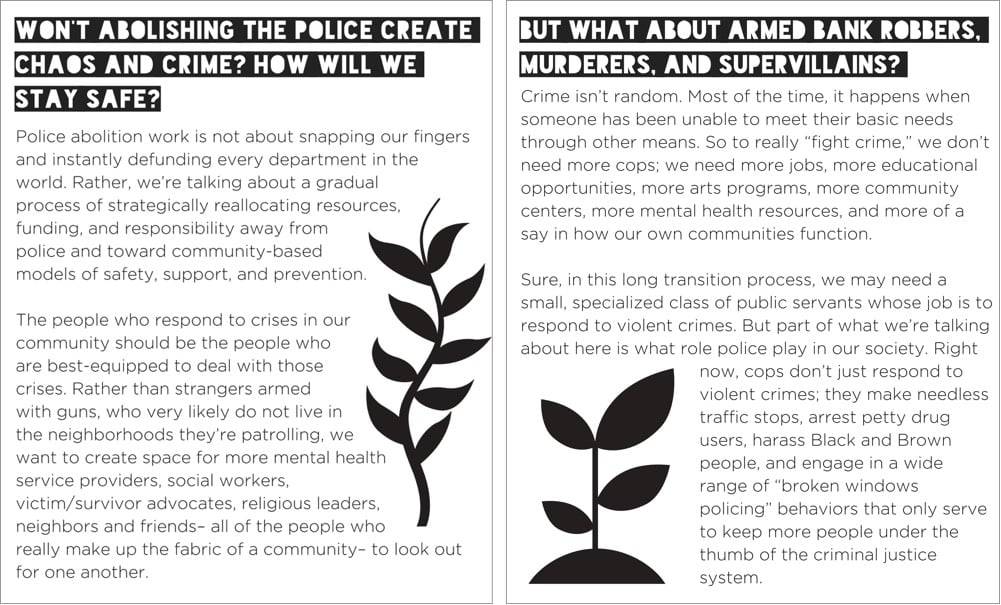
But don’t get me wrong. We are not abandoning our communities to violence. We don’t want to just close police departments. We want to make them obsolete.
We should redirect the billions that now go to police departments toward providing health care, housing, education and good jobs. If we did this, there would be less need for the police in the first place.
Confessions of a Former Bastard Cop is an essay allegedly written by a former police officer with ten years of experience in “a major metropolitan area in California with a predominantly poor, non-white population”. In it, he attempts to explain the system under which cops are trained and operate, “not to excuse their behavior, but to explain it and to indict the structures that perpetuate it.” At the very least, this essay corroborates what activists have been saying about the police for decades.
I could write an entire book of the awful things I’ve done, seen done, and heard others bragging about doing. But, to me, the bigger question is “How did it get this way?”. While I was a police officer in a city 30 miles from where I lived, many of my fellow officers were from the community and treated their neighbors just as badly as I did. While every cop’s individual biases come into play, it’s the profession itself that is toxic, and it starts from day 1 of training.
Every police academy is different but all of them share certain features: taught by old cops, run like a paramilitary bootcamp, strong emphasis on protecting yourself more than anyone else. The majority of my time in the academy was spent doing aggressive physical training and watching video after video after video of police officers being murdered on duty.
I want to highlight this: nearly everyone coming into law enforcement is bombarded with dash cam footage of police officers being ambushed and killed. Over and over and over. Colorless VHS mortality plays, cops screaming for help over their radios, their bodies going limp as a pair of tail lights speed away into a grainy black horizon. In my case, with commentary from an old racist cop who used to brag about assaulting Black Panthers.
And this, uh, training doesn’t prepare officers for what their actual job ends up being:
And consider this: my job as a police officer required me to be a marriage counselor, a mental health crisis professional, a conflict negotiator, a social worker, a child advocate, a traffic safety expert, a sexual assault specialist, and, every once in awhile, a public safety officer authorized to use force, all after only a 1000 hours of training at a police academy. Does the person we send to catch a robber also need to be the person we send to interview a rape victim or document a fender bender? Should one profession be expected to do all that important community care (with very little training) all at the same time?
To put this another way: I made double the salary most social workers made to do a fraction of what they could do to mitigate the causes of crimes and desperation. I can count very few times my monopoly on state violence actually made our citizens safer, and even then, it’s hard to say better-funded social safety nets and dozens of other community care specialists wouldn’t have prevented a problem before it started.
Armed, indoctrinated (and dare I say, traumatized) cops do not make you safer; community mutual aid networks who can unite other people with the resources they need to stay fed, clothed, and housed make you safer. I really want to hammer this home: every cop in your neighborhood is damaged by their training, emboldened by their immunity, and they have a gun and the ability to take your life with near-impunity. This does not make you safer, even if you’re white.
His conclusion: “consider abolishing the police” and “creating a society focused on reconciliation and restorative justice instead of punishment, pain, and suffering — a system that sees people in crisis as humans, not monsters”.
As someone who did it for nearly a decade, I need you to understand that by and large, police protection is marginal, incidental. It’s an illusion created by decades of copaganda designed to fool you into thinking these brave men and women are holding back the barbarians at the gates.
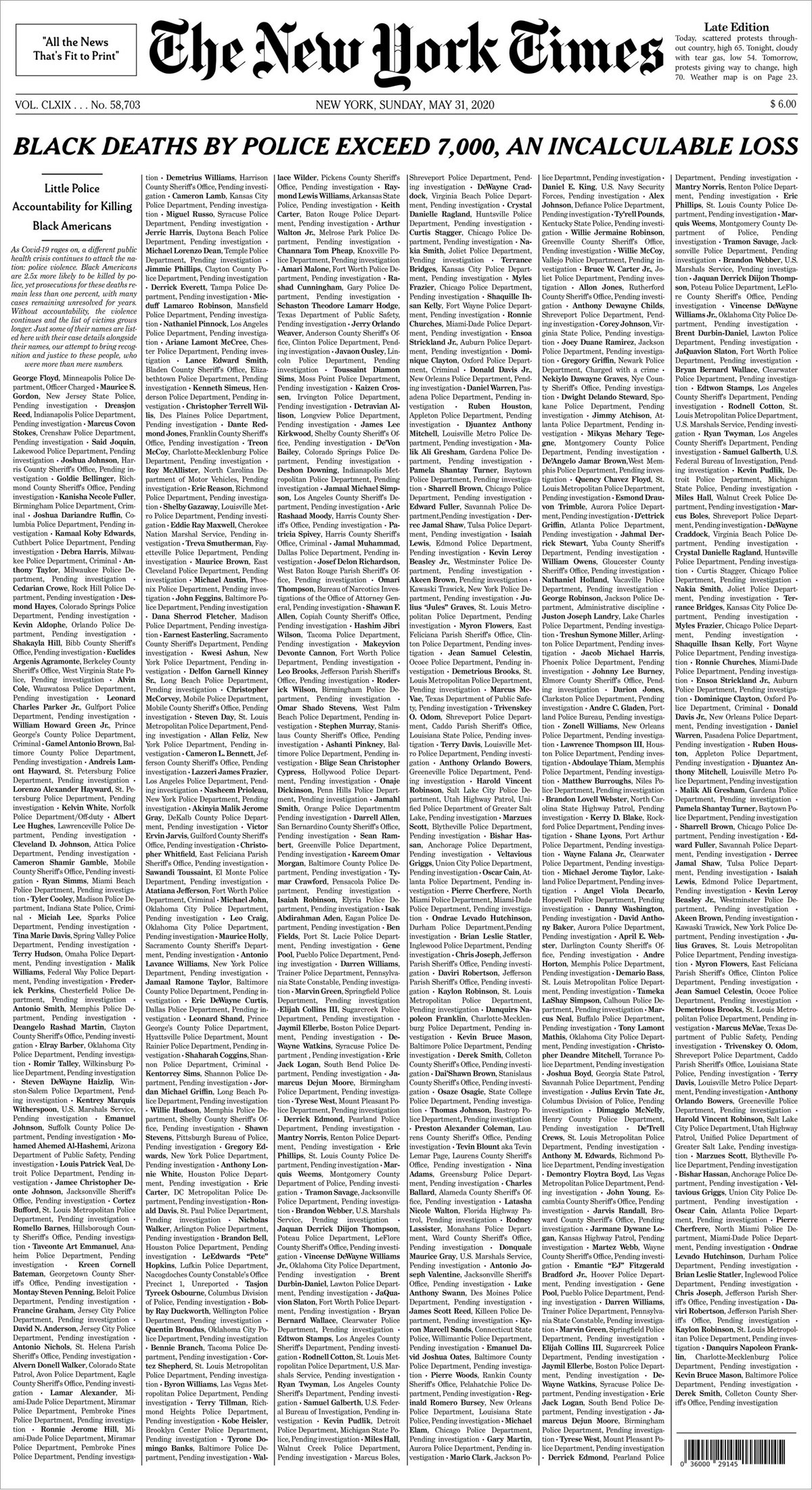
On Sunday May 24, the NY Times gave over their entire front page to listing the names of hundreds of victims of Covid-19 in the US. It was an iconic gesture that focused people’s attention on both the overall death toll and the stories & lives of the individual people who had been killed by the disease.
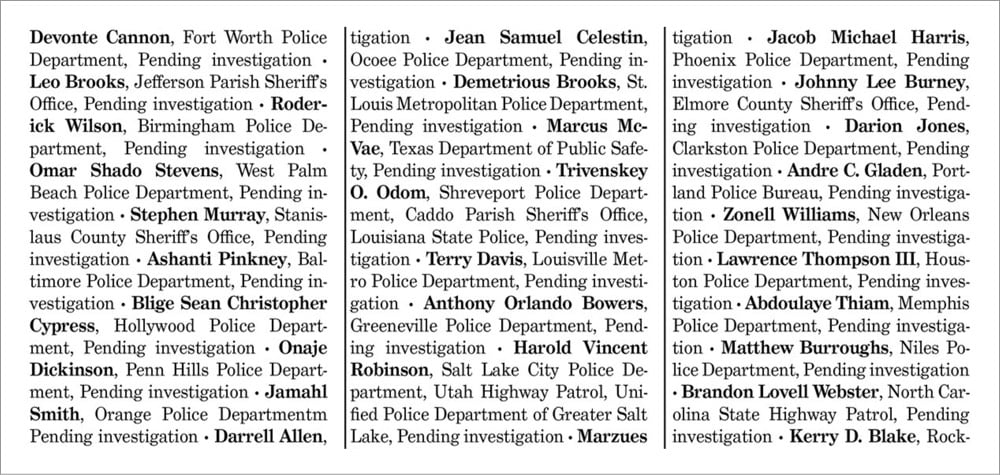
The Incalculable Loss Project has repurposed this design to honor some of the 7,000 Black Americans killed by police since 2000 and to ask why media outlets like the Times haven’t given “the same attention to this epidemic as they did Covid-19”. Each person’s name is accompanied by the name of the officer’s police department and the current status of the investigation into the killing (overwhelmingly “pending investigation”).






Stay Connected