


Vintage Pan-Am Luggage Tags


I love these oversized prints of vintage Pan-Am luggage tags from artist Ella Freire. The typography and colors are just perfect. (via daringfireball)

This site is made possible by member support. 💞
Big thanks to Arcustech for hosting the site and offering amazing tech support.
When you buy through links on kottke.org, I may earn an affiliate commission. Thanks for supporting the site!
kottke.org. home of fine hypertext products since 1998.
Beloved by 86.47% of the web.
I love these oversized prints of vintage Pan-Am luggage tags from artist Ella Freire. The typography and colors are just perfect. (via daringfireball)
Hey gang. I took a couple of days off at the beginning of the week to visit some colleges with my daughter. She found a potential contender, one that was just fine, and a school that isn’t going to work for her — we both independently zoned out listening to the presentation about 10 minutes in. 😂 It was a last-minute trip and I’m so glad we got to go do this together. Standout food of the trip was from All’Antico Vinaio — best sandwich I’ve had in months. Anyway, I’m back now and focused on the site because what else is there to do when it’s -5° outside?
Some of you have noticed that the comments have been turned off for the last few weeks. There was a rise in casual negativity that felt too close to how social media feels, i.e. a place where even well-meaning folks are not incentivized to think “this isn’t for me” and move on without comment. I understand that the pull of treating this social space just like other social spaces is strong, but we’re trying to do something different here, as outlined in the community guidelines. So, I took comments offline to regroup. They will be back soon; I miss them. Thanks for your patience.
I have been busy the last couple of months and have lots of things in the pipeline, including a new t-shirt (and store), new site features, and a bunch of behind-the-scenes things that (hopefully) you won’t even notice. I’ve been kinda stuck on finishing them up and rolling them out because of *waves hands around wildly at all the things happening in the world* — it feels like a tough time to be anything but laser-focused on fascism, even though that’s what they want.
The bastards, they’ve ground me down some, I can’t lie. Striking any sort of balance between normalcy and alarm, personally, has been challenging. Hardly a unique situation — everyone I talk to these days is in the same boat to some degree (and some are in more challenging & dangerous boats) — and sometimes that solidarity is a comfort but sometimes it ain’t and I just feel stuck and aimless and wrong for not caring or for caring too much. But I’ll figure it out — we all will. I hope. ✌️
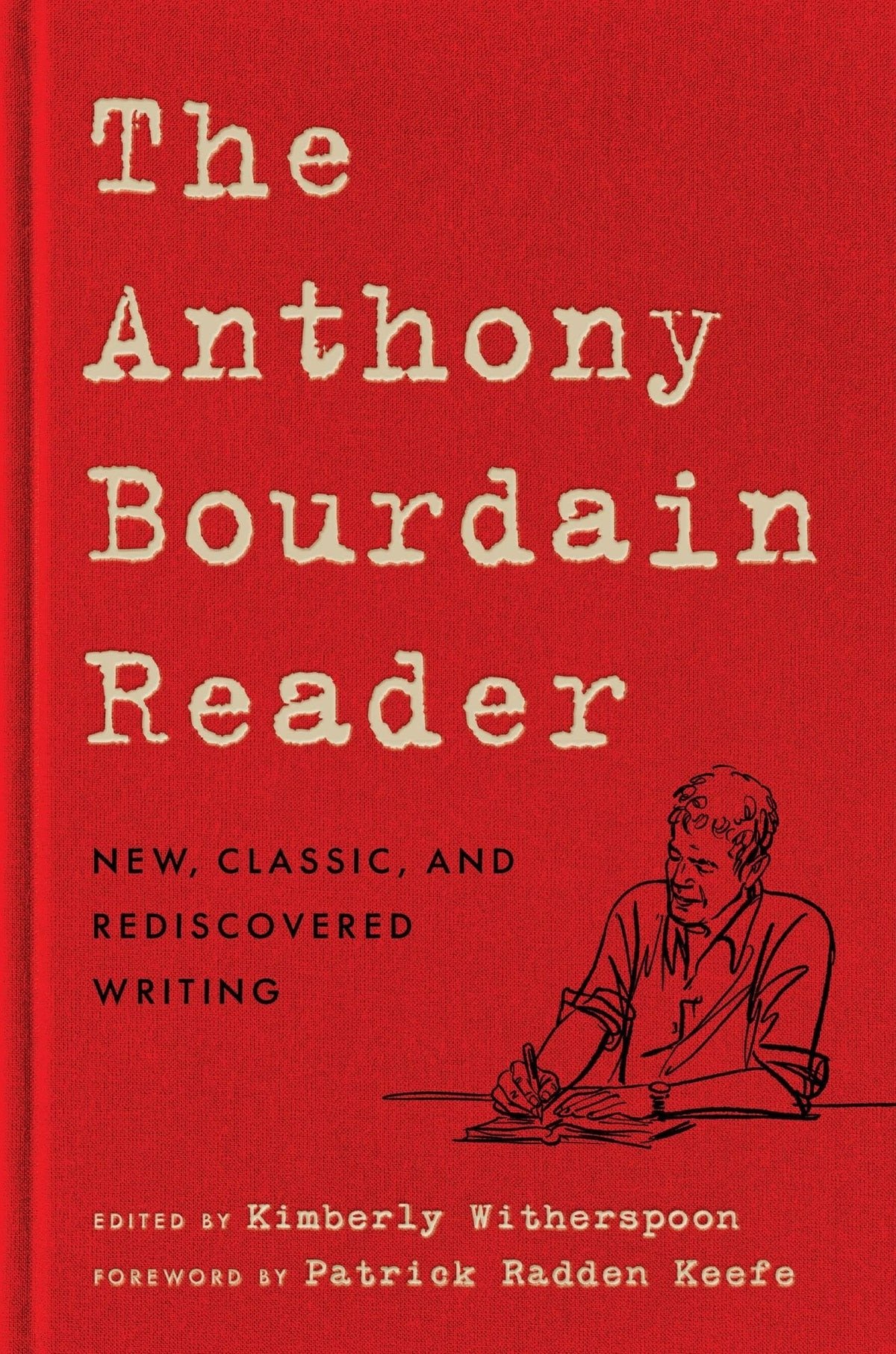
The Anthony Bourdain Reader (Amazon) is a collection of writings from the late author, TV host, and chef, including some unpublished pieces.
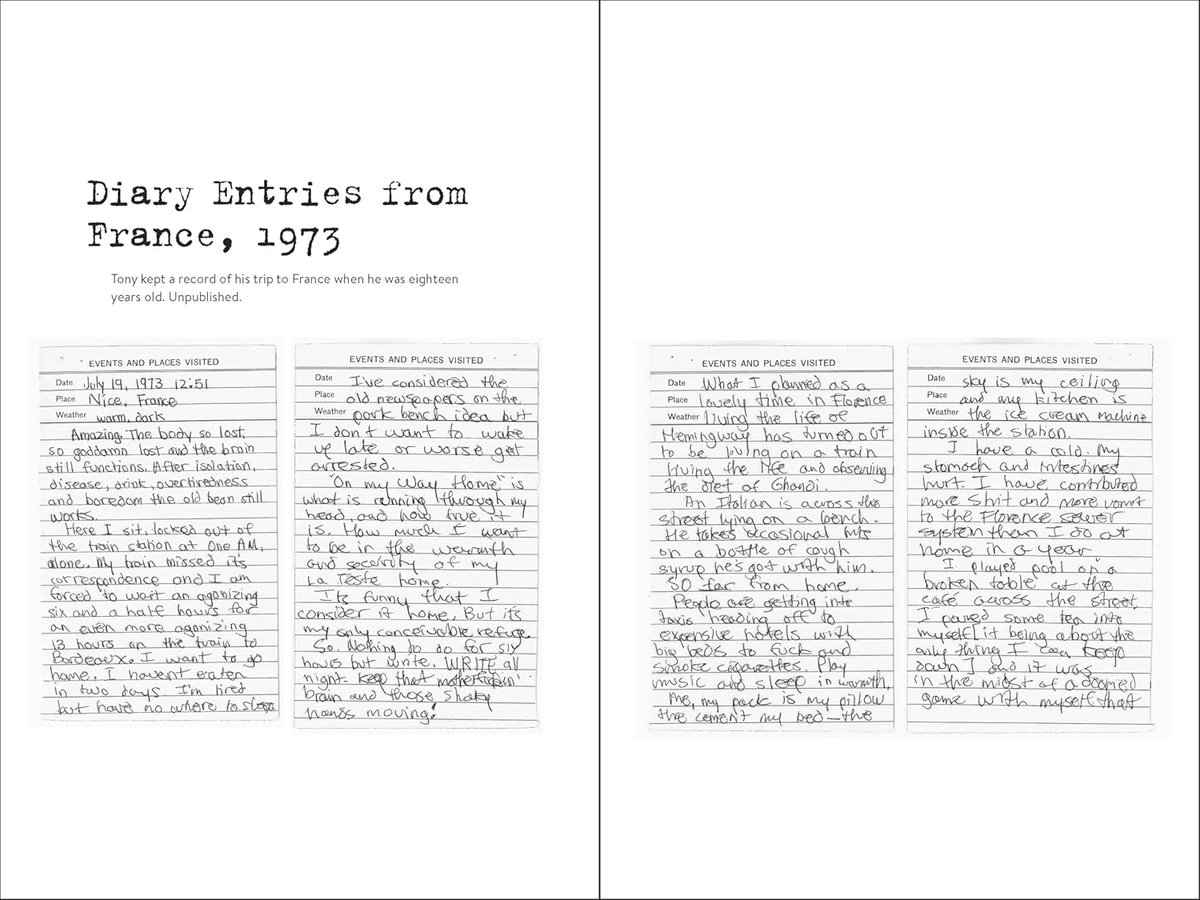
The Anthony Bourdain Reader is also a showcase for new and never-before-seen material, like diary entries from Bourdain’s first trip to France as a teenager and “It’s Cruel and Unforgiving Terrain,” a piece on the New York restaurant scene, as well as unpublished short fiction like “I Quit My Job Yesterday” and chapters from No New Messages, his unfinished novel. These newly discovered pieces all contribute to give the fullest picture of the man behind the books.
Here’s a sample from his teenage diary he kept on a trip to France:
And from a review in the Guardian:
Some of the loveliest passages come when Bourdain writes with just-so tenderness and precision about his family: a journey with his brother to La Teste-de-Buch in France among whose sand dunes they holidayed as young men; the outsize pleasure he takes in his five-year-old daughter nibbling on Pecorino and an anchovy. I suspect Bourdain will be read in years to come less as a writer about food than of food work. Everywhere he lands — whether in struggling bistros, mob joints or midtown nightclubs — he warms to the subaltern caste of underpaid toilers slicing and sizzling and sweating away.
The book was edited by his longtime agent Kimberly Witherspoon and contains a foreword by Patrick Radden Keefe. Buy now at Bookshop.org or Amazon.
A streaming services savings tip from the Nomadico newsletter that I was not aware of:
I’m going to add Apple TV at home after watching only part of Severance on a United flight, but I’ll likely subscribe in Mexico where it’s 28% cheaper than the USA. You can play this arbitrage game with most of the streaming services — I once got HBO on sale for $5 a month. In Mexico you can get the highest tier of Netflix for the price of the middle tier stateside, a 39% monthly savings (with a better studio movie selection too). Shop around if moving around. In Turkey, for example, the highest tier of Netflix with 4K hi-def is less than US$10 per month. Try regional gift cards, signing up while in another country, or using a good VPN for the first transaction.
Anyone else tried this?
Konnichiwa! I’m back from Japan and finally getting over my jetlag, which took much longer than I expected. Here’s a list of all the things I’ve been reading, watching, listening to, and experiencing over the past few months.1 Let us know what movies, books, art, TV, music, etc. you’ve been enjoying in the comments below!
Deacon King Kong by James McBride. This was my first time reading anything by McBride and maybe I have a new favorite author? I love everything about this story and the way he tells it. (A+)
The Da Vinci Code. One of my go-to comfort movies. “Scientific” art history detective story? Yes, please. (A)
One Battle After Another. Great. Especially Sean Penn. And it reminded me of a Wes Anderson movie for some reason? Like one that he would have made had he followed the Bottle Rocket path instead of the Rushmore Path. (A+)
Meredith Dairy Marinated Sheep & Goat Cheese. All cheese is delicious, but this one particularly so. (A)
Fantastic Four. It was ok? Aside from a few things, I’m having trouble getting excited about post-Infinity Saga Marvel. There was just a special alchemy about that whole arc that is proving impossible to reproduce. (B)
The Age of Innocence by Edith Wharton. Fantastic right from the first page. Sharp writing about social mores, reminded me of Middlemarch & Price and Prejudice in that respect. One of my all-time favorites, I think. (A+)
The Gilded Age (season three). Still enjoying the hell out of this show. Total suspension of disbelief is a must. (A-)
Mission: Impossible. I haven’t seen this in maybe 20 years and I guess it holds up? Not my favorite of the series though. (B+)
Tinker, Tailor, Soldier, Spy. Great spy thriller. Gary Oldman is fantastic in this. Cold War? Spies? Britain? I will pretty much watch as many of this type of movie as you can make. (A)
Leaving America. This is a 12-part podcast on the logistics, benefits, and challenges of leaving the United States. Oh, no reason. (B+)
The Fellowship of the Ring (and TT & ROTK) by J.R.R. Tolkien. It’s been a while since I’ve read The Lord of the Rings books and wow, are they long. There’s entirely too much “and they travelled from here to there” logistics that drag on over several pages and descriptions of hilltops & ancient landmarks that you only hear about once. But Andy Serkis narrating the audiobook? So good. (A-)
The Lord of the Rings trilogy. After each audiobook, I watched the extended version of the corresponding film. My general feeling after 65+ hours of audiobook and 12+ hours of movie is that the books are too long and the movies too short. An 18-hour mini-series — perhaps three seasons of six episodes each? — seems like the sweet spot. (A)
Star Trek: Strange New Worlds (season three). Maybe didn’t enjoy this quite as much as the previous two season, but I love spending time with these people and look forward to doing more of that when season four drops. (B+)
Jaws. Got to see this in the theater when they released it for the 50th anniversary. Spielberg had such a strong style right from the jump. (A-)
Paradise. Just fine. But I feel like there are better apocalyptic shows out there. (B)
Downton Abbey: The Grand Finale. It was so nice to head to the theater to nestle myself into the low-stakes world of Downton Abbey for 2 hours. (B+)
Daft Punk Fortnite. Love anything with Daft Punk. (A)
The Heaven & Earth Grocery Store by James McBride. Right after finishing Deacon King Kong, I did something I almost never do: started in on a different book from the same author. Loved this one too. (A+)
Tron: Ares. It was a loud NIN music video on a huge screen, what’s not to like? Jared Leto was fine, but there were probably better casting options here that the audience would have been more excited about. And the direction could have been stronger…Gillian Anderson and Greta Lee were both surprisingly meh. (B+)
Tron: Ares soundtrack. Better than the movie. (A-)
Total Recall. First time! Maybe a little too Verhoeven/B-movie for me. (C+)
Cars. I’ve seen this movie several times and what I noticed this time around is how incredibly expressive the cars are. You can just tell they worked very hard on that aspect of the animation. (A-)
Shopkeeping by Peter Miller. This was recommended from a couple of different vectors — pretty sure one was Robin Sloan. Lots of resonance to my work here and how I think about it (and want to think about it). (A-)
Japan. Absolutely loved it. (A+)
Iyoshi Cola. Craft colas are often disappointing, but this one was absolutely delicious. Wish I could get it in the States for less than $14 a can. (A)
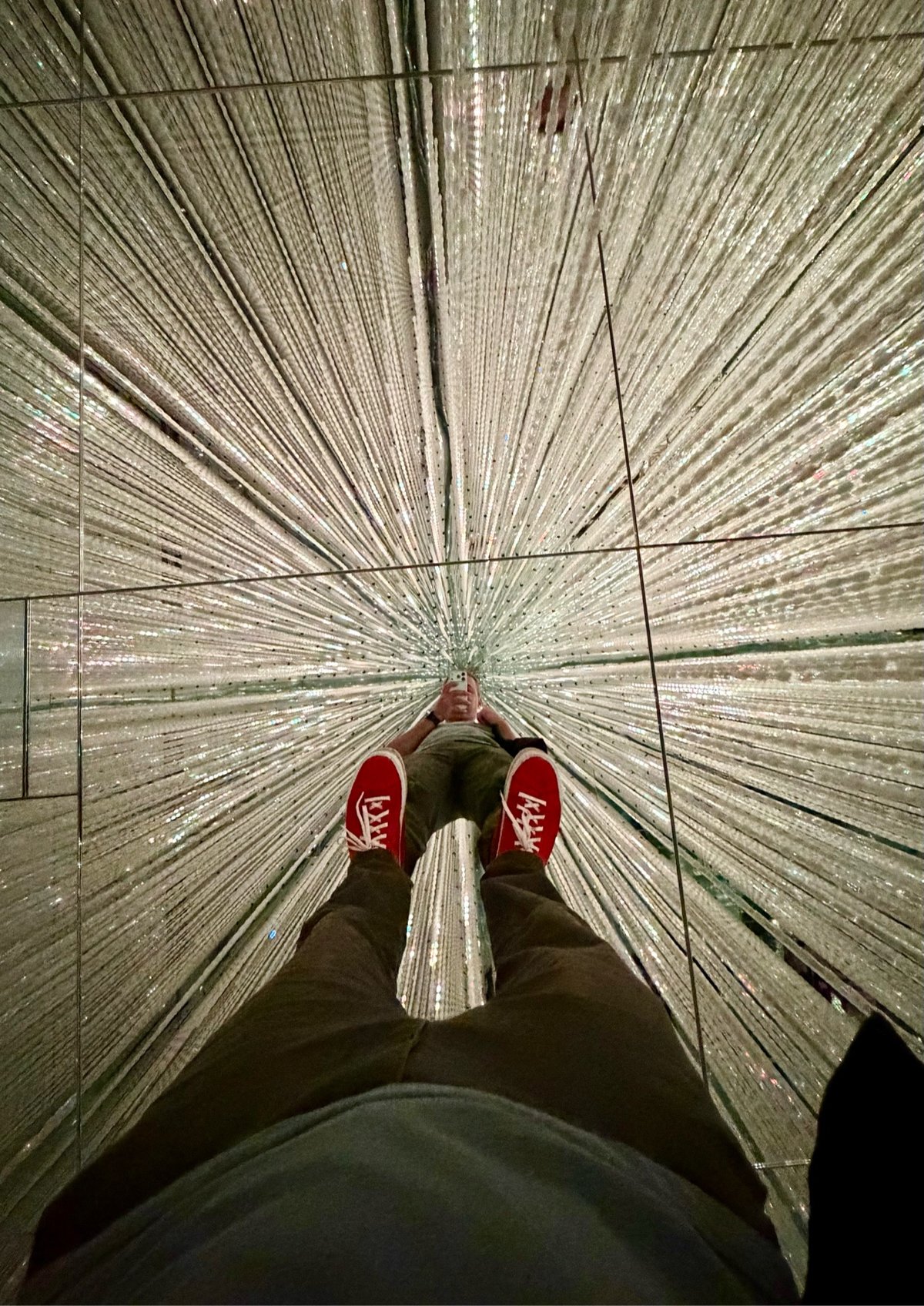
teamLab Borderless. Some of this was too “built for Instagram” but a couple of the rooms (the one where it felt like the whole room was moving & the cathedralish one with the light strings) were great. (A-)
The Sumida Hokusai Museum. Had to make the pilgrimage here. (A-)
In Praise of Shadows by Jun’ichirō Tanizaki. Read this book about Japanese aesthetics while visiting Japan — it provided an interesting context. (B+)
Hokusai at Creative Museum Tokyo. Fantastic show…there were hundreds and hundreds of prints and drawings that showed his evolution and influence. (A+)
Okunoin Cemetery. Had one of the strongest senses of place I have ever experienced. (A)
Konbini. The Japanese convenience stores really are as appealing as you’ve heard. (A-)
Awakening Your Ikigai by Ken Mogi. Perhaps a little over-simplifying when it comes to Japanese culture, but I appreciated the message of having a purpose. (B)
Sho-Chan Okonomiyaki. When I got to Hiroshima, I knew I had to try their version of okonomiyaki, so I went to Okonomimura, a multi-story building crammed with okonomiyaki restaurants. I picked one and had one of the most surprising meals of my trip. So good. (A)
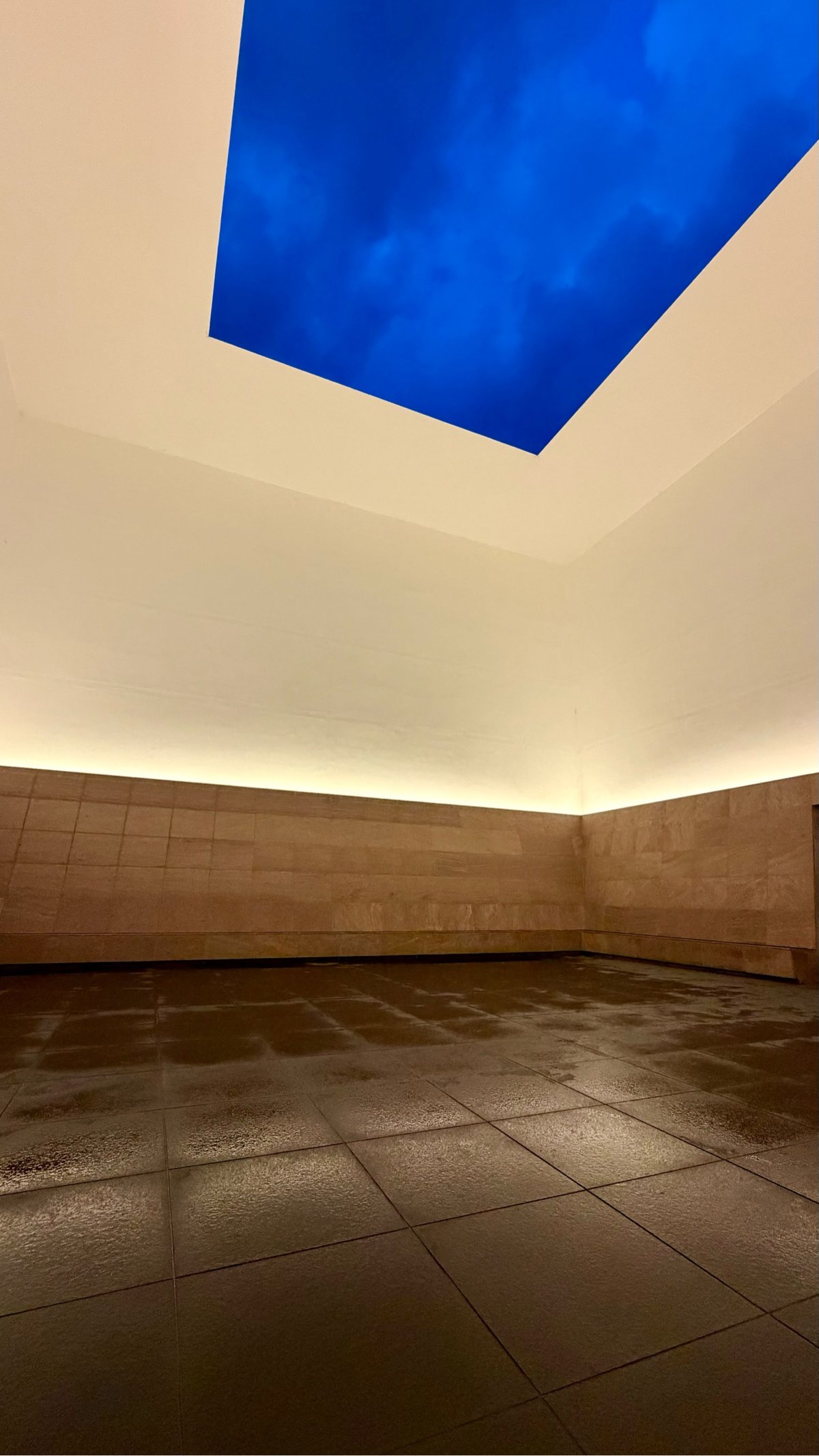
Blue Planet Sky. I spent a lot of time sitting in this room by James Turrell. (A)
Kanazawa Phonograph Museum. Lovely little museum, and a good opportunity to observe how successful inventions move from technology to culture/fashion/commerce. (A)
Princess Mononoke. I saw this in the theater on my last full day in Tokyo; they recently released a 4K remaster. Absolutely breathtaking. (A+)
Butch Cassidy and the Sundance Kid. Redford and Newman are both total smokeshows in this. And I’d forgotten how goofy this movie is. (B+)
A House of Dynamite. A very tough watch, but I thought this was fantastic as a tour of some of the different kinds of people who hold the fate of every single person on the planet in their hands every damn day. They’re tired, stressed, distracted, at cross-purposes with themselves, set in their ways, more celebs than leaders, and mediocre. And none of them have ever seen Dr. Strangelove? (A)
Past installments of my media diet are available here. What good things have you watched, read, or listened to lately?

I began at the end. The Chōishi-michi pilgrimage route is an amazing 12-mile trail that winds its way up through the forest from the Jison-in temple in the town of Kudoyama in the valley to the Danjo Garan temple in the town of Kōyasan in the mountains. The origins of the trail date back to the founding of Kōyasan as a center for the esoteric Shingon school of Buddhism by Kūkai (aka Kōbō Daishi) in 819 CE. Legend has it that Kūkai used the trail to visit his mother; ever since, for some 1200 years, Buddhist faithful have been using the Chōishi-michi to worship in sacred Kōyasan. I was going to follow in their footsteps, for my own ends.
To climb up a mountain like a proper pilgrim, you need to start at the base. Seeing as my lodgings were already in Kōyasan, my journey began by a) catching the bus down a winding forest road; b) where I boarded a cable car for the ludicrously steep journey down to Gokurakubashi; c) where I got on an extremely local train; and d) finally disembarked at the Kudoyama train station and walked to the starting point. One hour and 30 minutes after I’d left my guesthouse, I stepped through the gate of the Jison-in temple. Now all I had to do was climb the entire 4100 feet of elevation back to where I’d started.

When establishing the Chōishi-michi some 1200 years ago, Kūkai marked the route with wooden guideposts, one every 109 meters. You don’t want your pilgrims getting lost — how are you going to find eternal salvation if you can’t even make it to the temple? The markers were replaced with more sturdy stone gorintō in the late 13th century. 180 of these stone markers are situated along the route from to Jison-in to Danjo Garan, along with another 36 markers from Danjo Garan to the Mausoleum of Kōbō Daishi in the Okunoin Cemetery. In the spirit of wayfinding, perhaps a map of my there-and-back-again route would be useful:

———
I was thankful for the frequent stone markers as I’d gotten a little lost on my hike the previous day. I was traveling on — or I was supposed to be traveling on — the Nyonin-michi pilgrimage route (Women’s pilgrimage route) and doing pretty well when I took a wrong turn right near the end.
This particular trail, though popular, wasn’t on All Trails and markers were sparse, so I was doing a lot of pinching & zooming of Google Maps and a PDF I downloaded from the internet. The trail curved right and I stayed straight, wondering why this bit of the trail was a little less blazed than the rest of it had been, and I popped out into the backyard of a temple. Oh no, I thought, I’m not supposed to be back here; only monks are supposed to be back here. I’m offending so many ancestors right now.

More pinching and zooming — ok, there’s a road off to the northwest. I set off and walked by what looked like some recent graves? The ancestors: so mad right now! What a disgrace of a pilgrim I am. I found myself crouching as I walked almost on tiptoe, trying to evade detection — even though the Buddha surely knew where I was and what I’d done. The road was just where the map said it would be; I slipped through a gap in the fence and followed it downhill for a quarter mile, not entirely sure I wasn’t still in a restricted area.
I came up on the other side of the temple and realized I’d stumbled into the backyard of Kōbō Daishi’s Mausoleum, where Shingon founder Kūkai entered into eternal meditation in 835 CE,1 aka one of the absolute holiest places in all of Japan, aka I am in deep, deep shit with the ancestors. Abandoning my plans for lunch, I entered Okunoin Cemetery through a proper entrance and made my way to the mausoleum. Wishing to make amends, I bowed at every bridge and threshold where everyone else was bowing and threw some coins into the saisen box.2 Many of the people around me were quite emotional about being there. The whole atmosphere just felt good, peaceful, numinous.
———


Ok, back to the Chōishi-michi, the big 12-miler. The first few miles felt almost straight up and then the trail leveled off for a while. The weather was cool but humid, so I hiked in shorts sleeves, sweating. It rained intermittently. Fog crept up the mountainside. I hiked though persimmon orchards; they’re in season right now. Small stands sold oranges & persimmons on the honor system. The path was well marked, not only with the stone gorintō but with well-placed signs in Japanese and English pointing the way to Kōyasan.


Walking the narrow path between the forest’s tall evergreen trees felt like entering a European cathedral with a towering vaulted ceiling. A bamboo forest earlier on the hike had a similar feeling; spaces such as these make you look up and feel whatever power or force or presence you believe in. You feel small and big all at once. The forest: unbelievably beautiful.

I heard voices through the trees and then the crack of something — was that a golf ball? Am I hiking through a golf course? The trail came to a clearing and lo, the tee for the 13th hole. The path also passed by vending machines,3 crossed roads, and zagged through tiny towns. The modern world, built up around this ancient trail.
I stopped for lunch around the halfway point: a sandwich, apple & custard pastry, and a small can of consommé flavored Pringles procured the night before at FamilyMart. FamilyMart is one of the big three convenience stores (konbini) in Japan — the other two are Lawson and 7-Eleven. Before you come to Japan for the first time, everyone tells you how amazing the konbini are: “You’re not going to believe this, but…” And then you get here and damn, they were right. The consommé Pringles were delicious.
After lunch: one foot in front of the other. Pilgrim mode locked in. Maybe I should become a monk, I think. I’m pretty good at being a pilgrim, the hiking part of it, I mean. I’m fine being alone with my thoughts. The clothes look comfy. I could be a monk with the internet at the center of my practice. Hours spent doomscrolling is kind of like meditation, right? It’s certainly a flow state of sorts, like the blood gushing from the elevators in The Shining. I’m into aesthetics. And I— oh, it’s ascetic? Ah. Maybe I’ll just stick to my secular life then.
Another stone marker. Another 109 meters. Keep going. I pass one every 90-100 seconds or so. Early on, the markers flew by; I didn’t even notice some of them. Now I’m searching them out ahead, peering up the slope I know (via All Trails) steepens sharply right at the end. Is this is the last one? No. But keep going. It’s damp, the rocks are wet. An inch of moss covers everything save for the well-worn pilgrimage path. It feels like a rain forest. Another stone marker. Another 109 meters. Keep. Going.
I sense the top of the hill — something about the light changes. I see a guardrail ahead. Emerging on the side of the road, I cross it and make for the Daimon gate, the traditional entrance into town. On the threshold, I bow deeply. Stepping over, I pump my fist in the air — I’ve made it back to Kōyasan.
———
A weary pilgrim deserves a hot bath. My guesthouse is a further few hundred feet. The woman who runs it is very nice and a little kooky; I like her. After the sacred backyard debacle the other day, I told her about all the ancestors I’d offended. She chuckled and told me, the ancestors, they don’t mind so much. She cooked me breakfast (delicious, nutritious) every morning — you don’t look like a tofu person, she said, eyeing me. Correct.
On my last morning, I asked her about a bunch of boxes stacked on a table. I have an interest in incense, she said. Apparently it’s quite involved and the most skilled practitioners are equal in expertise to those who do the chadō tea ceremony. She opened one of the boxes and showed me a very expensive twig of charcoal, which is so special that they sell it by the stick. When the charcoal burns, it does so purely, without giving off any gases or sparking or spitting. Afraid she’s trapped me into politely listening to her going on about her hobby, she checks in: are you actually interested in this? My turn to chuckle; personally & professionally, I’m interested in all sorts of things, even fancy charcoal.
The guesthouse has a kick-ass bathtub, deep and quick-to-fill. My host keeps a selection of bath salts and I select a yuzu one. Tired but happy and fulfilled, I soak a long while, easing the pain in my aching feet & back, the yuzu scent filling my pores.
———
After bathing, I set out to finish my journey. I’d previously walked the length of town to the Okunoin Cemetery and back a couple of times, but I wanted to do the whole thing in one day: from Jison-in temple to Kōbō Daishi’s Mausoleum at the far end of the cemetery, a proper pilgrimage. Well, not quite proper…because I was tired from my hike, I caught the bus instead of walking. The quest is the quest, whatever it takes.

Okunoin Cemetery is one of the most breathtaking and magical places I’ve ever been. Imagine a redwood forest like Muir Woods with Buddhist temples and a 1200-year-old cemetery with tens of thousands of faithful buried in it. The soaring trees create that cathedral effect and even an atheist like me can’t help but feel holy in the presence of so many souls, including Kūkai/Kōbō Daishi himself.
I hopped off the bus and started into the cemetery. Night had fallen and it was quite dark; should I have brought my headlamp? Ah, no need…the way is lit by hundreds of lanterns lining the path at about shoulder height. There are also some brighter, taller lights, a concession to safety I suspect. They’re the wrong temperature though, a rare misstep in a country with an unrivaled collective attention to detail. Whereas the lanterns glow with a pleasant amber light, these safety lights are a cold, garish blue, a color as harsh to the eye as the word “garish” (or “harsh” for that matter).

Aside from a few other people, I’m the only one here at this hour. Why are my shoes. So! LOUD!!? Each footfall echoes about the whole place and the crunch of the sand on the wet pavement under my soles is deafening. Once again, I am disturbing the ancestors. I try to walk quieter but somehow that’s even louder? How is anyone supposed to be eternally meditating with all this racket going on? Definitely not monk material, neither me nor my cacophonous shoes.
What’s that noise?! Some kind of animal? Ok, I can still hear the faint sound of traffic on the nearby road and anywhere with automobile noise isn’t scary — dangerous perhaps, but not scary. I hear another noise, one that I can only describe as “probably bird but what if monkey?” Or maybe Ghibli monster? I gotta say, in case you didn’t know, Hayao Miyazaki sure nailed Japan. Hit it out of the park. Everywhere I go, I am reminded of his work: small food stalls, beautiful parks, tiny trucks, cute little train stations, forest paths — the just-so touches of Japan reflected and amplified by the meticulous and rich detail of Studio Ghibli’s work.

The cemetery oozes Ghibli energy; it is not difficult to imagine thousands of Miyazaki’s weird little guys hanging from every tree and lurking behind every gravestone. Buoyed by their benevolent presence, I make a full loop of the cemetery in the dark, all the way to Kōbō Daishi’s Mausoleum and back to the entrance again.
And then, not wanting to wait 25 minutes for the bus, I walked all the way back to my guesthouse again, stopping at a sushi place for dinner. When I poked my head through the door, there was one other customer, an old guy smoking a cigarette who gestured for me to join him at the communal table. A menu was produced; I ordered so much sushi. Baseball was on the TV in the corner — game 1 of the Japanese equivalent of the World Series. The old couple running the place brought me sake, six massive fatty tuna rolls, six even larger salmon nigiri, and a much larger bowl of miso soup than I was expecting. As the three of them chatted, we all watched the baseball and I finished everything they brought me. I’d walked a total of 17.5 miles and needed to replenish.
I rolled out of there around the 4th inning of the game, arigato gozaimasus all around, and limped the rest of the way back to the guesthouse with a full belly, full heart, and teeming mind — back to where I began, at the end, completely satisfied by one of the best, most fulfilling days I’ve had in a long time.

Hey folks. I’m very excited to be heading to Japan for the first time next month. I’ll be there from mid-October for 3-4 weeks. The current plan is Tokyo, Kamakura, Kanazawa, Kyoto, Osaka, Koyasan, and perhaps Hiroshima — change my mind? If you’ve been there, please leave your recs in the comments below or drop me an email. If you live there or will be visiting at the same time, let’s meet up!
The photograph above is from Koya Bound by Craig Mod & Dan Rubin. The companion website to the book is great.
Well, it’s been awhile since I’ve done one of these but I’m gonna skip the apologies and get right into it. Here’s a list of what I’ve been reading, watching, listening to, and experiencing over the past several months. Let us know what movies, books, art, TV, music, etc. you’ve been enjoying in the comments below!
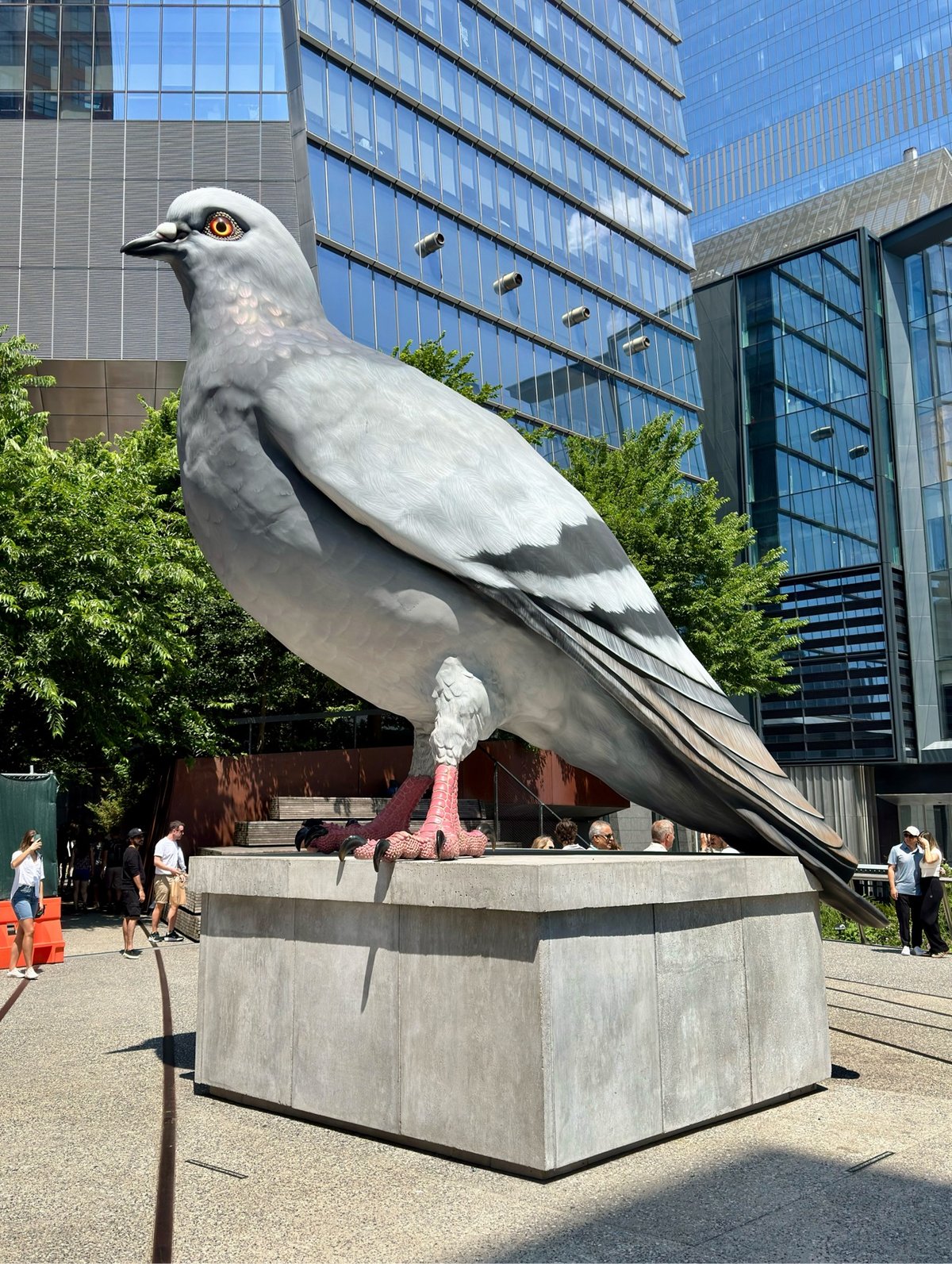
Dinosaur. It’s a huge pigeon on the High Line — what else do you need to know? (A-)
The Ministry of Time by Kaliane Bradley. Entertaining and engaging. It’ll make a good TV series. (B+)
Bill and Ted’s Excellent Adventure. I hadn’t seen this in several years but I still knew all the words. (A-)
My Brilliant Friend (season four). If there’s one thing I’ve watched in the past several years that I wish had gotten more attention from viewers, critics, and awards panels, it’s this wonderful show. (A+)
Pirates of the Caribbean: The Curse of the Black Pearl. Johnny Depp’s Jack Sparrow might be the most perfectly cast role in the history of cinema. Great story too. This movie surprised me when I saw it in the theater in 2003 and it’s still in the top tier of action/adventure movies. (A)
Andor (season one). A rewatch to prep for season two. I didn’t understand what the fuss was about this show the first time around, but this second viewing was a revelation. Andor is easily the best Star Wars thing since Empire. (A+)
Galleria Borghese. As previously discussed, the Bernini sculptures were a highlight of the summer. (A+)
Caravaggio 2025. Fantastic exhibition. (A)

The vivid blue color of the Mediterranean. (A+)
La Vita è Un Mozzico. We waited for an hour for sandwiches and it was probably worth it? (A)
Black Doves. British spy thriller? Keira Knightley? Ben Whishaw? Twist my arm. (B+)
Captain America: Brave New World. I’m sorry Sam Wilson / Anthony Mackie, there’s a “we have the Avengers at home” vibe here that’s hard to shake. (B)
Music to Refine To: A Remix Companion to Severance. I love this album; one of my favorite things of the past several months. (A+)
Mickey 17. It was fine? I was distracted while watching it in the theater, which is never a good sign. My favorite Bong Joon Ho film is still Snowpiercer. (B)
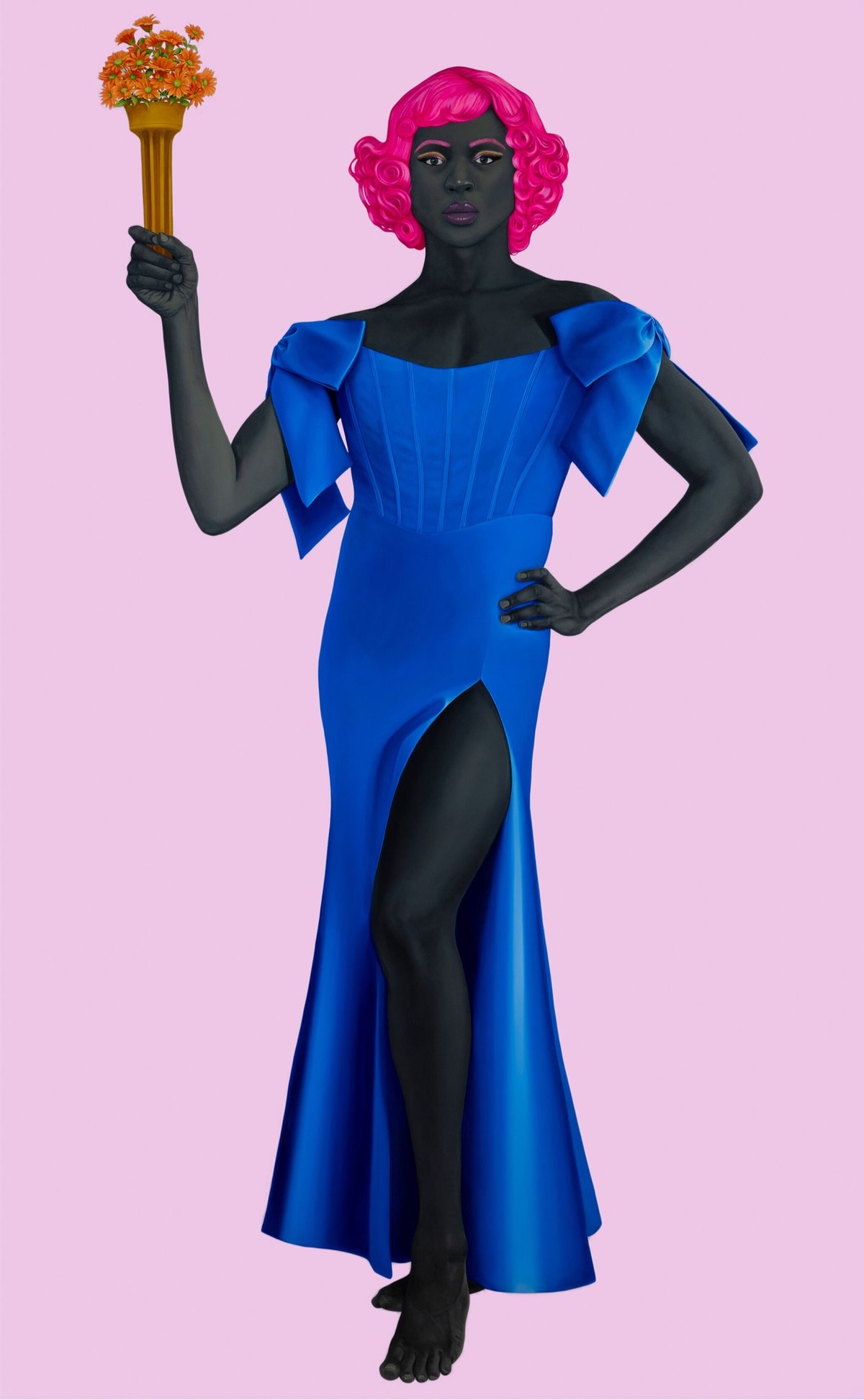
Amy Sherald: American Sublime. Absolutely fantastic. (A+)
The French Dispatch. This has quietly become a favorite of mine among Anderson’s films. (A)
The Royal Tenenbaums. However, this is still my favorite. (A+)
Paris Is Burning. Classic documentary of a bygone NYC era & a subculture that is now both flourishing and threatened. (A-)
Star Trek: Strange New Worlds (season two). I love these characters, always the sign of a good Trek. The crossover episode with Lower Decks was delightful even though I’ve not watched any of the animated series yet. The musical episode I liked less (not a showtunes guy) but I appreciated the experimentation. Bring on the Muppet episode. (A)
Severance (season two). Perhaps not as good as the first season — there was a lot in the mid-season episodes that didn’t land for me. Still, I always watched when a new episode dropped. (A-)
Army of Shadows. Part of the unplanned resistance film festival I’ve been screening for myself recently. Not quite as good as I remembered it, but it’s nice to watch something that doesn’t just lay everything out on a platter for you so you can emote properly. (A-)
Best in Show. So many lines from this that I use in my daily life. (A-)
The 99% Invisible Breakdown: The Power Broker. This is such a good series with fantastic guests about a legendary book. Who knew that Roman Mars was such a gigglepuss though? (A)
Johnny English. I didn’t find this quite as delightful as my family does. I prefer Mr. Bean. (B+)
Paddington in Peru. Not quite the magic of the first two, but entertaining. (B)
Indiana Jones and the Last Crusade. I have likely said this before, but while Raiders is likely the best Indy movie, Last Crusade is my favorite (probably due to Tom Stoppard’s heavy rewrite of the script). (A+)
Star Wars: The Return of the Jedi. It’s interesting to watch the original trilogy having seen so many subsequent movies & TV series.
Ocean’s Twelve. The dancing lasers scene is completely ridiculous. (A)
Wallace & Gromit: Vengeance Most Fowl. Well, I wasn’t expecting a critique of AI and the role of technology in society from this animated feature, but maybe I should have? (B+)
A Complete Unknown. Liked this more than I thought I would. (A-)
Pride and Prejudice by Jane Austen. Just a wonderful book — witty and fun. (A)
The Devil in the White City by Erik Larson. Fantastic book. Listen to the audiobook version if you can — Scott Brick’s narration elevates the story. (A)
A Quiet Place: Day One. I only watched this because I was on a plane. (B)
Severance (season one). After watching the second season, I rewatched season one. There was apparently much I missed the first time around. (A-)
Black Bag. Soderbergh is always worth watching, especially when he dips into Ocean’s Eleven territory — although this was more serious. (A-)
A Minecraft Movie. The first half was tolerable, enjoyable even. And then not so much. (C+)
Star Wars: Revenge of the Sith. Watched this in the theater for the 20th anniversary. There are some good bits in here, but some of the acting really stinks. Folks in the theater cheered when Anakin slaughtered the younglings, which is probably some sort of meme that I don’t want to know about. (B+)
Sinners. I loved this movie. (A+)
Thunderbolts*. Thought I would like this more than I did. (B)
Mission: Impossible – The Final Reckoning. The last scene is a masterclass in not having the faintest idea how to end a movie. (B+)
Andor (season two). Only a slight dip from season one. Overall, the series was a brilliant look at radicalization, the messiness of rebellion, and the oppressive flatness of authoritarianism. (A+)
There There by Tommy Orange. Devastating. (A-)
The Fear of Never Landing. Good album to chill out to by Marconi Union, who previously brought you the most relaxing song in the world. (A-)
Novocaine. This was bad. (D+)
Glass Onion. More Benoit Blanc mysteries please — I love watching Daniel Craig and his CSI: KFC accent chewing scenery. (A-)
The Gorge. Half of this was great and the other half was just another pseudo-horror action thing. (B-)
Martyr! by Kaveh Akbar. Marvelous. (A)
Andor: The Rogue One Arc. This fan edit of Rogue One in the style of a three-episode Andor arc is as Gilroy-esque a cut as you’re ever going to get. (A-)
Mission: Impossible – Rogue Nation. I had been kinda ambivalent about the M:I movies, but Fallout converted me, so now I’m slowly making my way back through the back catalog. (B+)
Via Carota. Best meal I’ve had in a long time. The tagliatelle was better than any pasta dish I had during my trip to Rome — it’s true, don’t @ me! And the roast chicken was perfect. (A+)
V for Vendetta. Underrated. (A-)
The Last Samurai by Helen DeWitt. I’m going to tell you the embarrassing truth: I thought this was about actual samurai and perhaps related to the Tom Cruise movie. It is very much not. I gave it a real shot but ended up abandoning it about halfway through. (C)
Spider-Man: Into the Spider-Verse. Still a marvel of animated creativity. (A)
The Phoenician Scheme. Didn’t vibe with this at all. (B-)
Downhill mountain biking. This is giving me so much life right now. (A+)
Wallace & Gromit: A Matter of Loaf and Death. Not my favorite W&G but still. (B+)
F1. Like Top Gun: Maverick crossed with Ford v Ferarri but Cruise and Bale played the aging outsider role much better than Pitt. Is Pitt even a good actor or is he just extremely charismatic? (B+)
Superman. I thought it was fine but didn’t like it as much as others seemed to. Better than anything Zach Snyder did for DC though. (B)
Shōgun. Rewatch with my son. Just an incredible show all the way around. (A+)
The Last of Us (season two). This show was always fighting an uphill battle with me — I don’t like zombie media and I dislike characters (Ellie!) who wouldn’t survive/thrive in the situations that they’re in with their personalities & characteristics. And I finally won. (C+)
The Handmaid’s Tale (season six). *sigh* No idea why I started watching (and then finished) this season; I’m a sucker for closure I guess. (C)
Nintendo Switch 2. I bought this to play Kart with my kids and also for a better Fortnite experience. So far, so good. (B+)
Mario Kart World. I haven’t played a ton of this, but it’s good so far. Free roam mode is pretty fun. I’ve gotta write up my Kart wishlist sometime…Nintendo only checked off one or two items in World. (B+)
Sargent and Paris. Caught this on the very last day of the show and hoo boy was it crowded. (A- for the show, C+ for the crowds)
Let God Sort Em Out. Need to listen to this one a few more times but I’m liking it so far. (B+)
Right now, I’m watching Star Trek: Strange New Worlds season three, listening to Deacon King Kong on audiobook (fantastic, a lock for an A+), rewatching Wandavision, and picking at Is a River Alive? by Robert Macfarlane.
Past installments of my media diet are available here. What good things have you watched, read, or listened to lately?
Join National Geographic as they ride one of the most punishing train routes in the world, the Mauritania Railway, which travels through the Sahara Desert.
One of the longest and heaviest trains in the world, the 1.8-mile beast runs from the mining center of Zouerat to the port city of Nouadhibou on Africa’s Atlantic coast. The train is the bedrock of the Mauritanian economy and a lifeline to the outside world for the people who live along its route.
The train carries iron ore but many passengers also rely on the train to move long distances:
Passenger cars are sometimes attached to freight trains, but more often passengers simply ride atop the ore hopper cars freely. Passengers include locals, merchants, and occasionally some adventure tourists. Conditions for these passengers are incredibly harsh with daytime temperatures exceeding 40°C, night-time temperatures approaching freezing, and death from falls being common.
In 1996, Harper’s published a long piece by David Foster Wallace called Shipping Out, in which Wallace, a decidedly non-luxury cruise person, goes on a week-long luxury cruise in the Caribbean.
I have now seen sucrose beaches and water a very bright blue. I have seen an all-red leisure suit with flared lapels. I have smelled suntan lotion spread over 2,100 pounds of hot flesh. I have been addressed as “Mon” in three different nations. I have seen 500 upscale Americans dance the Electric Slide. I have seen sunsets that looked computer-enhanced. I have (very briefly) joined a conga line.
I have seen a lot of really big white ships. I have seen schools of little fish with fins that glow. I have seen and smelled all 145 cats inside the Ernest Hemingway residence in Key West, Florida. I now know the difference between straight bingo and Prize-O. I have seen fluorescent luggage and fluorescent sunglasses and fluorescent pince-nez and over twenty different makes of rubber thong. I have heard steel drums and eaten conch fritters and watched a woman in silver lamé projectile-vomit inside a glass elevator. I have pointed rhythmically at the ceiling to the two-four beat of the same disco music I hated pointing at the ceiling to in 1977.
I have learned that there are actually intensities of blue beyond very bright blue. I have eaten more and classier food than I’ve ever eaten, and done this during a week when I’ve also learned the difference between “rolling” in heavy seas and “pitching” in heavy seas. I have heard a professional cruise-ship comedian tell folks, without irony, “But seriously.” I have seen fuchsia pantsuits and pink sport coats and maroon-and-purple warm-ups and white loafers worn without socks. I have seen professional blackjack dealers so lovely they make you want to clutch your chest. I have heard upscale adult U.S. citizens ask the ship’s Guest Relations Desk whether snorkeling necessitates getting wet, whether the trapshooting will be held outside, whether the crew sleeps on board, and what time the Midnight Buffet is. I now know the precise mixocological difference between a Slippery Nipple and a Fuzzy Navel. I have, in one week, been the object of over 1,500 professional smiles. I have burned and peeled twice. I have met Cruise Staff with the monikers “Mojo Mike,” “Cocopuff,” and “Dave the Bingo Boy.”
I have felt the full clothy weight of a subtropical sky. I have jumped a dozen times at the shattering, flatulence-of-the-gods-like sound of a cruise ship’s horn. I have absorbed the basics of mah-jongg and learned how to secure a life jacket over a tuxedo. I have dickered over trinkets with malnourished children. I have learned what it is to become afraid of one’s own cabin toilet. I have now heard — and am powerless to describe — reggae elevator music.
Wallace later expanded this piece for the titlular essay in his nonfiction collection, A Supposedly Fun Thing I’ll Never Do Again (a much better title).
Ok, having been all over the western Mediterranean for the past two weeks, I’m back. *sigh* Here, without comment or context (I know, I know), are some of the things I saw:


Not pictured: a bunch of amazing food we ate over the course of the trip.


I’m in Rome with my family to celebrate a milestone. We went to the Borghese Gallery this morning and I got to see my favorite sculpture, Bernini’s Ratto di Proserpina. A masterpiece. The photos both do and do not do it justice — so grateful to get to see it in person.
For his most recent video, Beau Miles (who you might remember from his “Mile an Hour” Marathon or Four-Day Commute to Work Via Kayak) returned to a pair of places (both outdoor camps) where his life took a significant turn.
I think we all suspect that world view comes from every day of your life in combination and all those experiences. But where are the moments where you thought, “Oh, here’s a big bloody fork in the road. There’s a powerful day of inspiration or a day of tragedy or something that is going to change your course”?
I’ve talked before about one of the big inflection points in my life:
When I tell people about the first time I saw the Web, I sheepishly describe it as love at first sight. Logging on that first time, using an early version of NCSA Mosaic with a network login borrowed from my physics advisor, was the only time in my life I have ever seen something so clearly, been sure of anything so completely. It was a like a thunderclap — “the amazing possibility to be able to go anywhere within something that is magnificent and never-ending” — and I just knew this was for me and that it was going to be huge and important. I know how ridiculous this sounds, but the Web is the true love of my life and ever since I’ve been trying to live inside the feeling I had when I first saw it.
I’d have to think hard about whether that was the moment or if it actually happened earlier, like going off to college (which was revelatory to me and opened me up to so many possibilities I didn’t even know existed) or deciding on physics as a major or even, much later, moving to NYC and finally feeling at home somewhere. (via sean breslin)
Hey look at this, a media diet post that’s not months and months since the last one! Phew, it’s a been a long-ass six weeks since the beginning of the year, hasn’t it? Here’s a list of what I’ve been reading, watching, listening to, and experiencing to help get me through the days.
Nosferatu (2024). Not usually a fan of horror movies, but I liked this a lot. Great acting and cinematography. (A-)
Shōgun by James Clavell. This took a bit to get fully into, but I was riveted for the last 600-800 pages, even though I knew what was going to happen from having seen the TV show. So much more delicious detail in the book though. A great reading experience. (A)
September 5. Loved this. Solid journalism thriller in the vein of Spotlight, The Post, and All the President’s Men. (A)
Silo (season two). In agreement with many other viewers that the middle of the season was not all that compelling, but the final two episodes were great. (B+)
Not Like Us. For whatever reason, I ignored the Drake/Kendrick feud, so I got to this late but wow. “Hey, hey, hey, hey, run for your life…” (A)
Arca Tulum. Eating at this sort of restaurant should yield exclamations like “I’ve never tasted anything quite like this”. I thought this at least three times at Arca. But also: a pile of rocks is not the ideal plate for messy food. (A-)
Aldo’s. This is a Mexican gelato chain and they had a Biscoff-flavored gelato that was so good that I went back for it three more times. (A)
Antojitos La Chiapaneca. This is the only restaurant I ate at twice in Tulum — their al pastor tacos are so good. (A)
The Serviceberry by Robin Wall Kimmerer. A quick read but very relevant to what’s happening in the world right now. In keeping with the theme, I left the book at my hotel for someone else to read. (B+)
Janet Planet. A little too contemplative for me. (B)
Abruzzo. Mario Carbone created the menu for this Italian place at the Newark Airport. I had the penne vodka and I think it was the best thing I have ever eaten at an airport? Is it insane that I kinda want to plan a trip with an EWR connection so that I can have it again? P.S. the Tripadvisor reviewers haaaated this place. (A)
Reservation Dogs (season three). I reviewed Res Dogs in the last media diet post (“I enjoyed the first season more than the subsequent two”) but I’d like another crack at it. The last three episodes of the show were fantastic, especially the hospital breakout and Elora meeting her dad. (A+)
Flow. Reminded me strongly of Studio Ghibli’s films, but this wonderful animated movie is also uniquely its own thing. (A+)
The Bends. My usual Radiohead fare tends towards Kid A and In Rainbows, but I’ve been listening to The Bends a lot lately and appreciating the less polished rockiness of it. (A-)
Wool. Since the book (more or less) covers the events of the first two seasons of the TV series, I read half of it after season one and the other half after the latest season. And…I think the TV series is much better? (B-)
Thelma. A gem of a film, like Mission Impossible crossed with About Schmidt (or maybe The Bucket List). June Squibb is *fantastic* in the lead role. (A)
The Great British Bake Off (2024). Overall I enjoyed this season — they recruited a selection of talented bakers and the changes they’ve made (e.g. getting away from stunt bakes). But I found the semifinal and final difficult to watch because one of the contestants forgot he was supposed to be entertaining on television and totally lost his composure. (B+)
GNX. I also reviewed this in the last media diet post but I’ve continued to listen and I think GNX may have moved past DAMN. as my favorite Kendrick album? (A+)
Hundreds of Beavers. Super fun and inventive…this is like an animated movie with video game elements made with live-action actors. If you’re the sort of person who loves movies like Monty Python and the Holy Grail, you’ll probably love this movie. (B+)
Orbital by Samantha Harvey. A reviewer complained that the final third of the book took on the style of a writing exercise and I agree. (B)
Bill & Ted’s Excellent Adventure. I must have watched this 50 times on VHS as a teenager — I can still recite every line. (A)
Alligator Bites Never Heal. Love this album. (A)
The Penguin. Colin Farrell is unrecognizable (and great) as Oz, and Cristin Milioti is a chillingly fantastic Sofia Falcone. The first few episodes were really strong but I felt it slipped a bit as the season went on. (A-)
I’m also in progress on Severance season two and Kaliane Bradley’s The Ministry of Time — but more on those next time.
Past installments of my media diet are available here. What good things have you watched, read, or listened to lately?
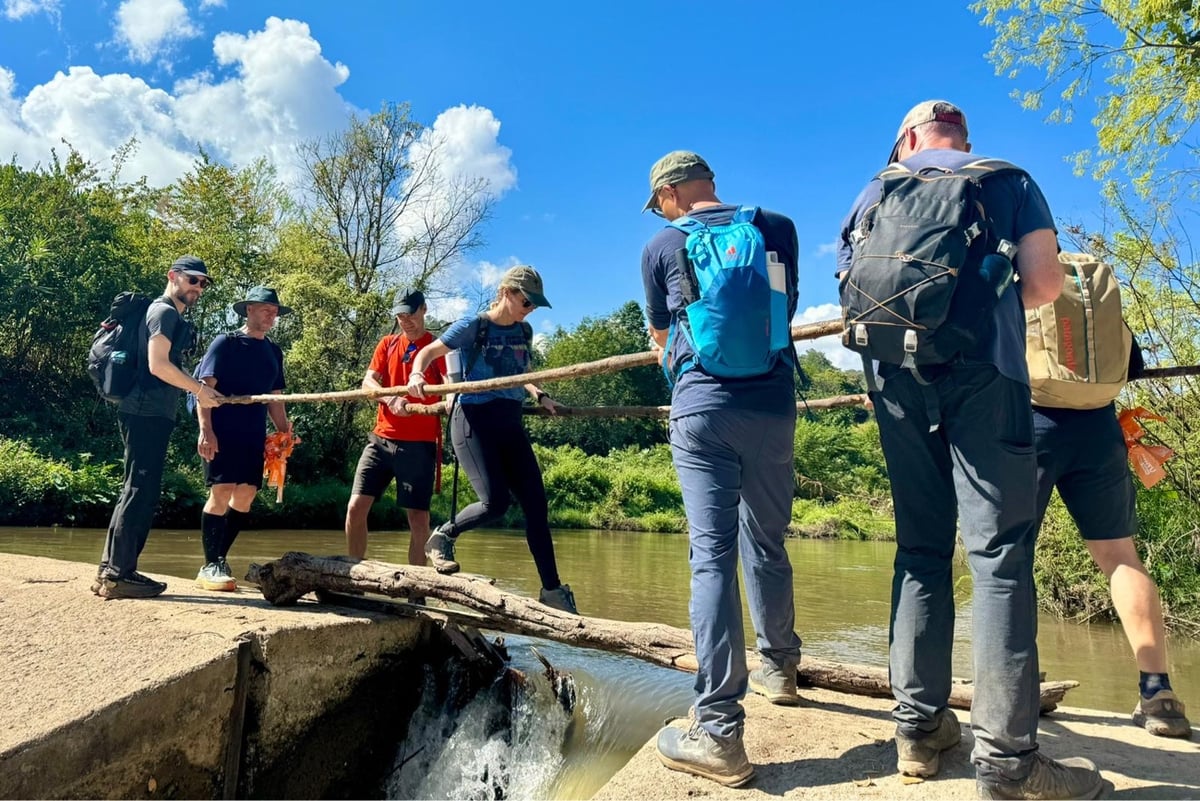
Kevin Kelly is the biggest traveller I know and he recently shared some of the advice he’s learned over his 50+ years on the road. Here are a few of my favorites:
If you hire a driver, or use a taxi, offer to pay the driver to take you to visit their mother. They will ordinarily jump at the chance.
Crash a wedding. You are not a nuisance; you are the celebrity guest!
When visiting a foreign city for the first time, take a street food tour.
Co-sign on the food tour. I’ve been doing this for the past few years and it’s such a good way to orient yourself in a new place.
The most significant criteria to use when selecting travel companions is: do they complain or not, even when complaints are justified? No complaining! Complaints are for the debriefing afterwards when travel is over.
Sketchy travel plans and travel to sketchy places are ok. Take a chance. If things fall apart, your vacation has just turned into an adventure. Perfection is for watches. Trips should be imperfect. There are no stories if nothing goes amiss.
It is always colder at night than you think it should be, especially in the tropics. Pack a layer no matter what.
I packed a warm layer for my recent trip to Mexico and was shocked that I didn’t need it for the whole 10 days I was there.
The hard-to-accept truth is that it is far better to spend more time in a few places than a little time in a bunch of places.
To book a train anywhere in the world outside your home country, your first stop should be The Man in Seat 61, a sprawling website which will conveniently help you book the train you want.
If you are starting out and have seen little of the world, you can double the time you spend traveling by heading to the places it is cheapest to travel. If you stay at the budget end, you can travel twice as long for half price.
When asking someone for a restaurant recommendation, don’t ask them where is a good place you should eat; ask them where they eat. Where did they eat the last time they ate out?
Kelly also breaks travel down into two modes: retreat or engage, which reminds me of this recent interview with Rick Steves.
I really enjoyed this interview with traveller and writer Rick Steves by Lulu Garcia-Navarro, which is also available as a YouTube video and podcast episode (Apple, Spotify). Here are some particularly appealing excerpts:
I love to be on a bus that’s so crowded that there’s people hanging outside the door when the bus takes off and then they settle in like cornflakes settle into a box, and there’s always room for one more body.
If you’ve never been on a bus or train like this, have you even travelled?
I just love to expose people to examples of things they would never encounter at home. Culture shock is a constructive thing. It’s the growing pains of a broadening perspective. To me, there are two kinds of travel: There’s escape travel, and there’s reality travel. I want to go home a little bit different, a little less afraid, a little more thankful, a little better citizen of the planet.
I love escape travel (my recent trip was 90% escape) but the trips I really value are the ones that change me.
Media consumption modes could also probably be sorted into escape and reality. I’ve watched/read a lot of escape/comfort/easy media over the past year and am trying to ease myself back into stuff that’s a little more challenging.
Thomas Jefferson wrote, Travel makes a person wiser if less happy. I’ve always had this hunger to be more engaged. Not necessarily more happy, but more engaged.
As someone who is often puzzled by how to answer the “are you happy?” question, I appreciate this perspective. Happiness is generally not my goal, something closer to engagement is.
Lulu, I’m in this sort of thing in my teaching where I remind people there’s three kinds of travel: You can travel as a tourist, a traveler or a pilgrim.
Ok Steve, is it two kinds of travel or three? 😉 Here’s his explanation of the three types:
Most travelers I know, they’re proud to be known as a traveler as opposed to a tourist: “I’m more thoughtful — I’m not just here to shop and get a selfie. I’m here to immerse myself in the culture and learn.” That is a traveler, to become a temporary local. A traveler learns about the world, but I think a pilgrim learns about themselves, and you learn about yourself by leaving your home and looking at it from a distance. You learn about yourself, I think, by trying to get close to God in your travels
Yeah, the pilgrim thing definitely resonates with me — “transformational travel” he calls it a paragraph later.
The most frightened people are the people who have never traveled, whose worldview is shaped by commercial news media. And the people that are not afraid are the people who have been out there and met the enemy. My most powerful travel experiences have been going places where I’m not supposed to go: Cuba, Palestine, Iran. The friendliest people, the most curious people, the people that need to meet me and I need to meet them. When they meet me, it’s tougher for their propaganda to demonize me, and when I meet them, it’s harder for my country’s propaganda to dehumanize them. It’s a powerful thing.
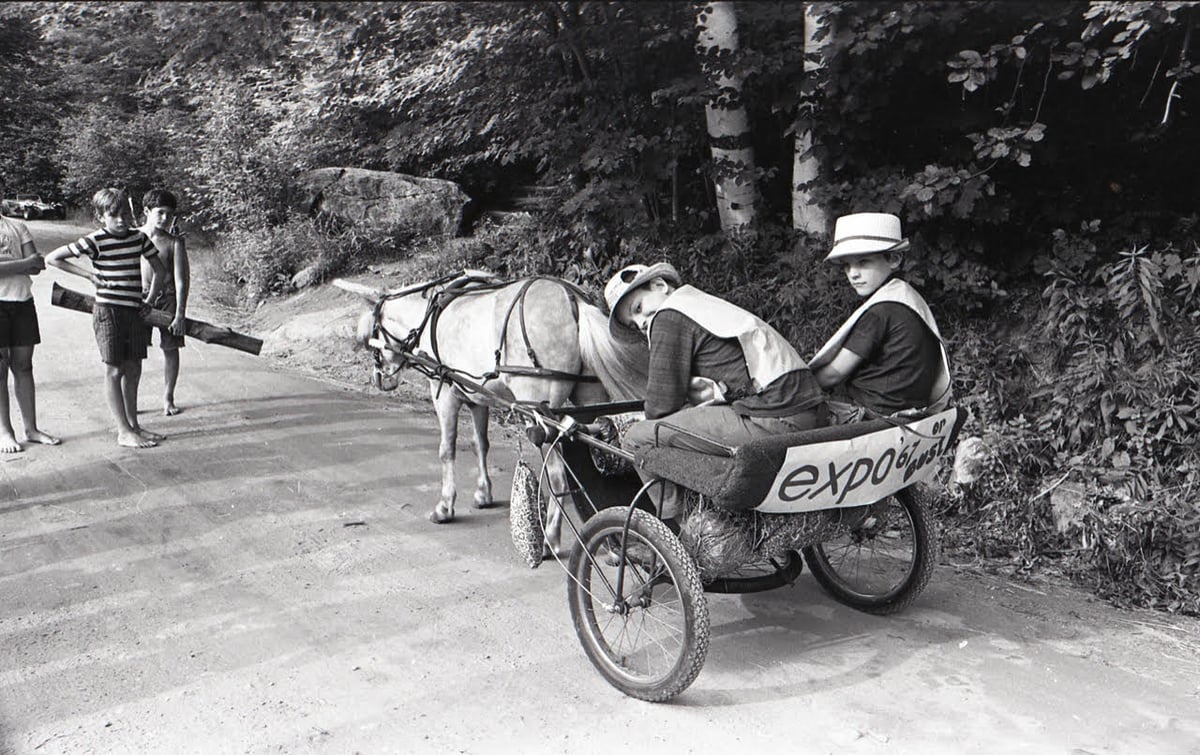
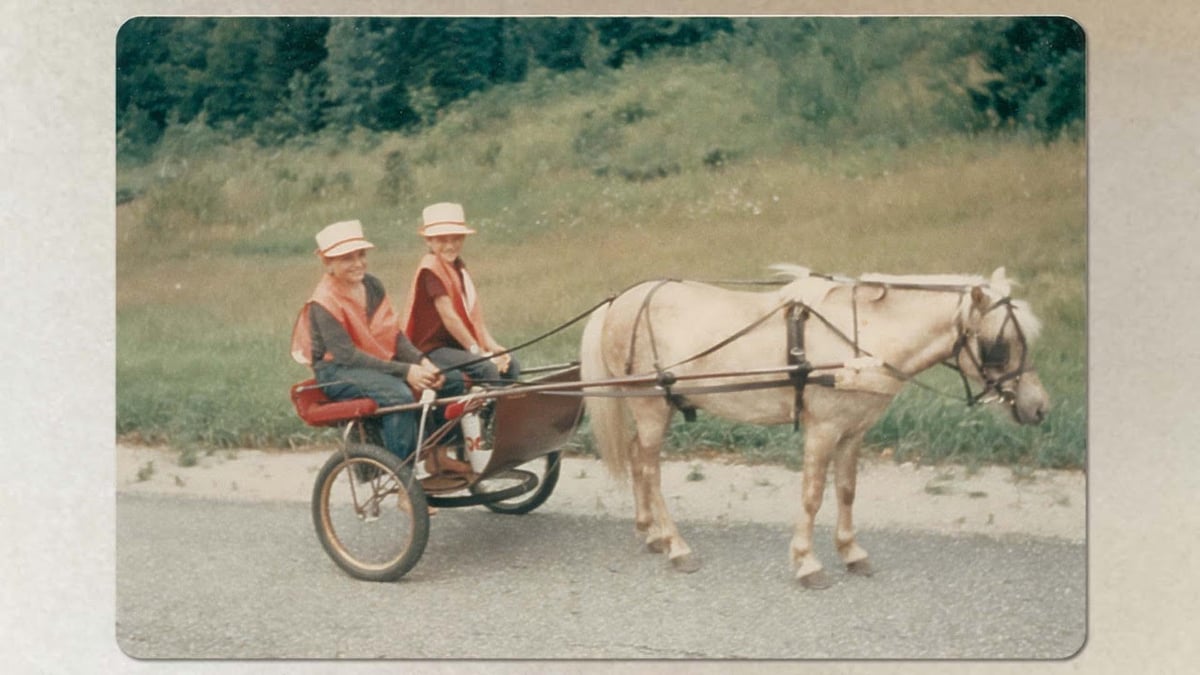
Pony Boys is a delightful short documentary about two boys (aged 9 & 11) who traveled from a Boston suburb to the 1967 World’s Fair in Montreal by pony cart.
In the short documentary above, the “pony boys,” Tony and Jeff Whittemore, recount that as youngsters, they were unaware of the controversial questions the trip raises. What constitutes responsible parenting? Did their parents do something dangerous, or was it a brilliant parenting move that taught lifelong lessons? What they recall is a life-changing adventure made possible by a free-spirited mother who believed they could do it.
You can watch Pony Boys here and check out more about their journey here, including press clippings, letters the boys & their parents received, and photos. And VPR has an interview with the filmmaker, Eric Stange. (thx, meg)
From Dynomight, some common sense and straight-forward advice about travel. Some favorites:
1. Mindset matters more than where you go.
12. Clothes dry much faster with body heat.
22. If you spend a ton of money and stay in very expensive hotels and whatever, you can eliminate almost all of the frustration and uncertainty of travel. But it also feels like you never leave the global capitalist monoculture.
41. Many of the people who seem “best” at travel seem to be really good at having sensory experiences — at shutting down the internal dialog and letting the sights and sounds and smells wash over them. I am by nature horrendous at having sensory experiences, but if I make a conscious choice, then it’s pretty easy and often quite profound.
(via sippey)
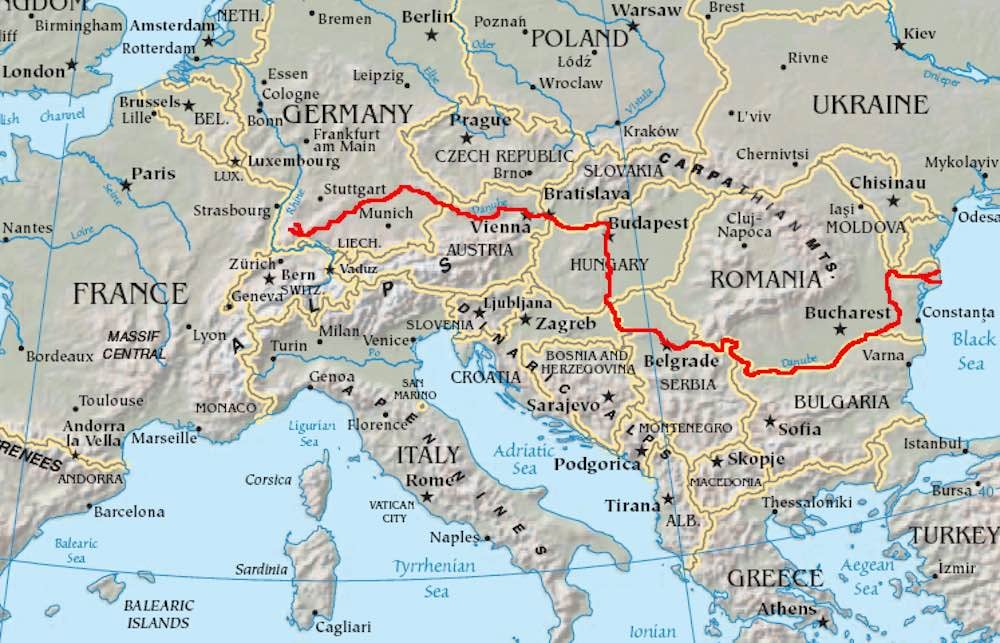
Has a novel ever made you desperate to travel somewhere? I’m reading The Historian, and I’m now dying to visit Eastern Europe. I want to see the Danube, visit Istanbul, and spend weeks in Dubrovnik. And, okay, maybe visit the monastery on an island in the middle of Lake Snagov! (Map of the Danube via wikivoyage.) Anyone else?
The NY Times asked a bunch of their readers what their favorite airport amenities were. Their answers included libraries, pools, and vending machines for things like cupcakes and canned cheese.
I love an airport with an outdoor area and areas for napping and free showers (like at Incheon). But my favorite airport thing by far is the bonkers indoor waterfall and garden/forest at Singapore’s Jewel Changi Airport:

What about you? What are your favorite airport shops, facilities, and conveniences when you travel? (Let’s not do “faster security” and such — that’s a given.)
Technology analyst & scholar Dan Wang was one of the folks on the walk and talk I did in northern Thailand back in December. In his annual letter for 2023, Wang recapped the walk, using it as a jumping-off point for his wheelhouse topic: China. Most interesting to me were his observations about the trend of Chinese moving abroad, including to Thailand.
Many people still feel ambivalence about moving to Thailand. Not everyone has mustered the courage to tell their Chinese parents where they really are. Mom and dad are under the impression that they’re studying abroad in Europe or something. That sometimes leads to elaborate games to maintain the subterfuge, like drawing curtains to darken the room when they video chat with family, since they’re supposed to be in a totally different time zone; or keeping up with weather conditions in the city they’re supposed to be so that they’re not surprised when parents ask about rain or snow.
There still are some corners in China that are relatively permissive. One of these is Yunnan’s Dali, a city on the northern tip of highland Southeast Asia, where I spent much of 2022. There, one can find the remnants of a drug culture as well as a party scene for an occasional rave. But even Dali is becoming less tenable these days since the central government has cottoned on that the city is a hub for free spirits. The tightening restrictions emanating from Beijing are spreading to every corner of the country. “China feels like a space in which the ceiling keeps getting lower,” one person told me. “To stay means that we have to walk around with our heads lowered and our backs hunched.”
I also recently read this piece about The Chinese Migrants of Chiang Mai by Amy Zhang (via Jodi Ettenberg)
What strikes me is how Thailand’s porousness — the fluidity of entries and exits due to the comparatively lax visa processes compared to other countries — mean that while some can stay and enroll their kids in school here, some may go back to China after a long visit, carrying new ideas and experiences with them home. And in this case, it’s Chinese feminism being discussed in Chiang Mai, while feminist and LGBTQ+ groups are being increasingly suppressed in China itself.
The sentiment in that line quoted by Wang — “China feels like a space in which the ceiling keeps getting lower” — probably feels quite familiar to many here in the United States, particularly women, LGBTQ+ folks, and their families living in states with increasingly draconian laws around bodily autonomy.
Over the past few months, I’ve had some time away from the computer and have taken several very long plane trips and some shorter car rides, which means a bit more reading, TV & movie watching, and podcast listening than usual. Oh, and holiday movies.
But the main story is how many things I’m currently in the midst of but haven’t finished: the latest season of the Great British Bake Off, season 3 of The Great, season 4 of For All Mankind, season 2 of Reservation Dogs, season 2 of The Gilded Age, the Big Dig podcast, On the Shortness of Life by Seneca, Excellent Advice for Living: Wisdom I Wish I’d Known Earlier by Kevin Kelly, and I’ve just dipped a toe into Craig Mod’s Things Become Other Things. That’s five TV shows, one podcast, and three books. I’m looking forward to tackling some of that (and maybe a new Star Trek series) over the upcoming holiday weekend.
Anyway, here’s my recent media diet — a roundup of what I’ve been reading, watching, listening to, and experiencing over the past few months.
The Killer. The excellent Michael Fassbender portrays a solitary, bored, and comfortable killer for hire who has a bit of a midlife crisis in fast forward when a job goes wrong. (A-)
Fortnite OG. I started playing Fortnite in earnest during Chapter 3, so it was fun to go back to Chapter 1 to see how the game worked back then. (B+)
Northern Thailand Walk and Talk. I’m going to write more soon but this was one of the best things I’ve ever done. (A+)
Edge of Tomorrow. Speaking of video games… Still love this under-appreciated film, despite a third act that falls a tiny bit flat. (A)
The Vaster Wilds by Lauren Groff. I did not enjoy this quite as much as Matrix — especially the last third — but Groff is one hell of a writer. (B+)
New Blue Sun. Good on André 3000 for not doing the expected thing and instead releasing an instrumental album on which he plays the flute. (A-)
Songs of Silence. I can’t remember who clued me into this lovely instrumental album by Vince Clarke (Erasure, Depeche Mode), but it’s been heavily in the rotation lately. (B+)
Trifecta. A.L.I.S.O.N.’s Deep Space Archives is a favorite chill work album for me and this one is nearly as good. (B+)
The Hunger Games: The Ballad of Songbirds and Snakes. Entertaining but lacks the zip and coherence of the first film. (B)
Shoulda Been Dead. I had no idea that Kevin Kelly appeared on an early episode of This American Life until someone mentioned it offhand on our Thailand walk. What a story…listen all the way to the end. (A)
Train Dreams by Denis Johnson. Oh the writing here is exquisite. (A)
Avengers: Infinity War & Avengers: Endgame. These are endlessly rewatchable for me. (A)
Elemental. Good but not great Pixar. (B)
The Wrong Trousers. I watched this with my 16-year-old son, who hadn’t seen it in like 9 or 10 years. We both loved it — it still has one of the best action movie sequences ever. (A+)
The Mountain in the Sea by Ray Nayler. Are AGI robots intelligent? Are octopuses? Are humans? This novel plays entertainingly with these ideas. (A-)
Myeongdong Kyoja. I stumbled upon this place, extremely cold and hungry, and after a brief wait in line, I was conducted to an open seat by the no-nonsense hostess running the dining room. The menu only has four items, conveniently pictured on the wall — I got the kalguksu and mandu. The hostess took my order and then, glancing at my frozen hands, reached down and briefly gave one of them a squeeze, accompanied by a concerned look that lasted barely half a second before she returned to bustling around the room. A delicious meal and a welcome moment of humanity in an unfamiliar land. (A)
Vagabonding: An Uncommon Guide to the Art of Long-Term World Travel by Rolf Potts. This made me want to give notice to my landlord and take off for somewhere else. (A-)
Barbie. Second viewing. Entertaining and funny, but this is a movie that has Something To Say and I still can’t figure out what that is. (B+)
Emily the Criminal. There were a few hiccups here and there, but I largely enjoyed this Aubrey Plaza vehicle. (A-)
Midnight in Paris. Not going to recommend a Woody Allen movie these days, but this is one of my comfort movies — I watch it every few months and love every second of it. (A)
Gran Turismo. Extremely predictable; they could have done more with this. (B)
The Rey/Ren Star Wars trilogy. I have lost any ability to determine if any of these movies are actually good — I just like them. 🤷♂️ (B+)
Loki (season two). This was kind of all over the place for me but finished pretty strong. Glorious purpose indeed. (B)
Die Hard. Still great. (A)
Home Alone. First time rewatching this in at least a decade? This movie would have worked just as well if Kevin were 15% less annoying. (B+)
The Grinch. My original review stands: “I wasn’t expecting to sympathize so much with The Grinch here. The social safety net constructed by the upper middle class Whos totally failed the most vulnerable member of their society in a particularly heartless way. Those Whos kinda had it coming.” (B+)
Past installments of my media diet are available here. What good things have you watched, read, or listened to lately?
Wandering through the countryside of northern Thailand has rekindled my intermittent desire to live overseas…or at least to spend time travelling for an extended period. In order to learn more about what I’d be signing up for, I recently read Rolf Potts’ classic Vagabonding: An Uncommon Guide to the Art of Long-Term World Travel (Bookshop), the 2003 book that helped kickstart the digital nomad movement. Here’s everything I highlighted on my Kindle while reading it.
Page 15:
This book views long-term travel not as an escape but as an adventure and a passion — a way of overcoming your fears and living life to the fullest.
Page 20:
So, as you prepare to read the book, just keep in mind what martial arts master Bruce Lee said: “Research your own experiences for the truth… Absorb what is useful… Add what is specifically your own… The creating individual is more than any style or system.”
Page 24:
Vagabonding is about using the prosperity and possibility of the information age to increase your personal options instead of your personal possessions.
Page 24:
Vagabonding is an attitude — a friendly interest in people, places, and things that makes a person an explorer in the truest, most vivid sense of the word.
Page 25:
Muir called these folks the “time-poor” — people who were so obsessed with tending their material wealth and social standing that they couldn’t spare the time to truly experience the splendor of California’s Sierra wilderness.
Page 29:
We’d love to drop all and explore the world outside, we tell ourselves, but the time never seems right. Thus, given an unlimited amount of choices, we make none.
Page 29:
Vagabonding is about gaining the courage to loosen your grip on the so-called certainties of this world. Vagabonding is about refusing to exile travel to some other, seemingly more appropriate, time of your life. Vagabonding is about taking control of your circumstances instead of passively waiting for them to decide your fate.
Page 29:
Vagabonding starts now. Even if the practical reality of travel is still months or years away, vagabonding begins the moment you stop making excuses, start saving money, and begin to look at maps with the narcotic tingle of possibility.
Page 32:
Work is how you settle your financial and emotional debts — so that your travels are not an escape from your real life but a discovery of your real life.
Page 33:
Many vagabonders don’t even maintain a steady job description, taking short-term work only as it serves to fund their travels and their passions. In Generation X, Douglas Coupland defined this kind of work as an “anti-sabbatical” — a job approached “with the sole intention of staying for a limited period of time (often one year)… to raise enough funds to partake in another, more personally meaningful activity.”
Page 34:
We need the possibility of escape as surely as we need hope; without it the life of the cities would drive all men into crime or drugs or psychoanalysis. —Edward Abbey, Desert Solitaire
Page 35:
Regardless of how long it takes to earn your freedom, remember that you are laboring for more than just a vacation. A vacation, after all, merely rewards work. Vagabonding justifies it.
Page 35:
Ultimately, then, the first step of vagabonding is simply a matter of making work serve your interests, instead of the other way around.
Page 35:
As citizens of a prosperous democracy, any one of us has the power to create our own free time, outside the whims of federal laws and private-sector policies.
Page 36:
Many people are able to create vagabonding time through “constructive quitting” — that is, negotiating with their employers for special sabbaticals and long-term leaves of absence.
Page 36 (on updating your resume):
List the job skills travel has taught you: independence, flexibility, negotiation, planning, boldness, self — sufficiency, improvisation.
Page 37:
And so I stand among you as one that offers a small message of hope, that first, there are always people who dare to seek on the margin of society, who are not dependent on social acceptance, not dependent on social routine, and prefer a kind of free-floating existence. —Thomas Merton, The Asian Journal of Thomas Merton
Page 46:
For all the most important things in life, the timing always sucks. Waiting for a good time to quit your job? To have that kid? To take a dream trip? Sadly, the traffic lights of life will never all be green at the same time. Conditions are never perfect. “Someday” (“someday I’ll do this, someday I’ll do that”) is a disease that will take your dreams to the grave with you. —Tim Ferriss
Page 53:
This notion — the notion that “riches” don’t necessarily make you wealthy — is as old as society itself. The ancient Hindu Upanishads refer disdainfully to “that chain of possessions wherewith men bind themselves, and beneath which they sink”; ancient Hebrew scriptures declare that “whoever loves money never has money enough.” Jesus noted that it’s pointless for a man to “gain the whole world, yet lose his very self,” and the Buddha whimsically pointed out that seeking happiness in one’s material desires is as absurd as “suffering because a banana tree will not bear mangoes.”
Page 54:
Money, of course, is still needed to survive, but time is what you need to live. So, save what little money you possess to meet basic survival requirements, but spend your time lavishly in order to create the life values that make the fire worth the candle.
Page 55:
Travel can be a kind of monasticism on the move: On the road, we often live more simply, with no more possessions than we can carry, and surrendering ourselves to chance. This is what Camus meant when he said that “what gives value to travel is fear” — disruption, in other words (or emancipation), from circumstance, and all the habits behind which we hide. —Pico Iyer, Why We Travel
Page 55:
On a basic level, there are three general methods to simplifying your life: stopping expansion, reining in your routine, and reducing clutter.
Page 57:
As Laurel Lee wryly observed in Godspeed, “Cities are full of those who have been caught in monthly payments for avocado green furniture sets.”
Page 58:
As I’ve said before, vagabonding is not an ideology, a balm for societal ills, or a token of social status. Vagabonding is, was, and always will be a private undertaking — and its goal is to improve your life not in relation to your neighbors but in relation to yourself.
Page 60:
In this way, simplicity — both at home and on the road — affords you the time to seek renewed meaning in an oft-neglected commodity that can’t be bought at any price: life itself.
Page 71:
Money is not required to buy one necessity of the soul. —Henry David Thoreau
Page 72:
Reading old travel books or novels set in faraway places, spinning globes, unfolding maps, playing world music, eating in ethnic restaurants, meeting friends in cafes… all these things are part of never-ending travel practice, not unlike doing scales on a piano, shooting free-throws, or meditating. —Phil Cousineau, The Art of Pilgrimage
Page 75:
And, as Phil Cousineau pointed out in The Art of Pilgrimage, I tend to believe that “reparation no more spoils the chance for spontaneity and serendipity than discipline ruins the opportunity for genuine self-expression in sports, acting, or the tea ceremony.”
Page 76:
As John Steinbeck wrote in Travels with Charley, “Once a journey is designed, equipped, and put in process, a new factor enters and takes over. A trip, a safari, an exploration, is an entity… no two are alike. And all plans, safeguards, policing, and coercion are fruitless. We find after years of struggle that we do not take a trip; a trip takes us.
Page 78:
When visiting the Holy Land in the nineteenth century, Mark Twain expressed frequent exasperation at the guidebook fundamentalists in his travel party: “I can almost tell, in set phrase, what they will say when they see Tabor, Nazareth, Jericho, and Jerusalem,” Twain wrote in The Innocents Abroad, “because I have the books they will ‘smouch’ their ideas from.”
Page 80:
A good traveler has no fixed plan, and is not intent on arriving. —Lao-Tzu, The Way of Life
Page 86:
Fortunately, you don’t ever need a really good reason to go anywhere; rather, go to a place for whatever happens when you get there.
Page 87:
Vagabonding is not like bulk shopping: The value of your travels does not hinge on how many stamps you have in your passport when you get home — and the slow, nuanced experience of a single country is always better than the hurried, superficial experience of forty countries.
Page 90:
Thus, the biggest favor you can do for yourself when trying to decide what to bring is to buy — and this is no joke — a very small travel bag.
This small pack, of course, will allow you only the minimum: a guidebook, a pair of sandals, standard hygiene items, a few relevant medicines (including sunscreen), disposable earplugs (for those inevitable noisy environments), and some small gift items for your future hosts and friends. Add a few changes of simple, functional clothes and one somewhat nice outfit for customs checks and social occasions. Toss in a small flashlight, a decent pair of sunglasses, a day pack (for carrying smaller items when you leave your hotel or guesthouse), and your smartphone. And then — looking down to make sure you have a sturdy pair of boots or walking shoes on your feet — close the bag and affix a small, strong padlock.
Page 105:
I remember a conversation with a college professor on the train to Sicily, discussing the need to travel. He said, “You can read everything there is in the world about a place, but there is no substitute for smelling it!” He was right! So make plans, but be happy to abandon them, if need be. Kurt Vonnegut once wrote: “Peculiar travel suggestions are dancing lessons from God.” I like that. Do as much research before leaving as possible, but certainly don’t let fears keep you away. On a given day, Los Angeles is far more dangerous than anyplace I’ve traveled. Take normal precautions, use common sense if you have any, and you’ll be fine. —Bill Wolfer
Page 107:
One of the most remarkable travel memoirs of the twentieth century was Juanita Harrison’s My Great, Wide, Beautiful World, which recounted the author’s journey through thirty-three countries over the course of eight years in the 1920s and 1930s. Harrison’s book was a bestseller in 1936 — yet, unlike most bestselling travel authors of that era, she was not an upper-middle-class white fellow who’d studied literature at a fancy university. Harrison was a Mississippi-born African American woman, who’d been working various domestic-labor jobs ever since her schooling ended at age ten.
Page 111:
“Travel in general, and vagabonding in particular, produces an awesome density of experience,” wrote Ed Buryn, “…a cramming together of incidents, impressions and life detail that is both stimulating and exhausting. So much new and different happens to you so frequently, just when you’re most sensitive to it… You may be excited, bored, confused, desperate and amazed all in the same happy day.”
Page 111:
If there’s one key concept to remember amid the excitement of your first days on the road, it’s this: Slow down. Just to underscore the importance of this concept, I’ll state it again: slow… down.
Page 112:
In many ways, this transition into travel can be compared to childhood: Everything you see is new and emotionally affecting, basic tasks like eating and sleeping take on a heightened significance, and entertainment can be found in the simplest curiosities and novelties. “Suddenly you are five years old again,” Bill Bryson observed in Neither Here nor There.” You can’t read anything, you only have the most rudimentary sense of how things work, you can’t even reliably cross a street without endangering your life. Your whole existence becomes a series of interesting guesses.”
Page 113:
Early on, of course, you’re bound to make travel mistakes. Dubious merchants may swindle you, unfamiliarity with cultural customs may cause you to offend people, and you’ll often find yourself wandering lost through strange surroundings. Some travelers go to great pains to avoid these neophyte blunders, but they’re actually an important part of the learning experience. As the Koran says, “Did you think you should enter the Garden of Bliss without such trials as came to those who passed before you?” Indeed, everyone starts out as a vagabonding greenhorn, and there’s no reason to presume you’ll be any different.
Page 116:
Tourist attractions are defined by their collective popularity, and that very popularity tends to devalue the individual experience of such attractions.
Page 118:
“The anti-tourist is not to be confused with the traveler,” wrote Paul Fussell in Abroad. “His motive is not inquiry but self-protection and vanity.” Ostentatiously dressing in local fashions, deliberately not carrying a camera, and sedulously avoiding the standard sights, “the antitourist doesn’t have much integrity or agenda beyond his self-conscious decision to stand apart from other tourists.
Page 128:
Slow down and remember this as you begin your travels: Being busy can be a form of laziness. Lazy thinking, and indiscriminate action. Being selective — in other words, doing less in a smart way — is usually the more productive and fun path. —Tim Ferriss
Page 131:
Travel is the best way we have of rescuing the humanity of places, and saving them from abstraction and ideology. —Pico Iyer, Why We Travel
Page 133:
Those who visit foreign nations, but associate only with their own countrymen, change their climate, but not their customs. They see new meridians, but the same men ; and with heads as empty as their pockets, return home with traveled bodies, but untraveled minds. —Charles Caleb Colton, Lacon
Page 134:
After all, cultural identity is instinctive, not intellectual — and this means that the challenge will come not in how you manage your own manners but in how you instinctively react to the unfamiliar manners of others.
Page 140:
As historian Dagobert Runes quipped, “People travel to faraway places to watch, in fascination, the kind of people they ignore at home.”
Page 140:
To truly interact with people as you travel, then, you have to learn to see other cultures not as National Geographic snapshots but as neighbors.
Page 166:
The secret of adventure, then, is not to carefully seek it out but to travel in such a way that it finds you.
Page 169:
“Good people keep walking whatever happens,” taught the Buddha. “They do not speak vain words and are the same in good fortune and bad.”
Page 183:
The use of traveling is to regulate imagination by reality, and instead of thinking how things may be, to see them as they really are. —Samuel Johnson, from Anecdotes of Samuel Johnson
Page 183:
“Our eyes find it easier on a given occasion to produce a picture already often produced, than to seize upon the divergence and novelty of an impression,” wrote Friedrich Nietzsche. “It is difficult and painful for the ear to listen to anything new; we hear strange music badly.”
Page 184:
“Tourists don’t know where they’ve been,” observed Paul Theroux in 1992, “travelers don’t know where they’re going.”
“Travelers are those who leave their assumptions at home, and [tourists are] those who don’t,” wrote Pico Iyer in 2000.
Page 187:
In this way, “seeing” as you travel is somewhat of a spiritual exercise: a process not of seeking interesting surroundings, but of being continually interested in whatever surrounds you.
Page 188:
Luxury, then, is a way of being ignorant, comfortably. —Leroi Jones, Political Poem
Page 191:
Thus, the purest way to see a culture is simply to accept and experience it as it is now — even if you have to put up with satellite dishes in Kazakhstan, cyber cafes in Malawi, and fast food restaurants in Belize.
Page 192:
Often I feel I go to some distant region of the world to be reminded of who I really am… Stripped of your ordinary surroundings, your friends, your daily routines, your refrigerator full of your food, your closet full of your clothes, you are forced into direct experience. Such direct experience inevitably makes you aware of who it is that is having the experience. That’s not always comfortable, but it is always invigorating. —Michael Crichton, Travels
Page 193:
As Salvador Dalí quipped, “I never took drugs because I am drugs.”
Page 207:
People say you have to travel to see the world. Sometimes I think that if you just stay in one place and keep your eyes open, you’re going to see just about all that you can handle. —Paul Auster, Smoke
Page 208:
If you really want to learn about a country, work there. —Charles Kuralt, A Life on the Road
Page 220:
Travel, after all, is a form of asceticism, which (to quote Kathleen Norris )” is a way of surrendering to reduced circumstances in a manner that enhances the whole person. It is a radical way of knowing exactly who, what, and where you are, in defiance of those powerful forces in society that aim to make us forget.”
Page 221:
Thus, travel compels you to discover your spiritual side by simple elimination: Without all the rituals, routines, and possessions that give your life meaning at home, you’re forced to look for meaning within yourself.
You can get your own copy of Vagabonding at Amazon or Bookshop or learn more about Rolf Potts at his website.
Have you travelled for long periods of time or moved to a different country? Any stories or advice you can offer to others who are thinking of taking the leap?
Cruise ships are a relatively new human invention that look quite different from other ships. Oh, and they are absolutely massive. How did they get that way?
The predecessor of today’s cruise ships was the ocean liner: big, beautiful ships that sailed across the Atlantic. But ocean liners had a totally different purpose from cruise ships: They were for transportation. Everything about them was designed to facilitate an ocean voyage from one continent to another.
But air travel changed that. Planes eliminated the main reason to take a ship somewhere, and ocean liner business plummeted. So the industry pivoted and began selling a ship as the destination itself. The cruise ship was born. But the ocean liners, built for a voyage, weren’t ideal for the purposes of a cruise, and over the next few decades, the cruise ship began its evolution. And it has culminated in the behemoths we see today.
Cruise ships always make me think of David Foster Wallace’s classic piece, Shipping Out (which you might know as A Supposedly Fun Thing I’ll Never Do Again).
In 1842, a French artist and scholar named Joseph-Philibert Girault de Prangey set out on a tour of the eastern Mediterranean to document sights and architecture via the brand new medium of photography. He started off in what is now Italy and continued on to Greece, Egypt, Turkey, Syria, and the Levant (which includes modern-day Lebanon, Israel, and Palestine). The daguerreotypes he took are the oldest surviving photos of those locations (aside from Italy). It’s incredible to time travel back 180 years to see what these places looked like. (via aeon)
Craig Mod recently finished a 16-day tour of jazz kissas in northern Japan. Jazz kissas are bar/cafes where one goes to listen to jazz, mostly on records and not live. Mod loosely defies them thusly:
Mostly defined as: Mid-20th century “listening cafes” for jazz music. But there is a lot of variance in this definition. Lots are coffee-focused cafes, fitting into the broader “kissaten” universe. But some are more bar-like, and some even jazz clubs (but for the most part, live music is rare). You can tie yourself in knots splitting hairs over this stuff. Though they’re traditionally known as “jazz kissa” — the shortened version of “kissaten” (fear not: even if you call them “jazz kissaten” you won’t suddenly turn into a pillar of salt). Some are seventy years old. Some forty. Some are five years old. The important defining element is simply: A presiding and effusive ever-abiding love for jazz, jazz, and more jazz.
At each stop, he recorded the ambient sounds of each kissa so that you can experience a little bit of the atmosphere at these places — here’s the full playlist. The recordings were done with a pair of microphones so that the audio is in stereo. This sounds great with a good pair of headphones!
As you’ll soon read in a comically long “what I did on my summer break” post I’m writing, almost everything I do on a day-to-day basis when I’m working on the site came to a complete halt when I went on sabbatical back in May - I stopped reading online, unsubscribed from all newsletters (save one or two), ignored Twitter, stopped paying attention to the news, didn’t really read my email. Pretty much the only concession I made was to keep track of what I was reading, watching, and listening to. So here you go, my media diet over the past seven months.
Russian Doll (season two). A worthy second act of Natasha Lyonne’s surprising hit. The NYC subway is the best time machine since the police box and the DeLorean. (A-)
Four Thousand Weeks: Time Management for Mortals by Oliver Burkeman. Another Burkeman banger. If The Antidote was a self-help book for people who don’t like self-help books, this is time management for people who don’t want to organize their lives like a Toyota factory. (A-)
Middlemarch by George Eliot. By far the best thing I read during my sabbatical and one of my favorite books of all time. For whatever reason, I thought this was going to be stuffy liht-tra-chure but it turns out it’s hilarious? Almost every page had me laughing out loud. The writing is exquisite and Eliot’s observations about human behavior are still, 150 years on, remarkably astute. And there’s a scene near the end of the book that is almost cinematic — she painted such a vivid picture that it took my breath away (like, literally I was holding my breath). (A+)
All of This by Rebecca Woolf. You’re about to split up with your husband and then he gets cancer and dies. That is a complex emotional landscape; Woolf describes how she navigated her relief and grief as her life was torn apart and put back together again. A brutally honest read. (B+)
Conversations with Friends. Not quite up to Normal People’s high bar but still pretty entertaining and affecting. (A-)
Ten Steps to Nanette: A Memoir Situation by Hannah Gadsby. Unexpectedly resonant — one of a number of things I’ve read recently by people who have discovered they’re on the autism spectrum as adults. (B+)
Troubling Love by Elena Ferrante. Didn’t like this one quite as much as her excellent Neapolitan novels. (B+)
Old. Decent M. Night Shyamalan effort. The Sixth Sense remains the only film of his I’ve actually liked though. (B-)
The Mt. Qi Pork Hand-Ripped Noodles Meal Kit from Xi’an Famous Foods. I find most restaurant meal kits to be expensive and the resulting food unsatisfyingly unlike what you’d get at the restaurant. Not so with this one…I feel like it’s an incredible bargain (when paired with some bok choi or something it feeds 4-6 in my experience) and it tastes exactly like what you get at the restaurant. I’ve recommended this to several folks and everyone loves this kit. Note: neither the ingredients or the finished product freezes well — order this when you can make and consume the whole thing over the course of a few days. (A)
Apple Watch. I haven’t worn a watch since the early 90s, so it took me awhile to talk myself into this. But I wanted a good way to track my exercise and perhaps use my phone less. The Watch has succeeded on the first point but not really on the second, and I’m convinced that this thing has no idea how to accurately track calories on mountain bike rides. (B+)
Blade Runner 2049. Always up for a rewatch of this. I (sacrilegiously?) prefer it to the original. (A)
Gattaca. I always use the title of this movie when I need to remember the four nucleotide bases of DNA. Which, admittedly, is not super often. (A-)
Against the Rules (season three). Timely and fascinating exploration of the role of experts in our society by Michael Lewis. (B+)
Maus I & II by Art Spiegelman. Finally got around to reading this after finding it on a local bookstore’s table of banned books. A masterpiece. (A+)
Doctor Strange in the Multiverse of Madness. I guess I am having a little trouble with caring about Marvel stuff after Endgame. Also, Sam Raimi’s horror thing doesn’t jibe with my dislike/indifference of/about horror movies. (B-)
Everything Everywhere All At Once. Second time. I love this movie so hard. (A+)
Top Gun: Maverick. I was shocked at how much I liked this movie — a Top Gun sequel didn’t have any right to be this entertaining. Straight-up no-frills thrill ride that’s best on a big screen. Loved Val Kilmer’s scenes. (A)
Roadrunner: A Film About Anthony Bourdain. I was a little wary of watching this; from what I’d read, it seemed like it was a bunch of Bourdain’s friends and loved ones blaming Asia Argento (who was not interviewed for the film) for his death. It’s a delicate balancing act, but the film doesn’t actually do that, IMO. And the stuff about his early-mid career is great and was personally resonant. (A-)
Slow Burn: The L.A. Riots. I was 18 years old and a busy freshman in college when the 1992 LA riots happened, so this was fascinating to listen to. Joel Anderson was the perfect host for this — authoritative, probing, and skeptical in all the right places. (A)
Hold Still: A Memoir with Photographs by Sally Mann. Nearly unbelievable family stories combined with fascinating insights on what it’s like to be an uncompromising artist. (A-)
Red Notice. Fun but forgettable. (B)
The Mysterious Benedict Society by Trenton Lee Stewart. Read this after my kids and I watched the Disney+ series. (B+)
Obi Wan Kenobi. This could have been terrible or messed too much with the original trilogy timeline/vibe, but they pulled it off. (B+)
Operation Mincemeat. If you like war dramas, this is a war drama. (B)
Last Night in Soho. Not my favorite Edgar Wright film. (C+)
Persepolis: The Story of a Childhood by Marjane Satrapi. A friend recommended this after I read Maus. Another masterpiece about the effects of authoritarianism. (A)
The Card Counter. Good performances but ultimately not that memorable. (B+)
The Grand Budapest Hotel. A rewatch after many years. Anderson’s most commercially successful film but not my favorite. I love that there are hundreds of reviews of the hotel on Tripadvisor. (B+)
Thor: Love and Thunder. Natalie Portman is a great actress who sometimes seems like she’s a bad actress — see also Star Wars. Maybe superhero sci-fi is not her bag? Also, I think they went a little overboard on the stuff that made Ragnarok so much fun…it just didn’t work as well here. (B)
Persuasion. Oof. A poor adaptation of Austen through the lens of Fleabag. (C-)
The Outsiders by S.E. Hinton. Hinton was in high school when she wrote this so it’s a little uneven, but the voice is amazing. (A-)
For All Mankind (seasons two and three). Not as good as the first season IMO. It’s tough for alt-histories as they get farther and farther from where the timelines split. That said, I am a sucker for such an artfully placed Radiohead song. (B+)
Schitt’s Creek. Late to this but what a delightful show! Was very sad when it ended; I wanted to spend more time with these people. P.S. If you’re in the US and missed this on Netflix, it’s available on Hulu now. (A)
The Bear. I’ll admit I didn’t love this at first — I got my fill of the edgy/grungy aesthetic in the 90s — but it crescendoed nicely. (A-)
Saap. Nisachon Morgan, the chef of this unassuming Thai place in the tiny town of Randolph, VT, won the 2022 James Beard award for best chef in the northeast. A friend of mine has been a regular there for years, so we stopped in for a meal. Let’s just say the Beard Foundation got this one right. (A)
The Gray Man. Gotta be honest — I think I got this confused with Red Notice. (B-)
Brave New World by Aldous Huxley. Still incredible that this was written in 1931 — it’s strikingly modern in many ways. (A-)
Deception Point by Dan Brown. Total beach read. Tom Clancy did this sort of book much better though. (B)
Lightyear. Solid Pixar effort. (B+)
The Lord of the Rings: The Rings of Power. I don’t understand the poor reviews of this series and its (unfair) comparison to the sexier House of the Dragon. It was engaging throughout, though maybe a little slow in places (I didn’t care much for the Harfoots plotline.) And it’s a setup for an epic tale that lasts four more seasons…there’s bound to be a lot of table-setting. (B+)
The Great Canadian Baking Show. Not as good as the original but worth a watch if you’re in Canada (either physically or via VPN), if only to catch how judge Bruno Feldeisen pronounces “sponge” and “layers”. Seasons one and two feature the delightful Dan Levy as one of the hosts. (B+)
Junior Bake Off. I understand that they’re children, but Bake Off just isn’t as fun when the baking is, uh, not great. (B)
Cloud Cuckoo Land by Anthony Doerr. With five different stories spanning hundreds of years, this was challenging to listen to as an audiobook at first. But it paid off well in the end. (B+)
Stories of Your Life and Others by Ted Chiang. Love anything and everything that Chiang writes. (A)
Source Code. I’m not sure this aged super-well but it was entertaining. (B)
Escape into Meaning: Essays on Superman, Public Benches, and Other Obsessions by Evan Puschak. Not quite the target audience here — I feel like this book would have hit me straight between the eyes in my late 20s or early 30s. (B-)
The US and the Holocaust. Essential documentary by Ken Burns, Lynn Novick, and Sarah Botstein about how the United States responded (and failed to respond) to Nazi Germany’s persecution and murder of European Jews in the years before, during and after WWII. (A+)
The Holocaust: A New History by Laurence Rees. I’ve watched and read a fair bit about the Holocaust over the years, but watching The US and the Holocaust and reading Maus spurred an interest in learning about how the Holocaust happened in detail. After some research, I settled on this book by Laurence Rees, which provides a good overview on how the Nazis harnessed European anti-Semitism to gain power and then used it to murder six millions Jews. It was unsettling to read but important to know this history so that we do not let it repeat. (A)
Murder on the Orient Express by Agatha Christie. The perfect little murder mystery. Like a magician revealing her tricks, Christie lays bare how murder mysteries are structured — and it takes nothing away from the thrill of the story. (A-)
Renaissance. Not my favorite Beyoncé album — it’s a little all over the place and the disco/house vibe isn’t exactly my jam — but there are some definitely bangers on here. All Up in Your Mind is my favorite track…I just wish it were longer! (B+)
Star Fluxx. A friend recommended this after I asked him for card/board games that would be good to play with my now-teenaged kids. Part of the game play includes changing the rules of the game as you go…we’ve been enjoying it. (B+)
Unspoken Words. Ambient-ish electronica from Max Cooper. My favorite track from this one is Everything. (A-)
See How They Run. Fun murder mystery with a few laugh out loud moments and great performances by Saoirse Ronan and Sam Rockwell. (B+)
Cool It Down. First new album from the Yeah Yeah Yeahs for the first time in nearly a decade? Yes yes yes. Spitting Off the Edge of the World is sublime. (A-)
Downton Abbey: A New Era. Sometimes, nothing but a low-stakes British period drama will do. (B+)
Night and Fog. An illuminating but difficult-to-watch companion to my other explorations of the Holocaust. (A)
Munich — The Edge of War. Solid historical drama that takes place around the events of the Munich Agreement that gave the so-called Sudetenland in Czechoslovakia to Nazi Germany in exchange for postponing WWII for about a year. (B+)
The Worst Person in the World. Really interesting and affecting in parts and a great performance by Renate Reinsve. (A-)
Barbarian Days: A Surfing Life by William Finnegan. I can’t say that this book made me want to become obsessed with surfing, but maybe it made me want to become obsessed with something again. Beautifully written and personally resonant. (A)
Enemy. Good acting and direction but this is the type of film that I don’t think I care for anymore. (B)
Say Nothing: A True Story of Murder and Memory in Northern Ireland by Patrick Radden Keefe. Compelling and well-researched. The Troubles happened during my lifetime and I saw bombings on the news as a kid, but I didn’t have any more than a vague sense of what it was all about until I read this. (A)
Black Panther: Wakanda Forever. I thought Coogler and co. did a good job in paying tribute to Chadwick Boseman while moving the story forward. But the kids and I agreed that we missed some of the fun and lightheartedness of the first film. (B+)
Harry Potter and the Order of the Phoenix. We listened to the audiobook in the car over several months — the British Stephen Fry version not the (IMO) inferior Jim Dale versions. (B+)
Harry Potter and the Order of the Phoenix. The rules are, when you finish the audiobook, you watch the movie. (B)
Her Place. A unique dining experience that’s not unlike going over to someone’s house for a dinner party. There are two seatings a night, at 6:00 and 8:30; all parties are seated at the same time. It’s a set menu with no substitutions and everyone in the restaurant is served at the same time. Every course or two, the chef quiets the diners to explain what’s coming up, who cooked it, where the ingredients are from, and anything else she thinks is relevant. It’s operationally smart and creates a great dining environment. Esquire just named it one of the best new restaurants in America. (A)
Tim Carmody’s wedding. Tim has been my friend and a vital part of this website for more than a decade, so it was a real pleasure to be able to join him and Karen McGrane for their wedding. We got to walk through a 20-foot-tall model of a human heart at the Franklin Institute! What a metaphor! (A)
The Handmaid’s Tale (seasons four and five). The first two seasons of this show were great. And then…well, they turned June into an antihero and a superhero, neither of which was very compelling. I dunno, maybe I just can’t get past how Elisabeth Moss can play someone escaping a cult-driven society while belonging to a cult herself. (C)
You’re Wrong About. I’ve given it a chance over the past several months but the new iteration of You’re Wrong About isn’t as good as the Sarah and Michael version. The show is still interesting and guests are fine, but the podcast is missing that comfortable witty banter, pacing, and Michael’s sharp editing (the double intro and outro are awkward and should be discarded). One odd thing for a show that is literally about explaining things: since the format changed, they often don’t plainly describe the subject matter at hand — it’s just assumed that we all know what they’re talking about (the eugenics and Henry Lee Lucas episodes for example). (B)
Le Relais de l’Entrecôte. If I ever own a restaurant, it’s gonna serve one thing, really fucking well. (A)
Arnaud Nicolas. Absolutely mind-blowing charcuterie. (A)
Trains in Europe. Specifically in Switzerland & France and to a lesser extent in Portugal & Italy. *sigh* (A)
The Strasbourg astronomical clock. A mechanical wonder located in the Cathédrale Notre-Dame in Strasbourg, France. I stayed for quite awhile, examining all the details. (B+)
Venice. This city seems fake, like you’re on a movie set or something. Even though Venice is unbelievably crowded in the touristy areas and the food is often so-so, it’s so so so relaxing and quiet to walk around a city without cars. (A)
Switch Sports. Nice to have a sports game on the Switch, but I miss the golf and a couple of games from Wii Sports Resort. (B+)
Mr. Morale & the Big Steppers. Couldn’t get into this one. (C+)
Benfica vs. Newcastle United. My very first time watching a football match in a European stadium and wow, what a stadium and experience. Great crowd for a preseason friendly and an 89th minute winner by the home club didn’t hurt either. Almirón, who is making some waves in the Premier League this season, scored two goals for the away team. (A)
Bar Kismet. Reminded me of my dearly departed favorite place in NYC. Great food, great casual atmosphere, creative cocktails, friendly service. (A)
Snowden Deli. My new favorite place for smoked meat in Montreal. (A-)
The Wok: Recipes and Techniques by Kenji López-Alt. Have only scratched the surface of this one, but it’s upped my wok cooking game already. Also, does anyone else’s entire family groan when I weigh in on some food question with “well, Kenji says…” or is that just me? (A-)
Legacy of Speed. Great story about athletics, politics, and activism. (B+)
The Code Breaker: Jennifer Doudna, Gene Editing, and the Future of the Human Race by Walter Isaacson. Conventional overview of the discovery of CRISPR and what it means for the future of humanity. I think there’s a better book to be written about this though. (B)
Slaughterhouse-Five: Or the Children’s Crusade, a Duty-Dance with Death by Kurt Vonnegut. Despite it being a modern American classic, I had very little idea what this book was about. I was not expecting….Tralfamadorians. (A-)
Ejaculate Responsibly: A Whole New Way to Think about Abortion by Gabrielle Blair. A clever & compelling common-sense reframing of the abortion debate that places much more of the responsibility for birth control on men (for a whole host of reasons enumerated by Blair). Fellows, this is worth your attention and consideration. (A-)
Enola Holmes 2. Fun and entertaining but could have been 20 minutes shorter. (B)
Tár. Incredible performance from Cate Blanchett. I’m not going to weigh in on what I thought the film was about, but do read Tavi Gevinson’s take in the New Yorker. (A)
Past installments of my media diet are available here.
Architect Kei Endo creates really lovely watercolor paintings of hotel rooms that she’s stayed in — you can find her work on Instagram and her website. The paintings include floor plans of the rooms, exterior and interior views, illustrations of the food, and even precise renderings of the bath products. I love these so much.


You can check out her painting process on Instagram (for instance) and YouTube. (via spoon & tamago)
Ahh, the 80s — when children were given much more freedom than today, an autonomy that two Irish boys used in 1985 to travel from their house in a Dublin suburb all the way to New York City — via two trains, a ferry, and then stowing away on a JFK-bound 747, with nothing more than a few coins in their pockets.
When the boys arrived at John F. Kennedy International Airport, in New York, they tried to bypass a security checkpoint with a sly bit of street smarts, saying to the officer, “Our ma’s just behind us.” It aroused suspicion, but the pair ran when the airport official turned his head away. They then spent a few hours in the airport before wandering outside, astounded by yellow cabs and lofty skyscrapers. A policeman, Kenneth White, stopped them and asked where they were headed. After they lied to White about how they were meeting their mother at the center of town, White pressed further, and Byrne and Murray admitted that they were alone. White radioed for a supervisor, and Sergeant Carl Harrison came to assist him. After more questioning, the two boys were placed in the back of an N.Y.P.D. car and driven to a precinct, where they were held in a room for several hours — they eventually confessed what they had done. After calling other overseas jurisdictions and the boys’ parents, the police officers fed the boys chips and soda, and unloaded their own guns and let the boys play with the firearms. Air India put Byrne and Murray up in a gigantic suite at a five-star hotel and plied them with McDonald’s and movies. “I was never in a hotel before, so it was brilliant,” Murray says. The next day, the security guards who were tasked with supervising the boys asked them why they had come. Byrne and Murray told the officials that they wanted to meet the character B. A. Baracus from “The A-Team.” The guards then brought the boys on sightseeing tours throughout the boroughs, gave them some cash, and bought them “I Love New York” T-shirts.
What a story! It’s wonderful to hear the two men talk about their now long-ago adventures with a mischievous twinkle in their eye — and the old footage of Dublin, Heathrow, and NYC is a great accompaniment.
“Recent” is increasingly becoming a lie with these media diet posts…the last one I did was back on Sept 13, right before my life went to hell in a handcart for a couple of months.1 So let’s get to it: a list of short reviews of all the movies, books, music, TV shows, podcasts, and other things I’ve enjoyed (or not) in the last few months of 2021 (as well as a few 2022 items). As usual, don’t pay too much attention to the letter grades — they are subjective and inconsistent. Oh and some of this stuff might have already popped up in my end-of-2021 review, but I’ll try and say something different about them here.
The Great British Baking Show. I already covered this in the last media diet (and the year-end review), but I wanted to include it here as well because it’s become a real favorite. Rahul 4eva! (A)
Project Hail Mary. After my whole family read this and couldn’t stop talking about it, I had to read it too. And……it was alright. I guess I don’t quite get the acclaim for this book — reminded me of a sci-fi Da Vinci Code. Looking forward to the movie being better. (B)
The French Dispatch. Maybe my favorite Wes Anderson movie since The Royal Tenenbaums? (A)
The Hunger Games. I watched all four movies in this series because I needed something familiar and also mindless to switch my brain off. (B+)
Ted Lasso (season two). Not quite as good as the first season and definitely not as beloved because they had some new ground to cover, but I enjoyed the season as a whole. And put me down as a fan of the Coach Beard Rumspringa episode. (A-)
Izakaya Minato. I don’t exactly know what it was about this meal, but I’m still thinking about it more than 3 months later. Really fresh, clean, creative food. (A)
Magnus on Water. Amazing cocktails, great service, and the outdoor seating area was just right. (A-)
The Lost Daughter. Gah, so good! Olivia Colman, Dakota Johnson, and Jessie Buckley are all fantastic and the direction and cinematography (all those tight, almost suffocating shots) were just great. Gonna be thinking about this one for awhile. (A+)
Therapy. I’ve got more to say about this at some point, but I’ve been seeing a therapist since September and it’s been really helpful. (A)
Shang-Chi and the Legend of the Ten Rings. I enjoyed this quite a bit, more than Black Widow or The Eternals (haven’t seen latest Spidey yet). (B+)
Shang-Chi and the Legend of the Ten Rings soundtrack. Really, really good — been blasting this in the car a lot lately. (A)
Dune. Felt good to see a serious blockbuster in the theater again. And to be able to rewatch it on HBO Max a couple of weeks later. (A-)
Ravine. I’ve only played this a couple of times with the kids, but it got high marks all around for fun and quick rounds. (B+)
The Power of the Dog. A slow burn with a great payoff. Wonderful cast & direction. (A)
No One Is Talking About This by Patricia Lockwood. I loved the first half of this book — lots of pithy observations about social media. (B+)
Don’t Look Up. Everyone is comparing this to Dr Strangelove and while it’s not quite on that level, it certainly does some of the same things for climate change that DS did for nuclear war. (A)
When We Cease to Understand the World by Benjamin Labatut. A super interesting mix of historical fact and narrative fiction about the swift technological changes that took place in the early 20th century that altered history in small and large ways. (A-)
Wingspan. Bought this game after reading Dan Kois’ review and our family has been enjoying it. (B+)
Pirates of the Caribbean. Still fun. I remember being very skeptical before seeing this for the first time back when it came out, but as soon as Jack Sparrow stepped off his sinking ship right onto the dock, I knew it was going to be good. (A-)
Clear and Present Danger. I don’t actually remember watching much of this…must have switched off my brain too much. (-)
Spies in Disguise. I read the plot synopsis of this on Wikipedia and I still don’t remember watching any of it. I think the kids liked it? (-)
The Courier. Solid spy thriller starring Benedict Cumberbatch. Based on a true story. (B+)
Finch. Charming but nothing much actually happens? (B)
Eternals. Now that the Infinity Saga is done, I’m not sure how much interest I’m going to have in some of these new characters & storylines. (B)
Mad Max Fury Road. Seventh rewatch? Eighth? I just plain love this movie. (A)
No Time to Die. I am not really a James Bond fan but I liked this one. (B+)
Succession (season three). This got off to a bit of a slow, meandering start, but the last few episodes were just fantastic. (A)
Omicron variant. You think you’re out but they keep pulling you back in. (F-)
Swimming with bioluminescent plankton. Thought the water was going to glow as I swam through it, but it was more like sparkly fireworks. Magical. (A)
Xolo Tacos. We stumbled in here for dinner after nothing else looked good and were rewarded with the best tacos on Holbox. The carne asada taco might be the best taco I’ve had in years and we ended up ordering a second round. (A)
Beautiful World, Where Are You by Sally Rooney. I liked this one slightly less than her first two novels. But only slightly. (A-)
Free Guy. Fun entrant into the video game movie genre. (B+)
Hacks. It was fine but ultimately didn’t understand why so many people on my timeline were raving about this. (B+)
NY Times Crossword app. I’ve never been much for crossword puzzles, but the Times app does all the fiddly work (e.g. of finding the current clue’s boxes, etc.) for me so I’ve been enjoying dipping my toe into the Monday and Tuesday puzzles. But the Minis and Spelling Bee are where it’s at for me. (B+)
The Hunt for Red October. Still a great thriller. (A-)
Avatar: The Last Airbender. After watching The Legend of Korra, the kids and I went back to watch Avatar. The first season and a half is kinda uneven, but overall we really liked it. The beach episode has to be one of the weirdest things I’ve ever seen on television and the one where Aang is hallucinating from the lack of sleep made my kids laugh so hard I thought they were going to pass out. (A-)
The Matrix Resurrections. I am someone who didn’t dislike the second and third Matrix movies as much as everyone else seemed to, and so it is with this one as well. Wish I could have seen this in the theater, but Omicron. (A-)
The Wrong Trousers. The last five minutes is still maybe the best chase scene in movie history. (A)
Preview of the next media diet: I am enjoying the hell out of Lauren Groff’s Matrix, want to read The Lost Daughter, just started the last season of The Expanse, listening to the audiobook version of Exhalation, want to check out Station Eleven on HBO Max, and plan on watching Pig, Drive My Car, and Licorice Pizza. Oh, and I need to dig into the second seasons of The Great and For All Mankind. And more GBBO! We’ll see how much of that I actually follow through on…
Past installments of my media diet are available here.
Nothing serious, I am embarrassed to say. I just got really into the weeds with a number of things and I kinda fell to pieces.↩

Socials & More