kottke.org posts about politics
Jamelle Bouie almost never misses. In this video that’s just shy of 10 minutes long, he chastises American political & cultural pundits for their lack of moral seriousness w/r/t their focus on “wokeness” instead of the real harms being done by the authoritarian Trump regime. (And he worked in a reference to Jonathan Frakes saying no.)
I bring this up because this is just a great example of a phenomenon I’ve been struck by over the past year. Which is that, in the midst of a government that is systematically dismantling Americans’ rights, that is systematically dismantling the post-World War II world order, that is systematically tearing apart the social safety net, that is trying to exert nearly totalitarian control over large parts of American life, which is constructing concentration camps and throwing migrants into them, which has killed two Americans on the street and is looking to suppress as much as possible dissent, even bringing the full force of the federal government against people it wrongly accuses of wrongdoing — as we observe all of this, so many of our pundits and professional commentators are still obsessed with people they got mad at in 2020 and 2021.
They are obsessed with fighting the specter of wokeness — whatever that misappropriation of African American vernacular means. They look at overzealous college students, overbearing HR departments, or colleagues who put pronouns in their signatures as tantamount to a Cultural Revolution. And meanwhile, as the Secretary of Defense quite literally purges Black people from the highest reaches of the military, it doesn’t look like anything to them.
They don’t even comment on it. The Republican Party has turned pretty openly against liberal democracy. Republican lawmakers are confirming election deniers to lifetime appointments. They’re nominating election deniers to high-ranking offices like governor. And meanwhile, pundits, reporters, the press — they’re obsessed with “Hey, did Francesca Hong once say that she thought we should cancel Thanksgiving?”
I would note that the free speech absolutists are awfully quiet these days too.
Bouie was reacting specifically to this David Brooks piece and this one from from Ross Douthat (with the amazing titular admission that he can’t tell the good guys from the bad guys these days)1 and possibly this one too. Michael Hobbes has been talking about this on Bluesky as well:
There were excesses in 2020 but they were mostly low-stakes efforts by well-intentioned people to address real injustices.
The excesses of the right during the same era were far more harmful. The reckoning we need now is about how elites lost sight of that.
…
Centrists convinced themselves annoying leftists on twitter were an equivalent threat to Jan 6 insurrectionists. They wildly inflated the threat of left-wing authoritarianism while ignoring how it was taking hold on the right.
Meanwhile, the right never meant any of it. They moaned about “cancellation” for a decade but embarked on mass firings as soon as they took power. They pretended to care about “free speech restrictions” and “educational indoctrination” while embarking on them every chance they got.
The excesses of the Woke 1 era mostly amount to cringe public statements, harmless vocabulary updates and loss of prestige for public figures.
The backlash to Woke 1, on the other hand, is imprisoning dissidents, dismantling public education and eroding democracy. That’s what needs reckoning.
This is an extremely 2026 story (derogatory): because of the Trump regime’s assualt on scientific funding, a group of scientists who has been studying marmot populations in Colorado since 1962 turned to OnlyFans to fund their research this year.
From The NY Times:
In June, Daniel Blumstein, a biologist, sat in a field in Gothic, Colo., waiting to see a marmot. The rodent was elusive, leaving his thoughts to wander.
He lamented a lack of funding for his work amid federal cuts to scientific research. Then he alighted on the television show “Margo’s Got Money Troubles” and that’s when the epiphany came.
Perhaps the show’s plot, about a single mother who, unable to find conventional work, turns to the adult-content site OnlyFans to support herself, could be applied to marmots and research funding.
Back at his lab, Dr. Blumstein pitched the idea (with a wholesome spin) to his colleagues, who offered mixed feedback. But then one of his graduate students suggested naming the profile OnlyMarms.
Here’s the G-rated OnlyMarms account on OnlyFans; you can also donate to the project directly. More from Live Science:
OnlyFans is a subscription platform that allows users to pay creators to see exclusive photos and videos. The platform has become popular with adult-only content creators, but it hosts others too, including musicians, athletes and celebrities — and now marmots.
“We’re trying this out of frustration with an extremely challenging funding environment,” Blumstein said. “If we’re lucky, it can help raise money for supplies and some expenses. But unless we are very lucky, it won’t replace the federal funding that has driven discovery in the US since the 1950s.”
We’ve got GoFundMe for healthcare and now OnlyFans for science funding. The privatization of the United States is coming along nicely and the future looks bright!
I appreciate the plain speech of Science magazine’s Derek Lowe in his recent piece, The Assault On Science Funding Continues.
When I talk to people about this subject (and that includes some journalists as well) and say what I’m about to at the end of this paragaph I am sometimes met with disbelief. But I mean what I say and I am trying my best to say what I mean: The Trump administration hates academic science funding, full stop. They hate where that money goes, and they hate who it goes to. They want to keep all that money for themselves, to hand out to favored cronies who can help them get elected and to steer yet more money and more power back into their hands.
That’s it. That’s the story. They are naturally not putting it in those words, but instead talking about “gold standard science” and the “reproducibility crisis” and funding “bold inquiry” for “transformational breakthroughs”. This is all bullshit, and it’s important to realize that. Shameless hand-waving bullshit, delivered in a how-dare-you-think-otherwise manner is the defining style of the entire Trump administration. You can see it in every appointee, in every part of the executive branch, and in the pronouncements of all of Trump’s supporters. I realize that this is a simple heuristic to apply, and a very unambiguous and unflattering one, but I find it to be all too useful and all too accurate. Give it a try.
Yep. He’s the mob boss president — everything is about favors, taking his cut, deals, tough guy-ness, bending the world to his will, power, and white male supremacy.
To celebrate the 250th anniversary of our great nation, The Onion has produced a Ken Burns-esque film called Birth of a Nation (“the only movie ever named this”).
250 years ago, a group of illiterate men would gather in these hallowed halls to scribble down what historians can now only assume were words. Words that would one day be assigned meaning. Words and pictures. Pictures mostly. That would serve as the founding principles for a grand new experiment that would forever change the course of human history. An experiment that would produce a monstrosity so powerful it would soon be known to the whole world by just one name. America.

Now that Andor has been out for a while, showrunner Tony Gilroy is free to speak his mind on what the show was all about. I mean, it was pretty clear to the audience, but now he can say his piece. Andor won a Peabody Award and at the awards ceremony, Gilroy gave the following acceptance speech:
We spent six years contemplating a fascist takeover of a galaxy far, far away. Six years thinking about what happens to ordinary beings when an authoritarian, insane, unchecked regime comes into the deal, and the show is really kind of what we learned.
If you’re not willing to fight for the things that you love — your family, community, your culture, your planet, your truth, freedom — there’s an asshole ready to come in and take it away. We learned that bravery and sacrifice and resistance comes in all shapes and sizes, and we learned that courage is contagious.
There’s so much is happening, it’s a fire hose of crap that you just can’t get through. And here we are. There isn’t a new cycle that goes by right now that doesn’t contain a variety of outrages that in any other time in our history in America wouldn’t be grounds for treason.
Please do not stop. Please do not turn out the lights until we can kill this nightmare. And fuck the Empire!
Gilroy also recently appeared on Peabody’s podcast We Disrupt This Broadcast where he talks about the show’s prescience regarding the current political moment. From the transcript:
So any really specific prescient coincidence, and there probably will be some, they’re not intentional. They weren’t intentional at the time. They’re sadly what they are. And we were not looking at the newspaper when we wrote this. It doesn’t behoove me to do that. It’s incredibly, almost narcissistic how people feel that they’re always living at the edge of history in a way that’s just so unique. We feel so special.
And the sad truth is that, you know, we are just in another wheel of history. And I must admit that after 9/11 and Vietnam and Covid and Watergate and all the things I’ve grown up, I’m 68. I kind of thought, well, I’ve seen all the history I’m gonna see. I don’t feel that way anymore. I don’t feel so special anymore as a human who’s lived on the planet and lived in something called civilization. I think sadly, it’s sort of a Catherine Reel of repetitive stupidity.
See also Andor Creator Tony Gilroy Is Free to Speak About Fascism Now and An Interview With Andor’s Creator, Tony Gilroy.
Jamelle Bouie writes that each US president molds the presidency in his own image and Trump has constructed a “government as protection racket and the president as mob boss”.1
So what manner of presidency has Trump devised for himself?
You could call it the pecuniary presidency, a presidency not devoted to the public good or to the preservation of the union or even to some narrow ideological crusade, but to the quest for personal enrichment. A presidency devoted to the aggrandizement of a single person, not to satisfy a grand design for the nation but to squeeze a few million here and a few billion there out of the public coffers for your own benefit.
This isn’t the “honest graft” of Tammany Hall — corruption as the price paid for public improvement. It is petty theft. It’s stealing from the Treasury and using your authority, enhanced by the baroque theories of your allies on the Supreme Court, to make yourself unaccountable. It is government as protection racket and the president as mob boss (a role that Trump has clearly embraced).
As I wrote last month:
I’ve found it useful to think of DJT’s 2nd term primarily as a heist: a theft of money & power from the American people by a con man who finally found the perfect score.
Trump feels like he’s running the largest casino in the world and he’s gonna take his deserved cut.
One of the biggest assholes in the Trump regime is Russell Vought — and that’s really saying something; it’s a fierce competition. He’s the guy who said in 2023 that he wanted to put federal workers “in trauma”. ProPublica produced a video in Oct 2025 about how Vought is acting as a shadow president in his drive to dismantle the US federal government.
Russell Vought is one of the most powerful people in the Trump administration. For almost three decades, he worked in Congress and held prominent roles at conservative think tanks. But he was little known outside of political circles. He’s now the director of the White House Office of Management and Budget and the chief architect of President Donald Trump’s campaign to radically reduce the size of the federal bureaucracy.
In this video, ProPublica reporter Andy Kroll tells the story of Vought’s rise from a young staffer for Texas Sen. Phil Gramm to his role as the driving force behind Trump’s plan to dismantle the so-called “administrative state.” Vought declined to be interviewed. Kroll’s account is drawn from dozens of interviews, thousands of pages of documents and hours of videos and recordings of Vought’s briefings to supporters, including one where Vought says he wanted to put federal workers “in trauma.”
ProPublica and the New Yorker co-published a lengthy companion article as well.
During the Biden years, Vought labored to translate the lessons of Trump’s tumultuous first term into a more effective second presidency. He chaired the transition portion of Project 2025, a joint effort by a coalition of conservative groups to develop a road map for the next Republican administration, helping to draft some 350 executive orders, regulations and other plans to more fully empower the president. “Despite his best thinking and the aggressive things they tried in Trump One, nothing really stuck,” a former OMB branch chief who served under Vought during the first Trump administration told me. “Most administrations don’t get a four-year pause or have the chance to think about ‘Why isn’t this working?’” The former branch chief added, “Now he gets to come back and steamroll everyone.”

This is a smart piece about where we are in America right now, post-Citizen’s United, post-Voting Rights Amendment, post-Dobbs, mid-MAGA: The VRA Was the Nice Version (archive).
First, let’s be honest about what the Voting Rights Act actually was, because everything here on out flows from it. It wasn’t a gift, not charity, and definitely not some magnanimous extension of democracy to people who’d been waiting their turn.
It was architecture. Lyndon Johnson, who had few illusions about how power actually worked, understood something the current Court either doesn’t know or doesn’t care to.
The bargain was simple: your participation produces results, so stay in the game.
That deal wasn’t made for the benefit of Black Americans alone, though it was Black blood that paid for it. It was made for the benefit of a country that needed a working, peaceful way for people with every reason in the world to burn the whole thing down to instead choose to work within it. The VRA wasn’t just the nice move — it was the smart one. Its purpose was to keep legitimate grievance inside the system rather than outside it.
Now they’ve put it back outside.
And what happens when you can’t work within the system to effect change? People want to route around it (emphasis mine):
The question is whether this country holds or comes apart, and coming apart doesn’t mean a stern editorial in The Atlantic. It means what it has always meant, every time a society told a critical mass of its members that their participation was decoration. It means blood. It means whole regions of this country deciding that the social contract is a piece of paper the other side already burned, and they’re under no obligation to honor a corpse.
That’s the alternative. Not inconvenience, not even a bad news cycle. That.
The whole thing is worth a read.

Since Reporters Without Borders started tracking their World Press Freedom Index 25 years ago, the global rating has never been lower than the 2026 score. From a summary of their analysis:
For the first time in the history of the Reporters Without Borders (RSF) World Press Freedom Index, over half of the world’s countries now fall into the “difficult” or “very serious” categories for press freedom. In 25 years, the average score of all 180 countries and territories surveyed in the Index has never been so low. Since 2001, the expansion of increasingly restrictive legal arsenals — particularly those linked to national security policies — has been steadily eroding the right to information, even in democratic countries. The Index’s legal indicator has declined the most over the past year, a clear sign that journalism is increasingly criminalised worldwide. In the Americas, the situation has evolved significantly, with the United States dropping seven places and several Latin American countries sliding deeper into a spiral of violence and repression.
The United States ranks 64th out of 180 countries, a pathetic showing for a country that claims to value the First Amendment:
US President Donald Trump has turned his repeated attacks on the press and journalists into a systematic policy, pushing the US down to 64th place (-7). The detention of Salvadoran journalist Mario Guevara, who was later deported, has contributed to the deterioration of an already tense security environment marked by police violence. The drastic cuts to the US Agency for Global Media (USAGM) workforce had global repercussions, leading to the closure, suspension and downsizing of international broadcasters such as Voice of America (VOA), Radio Free Europe/Radio Liberty (RFE/RL) and Radio Free Asia (RFA) in countries where they were some of the last reliable sources of information.
Some other takeaways from the 2026 report:
Post-Assad Syria has seen the biggest improvement in press freedom of all the countries and territories in the 2026 Index, climbing 36 places in the ranking.
In 2002, 20% of the global population lived in a country where the state of press freedom was categorised as “good.” Twenty-five years later, less than 1% of the world’s population lives in a country that falls under this category.
In some countries, the information space has shrunk over the past 25 years due to political changes and increasingly draconian regimes. This has notably been the case in Hong Kong (140th, -122) since Beijing tightened its control on the territory; in El Salvador (143rd), which dropped 105 places since 2014 and the start of the war on maras, or “gangs”; and in Georgia (135th), which has dropped 75 places as the crackdown on the press has intensified in recent years.
Twenty-five years after the attacks of 11 September 2001 in the United States, expanding the scope of defence secrets and national security has become a means to prohibit coverage of issues of public interest in many countries. This trend, which is particularly prevalent in authoritarian regimes, has also gained traction in democracies and typically goes hand in hand with abusive applications of the law against journalists, notably in the name of combatting terrorism.
(thx, margaret)
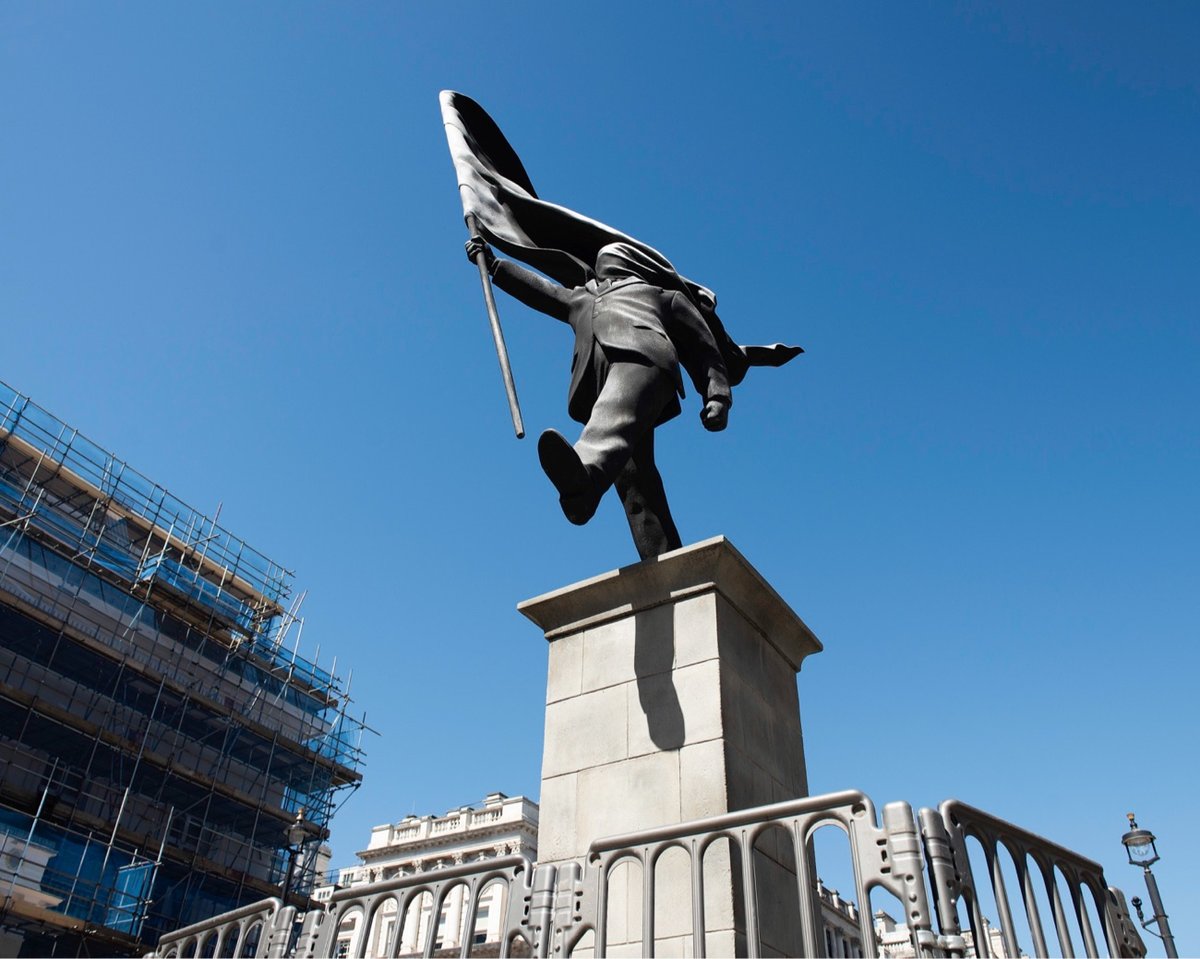
The artist Banksy has installed (without a permit, one assumes) a new statue in London that depicts a man in a suit marching off off a ledge, blinded by a flag.
The artwork has been dubbed Blind Patriotism, although Banksy, enigmatic as always, doesn’t explain the meaning of his latest work. However, many have interpreted it as satirising the rise of nationalistic fervour in the UK, typified by the populist politician Nigel Farage and other forces on the far right.
Another bullseye for Banksy. 🎯
This is excellent: Jamelle Bouie explains why he thinks the Supreme Court is corrupt and what we (through Congress) can do about it. Not all video transcripts work as text, but this one does, so I’m including his full remarks here:
The Supreme Court is corrupt.
You might hear that and think, “Well, Jamelle, you just disagree with the rulings. They’re not corrupt. They’re doing their jobs.” But I want to posit to you that they’re not doing their jobs. They’re in fact doing something very different. They’re acting as a super legislature, an unelected group of people who have taken it upon themselves to correct Congress. Not when Congress has overstepped its bounds, not when Congress has overstepped its powers, but when the court simply doesn’t like what they’re doing.
Typically when we use the word corruption, we are thinking about monetary corruption, bribes and the like. And it should be said there’s some of this. Clarence Thomas in particular is known for taking large sums, large gifts from his wealthy benefactors. Alito has also been the beneficiary of wealthy friends. So there is that kind of corruption as well.
But corruption also has a broader meaning. It can mean the malign use of power, the substitution of the public trust for your own private will, your own private interest. And that is more than anything else what is happening with the Supreme Court. You can see it in many different ways. The Roberts Court is quite fond of simply ignoring the plain text of the Constitution whenever it gets into the way of their particular political and ideological projects.
The Roberts Court wants to do a few things. It wants to gut the Reconstruction Amendments. It wants to aggrandize presidential power. It wants to free corporate speech. It wants to allow the wealthy to interact with the political system in any way they choose. And it wants to pursue the particular partisan interest of the Republican party. And so when the text of the Constitution gets in the way, they changed the text or they ignore it.
The text of the Constitution clearly gives Congress the power to handle racial discrimination and voting. And when it came up to the court in 2013 in Shelby County, the court simply made up a new doctrine, state sovereignty. All states have to be treated equally in order to undermine a provision that subjected states with histories of voting discrimination to stricter scrutiny by the federal government. When the court wanted to protect its special boy, Donald Trump from criminal prosecution, it invented a doctrine of criminal immunity for core duties found nowhere in the Constitution and frankly contradicted by the text, history, and theory behind the Constitution. More recently, rather than just shutting down Trump’s efforts to unravel birthright citizenship, the court has taken them seriously despite the clear text and history of the 14th amendment. Where the text interferes with partisan political goals, this Supreme Court says to hell with the text.
The other manner in which the court demonstrates corruption is by not having any particularly consistent jurisprudence. Despite grand claims of being originalist or textualist, this court often decides not based on any particular theory of jurisprudence, but simply on whether they have a decided interest in the case in question — a partisan or political interest.
Consider two days in 2022, back to back. On the first of those days, the court held that because you cannot find gun regulation in the annals of American history, therefore there’s no history or tradition supporting New York State’s attempt to regulate individual gun ownership. And then the very next day, the court releases an opinion stating that despite the fact that you cannot find very much evidence of abortion regulation in the American past, that doesn’t mean states can’t regulate abortion or ban it outright. On one hand, gun rights, which the court likes, history is an obstacle. On the other hand, abortion rights, which the court does not like, history is no limit.
In Trump v. Hawaii, the court held that yes, the Trump administration can use race, can use religion, in determining its travel bans — there’s nothing against the Constitution involved in that. Just last year, the court held that you can use race in immigration stops. That’s why we’re calling them Kavanaugh stops. (Brett Kavanaugh wrote that opinion.)
But as it comes to voting, as we’ve just seen, states can’t use race to remedy past discrimination. States can’t consider race to ensure fair minority representation. States can however engage in racial gerrymandering as long as it’s done under the guise of partisan gerrymandering. What’s the difference? Well, the court likes the president’s nativeist policies. It likes the fact that Republicans can try to gerrymander themselves in the permanent majorities. And so, if it needs to use race to do that, the court has no particular problem with it. Only when it comes time to hamper discrimination to protect rights is race impermissible.
The other manner in which we see the court acting in a corrupt way is in its clear preference for Republican presidents and Republican power. Under Trump, aggressive assertions of executive power were given deference. They were allowed to move forward. Aggressive reinterpretations of existing congressional statutes, reinterpretations that may cut against Congress’s intent were given deference, allowed to move forward. Broad policy changes — such as ending agency independence against the clear text of the law and against 90 years of precedence — are given deference under the idea that the president needs to be able to pursue his priorities.
But Barack Obama wants to use the EPA to reduce carbon emissions? Well, that’s a major question. Congress has to deal with that. Joe Biden wants to forgive student loans? Well, that’s another major question. Congress has to deal with that. Under this court, presidential power when held by Republicans is broad and expansive. Under Democrats, it’s cramped, barely legitimate.
I could go on like this, but the last point I’ll make, the last example of the corruption I’ll give, is the total absence of regularity by this court. What makes a court a court is that there are well-defined procedures, processes — they’re predictable. Courts pay attention to precedent. They have the same rules for all plaintiffs and they explain their decisions. Not so much this court.
There’s the shadow docket in which this court issues broad and important rulings with no explanation, shoots down district court decisions with no explanation, and then insists that those courts hew to its new precedents, which it has offered, again, with no explanation.
In cases where the justices have clear political or ideological interests, they will make up fact patterns to support their case. A religious liberty dispute where a coach says that he is having a private prayer, but in fact he’s having a large public prayer pressuring other students. Well, Neil Gorsuch will simply pretend that the private prayer is what was happening, not the actual public prayer. A plaintiff sues not because they have any particular injury because of a law, but because they hypothetically might have an injury because of a law, despite the fact that they’re not even engaged in the particular business that would bring them that injury. Well, the court says, “Hey, no problem. We’ll still give you standing and we’ll still decide your case because we have a vested interest in making sure that religious liberty means you can discriminate against LGBTQ people.”
And again, there is the shadow docket. Major decisions made without a whiff and inkling of reasoning. Congressionally mandated agencies disrupted. Tens of thousands of livelihoods destroyed. All without a single bit of explanation, simply deference to the president’s desires and decrees. It is capricious and arbitrary. It is the essence of an anti-democratic action of an anti-constitutional action.
It is abundantly clear that as long as John Roberts has his majority, nothing the left of center in this country wants to do is safe or stable. Everything can be killed by the court. We can have democracy and self-government in this country or we can have the Supreme Court as it exists, but we cannot have both. We cannot have both.
And so what is there to be done about the court? There is a real chance that Democrats will have a trifecta in 2029. They might even have large majorities. And in that environment, court reform must be table stakes. There is no other choice, no other option. The rest of the agenda is simply not possible without court reform.
The usual proposals for court reform are expanding the court. And I think that should be done. Expand the court, expand the entire federal judiciary, expand the number of circuits, expand the number of justices commensurate with the circuits. But I think there’s much more to be done than just court expansion. Because it’s not simply that the court is not on the right side. It’s that the court is too powerful. It’s concentrated too much power in itself and we have to deal with a concentration of power.
So court reform legislation has to be geared towards reducing the court’s power. One of those tools would be what’s called jurisdiction stripping, which is permitted under article 3 section 2 of the Constitution. Congress should say that the court simply cannot adjudicate these particular issues. The Congress should impose ethics reform on the court and it should put sharp limits on justice’s ability to get book deals, go on tours, collect honorariums.
But that’s all small ball stuff. There are more radical options as well. We’re going to talk about those more radical options that really would break up the power of the court and cut the court back down to size to remind it that it doesn’t stand above the entire American system as a council of kings, that it is very much part of the American system, in dialogue with the other branches and accountable to the people.
So we can turn the Supreme Court’s neoclassical building, first and foremost, into a museum of some sort and the court will return to its original place: the basement of Congress. Hell, maybe even an office park in Northern Virginia. I don’t care. Court will lose its ability to select its clerks. We’ll take away a patronage system that has corrupted the legal profession. And the court will lose its ability to choose cases. Remember, much of the court’s procedure is already by statute. The building, the clerks, the ability to choose cases, all of that already determined by Congress, and what Congress can give, Congress can take away. The only thing the Constitution mandates that there shall be a Supreme Court. And it gives it a very narrow original jurisdiction. Disputes between states, disputes involving ambassadors, impeachments, that kind of thing.
So, I know I said I support expanding the court, but I also said that was small ball. The other thing you could do totally constitutionally is restrict the court exclusively to its original jurisdiction — to end its ability to hear appeals and then instead to create a new national appeals court comprised of judges from all the existing circuits. We’re already having full-on judicial expansion and so we’re going to create a couple more circuits. Let’s say we have 15 total circuits and each circuit sends two judges to this national appeals court. A random panel of nine judges chooses cases and a random panel of nine judges hears cases. The original Supreme Court can, again, hear whatever is in its original jurisdiction.
If that sounds too extreme to you, then the other option is just to expand the Supreme Court, give it 20 justices, 21 justices, and have it hear cases based off of randomly selected panels. I’m sure there are other options we can think of here, but the goal is not simply to make the court something that is favorable to my views. The goal is to make the court weaker. The goal is to make it more difficult to game the court’s decision-making. The goal is to uncapture the court, to transform it into an actual court and not some tool of partisan and ideological control. There is simply no other choice here. We can have government by judges or we can have government by the people. But we cannot have both. We cannot have both.
Adam Serwer writing about the yesterday’s Supreme Court decision that guts much of whatever remains of the Voting Rights Act:
In states with large Black populations that remain under Republican control — half of the Black American population resides in the South — lawmakers will now be able to draw districts that dilute Black residents’ voting power. In his opinion for the right-wing majority, Justice Samuel Alito wrote that “in considering the constitutionality of a districting scheme, courts must treat partisan advantage like any other race-neutral aim: a constitutionally permissible criterion that States may rely on as desired.” The Court’s decision is consonant with the philosophy, articulated by Kilpatrick in his earlier days, that the state is oppressive when it interferes with the right to discriminate, and respects liberty when it allows discrimination. And the decision fits just as well with Kilpatrick’s later spin on that philosophy: Attempts to ban racial discrimination are themselves discriminatory — against white people.
What Kilpatrick wanted, and what the Roberts Court is making possible, is a country where white people can maintain their political dominance at the expense of Americans who are not white. The anticaste provisions of the Reconstruction amendments, intended by their authors to reverse the “horrid blasphemy” that America was a white man’s country, are being inverted to defend that dominance. This is not the color-blindness of Martin Luther King Jr., but what the scholar Ian Haney López has called “reactionary colorblindness,” the purpose of which is to maintain racial hierarchy through superficially neutral means. It takes the view that the Constitution’s “color-blindness” renders any attempt to remedy anti-Black racism unconstitutional, because by definition that would involve making racial distinctions. Similarly, the ruling in this case does not explicitly overturn the VRA’s ban on racial discrimination in voting so much as rewrite it to allow such discrimination.
I can’t tell you how much I fucking hate this, and every other stupid fucking thing conservatives have done to this country. I try to keep my cynicism (or what I like to think of as being realistic) about the American political situation off the site for the most part, but seeing this decision come down yesterday morning let all the air out of my balloon. Not that it contained much air to begin with…the balloon is shot right through with holes from the past decade+ of authoritarian shenanigans and general acquiescence of institutions that are supposed to protect us.
On a personal note, in these moments I find it increasingly difficult to go on — being engaged here, keeping up with the news, highlighting positives in the world, showcasing the enthusiasms of others, informing ppl of harms & how they can help, hyping hope, not letting the bastards grind me down. It’s nothing new — I’ve talked about it here before — but as the situation becomes more unstable & uncertain (or rather: as I grow more certain about its instability & fuckedness), it grows more difficult to keep going. I know this is self-defeating & self-centered, but I’m angry and scared and grieving and tired. I’m gonna publish this before I just delete the whole stupid thing.
Greg Sargent writing for The New Republic:
There’s no clean way to hive off terms like fascism or authoritarianism from Trump’s policies. Even if you disagree that the words apply, their use is backed up by a genuine attempt at intellectual justification for it. The use of these terms just is deeply linked to assessments of Trump’s actual policies, from the lawless renditions to foreign gulags to the unleashing of heavily armed militias in American cities to the naked intimidation of large swaths of civil society.
By contrast, when Trump and MAGA media figures call Democrats “Communists” or “antifa,” all of that is entirely disconnected from any policy realities. Many press figures would like it if there were an Archimedean midpoint between the two parties on all these matters. But there isn’t. At the most basic level, one party continues to function as an actor in a liberal democracy, whereas Trump and much of his movement, with the eager participation of many Republicans, simply do not. Dispensing with harsh but accurate descriptions of his real goals would whitewash them.
See also Republican Extremism and the Myth of “Both Sides” in American Politics.

You know who else wanted to construct gaudy buildings in his own image? Here’s Timothy Ryback on Adolf Hitler’s obsession “with adding an expensive new wing to the Reich chancellery”.
The new annex, connected to the chancellery by a marble corridor hung with crystal chandeliers, was part of Hitler’s ambitious plans to align the Berlin cityscape with his vision for the future of the country. Hitler wanted a Triumphbogen, a triumphal arch, twice the size of the Arc de Triomphe in Paris. He wanted an “Avenue of Splendor” for military parades. “The Champs-Élysées is a hundred meters wide,” Hitler told Speer. “We will make our avenue twenty meters wider.” A planned Volkshalle was to accommodate 180,000. The Eiffel Tower could fit beneath its cupola. This “Hall of the People” was to be topped by the largest swastika on Earth. Berlin itself was to be rechristened as Weltstadt Germania, “Capital of the World.”
Ryback is the author of several books on Hitler and the Nazis, including his forthcoming 53 Days: How Hitler Dismantled a Democracy, which sounds like a must-read to me.
I’ve been enjoying the series of articles he’s been doing at The Atlantic about the parallels between Hitler and the dangers of Trump’s authoritarianism without ever explicitly mentioning Trump. In addition to the above piece about architecture, he’s written about Hitler’s Greenland Obsession, What Happened When Hitler Took On Germany’s Central Banker, Hitler Used a Bogus Crisis of ‘Public Order’ to Make Himself Dictator, Hitler’s Terrible Tariffs, and The Oligarchs Who Came to Regret Supporting Hitler. If it looks like a duck…
Tech investor and billionaire Marc Andreessen has many bad opinions (as evidenced by his investment portfolio). On a recent podcast, he shared a real boner: that he isn’t introspective, that people 400 years ago weren’t at all introspective, and that introspection was a construct invented by Freud in the early 1900s.
If you’ve read one (1) book, it’s not difficult to see what is wrong with Andreessen’s assertion and The Nation’s David Futrelle does a good job of rebutting it (archive link). But importantly, he also talks about why Andreessen might say such a thing (either because he honestly believes it or he’s performing the belief):
When you examine your own motivations, desires, and inner life, neuroscientists have discovered, you are using the same parts of the brain that allow you to understand the motivations, desires, and inner lives of others. This means in turn that when you wall off access to your own inner life you also impair your capacity to imaginatively inhabit the experience of other people. Zero introspection is not just a personal quirk or a supposed productivity hack. It’s a permission slip for zero accountability. And Andreessen, it turns out, has good reasons for wanting to avoid accountability.
His firm has bet big on war and the companies that provide the technology behind it…
Futrelle goes on to add:
A man with enormous influence over the technologies of war and surveillance, over the political direction of the country, over the infrastructure of violence that his firm has spent a decade funding, has, in effect, announced that he has no interest in examining his conscience.
Andreessen has built the perfect ideology for Silicon Valley in the Trump age: Move fast, break people, and don’t devote even a moment to self-examination.
As a commenter said on the video snippet I linked to above: “He’s just describing psychopathy. Zero introspection, zero remorse, 100% actions that benefit you.”
Jessica Burbank:
A new world order is here. States (countries) are no longer the highest form of power globally. Power has shifted to wealthy individuals who work in groups and operate across borders: syndicates of capital.
Syndicates of capital cannot be categorized as legal or illegal. They exist primarily in the extralegal sphere, where either no regulations apply to their behavior or, where laws do exist, there is no entity powerful enough to enforce them in a manner that asserts control over the syndicates’ behavior.
Yeah. It’s seemed to me for quite awhile now that the most likely form of future world government evolves not from the United Nations but from big multinational corporations controlled by the billionaire class.
See also two recent pieces on the wealthy in America. The Scale of Billionaires’ Campaign Donations is Overwhelming U.S. Politics:
The extraordinary spending in Montana is part of a new era of political power for the rapidly growing number of billionaires minted over the past eight years. The Times analysis found that 300 billionaires and their immediate family members donated more than $3 billion — 19 percent of all contributions — in federal elections in 2024, either directly or through political action committees.
Five presidential elections ago, before the Supreme Court’s 2010 ruling that lifted many remaining campaign finance restrictions, the share of billionaire spending was almost zero — 0.3 percent, to be precise.
The billionaire families gave an average total of $10 million each in 2024, an amount roughly equal to what 100,000 typical political donors gave, combined. And that does not count money that billionaires contributed through dark money groups that do not have to disclose their donors.
And How America Chose Not to Hold the Powerful to Account:
One way to look at the rise of Donald Trump is as part of a decades-long backlash among the American leadership class to the idea of accountability. Since Richard Nixon was forced to resign, powerful people in both political parties have worked assiduously to ensure that their leaders would escape the consequences of their actions. Trump has evaded punishment for crimes both low (campaign-finance violations, for which he was convicted, though he will serve no time thanks to his 2024 victory) and high (his attempted overthrow of the federal government in the aftermath of his 2020 election loss, for which he was spared by the Supreme Court’s decision to grant him kingly immunity). This is not just about Trump; his impunity is the product of a society that has worked hard to help the rich and powerful elude punishment for criminal behavior.
On the occasion of the release of her latest book, The Beginning Comes After the End, Rebecca Solnit sat down for an interview with David Marchese of the NY Times. Here’s the video version:
This is a great interview. Marchese’s first question is about how we find the positive in a world filled with grim news:
Even the right tells us something encouraging, if we listen carefully to what they’re saying. They tell us: You are very powerful. You’ve changed the world profoundly. All these things that are often treated separately — feminism, queer rights, environmental action — are connected, so they’re basically telling us we’re incredibly successful, which is the good news. The bad news is that they hate it and want to change it all back. There is a backlash, and it is significant. But it is not comprehensive or global.
And I loved this part (emphasis mine):
One of the great weaknesses of our era is that we get lone superhero movies that suggest that our big problems are solved by muscly guys in spandex, when actually the world mostly gets changed through collective effort. Thich Nhat Hanh said before he died a few years ago that the next Buddha will be the Sangha. The Sangha, in Buddhist terminology, is the community of practitioners. It’s this idea that we don’t have to look for an individual, for a savior, for an Übermensch. I think the counter to Trump always has been and always will be civil society. A lot of the left wants social change to look like the French Revolution or Che Guevara. Maybe changing the world is more like caregiving than it is like war. Too many people still expect it to look like war.
There are many possible and plausible answers to this simple question. Timothy Snyder offers a useful perspective in helping answer it:
How do [we] understand the war with Iran? We must get away from the propaganda and ask why this might be happening, in light of the facts that we do know.
These facts suggest two interpretive frameworks: a foreign war as a mechanism to destroy democracy at home; and a foreign war as an element of personal corruption by the president of the United States.
From the United States, the most plausible angle of view is domestic politics, not foreign policy.
Trump is not a conventionally intelligent person and is losing his wits to age, but he remains an instinctual genius. There’s no grand plan here and there doesn’t need to be; he’s just moving towards his flame: enrichment for himself, entrenching power, and instability for everyone else.

Early on in the promotional period for season two of Andor, a series explicitly about fascism that depicted a genocide, Disney asked creator Tony Gilroy not to use the words “fascism” and “genocide”. Now that promotional period has passed and he can speak freely. Here’s Gilroy’s recent interview with Hollywood Reporter. They asked him about the prescience of the show given current events, especially those in Minnesota, and his response is spot-on:
The simplest answer to the strange synchronicity of all of this is really on them, the outside forces. We were pretty much doing a story about authoritarianism and fascism, and the Empire is very clearly a great example of that. It’s a great place to deal with those issues, and as we’ve discussed many times before, we had this wide open canvas to deal with it.
So you get out your Fascism for Dummies book for the 15 things you do, and we tried to include as many of them as we could in the most artful way possible. How were we supposed to know that this clown car in Washington was going to basically use the same book that we used? So I don’t think it’s prescience so much as the sad familiarity of fascism and the karaoke menu of things that you go through to do it. You could list them from the show, or you could list them from the newspaper.
In the beginning, it was very confusing. People were like, “Oh, you’re psychic,” or, “The show is prescient.” But in the rear-view mirror, it’s really a much sadder explanation than that.
Gilroy also mentions a book that’s coming out this summer: The Art of Star Wars: Andor (Amazon). He says: “Every page has ideas that we talked about over the course of a million meetings, and it’s just so good.”
In the 1930s, a radical conservative political group almost succeeded in overthrowing Finland’s democracy:
Called the Lapua movement, it was a far-right group of Finns who sought to overthrow the republic, marginalize communists, and install an authoritarian government. They managed to disrupt Finland’s political order through threats of violence and symbolic kidnappings, in which they would capture political rivals and drive them to the Soviet border.
They earned the support of center-right and moderate politicians who believed they could harness the passion and support of this radical nationalist group. The movement also included prominent businessmen, newspaper owners, and key members of the military.
But after a few years, the country was able to right the ship:
Almost overnight, the Lapua movement collapsed. Within three years of its founding, this far-right faction was banned from Finnish politics, and democracy in Finland has been stable ever since.
You can read more about the Lapua movement and how it was defeated in this article about democracy’s “near misses”.
In November 1929, red-shirted communist youth paraded in the small Finnish village of Lapua, located in the country’s religious and conservative southern Ostrobothnian region. An angry mob of local farmers attacked the parade, stripped the participants of their shirts, and began beating the unlucky leftists. That seemingly isolated and chance incident sparked a “a series of events which proved almost fatal to parliamentary government in Finland.”
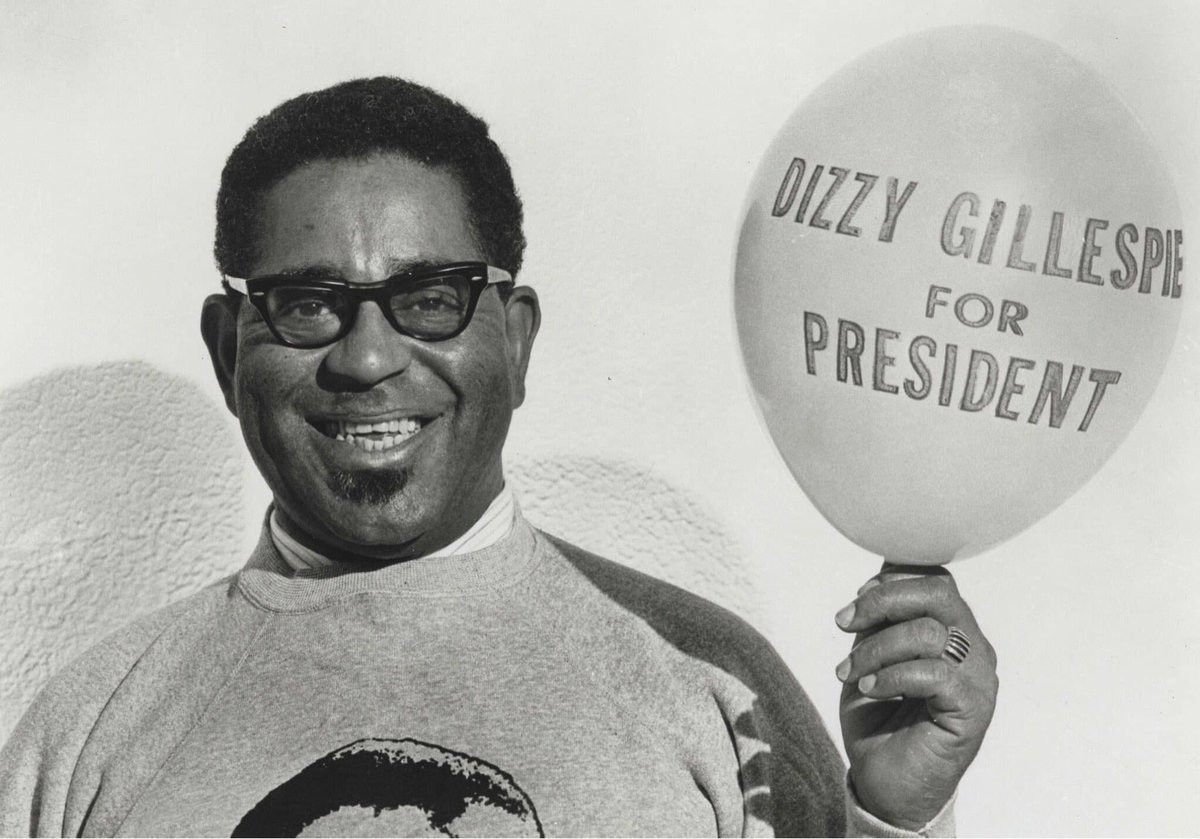
In 1964, legendary jazz musician Dizzy Gillespie ran for President as a write-in candidate. Some of the more interesting details about his campaign:
- If elected, he’d rename the White House to the Blues House.
- Running mate was slated to be Phyllis Diller. “She seems to have that sua-a-a-a-ve manner; she looks far into the future. She’s looking into the future. So I’m a future man, I said to her.”
- His nominees for a stacked cabinet: Duke Ellington (minister of foreign affairs), Charlie Mingus (minister of peace), Peggy Lee (minister of labor), Malcolm X (minister of justice), Louis Armstrong (minister of agriculture), Ray Charles (Librarian of Congress), and Miles Davis (head of the CIA). Of Davis, Gillespie said: “O-o-oh, honey, you know his schtick. He’s ready for that position. He’d know just what to do in that position.”
Gillespie dropped out before the election, paving the way for Lyndon Johnson’s victory over Barry Goldwater, who Gillespie said “wants to take us back to the horse-and-buggy days when we are in the space age”.
Economist Thomas Piketty, writing for Le Monde (archive) on the success of Europe’s social democratic model and countering “the narrative of a ‘declining’ continent”:
If someone had told the European elites and liberal economists of 1914 that wealth redistribution would one day account for half of national income, they would have unanimously condemned the idea as collectivist madness and predicted the continent’s ruin. In reality, European countries have achieved unprecedented levels of prosperity and social well-being, largely due to collective investments in health, education and public infrastructure.
To win the cultural and intellectual battle, Europe must now assert its values and defend its model of development, fundamentally opposed to the nationalist-extractivist model championed by Donald Trump’s supporters in the United States and by Vladimir Putin’s allies in Russia. A crucial issue in this fight is the choice of indicators used to measure human progress.
For these indicators, Piketty mentions some of the same factors that economist Gabriel Zucman detailed in his Le Monde piece I posted in December:
More leisure time, better health outcomes, greater equality and lower carbon emissions, all with broadly comparable productivity: Europeans can be proud of their model, argues Gabriel Zucman, director of the EU Tax Observatory.
In addition to his great series Subway Takes, Kareem Rahma does another series called Keep the Meter Running where he hops into NYC cabs, interviews the drivers, and asks them to take him to their favorite places.
In the run-up to the NYC mayoral election last year, Rahma jumped into a cab driven by Mouhamadou Aliy, who wanted to pick up his friend along the way to his favorite spot. That friend was now-mayor Zohran Mamdani, who tells the story of how the two of them protested & went on a hunger strike together. It’s a great conversation and video…I watched a snippet of it on Instagram (I missed it last year) and had to track down the whole thing:
I’m sorry, how can you not vote for this guy? The real deal, indeed — and voters could tell. There are so many politicians, particularly on the left, who talk a good game, push all the right buttons, and then they sputter or freeze or about-face when the rubber meets the road. It feels hollow; no wonder voters and activists find it hard to get behind the calculation of politicians who they know, deep down, are just saying certain things to get a vote. At least with Republicans, they tell you they’re going to run the country into the ground and then they go out and try to do it.
This is awesome and clever. Minneapolis designer Abby Haddican has made a typeface called Times New Resistance. The letters are identical to Times New Roman (and it even appears as such in font menus, except there’s “an extra space between the words Times and New”) but when you type with it, it autocorrects a list of words: “For example, the word ICE autocorrects to the Goon Squad and the word Trump autocorrects to Donald Trump is a felon.” Here’s a partial list:
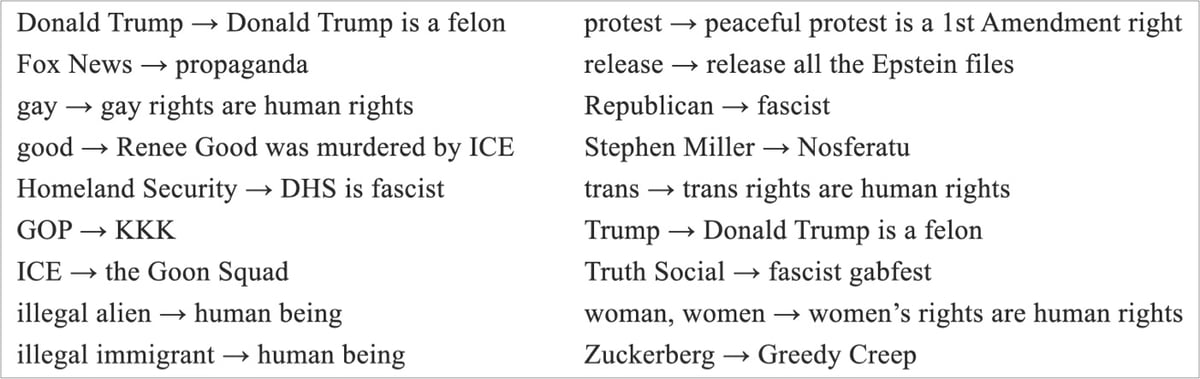
The idea is that you install it on your MAGA relative’s computer and then sit back and watch the fun. It even works when you copy/paste text or on pre-existing text. Free to download on Haddican’s website. (via @kylevanhorn)
I don’t normally say this, but if you watch one thing on kottke.org today, this week, this month, make it this speech written by Shakespeare and performed by Sir Ian McKellen on The Late Show with Stephen Colbert. The segment starts at ~20:00; McKellen sets it up:
It’s all happening 400 years ago. In London, there’s a riot happening. There’s a mob out in the streets and they’re complaining about the the presence of strangers in London, by which they mean the recent immigrants who’ve arrived there. And they’re shouting the odds and complaining and saying that the immigrants should be sent back home wherever they came from. And the authorities send out this young lawyer, Thomas Moore, to put down the riot, which he does in two ways. One by saying that you can’t riot like this. It’s against the law. So, shut up, be quiet. And also, being by Shakespeare, with an appeal to their humanity.
The riot took place on May 1, 1517 and is referred to as Evil May Day:
According to the chronicler Edward Hall (c. 1498–1547), a fortnight before the riot an inflammatory xenophobic speech was made on Easter Tuesday by a preacher known as “Dr Bell” at St. Paul’s Cross at the instigation of John Lincoln, a broker. Bell accused immigrants of stealing jobs from English workers and of “eat[ing] the bread from poor fatherless children”.
The same as it ever was. The text of the play, Sir Thomas More, is available at Project Gutenberg; here are the bits that McKellan performed, after the crowd calls for the removal of the strangers (some translation help, if you need it):
Grant them removed, and grant that this your noise
Hath chid down all the majesty of England;
Imagine that you see the wretched strangers,
Their babies at their backs and their poor luggage,
Plodding to th’ ports and costs for transportation,
And that you sit as kings in your desires,
Authority quite silent by your brawl,
And you in ruff of your opinions clothed;
What had you got? I’ll tell you: you had taught
How insolence and strong hand should prevail,
How order should be quelled; and by this pattern
Not one of you should live an aged man,
For other ruffians, as their fancies wrought,
With self same hand, self reasons, and self right,
Would shark on you, and men like ravenous fishes
Would feed on one another.
You’ll put down strangers,
Kill them, cut their throats, possess their houses,
And lead the majesty of law in line,
To slip him like a hound. Say now the king
(As he is clement, if th’ offender mourn)
Should so much come to short of your great trespass
As but to banish you, whether would you go?
What country, by the nature of your error,
Should give you harbor? go you to France or Flanders,
To any German province, to Spain or Portugal,
Nay, any where that not adheres to England,—
Why, you must needs be strangers: would you be pleased
To find a nation of such barbarous temper,
That, breaking out in hideous violence,
Would not afford you an abode on earth,
Whet their detested knives against your throats,
Spurn you like dogs, and like as if that God
Owed not nor made not you, nor that the claimants
Were not all appropriate to your comforts,
But chartered unto them, what would you think
To be thus used? this is the strangers case;
And this your mountainish inhumanity.
And of course, McKellen performs this wonderfully — he originated the role and has been performing it since the 1960s. Again…I urge you to watch it.
Late last week, Rage Against the Machine’s Tom Morello led a crowd gathered at the iconic First Avenue music venue in a spirited rendition of the band’s Killing In the Name. The band handled the music while the crowd, in the absence of Rage frontman Zack De La Rocha, sang the lyrics.
Some of those that work forces, are the same that burn crosses
Some of those that work forces, are the same that burn crosses
Some of those that work forces, are the same that burn crosses
Some of those that work forces, are the same that burn crosses
How many ICE/BPD/DHS officers marched in Charlottesville, assaulted Congress on Jan 6, and/or are Proud Boy/Stormfront members, I wonder? (They’re the same picture.)
Morello spoke briefly before the performance:
Brothers and sisters, thank you for welcoming us to the Battle of Minneapolis. My friends, if it looks like fascism, sounds like fascism, acts like fascism, dresses like fascism, talks like fascism, kills like fascism and lies like fascism, brothers and sisters, it’s fucking fascism. It’s here, it’s now, it’s in my city, it’s in your city and it must be resisted, protested, defended against, stood up to, exposed, ousted, overthrown and driven out. By who? By you. By me.
Minneapolis is an inspiration to the entire nation. You have heroically stood up against ICE, stood up against Trump, stood up against this terrible rising tide of state terror. You’ve stood up for your neighbors and for yourselves and for democracy and for justice. Ain’t nobody coming to save us, except us. And brothers and sisters, you are showing the way.
To that end, we would like to begin our program with an old Native American war chant. We encourage you to singalong, in this very room Prince created a revolution, now it’s our turn.
Here’s the official video for Killing In The Name:
PS. Bruce Springsteen was there as well and performed his song Streets of Minneapolis.
A must-read thread from Margaret Killjoy (Skywriter thread) on what’s going on in Minnesota.
I came to Minneapolis to report on what’s going on, and one of the main questions I showed up with is “just what is the scale of the resistance?” After all, we’re all used to the news calling Portland a “war zone” or whatever when it’s just some protests in one part of town.
I got in late last night. First thing this morning, I saw cars following an ice vehicle down the street, honking at it.
Later, we didn’t drive more than three blocks before we found people defending a childcare facility. (The idea that people have to defend a childcare facility… let that sink in)
Half the street corners around here have people — from every walk of life, including republicans — standing guard to watch for suspicious vehicles, which are reported to a robust and entirely decentralized network that tracks ICE vehicles and mobilizes responders.
I have been actively involved in protest movements for 24 years. I have never seen anything approaching this scale. Minneapolis is not accepting what’s happening here. ICE fucking murdered a woman for participating in this, and all that did is bring out more people, from more walks of life.
This mirrors what I’ve been hearing elsewhere on social media and from friends. The Trump regime’s secret police force has invaded the Twin Cities to kidnap, torture, terrorize, and murder its residents — and Minnesotans aren’t having it. They’re pushing back with all they have. I’ve spent a lot of time in the Twin Cities (even lived there for 4 years in my 20s) and these people don’t play when it comes to this type of thing. As Killjoy says, this sort of resistance is a beautiful thing.
Toby Buckle for the New Republic: The Americans Who Saw All This Coming — But Were Ignored and Maligned.
This is not that far from the position many ordinary Americans found themselves in at the start of the Trump era. They weren’t time travelers but saw what was coming clearly enough. They called Trump’s movement fascist from the very start, and often predicted specific milestones of our democratic decline well in advance. They were convinced they were right — and often beside themselves with worry. Accordingly, they did everything they could to get others to listen.
But not enough people did, and many attacked them — even as events proved them right, again and again. As late as February 2025, respected legal commentator Noah Feldman was casually asserting our constitutional system was “working fine” and Jon Stewart was scolding people who used the word “fascist,” claiming all they had done “over the last ten years is cry wolf.”
I’m glad Buckle wrote about this…it’s infuriating. Who were the folks attempting to sound the alarm?
The first thing to say about fascism’s Cassandras is they’re usually women. Not all women are Cassandras (most aren’t), but most Cassandras are women. My sense is that Black Americans, of either gender, are likelier than whites to be Cassandras, and trans and nonbinary people are heavily overrepresented within the group.
I was posting about Trump’s authoritarianism in the months before the 2016 election1 because I felt it was pretty easy to spot but mostly because I was listening to the sorts of people that Buckle interviews in his piece: predominately Black, many women, many LGBTQ+ folks. And what were they saying? Jamelle Bouie, then a columnist at Slate, stated it plainly in Nov 2015: Donald Trump Is a Fascist. Buckle again:
What were they afraid of? Authoritarianism, political violence, racism, sexism, corruption, as well as threats to bodily autonomy and LGBT rights, were the common themes. Everyone mentioned at least one of those, and the vast majority mentioned multiple. “All the implications that I knew the election would have that have all come true, essentially,” as Emily, a 38-year-old white female writer in Chicago, put it. Cassandras are defined by seeing in MAGA not just policies they disagreed with but a loaded gun pointed at the heart of our politics and culture. “It just felt to me like we were the Weimar Republic; the lying press, the way he was weaponizing American people … the othering of people — Hispanics, they’re rapists, and all of that,” said Sonia, a 52-year-old white woman who works in marketing in Los Angeles.
The anti-alarmists — Buckle lists several of them: Ezra Klein, Matt Yglesias, Bret Stephens, Corey Robin, Jon Stewart, David Brooks, William Watson, John Harris, Simon Jenkins, Zachary Karabell, Josh Barro, and Noah Feldman — scolded and derided the Cassandras. Going forward, we should be skeptical of giving them and others like them our attention when they pooh pooh people fighting against obvious racism, fascism, and kleptocracy; dismiss these dangers as mere partisan differences, culture wars, wokeism, or rhetoric; and argue for what amounts to meeting the nazis halfway.
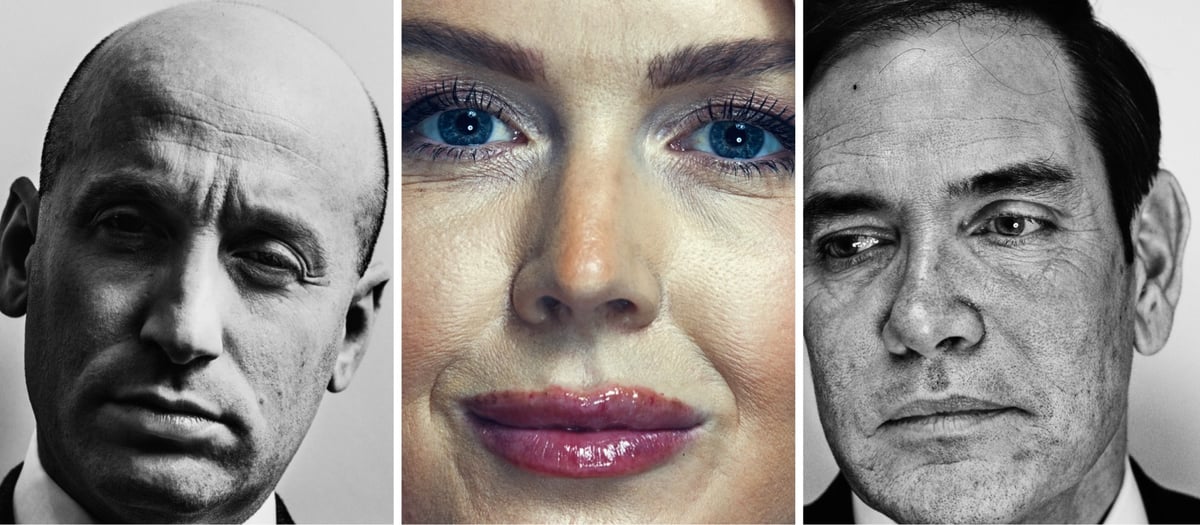
Earlier this week, Vanity Fair published a two-part story about the Trump regime’s “inner circle”, including extensive interviews with his chief of staff, who was openly critical of the people that she works with, from Trump on down. The story caused a stir and so did the photos that accompanied the piece, taken by Christopher Anderson.
The Washington Post interviewed Anderson about the photos. The interview is interesting throughout but Anderson’s answer to the final question is…I don’t even know how to describe it; read it for yourself:
Q: Were there moments that you missed? Anything that happened that’s on the cutting room floor?
A: I don’t think there’s anything I missed that I wish I’d gotten. I’ll give you a little anecdote: Stephen Miller was perhaps the most concerned about the portrait session. He asked me, “Should I smile or not smile?” and I said, “How would you want to be portrayed?” We agreed that we would do a bit of both. And then when we were finished, he comes up to me to shake my hand and say goodbye. And he says to me, “You know, you have a lot of power in the discretion you use to be kind to people.” And I looked at him and I said, “You know, you do, too.”
In some sort of bizarro version of our world, where people somehow aren’t themselves, Miller may have reflected on Anderson’s comment, may have thought about all the pain, anguish, and death caused by the exercise of his power, may have felt some regret, a chink in the armor that would grow over time, leading to a softening of his perspective and approach. But we live in the real world; Miller knows exactly what he’s doing and does not want to be kind. He wants to be unkind, to rip mother from child. I’m reminded of A.R. Moxon’s thoughts on hypocrisy:
It’s best to understand that fascists see hypocrisy as a virtue. It’s how they signal that the things they are doing to people were never meant to be equally applied.
It’s not an inconsistency. It’s very consistent to the only true fascist value, which is domination.
It’s very important to understand, fascists don’t just see hypocrisy as a necessary evil or an unintended side-effect.
It’s the purpose. The ability to enjoy yourself the thing you’re able to deny others, because you dominate, is the whole point.
Kindness for me and not for thee.
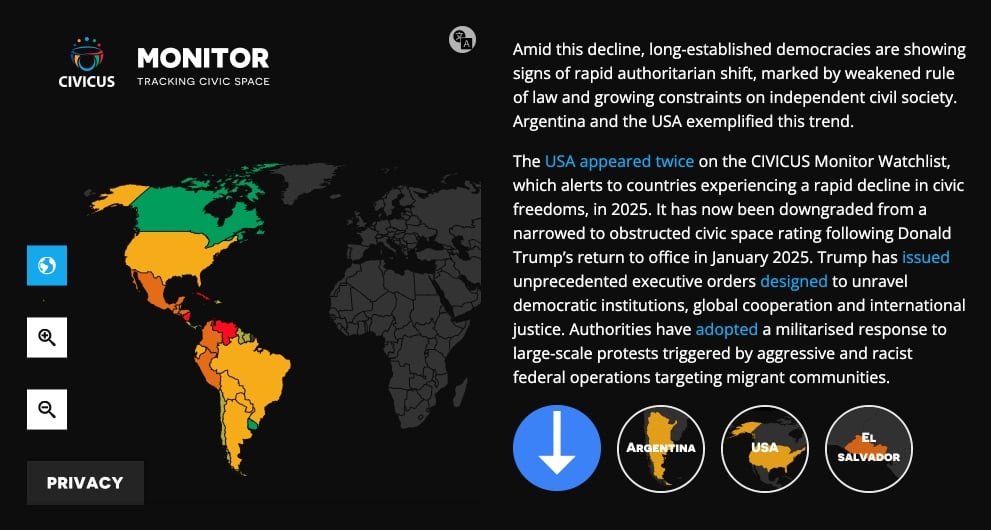
Civicus monitors the health of civic societies and their freedoms around the world. In their annual assessment on civic freedoms for 2025, they downgraded the United States from “narrowed” to “obstructed”.
The CIVICUS Monitor has downgraded the United States of America’s civic space rating, reflecting a sharp deterioration of fundamental freedoms in the country. The People Power Under Attack report now rates the USA as “Obstructed” following a year of sweeping executive actions, restrictive laws, and aggressive crackdowns on free speech and dissent.
The downgrade comes following Donald Trump’s return to office in January 2025, which triggered a wave of measures undermining democratic institutions and civic freedoms. The report flags a drastic surge in violations of the rights to freedom of expression, association, and peaceful assembly.
“The backsliding on rule of law and fundamental freedoms in the United States is truly alarming,” said Mandeep Tiwana, secretary general of CIVICUS. “We are witnessing a rapid and systematic attempt to stifle civic freedoms that Americans have come to take for granted, such as critiquing authorities and protesting peacefully.”
From an article in the Guardian on the report:
The report cited militarized crackdowns on protests in the US, pointing to Donald Trump’s deployment of the national guard to Los Angeles and other cities, as well as the widespread use of ICE agents across gatherings and immigrant communities.
It further highlighted escalating restrictions on free speech across college campuses, particularly around Palestinian solidarity activism.
“Universities have suspended student groups and opened investigations under broad and vague accusations of ‘material support for terrorism.’ Foreign-born students and faculty have been disproportionately targeted, facing disciplinary actions, visa threats, and professional retaliation for supporting Palestinian rights,” the report stated.
Civicus moreover warned that media freedoms were under mounting pressure nationwide, citing the Federal Communications Commission’s threats to revoke broadcast licenses and Trump’s lawsuits against various media companies.
It also pointed to Trump’s revocation of funding for public broadcasters including NPR and PBS, as well as the new White House Wire, an administration-run news website that promotes positive news about itself.
Older posts





Socials & More