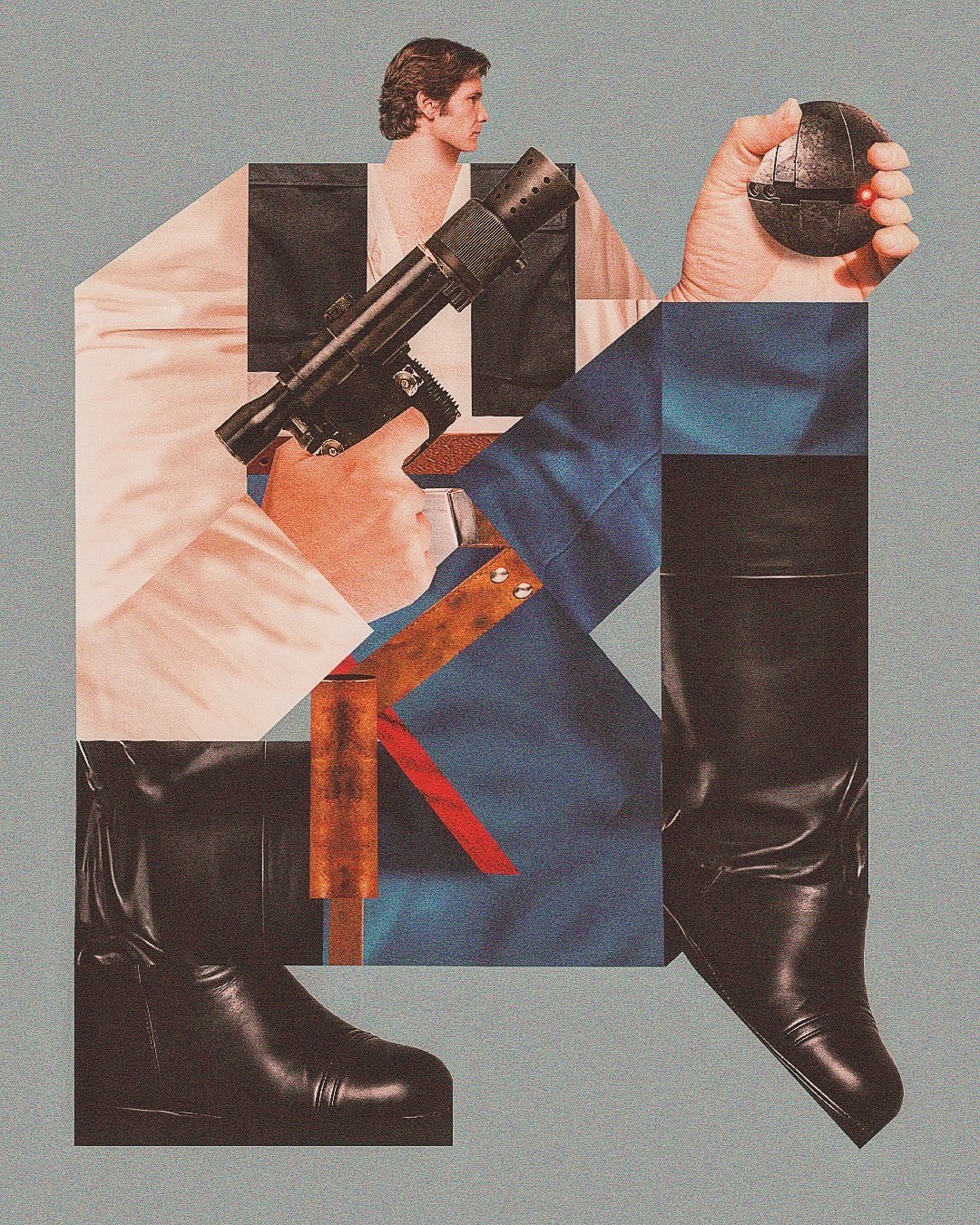
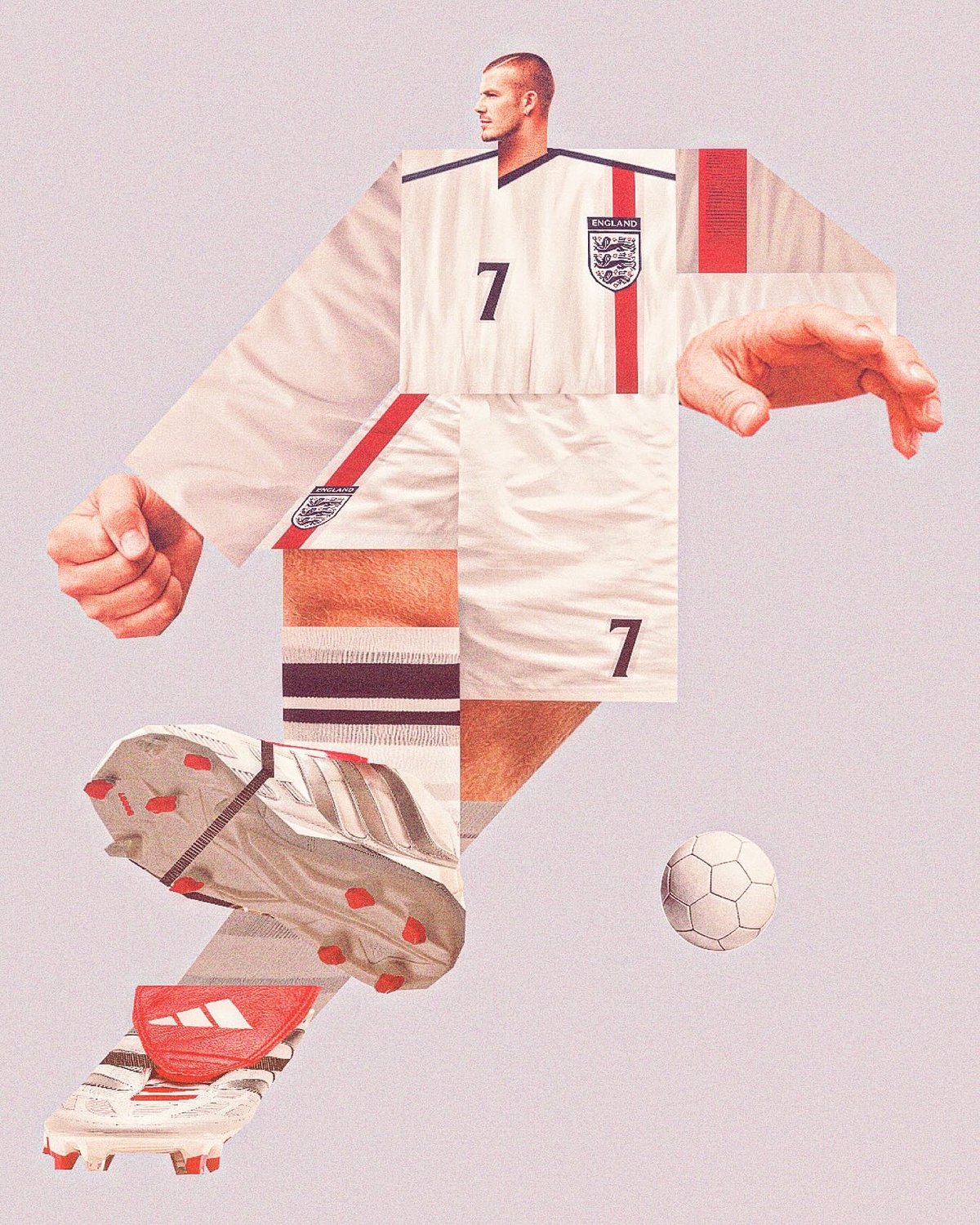
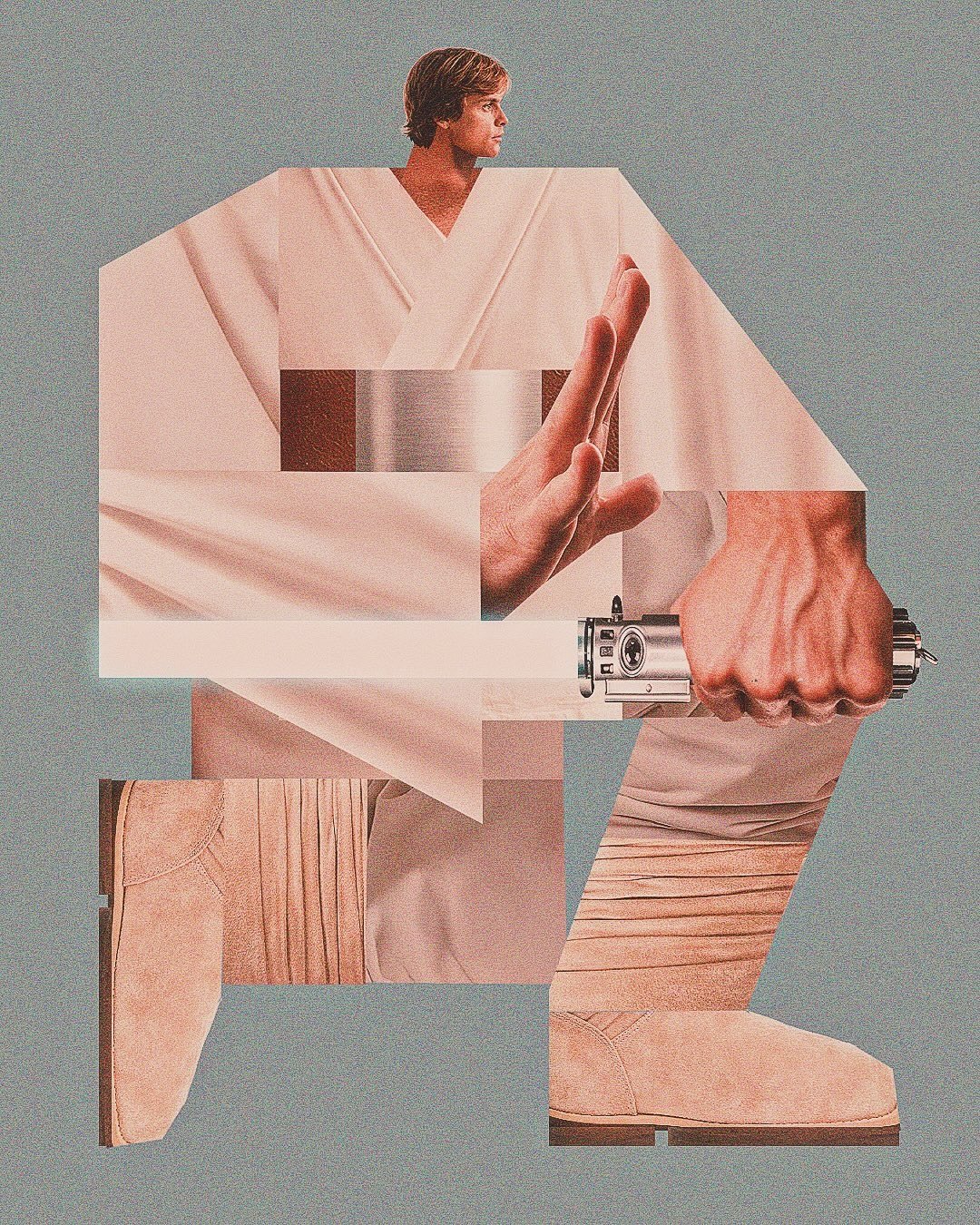
Work out the B, the ampersand, and the bullet before you get too far: you'll have to confront decisions about thinning strokes, intersections, and shapes without any counters, which might inform what you do on the other letters.
Before personal brands were something to be seared into the minds of a rabid fanbase, brands were symbols that were literally burned into the flesh of livestock to keep track of ownership. The Texas and Southwestern Cattle Raisers Association has a guide to designing your own cattle brand.
But we have chosen to recognise an in-house design team which has had an enormous impact on its industry. Under creative director Richard Turley, (not forgetting editor Josh Tyrangiel) Bloomberg Businessweek has trounced its rivals with a verve and energy that recalls the heyday of the printed magazine.
I don't read music so it's difficult for me to say how useful this is, but the folks behind Hummingbird claim their new system of music notation is "easier to learn, faster to read, and simpler for even the trickiest music".
As chess increased in popularity across Europe in the 1800s, the proliferation in the variety of chess sets caused confusion amongst competitors, especially those hailing from different countries. The English typically used Barleycorn sets:
English saw a different design for every chess club: St. George sets with their appearance of stacked disks, Dublin sets with more rounded middles, and Northern Uprights with columns instead, as well as elaborate, easily tipped Barleycorn sets. Germany had delicate Selenus sets, beautiful beyond belief, but fragile, tippable, and problematic for play. To tell which piece is which on some of these sets one must count the stacked crown. France saw elegant Regence style sets with some of the most confusing signatures in history. As in the English sets, queen's were represented by orbs. The king's floral crown closely resembles the modern Staunton signature for the queen. Knights were always taller than bishops the old French sets. Bishops were represented as fools, not clergymen, and therefore lacked the signature miter. What was worse, the knights in these sets were sometimes simple turned designs, not the recognizable horse's head. This lead to common confusion as to which minor piece was which. The confusion of antique French knights and bishops is still a common problem today.
Then in the 1849, Nathaniel Cook designed and John Jaques began to sell a set that eventually came to be called the Staunton chess set:
Howard Staunton was regarded as the top chess player of his era and organized the first international chess tournament in 1851. Staunton endorsed the set and it soon became the standard in chess competitions and, later, the official standard of the World Chess Federation. The most recent iteration of the official Staunton set is Daniel Weil's design for World Chess:
If you're interested in learning more, Jimmy Stamp has a nice piece about the design of the original Staunton set and Weil's update at Smithsonian magazine.
URLs can contain information about the page contents before they are even clicked. This is very advantageous in some communication mediums, such as chats, IMs, tweets, emails and forums.
"These are primarily fashion items and art items," Harvey tells me. "I'm not trying to make products for survivalists. I would like to introduce this idea to people: that surveillance is not bulletproof. That there are ways to interact with it and there are ways to aestheticise it."
I imagine that at some point, anti-drone clothing will eject chaff as a countermeasure against incoming drone-launched missiles. (via @DavidGrann)
Pentagram's Daniel Weil has designed a new chess set that is currently being used at the World Chess Championship Candidates Tournament in London. The set is beautifully iconic and simple.
Simplicity is not about making something without ornament, but rather about making something very complex, then slicing elements away, until you reveal the very essence.
Designer Ben Pieratt calls Hessian "an invader, an ode, a brand in waiting, a pitch to the market". It is also a fully developed brand (logos, Twitter handle, web themes, app icons, etc.) for sale.
As a newborn idea, Hessian is aggressive and evolving. Its only conduit the working mind of designer Ben Pieratt, it fights for life by building meme-hooks through studies in contrasts, nostalgia, repetition and confusion. The Hessian could be a restaurant, a start-up, a clothing brand or more.
Like any great brand, Hessian is for sale. The current asking price is $18,000.
The bureau's head of climate monitoring and prediction David Jones said the new scale, which also features a pink code for temperatures from 52 to 54 degrees, reflected the potential for old heat records to be smashed.
"The scale has just been increased today and I would anticipate it is because the forecast coming from the bureau's model is showing temperatures in excess of 50 degrees," Jones told Fairfax newspapers.
Australia's all-time record temperature is 50.7 degrees, set in January 1960 at Oodnadatta in the state of South Australia.
The nation as a whole experienced its hottest day on record on Monday with the average maximum temperature across the country hitting 40.33 degrees, surpassing the previous mark of 40.17 degrees set in 1972.
I feel like climate change needs a Steve Jobs to kick everyone's ass into action on this, iPhone announcement-style. "Unprecedented polar ice cap melt, new colors on Australia's weather map, massive East Coast hurricanes, are you getting it? These are not three separate incidents. This is one global pattern. And we are calling it anthropogenic climate change. [wild applause]" (via @ftrain)
On December 14th, I helped chaperone my daughter's second-grade-class field trip to a local production of "The Nutcracker," where I spent most of my time not watching the ballet but marvelling at the calm efforts of the teacher to keep the yelling, excited class quieted down. Teaching was not, I concluded at one point, a profession in which I could survive for even one day. Our buses came back to the school at midafternoon, and I and the other volunteer parents left our children for another hour of wind-down time (for us, not them) before returning for the regular 3-P.M. pickup. I came home, however, not to any wind-down but to the unfolding coverage of the Newtown shooting. Shaken to the core, I returned to the school, where a grim quiet bound myself and the other parents together, the literally unspeakable news sealing our smiles while, at a lower strata, our happy, screaming children ran out of the building into our arms still frothed up by sparkling visions of the Sugar Plum Fairy.
The Cooper-Hewitt National Design Museum has a relatively new Object of the Day feature. Recent items include an abacus image by Paul Rand, an 18th-century version of bingo, and a Tiffany lamp.
Peter Dean is a big Beatles fan. And so he set out to reproduce exactly -- from photographic evidence only -- an old circus poster owned by John Lennon. In true Sgt. Pepper's fashion, he had a little help from his friends.
This is a reproduction of the poster that inspired John Lennon to write the song Being for the Benefit of Mr. Kite!, which appeared on The Beatles' 1967 album Sgt. Pepper's Lonely Hearts Club Band. It is printed in a limited edition of 1,967.
Lennon bought the poster in an antiques shop and hung it in his music room. While writing for Sgt. Pepper one day, he drew inspiration from the quirky, old-fashioned language and set the words to music.
This camera will be the mother of all limited editions based on one simple fact: only a single unit of the camera will ever be produced. Aside from announcing this camera, not much else was revealed. It is, however, for more than just a publicity stunt: the camera will be auctioned off, and the proceeds will be donated to charity.
The regular M retails for almost $7000 so I imagine the iLeica will go for about eleventy gajillion. Also, designed? How much leeway will Ive have to really change the camera? He'll just slap some new colorways on it, yes? (via df)
The Microsoft brand is about much more than logos or product names. We are lucky to play a role in the lives of more than a billion people every day. The ways people experience our products are our most important "brand impressions". That's why the new Microsoft logo takes its inspiration from our product design principles while drawing upon the heritage of our brand values, fonts and colors.
The shoes are fabricated using a selective laser sintering process that uses precise 3-D scans of an athlete's foot to achieve maximum fit. The really tantalizing (but unfortunately uncited) bit about Fusaro's design is that by fitting shoes to a sprinter's feet so precisely, significant performance improvements might result:
Scientific investigations have shown that tuning the mechanical properties of a sprint shoe to the physical abilities of an athlete can improve performance by up to 3.5%.
For 100-meter world record holder Usain Bolt, a performance improvement of 3.5% could lower his world record to 9.24...just by wearing different shoes. That seems insane but Speedo's LZR Racer suit that was responsible for dozens of world records falling in 2008 were shown to lower racing times by 1.9 to 2.2 percent so that sort of improvement is certainly possible. (via @curiousoctopus)
With the Olympics about two weeks away, consider this a final you-can't-unsee-it reminder that the 2012 London Olympics logo looks like Lisa Simpson performing oral sex.
It's not as bad as some of the others on this list (oh, that Mon-Sat logo), but it's still exceptionally unforgettable. Enjoy the wall-to-wall Olympic coverage for the next two weeks!
Gawker has rebranded their new commenting system...it's now called Kinja. The name is recycled from a project that Nick Denton worked on with Meg Hourihan starting in 2003. Kinja 1 was an attempt to build a blog aggregator without relying solely on RSS, which was not then ubiquitous. Here's a mockup of the site I did for them in late 2003:
Luckily they got some real designers to finish the job...here's a version that 37signals did that was closer to how it looked at launch.
Where is the team that worked on that Kinja? Nick's still hammering away at Gawker, Meg is raising two great children (a more difficult and rewarding task than building software), programmer Mark Wilkie is director of technology at Buzzfeed, programmer Matt Hamer still works for Gawker (I think?), intern Gina Trapani is running her own publishing/development empire & is cofounder of ThinkUp, and 37signals (they worked on the design of the site) is flying high.
For the most recent issue of Fast Company, Jeff Chu profiled Tadashi Yanai, the CEO of Uniqlo, one of the hottest retail companies in the world. The piece is full of interesting business & design wisdom throughout.
Yanai, though, cannot resist the American market. Around the corner from his Tokyo office, there's a large map of Manhattan. There are push pins marking Abercrombie & Fitch, American Eagle, Forever 21, Gap, Hollister, and a half-dozen other brands that could be considered immediate competitors. Significantly, there's one outlier marked: the Apple Store. When I ask Yanai about this, he replies simply, "People have only one wallet."
More notably, Apple is perhaps the best example of a company whose products have become ubiquitous without losing cachet. "Specialness is nice to have," Yanai says, "but what's more important is being made for all."
One of my favorite things about shopping at Uniqlo is how they hand you your credit card back:
All associates are trained, for instance, to return your credit card and receipt with both hands, as a sign of respect.
It took three years for Ekuan and his team to arrive at the dispenser's transparent teardrop shape. More than 100 prototypes were tested in the making of its innovative, dripless spout (based on a teapot's, but inverted). The design proved to be an ideal ambassador. With its imperial red cap and industrial materials (glass and plastic), it helped timeless Japanese design values -- elegance, simplicity and supreme functionality -- infiltrate kitchens around the world.
When some unknown ancient civilization invented the Solo cup, they placed several lines on the outside of the cup, seemingly at random intervals. Was it a star chart? A moon calendar? A representation of their water god? Recently internet memiticians have uncovered the startlingly simple pattern behind those lines. Are you ready for this?
There you have it, the ancients used those marks to measure out appropriate quantities of alcohol, just like today's college kids do at frat parties. Nevermind that Solo is moving away from that cup design...this is still an amazing discovery. (via stellar)
The lines on our Party Cups are designed for functional performance and are not measurement lines. If the lines do coincide with certain measurements, it is purely coincidental.
Dirk van der Kooij is a designer who uses a low-resoution 3D printer of sorts to print out plastic furniture with plastic recovered from recycled refrigerators.
From how rub-on lettering democratized design by fueling the DIY movement and engaging people who knew nothing about typography to how the concept of the "teenager" was invented after World War II as a new market for advertisers, many of the ideas are mother-of-invention parables. Together, they converge into a cohesive meditation on the fundamental mechanism of graphic design -- to draw a narrative with a point of view, and then construct that narrative through the design process and experience.
Blown Covers is a new book that details the illustrations that never made it to the front cover of the New Yorker. At Imprint, Michael Silverberg interviews Françoise Mouly, the book's author and the New Yorker's art editor since 1993, and shares some of best rejected covers. I like this one by Christoph Niemann showing the attempted return of the Statue of Liberty to France:
"Think of me as your priest," she told one of them. Mouly, who cofounded the avant-garde comics anthology RAW with her husband, Art Spiegelman, asks the artists she works with -- Barry Blitt, Christoph Niemann, Ana Juan, R. Crumb -- not to hold back anything in their cover sketches. If that means the occasional pedophilia gag or Holocaust joke finds its way to her desk, she's fine with that. Tasteless humor and failed setups are an essential part of the process. "Sometimes something is too provocative or too sexist or too racist," Mouly says, "but it will inspire a line of thinking that will help develop an image that is publishable."
Our everyday lives are filled with a massive flow of information that we must interpret in order to understand the world we live in. Considering this complex variety of data floating around us, sometimes the best -- or even only -- way to communicate is visually. This unique book presents a fascinating historical perspective on the subject, highlighting the work of the masters of the profession who have created a number of breakthroughs that have changed the way we communicate. Information Graphics has been conceived and designed not just for designers or graphics professionals, but for anyone interested in the history and practice of communicating visually.
The in-depth introductory section, illustrated with over 60 images (each accompanied by an explanatory caption), features essays by Sandra Rendgen, Paolo Ciuccarelli, Richard Saul Wurman, and Simon Rogers; looking back all the way to primitive cave paintings as a means of communication, this introductory section gives readers an excellent overview of the subject. The second part of the book is entirely dedicated to contemporary works by the current most renowned professionals, presenting 200 graphics projects, with over 400 examples -- each with a fact sheet and an explanation of methods and objectives -- divided into chapters by the subjects Location, Time, Category, and Hierarchy.
Any scientist or engineer who communicates research results will immediately recognize this practical handbook as an indispensable tool. The guide sets out clear strategies and offers abundant examples to assist researchers-even those with no previous design training-with creating effective visual graphics for use in multiple contexts, including journal submissions, grant proposals, conference posters, or presentations.
Visual communicator Felice Frankel and systems biologist Angela DePace, along with experts in various fields, demonstrate how small changes can vastly improve the success of a graphic image. They dissect individual graphics, show why some work while others don't, and suggest specific improvements. The book includes analyses of graphics that have appeared in such journals as Science, Nature, Annual Reviews, Cell, PNAS, and the New England Journal of Medicine, as well as an insightful personal conversation with designer Stefan Sagmeister and narratives by prominent researchers and animators.
The official report by French accident investigators is due in a month and seems likely to echo provisional verdicts suggesting human error. There is no doubt that at least one of AF447's pilots made a fatal and sustained mistake, and the airline must bear responsibility for the actions of its crew. It will be a grievous blow for Air France, perhaps more damaging than the Concorde disaster of July 2000.
But there is another, worrying implication that the Telegraph can disclose for the first time: that the errors committed by the pilot doing the flying were not corrected by his more experienced colleagues because they did not know he was behaving in a manner bound to induce a stall. And the reason for that fatal lack of awareness lies partly in the design of the control stick - the "side stick" - used in all Airbus cockpits.
Among the problems Nabokov's Lolita poses for the book designer, probably the thorniest is the popular misconception of the title character. She's chronically miscast as a teenage sexpot-just witness the dozens of soft-core covers over the years. "We are talking about a novel which has child rape at its core," says John Bertram, an architect and blogger who, three years ago, sponsored a Lolita cover competition asking designers to do better.
Now the contest is being turned into a book, due out in June and coedited by Yuri Leving, with essays on historical cover treatments along with new versions by 60 well-known designers, two-thirds of them women: Barbara deWilde, Jessica Helfand, Peter Mendelsund, and Jennifer Daniel, to name a few. They don't shy away from frank sexuality, but they add layers of darkness and complication. And like Jamie Keenan's cover -- a claustrophobic room that morphs into a girl in her underwear -- they provoke without asking readers to abdicate their responsibility.
The images in this post all come from Columbia University's very large assortment of commercial stationery (featuring architectural illustrations): the Biggert Collection.
The vast majority of the images below have been cropped, cleaned and variously doctored for display purposes, with an intent towards highlighting the range of letterform/font and design layouts. The underlying documents are invoices (most), letters, postcards, shipping records and related business and advertising letterhead ephemera from the mid-1800s to the 1930s.
Out today: Mike Monteiro's Design is a Job. The book is an important reminder that how effective you are as a designer depends on many things aside from what you can do in Photoshop or InDesign. You need to build a stable environment for yourself (and your employees) to do your best work: you need to get clients, know how to talk to them, set up a stable and sustainable business, collaborate with others, etc. etc. For a taste of what the book has to offer, A List Apart has an excerpt of the second chapter, Getting Clients.
The biggest lie in this book would be if I told you I don't worry about where the next client is coming from. I could tell you that once you build up enough of a portfolio, or garner enough experience, or achieve a certain level of notoriety in the industry, this won't be a concern anymore. I could tell you I sleep soundly, not bolting out of bed at 4 a.m. to run laps around the local high school track. I could tell you that I never worry about enough presents under the tree. I could tell you these things, but I'd be lying. And I don't want to lie to you. Getting clients is the most petrifying and scary thing I can think of in the world. I'd rather wrestle lady Bengal tigers in heat with meat strapped to my genitals than look for new clients.
If putting in the work to get the kind of work you want to do sounds too daunting, then close this book right now. Walk away. Rethink your life choices and take up a less stressful craft, like cleaning out cobra pits. Do it. No one will think less of you. Cover yourself in sackcloth and pray to your god for penance.
If you're actually reading this on the site and not in RSS (guys, come on in from the cold, don't be shy), you'll already have noticed that I changed the "look and feel" of the site. In doing the design, I focused on three things: simplicity, the reading/viewing experience, and sharing.
Aside from those three things, one of my unstated goals with the redesign was to increase the number of people reading kottke.org2 and I had a hunch that the focus on simplicity, sharing, the reading experience would do just that. Using Google Analytics and a couple of other sources, I compared the traffic stats from the past 30 days (I didn't include the day of launch because that was an outlier day, traffic-wise) to that of the previous 30 days. Here are some of the results. (Except where noted, when I say "traffic", I mean visits.)
- Overall traffic to kottke.org was up 14%. And February was a pretty good month itself so that's a nice bump.
- As I hoped, the two areas that saw the most improvement were mobile and referral traffic. Mobile was the lowest-hanging fruit I addressed with the redesign...kottke.org's previous mobile experience sucked. It's better now. And the focus on sharing boosted referral traffic.
- Mobile traffic now accounts for 19% of kottke.org's traffic and increased by 25% over the past 30 days. iPad usage in particular shot up 40% and iPad users are spending longer on the site than they previously were. iPhone and iPod touch traffic both showed double digit percentage increases as well.
- Referral traffic now accounts for 45% of kottke.org's traffic and increased by 28% over the past 30 days. Most of this increase come from social network sharing. Traffic from Facebook increased by 45%, Facebook mobile was up 43%, Twitter increased by 6% (I already did Twitter sharing pretty well before, so not a huge jump here), and Tumblr referrals went up 125%.
- That big Tumblr increase was due to kottke.org's new Tumblr blog. Having kottke.org posts be properly rebloggable is paying off. In addition, it's got over 800 followers that are reading along in the dashboard. I'd like to see that number increase, but I'd probably need to engage a bit more on Tumblr for that to happen.
- For reference, kottke.org's Twitter account added 1000 followers over the same period, about 20% more than the previous month.
- One of the small changes I made was to stop using post titles for posting to Twitter. I had hoped that using more descriptive text would make the tweets more easily retweetable...look at this tweet for example and compare to the title of the post it links to. This hasn't really happened, which is surprising and disappointing.
- I also removed the links to the tag pages (like this and this) from the front page. I had a hunch that very few people were using those links compared to the real estate they took up and the traffic numbers bear that out...traffic to tag pages decreased only 3%.
That's enough for now...I very rarely dig into the traffic stats so it's difficult to stop when I do. That and it's rewarding when you redesign something and it actually works out the way you thought it was going to.
[1] Like this weird Safari bug that results in overlapping link text. Many people have reported this but it only happens sporadically (and usually goes away with a refresh) and I can't reproduce it or find any other sites/designers who are having the same issue. Oh, and it seems like it only happens on OS X Lion. I have no idea if it's the web fonts or something in my CSS. Anyone have any ideas? ↩
[2] Not for $$$ reasons, although that is certainly a consideration. No, it's more that I believe there are literally millions of people out there who are not reading kottke.org that would love it. I put a lot of myself into the site, I'm proud of it, and I want people to see it. That's pretty much it. Oh, and I would also like the unlimited power that comes with millions of readers. evil cackle and cat stroking noises And the money. even more cat stroking noises And the chicks. expensive champagne cork popping noises And my kids' love and respect. surprisingly loud whining noise that you can't even believe came from someone less than 40 inches tall oh come on you just watched Wallace and Gromit for the past hour and you want more orange juice jesus come on give it a rest and now there's a surprisingly loud whining noise coming from a 38-year-old man that should know better...↩
We were exploring things like, 'How shiny should the skin be? How visceral and uncomfortable can we make it? How abstract can we get? Is that a flower? Is it a vagina?' -- that sort of thing.
During David's visits to the studio we would brace for impact, because he has a reputation for being incredibly picky. The first time I met him, I asked one of his friends, 'How picky is David?' And he said, 'You've heard of pixel fuckers? Well David breaks each pixel down to its separate RGB components and fucks them one at a time.' So there was some fear every time we would send something in, but 99% of the time we were just told to keep going.
You've seen the now-famous Keep Calm and Carry On poster and its many many variations, but did you know that this British WWII poster was never distributed to the public and was discovered only recently in an English book shop?
If you're actually reading this on the site and not in RSS (guys, come on in from the cold, don't be shy), you'll already have noticed that I changed the "look and feel" of the site. In doing the design, I focused on three things: simplicity, the reading/viewing experience, and sharing.
Simplicity. kottke.org has always been relatively spare, but this time around I left in only what was necessary. Posts have a title, a publish date, text, and some sharing buttons (more on those in a bit). Tags got pushed to the individual archive page and posts are uncredited (just like the Economist!). In the sidebar that appears on every page, there are three navigation links (home, about, and archives), other ways to follow the site (Twitter, Facebook, etc.), and an ad and job board posting, to pay the bills. There isn't even really a title on the page...that's what the <title> is for, right? Gone also is the blue border, which I liked but was always a bit of a pain in the ass.
Reading/viewing experience. I made the reading column wider (640px) for bigger photos & video embeds and increased the type size for easier reading. But the biggest and most exciting change is using Whitney ScreenSmart for the display font, provided by Hoefler & Frere-Jones' long-awaited web font service, which is currently in private beta. Whitney SSm is designed especially for display in web browsers and really pushes the site's design & readability to a higher level. Many thanks to Jonathan and his web fonts team for letting me kick their tires. I believe that kottke.org is one of only two sites on the entire Internet currently using H&FJ's web fonts...the other is by some guy who currently lives in a white house near Maryland. Barnaby something...
The reading experience on mobile devices has also been improved. The text was formerly too small to read, the blue border was a pain in the ass (especially since the upgrade to iOS 5 on the iPhone & iPad changed how the border was displayed when zoomed), and the mobile version was poorly advertised. The site now uses the same HTML and CSS to serve appropriate versions to different browsers on different hardware using some very rudimentary responsive design techniques. Whitney ScreenSmart helps out here too...it looks freaking AMAZING on the iPhone 4S's retina display. Really, you should go look. And then zoom in a bunch on some text. Crazy, right?
Sharing. I've always thought of kottke.org as a place where people come to find interesting things to read and look at, and design has always been crafted with that as the priority. A few months ago, I read an interview with Jonah Peretti about what BuzzFeed is up to and he said something that stuck with me: people don't just come to BuzzFeed to look at things, they come to find stuff to share with their friends. As I thought about it, I realized that's true of kottke.org as well...and I haven't been doing a good enough job of making it easy for people to do.
So this new design has a few more sharing options. Accompanying each post is a Twitter tweet button and a Facebook like button. Links to posts are pushed out to Twitter, Facebook, and RSS where they can be easily shared with friends, followers, and spambots. I've also created a mirror of kottke.org on Tumblr so you can read and share posts right in your dashboard. I've chosen just these few options because I don't want a pile of sharing crap attached to each post and I know that kottke.org readers actually use and like Twitter, Tumblr, and even Facebook.
Speaking of Apple, here's a profile of Jerry Manock, who worked for Apple from 1977 to 1984 and designed the case for the Apple II and helped design the Macintosh. Manock was Jobs' first Jony Ive.
The whole basis of the class I've taught at UVM for 21 years is ... integrated product development, which means concurrently looking at all of these things: the aesthetics, the engineering, the marketing ... which is what we were doing at Apple. Not necessarily purposefully, but everybody was just thrown together... I would walk through the software place and look around and see what people were doing ... walk through the marketing area. I had my drawings all on the walls, so anybody could come up. There was a red pencil hanging there. I'd say, "If you see something you don't like, or is a problem -- I don't care whether it's a janitor or Steve -- write the correction, circle it, put your phone there and I'll call you and we'll talk about it."
If recent movies like The Hangover, Drive, Inception, and Rushmore had been made in an earlier era, who would have starred in and directed these premakes? How about Dean Martin, Jack Lemmon, and Jerry Lewis in The Hangover?
"During our initial meeting with Malcolm, he referred to the three books as 'intellectual adventure stories,'" Sahre tells Co.Design. "Brian and I really responded to that, as it suggested a specific and interesting way to think about how the books could be designed. We wanted the books to feel like first editions of Moby-Dick or Treasure Island or The Wizard of Oz."
The tasteful gray cloth binding and foil stamping of the set and its "extremely conventional" design, as Sahre puts it ("maybe 'comfortable' would be a better way to describe it," he adds) makes me think of famous children's literature collections, like The Chronicles of Narnia. "This 'traditional/comfortable' design allowed for the drawings Brian was doing to venture off into the abstract and unconventional place they ended up," Sahre continues. "More importantly, the quiet design allowed the text and the drawings room to interact and to breathe. I hope the reader doesn't notice the design of the book at all."
This map of the US was made by David Imus -- he worked seven days a week for two years on it -- and it won the Best of Show award at the Cartography and Geographic Information Society competition for 2010. Here's why.
According to independent cartographers I spoke with, the big mapmaking corporations of the world employ type-positioning software, placing their map labels (names of cities, rivers, etc.) according to an algorithm. For example, preferred placement for city labels is generally to the upper right of the dot that indicates location. But if this spot is already occupied-by the label for a river, say, or by a state boundary line-the city label might be shifted over a few millimeters. Sometimes a town might get deleted entirely in favor of a highway shield or a time zone marker. The result is a rough draft of label placement, still in need of human refinement. Post-computer editing decisions are frequently outsourced-sometimes to India, where teams of cheap workers will hunt for obvious errors and messy label overlaps. The overall goal is often a quick and dirty turnaround, with cost and speed trumping excellence and elegance.
By contrast, David Imus worked alone on his map seven days a week for two full years. Nearly 6,000 hours in total. It would be prohibitively expensive just to outsource that much work. But Imus-a 35-year veteran of cartography who's designed every kind of map for every kind of client-did it all by himself. He used a computer (not a pencil and paper), but absolutely nothing was left to computer-assisted happenstance. Imus spent eons tweaking label positions. Slaving over font types, kerning, letter thicknesses. Scrutinizing levels of blackness. It's the kind of personal cartographic touch you might only find these days on the hand-illustrated ski-trail maps available at posh mountain resorts.
Today, as webfonts are buoyed by a wave of early-adopter enthusiasm, they're marred by a similar unevenness in quality, and it's not just a matter of browsers and rasterizers, or the eternal shortage of good fonts and preponderance of bad ones. There are compelling questions about what it means to be fitted to the technology, how foundries can offer designers an expressive medium (and readers a rich one), and what it means for typography to be visually, mechanically, and culturally appropriate to the web. This is an exploration of this side of web fonts, and a discussion of where the needs of designers meet the needs of readers.
I love Typekit, but I am very much looking forward to switching Stellar over to Whitney or somesuch when H&FJ's webfonts are released (if the price and performance are right).
Steve Silberman has a nice piece on Susan Kare, the woman who designed the original icons for the Macintosh, including a never-before-seen look at her initial sketches for some of them.
Inspired by the collaborative intelligence of her fellow software designers, Kare stayed on at Apple to craft the navigational elements for Mac's GUI. Because an application for designing icons on screen hadn't been coded yet, she went to the University Art supply store in Palo Alto and picked up a $2.50 sketchbook so she could begin playing around with forms and ideas. In the pages of this sketchbook, which hardly anyone but Kare has seen before now*, she created the casual prototypes of a new, radically user-friendly face of computing - each square of graph paper representing a pixel on the screen.
My dad had a bunch of different cars when I was growing up and I remember staring at this particular speedometer for hours...I loved the way the numbers scrunched together in the middle. (via ★vuokko)
Remember the kerning game? The same folks have built a letter shaping game where you can play at being a type designer. I found this to be a bit more difficult than kerning.
[Apple's] devices have become increasingly simple and pared down, even as the power contained in them has increased. There is very little, if anything, extraneous on the Magic Trackpad or the MacBook Air. And of course the iPhones 4 and 4S are radically simple, yet well-constructed masterpieces of industrial design.
Yet, when it comes to stuff that isn't hardware:
But no one laughs when Apple delivers a calendar application for the iPad that tries its hardest to look like a real-word desktop calendar pad, complete with fake leather and "torn" pages.
Still fewer have a chuckle when they see the new Address Book app on Mac OS X Lion, or the even more recent Find My Friends iPhone app.
These apps, and many more besides, all stem from a completely different, and I would say opposite aesthetic sensibility than the plain devices they run on.
They are an expression of purest kitsch, sentimentality, and ornamentation for its own sake. In Milan Kundera's brilliant definition, kitsch is "the absolute denial of shit". These are Disney-like apps, sinister in their mendacity.
This isn't a recent thing either...look at the cheeseball themes and transitions in Keynote (many of them used by Jobs in his keynotes), some of the default system fonts, the emphasis in past keynotes on things like Mail.app themes, etc. Without too much effort, you could pull together many design examples from their currently shipping software that make it appear as though Apple doesn't have a good aesthetic sense of design at all. But then you look at the general aesthetics of OSX and iOS...I don't know, it's really confusing how the same company, especially one that had such strong design leadership, could produce something as beautifully spare as iOS and something as cheesy as the Game Center app. (via ★thefoxisblack)
After years of inactivity, K10k, the venerable design portal, has finally been permanently shuttered. Sad to see it go...K10k was one of a handfull of sites that most influenced my design/online efforts in the 90s.
This evening and daylong program features presentations, conversations, interviews, and performances on the subjects of design and script writing, cognitive science, gaming, augmented reality, and communication.
Dieter Rams' 40 year stint at Braun until 1995 redefined the world of product design, taking pure modernism to the world of gadgets. He is the direct inspiration for much of Apple's product design after Steve Jobs returned and in many aspects his work is more rigorous and more coherent than Apple's.
The incomplete fonts found in the PDFs were reassembled into the text of Frankenstein based on their frequency of use. The most common characters are employed at the beginning of the book, and the text devolves into less common, more grotesque shapes and forms toward the end.
A couple years ago, I pointed to a 10-minute clip of a longer documentary called The Social Life of Small Urban Spaces. Some kind soul has put the whole thing up on YouTube:
This witty and original film is about the open spaces of cities and why some of them work for people while others don't. Beginning at New York's Seagram Plaza, one of the most used open areas in the city, the film proceeds to analyze why this space is so popular and how other urban oases, both in New York and elsewhere, measure up. Based on direct observation of what people actually do, the film presents a remarkably engaging and informative tour of the urban landscape and looks at how it can be made more hospitable to those who live in it.
Sanborn's fire insurance enterprise produced not only excellent and detailed urban maps, but they also maintained an elegant aesthetic in the headings and legends on the maps themselves, and in the title pages of the (larger) city volumes. The ornamental flair is diverse -- I don't think any of the examples above repeat type styles -- and lends an air of individuality and refinement to each of the towns surveyed.
Although this sort of artistic embellishment was unlikely to have increased map sales on its own, it's a charming addition which will have perhaps made the purchasers feel a sense of pride and a little more secure about their own unique town. And it's certainly in keeping with the cartographic tradition of decorative trimmings.
Chris Ware must have a stack of these babies near his drawing table from which to crib.
There's been a lot written about Steve Jobs in the past week, a lot of it worthy of reading, but one piece you probably didn't see is David Galbraith's piece on Jobs' similarity to architect Norman Foster. The essay is a bit all over the place, which replicates the experience of talking to David in person, but it's littered with insight and goodness (ditto).
The answer is what might be called the sand pile model and it operated at Apple and Fosters, the boss sits independently from the structural hierarchy, to some extent, and can descend at random on a specific element at will. The boss maintains control of the overall house style by cleaning up the edges at the same time as having a vision for the whole, like trying to maintain a sand pile by scooping up the bits that fall off as it erodes in the wind. This is the hidden secret of design firms or prolific artists, the ones where journalists or historians agonize whether a change in design means some new direction when it just means that there was a slip up in maintaining the sand pile.
And I love this paragraph, which integrates Foster, Jobs, the Soviet Union, Porsche, Andy Warhol, Lady Gaga, and even an unspoken Coca-Cola into an extended analogy:
Perfecting the model of selling design that is compatible with big business, Foster simultaneously grew one of the largest architecture practices in the world while still winning awards for design excellence. The secret was to design buildings like the limited edition, invite only Porsches that Foster drove and fellow Porsche drivers would commission them. Jobs went further, however, he managed to create products that were designed like Porsches and made them available to everyone, via High Tech that transcended stylistic elements. An Apple product really was high technology and its form followed function, it went beyond the Porsche analogy by being truly fit for purpose in a way that a Porsche couldn't, being a car designed for a speed that you weren't allowed to drive. Silicon Valley capitalism had arguably delivered what the Soviets had dreamed of and failed, modernism for the masses. An iPhone really is the best phone you can buy at any price. To paraphrase Andy Warhol: Lady Gaga uses an iPhone, and just think, you can have an iPhone too. An iPhone is an iPhone and no amount of money can get you a better phone. This was what American modernism was about.
Berg and its peers use design in the traditional way as a tool in the translation process, but they have also developed new means of enabling people to engage with technology, and to feel confident about using it. Mostly Berg does so by making complex technologies seem playful and humorous.
The origin of the mark goes like this: Knight wanted to differentiate BRS's custom product from the ones they were importing from Onituska in Japan: "...so Knight turned to a graphic design student he met at Portland State University two years earlier." One day in 1969, the student, Carolyn Davidson, was approached by Knight and offered $2 per hour "to make charts and graphics" for his business. For the next two years Davidson managed the design work on BRS. "Then one day Phil asked me if I wanted to work on a shoe stripe," Davidson recalled. The only advice she received was to "Make the stripe supportive of the shoe." Davidson came up with half a dozen options. None of the options "captivated anyone" so it came down to "which was the least awful."
Two other factors often undervalued (and often ignored) in the workplace? Family and time. Architect Iris Regn and artist Rebecca Niederlander have been working to bring these into the conversation by exploring the intersection between creativity and family life in an ongoing collaborative effort they call Broodwork.
Don't be put off by the awkward name. Broodwork suggests that, far from being the hindrance it's often presented as, incorporating family into work can have overwhelmingly positive effects. Regn is trained as an architect but is open enough in her thinking to understand that in the scheme of things, the adjustability of her desk isn't going to have an impact on her creative process nearly as much as what her daughter might say tonight at the dinner table.
"The first impetus [of Broodwork] was to get people to acknowledge interweaving of creative practice and family life," she told me. "Not to have to hide [your family] when you have to go pick up your kid while at a meeting, for example. That raised eyebrow is going away. Yes, you're juggling. That's just part of the deal. When you talk to other parents, everyone knows the deal so why is it that in a professional setting that can't be brought to the table?
After applying many bad-clip-art tattoos on my daughter Ella, I decided to stop complaining and take matters into my own hands. I was ready to put designy, cool, typographic tattoos on my daughter, or myself for that matter. The idea for Tattly was born.
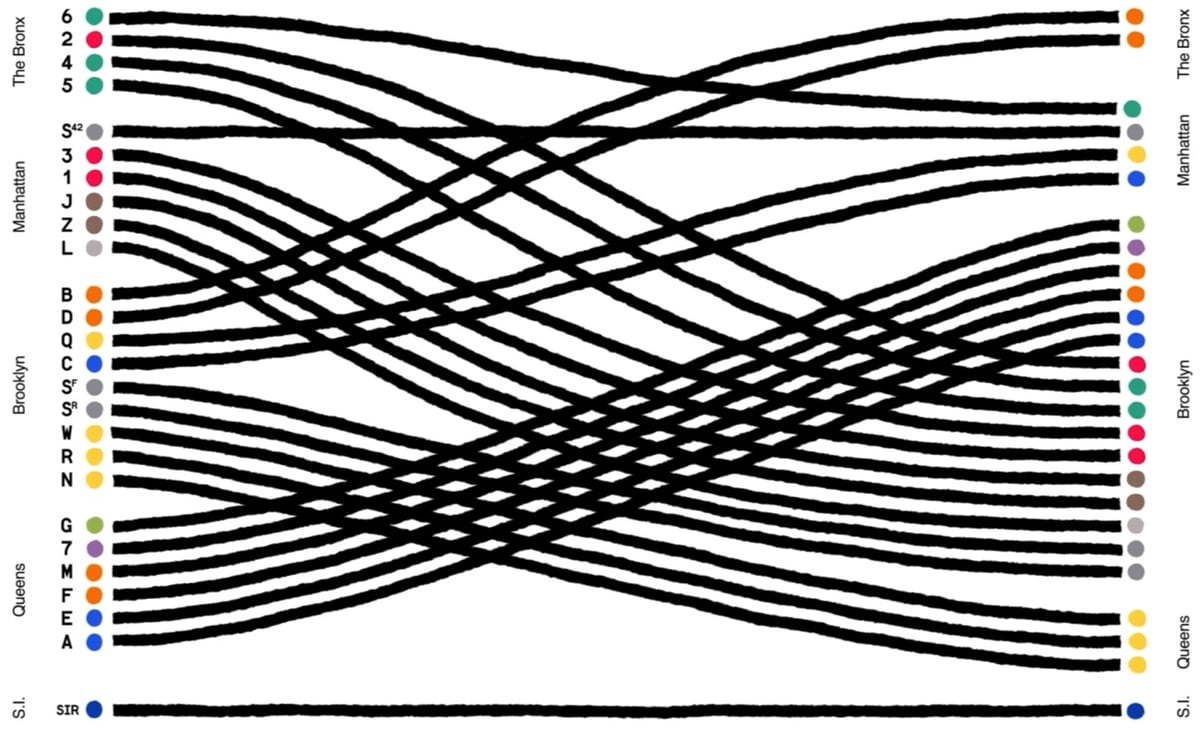
Charlie Park takes a look at a type of chart that Edward Tufte developed for his 1983 book, The Visual Display of Quantitative Information. Unlike sparklines, another Tufte invention/coinage, slopegraphs didn't really take off.
It's curious that it hasn't become more popular, as the chart type is quite elegant and aligns with all of Tufte's best practices for data visualization, and was created by the master of information design. Why haven't these charts (christened "slopegraphs" by Tufte about a month ago) taken off the way sparklines did? In this post, we're going to look at slopegraphs -- what they are, how they're made, why they haven't seen a massive uptake so far, and why I think they're about to become much more popular in the near future.
Can't remember who tipped me off to this (Cederholm? Hoefler? Pieratt?), but Colossal is a top-notch visual art/design blog. There are a dozen things on the first two pages that could slide right into kottke.org quite easily. He's on Stellar too!
A rare sighting, the A-Hole label is usually more than a label. Often, the whole bottle is some unique shape. Look! I'm a wine bottle in the shape of a shampoo bottle! Deal with it! Whatever. What to Expect: I wouldn't know, for I do not condone this sort of behavior. And neither should you.
3-Way Street is a fascinating video by Ron Gabriel that highlights bad interactions between cars, bikes, and pedestrians at a typical NYC street intersection.
There are lots of ways to show these interactions...the overhead view and highlighting are particularly effective design choices. Well done. (thx, janelle)
Olmsted believed the goal wasn't to make viewers see his work. It was to make them unaware of it. To him, the art was to conceal art. And the way to do this was to remove distractions and demands on the conscious mind. Viewers weren't supposed to examine or analyze parts of the scene. They were supposed to be unaware of everything that was working.
The page fails on a fundamental level -- it's supposed to be where you find out what's happened on Flickr while you were away. The current design, unfortunately, encourages random clicking, not informed exploration.
The page isn't just outdated, it's actively hurting Flickr, as members' social graphs on the site become increasingly out of sync with real life. Old users forget to visit the site, new sign ups are never roped in, and Flickr, who increased member sign-ups substantially in 2010, will forego months of solid work when new members don't come back.
Many of my friends have switched their photo activities to Instagram and, more recently, Mlkshk. And Flickr's broken "what's new from your friends" page is to blame. Both of those sites use a plain old one-page reverse-chronological view of your friends' photos...just scroll back through to see what's going on. The primary advantage of that view is that it tells a story. Ok, it's a backwards story like Memento, but that kind of backwards story is one we're increasingly adept at understanding. The Flickr recent uploads page doesn't tell any stories.
As long as we're talking about what's wrong with Flickr -- and the stories thing comes in here too -- the site is attempting to occupy this weird middle ground in terms of how people use it. When Flickr first started, it was a social game around publishing photos. You uploaded photos to Flickr specifically to share them with friends and get a reaction out of them. As the service grew, Flickr became less of a place to do that and more of a place to put every single one of your photos, not just the ones you wanted friends to see. Flickr has become a shoebox under the bed instead of the door of the refrigerator or workplace bulletin board. And shoeboxes under beds aren't so good for telling stories. A straight-up reverse-chron view of your friends' recent photos probably wouldn't even work on Flickr at this point...you don't want all 150 photos from your aunt's trip to Kansas City clogging up the works. Instagram and Mlkshk don't have this problem as much, if at all. (via @buzz)
After the publication of Envisioning Information, Tufte decided, he told me, "to be indifferent to culture or history or time." He became increasingly consumed with what he calls "forever knowledge," or the idea that design is meant to guide fundamental cognitive tasks and therefore is rooted in principles that apply regardless of the material being displayed and the technology used to produce it. As Tufte explains it, basic human cognitive questions are universal, which means that design questions should be universal too. "I purposely don't write books with names like How to Design a Web Site or How to Make a Presentation," he told me.
Sippey posted a brief item on pagination navigation on "river of news" type sites, comparing the opposite approaches of Stellar and Mlkshk. I thought a lot about where to put those buttons and what to label them. There's no good correct answer. For example, "older" usually points the way to stuff further back in the timeline that you haven't read, i.e. it's new to you but old compared to the first page of stuff...are you confused yet? I focused on two things in choosing a nav scheme:
1. The Western left-to-right reading pattern. If you're in the middle of reading a book, the material to your left is a) chronologically older and b) has already been read and the material to your right is a) chronologically newer and b) unread. From a strict data perspective, a) is the correct way to present information but websites/blogs don't work like books. b) is how people actually how people use blogs...when a user gets to the bottom of the page, they want to see more unread material and that's naturally to the right.
2. Consistency. Once you add page numbers into the mix -- e.g. "< newer 1 2 3 4 older >" -- it's a no-brainer which label goes where. I don't think I've ever seen the reverse: "< older 4 3 2 1 newer >".
We put "Older" on the right, but did away with "Newer" altogether in favor of a link back to page 1. If they want to go back to the previous pages, people can use their back button.
Or maybe put "newer" at the top of the page? Still a waste of screen real estate? Anyway, once I figure out how I want to do infinite scrolling on Stellar, those problematic older/newer buttons will go away. Huzzah!
The resulting booklet is comprised of a cover, two inner pages, a letterpressed band (with instructions and a tear-off RSVP postcard), and a flexdisc on a screwpost. The recipient bends the second page of the booklet back to create a tented "arm." With the needle placed, they then carefully spin the flexidisc at 45 RPM (ish) to hear the song. The sewing needle travels the length of the song and produces the sound. Its vibrations are amplified by the thin, snappy paper to which it is adhered. To keep the needle down on the record, we reinforced the back of the "tent" with a spray-mounted half page of heavier cardstock. To reduce friction between the acetate flexidisc and the backing cover, we had the inside of the booklet laminated to be slick and conducive to hand-spinning.
Move all settings out of the app. For iOS at least, you can move settings out of the app and into the general settings window. Please do this because toddlers are drawn to your little setting icons, and they a) destroy the flow of the app and b) the toddler will change all of them and put the app into an annoying state, e.g. in another language, too hard for them, etc.
As it turned out, it was too distracting and sad for me to read while I was designing it. Wallace's tiny, pointy notes were all over the manuscript copy, mostly name changes and corrections and small additions. One character, Elise Prout, used to be a "G3," and a phrase that said "been squashed like a cartoon character" was changed to "worn the brown helmet." His notes reminded me of the post-it notes that would come back to me on galley pages of the essay "Host" from Consider the Lobster -- notes that said things like "Totally bitchingly great" -- and I remembered that I no longer lived in a world where David Foster Wallace was alive.
Designers are clearly thinking about the way two facing pages work together, whether the stories are related or not. This creates a flow that encourages reading without interruption.
i is composed like a beautiful piece of music. It has the discipline to play only the high notes that matter most. For example, it uses its full bleed capability sparingly. It creates strong impact, even with small things. The surprise of occasional whimsy makes the content inviting.
Chartwell is a type family you can use to build all kinds of graphs and charts. Stringing letters and numbers together into ligatures, you can make things like this:
Not quite sure how these are done -- it looks like each vertical slice is representative of the colors in a given frame from the film -- but these moviebarcodes provide a good sense of a movie's tone and color. This one is...any guesses?
The Daily Mail has a profile of Apple's lead designer, Jony Ive...some bits in there that I hadn't read before, including this strange anecdote about a bad meeting that may have led to Ive's departure to Apple:
'We lost a great talent,' says Grinyer. 'We virtually created our own consultancy, Tangerine, just so that we could employ Jony (as Ive prefers to be called). And if I had to put my finger on why and where we lost him it would have to have been one day at Ideal Standard in Hull.
'Tangerine had a consultancy contract with the bathroom-fittings company to design a toilet. I was there when Jony made an excellent presentation to this guy who was wearing a red nose because it was Comic Relief day. This clown then decided to throw his weight around and pulled apart Jony's design. It was ridiculous. Britain lost Jony Ive then and there.'
This is the text of a note that was stuck on the cans when the reels of film for "The Man With the Golden Arm" arrived at US movie theatres in 1955. Until then the credits were referred to as 'popcorn time.' Audiences resented them and projectionists only pulled back the curtains to reveal the screen once they'd finished. Saul Bass' powerful title sequence for "The Man With the Golden Arm" changed the way directors and designers would treat the opening titles.
I cobbled together this set up out of the desire to properly archive my design work. Next thing I knew I started getting paid for it, and it became an integral part of my work. I am simply listing my equipment and a little bit about what I know to get some designers started in figuring out the best way to shoot their own work.
Redesigns are always interesting, and non more so than when a title as significant and influential as the NYT makes changes. Duplessis has worked with new editor Hugo Lindgren (ex-Bloomberg Business Week and New York magazine) to provide a new vision for the title, researching the magazine's archive and becoming fascinated by its 60s and 70s incarnations.
For some reason, it reminds me of Monocle, even though it probably shouldn't? (thx, @nedward)
For the past five years, Michael Bierut has taught a class for aspiring designers where students have to record the results of "a design operation that [they] are capable of repeating every day" for 100 straight days. Here are some of the results.
Zak Klauck: "Over the course of 100 days, I made a poster each day in one minute. The posters were based on one word or short phrase collected from 100 different people. Anyone and everyone was invited to contribute." The perfect exercise for a graphic designer.
Well worth a listen: Dan Benjamin interviews Mike Monteiro on The Pipeline podcast about his design work and Twitter infamy. The last 10 minutes or so, where Mike calls out designers who don't talk to clients, is gold. One of the reasons I got out of design is that I was never very good at that part of the job and as Mike says, you have to be able to not only accept but embrace selling your designs to truly succeed.
While we're being all nostalgic, here's what Gizmodo looked like when it launched:
The site, which launched several months before Gawker, was designed & developed by Ben and Mena Trott with the couple's relatively new blogging software, Movable Type.
With all the buzz around the new Gawker design, I figured I'd dig out the first design I ever showed Nick for the site back in October of 2002:
Nick didn't like it too much. Background too dark, masthead text not logo-y enough. Two weeks later, I sent him this, with a half-assed technicolor logo that I'd dashed off in Photoshop in like 30 minutes:
To my shock, he loved it -- so much so that they're still using the damn thing! -- and that design was very close to how the site looked when it launched.
Steven Heller had heard rumors of a Nazi graphics standards manual for years and finally tracked one down.
Published in 1936, The Organizationsbuch der NSDAP (with subsequent annual editions), detailed all aspects of party bureaucracy, typeset tightly in German Blackletter. What interested me, however, were the over 70 full-page, full-color plates (on heavy paper) that provide examples of virtually every Nazi flag, insignia, patterns for official Nazi Party office signs, special armbands for the Reichsparteitag (Reichs Party Day), and Honor Badges. The book "over-explains the obvious" and leaves no Nazi Party organization question, regardless of how minute, unanswered.