kottke.org posts about YouTube
The folks at Fred Rogers Productions have launched a YouTube channel dedicated to Mister Rogers’ Neighborhood. They plan to post compilations, clips, and full episodes, some of which haven’t been seen on PBS in years & years. One of the first complete episodes they’ve posted is the one about how crayons are made!
Other full episodes include A Visit with Officer Clemmons, The Very First Episode (from 1968), and Koko the Gorilla Meets Mister Rogers.
And there’s also this 30-minute compilation of fan-favorite factory visits.
Again, here’s the channel if you want to subscribe or explore more.
Sesame Street has uploaded a bunch of classic episodes to YouTube that are free to watch, including the very first episode from 1969, the one where Mister Rogers visits, and the episode where Mr. Snuffulupagus is finally revealed. The most recent one was uploaded just a couple of days ago, so it appears to be an ongoing effort. (via open culture)
P.S. From Four Things About Mr. Snuffleupagus:
Snuffy was finally introduced to the main human cast mainly due to a string of high profile and sometimes graphic stories of pedophilia and sexual abuse of children that had been aired on shows such as 60 Minutes and 20/20. The writers felt that by having the adults refuse to believe Big Bird despite the fact that he was telling the truth, they were scaring children into thinking that their parents would not believe them if they had been sexually abused and that they would just be better off remaining silent.
Since launching in 2005, YouTube has changed the progress/volume/tool bar on their video player several times. Here’s what it’s looked like through the years:1
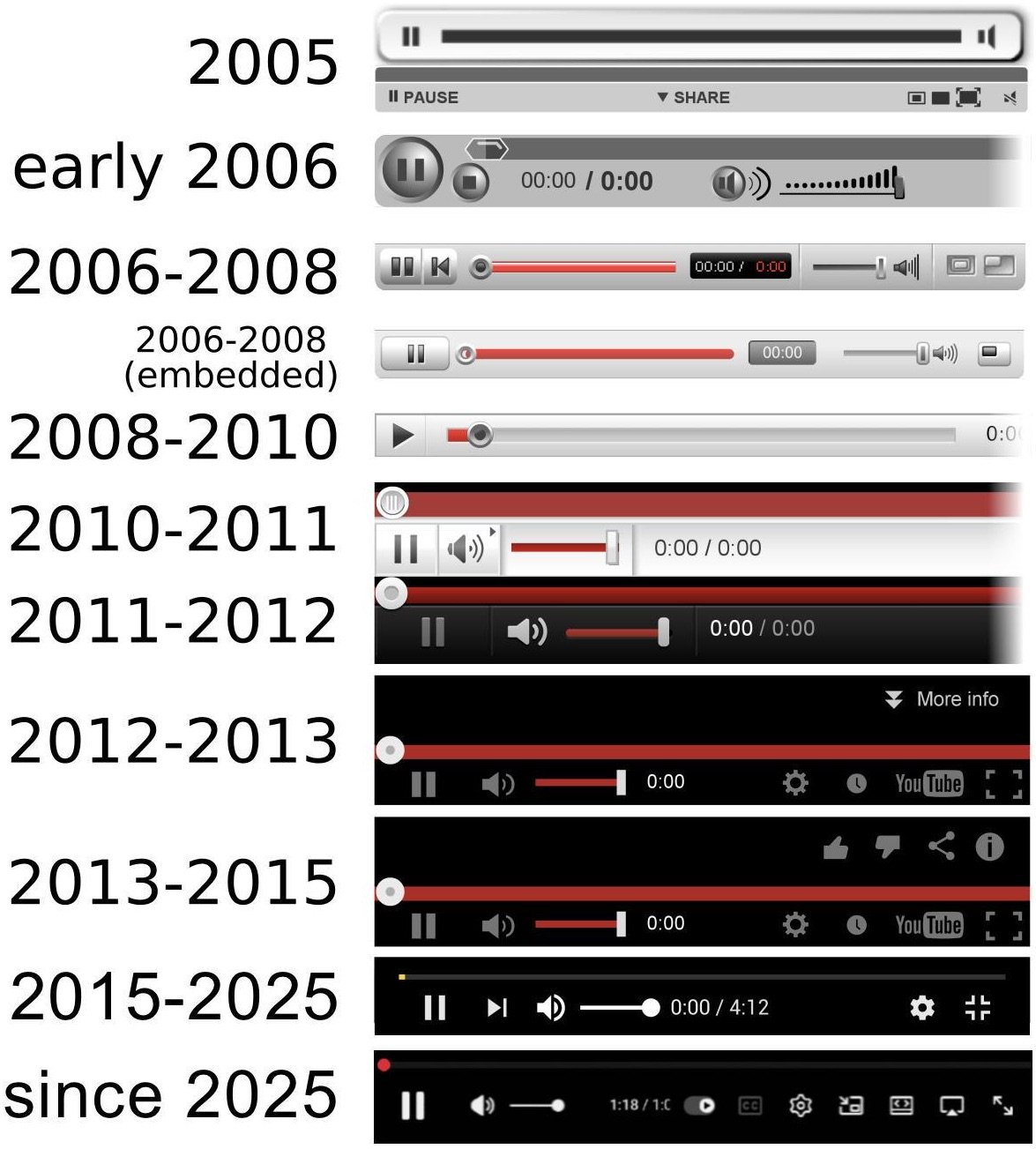
I don’t remember the first two or three at all, but that 2008-2010 version is a nostalgia bomb, albeit a deceptive one. You might be fooled into remembering that it used to be very simple, but the whole progress/tool bar is cut off in the graphic above; here’s the full version.
I’d love to see versions of this for iTunes/Apple Music, Spotify, and other players.
Lagarto Films is a film collective based in Puerto Rico that makes interactive YouTube videos and games. This is pretty clever actually…they use keyboard shortcuts to skip to different parts of the video, Choose Your Own Adventure style. So you can play a game of Uno:
Or direct the action in a short cops & robbers film:
Play Grand Theft Auto in real life:
There are many more of their interactive videos in this playlist. (thx, ollie)
“Brothers dancing in sync” (above and below) is turning out to be my favorite video genre of 2024 so far. (Thanks, Instagram algorithms.) Both these duos — the Irish Gardiner Brothers and the Delaware-based Griffin Brothers — have been around for years, so they may be old news to many readers, but they only came to my attention recently. I played a bunch of Gardiner Brothers videos (and beyond; Riverdance still rules) for my family a few weeks ago, hoping to plant seeds of Irish dance-interest in my daughters’ hearts and brains. There’s also a roller skating rink not too far away from where we live…
Speaking of forcing encouraging my family to participate in group performance, it’s probably too late for us to meaningfully emulate Natalie MacMaster and her dancing/fiddling family, but I can still watch this one particular video every few years.
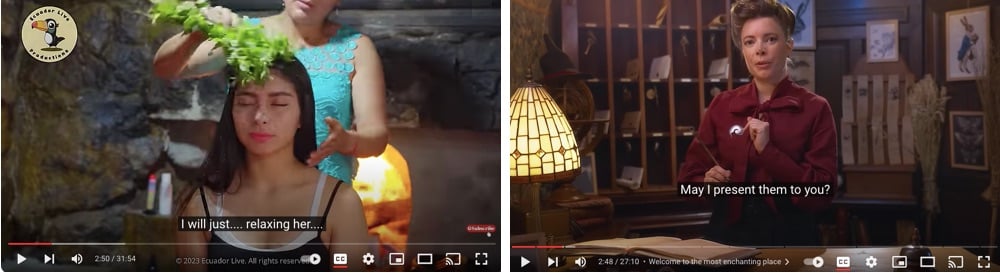
I’m hesitant to write much about ASMR videos, because the experience feels so personal, but I usually watch (or, listen) for a half hour each night, usually to fall asleep. I go through phases of enjoying different ASMRtists, but lately it’s been Ecuador Live (above left) and Moonlight Cottage (above right). Doña Esperanza from Ecuador Live has maybe the most peaceful voice in the world, and Diane from Moonlight Cottage is on another level with her sets and art direction. But mostly it’s just her voice, too. (I thought this one might be too weird, but it was not.) If there’s an ASMR Review newsletter out there, I’d love to know about it.
For what it’s worth, I’m not sure I get the signature ASMR “tingles,” but these videos do put me to sleep.
TheirTube lets you see YouTube recommended videos for preppers, liberals, climate deniers, fruitarians, conservatives, etc. Here’s the climate deniers home page from a couple of days ago:
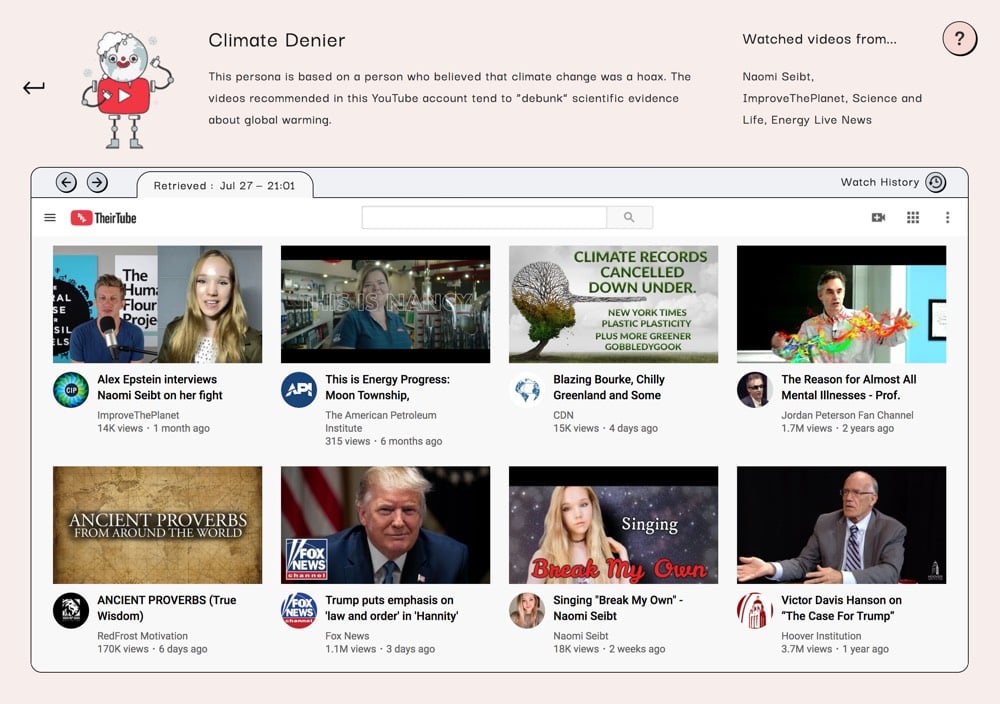
Theirtube is a Youtube filter bubble simulator that provides a look into how videos are recommended on other people’s YouTube. Users can experience how the YouTube home page would look for six different personas. Each persona simulates the viewing environment of real Youtube users who experienced being inside a recommendation bubble through recreating a Youtube account with a similar viewing history.
The simulator was developed by Tomo Kihara after he got into an argument with someone who lived in a completely different filter bubble:
This whole project started when I was in a heated discussion with a person who thought climate change was a hoax and 9/11 was a conspiracy. Through conversations with him, I was surprised to learn that he thought everyone’s YouTube feed had the same information as his own feed. When we showed each other our YouTube homepages, we were both shocked. They were radically different. And it got me thinking about the need for a tool to step outside of information bubbles.
The project is open-sourced on GitHub so you can make your own personas, etc. (via craig mod)
Update: Leveraging Twitter’s lists functionality, Vicariously lets you see the timelines of other Twitter users. And not only that, but you can merge the timelines of several users, only the mutual follows of those users, and other options.
From Evan Puschak, this is an analysis of a tightly edited five-minute montage in the middle of Bong Joon-ho’s Parasite in which a family of schemers removes the last obstacle in their way of a luxurious life of service.
(This next bit is way off topic…I am not even going to try and connect it to the movie or Puschak’s thoughts on editing.) In looking for an appropriate quote from the video, I went searching in YouTube’s automatically generated transcript of the video and instead discovered whatever fancy AI program they’ve employed for transcription had some problems with the Korean language spoken in the video:
well the Kogi’s held on crew could to work a contra cut under something crazy kangaroo hot lava could carry yours a tiny car would cause a huge bang engines in his element saw cars motherfuckers Christian wear boxers and couvent a easy call it to Minaj Monica City on criminals chief juniper gun and a car don’t belong back in case come on Joey tell him to cool on the cloud Coronas our tornado man hold it up on watch from Atlanta
Also, peaches are a thing now in movies!
The transformation of (a lot of) the internet into simply a larger, more diversified series of tv channels continues apace. Sharing here for the last quote below, which seems like an important insight and transformation.
In 2019, authenticity has been replaced with pageantry, and relationships with viewers have been manipulated into making the audience care about something produced blatantly to turn a profit.

As the YouTube community faces a reality where “mainstream networks are starting to dominate the platform and eclipse independent creators,” they try to join those networks or endeavour to create their own TV-show-like productions.
YouTube’s community borrowed from reality TV’s most innovative narrative tool — confessionals — to create what the entire world now understands as modern vlogging. It worked extremely well. But as the vlogging format went out of style, creators are now looking for new and creative ways to remain relevant and catch people’s attention. For creators like Paul and Mongeau, that’s meant a return to the trappings of reality TV. (Emphasis mine.)
This afternoon, my friend Casey Newton posted a thread of YouTube videos so good that I had to login on a Sunday and blog about it. There’s a simple theme connecting these videos that I’ll let Casey explain:
This might be my favorite one:
The kids are all right. Better than, in fact.
Joel Embiid is (probably) the most talented and (easily) the most entertaining young player in the NBA today. It’s really not even close. He’s created a persona that feels like it wasn’t created at all, an unfiltered big kid on a scale we haven’t seen since young Shaquille O’Neal. He’s full of unbridled enthusiasms and trash talk, peppered with charm and feeling, and a kind of canny naïveté. He’s also 7’2,” can jump out of the gym, is already an all-defense lock as long he’s healthy, hits three-pointers, etc. So he’s fun to watch, too.
Unsurprisingly, Joel’s first-person narrative for The Players Tribune is a perfect specimen of Pure Embiid. He writes about his childhood in Cameroon, being unable to watch basketball or sports because his mother was too strict, and piecing together the game from YouTube clips, natural talent, and sheer competitiveness.
So I’m chilling one night, and I go on YouTube, and I’m thinking I’m about to figure this shooting thing out.
I go to the search box like….
HOW TO SHOOT 3 POINTERS.
Nah.
HOW TO SHOOT GOOD FORM
Nah.
Then the light bulb went off, man. I typed in the magic words.
WHITE PEOPLE SHOOTING 3 POINTERS.
Listen, I know it’s a stereotype, but have you ever seen a normal, 30-year-old white guy shoot a three-pointer? That elbow is tucked, man. The knees are bent. The follow-through is perfect. Always. You know how in America, there’s always an older guy wearing like EVERLAST sweat-shorts at the court? That guy is always a problem. His J is always wet.
Thankfully, Embiid also watched plenty of clips of legendary big men like Hakeem Olajuwon, so he doesn’t just chuck up Js like a thirtysomething Duke grad or play nonstop hero ball like his idol Kobe Bryant. That’s the thing about piecing together your game or your personality through YouTube, hip-hop, social media, etc. Ideally, you don’t just get one flavor. You get to sample a little of everything.
In a recent interview at SXSW, YouTube’s CEO Susan Wojcicki said the company planned to use information from Wikipedia to counter misinformation in YouTube’s videos. In the NY Times, John Herrman wrote about the potential burden of a massive company like Google leaning so heavily on a relatively small non-profit organization like Wikipedia.
Then there’s the issue of money. As important as Wikipedia may be to some of the richest companies in the world, it is, in financial terms, comparatively minuscule, with a yearly budget of less than $100 million — a rounding error for big tech. (It should be noted that Google has made one-off contributions to Wikipedia in the past and includes the Wikimedia Foundation in a program through which it matches employee donations, which netted the foundation around $1 million last year.)
A few years ago, I wrote about financially supporting Wikipedia.
I consider it a subscription fee to an indispensable and irreplaceable resource I use dozens of times weekly while producing kottke.org. It’s a business expense, just like paying for server hosting, internet access, etc. — the decision to pay became a no-brainer for me when I thought of it that way.
I also called on other companies to support Wikipedia on a recurring basis:
Do other media companies subscribe to Wikipedia in the same fashion? How about it Gawker, NY Times, Vox, Wired, ESPN, WSJ, New York Magazine, Vice, Washington Post, The Atlantic, Buzzfeed, Huffington Post? Even $500/month is a drop in the bucket compared to your monthly animated GIF hosting bill and I know your writers use Wikipedia as much as I do. Come on, grab that company credit card and subscribe.
Wikipedia is a shared online resource that we all would sorely miss if it went away, people and companies alike. We should all pitch in and support it.
Writer and artist James Bridle has noticed that something is wrong on the internet. Specifically, algorithmically chosen and produced content is taking over more and more of the internet, including what your young children are watching on YouTube.
Someone or something or some combination of people and things is using YouTube to systematically frighten, traumatise, and abuse children, automatically and at scale, and it forces me to question my own beliefs about the internet, at every level.
By his own admission, there doesn’t seem to be anything egregiously wrong or upsetting about many of the examples Bridle uses. I mean, have you read Grimm’s fairy tales? Some of them are really dark and/or weird, like Black Mirror for children. But the effect in the aggregate is huge, resulting in what he asserts is a system of abuse in which Google is complicit, a technology fueled by advertising and weaponized against its users:
The architecture they have built to extract the maximum revenue from online video is being hacked by persons unknown to abuse children, perhaps not even deliberately, but at a massive scale. I believe they have an absolute responsibility to deal with this, just as they have a responsibility to deal with the radicalisation of (mostly) young (mostly) men via extremist videos — of any political persuasion. They have so far showed absolutely no inclination to do this, which is in itself despicable. However, a huge part of my troubled response to this issue is that I have no idea how they can respond without shutting down the service itself, and most systems which resemble it. We have built a world which operates at scale, where human oversight is simply impossible, and no manner of inhuman oversight will counter most of the examples I’ve used in this essay. The asides I’ve kept in parentheses throughout, if expanded upon, would allow one with minimal effort to rewrite everything I’ve said, with very little effort, to be not about child abuse, but about white nationalism, about violent religious ideologies, about fake news, about climate denialism, about 9/11 conspiracies.
Last week, after the State of the Union address, President Obama was interviewed by three prominent YouTube users. Oh, the outcry that arose! (Even though he did the same thing last year.) The President giving valuable country-running time over to mere social media stars, what has this country come to?
Well, it turns out if you get different kinds of people asking different kinds of questions, you’re going to get answers you normally wouldn’t hear. Case in point: Ingrid Nilsen was one of the three YouTubers chosen to interview the President. She asked him to talk about a meaningful item from his house and the President told a wonderful story about what he carries in his pockets every day:
Obama continues to be delightful and Nilsen might be my new favorite person after watching her YT channel for a bit this morning. I mean, just watch the first few minutes of this video where she came out to her viewers.
This video is 20 minutes of the best YouTube footage from 2015 of extreme sports, marriage proposals, cute kids, funny animals, fast cars, groovy dancing, dronies, and more slow-motion GoPro footage than you could ever want to see in one lifetime. I’ve linked to a few of these videos, but generally my list of cool videos of the year would be a bit less X-TREEM. If you want to watch all 506 videos in the compilation, check out this playlist.
The Associated Press and British Movietone are uploading 17,000 hours of archival news footage, some of dating back to the late 19th century. The videos can be found on the AP Archive and British Movietone channels. Some notable videos from the collection follow. Coverage of the Hindenberg disaster:
The celebration of VE Day in London:
Coco Chanel fashion show from 1932:
Martin Luther King Jr. and marchers being arrested in Selma:
See also British Pathe.
Burning a person alive is not a new act in warfare or intimidation. Far from it. So how did the gruesome burning of a Jordanian pilot become a incident that outraged the world and possibly altered a war? It was on video. Seeing a video changes everything. The existence of video footage can determine what leads the news, what drives public opinion, and what gets lodged in our memories. It can also determine who becomes a celebrity, who gets elected, which products we purchase, and confirm again and again the dominance of the once overlooked house-cat. Whoever controls the video controls the story. And since about 2005, the person who’s controlled the video has been you. You, the cat owner. You, the aspiring singer. You, the citizen journalist. And yes, you the terror group determined to intimidate and remain at the forefront of a global conversation. From The Telegraph: How YouTube Changed the World.
There’s a good reason your cat looks so depressed. The days of her antics dominating YouTube are long gone. As the New Yorker’s Tad Friend explains, in addition to cats “YouTube was adults with camcorders shooting kids being adorably themselves. It was amateur hour.” Since then, YouTube has gone pro. Jeffrey Katzenberg predicts that “within five years, YouTube will be the biggest media platform of any, by far, in the entire world.” It’s where your kids are. It’s where the new stars are. And it’s where your cat isn’t. Welcome to the new Hollywood and Vine.
Great essay by Paul Ford on the hidden infrastructure that makes most of your favorite user-created viral videos possible: 4’ by 8’ by 1/2” slabs of drywall, screwed into studs and painted beige.
The people dancing and talking and singing in beige rooms with 8’ ceilings are surrounded by standards, physically and online. Technological standards like HTML5 also allow us to view web pages and look at video over the Internet. All of their frolic is bounded by a set of conventions that are essentially invisible yet define our national physical and technological architecture. Their dancing, talking bodies are the only non-standardized things in the videos.
This is a nice article about how memes are often made or promoted deliberately by financial interests and not because of a spontaneous popular uprising, but mostly I wanted to highlight this statement:
Google’s YouTube, not Apple’s iTunes, is now the dominant force in music.
I’ve been convinced for awhile now that YouTube and not Android or Google+ will be their main source of revenue if/when Google’s search business wanes. (via @claytoncubitt)
This Reddit group is collecting links to full-length movies and TV shows that are available on YouTube. Like this unauthorized copy of Django Unchained:
See if you can get through the whole thing before it gets taken down.
Update: David reminded me that you can actually watch full-length movies and TV shows on YouTube for a rental fee. (thx, david)
Keith Ratliff posted dozens of videos showcasing high-powered guns on his popular YouTube channel, FPSRussia. Last week, he was found dead with a single shot to the head, surrounded by several guns…but not the gun that killed him.
The news, coming amid a national debate about gun control, rippled across the blogs and social networking sites where his videos were popular. Tributes on Facebook and Twitter came from fans stunned that such a well-armed expert had not been able to defend himself.
“For him not to pull out that gun and try to defend himself, he had to feel comfortable around somebody,” his wife, Amanda, told a television channel in Lexington, Ky., where he used to live. “Either that or he was ambushed.”
Here’s a FPSRussia video showing off a fully automatic shotgun that can shoot 300 rounds per minute even after being submerged in water:
And this drone with a machine gun on it is terrifying:
(via the atlantic)
Update: Just to clarify because I’m getting a bunch of mail about it, Ratliff was a gun nut and the owner of that YouTube channel, but he was not the person in all those videos…he was more like the producer/camera operator.
Also, that quadricopter machine gun thing is CGI and a commercial for a video game. Soon enough though.
AVOS, a new internet company founded by YouTube founders Chad Hurley and Steve Chen, has acquired the social bookmarking service Delicious from Yahoo!
Why has Yahoo! chosen to transition Delicious to AVOS?
While we love Delicious (and our users love Delicious), we wanted to find a home for the product where it can receive more love and attention. We think AVOS is that place.
When will AVOS officially start running Delicious?
We anticipate Delicious in its current form will be available until approximately July 2011. By agreeing to AVOS’s terms of service upfront, you will allow us to move your data when the time comes to transfer control to AVOS.
Delicious founder Josh Schachter reacted to the news on Twitter, saying:
inbox asplode!
You give it a year and YouTube Time Machine will show you videos of events from that year. For instance: 1894, 1943, and 1991. A super idea. (thx, alice)
In defending itself against a copyright lawsuit brought by Viacom, YouTube notes that the media company has been surreptitiously uploading its copyrighted content to YouTube for years.
For years, Viacom continuously and secretly uploaded its content to YouTube, even while publicly complaining about its presence there. It hired no fewer than 18 different marketing agencies to upload its content to the site. It deliberately “roughed up” the videos to make them look stolen or leaked. It opened YouTube accounts using phony email addresses. It even sent employees to Kinko’s to upload clips from computers that couldn’t be traced to Viacom. And in an effort to promote its own shows, as a matter of company policy Viacom routinely left up clips from shows that had been uploaded to YouTube by ordinary users. Executives as high up as the president of Comedy Central and the head of MTV Networks felt “very strongly” that clips from shows like The Daily Show and The Colbert Report should remain on YouTube.
This jibes with what I heard a couple of years ago:
I heard that the staff of the Daily Show and Colbert Report upload the shows to YouTube as soon as they can after the shows air and then the next day, lawyers from Comedy Central hit YouTube with takedown requests for the uploaded shows.
(thx, @peretti)
Drei Klavierstücke op. 11 is a set of pieces written for the piano by Arnold Schoenberg in 1909, some of the first western music to written in an atonal style. Cory Arcangel took a bunch of YouTube videos of cats playing the piano and fused them together into a performance of op. 11.
This project fuses a few different things I have been interested in lately, mainly “cats”, copy & paste net junk, and youtube’s tendency in the past few years to host videos that are as good and many times similar to my favorite video artworks. I think all this is somehow related.
Cory’s no-bullshit statements about his art are just as entertaining as the work itself:
So, I probably made this video the most backwards and bone headed way possible, but I am a hacker in the traditional definition of someone who glues together ugly code and not a programmer. For this project I used some programs to help me save time in finding the right cats. Anyway, first I downloaded every video of a cat playing piano I could find on Youtube. I ended up with about 170 videos…
You can catch Cory’s project in-person at Team Gallery in NYC and at Kunsthaus Graz in Austria.
Josh Poehlein’s Modern History project takes screen grabs from YouTube videos and assembles them into collages.
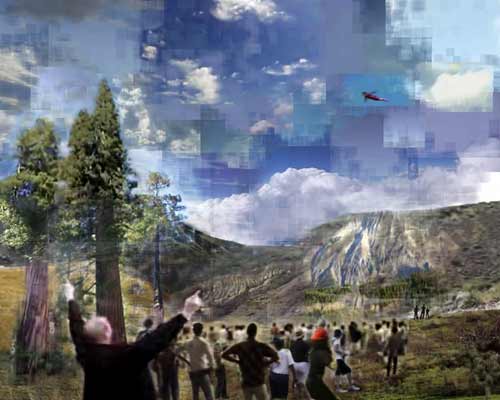
These are wonderful. And he’s giving them away.
I am offering large printable files to anyone interested at no cost. Computer files are the most easily reproducible information on the planet. In this particular case I see no reason to imbue a false sense of preciousness on the work. The information I gathered to create the collages is publicly availaibe, and the collages themselves are no different.
(via conscientious)
Thru You is a site that showcases remixed YouTube videos…the singing from one video combined with the drums from another and the piano from a third and so on. I was skeptical but these are really well done. Do I even need to say that this reminds me of Christian Marclay’s Video Quartet? (via sfj)
Aha, Obama will be doing online fireside chats, but in video format on YouTube.
Online political observers say President-elect Obama’s innovative, online-fueled campaign will likely evolve into a new level of online communication between the public and the White House — the Internet-era version of President Franklin Roosevelt’s famous “fireside chats” between 1933 and 1944.
Here’s Obama’s first video address as President-Elect. His transition team, potential cabinet members, and other experts will also be recording videos in the coming weeks.
Older posts






Socials & More