kottke.org

...is a weblog about the liberal arts 2.0 edited by Jason Kottke since March 1998 (archives). You can read about me and kottke.org here. If you've got questions, concerns, or interesting links, send them along.

104 kottke.org posts about baseball


From the Babe to Matsui

Larry Granillo explores how the Yankees' World Series victories have been covered by the New York Times through the years.

The New York Yankees, the Microsoft of baseball

Greg Knauss on how the New York Yankees are like Microsoft.

But, wait... Two-thousand was -- the last time the Yankees managed to win a championship. And it was awfully close to the last time that that Microsoft managed to produce a version of Windows that anybody cared about. And, hey, both the Yankees and Microsoft have long histories of dominating their professions, and of using that dominance to run up huge payrolls with -- let's be honest here -- a near-decade of lackluster results.

It's an uncanny resemblance.

Dump the ump

Joe Sheehan at Baseball Prospectus: use pitch tracking technology to call strikes in pro baseball games.

If a breaking ball crosses the plate at a point between a batter's knees and the midpoint between his shoulders and pants, it's a strike, no matter what the anachronism behind the plate thinks he sees. In eighteendicketysix, a human being was state-of-the-art technology for making these decisions. Now, you can get better information -- we do get better information -- by using better technology. Championships should be decided by the players and by what actually happened, not by what somebody thinks happened.

Heh. Dickety. (via david)

By Jason Kottke    Oct 9, 2009    baseball   sports

What's in (or out) of a name

In case you ever wondered why you're cheering for a group of young bears, Northern statesmen, or tiny birds, here's a Venn diagram of baseball team names and their etymology.

How good is Albert Pujols?

Really very good and has a shot at being among the best of all time. Post-1901, he's #1 on the list of most HRs in the first 9 seasons of a player's career and is in the top 20 all-time in batting average amongst all players with 4000+ plate appearances. Longevity will tell the tale, particularly if (birthers, take note!) Pujols is older than he claims. (thx, david)

Immaculate innings

Immaculate innings are those innings in baseball games where the pitcher strikes out all three batters with nine pitches. It's only happened 42 times in the history of the game. David Archer is tracking the frequency of such innings; they are getting more common.

As one friend pointed out, the best explanation for the increase in recent decades appears to be the advent of the modern reliever, especially the flame-throwing, one inning closer (more immaculate innings have been thrown in the 9th inning* (eight) than in any other inning), though starters -- such as Burnett -- have also been throwing them with impressive frequency.

Update: See also three-pitch innings. (via noah brier)

Moneyball inefficiencies erased

Unsurprisingly, the MLB teams currently drawing the most benefit from the lessons of Moneyball are those with lots of money operating in big markets.

Well, of course, the big-market teams figured it out. They hired their own Ivy League consultants. They bought even better computers. Walks is only one tiny aspect in it ... but who leads the American League in walks this year? The New York Yankees. Last year? The Boston Red Sox. The year before that? The Boston Red Sox. And so it goes. Now, six years later, it seems to me that the small-market teams are really grasping and trying to find some loophole, some opening that will allow them to win in this tough financial environment.

Steroid users as sports pioneers

Baseball historian Bill James makes a compelling argument that steroids will eventually become an accepted aspect of sports (and society as a whole) and that baseball players who are now more or less banned from entering the Hall of Fame (though not officially) will eventually be elected to Cooperstown.

If we look into the future, then, we can reliably foresee a time in which everybody is going to be using steroids or their pharmaceutical descendants. We will learn to control the health risks of these drugs, or we will develop alternatives to them. Once that happens, people will start living to age 200 or 300 or 1,000, and doctors will begin routinely prescribing drugs to help you live to be 200 or 300 or 1,000. If you look into the future 40 or 50 years, I think it is quite likely that every citizen will routinely take anti-aging pills every day.

How, then, are those people of the future -- who are taking steroids every day -- going to look back on baseball players who used steroids? They're going to look back on them as pioneers. They're going to look back at it and say "So what?"

(via hello typepad)

Of two minds on the pitcher's mound

If I ever write a book, it might have something to do with the two minds that govern creative expertise: the instinctual unconscious mind (the realm of relaxed concentration) and the thinking mind (the realm of deliberate practice). The tension between these two minds is both the key to and fatal flaw of human creativity. From the world of sports1, here's Rockies pitcher and college physics major Jeff Francis describing the interplay of the minds on the mound:

Even though I do understand the forces and everything, there's a separation when I'm pitching. If I throw a good pitch, I know what I did to do it, but there has to be a separation between knowing what I did and knowing why what I did helped the ball do what it did, if that makes any sense at all. If I thought about it on the mound, I'd be really mechanical and trying to be too perfect instead of doing what comes naturally.

But you don't need to be a physics major to wrestle with the consequences of the conflict between the two minds. After an injury and subsequent surgery, Francis' instinctual mind works to protect his body from further injury:

Francis repeatedly pulled the ball back in preparation to throw. But as he flashed his arm forward, his hand would, mind unaware, bring the ball back toward his ear rather than at full extension. It was his body essentially shortening the axis of his arm to decrease the force on his shoulder, protecting him from pain. And Francis could not stop it.

After his 10th pitch and first muffled groan of pain, he stopped.

"It's hurting you?" Murayama said.

"Yeah," Francis said.

"I can tell. You're getting out ahead of your arm. Slow down, stay back a little more."

"Does it look like I'm scared to throw a little?"

"Are you scared?"

"Not consciously."

To fully recover and regain his former effective pitching motion, Francis will utilize his thinking mind to retrain his unconscious mind through deliberate practice to ignore the injury potential. (thx, adriana)

[1] Most of the examples I've cited over the years deal with sports, mostly because professional athletes are among the most trained, scrutinized, studied, and optimized creative workers in the world. For a lot of other professions and endeavors, the data and scrutiny just isn't as evident.

Salary vs performance in baseball

Ben Fry just updated his interactive salary vs performance graph that compares the payrolls of major league teams to their records. Look at those overachieving Rays and Marlins! And those underachieving Indians, Mets, and Cubs!

By Jason Kottke    Jul 2, 2009    baseball   Ben Fry   infoviz   sports

Jack Kerouac's fantasy baseball league

Unbeknownst to his close friends, Jack Kerouac invented a fantasy baseball game and played it for most of his life.

[Kerouac's game charted] the exploits of made-up players like Wino Love, Warby Pepper, Heinie Twiett, Phegus Cody and Zagg Parker, who toiled on imaginary teams named either for cars (the Pittsburgh Plymouths and New York Chevvies, for example) or for colors (the Boston Grays and Cincinnati Blacks).

He collected their stats, analyzed their performances and, as a teenager, when he played most ardently, wrote about them in homemade newsletters and broadsides. He even covered financial news and imaginary contract disputes. During those same teenage years, he also ran a fantasy horse-racing circuit, complete with illustrated tout sheets and racing reports. He created imaginary owners, imaginary jockeys, imaginary track conditions.

Don't miss the slideshow of some of Kerouac's notebooks and publications related to his imaginary sports.

Baseball cards: not for kids anymore

The Baseball Card Movie is a nice nine-minute film that introduces the viewer to a world where adults pay up to $500 for a pack of cards (aka cardboard crack) and act very superstitiously about opening them.

Thw whole sports memorabilia thing is an odd world. There's a story about major league pitcher Barry Zito buying his own autographed cards on eBay:

He once made it a practice to buy his own autographed baseball cards on eBay; when asked why he bought them at auction for high prices rather than acquiring unsigned cards and signing them himself, Zito replied, "Because they're authenticated."

Possibly apocryphal but Zito would likely have a difficult time selling self-signed cards because they're not authenticated.

The economics of the new Yankee Stadium

Ticket prices at the new Yankee Stadium are so high that if a New Yorker wants to watch a Mariners/Yankees game from the best seats, it would be a lot cheaper to fly to Seattle, stay in a nice hotel, eat fancy dinners, and see two games.

Option 1: Two tickets to Tuesday night, June 30, Mariners at Yanks, cost for just the tickets, $5,000.

Option 2: Two round-trip airline tickets to Seattle, Friday, Aug. 14, return Sunday the 16th, rental car for three days, two-night double occupancy stay in four-star hotel, two top tickets to both the Saturday and Sunday Yanks-Mariners games, two best-restaurant-in-town dinners for two. Total cost, $2,800. Plus-frequent flyer miles.

(thx, david)

Dixie Upright and his friends

The pace of baseball is such that one wonders about all the baseball players whose last names are adjectives.

Woody Rich, Pop Rising. Harry Sage. Several Savages. Mac Scarce. Bill Sharp. Bill, Chris, Dave, and Rick Short. Many Smalls. One Smart guy (JD). Three Starks. Adam Stern. Of course, there's Doug Strange (and Alan and Pat, too). Jamal and Joe Strong. Even a guy named Sturdy, literally: Guy Sturdy. DIck Such. Bill Swift, x2.

Update: See also musicians whose names are sentences. (thx, colter)

By Jason Kottke    May 1, 2009    baseball   language   music   sports

The luckiest fan in America

A Philadelphia sports fan with a knack for getting into good seats at the ballgame for free ended up partying with the Phillies in their clubhouse after winning the World Series.

Lionel goes 5'8", 240, and he's got the same shirt and lei as the players, so he looks like a player, which is maybe why he's suddenly in the middle of every hug. And that's about when Chase Utley says to Jimmy Rollins: "Let's go celebrate!" And Lionel says exactly what you'd think he'd say, which is, "I'm with you guys!"

(via memeticians)

By Jason Kottke    Jan 29, 2009    baseball   sports

An unlikely baseball record

The number of pinstripes on a Yankees jersey varies with the size of the player...the bigger the man, the more pinstripes on the jersey. With the Yankees' recent signing of CC Sabathia, a rather large gentleman, ESPN's Paul Lukas wonders: will Sabathia have the most Yankee pinstripes in history?

You're embarking on a new field of study here, so we have to make up our own rules and standards as we go," he said. "For example, depending on how a jersey is tailored, the number of pinstripes at the top and at the bottom aren't necessarily the same. Also, the space between the pinstripes has changed a bit over the years, and the pinstripes themselves are thinner today than in the old days.

(thx, djacobs)

The Billy Ripken

It's the 20th anniversary of the Billy Ripken "fuck face" card. Ripken explains for the first time how the card came to be.

Now I had to write something on the bat. At Memorial Stadium, the bat room was not too close to the clubhouse, so I wanted to write something that I could find immediately if I looked up and it was 4:44 and I had to get out there on the field a minute later and not be late. There were five big grocery carts full of bats in there and if I wrote my number 3, it could be too confusing. So I wrote 'F--k' Face on it.

At the time, it was assumed by many that Ripken had intentionally sabotaged his card with the obscenity. I still have one of these somewhere... (via unlikely words)

Mmm, Coco Crisp

I'm only posting this so I can say: the Sox got enough of that Coco Crisp.

Tweet, tweet, free tacos

Fun evening activity: type whatever crazy shit is happening on TV into Twitter Search and watch the wittisicms and not-so-witticisms roll by. Example: in game one of the World Series tonight, someone stole a base and every single person in the United States won a free taco from Taco Bell. Instant tweetalanche.

By Jason Kottke    Oct 22, 2008    baseball   food   sports   tacobell   TV   Twitter

Fenway as scale model

A fake tilt-shift photo of Fenway Park in Boston makes the ballpark look like a scale model. I seemingly will never tire of this gimmick. (via let's go mets)

Manny being Manny

Conventional wisdom and prevailing opinion among hardcore Boston Red Sox fans is that LA Dodgers left fielder Manny Ramirez finally sulked his way out of a Boston Red Sox uniform by basically phoning it in and causing trouble for his team for a couple of months earlier in the season, which phoning and trouble resulted in a trade of Ramirez to LA for very little in return. Two rebuttals have surfaced recently that seem more plausible to me. The first is Facts About Manny Ramirez by Joe Sheehan. Sheehan uses some of those pesky facts to illustrate that on the field, Manny played as well or better during the supposed phoning-it-in period than he has in the past.

When he played, Ramirez killed the league. He hit .347/.473/.587 in July. His OBP led the team, and his SLG led all Red Sox with at least 25 AB. The Sox, somewhat famously, went 11-13 in July. Lots of people want you to believe that was because Manny Ramirez is a bad guy. I'll throw out the wildly implausible idea that the Sox went 11-13 because Ortiz played in six games and because veterans Mike Lowell and Jason Varitek has sub-600 OPSs for the month.

Four days before he was traded, Manny Ramirez just about single-handedly saved the Red Sox from getting swept by the Yankees, with doubles in the first and third innings that helped the Sox get out to a 5-0 lead in a game they had to win to stay ahead of the Yankees in the wild-card race.

In Manny Being Manipulated, Bill Simmons attempts to answer the question, Ok, so why did Manny suddenly want to be traded and, more importantly, why did the Red Sox actually oblige? Simmons' answer: Scott Boras, Ramirez's agent and "one of the worst human beings in America who hasn't actually committed a crime". According to Simmons, it all boiled down to mismatched incentives and following the money.

Manny's contract was set to expire after the 2008 season, with Boston holding $20 million options for 2009 and 2010. Boras couldn't earn a commission on the option years because those fees belonged to Manny's previous agents. He could only get paid when he negotiated Manny's next contract. And Scott Boras always gets paid.

Boras could only get paid for representing Ramirez if Manny signed a new contract. Which he will next year because as part of the trade, the Dodgers agreed to waive his 2009 option and allow him to become a free agent. And the Red Sox went along because they decided they'd rather have a good relationship with Scott Boras going forward instead of a weird relationship with Ramirez. As for Manny, he gets paid either way, rarely appreciated the weird pressure/adulation put on him and every other Red Sox player by Boston fans, and, I get the feeling, likes swinging a bat, no matter what team he plays for.

1908, Cubs vs. NY Giants

The crazy finish to the 1908 baseball season, which was decided by an obscure rule, Christy Mathewson's dead arm, Mordecai "Three Finger" Brown's pitching, and Fred Merkle's decision not to run all the way to second base. Things got ugly.

"From the stands there was a steady roar of abuse," Brown said later. "I never heard anybody or any set of men called as many foul names as the Giant fans called us that day." Foul names might have been the least of their worries. The New York Journal reported that Cubs catcher Johnny Kling, chasing a pop foul, had to dodge "two beer bottles, a drinking glass and a derby hat."

The box score of the first game and a bunch of other juicy details are available in the original 1908 NY Times article.

Censurable stupidity on the part of player Merkle in yesterday's game at the Polo Grounds between the Giants and Chicago placed the New York team's chances of winning the pennant in jeopardy. His unusual conduct in the final inning of great game perhaps deprived New York of a victory that would have been unquestionable had he not comitted a breach in baseball play that resulted in Umpire O'Day declaring the game a tie.

It's also interesting to look at the statistics for that season. Merkle is listed as the league's youngest player, and Honus Wagner won nearly every single batting category, the Brooklyn Superbas (no, really!) topped the league with only 28 homers (for the entire team), and Mathewson won a whopping 37 games. Here's that NY Times article again:

Up to the climatic ninth it was the toss of a coin who would win. For here is our best-beloved Mathewson pitching as only champions pitch, striking out the power and the glory of the Cubs, numbering among his slain Schulte in the first, Pfeister in the third, Steinfeldt in the fourth, Pfeister in the fifth, Haydon in the eighth, and Evers and Schulte in the ninth -- these last in one-two order. Proper pitching, and for this and other things we embrace him.

With such headings as "The Fatal Third Inning", the 1908 Times story about the second game is worth a look as well.

Love is a ballfield

A poem in which each instance of the word "love" is replaced by "Boston Red Sox Hall of Fame Catcher Carlton Fisk".

"And know you not," says Boston Red Sox Hall of Fame Catcher Carlton Fisk, "who bore the blame?"
"My dear, then I will serve."

(via hodgman)

Why are MLB bats breaking?

Popular Woodworking magazine weighs in: why are major league bats breaking at an increasing rate?

So is the broken bat mystery merely a question of maple vs. ash? As a woodworker, I doubt it. I will concede that the safety question is best answered with the choice of ash over maple because I'd bet the ash will be far less likely to break in two and send a hurtling projectile. More likely, ash will just crack or splinter.

(thx, brent)

Update: Cal Ripken and Harold Reynolds agree with the woodworkers: bats break because they're lighter with thinner handles. (thx, gerard)

By Jason Kottke    Aug 8, 2008    baseball   sports

RBI Baseball and Tecmo Super Bowl active players

For the past few years, Mark Bottrell has been tracking how many players who have appeared in RBI Baseball (from 1988) and Tecmo Super Bowl (from 1991) are still active in MLB and the NFL. Sad news this year...only one player is still active.

Pitcher Tim Lincecum

Tim Lincecum is a 5' 10" 172-pound Major League pitcher with a 98-mph fastball. Such velocity out of such a small frame is attributed to his unique (but mechanically sound) pitching technique.

One key to Lincecum's delivery is to keep his left side, especially his left shoulder, aimed toward his target for as long as possible. "Don't open up too soon because then you lose leverage," Tim says. "If you twist a rubber band against itself, the recoil is bigger. The more torque I can come up with, the better."

Where Lincecum truly separates himself from most pitchers is the length of his stride. It is ridiculously long as it relates to his height. And just as his left foot, the landing foot, appears to be nearing the ground at the end of his stride, he lifts it as if stepping over a banana peel -- extending his stride even more. The normal stride length for a pitcher is 77% to 87% of his height. Lincecum's stride is 129%, or roughly 7 1/2 feet.

As a casual fan, it's difficult to see what's so different and violent about Lincecum's pitching technique.

By Jason Kottke    Jul 7, 2008    baseball   sports   timlincecum   video

Moneyball works

Every year or so, the same question is asked: how is the Moneyball strategy working out for the Oakland A's. This year's answer is: pretty damn good.

Additions like [Frank] Thomas, motivated by this incremental approach, help explain why the A's have won so many games in recent years even though they've consistently traded away or declined to re-sign their top players (Jason Giambi, Miguel Tejada, Tim Hudson, etc.), who demand top dollar--and largely on the basis of past performance. In short, Beane has bought low and sold high repeatedly and systematically, and as a result the A's have won more games this decade than every team in the league except the Yankees (whose team payroll is routinely two-to-four times larger than Oakland's).

Check out the current positions of the A's and Yankees on the salary vs. performance graph.

The Griffey card

The 1989 Upper Deck Ken Griffey Jr. baseball card is both coveted and widely available, which is odd for baseball cards (and other collectable items).

The Griffey card was the perfect piece of memorabilia at the perfect time. The number the card was given only furthered the prospect of his cardboard IPO. Junior was chosen to be card No. 1 by an Upper Deck employee named Tom Geideman, a college student known for his keen eye for talent. Geideman earned his rep by consistently clueing in the founders of The Upper Deck, the card shop where the business was hatched, on which players would be future stars. Geideman took the task of naming the player for the first card very seriously. Using an issue of Baseball America as his guide, Geideman knew that card No. 1 would belong to Gregg Jefferies, Sandy Alomar Jr., Gary Sheffield, or a long-shot candidate, the phenom they called "The Kid." It's probably the most thinking Geideman ever did compiling a checklist, save for the 1992 Upper Deck set when he assigned numbers that ended in 69 to players with porn-star-sounding names. (Dick Schofield at No. 269, Heathcliff Slocumb at No. 569, and Dickie Thon at No. 769.)

I still remember when I got my one and only "Griffey card" (as everyone called it then). My friend Derek and I ventured out in a downpour in response to a call from Al, the owner of our small town's only card shop. Al ran his shop out of his mother's garage; he was maybe 30 years old at the time, still lived with his mom, and was one of the nicest, most generous people I've ever met. He had half a box of Upper Deck packs that he'd procured from who knows where. Derek and I bought the lot at a slight markup over retail and opened them right there in the cold garage. We both got a Griffey that night; I've still got mine sheathed in a hard plastic case.

When I think back on how precious those cards were to me then and consider my current purchasing power relative to my 16-year-old self, I feel a giddy power in the realization that if I wanted to, I could go out right now and buy 10 or 20 Griffey cards. Gah, where's that eBay login info?

Best pitch ever

Video of the best baseball pitch ever. (via hello typepad)

By Jason Kottke    May 22, 2008    baseball   sports   video

The under-construction facade of the new Apple

The under-construction facade of the new Apple Store in Boston looks like Fenway Park's Green Monster. I bet they did this just to piss off Gruber.

Ben Fry has updated his salary vs.

Ben Fry has updated his salary vs. performance chart for the 2008 MLB season that compares team payrolls with winning percentage. The entire payroll of the Florida Marlins appears to be less than what Jason Giambi and A-Rod *each* made last year.

This season, baseball managers are being a

This season, baseball managers are being a bit more experimental in how they construct their batting and pitching lineups. For instance, the Yankees, Giants, and Dodgers started relief pitchers in games that they suspected might be shortened by rain in order to save the scheduled starter for the next game. The Braves shifted their pitcher to the outfield for one at-bat then brought him back to the mound for the next one.

The article is also notable for this quote from an Angels spokesperson, who said that Angels star Vladimir Guerrero is "somebody who's not affected by things". !!

By Jason Kottke    Apr 25, 2008    baseball   sports

The break on the knuckleball

MLB tracks every pitch thrown in a game using a system called PITCHf/x. You may have seen this system in action during televised games; it's used to show the viewer where the pitch was located when it crossed the plate relative to the strike zone. On his baseball statistics blog, Josh Kalk takes these stats and lets you slice and dice them however you want.

One of the most interesting statistics measured is the break of a pitch...how much up-and-down and side-to-side motion a pitched ball goes through after leaving the pitcher's hand. The break demonstrates why the knuckleball is such a difficult pitch to hit, particularly when used in conjunction with other pitch types. Here's a graph showing the break on knuckleballer Tim Wakefield's pitches so far this season:

Break Wakefield

The ball is all over the place...the hitter doesn't know where it's going. Compare that to the break on the three different pitches thrown by fellow Red Sox player Daisuke Matsuzaka:

Break Matsuzaka

Now take a look at the graphs on the player cards for Wakefield and Matsuzaka. Wakefield's pitches also have a wider range of velocities...Matsuzaka's pitches range in speed from about 77 to 95 mph while Wakefield's pitches range from 65 to 95 mph. And the graphs don't even account for the multiple breaks that a knuckleball can make during a single pitch. The uncertainties of speed and break of a knuckleballer's pitches combine to create a lot of trouble for batters...they neither know where the ball's going nor when it's going to arrive. (thx, fred)

P.S. So why is Wakefield not as effective as many other major league pitchers (his career stats aren't that impressive), none of whom throw the knuckleball? One guess is that sometimes the knuckleball doesn't break and essentially becomes a 60-65 mph meatball right down the middle of the plate, a pitch any decent hitter can put anywhere he wants.

Update: I thought that Wakefield's upper velocity range was a little high. I'm getting a lot of feedback saying that Wakefield's fastball is in the low 80s, not the mid-90s. Looks like we've got some screwy data here.

Also, another reason why knuckleballers are of limited effectiveness: it's difficult to throw a strike on command, which can be a problem when you're behind in the count and you have to throw your 80 mph fastball for a strike. (thx, jonathan & steve)

An ode to the knuckleball, a truly

An ode to the knuckleball, a truly screwy pitch.

Few pitchers are able to throw the knuckler, giving those who can a cult-like status. It generally requires very large fingers. As Hall of Famer Willie Stargell explained it, "Throwing a knuckleball for a strike is like throwing a butterfly with hiccups across the street into your neighbor's mailbox".

Yankees third baseman Wade Boggs once used the knuckleball to retire the side in an inning during a rare appearance on the mound. When he's got his stuff working, I love watching knuckleballer Tim Wakefield pitch.

By Jason Kottke    Apr 18, 2008    baseball   sports

Six reasons why baseball is the best

Six reasons why baseball is the best of all games, from a 1961 conversation.

First: the rules of the game are in equilibrium: that is, from the start, the diamond was made just the right size, the pitcher's mound just the right distance from home plate, etc., and this makes possible the marvelous plays, such as the double play. The physical layout of the game is perfectly adjusted to the human skills it is meant to display and to call into graceful exercise. Whereas, basketball, e.g., is constantly (or was then) adjusting its rules to get them in balance.

Second: the game does not give unusual preference or advantage to special physical types, e.g., to tall men as in basketball. All sorts of abilities can find a place somewhere, the tall and the short etc. can enjoy the game together in different positions.

The comments are entertaining as well; the level of erudition is higher than most blog comment threads, but the insults and arguments are still there.

By Jason Kottke    Apr 11, 2008    baseball   sports

Business guru Lenny Dykstra

Just got around to reading Ben McGrath's New Yorker profile of Lenny Dykstra, the former baseball All-Star who has, somewhat improbably, become rich post-baseball as a business owner and day trader.

Dykstra last played in the majors in 1996, at age thirty-three. Improbably, he has since become a successful day trader, and he let me know that he owns both a Maybach ("the best car") and a Gulfstream ("the best jet").

But maybe not so improbably...Dykstra has a canny sense for business:

Dykstra chose car washes, he says, because of the automobile-centric culture in California, and because "it was a business that couldn't be replaced by a computer chip." He brought his own frustrated consumer experiences to bear in creating the business model, and eliminated many of the usual array of motor-oil choices-startup, high-mileage, various blends-from his inventory. "You get the shit out of the ground," he said, referring to standard Castrol GTX, "or the shit made in the laboratory that's the perfect lubricant" (Syntec). "Meaning, it's either A or B. It's not about the oil. It's about the people. They got confused." He stocked the places with baseball memorabilia and flat-screen TVs, and served free coffee ("the good kind"), so that customers would associate the experience with luxury rather than with cumbersome chores.

One of the characteristics of Dykstra the businessman is his constant use of baseball metaphors and comparisons. Here's a listing from the article:

The Players Club, in contrast to the television installation, would be "major league," he explained, and to that end he was assembling an editorial staff of ".300 hitters," and lining up sponsors to match.

Dykstra's business card gives an address for the "headquarters" of The Players Club, at 245 Park Avenue, which he describes as "big league-like, top five addresses in the world."

Next, he took a call from a designer he wanted to hire for the magazine. "You worked for Esquire and In Style," he said, delivering a pep talk. "That's called the big leagues. It's like in baseball. You can't go above the major leagues. There's not another league. We're teeing it up high, dude."

He quoted from Confucius, Dickens, and Billy Joel, and balanced straight stock picks ("Intel is the N.Y. Yankees of the chipmakers") with musings about fatherhood and current events, like the war in Iraq, seldom passing up the opportunity to draw extended sports analogies.

"My approach in investing is much the same as my approach to hitting," he wrote. "I would rather take a walk or single and reach first than shoot for a home run and strike out swinging."

Dykstra hopes the magazine will help players recognize the importance of marriage and family. He drew three stick figures and named them Tom, Dick, and Harry. Above Tom, he drew a man and a woman-two parents. Dick got a father but no mother, and Harry the reverse. "Do you know the studies and what they've proven?" he asked. "You should look that up, dude. Like, bad things. It's like the one-one count." The one-one count is another of Dykstra's baseball metaphors for life, meant to illustrate that some moments, and the choices they bring, are more fateful than others (i.e., the next pitch makes all the difference), or, in this case, that circumstances set in motion during the early stages of development are difficult to overcome later on. If a batter falls behind, one ball and two strikes, he's in a hole from which, the statistics augur, he will not recover, even if he is Barry Bonds; and if he gets ahead, to two balls and one strike, he wrests control from the pitcher and takes charge of his own destiny. Having two parents puts you in control of life's count, and enables you to become a .300 hitter.

Here's an archive of Dykstra's articles on trading for The Street.

Update: Not so fast, Nails. Seems as though Mr. Dykstra's business sense was not that good; he recently filed for chapter 11 bankruptcy.

The 46-year-old has no more than $50,000 of assets and between $10 million and $50 million of liabilities, according to a petition filed Tuesday with the U.S. Bankruptcy Court in the Central District of California.

Dykstra's filing comes in the wake of more than 20 lawsuits he faces tied to his activities as a financial entrepreneur, including The Players Club, a glossy magazine for athletes he had helped launch in 2008.

Sounds like he was a little over-leveraged. (thx, todd)

Bruce Bukiet is back with his annual

Bruce Bukiet is back with his annual mathematically modeled prediction of how the upcoming baseball season is going to play out. His results should be taken with a grain of salt; last year he picked the Yankees to win 110 games (they only won 94).

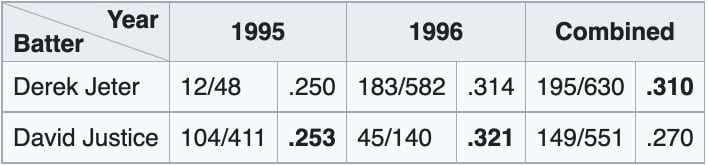
Speaking of the Yankees, Derek Jeter always seems to get a lot of credit for those four World Series victories in five years but a quick look at the OBP stats for those years shows that Bernie Williams was the engine driving that offense. Jeter's a little overrated maybe?

According to a simple statistical analysis using

According to a simple statistical analysis using computer simulations, a hitting streak as long as Joe DiMaggio's 1941 56-game streak is not the freakish occurrence that most people think it is.

More than half the time, or in 5,295 baseball universes, the record for the longest hitting streak exceeded 53 games. Two-thirds of the time, the best streak was between 50 and 64 games.

In other words, streaks of 56 games or longer are not at all an unusual occurrence. Forty-two percent of the simulated baseball histories have a streak of DiMaggio's length or longer. You shouldn't be too surprised that someone, at some time in the history of the game, accomplished what DiMaggio did.

I think there are probably some cumulative effects that are being ignored here though, like increasing media pressure/distraction, opponents trying particularly hard for an out as the streak continues, pitchers more likely to pitch around them, or even the streaking player getting super-confident. The first game in a streak and the 50th game in a streak are, as they say, completely different ball games.

As we look forward to baseball season

As we look forward to baseball season starting up, we look back at Stephen Jay Gould remembering the New York teams of his youth.

Thus, I can watch Roger Clemens striking out 15 Mariners in a brilliant one-hitter and place his frame right on top of Don Larsen pitching his perfect game (27 Bums up, 27 Bums down) in 1956. And I can admire the grace of Bernie Williams in center field, while my teenage memories see Mantle's intensity, and my first impressions of childhood recall DiMaggio's elegance, in exactly the same spot. I can then place all three images upon the foundation of my father's stories of DiMaggio as a rookie in the 1936 Series, and my grandfather Papa Joe's tales of Babe Ruth in the first three New York Series of 1921-1923.

(thx, matt)

Ten quirky baseball rules and oddities, including

Ten quirky baseball rules and oddities, including a list of the 23 ways to get a man on first base. (via subtraction)

By Jason Kottke    Jan 29, 2008    baseball   lists   sports

Three body language analysts studied two recent

Three body language analysts studied two recent Roger Clemens interviews about his alleged steroid use and found that maybe he's not telling the whole truth.

In the "60 Minutes" interview, for example, the analysts noticed that Clemens swallowed hard, looked down, and licked and pursed his lips when answering questions - all signs, they said, that he might not have been telling the truth. "That's indicative of deception, that's indicative of stress," said Joe Navarro, a retired F.B.I. agent who trains intelligence officers and employees for banks and insurance companies.

The article also notes that these experts are only right about half the time and that the technique is used as a tool to evaluate if further investigation is warranted and not to determine truth.

In light of the Mitchell Report, Yanksfan

In light of the Mitchell Report, Yanksfan vs Soxfan has proposed a record book annotation system so that sports fans can tell which records were set under the influence of which substances. The asterisk is for straight-up steroids and some of the other marks are as follows:

! = Amphetamines
$ = Gambling
|| = Cocaine
~ = Alcohol
. = Dead ball era
∞ = Wore glasses
† = Crazy religious freak
X = General douchebag

A list of the leaked names from

A list of the leaked names from the Mitchell Report of MLB players that allegedly used steroids. The official Mitchell Report is here...many of the names on the preliminary list are missing. Any surprises here? Disappointments?

Update: Deadspin has the official list.

By Jason Kottke    Dec 13, 2007    21 comments    baseball   drugs   sports   steroids

Seven things you can never say while playing Old-Timey Baseball

Look out, 1897. There's a new George Carlin in town, with a comprehensive no-no list of the things Major League Baseball players can't say during gameplay (especially in the presence of a lady).

The Yanksfan vs. Soxfan blog has hilarious scans of the original parchment used for an official league document intended to eradicate swearing in baseball, drafted by the owner of the National League's Cincinnati franchise. Highlights from the list:

  • You prick-eating bastard!
  • A dog must have fucked your mother when she made you!
  • I'll make you suck my ass!

If the mood for obscenity strikes while on the field, players, concentrate on something else, like rewaxing the curl in your moustache or sipping on a nice, cool sasparilla ginger ale (I mixed up my old-timey beverages).

Meg, these infographics will help our understanding

Meg, these infographics will help our understanding of all the different baseball pitches come next season.

By Jason Kottke    Nov 14, 2007    baseball   infoviz   sports

If anyone steals a base during the

If anyone steals a base during the World Series, Taco Bell is going to give everyone in the US a free taco. They did something similar last year and the terms and conditions of the offer were pretty amusing.

By Jason Kottke    Oct 25, 2007    baseball   legal   sports   tacobell

Yanksfan vs Soxfan mines the NY Times

Yanksfan vs Soxfan mines the NY Times archive and turns up a 1914 article that mentions a youngster named Babe Ruth:

"Babe" Ruth, a youngster, opposed the Giants, who made nine hits off him. Four double plays, all started by Claude Derrick, who handled twelve outs of the thirteen chances, kept the Giants from scoring more runs.

YvS and Soccer Dad also found a series that the Times did on another youngster, Manny Ramirez, back when Manny being Manny meant hitting .650 in his senior year in high school.

The Boston Red Sox's designated hitter, David

The Boston Red Sox's designated hitter, David Ortiz, makes extensive use of video replays during games. He reviews at-bats right after they happen and can watch every pitch he's ever seen from the pitcher that he's facing, on demand. (via collision detection)

I'm no Yankees fan, but I got

I'm no Yankees fan, but I got a little sad reading this article about Joe Torre's possible departure from the team after 12 years. It seems like the individual leader gets too much credit for successes and is assigned too much blame for failures these days. Surely the team's poor hitting and pitching was a big contributing factor that Torre couldn't do much about?

(Last night's game was great, BTW. The way those fans almost willed the Yankees back into the game while Cleveland held fast was fascinating to watch.)

Watch the baseball bat on the replay...

Watch the baseball bat on the replay...it does some crazy stuff.

By Jason Kottke    Sep 17, 2007    baseball   sports   video

Stats (wins, losses, probability of making the

Stats (wins, losses, probability of making the playoffs, etc.) from the rest of the MLB baseball season, played a million times. "The post-season odds report was compiled by running a Monte Carlo simulation of the rest of the season one million times." (thx, david)

Before the 2007 season started, mathematician Bruce Bukiet's

Before the 2007 season started, mathematician Bruce Bukiet's mathematical model predicted the NY Yankees would win 110 games this year...they might win 90 based on their current pace. Related: check out how the team salary vs. performance graph is shaping up as we move into the last few weeks of the 2007 season.

The Philadelphia Phillies have lost more games

The Philadelphia Phillies have lost more games than any other team in professional sports, almost 10,000.

Nation to Ken Griffey Jr.: We Wish

Nation to Ken Griffey Jr.: We Wish It Were You Hitting 765 Home Runs. "They talked about his 1989 Upper Deck rookie card, and how, instead of going down in value with every hamstring injury, it should have skyrocketed in price with his 800th, maybe 900th home run."

By Jason Kottke    Jun 1, 2007    baseball   funny   kengriffeyjr   sports

Last 100 posts, part 8

Here are some updates on some of the topics, links, ideas, posts, people, etc. that have appeared on kottke.org recently (previous installment is here):

The Celluloid Skyline exhibition at Grand Central is well worth checking out...I was up there this past weekend. Pentagram collaborated with Saunders on the exhibit and wrote up a brief piece on how it came together.

My short post on Nina Planck's reaction to the recent "death by veganism", as she calls it, of a baby boy is a good reminder that I don't always agree with the things I link to. My only criteria for posting a link is that it's interesting, whether I think it's right or wrong or am still trying to form an opinion about it. Anyway, I got lots of mail about this one, much of it that said that the parents' veganism was beside the point -- which the prosecutors and jury in the subsequent criminal case agreed with (thx, matt) -- and that a headline like "Death By Stupidity" was probably more appropriate. After all, you don't see "Death by Omnivorism" headlines every time a baby with a more traditional diet dies of starvation.

Debra from Culiblog pointed out that contrary to Planck's assertion that "there are no vegan societies", the Jainists practice vegetarianism and veganism. On the other side of the aisle, meat fan Michael Ruhlman chastised Planck for going too easy on vegans, saying that "Veganism is a colossal arrogance, a refusal to admit to our own nature, a denial of our humanity. Sometimes it kills people. And it's not very much fun, besides." You can imagine the discussion that generated...although it was nothing like the 300+ comment thread on MetaFilter.

My opinion of Cars improved with a second viewing.

Discover's chat bot conversation reminded a reader of this old interview with the Ask Jeeves search engine (thx david). Back in 2002, I interviewed ELLEGirl magazine's AIMbot:

jkottke: Do you do anything to celebrate or recognize the changing of seasons?
ELLEgirlBuddy: do you do anything to celebrate or recognize the changing of seasons? that's a tough choice.
jkottke: yes, to celebrate or merely recognize. that is a toughie.
ELLEgirlBuddy: yes to celebrate or merely recognize that is a toughie? i dunno.
jkottke: you seem like an actual 13 year old girl.
ELLEgirlBuddy: i haven't really made a decision 'bout that.
jkottke: growing up is tough, isn't it?
ELLEgirlBuddy: i dunno.

And whoever posted the chat bot story to Digg (5696 Diggs and counting!) used the exact wording from my original post. You're welcome!

Prime, David Burke's quarter-million-dollar Black Angus bull, has his own web site. (thx, brian)

Regarding Alex Reisner's excellent baseball statistics web site and, in particular, the pennant race graphs, here's another interesting visualization of the pennant races...you can see the teams race to the end of the year like horses. (thx, scott)

Re: my post on better living through self-deception, I've heard that pregnant women tend to forget the pain of childbirth, perhaps because "endorphins reduce the amount of information trauma victims can store". Also related tangetially is this article on research into lying and laughing, which includes this simple test to see if you're a good liar:

Are you a good liar? Most people think that they are, but in reality there are big differences in how well we can pull the wool over the eyes of others. There is a very simple test that can help determine your ability to lie. Using the first finger of your dominant hand, draw a capital letter Q on your forehead.

Some people draw the letter Q in such a way that they themselves can read it. That is, they place the tail of the Q on the right-hand side of their forehead. Other people draw the letter in a way that can be read by someone facing them, with the tail of the Q on the left side of their forehead. This quick test provides a rough measure of a concept known as "self-monitoring". High self-monitors tend to draw the letter Q in a way in which it could be seen by someone facing them. Low self-monitors tend to draw the letter Q in a way in which it could be read by themselves.

High self-monitors tend to be concerned with how other people see them. They are happy being the centre of attention, can easily adapt their behaviour to suit the situation in which they find themselves, and are skilled at manipulating the way in which others see them. As a result, they tend to be good at lying. In contrast, low self-monitors come across as being the "same person" in different situations. Their behaviour is guided more by their inner feelings and values, and they are less aware of their impact on those around them. They also tend to lie less in life, and so not be so skilled at deceit.

The skyscraper with one floor isn't exactly a new idea. Rem Koolhaas won a competition to build two libraries in France with one spiraling floor in 1992 (thx, mike). Of course, there's the Guggenheim in NYC and many parking garages.

After posting a brief piece on Baltimore last week, I discovered that several of my readers are current or former residents of Charm City...or at least have an interest in it. Armin sent along the Renaming Baltimore project...possible names are Domino, Maryland and Lessismore. A Baltimore Sun article on the Baltimore Youth Lacrosse League published shortly after my post also referenced the idea of "Two Baltimores. Two cities in one." The Wire's many juxtapositions of the "old" and "new" Baltimore are evident to viewers of the series. Meanwhile, Mobtown Shank took a look at the crime statistics for Baltimore and noted that crime has actually decreased more than 40% from 1999 to 2005. (thx, fred)

Cognitive Daily took an informal poll and found that fewer than half the respondants worked a standard 8-5 Mon-Fri schedule. Maybe that's why the streets and coffeeshops aren't empty during the workday.

Alex Reisner's cabinet of statistical wonders

While bumping around on the internet last night, I stumbled upon Alex Reisner's site. Worth checking out are his US roadtrip photos and NYC adventures, which include an account and photographs of a man jumping from the Williamsburg Bridge.

But the real gold here is Reisner's research on baseball...a must-see for baseball and infographics nerds alike. Regarding the home run discussion on the post about Ken Griffey Jr. a few weeks ago, Reisner offers this graph of career home runs by age for a number of big-time sluggers. You can see the trajectory that Griffey was on before he turned 32/33 and how A-Rod, if he stays healthy, is poised to break any record set by Bonds. His article on Baseball Geography and Transportation details how low-cost cross-country travel made it possible for the Brooklyn Dodgers and New York Giants to move to California. The same article also riffs on how stadiums have changed from those that fit into urban environments (like Fenway Park) to more symmetric ballfields built in suburbs and other open areas accessible by car.

Fenway Shea

And then there's the pennant race graphs for each year since 1900...you can compare the dominance of the 1927 Yankees with the 1998 Yankees. And if you've gotten through all that, prepare to spend several hours sifting through all sorts of MLB statistics, represented in a way you may not have seen before:

The goal here is not to duplicate excellent resources like Total Baseball or The Baseball Encyclopedia, but to take the same data and present it in a way that shows different relationships, yields new insights, and raises new questions. The focus is on putting single season stats in a historical context and identifying the truly outstanding player seasons, not just those with big raw numbers.

Reisner's primary method of comparing players over different eras is the z-score, a measure of how a player compares to their contemporaries, (e.g. the fantastic seasons of Babe Ruth in 1920 and Barry Bonds in 2001):

In short, z-score is a measure of a player's dominance in a given league and season. It allows us to compare players in different eras by quantifying how good they were compared to their competition. It it a useful measure but a relative one, and does not allow us to draw any absolute conclusions like "Babe Ruth was a better home run hitter than Barry Bonds." All we can say is that Ruth was more dominant in his time.

I'm more of a basketball fan than of baseball, so I immediately thought of applying the same technique to NBA players, to shed some light on the perennial Jordan vs. Chamberlain vs. Oscar Robertson vs. whoever arguments. Until recently, the NBA hasn't collected statistics as tenaciously as MLB has so the z-score technique is not as useful, but some work has been done in that area.

Anyway, great stuff all the way around.

Update: Reisner's site seems to have gone offline since I wrote this. I hope the two aren't related and that it appears again soon.

Update: It's back up!

Ben Fry has updated his salary vs.

Ben Fry has updated his salary vs. performance graph for the 2007 MLB season...it plots team payrolls vs. winning percentage. The Mets and Red Sox should be winning and are...the Yankees, not so much. Cleveland and the Brewers are making good use of their relatively low payrolls.

Shoulda, woulda, coulda

Last night, Ken Griffey Jr. hit the 564th home run of his career to move into 10th place on the all-time list. Reading about his accomplishment, I was surprised he was so far up on the list, given the number of injuries he's had since coming into the league in 1989. That got me wondering about what might have been had Griffey stayed healthy throughout his career...if he would have lived up to the promise of his youth when he was predicted to become one of the game's all-time greats.

Looking at his stats, I assumed a full season to be 155 games and extrapolated what his home run total would have been for each season after his rookie year in which he played under 155 games. Given that methodology, Griffey would have hit about 687 home runs up to this point. In two of those seasons, 1995 and 2002, his adjusted home run numbers were far below the usual because of injuries limiting his at-bats and effectiveness at the plate. Further adjusting those numbers brings the total up to 717 home runs, good for 3rd place on the all-time list and a race to the top with Barry Bonds.

Of course, if you're going to play what-if, Babe Ruth had a couple of seasons in which he missed a lot of games and also played in the era of the 154-game season. Willie Mays played a big chunk of his career in the 154-game season era as well. Ted Williams, while known more for hitting for average, missed a lot of games for WWII & the Korean War (almost 5 full seasons) and played in the 154-game season era...and still hit 521 home runs.

A list of possible Red Sox-inspired wines.

A list of possible Red Sox-inspired wines. Matsusake, Two-Buck 'Tek, Coco Cristal, and Big Papinot Noir all sound delicious.

By Jason Kottke    Apr 13, 2007    baseball   beverages   Boston Red Sox   food   sports   wine

Matthew McGough tells the story of his

Matthew McGough tells the story of his first day as a NY Yankees batboy. "The game starts in about two hours and I need you to find me a bat stretcher."

By Jason Kottke    Apr 13, 2007    baseball   sports

Denny McLain has been contributing to the

Denny McLain has been contributing to the Britannica Blog for the last month or so...his most recent post is about NYC's demanding baseball fans and the difference between A-Rod and Derek Jeter. McLain was the last pitcher to win 30 games (probably the last ever) and had one of the best seasons in baseball history in 1968, going 31-6 with a 1.96 ERA and winning both the MVP and Cy Young awards.

By Jason Kottke    Apr 11, 2007    baseball   dennymclain   NYC

Pat Venditte is a switch pitcher for

Pat Venditte is a switch pitcher for his college team, a rarity at baseball's higher levels. "Against Nebraska last year, a switch-hitter came to the plate right-handed, prompting Venditte to switch to his right arm, which caused the batter to move to the left-hand batter's box, with Venditte switching his arm again."

By Jason Kottke    Apr 6, 2007    baseball   sports

The only known copy of the Honus

The only known copy of the Honus Wagner T206 baseball card in near mint condition was sold recently for $2.35 million. "The T206 Honus Wagner card has long been recognized as the most iconic, highly coveted and valuable object in the field of sports memorabilia."

Do Japanese pitchers, including Daisuke Matsuzaka, a

Do Japanese pitchers, including Daisuke Matsuzaka, a new member of the Boston Red Sox, have an extra pitch called the gyroball? "The pitch started on the same course as a changeup, but it barely dipped. It looked like a slider, but it did not break. The gyroball, despite its zany name, is supposed to stay perfectly straight." Nice accompanying infographics as well.

The WSJ reports on economist J.C.

The WSJ reports on economist J.C. Bradbury's new book The Baseball Economist, which sounds Moneyball-ariffic. Contrary to popular belief in "protection", Bradbury found that "a weak on-deck hitter makes a batter more likely to get an extra-base hit". Bradbury is also the author of the Sabernomics blog. (via biourbanist)

A paper on the tradeoff in baseball

A paper on the tradeoff in baseball between home runs and hitting for average that I don't fully understand but seems interesting. "Both models find a significant and negative relationship between home runs per at-bat and contact rate." (thx, aaron)

Long audio interview with Michael Lewis by

Long audio interview with Michael Lewis by economist Russ Roberts on "the hidden economics of baseball and football". "Michael Lewis talks about the economics of sports -- the financial and decision-making side of baseball and football -- using the insights from his bestselling books on baseball and football: Moneyball and The Blind Side. Along the way he discusses the implications of Moneyball for the movie business and other industries, the peculiar ways that Moneyball influenced the strategies of baseball teams, the corruption of college football, and the challenge and tragedy of kids who live on the streets with little education or prospects for success."

Pro baseball player Don Carman wrote up

Pro baseball player Don Carman wrote up a list of stock responses to reporter's questions...it reads like a script for almost every locker room interview I've ever seen. "We're going to take the season one game at a time."

By Jason Kottke    Dec 4, 2006    baseball   cliches   journalism   sports

Phillies pitcher Don Carman found a box

Phillies pitcher Don Carman found a box of fan mail in his garage that he had accidentally not answered 15 years ago...so he replied to them, better late than never. "He lugged the envelopes down to the Naples post office, where he discovered that most of them included 25-cent stamps. 'I told the postman I needed 250 10-cent stamps, and 250 4-cent stamps, and he just looked at me like, "What are you doing?"'" (thx, margaret)

Free home run tacos, several strings attached

As part of a World Series promotion, Taco Bell will give away a free taco to everyone in the United States if someone hits a home run over the left field wall in tonight's game 3. This is a big offer for a big company so of course their lawyers want to make darn sure that we know precisely what "Taco Bell" means when they say "home run", "left field", and "free taco" with an extensive list of terms and conditions. Surely the first legal document containing the phrase "a completely outside the bun idea", the T&C is a fun read, but my favorite is the first condition that you agree to if you take advantage of the offer:

...to release, Major League Baseball Properties, Inc., Major League Baseball Enterprises, Inc., MLB Advanced Media, L.P., MLB Media Holdings, Inc., MLB Media Holdings, L.P., MLB Online Services, Inc., the Office of the Commissioner of Baseball, and the Major League Baseball Clubs, and each of their respective shareholders, employees, parents, directors, officers, affiliates, representatives, agents, successors, and assigns (hereinafter, "MLB Entities") and Sponsor and their affiliates, subsidiaries, retailers, sales representatives, distributors and franchisees, and each of their officers, directors, employees and agents ("Promotional Parties"), from any and all liability, loss or damage incurred with respect to participation in this contest and/or the awarding, receipt, possession, and/or use or misuse of any Free Taco

Man, I really hope someone hits a left field home run tonight. I'm dying to see some creative misuse of free tacos.

By Jason Kottke    Oct 24, 2006    baseball   food   legal   sports   tacobell

John Cobb and Ray Edwards own a

John Cobb and Ray Edwards own a Honus Wagner T-206 card -- the most valuable sports card in the world -- and they've tried to sell it a number of times, but no one bites because the card hasn't been properly authenticated (even though paper and printing experts have said the card seems real). Related: the obsessive Vintage Baseball Card Forum. (thx, david)

Rethinking Moneyball. Jeff Passan looks at how

Rethinking Moneyball. Jeff Passan looks at how the Oakland A's 2002 draft class, immortalized in Michael Lewis' Moneyball, has done since then. "It is not so much scouts vs. stats anymore as it is finding the right balance between information gleaned by scouts and statistical analyses. That the Moneyball draft has produced three successful big-league players, a pair of busts and two on the fence only adds to its polarizing nature." Richard Van Zandt did a more extensive analysis back in April.

Another article on the decline of the

Another article on the decline of the baseball card industry in the US. "Why does a kid want a baseball card of a player when, with a joystick, he can be that player in a video game?" (thx, peter)

Baseball card days

Dave Jamieson used to collect baseball cards and recently uncovered his stash when he cleaned out the closet of his childhood home. In attempting to recoup some of the time and money spent in his youth on this cardboard, Jamieson found that baseball cards aren't as popular or as lucrative as they used to be:

Baseball cards peaked in popularity in the early 1990s. They've taken a long slide into irrelevance ever since, last year logging less than a quarter of the sales they did in 1991. Baseball card shops, once roughly 10,000 strong in the United States, have dwindled to about 1,700. A lot of dealers who didn't get out of the game took a beating. "They all put product in their basement and thought it was gonna turn into gold," Alan Rosen, the dealer with the self-bestowed moniker "Mr. Mint," told me. Rosen says one dealer he knows recently struggled to unload a cache of 7,000 Mike Mussina rookie cards. He asked for 25 cents apiece.

Close readers of kottke.org know that I collected sports cards too. I got involved in this prepubescent hobby later than most; I was 14 or 15 when a friend and his older brother -- who was around 24 and collecting for investment -- introduced me to it. And I loved it:

I still have them all somewhere, in boxes, collecting dust faster than value. The Ken Griffey Jr. Upper Deck rookie, the 130 different Nolan Ryan cards, the complete 1989 Hoops set (with the David Robinson rookie), and several others I really can't remember right now.

I used to spend untold hours sifting through them, looking up the values in Beckett's Price Guide, visiting card shops, flipping through commons to complete sets, looking for patterns in Topps' rack packs (I scored many a Jim Abbott rookie with this technique), chewing that ancient bubble gum (I bought a pack of 1983 cards once and chewed the gum...it was horrible), and keeping track of the total value of my collection with a Lotus 1-2-3 spreadsheet on my dad's 286. It was a lot of fun at the time (as the Web is fun for me now); I guess that's about all one can ask for from a hobby.

Recently I stumbled across The Baseball Card Blog and was hit by a giant wave of nostalgia for my old obsession. One thing led to another -- you know how that goes -- and before I knew it, a package was speeding its way to me from a card shop in Pennsylvania containing several 1989 Fleer & Donruss wax packs, a 1989 Topps rack pack, and a couple of 1987 Topps wax packs.1

I've been opening a pack every few days since they arrived. Smell is the sense most powerfully associated with memory, so getting a whiff of that cardboard is really sending me back. Like a wine connoisseur, I can even smell the difference between each brand of card; the smell of Topps cards holds the strongest memories for me...the 1989 Topps set was my favorite. I opened the '87 Topps packs with a fellow ex-collector, but when we tried to chew the gum, it tasted like the cards and turned to a muddy dust in our mouths. But that was mostly what happened even when the gum was new, so we were unsurprised.

Because of the aforementioned slump in the baseball card collecting economy, the card packs I ordered were the same price I paid for them as a kid (factoring for inflation), even though they're almost 20 years old and way more scarce. Back then, I used most of my $5/week allowance on cards, and it took weeks and months of patience to buy enough packs to complete a set, procure that Griffey rookie card, or amass enough Mark McGwires to trade to a friend for a desired Nolan Ryan.

As an adult, I have the cashflow to buy any card I want whenever I want (within reason). Or several boxes of cards, so as to compile complete sets instantly. Or I can just purchase the complete sets and skip the intermediate step. I could buy an entire box of 1989 Upper Deck packs -- at $1.25 per pack and nearly impossible to find in rural Wisconsin, an unimaginable extravagance for me as a kid -- right now on eBay. When I think about the financial advantages I now have over my 16-yo self in collecting the same exact cards, I feel like the NY Yankees (and their monster payroll) competing in a Single A league. It's unfair and even thinking about collecting cards in that manner takes a lot of the fun out of it for me. If I do start collecting cards again, I'm going to approach it like I did back then: by hand, a little at a time, and treating even the essentially worthless commons with care. Unless Nolan Ryan is involved...in that case, the sky's the limit, although I might have to sell my bicycle to get it. In the meantime, I'm waiting for the next household footwear purchase so I can put my newly purchased cards in the shoe box for safe keeping.

[1] A quick note on terminology. A "wax pack" is a basic pack of around 15 cards (plus gum, when cards still had gum packaged with them), so-called because the packages used to be sealed with wax. (Now they're all probably packaged in plastic and whatnot...I don't know, I haven't kept up.) The bottom card in such a pack is called a "wax back" because the card got a thin layer of wax on it from the sealing process. A "rack pack" is a hanging triple pack made of see-thru plastic. A "common" is an ordinary card not worth very much, as opposed to cards or rookies, hot prospects, all-stars, and the like. A "box" contains several wax packs, typically 20-40 packs/box. A "complete set" is a collection of every card sold by a company in a particular year. The '89 Topps set had 792 cards. Sets were sold in factory-sealed boxes or were compiled by hand from cards acquired in packs.

My new favorite weblog: The Baseball Card

My new favorite weblog: The Baseball Card Blog. I'm having acid flashbacks to my teenaged years, but without the acid. The 1989 Upper Deck set was one of the first I built from scratch, a tall order for someone whose weekly allowance was $5. I remember lusting after the Jerome Walton card in the High Numbers Series...he didn't do so well after that rookie year of his.

An update on how many players from

An update on how many players from Tecmo Bowl, Tecmo Super Bowl, and RBI Baseball are still active. The Mets Julio Franco is still playing at 47 years old.

By Jason Kottke    Jun 9, 2006    baseball   footbal   games   MLB   NFL   sports   tecmobowl   tecmosuperbowl   video games

A night at the ballpark

You know that "Take Me Out to the Ballgame" song? They should add another verse, something like:

Take your glove to the ballgame
and if you don't, you're an idiot

We went to the Yankees/Red Sox game at Yankee Stadium with David and Adriana last night and in the bottom of the third inning, Yankees second baseman Miguel Cairo hit a line drive just wide of the foul pole in left field. As I watched the ball coming towards us, I thought a million things -- it's foul, it's gonna drop into the seats way in front of us, never gonna get here, what's the count now, is it time for cheese fries yet...almost everything except for "holy shit, it's coming right at me" -- and then stuck my bare hand straight up in the air, leaned slightly to my left, and dropped the ball.

Dropped isn't the right word, really. Deflected the ball off my bare hand is more accurate. It bounced into the seats behind me and then rolled down under Adriana's seat. After a brief scramble, some meatheads who were ambling by on their way to beer, pretzels, or the can stuck their paws in and made off with the ball. A Yankees fan who observed the whole thing got up in Meg's face, framed by her faded Red Sox hat, and yelled, "ha ha, Boston fans can't catch!" His truth stung almost as much as my rapidly swelling hand. David scored the play as an error, Box 324, Seat 3.

But the most entertaining play of the night by a fan who was not me award goes to the fellow in the yellow shirt who, emboldened by too much Miller Lite, dashed out onto the field, arms raised triumphantly, soaking in the cheers of the adoring crowd. Out came security from all corners of the field and the crowd redirected its enthusiasm from the hunted to the hunters, cheering for blood. "Hit em!" the guy behind me was screaming, "HIT EM!!"

Security eventually converged on the would-be outfielder and he adopted the surrendering posture of a man who knows he's had his fun, palms in the air, head down, not running anymore, almost sinking to his knees. And -- BAMMM! -- this security guard, a former linebacker by the looks of him, comes flying in from the blind side and wallops the guy, knocking him to the ground in a full-on lay-out tackle. The crowd roared at the guard's tackle and cheered lustily as the gladiator was removed from the coliseum.

Barry Bonds finally ties Babe Ruth with 714

Barry Bonds finally ties Babe Ruth with 714 home runs. And with relatively little fanfare, largely because the homers will be eventually invalidated by his drug use and because Bonds is a dink.

Update: The kid who caught the home run ball doesn't care for Bonds much: "When asked if he would consider giving [the ball] to Bonds, Snyder declined with a mild expletive." Bonds was also booed at stadiums around the league when the homer was announced.

By Jason Kottke    May 20, 2006    Babe Ruth   Barry Bonds   baseball   drugs   MLB   sports   steroids

Gladwell's reading Game of Shadows (which alleges

Gladwell's reading Game of Shadows (which alleges that Barry Bonds took steroids) and proposes that record setters like Bonds, Flo Jo, and Bob Beamon should be subjected to a high degree of statistical analysis before their records should be allowed to stand. (followup)

The Gateway Grizzlies are introducing a new

The Gateway Grizzlies are introducing a new menu item at their ballpark: a bacon cheeseburger with Krispy Kreme donuts as a bun.

Update: The burger w/donut buns is not a new invention...it's commonly called the "Luther Burger" after Luther Vandross. Double true. (thx, scott)

"What would your ideal fantasy-baseball lineup be

"What would your ideal fantasy-baseball lineup be if you had to create it using only characters from classic Nintendo video games?" Toad and Mario from Super Mario Bros make the starting lineup.

MC Hammer has posted a love letter

MC Hammer has posted a love letter to Barry Bonds on his weblog. "As you close in on the record, and the day of reckoning is at hand, there will be many attemps by the bloodhounds to shake you and force you to quit." David Jacobs thinks the fans and the media are being hypocritical about Bonds' situation.

Not a big surprise, but it looks

Not a big surprise, but it looks like Barry Bonds took all sorts of performance-enhancing drugs in the last few years of his career, including the season he hit 73 home runs.

By Jason Kottke    Mar 7, 2006    Barry Bonds   baseball   drugs   MLB   sports

Kirby Puckett dies at age 45. Aw, shoot.

Kirby Puckett dies at age 45. Aw, shoot. As a local, I cheered the Twins on to their two World Series victories...I can still hear Bob Casey's "KIR-beeeeeeeeee PUCK-it" echoing around the Metrodome.

Susan Orlean attempts to answer the question

Susan Orlean attempts to answer the question about why fans at Fenway sing Sweet Caroline during the game.

The Baseball Visualization Tool was designed to

The Baseball Visualization Tool was designed to help managers answer the question: should the pitcher be pulled from the game? Handy charts and pie graphs give managers an at-a-glance view of how much trouble the current pitcher is in. I wonder what TBVT would have told Grady Little about Pedro at the end of Game 7 of the 2003 ALCS?

In an era when players are so

In an era when players are so much bigger, stronger, faster, and richer than the rest of us, it's getting harder for fans to really connect with pro sports teams.

By Jason Kottke    Jan 3, 2006    baseball   business   football   NBA   NFL   sports   tikibarber

Wow, Johnny Damon goes from the Red

Wow, Johnny Damon goes from the Red Sox to the Yankees. It's looking like that Boston championship was a one-shot deal.

In the WSJ, Jason Fry writes about

In the WSJ, Jason Fry writes about his experiences in starting a weblog about the Mets. If you're a new blogger, this is a good look at how your first few months might go. "The downside of being a blog writer? Being a blog administrator."

By Jason Kottke    Nov 1, 2005    baseball   MLB   sports   weblogs

Watching the World Series last week, Meg

Watching the World Series last week, Meg wondered, "why White/Red Sox and not Socks?" I knew that if we waited long enough, the Internet would come up with the answer. Bonus: the NY Yankees were once known as the Porchclimbers. Those rascals!

By watching tapes of old baseball games,

By watching tapes of old baseball games, a New York illustrator has discovered the secret of great pitchers. "Witte's scientific theory, the specifics of which he refuses to divulge, has something to do with how successful pitchers keep their gloves elevated at the start of their windups, let their back shoulders drop, and lift their front legs high."

By Jason Kottke    Oct 18, 2005    6 comments    baseball   sports

New York City, redemption, and the 2005 New

New York City, redemption, and the 2005 New York Yankees. "Jason [Giambi] was redeemed, and his legend is assured now as the star who wanted more, who lost everything to greed and arrogance, and who recovered his glory, which is now vastly more appealing for the fact that it's tarnished. It's a real New York kind of story."

I had more than a few of

I had more than a few of the cards in this worthless baseball card collection. Ah, commons.

Dressed to the Nines is an interactive

Dressed to the Nines is an interactive look at the design of baseball uniforms. "Whether we are looking at someone in a uniform or we are trying it on ourselves, it is the feeling of the fabric, the design on the cap and jersey, the colors, cut, and history of the outfit, that all lend meaning to our relationship with the game."

By Jason Kottke    Sep 15, 2005    aigadc2005   baseball   design   fashion   sports

A look at Jefferson Burdick's baseball card

A look at Jefferson Burdick's baseball card collection which he donated the Met Museum in NYC. One downside to the collection: most of the cards are pasted into albums and so are in poor condition.

By Jason Kottke    Sep 15, 2005    4 comments    aigadc2005   baseball   baseball cards   design   met   museums   NYC   sports

Design and Fenway Park

One of the pre-conference events was a talk at Fenway Park followed by a tour of the ballpark. Janet Marie Smith, VP of planning and development for the Sox, kicked things off with how the team (especially the new management) works really hard to preserve the essential character of Fenway while at the same time trying to upgrade the park (and keep it from getting torn down). She talked about the advertisements added to the Green Monster, which was actually not a purely commercial move but a throwback to a time when the Monster was actually covered with ads.

Lots of talk and awareness of experience design...the Red Sox folks in particular kept referring to the "experience" of the park. One of the speakers (can't recall who, might have been Jim Dow) talked about how other ballparks are becoming places where only people who can afford $100 tickets can go to the games and what that does to the team's fan base. With Fenway, they're trying to maintain a variety of ticket prices to keep the diversity level high...greater diversity makes for a better crowd and a better fan base and is quite appropriate for Boston (and New England in general), which has always been an area with vibrant blue collar and blue blood classes.

Janet also referred to the "accidental" design of the park. Like many other urban ballparks built in the late 19th/early 20th centuries, the placement of the streets constrained the design of Fenway and made it rather an odd shape....these days larger plots are selected where those types of restraints are removed. And over time, the game has changed, the needs of the fans have changed, and the fire codes have changed and the park has changed with the times. In the dead ball era, the walls of the stadium weren't for hitting home runs over; their sole function was to keep people on the street for catching the game for free, so the Fenway outfield ran over 500 feet in right field -- practically all the way to the street -- where there's now 30 rows of seats. Jim Holt observed that American butts have gotten bigger so bigger seats are called for. Fire codes helped that change along as well...wooden seats, bleachers, and overcrowding are no longer a large part of the Fenway experience (save for the wooden seats under the canopy).

The design talk continued on the tour of the park. Our guide detailed how ballparks are built around specific ballplayers. Yankee Stadium was the house that Ruth built but it was also seemingly (but not literally) built for him with a short trip for his home run balls to the right field wall. Boston added a bullpen to make the right field shorter for Ted Williams. Barry Bonds does very well at PacBell/SBC/WhateverItsCalledTheseDays Park. And more than that, the design of Fenway also dictated for a long time the type of team that they could field, which had some bearing on how they did generally. Players who played well in Fenway (i.e. could hit fly balls off of the Monster in left) often didn't do so well in other parks and the team's away record suffered accordingly.

Odd story of one astronomer possibly "stealing"

Odd story of one astronomer possibly "stealing" another astronomer's discovery of a large trans-Neptunian object. The original discoverer alleges that the usurper looked at a couple of Web sites that detailed the discovery and where the discover's telescopes were pointed...the astronomy equivalent of stealing signs.

By Jason Kottke    Sep 14, 2005    astronomy   baseball   discovery   physics   science   sports   theft

Jeff Ma, who was a key member

Jeff Ma, who was a key member of the infamous MIT blackjack team, notes the turn around of the Oakland A's and the reversal of criticism directed toward GM Billy Beane. Even Steven Levitt, who thinks not too highly of Moneyball, has conceded that maybe Beane and the A's are onto something.

Fantasy Fashion League is fashion's answer to

Fantasy Fashion League is fashion's answer to fantasy football and rotisserie baseball. Pick your favorite designers and earn points when their fashions show up in magazines. (via E&N) Related: NY Times ombudsman Daniel Okrent helped invent rotisserie baseball?

Both baseball and softball voted out of

Both baseball and softball voted out of the 2012 Olympic Games in London.

The career of major league pitcher Dock

The career of major league pitcher Dock Ellis, including how he pitched a no-hitter on acid.

By Jason Kottke    Jun 27, 2005    baseball   dockellis   drugs   MLB   sports

Plunk Biggio is a blog "dedicated to

Plunk Biggio is a blog "dedicated to Craig Biggio and his (probably unintentional) Quest to break the all time major league career record for getting hit by pitches". He's only 5 HBPs away from Don Baylor, the official MLB record holder.

By Jason Kottke    Jun 7, 2005    baseball   craigbiggio   donbaylor   MLB   records   sports

Moneyball author Michael Lewis on the converging

Moneyball author Michael Lewis on the converging paths of two ballplayers and their "quest" to hit for power and make the big leagues.

Moneyball by Michael Lewis

Moneyball

Since Lewis writes primarily on business, business folks will undoubtably read Moneyball with an eye toward picking up some pointers on how to run their companies. Some will completely misunderstand what Lewis discovered about major league baseball and beefheadedly apply their new "knowledge". The lesson of Moneyball is not that there are potential employees out there that are cheaper than your current employees. That's the holy grail of large American corporations and exactly what they would want to hear.

As Lewis reports, what Oakland actually did is a) measure player statistics as objectively as they could, b) identify players that perform well in those statistical categories, c) discover that the players they valued were not valued by other teams and were therefore relatively cheap, and d) went out and got the players they wanted at bargain prices. As much as the business person would like to skip directly to step d, it's impossible to determine if that will actually be effective unless you do the a-c analysis first.

kottke.org, quickly...

The best way to get a sense of what kottke.org is all about is to head to the front page or check out some random entries from the archives.

Tags related to baseball:

sports (486)    New York Yankees (12)    baseball cards (15)    infoviz (163)    NYC (694)    Moneyball (18)    steroids (7)    books (737)    Michael Lewis (43)    video (746)    economics (202)    Ben Fry (7)    NY Times (64)    journalism (176)    physics (126)

Looking for work?

See more on the Job Board.

Tags, tags, tags

Many posts on kottke.org have been "tagged" with keywords, which activity results in collections of related posts like sports, infoviz, or best of.

Recently popular tags (last 3 weeks)

The 2000s (14)    post updates (43)    video (746)    USA (13)    movies (1072)    books (737)    science (634)    lists (646)    food (666)    photography (821)    art (389)    best of (372)    sports (486)    advertising (178)    maps (234)

All-time popular tags

movies (1072)    photography (821)    video (746)    books (737)    NYC (694)    food (666)    lists (646)    science (634)    design (612)    sports (486)    music (405)    art (389)    business (382)    best of (372)    TV (370)

Useful favorites

photography (821)    economics (202)    lists (646)    best of (372)    infoviz (163)    food (666)    NYC (694)    firstworldproblems (4)    cities (135)    restaurants (188)    video (746)    timelapse (3)    interviews (256)    language (272)    maps (234)    fashion (164)    NSFW (63)    remix (207)

Random tags

gameoflife (2)    ira (2)    Haruki Murakami (5)    steroids (7)    instapundit (2)    archimedes (2)    marieantoinettemovie (4)    Dorothy Gambrell (2)    intrepid (2)    Anthony Bourdain (7)    dickcheney (4)    interfaceculture (2)    gizmodo (2)    skinnycorp (2)    pseudoscience (12)