It's not really a secret, per se, but there's a quiet understanding among many iOS app developers that it is acceptable to send a user's entire address book, without their permission, to remote servers and then store it for future reference. It's common practice, and many companies likely have your address book stored in their database. Obviously, there are lots of awesome things apps can do with this data to vastly improve user experience. But it is also a breach of trust and an invasion of privacy.
I did a quick survey of 15 developers of popular iOS apps, and 13 of them told me they have a contacts database with millons of records. One company's database has Mark Zuckerberg's cell phone number, Larry Ellison's home phone number and Bill Gates' cell phone number. This data is not meant to be public, and people have an expectation of privacy with respect to their contacts.
13 out of 15! Zuckerberg's cell phone number! Maybe I'm being old-fashioned here, but this seems unequivocally wrong. Any app, from Angry Birds to Fart App 3000, can just grab the information in your address book without asking? Hell. No. And Curtis is right in calling Apple out about this...apps should not have access to address book information without explicitly asking. But now that the horse is out of the barn, this "quiet understanding" needs to be met with some noisy investigation. What happened to Path needs to happen to all the other apps that are storing our data. There's an opportunity here for some enterprising data journalist to follow Thampi's lead: investigate what other apps are grabbing address book data and then ask the responsible developers the same questions that were put to Path.
Update: I am aware of this very confusing display of data from the Wall Street Journal. It indicates that of the ~50 iPhone apps surveyed, only three (Angry Birds, Facebook, and TextPlus 4) transmit address book data to a server. That's not exactly the widespread problem that Curtis describes (the data sets are likely different)...it would be nice to see the net cast a bit wider.
Speaking of Apple, here's a profile of Jerry Manock, who worked for Apple from 1977 to 1984 and designed the case for the Apple II and helped design the Macintosh. Manock was Jobs' first Jony Ive.
The whole basis of the class I've taught at UVM for 21 years is ... integrated product development, which means concurrently looking at all of these things: the aesthetics, the engineering, the marketing ... which is what we were doing at Apple. Not necessarily purposefully, but everybody was just thrown together... I would walk through the software place and look around and see what people were doing ... walk through the marketing area. I had my drawings all on the walls, so anybody could come up. There was a red pencil hanging there. I'd say, "If you see something you don't like, or is a problem -- I don't care whether it's a janitor or Steve -- write the correction, circle it, put your phone there and I'll call you and we'll talk about it."
I take this to mean that any iPhone app can download your address book to their servers? What. The. Hell! Apple?
Upon inspecting closer, I noticed that my entire address book (including full names, emails and phone numbers) was being sent as a plist to Path. Now I don't remember having given permission to Path to access my address book and send its contents to its servers, so I created a completely new "Path" and repeated the experiment and I got the same result - my address book was in Path's hands.
Amazon is somewhat of an unusual company for American investors because it focuses on the long-term (10- 20-year timelines) instead of the short-term (quarterly earnings).
"If everything you do needs to work on a three-year time horizon, then you're competing against a lot of people," Mr. Bezos told reporter Steve Levy last month in an interview in Wired. "But if you're willing to invest on a seven-year time horizon, you're now competing against a fraction of those people, because very few companies are willing to do that. Just by lengthening the time horizon, you can engage in endeavors that you could never otherwise pursue. At Amazon we like things to work in five to seven years. We're willing to plant seeds, let them grow-and we're very stubborn."
Like Apple, Amazon is one of those large market cap growth stocks that investors don't really know what to do with. Both stocks are still undervalued compared to much of the rest of the market, IMO.
Get it while you can: an hour-long BBC documentary about Steve Jobs with on-camera interviews with Woz, Stephen Fry, Tim Berners-Lee, John Sculley and many others.
The company was obviously under tight constraints as to what they could do with the store (they would have loved to encase the whole thing in plexiglass probably), but from the looks of things, they did a marvelous job. There's so little styling -- the whole store is just tables and screens mostly -- that it looks like the Apple Store not only belongs there, but that it's been there forever, like Grand Central was designed with the Apple Store in mind. If you walk around Grand Central, not a lot of the other retail locations can say that, if any. (photo by katie sokoler)
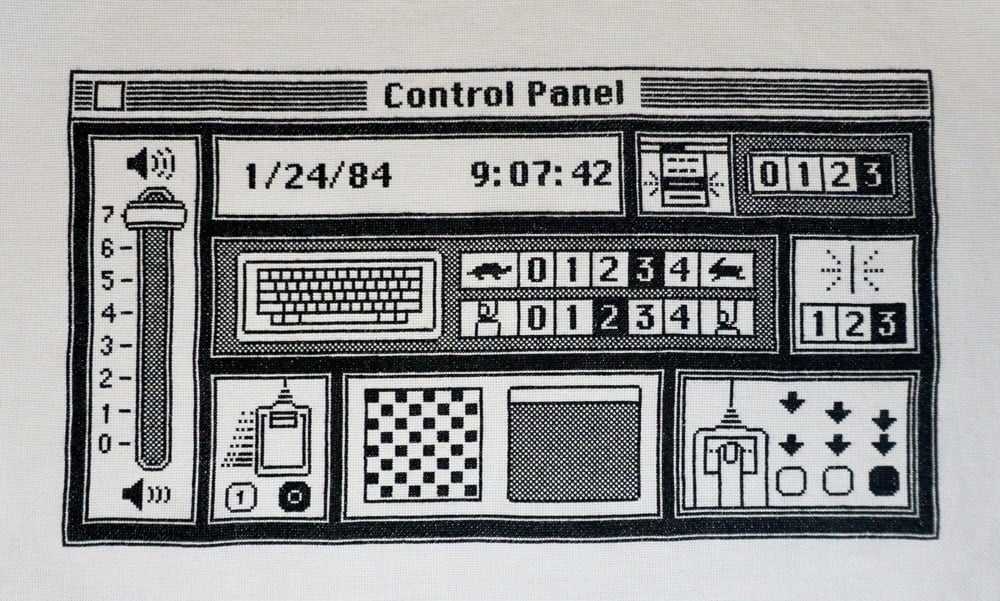
Steve Silberman has a nice piece on Susan Kare, the woman who designed the original icons for the Macintosh, including a never-before-seen look at her initial sketches for some of them.
Inspired by the collaborative intelligence of her fellow software designers, Kare stayed on at Apple to craft the navigational elements for Mac's GUI. Because an application for designing icons on screen hadn't been coded yet, she went to the University Art supply store in Palo Alto and picked up a $2.50 sketchbook so she could begin playing around with forms and ideas. In the pages of this sketchbook, which hardly anyone but Kare has seen before now*, she created the casual prototypes of a new, radically user-friendly face of computing - each square of graph paper representing a pixel on the screen.
Why not the same thing [as Newsstand] for TV channels? We're seeing the beginnings of this, with iPhone and iPad apps like HBO Go, Watch ESPN, and the aforementioned Bloomberg TV+. Letting each TV network do their own app allows them the flexibility that writing software provides. News networks can combine their written and video news into an integrated layout. Networks with contractual obligations to cable operators, like HBO and ESPN, can write code that requires users to log in to verify their status as an eligible subscriber.
This smells right to me...it's a very Apple-y way of approaching the TV/movie problem. Rather than fight with the studios and networks over content sold through the iTunes Store (where the studios control the licensing rights), just provide a platform (iPhone + iPad + iTV + App Store) controlled by Apple and if the studios/networks want to reach those customers, they need to provide an app...with Apple taking a 30% cut of the App *and* content sales.
[Apple's] devices have become increasingly simple and pared down, even as the power contained in them has increased. There is very little, if anything, extraneous on the Magic Trackpad or the MacBook Air. And of course the iPhones 4 and 4S are radically simple, yet well-constructed masterpieces of industrial design.
Yet, when it comes to stuff that isn't hardware:
But no one laughs when Apple delivers a calendar application for the iPad that tries its hardest to look like a real-word desktop calendar pad, complete with fake leather and "torn" pages.
Still fewer have a chuckle when they see the new Address Book app on Mac OS X Lion, or the even more recent Find My Friends iPhone app.
These apps, and many more besides, all stem from a completely different, and I would say opposite aesthetic sensibility than the plain devices they run on.
They are an expression of purest kitsch, sentimentality, and ornamentation for its own sake. In Milan Kundera's brilliant definition, kitsch is "the absolute denial of shit". These are Disney-like apps, sinister in their mendacity.
This isn't a recent thing either...look at the cheeseball themes and transitions in Keynote (many of them used by Jobs in his keynotes), some of the default system fonts, the emphasis in past keynotes on things like Mail.app themes, etc. Without too much effort, you could pull together many design examples from their currently shipping software that make it appear as though Apple doesn't have a good aesthetic sense of design at all. But then you look at the general aesthetics of OSX and iOS...I don't know, it's really confusing how the same company, especially one that had such strong design leadership, could produce something as beautifully spare as iOS and something as cheesy as the Game Center app. (via ★thefoxisblack)
Dieter Rams' 40 year stint at Braun until 1995 redefined the world of product design, taking pure modernism to the world of gadgets. He is the direct inspiration for much of Apple's product design after Steve Jobs returned and in many aspects his work is more rigorous and more coherent than Apple's.
Dan Lyons posted the notes of a long conversation he had with Steve Wozniak last week. Lots of Apple history and prehistory...I didn't know, for instance, that Woz designed the Apple I before Jobs was involved.
I was highly regarded for my engineering skills. But I never wanted money. I would have been a bad person to run a company. I wanted to be a nice guy. I wanted to make friends with everybody. Yes I came up with the idea for the personal computer but I don't want to be known as a guy who changed the world. I want to be known as an engineer who connected chips in a really efficient way or wrote code that is unbelievable. I want to be known as a great engineer. I'm thankful Steve Jobs was there. You need someone who has a spirit for the marketplace. Who has the spirit for who computers change humanity. I didn't design the Apple II for a company. I designed it for myself, to show off. I look at all the recent Apple products, like the iPhone, the iPad, and even Pixar, and it was like everything Steve worked on had to be perfect. Because it was him. Every product he created was Steve Jobs.
And Woz is *still* an Apple employee! He makes $100 a week. (via stellar)
I am incredibly sad this morning. Why am I, why are we, feeling this so intensely? I have some thoughts about that but not for now. For now, I'm just going to share some of the things I've been reading and watching about Jobs. And after that, I think I'm done here for the day and will move on to spend some time building my little thing that I'm trying to make insanely great.
The 2005 Stanford Commencement Speech. For me, the speech is better in text than in video.
Your time is limited, so don't waste it living someone else's life. Don't be trapped by dogma - which is living with the results of other people's thinking. Don't let the noise of others' opinions drown out your own inner voice. And most important, have the courage to follow your heart and intuition. They somehow already know what you truly want to become. Everything else is secondary.
The iPhone announcement in 2007. I am with Dan Frommer on this one: this is Jobs at his absolute best. He was just so so excited about this thing that he and his team had created, so proud. His presentation is also a reminder of how revolutionary the iPhone was four years ago.
Steven Levy on Jobs. Levy covered Apple and Jobs extensively for many years; his obit is a good one.
Jobs usually had little interest in public self-analysis, but every so often he'd drop a clue to what made him tick. Once he recalled for me some of the long summers of his youth. I'm a big believer in boredom," he told me. Boredom allows one to indulge in curiosity, he explained, and "out of curiosity comes everything." The man who popularized personal computers and smartphones -- machines that would draw our attention like a flame attracts gnats -- worried about the future of boredom. "All the [technology] stuff is wonderful, but having nothing to do can be wonderful, too."
I like to think that in the run-up to his final keynote, Steve made time for a long, peaceful walk. Somewhere beautiful, where there are no footpaths and the grass grows thick. Hand-in-hand with his wife and family, the sun warm on their backs, smiles on their faces, love in their hearts, at peace with their fate.
Moments after news broke about Steve Jobs' death, a rainbow popped out of the Pixar campus (taken with my iPhone 4). Rest in peace, Steve, and thank you.
Jobs testing Photo Booth filters. Perhaps these aren't the best photos ever taken of Steve Jobs, but they are among my favorites.
I have no way of knowing how Steve talked to his team during Apple's darkest days in 1997 and 1998, when the company was on the brink and he was forced to turn to archrival Microsoft for a rescue. He certainly had a nasty, mercurial side to him, and I expect that, then and later, it emerged inside the company and in dealings with partners and vendors, who tell believable stories about how hard he was to deal with.
But I can honestly say that, in my many conversations with him, the dominant tone he struck was optimism and certainty, both for Apple and for the digital revolution as a whole. Even when he was telling me about his struggles to get the music industry to let him sell digital songs, or griping about competitors, at least in my presence, his tone was always marked by patience and a long-term view. This may have been for my benefit, knowing that I was a journalist, but it was striking nonetheless.
At times in our conversations, when I would criticize the decisions of record labels or phone carriers, he'd surprise me by forcefully disagreeing, explaining how the world looked from their point of view, how hard their jobs were in a time of digital disruption, and how they would come around.
This quality was on display when Apple opened its first retail store. It happened to be in the Washington, D.C., suburbs, near my home. He conducted a press tour for journalists, as proud of the store as a father is of his first child. I commented that, surely, there'd only be a few stores, and asked what Apple knew about retailing.
He looked at me like I was crazy, said there'd be many, many stores, and that the company had spent a year tweaking the layout of the stores, using a mockup at a secret location. I teased him by asking if he, personally, despite his hard duties as CEO, had approved tiny details like the translucency of the glass and the color of the wood.
Heartwarming/breaking: shortly following the news of Steve's death, our daughter called me "dada" for the first time. It goes on.
The Computer That Changed My Life. Bryce Roberts shares the story of the first Apple computer he bought.
As I sat alone in my makeshift office in Sandy, UT I decided that I wanted to start fresh, all the way down to my operating system. It sounds funny now, but it was an important psychological move for me. I wanted the next level to look and feel different than what I'd experienced in the past in every possible way.
I fired up my Sony Viao and surfed over to Apple.com. I wasn't an Apple fanboy. I'd never owned one of their machines. And that was the point.
I didn't know if I would love it or even like it, but it was going to be different. And different was exactly how I wanted the next level to feel.
This is *exactly* why I bought an iBook in 2002 after a lifetime of Windows/DOS machines.
Brian Lam apologies to Steve Jobs for being an asshole. If you followed the whole Gizmodo/iPhone thing, this is worth a read.
I was on sabbatical when Jason got his hands on the iPhone prototype.
An hour after the story went live, the phone rang and the number was from Apple HQ. I figured it was someone from the PR team. It was not.
"Hi, this is Steve. I really want my phone back."
He wasn't demanding. He was asking. And he was charming and he was funny. I was half-naked, just getting back from surfing, but I managed to keep my shit together.
A common reaction to Apple's announcement of the iPhone 4S yesterday was disappointment...Mat Honan's post at Gizmodo for instance.
I was hoping for something bold and interesting looking. The iPhone 4 was just that when it shipped. So too were the original iPhone and the iPhone 3G. If I'm going to buy a new phone, of course I want it to look new. Because of course we care about having novel designs. If we didn't we'd all be lugging around some 10-inch thick brick with a 12 day battery life.
Mat's is an understandable reaction. After I upgraded my iPhone, Macbook Pro, and OS X all at once two years ago, I wrote about Apple's upgrade problem:
From a superficial perspective, my old MBP and new MBP felt exactly the same...same OS, same desktop wallpaper, same Dock, all my same files in their same folders, etc. Same deal with the iPhone except moreso...the iPhone is almost entirely software and that was nearly identical. And re: Snow Leopard, I haven't noticed any changes at all aside from the aforementioned absent plug-ins.
So, just having paid thousands of dollars for new hardware and software, I have what feels like my same old stuff.
Deep down, when I stop to think about it, I know (or have otherwise convinced myself) that these purchases were worth it and that Apple's ease of upgrade works almost exactly how it should. But my gut tells me that I've been ripped off. The "newness" cognitive jolt humans get is almost entirely absent.
For me, yesterday's event, Apple's continued success in innovation *and* business, and the recent CEO change provided a different perspective: that Apple makes two very complementary types of products and we should be excited about both types.
The first type of product is the most familiar and is exemplified by Steve Jobs: Apple makes magical products that shape entire industries and modify social structures in significant ways. These are the bold strokes that combine technology with design in a way that's almost artistic: Apple II, Macintosh, iPod, iPhone, and iPad. When they were introduced, these products were new and exciting and no one quite knew where those products were going to take us (Apple included). That's what people want to see when they go to Apple events: Steve Jobs holding up a rainbow-hued unicorn that you can purchase for your very own.
The second type of product is less noticed and perhaps is best exemplified by Apple's new CEO, Tim Cook: identify products and services that work, continually refine them, innovate at the margins (the addition of Siri to the iPhone 4S is a good example of this), build interconnecting ecosystems around them, and put processes and infrastructure in place to produce ever more of these items at lower cost and higher profit. The wheel has been invented; now we'll perfect it. This is where Apple is at with the iPhone now, a conceptually solved problem: people know what they are, what they're used for, and Apple's gonna knuckle down and crank out ever better/faster/smarter versions of them in the future. Many of Apple's current products are like this, better than they have ever been, more popular than they have ever been, but there's nothing magical about them anymore: iPhone 4S, iPod, OS X, iMacs, Macbooks, etc.
The exciting thing about this second type of product, for investors and consumers alike, is Apple is now expert at capturing their lightning in a bottle. 'Twas not always so...Apple wasn't able to properly capitalize on the success of the Macintosh and it almost killed the company. What Tim Cook ultimately held up at Apple's event yesterday is a promise: there won't be a return to the Apple of the 1990s, when the mighty Macintosh devolved into a flaky, slow, and (adding insult to injury) expensive klunker and they couldn't decide on a future direction for their operating system (remember Copland?). There will be an iPhone 5 in the future and it will be better than the iPhone 4S in significant & meaningful ways but it will also *just work*. And while that might be a bit boring to Apple event watchers, this interconnected web of products is the thing that makes the continued development of the new and magical products possible.
In 1987, Apple made a video showcasing a concept they called Knowledge Navigator:
The crazy thing is that the year in the video is 2011...and Apple announced something very much like Knowledge Navigator (Siri, a natural language voice assistant) at their event yesterday. (via waxy)
New Tumblr: Things Apple is Worth More Than. Such as: the GDP of Singapore, every single home in Atlanta, Georgia, and all the illegal drugs in the world.
There's been a lot written about Steve Jobs in the past week, a lot of it worthy of reading, but one piece you probably didn't see is David Galbraith's piece on Jobs' similarity to architect Norman Foster. The essay is a bit all over the place, which replicates the experience of talking to David in person, but it's littered with insight and goodness (ditto).
The answer is what might be called the sand pile model and it operated at Apple and Fosters, the boss sits independently from the structural hierarchy, to some extent, and can descend at random on a specific element at will. The boss maintains control of the overall house style by cleaning up the edges at the same time as having a vision for the whole, like trying to maintain a sand pile by scooping up the bits that fall off as it erodes in the wind. This is the hidden secret of design firms or prolific artists, the ones where journalists or historians agonize whether a change in design means some new direction when it just means that there was a slip up in maintaining the sand pile.
And I love this paragraph, which integrates Foster, Jobs, the Soviet Union, Porsche, Andy Warhol, Lady Gaga, and even an unspoken Coca-Cola into an extended analogy:
Perfecting the model of selling design that is compatible with big business, Foster simultaneously grew one of the largest architecture practices in the world while still winning awards for design excellence. The secret was to design buildings like the limited edition, invite only Porsches that Foster drove and fellow Porsche drivers would commission them. Jobs went further, however, he managed to create products that were designed like Porsches and made them available to everyone, via High Tech that transcended stylistic elements. An Apple product really was high technology and its form followed function, it went beyond the Porsche analogy by being truly fit for purpose in a way that a Porsche couldn't, being a car designed for a speed that you weren't allowed to drive. Silicon Valley capitalism had arguably delivered what the Soviets had dreamed of and failed, modernism for the masses. An iPhone really is the best phone you can buy at any price. To paraphrase Andy Warhol: Lady Gaga uses an iPhone, and just think, you can have an iPhone too. An iPhone is an iPhone and no amount of money can get you a better phone. This was what American modernism was about.
I have always said if there ever came a day when I could no longer meet my duties and expectations as Apple's CEO, I would be the first to let you know. Unfortunately, that day has come.
I hereby resign as CEO of Apple. I would like to serve, if the Board sees fit, as Chairman of the Board, director and Apple employee.
This can't be good news regarding his health. I hope I'm wrong. Good luck, Steve...you've been a great inspiration to me.
Matt Buchanan's Unedited thoughts about technology better left unposted is like the sportswriter 'nuggets from the drawer'-type column for tech writing. Seems like Facebook, Twitter, and Tumblr would have been low hanging fruit, what other tech companies are missing? On the other hand, there are 9 paragraphs and 4 of them relate to Apple in some way. Maybe this should have just been unedited thoughts about Apple better left unposted.
A lot of the suggestions were to be more like Microsoft and embrace the Windows platform. Apple, obviously, rejected that path and has benefitted greatly from doing so. It's hard to remember now, but many people thought that Apple should drop their operating system and instead turn to making high end Windows PCs. I think we're all glad they never went that route.
Not content to knock-off simple iPhones and iPads, some enterprising Chinese have built an entire fake Apple Store in Kunming, China. It's an actual store selling actual products but is obviously not affiliated with Apple in any way.
Being the curious types that we are, we struck up some conversation with these salespeople who, hand to God, all genuinely think they work for Apple.
And as usual, the definitive review of any new version of OS X is John Siracusa's for Ars Technica. This time around, it runs 19 pages. If that's not to your liking, you can just download Lion right now from the Mac App Store for $30.
Two other misc Apple thoughts: 1) They appear to have discontinued the MacBook. There are Airs and Pros but no plain-old MacBooks. 2) Apple Inc, already among the largest companies in the world in terms of market cap, announced yesterday that the company's "revenue [is] up 82 percent and profits [are] up 125 percent" over the same quarter last year. That level of growth in such a big company...that's just astounding. And much of the revenue and profit are from products that didn't exist even five years ago...the iPad alone was a ~$5 billion business in Q3 (for comparison, Google had $9 billion in total revenues in Q2). If that's not unprecedented, it's damn close.
From 1990, a NY Times article on a new factory built by Next, the company Steve Jobs started after he left Apple. The more you learn about Next, the more you realize just how much Next DNA there is in the current incarnation of Apple. The story of Apple's second coming could easily be written as the triumph of Next. This section from the middle of the article articulates perfectly Apple's current approach to manufacturing:
Indeed, critics of Mr. Jobs, who is 35 years old, say he is wasting his money by building a factory at this point. With the small number of machines he is building today, it would have been cheaper simply to contract with other companies to assemble the computers, they say.
But Dr. Piszczalski said the initial high investment in an automated factory may permit Next more control of its expenses while volumes are low.
And backers of Mr. Jobs note that he has a long-term strategy in which manufacturing makes sense. "Steve will be in business for the long pull," said H. Ross Perot, one of Next's investors. "He's not in business for six months."
Next's products have yet to gain a significant share of the marketplace, but Mr. Jobs, who has a reputation for painstaking attention to detail and a passion for the importance of manufacturing, argues that by linking this flexible factory more closely than ever to Next's research and development process, his company can gain a strategic advantage in the industry that will eventually pay off in larger sales.
In Mr. Jobs's view, the factory testifies to the fact that the United States can still compete as both a low-cost and a world-class manufacturer when it sets its mind to the task.
Mr. Jobs said he modeled the factory after those of Japanese corporations like the Sony Corporation that have perfected a design-for-manufacturing strategy that transforms the factory floor into an extension of the company research and development center.
Update: Next made a documentary on how computers are made at the new factory.
That's got to be a Hans Zimmer soundtrack, yes? (via @mgrdcm)
In the near term, companies making iPhone and iPad competitors are never going to beat Apple at their own game. Apple has supply chain advantages, a massive number of their customers' credit card numbers (why do you think Jobs brings this up at every single Apple event...it's important!), key patents, one-in-lifetime personnel like Steve Jobs and Jony Ive, solid relationships with key media companies, and an integrated ecosystem of stores, apps, applications, and hardware. They are an imposing competitor.
But Apple also has some weak spots which a canny competitor should be able to exploit to make compelling products that Apple won't be able to duplicate or directly compete with.
1. Apple doesn't do social well on a large scale. Ping? Game Center? Please. Social applications don't seem to be in Apple's DNA...their best applications are still single-player or 2/3/4-player. Someone should figure out how to leverage Facebook's social graph to make the phone/app/gaming/music/video experience significantly better than on the iPhone/iPad and then partner exclusively with Facebook to make it happen. The Facebook Fone would be a massive hit if done right.
2. Apple can't do the cloud either. Mobile Me has been around since January 2000 (when it was called iTools) and the service is still not as compelling as newcomer Dropbox. iPods, iPhones, and iPads are still very much tethered to plain-old desktop/laptop computers and iTunes...there's an opportunity here for a better way.
3. iTunes is getting long in the tooth. The cloud and social are the two Apple weaknesses, but iTunes is showing its age and over the years has become a bloated collection of functionalities...music store, video store, app store, mobile device manager, "social" network, and, oh, by the way, you can also use it to play your music. Spotify, Pandora, and Rd.io point the way to a different approach.
4. I can't remember if this is my own theory or I read about this on Daring Fireball or something, but the Apple products & services that Apple does well are the ones that Steve Jobs uses (or cares about) and the ones he doesn't use/care about are less good (or just plain bad). Jobs uses Keynote and it's very good...but I'm pretty sure Jobs never has had to schedule his own appointments with iCal so that program is less good. Cloud apps and social apps are at the top of this list for a reason...I just don't think Jobs cares about those things. I mean, he cares, but there's not a lot of passion there...they aren't a priority for him so he doesn't really know how to think about them and attack those problems.
And then there are a couple of Apple weaknesses that actually aren't weaknesses at all:
1. Price. Everyone still thinks that Apple products are expensive, or, more to the point, overpriced. But no one else has made a compelling tablet for under $500 yet. And if you attack Apple on price, potential gothchas lurk: Apple is absurdly profitable and cash-rich; if they feel the need to compete with anyone on price in order to protect their business interests, they can do so with price cuts deep enough and long enough to drive most potential competitors out of business.
2. Openness and secrecy. Competitors should take a page from Apple's playbook here and be open about stuff that will give you a competitive advantage and shut the hell up about everything else. Open is not always better.
He is 27 years old. He lives in Los Gates, Calif., and works 20 minutes away in Cupertino, a town of 34,000 that his company has so transformed that some San Franciscans, about 35 miles to the north, have taken to calling it Computertino. There is no doubt in any case that this is a company town, although the company, Apple, did not exist seven years ago. Now, Apple just closed its best year in business, racking up sales of $583 million. The company stock has a market value of $1.7 billion. Jobs, as founder of Apple, chairman of the board, media figurehead and all-purpose dynamo, owns about 7 million shares of that stock. His personal worth is on the balmy side of $210 million. But past the money, and the hype, and the fairy-tale success, Jobs has been the prime advanceman for the computer revolution. With his smooth sales pitch and a blind faith that would have been the envy of the early Christian martyrs, it is Steven Jobs, more than anyone, who kicked open the door and let the personal computer move in.
The article contains some really interesting stuff: perhaps the first mention of Jobs' "reality-distortion field", a prescient comment that Jobs "should be running Walt Disney", and a description of Steve Wozniak as "a Steiff Teddy bear on a maintenance dose of marshmallows".
The Daily Mail has a profile of Apple's lead designer, Jony Ive...some bits in there that I hadn't read before, including this strange anecdote about a bad meeting that may have led to Ive's departure to Apple:
'We lost a great talent,' says Grinyer. 'We virtually created our own consultancy, Tangerine, just so that we could employ Jony (as Ive prefers to be called). And if I had to put my finger on why and where we lost him it would have to have been one day at Ideal Standard in Hull.
'Tangerine had a consultancy contract with the bathroom-fittings company to design a toilet. I was there when Jony made an excellent presentation to this guy who was wearing a red nose because it was Comic Relief day. This clown then decided to throw his weight around and pulled apart Jony's design. It was ridiculous. Britain lost Jony Ive then and there.'
Since the introduction of the iPhone, Apple has ruled the December holidays. Under the tree, by the menorah, and around the Festivus pole has appeared a steady stream of iPods, iPhones, iTunes gift cards, iPod touches, and even MacBooks. Apple has sold tons of devices in the final quarter of the last three years and, with the iPad added to the lineup, will likely do so again this year.
But I think two companies who will do even better than Apple in December this year.
The first is Amazon**. The cheapest Kindle is now only $139 (and the one with free 3G is $50 more). They are going to sell a metric crapload of these things this Christmas. And even if they don't, they're going to sell 50 million metric shitloads of Kindle books because you don't even need a Kindle to read Kindle books...Amazon has readers for the iPad (which is way better than Apple's iBooks app IMO), iPhone, Android devices, Blackberry, WinPhone 7, Windows, and OS X. I never would have predicted it, but I am a firm convert to Kindle books...and I don't even have a Kindle. The killer feature here is Amazon's multi-platform support. I *love* reading books on the iPad at home but when I'm out and about, if I've got my iPhone in my pocket, I can read a book. The best book is the one that's always with you.
This one is more of a guess, but the other company that will do well this holiday season is Microsoft. I know, right? But have you seen this Kinect thing? It's an add-on for Xbox 360 that takes everything people loved about the Wii and Wii Fit and makes it easier, more natural, and more powerful. Basically you hook this bar up to your Xbox 360 and it tracks your motion around the room. You're the controller. Here's a snippet from David Pogue's positive review:
The Wii, by tracking the position of its remote control, was amazing for its time (2006). It's a natural for games in which you swing one hand -- bowling, tennis, golf. But the Kinect blows open a whole universe of new, whole-body simulations -- volleyball, obstacle courses, dancing, flying.
It doesn't merely recognize that someone is there; it recognizes your face and body. In some games, you can jump in to take a buddy's place; the game instantly notices the change and signs you in under your own name. If you leave the room, it pauses the game automatically.
There's a crazy, magical, omigosh rush the first time you try the Kinect. It's an experience you've never had before.
The ventilation stripes used on Apple products from 1984 to 1990 were part of a design language developed by Frog Design called Snow White.
The Snow White design language was an industrial design language developed by Frog Design, founded by Hartmut Esslinger. It was used by Apple Computer from 1984 to 1990. It is characterised by vertical and horizontal stripes acting as decoration and occasionally ventilation, as well as creating the illusion of the computer enclosure being smaller than it actually is.
I enjoyed this extensive interview with John Sculley about his time at Apple (he was CEO from 83-93) because of 1) his insight into Steve Jobs' way of thinking, 2) his willingness to talk about his mistakes, and 3) his insights about business in general...he gives Jobs a lot of credit but Sculley is clearly no slouch. Some high points:
[Jobs] felt that the computer was going to change the world and it was going to become what he called "the bicycle for the mind."
On the small size of teams actually building products:
Normally you will only see a handful of software engineers who are building an operating system. People think that it must be hundreds and hundreds working on an operating system. It really isn't. It's really just a small team of people. Think of it like the atelier of an artist.
Sculley was president of Pepsi before coming to Apple:
We did some research and we discovered that when people were going to serve soft drinks to a friend in their home, if they had Coca Cola in the fridge, they would go out to the kitchen, open the fridge, take out the Coke bottle, bring it out, put it on the table and pour a glass in front of their guests.
If it was a Pepsi, they would go out in to the kitchen, take it out of the fridge, open it, and pour it in a glass in the kitchen, and only bring the glass out. The point was people were embarrassed to have someone know that they were serving Pepsi. Maybe they would think it was Coke because Coke had a better perception. It was a better necktie. Steve was fascinated by that.
On why he should not have been hired as Apple's CEO:
The reason why I said it was a mistake to have hired me as CEO was Steve always wanted to be CEO. It would have been much more honest if the board had said, "Let's figure out a way for him to be CEO. You could focus on the stuff that you bring and he focuses on the stuff he brings."
Remember, he was the chairman of the board, the largest shareholder and he ran the Macintosh division, so he was above me and below me.
After Jobs left, Sculley tried to run the company as Jobs would have:
All the design ideas were clearly Steve's. The one who should really be given credit for all that stuff while I was there is really Steve. [...] Unfortunately, I wasn't as good at it as he was.
And finally, Sculley and Jobs probably haven't spoken since Jobs left the company:
He won't talk to me, so I don't know.
Jobs is pulling a page from the Don Draper playbook here. In season two, Don tells mental hospital patient Peggy:
Peggy listen to me, get out of here and move forward. This never happened. It will shock you how much it never happened.
Maybe Jobs is still pissed at Sculley and holds a grudge or whatever, but it seems more likely that looking backwards is something that Jobs simply doesn't do. Move forward, Steve.
Last week I complained about the New Yorker app costing $4.99 an issue even for print magazine subscribers. Magazine publishers, including the Conde Nast, are complaining about it as well...to Apple.
The launch highlights the mounting pressure on Apple Inc. to give publishers a way to sell their magazines more than one digital issue at a time. Executives from the New Yorker and its publisher, Conde Nast, say the true value of apps like the New Yorker's can't be realized until readers are allowed to purchase subscriptions.
"It is important to the New Yorker that we have offerings that allow long-term relationships with the consumers," said Conde Nast President Bob Sauerberg. "Obviously, we don't have that in place for the moment with Apple. We are very keen to do that."
The other night, however, a very amazing thing happened. I downloaded an app called Color ID. It uses the iPhone's camera, and speaks names of colors. It must use a table, because each color has an identifier made up of 6 hexadecimal digits. This puts the total at 16777216 colors, and I believe it. Some of them have very surreal names, such as Atomic Orange, Cosmic, Hippie Green, Opium, and Black-White. These names in combination with what feels like a rise in serotonin levels makes for a very psychedelic experience.
I have never experienced this before in my life. I can see some light and color, but just in blurs, and objects don't really have a color, just light sources. When I first tried it at three o'clock in the morning, I couldn't figure out why it just reported black. After realizing that the screen curtain also disables the camera, I turned it off, but it still have very dark colors. Then I remembered that you actually need light to see, and it probably couldn't see much at night. I thought about light sources, and my interview I did for Get Lamp. First, I saw one of my beautiful salt lamps in its various shades of orange, another with its pink and rose colors, and the third kind in glowing pink and red.. I felt stunned.
One of the first things that Steve Jobs did after taking over as Apple's interim CEO in 1997 is to get Apple back on track with their branding. In this short presentation from '97, Jobs talks about branding & Apple's core values and introduces the Think Different campaign.
What's interesting is how the iPad and iPhone advertisements focus almost entirely on the product. Apple no longer has to imply that their products are the best by showing you pictures of Albert Einstein and Amelia Earhart...they just show you the products and you know. But I don't see Jobs doing a "fake it 'til you make it" branding presentation anytime soon. :)
This Best of Kottke post was easy, because I wanted to write something about Steve Jobs over the years anyways. The kickoff is Jason's link to a 1995 interview with Jobs for Smithsonian Magazine. It's mostly reflective, talking about his childhood, his history with Apple and early history with NEXT and Pixar. Toy Story hadn't come out yet, and it's fascinating to read what could be his bluster about what the movie and company were going to do, which of course turned out to be totally true. He's also absolutely thrilled with what NEXT was doing with graphical user interface and networked computers. Windows 95 came out four months later.
It's a sharp contrast with his interview the next year for Wired, which is mostly about the future of computing. He's devastated and angry about Windows, but incredibly enthusiastic about the open web.
The desktop computer industry is dead. Innovation has virtually ceased. Microsoft dominates with very little innovation. That's over. Apple lost. The desktop market has entered the dark ages, and it's going to be in the dark ages for the next 10 years, or certainly for the rest of this decade.
It's like when IBM drove a lot of innovation out of the computer industry before the microprocessor came along. Eventually, Microsoft will crumble because of complacency, and maybe some new things will grow. But until that happens, until there's some fundamental technology shift, it's just over.
The most exciting things happening today are objects and the Web. The Web is exciting for two reasons. One, it's ubiquitous. There will be Web dial tone everywhere. And anything that's ubiquitous gets interesting. Two, I don't think Microsoft will figure out a way to own it. There's going to be a lot more innovation, and that will create a place where there isn't this dark cloud of dominance.
He also has this crystal clear vision about how the web was going to move beyond simple publishing and would be used to do commerce and create marketplaces for physical and virtual goods -- a vision, which, again, turned out to be exactly right.
Two common threads in both interviews: he hates teachers' unions, and doesn't think technology can do anything for education. You generally see a much more libertarian, pessimistic Jobs in both of these interviews than you do today. He talks about death a lot, even though he's still young and healthy.
Finally, I'll link to what's still one of my favorite looks at the future of consumer technology, Jobs and Bill Gates's 2007 joint interview at D5 with Walt Mossberg and Kara Swisher. (Prologue - Full Video - Transcript) It's long to watch, but so worth it. They joke and reminisce with each other, tell stories about the early days of the computer industry, and share ideas about where things are going. (Bill Gates's first line: "First, I just want to say: I am not Fake Steve Jobs.")
The iPhone (announced but not released) is hot as hell, but Apple is still a much smaller company than Microsoft. Vista's just been released and is stumbling out of the gate. Gates, unlike Jobs, is incredibly invested in trying to do something in tech to help education, and Jobs (whose Apple now has a huge education market) is mostly silent.
It's also painfully obvious in retrospect that Jobs is talking about the expansion of the iOS into the iPod Touch, iPad (and maybe beyond) while Gates is talking about the experiments in input recognition that played into Windows 7 and the new XBox Kinect. Neither of them have any real idea what to do with TVs, but Gates actually seems to be more visionary, in part because he can afford to be less coy. It's great. I've probably rewatched it four times, and you've never seen it, and care about this stuff at all, you should catch it.
Here's a great story of Jami getting her bike stolen last night in Brooklyn. Wait, why is that great? Because, thanks to some internet sleuthing, a lot of luck (!!!), and solid police work from Brooklyn's finest, she had it back by 11:30 this morning!
While we're on the subject of bikes, according to a recently filed patent, Apple is looking at making a smart bike. I look to the future and I see 1) Consternation that Apple has signed an exclusive agreement to release the bike on Trek frames only for a period of 3, 4, or 5 years depending on which rumor you believe. 2) Several media stories crediting Apple for popularizing the riding of bikes. 3) Several media stories criticizing Apple for claiming they popularized the riding of bikes, even if they didn't.make that claim, 4) Much rejoicing 3 weeks after release of the bike when someone has figure d out how to jail break the phone into a fixed gear. 5) 250 posts from John Gruber refudiating predictions of iBike failure. I look forward to all of it.
Lastly, on the topic of bikes. My friend Chris Piascik is drawing all the bikes he's ever owned. This wouldn't be a big deal for most people, Chris, however, has owned a gazillion bikes. The drawings are accompanied by vignettes on the bikes and I think the project will end up being more of a memoir than Chris originally anticipated. (Disclosure: If I had to name a favorite artist, it'd probably be Chris, and I post his art often on UW.)
1. a creation myth highlighting the counter-cultural origin and emergence of the Apple Mac as a transformative moment; 2. a hero myth presenting the Mac and its founder Jobs as saving its users from the corporate domination of the PC world; 3. a satanic myth that presents Bill Gates as the enemy of Mac loyalists; 4. and, finally, a resurrection myth of Jobs returning to save the failing company...
On Twitter, Tim Carmody adds that Apple's problems are increasingly theological in nature -- "Free will, problem of evil, Satanic rebellion" -- which is a really interesting way to look at the whole thing. (John Gruber the Baptist?)
** The Antennagate being, of course, the hotel where Apple Inc. is headquartered.
If the Mac was so great, why did it lose? Cost, again Microsoft concentrated on the software business and unleashed a swarm of cheap component suppliers on Apple hardware. It did not help either that suits took over during a critical period. (And it hasn't lost yet. If Apple were to grow the iPod into a cell phone with a web browser, Microsoft would be in big trouble.)
Then again, a few footnotes later Graham writes:
I would not even use Javascript, if I were you; Viaweb didn't. Most of the Javascript I see on the Web isn't necessary, and much of it breaks. And when you start to be able to browse actual web pages on your cell phone or PDA (or toaster), who knows if they'll even support it.
Apple is holding a press conference today, which will presumably address the antenna problems that few actual customers seem to be having on the still-selling-like-hotcakes iPhone 4. I have a number of sources at Apple and based on my conversations with them, here's my prediction on how today's event will play out:
Steve Jobs will come out on stage and will sit in front of a large olde tyme cash register. He will immediately begin taking questions from the assembled journalists and bloggers. As the first-question scrum begins, Jobs will start madly ringing up purchases on the very loud register while pointing to his ears, shaking his head, and shouting "gosh, I'm sorry I can't hear you guys over the sound of the register". This will continue for several minutes and then the press conference will be over.
Someone on Apple's board suggested a more conventional press event but Jobs quickly wrote an email back saying that they were not going to "hold it that way".
I have to think (and experiment) every single time I want to decipher one of these keyboard "shortcuts". Why is it that only the command key (⌘) actually has the symbol printed on the key itself? And what's up with the symbol for the option key (⌥)?
Phil Plait of Bad Astronomy takes on Steve Jobs' claim that iPhone 4's pixels are too small for the human eye to see individually. I have confidence in Plait's conclusions:
I know a thing or two about resolution as well, having spent a few years calibrating a camera on board Hubble.
He may as well have pulled Marshall McLuhan out from behind a movie poster.
The recently announced iPhone 4 includes a feature called FaceTime; it's wifi videophone functionality. In Infinite Jest, David Foster Wallace wrote that within the reality of the book, videophones enjoyed enormous initial popularity but then after a few months, most people gave it up. Why the switch back to voice?
The answer, in a kind of trivalent nutshell, is: (1) emotional stress, (2) physical vanity, and (3) a certain queer kind of self-obliterating logic in the microeconomics of consumer high-tech.
First, the stress:
Good old traditional audio-only phone conversations allowed you to presume that the person on the other end was paying complete attention to you while also permitting you not to have to pay anything even close to complete attention to her. A traditional aural-only conversation [...] let you enter a kind of highway-hypnotic semi-attentive fugue: while conversing, you could look around the room, doodle, fine-groom, peel tiny bits of dead skin away from your cuticles, compose phone-pad haiku, stir things on the stove; you could even carry on a whole separate additional sign-language-and-exaggerated-facial-expression type of conversation with people right there in the room with you, all while seeming to be right there attending closely to the voice on the phone. And yet -- and this was the retrospectively marvelous part -- even as you were dividing your attention between the phone call and all sorts of other idle little fuguelike activities, you were somehow never haunted by the suspicion that the person on the other end's attention might be similarly divided.
[...] Video telephony rendered the fantasy insupportable. Callers now found they had to compose the same sort of earnest, slightly overintense listener's expression they had to compose for in-person exchanges. Those caller who out of unconscious habit succumbed to fuguelike doodling or pants-crease-adjustment now came off looking extra rude, absentminded, or childishly self-absorbed. Callers who even more unconsciously blemish-scanned or nostril explored looked up to find horrified expressions on the video-faces at the other end. All of which resulted in videophonic stress.
And then vanity:
And the videophonic stress was even worse if you were at all vain. I.e. if you worried at all about how you looked. As in to other people. Which all kidding aside who doesn't. Good old aural telephone calls could be fielded without makeup, toupee, surgical prostheses, etc. Even without clothes, if that sort of thing rattled your saber. But for the image-conscious, there was of course no answer-as-you-are informality about visual-video telephone calls, which consumers began to see were less like having the good old phone ring than having the doorbell ring and having to throw on clothes and attach prostheses and do hair-checks in the foyer mirror before answering the door.
Those are only excerpts...you can read more on pp. 144-151 of Infinite Jest. Eventually, in the world of the book, people began wearing "form-fitting polybutylene masks" when talking on the videophone before even that became too much.
At 1pm ET, Steve Jobs is scheduled to take the stage at the Apple Worldwide Developers Conference and announce some new stuff. Rumored so far: iPhone 4.0, some kind of magic trackpad, Safari 5, and a new version of AppleTV.
Last week, Mike Davidson put up a post about Apple discussing the idea that having a ruthless company making great products is a good problem to have (compared to a ruthless company making so-so products). It got picked up by DF, but I flagged it in my RSS because of a section close to the bottom. I haven't seen this theory about Apple discussed before.
What's the best way to avoid becoming a monopoly? Make sure you never get close to 100% market share. What's the best way to temper your market share? Keep prices a bit higher than you could. Keep supply a bit lower than you could. Keep investing in high margin differentiation and not low margin ubiquity...They are fighting hard right now to make sure they are one of the two or three that will continue to be relevant in 5-10 years, but their goal is clearly not to be at 100% or even 90%...It's scary to people because they remember the harm other companies have done when they reached monopoly status, but with Google, Microsoft, Nokia, RIMM, and now HP all keeping the market healthy with different alternatives, there is no excuse for not voting with your feet if you're unhappy. Apple's not going to take over the world because -- if for no other reason -- the laws of the United States won't let them.
Until we see that the iPhone is as thoroughly entangled into a network of landscapes as any more obviously geological infrastructure (the highway, both imposing carefully limited slopes across every topography it encounters and grinding/crushing/re-laying igneous material onto those slopes) or industrial product (the car, fueled by condensed and liquefied geology), we will consistently misunderstand it.
A letter from Steve Jobs about why they don't allow Flash on iPhones, iPods, and iPads. (Notice he specifically uses the harsher "allow" instead of the much softer "support".)
Though the operating system for the iPhone, iPod and iPad is proprietary, we strongly believe that all standards pertaining to the web should be open. Rather than use Flash, Apple has adopted HTML5, CSS and JavaScript -- all open standards. Apple's mobile devices all ship with high performance, low power implementations of these open standards. HTML5, the new web standard that has been adopted by Apple, Google and many others, lets web developers create advanced graphics, typography, animations and transitions without relying on third party browser plug-ins (like Flash). HTML5 is completely open and controlled by a standards committee, of which Apple is a member.
Jobs sort of circles around the main issue which is, from my own perspective as heavy web user and web developer: though Flash may have been necessary in the past to provide functionality in the browser that wasn't possible using JS, HTML, and CSS, that is no longer the case. Those open web technologies have matured (or will in the near future) and can do most or even all of what is possible with Flash. For 95% of all cases, Flash is, or will soon be, obsolete because there is a better way to do it that's more accessible, more open, and more "web-like".
After posting the Apple stock purchase vs. Apple product purchase thing this afternoon, I thought, hey, Microsoft's stock went up a bunch after Windows 95 came out so I'll figure out how much the software's purchase price would be worth in Microsoft stock today. The answer was not very exciting as you can see from this graph courtesy of Google Finance:
Since the Windows 95 launch, Microsoft's stock has only (only!) quadrupled in value while Apple's stock has increased by more than 24 times. 24 times! That kind of growth is remarkable for a company that had already been public for 15 years and, everyone assumed, had already been through their boom time. Of course, what goes up can easily come down...
I stuck Google in there for good measure. It doesn't show as much growth as you'd think because GOOG's IPO-day closing price made it a very large company from the start...the chart hides Google's pre-IPO growth in value. But still, look at how much Apple's stock price has grown in comparison to Google's since the latter's IPO. (For fun, add Yahoo into the mix and dial the graph back to 1996.)
In 2001, a PowerBook G4 would have set you back $3500. Suppose instead that you had purchased $3500 in Apple stock instead of the computer...that stock would now be worth about $110,000. Even an original iPod's worth in AAPL ($399) would be worth almost $12,000 today.
Writing for the New Yorker, Ken Auletta surveys the ebook landscape: it's Apple, Amazon, Google, and the book publishers engaged in a poker game for the hearts, minds, and wallets of book buyers. Kindle editions of books are selling well:
There are now an estimated three million Kindles in use, and Amazon lists more than four hundred and fifty thousand e-books. If the same book is available in paper and paperless form, Amazon says, forty per cent of its customers order the electronic version. Russ Grandinetti, the Amazon vice-president, says the Kindle has boosted book sales over all. "On average," he says, Kindle users "buy 3.1 times as many books as they did twelve months ago."
Many compare ebook-selling to what iTunes was able to do with music albums. But Auletta notes:
The analogy of the music business goes only so far. What iTunes did was to replace the CD as the basic unit of commerce; rather than being forced to buy an entire album to get the song you really wanted, you could buy just the single track. But no one, with the possible exception of students, will want to buy a single chapter of most books.
I've touched on this before, but while people may not want to buy single chapters of books, they do want to read things that aren't book length. I think we'll see more literature in the novella/short-story/long magazine article range as publishers and authors attempt to fill that gap.
Lorem iPad dolor sit amet, consectetur Apple adipisicing elit, sed do eiusmod incididunt ut labore et dolore magna aliqua Shenzhen. Ut enim ad minim veniam, quis nostrud no multi-tasking ullamco laboris nisi ut aliquip iPad ex ea commodo consequat. Duis aute irure dolor iPad in reprehenderit in voluptate velit esse CEO Steve Jobs dolore eu fugiat nulla pariatur. Windows 7 ha ha ha. Excepteur sint occaecat battery life non proident, iPad in culpa qui officia deserunt mollit anim id est laborum.
Morbi erat justo, magical in semper posuere Jony Ive, molestie eget ipsum. Praesent eget erat no camera. Apple a erat sit amet ante pretium just a big iPod touch bibendum a at magna. Suspendisse Flash, sem sed tempor gravida, dolor mi auctor HTML5, vel feugiat justo metus nec diam. Maecenas quis iPad volutpat augue.
You know, by people who have actually used the thing for more than 5 minutes at a press event. Walt Mossberg from WSJ:
It's qualitatively different, a whole new type of computer that, through a simple interface, can run more-sophisticated, PC-like software than a phone does, and whose large screen allows much more functionality when compared with a phone's. But, because the iPad is a new type of computer, you have to feel it, to use it, to fully understand it and decide if it is for you, or whether, say, a netbook might do better.
The simple act of making the multitouch screen bigger changes the whole experience. Maps become real maps, like the paper ones. You see your e-mail inbox and the open message simultaneously. Driving simulators fill more of your field of view, closer to a windshield than a keyhole.
Also from Pogue, an interesting tidbit on how you buy access for the iPad through AT&T:
But how's this for a rare deal from a cell company: there's no contract. By tapping a button in Settings, you can order up a month of unlimited cellular Internet service for $30. Or pay $15 for 250 megabytes of Internet data; when it runs out, you can either buy another 250 megs, or just upgrade to the unlimited plan for the month. Either way, you can cancel and rejoin as often as you want -- just March, July and November, for example -- without penalty. The other carriers are probably cursing AT&T's name for setting this precedent.
The most compelling sign that Apple got this right is the fact that despite the novelty of the iPad, the excitement slips away after about ten seconds and you're completely focused on the task at hand ... whether it's reading a book, writing a report, or working on clearing your Inbox. Second most compelling: in situation after situation, I find that the iPad is the best computer in my household and office menagerie. It's not a replacement for my notebook, mind you. It feels more as if the iPad is filling a gap that's existed for quite some time.
The first iPad is a winner. It stacks up as a formidable electronic-reader rival for Amazon's Kindle. It gives portable game machines from Nintendo and Sony a run for their money.
Maybe the most exciting thing about iPad is the apps that aren't here yet. The book-film-game hybrid someone will bust out in a year, redefining the experience of each, and suggesting some new nouns and verbs in the process. Or an augmented reality lens from NASA that lets you hold the thing up to the sky and pinpoint where the ISS is, next to what constellation, read the names and see the faces of the crew members, check how those fuel cells are holding up.
I like it a lot. But it's the things I never knew it made possible -- to be revealed or not in the coming months -- that will determine whether I love it.
The iPad does perform tasks -- it runs apps and has the calendar, e-mail, Web browsing, office productivity, audio, video and gaming capabilities you would expect of any such device -- yet when I eventually got my hands on one, I discovered that one doesn't relate to it as a "tool"; the experience is closer to one's relationship with a person or an animal.
Companies who target the middle of the market (Sony, Dell, General Motors) are losing customers to companies like Apple & Hermes at the high end and Ikea & H&M at the low end. From James Surowiecki:
The products made by midrange companies are neither exceptional enough to justify premium prices nor cheap enough to win over value-conscious consumers. Furthermore, the squeeze is getting tighter every day. Thanks to economies of scale, products that start out mediocre often get better without getting much more expensive -- the newest Flip, for instance, shoots in high-def and has four times as much memory as the original -- so consumers can trade down without a significant drop in quality. Conversely, economies of scale also allow makers of high-end products to reduce prices without skimping on quality. A top-of-the-line iPod now features video and four times as much storage as it did six years ago, but costs a hundred and fifty dollars less. At the same time, the global market has become so huge that you can occupy a high-end niche and still sell a lot of units. Apple has just 2.2 per cent of the world cell-phone market, but that means it sold twenty-five million iPhones last year.
I straight-up loved this movie. It's a fascinating look at the creative process of a team with strong leadership operating at a very high level. The trailer is pretty misleading in this respect...the main story in the film has little to do with fashion and should be instantly recognizable to anyone who has ever worked with a bunch of people on a project. Others have made the comparison of Anna Wintour with Steve Jobs and it seems apt. At several points in the film, my thoughts drifted to Jobs and Apple; Wintour seems like the same sort of creative leader as Jobs.
The pessimistic dig on Apple, says Gruber, is that it's a supremely well-organized company organized around one irreplaceable guy. The optimistic view is that Jobs has structured it to run like his other company, Pixar, which manages to turn out hit after hit, year after year, without a charismatic celebrity leader.
David Heinemeier Hansson has some thoughts on "quality control without the quality part" nature of Apple's App Store.
In fact, lots of software has lower quality because of the App Store process. Developers can't easily get bug fixes out and they certainly don't release new versions as often as they otherwise would. This harks back to the era where software was really cumbersome to release on CDs, so you did it much less frequently.
If you don't like the prices in Apple's iBook Store, just use Amazon's Kindle app on the iPad.
No 3G? No contracts? (Might be saving this for last/later.)
I'm looking on the photos of this thing and there doesn't seem to be a camera, video or otherwise.
The iPad appears to be a device that you use sitting down. Can you type on it while holding it standing up?
Ok, there's 3G. $15/mo for 250 MB of data. $30/mo for "unlimited".
iPad is unlocked. International SIM cards "will just work".
Price: $500. Boom. That's for the low-end model with no 3G.
Ooh, keyboard dock. If they could outfit that with a hinge and some sort of latching device, I wonder what that kind of thing would look like? (Will the keyboard work with the iPhone -- er, iPad nano -- as well?)
Will there be an iBook Reader/Store app for the iPhone?
Oh, from earlier: Jobs repositioned Apple as a "mobile devices company".
Right at the end, Jobs showed a street sign marking the intersection of "Technology" and "Liberal Arts". I guess that means that kottke.org is now in direct competition with Apple, Inc. YOU'RE GOING DOWN, STEVE!
The iPad makes the Kindle look like it's from the 1980s.
Amazon's stock price is up...it dipped a bit when the iPad's price was announced but recovered shortly after. I have heard more than a few people say that the Kindle is "dead". But one minus in the iPad column is that readability in the outdoors is not going to be so good...the iPhone in the sunshine might as well be a stone for how useful it is.
If you watch the video on Apple's site, there are now (at least) three different keyboard interactions people need to know to use Apple products. There's 10-fingered touch typing on analog keyboards, thumb typing on the iPhone keyboard, and (about 2:30 into the video) the really odd 4-fingered no-thumbs way of typing on the iPad.
Thinking ahead to the iPad 2, they'll add a video camera, right? What else?
Whoa, the zooming on the Google Maps apps (@ 3:45 in the video) looks incredible. The page flipping animation in the iBooks app though? Super cheesy. It's like in the early days of cars where they built them to look like horse-drawn carriages. Can't we just scroll?
The orientation on the keyboard dock is wrong...it should be horizontal, not vertical.
Gruber gleefully reports that there's no Flash on the iPad. Which is a genuine bummer because this thing is perfect for playing all the (free!) addictive Flash games that I so love.
iPad is not a good name. Too close to iPod for one thing. But mainly just blah.
If the iPhone is any indication, this thing is going to be great for kids. Ollie likes playing games and looking at videos on the iPhone but the larger screen size of the iPad allows for more collaborative play...one kid + one adult or two kids using it together. The iPhone is for solitary use; the iPad can be collaborative (or at least collective). Later: Sippey calls the iPad the family computer:
It looks like a great machine to travel from the living room to the kitchen to the kids room to the bedroom. We'll search the web on it, read the news on it, the kids will do email on it, play Brushes and Bejeweled on it, and it'll be the perfect complement to the Sunday afternoon TV football ritual. We'll use it to control the music in the house, and do some quick bet-settling during dinner. I'm sure we'll eventually enjoy some multiplayer "board" games on it, or read a book on it, or watch a TV show on it. And the kids will argue with each other over who gets it next. (Dad will.)
As usual, several media outlets will bring you breathless coverage of Apple's shiny new thing, in this case, some sort of tablet-y device/service. The event starts at 1pm ET; you can follow along on Ars Technica, Engadget, gdgt, NY Times' Bits blog, or Gizmodo (which is often irritating).
I don't know if these two photos depict the rumored Apple tablet or not, but I *do know* I want 5000 words from Errol Morris that attempt to answer these two seemingly related questions in an attempt to determine their authenticity:
1. Which photo was taken first?
2. Why was the tablet moved between photos?
Allow two classes of apps in the App Store: those approved by Apple and those not approved by Apple. The unapproved apps would only be accessed through direct searches (they would not appear in top 10 lists or be featured on the front page), would carry cigarette-grade warnings that it might kill your phone and cause cancer, and maybe Apple would take a slightly larger cut to incentivize developers to get apps approved. Non-approved apps could still be pulled from the store by Apple at any point for blatant violations of Apple's guidelines. That way, if developers want to skirt around all the headaches of Apple's approval process and if users want to gamble on an app to run on their own hardware that Apple won't or can't approve in a timely fashion, they can.
Like the Lisa, it uses a hand-held "mouse" -- a small pointing device which enables the user to select programs, and move data from one part of the screen to another. Also like the Lisa, Macintosh uses a black and white display screen whose resolution is so high that it can quickly draw detailed pictures while at the same time display crisp and readable text.
Few technology and device-making companies probably realize it, but they are in direct competition with Apple (or soon will be). How did this happen? Well, the iPhone1 does a lot of useful things pretty well, well enough that it is replacing several specialized devices that do one or two things really well. Space in backpacks, pockets, and purses is a finite resource, as is money (obviously). As a result, many are opting to carry only the iPhone with them when they might have toted several devices around. Here is a short list of devices with capabilities duplicated to some degree by the iPhone:
Mobile phone - All the stuff any mobile phone does: phone calls, texting, voicemail.
PDA - The iPhone meets all of the basic PDA needs: address book, calendar, to-dos, notes, and easy data syncing.
iPod - The iPhone is a full-featured music-playing device. And with 32 GB of storage, the 3GS can handle a huge chunk of even the largest music collection.
Point and shoot camera - While not as full-featured as something like a PowerShot, the camera on the iPhone 3GS has a 3-megapxiel lens with both auto and manual focus, shoots in low-light, does macro, and can shoot video. Plus, it's easy to instantly publish your photos online using the iPhone's networking capabilities and automatically tag your photos with your location.
Personal computer - With the increased speed of the iPhone 3GS, the 3G and wifi networking, a real web browser, and the wide array of available apps at the App Store, many people find themselves leaving the laptops at home and using the iPhone as their main computer when they are out and about.
Nintendo DS or PSP - There are thousands of games available at the App Store and if the folks in my office and on the NYC subway are any indication, people are using their iPhones as serious on-the-go gaming machines.
GPS - With geolocation by GPS, wifi, or cell tower, the Google Maps app, and the built-in compass, the iPhone is a powerful wayfinding device. Apps can provide turn by turn directions, current traffic conditions, satellite and photographic street views, transit information, and you can search for addresses and businesses.
Flip video camera - The iPhone 3GS doesn't shoot in HD (yet), but the video capabilities on the phone are quite good, especially the on-phone editing and easy sharing.
Compass - Serious hikers and campers wouldn't want to rely on a battery-powered device as their only compass, but the built-in compass on the iPhone 3GS is perfect for casual wayfinding.
Watch - I use the clock on my iPhone more often than any other function. By far.
Portable DVD player - Widescreen video looks great on the iPhone, you can d/l videos and TV shows from the iTunes Store, and with apps like Handbrake, it's easy to rip DVDs for viewing on the iPhone.
Kindle - Amazon's Kindle app for the iPhone is surprisingly usable. And unlike Amazon's hardware, the iPhone can run many ebook readers that handle several different formats.
With all the apps available at the App Store, the list goes on: pedometer, tape recorder, heart monitor, calculator, remote control, USB key, and on and on. Electronic devices aren't even the whole story. I used to carry a folding map of Manhattan (and the subway) with me wherever I went but not anymore. With Safari, Instapaper, and Amazon's Kindle app, books and magazines aren't necessary to provide on-the-go reading material.
Once someone has an iPhone, it is going to be tough to persuade them that they also need to spend money on and carry around a dedicated GPS device, point-and-shoot camera, or tape recorder unless they have an unusual need. But the real problem for other device manufacturers is that all of these iPhone features -- particularly the always-on internet connectivity; the email, HTTP, and SMS capabilities; and the GPS/location features -- can work in concert with each other to actually make better versions of the devices listed above. Like a GPS that automatically takes photos of where you are and posts them to a Flickr gallery or a video camera that'll email videos to your mom or a portable gaming machine with access to thousands of free games over your mobile's phone network. We tend to forget that the iPhone is still from the future in a way that most of the other devices on the list above aren't. It will take time for device makers to make up that difference.
If these manufacturers don't know they are in competition with the iPhone, Apple sure does. At their Rock & Roll event last week, MacWorld quotes Phil Schiller as saying:
iPod touch is also a great game machine. No multi-touch interface on other devices, games are expensive, there's no app store, and there's no iPod built in. Plus it's easier to buy stuff because of the App Store on the device. Chart of game and entertainment titles available on PSP, Nintendo DS, and iPhone OS. PSP: 607. Nintendo DS: 3680. iPhone: 21,178.
The same applies to the iPhone. At the same event, Steve Jobs commented that with the new iPod nano, you essentially get a $149 Flip video camera thrown in for free:
We're going to start off with an 8GB unit, and we're going to lower the price from $149 to free. This is the new Apple, isn't it? (laughter) How are we going to do that. We're going to build a video camera into the new iPod nano. On the back of each unit is a video camera and a microphone, and there's a speaker inside as well. Built into every iPod nano is now an awesome video camera. And yet we've still retained its incredibly small size.
"I'm sure there will always be dedicated devices, and they may have a few advantages in doing just one thing," he said. "But I think the general-purpose devices will win the day. Because I think people just probably aren't willing to pay for a dedicated device."
In terms of this competition, the iPhone at this point in its lifetime2 is analogous to the internet in the late 1990s. The internet was pretty obviously in competition with a few obvious industries at that point -- like meatspace book stores -- but caught (and is still catching) others off guard: cable TV, movie companies, music companies, FedEx/USPS/UPS, movie theaters, desktop software makers, book publishers, magazine publishers, shoe/apparel stores, newspaper publishers, video game console makers, libraries, grocery stores, real estate agents, etc. etc....basically any organization offering entertainment or information. The internet is still the ultimate "there's an app for that" engine; it duplicated some of the capabilities of and drew attention away from so many products and services that these businesses offered. Some of these companies are dying -- slowly or otherwise -- while others were able to adapt and adopt quickly enough to survive and even thrive. It'll be interesting to see which of the iPhone's competitors will be able to do the same.
[1] In this essay, I'm using "the iPhone" as a convenient shorthand for "any of a number of devices and smartphones that offer similar functionality to the iPhone, including but not limited to the Palm Pre, Android phones, Blackberry Storm, and iPod Touch". Similar arguments apply, to varying degrees, to these devices and their manufacturers but are especially relevant to the iPhone and Apple; hence, the shorthand. If you don't read this footnote, adequately absorb its message, and send me email to the effect of "the iPhone sux because Apple and AT&T are monopolistic robber barons", I reserve the right to punch you in the face while yelling I WASN'T JUST TALKING ABOUT THE IPHONE YOU JACKASS. ↩
[2] You've got to wonder when Apple is going to change the name of the iPhone. The phone part of the device increasingly seems like an afterthought, not the main attraction. The main benefit of the device is that it does everything. How do you choose a name for the device that has everything? Hell if I know. But as far as the timing goes, I'd guess that the name change will happen with next year's introduction of the new model. The current progression of names -- iPhone, iPhone 3G, iPhone 3GS -- has nowhere else to go (iPhone 3GS Plus isn't Apple's style). ↩
Among the questions voiced by video game executives: How can Nintendo, Sony and Microsoft keep consumers hooked on game-only consoles, like the Wii or even the PlayStation Portable, when Apple offers games on popular, everyday devices that double as cellphones and music players?
And how can game developers and the makers of big consoles persuade consumers to buy the latest shoot'em-ups for $30 or more, when Apple's App store is full of games, created by developers around the world and approved by Apple, that cost as little as 99 cents -- or even are free?
I recently upgraded to a new MacBook Pro from a two-year-old version of the same model (more or less). It's sturdier, faster, has a more functional trackpad, and has a much larger hard drive than the previous model, making it well worth the ~$2700 purchase price because I use my computer for more hours in a year than I sleep. Three weeks ago, my first-generation iPhone broke and rather than pay for a straight-up replacement, I upgraded to a new iPhone 3G (and promised AT&T my spare kidney in the process). Again, totally worth it...the speed and video camera alone were worth the upgrade. On Monday, I upgraded the OS on my MBP to OS X 10.5 Service Pack 1 Snow Leopard. Not sure whether it was worth it at this point or not, but it was only $29 and promised much.
The upgrade process in each case was painless. To set up the MBP, I just connected it to my Time Machine drive and was up and running about an hour later with all my apps and preferences intact. The iPhone took even less time than that and everything from my old phone was magically there. Snow Leopard took 45 minutes and, aside from a couple of Mail.app and Safari plug-ins I use, everything was just as before.1 Past upgrades of Apple computers and iPods have gone similarly well.
Which is where the potential difficulty for Apple comes in. From a superficial perspective, my old MBP and new MBP felt exactly the same...same OS, same desktop wallpaper, same Dock, all my same files in their same folders, etc. Same deal with the iPhone except moreso...the iPhone is almost entirely software and that was nearly identical. And re: Snow Leopard, I haven't noticed any changes at all aside from the aforementioned absent plug-ins.
So, just having paid thousands of dollars for new hardware and software, I have what feels like my same old stuff.
Deep down, when I stop to think about it, I know (or have otherwise convinced myself) that these purchases were worth it and that Apple's ease of upgrade works almost exactly how it should. But my gut tells me that I've been ripped off. The "newness" cognitive jolt humans get is almost entirely absent. I don't know if Apple is aware of this (I'd guess yes) and don't know if it even matters to them (because, like I said, this is the way that it should work...and look at those salesfigures), but it's got to be having some small effect. People want to feel, emotionally speaking, that their money is well-spent and impeccable branding, funny commericals, and the sense of belonging to a hip lifestyle that Apple tries to engender in its customers can only go so far. [Apple Tablet, this is your cue.]
[1] Merlin Mann's upgrade did not go well. Not only did Merlin not get the "newness" cognitive jolt, his new stuff worked worse than his old stuff. Although, Merlin, upgrading five (five!) computers while "writing a book on deadline" probably wasn't the best idea. ↩
Apple is finally offering the 15" MacBook Pro with an anti-glare screen. I bought a new MBP about a week before Marco but don't want to pay $250 for the exchange even though the glossy screen bugs the shit out of me and ranks right up there with Apple's worst design decisions ever (e.g. the Mighty Mouse and the puck mouse). Irritating.
From John Gruber, an Apple booster, an essay on Microsoft's Long, Slow Decline. And, is if in reply, an essay called Apple: Secrecy Does Not Scale from Anil Dash, Microsoft enthusiast. A perhaps unsubtle reply to both essays might be "I can't hear you over the continual sounds of the cash register"...MS and Apple continue to be enormously profitable doing business the way they do.
Book publishers have been in talks with Apple and are optimistic about being included in the computer, which could provide an alternative to Amazon's Kindle, Sony's Reader and a forthcoming device from Plastic Logic, recently allied with Barnes & Noble.
And if it runs apps from the App Store ("yes" seems to be the general consensus), you'll be able to read books in the Apple tablet format *and* in Amazon's Kindle format (with the Kindle app), which can't be happy news for Amazon, hardware-wise.
Then an amazingly lucky thing happened. I refreshed the iPhone location and the circle moved, to the corner of the block, and shrunk in size to maybe 100 feet across. I waited a minute and refreshed again. The small circle had shifted southward down Washtenaw.
"THAT WAY!"
Us three skinny white guys walked at a rapid pace in the direction of the circle. We moved past the birthday party, curious if one of the participants might be culpable, but the circle again shifted farther south. I was ready to break for our car if the phone started moving away faster than we could catch it, but it hovered at the very end of the street, at the corner of Washtenaw and Milwaukee.
I wonder if Apple imagined this sort of amateur (and potentially dangerous) police work would happen when they implemented Find My iPhone.
This must be a deliberate, timed leak from Apple. The timing is simply perfect from Apple's perspective -- midnight on the Friday of what appears to be the most successful new product launch in company history.
In the photographs, a visual parallel between the wires delivering energy to a mechanical memory and the neural pathways of human anatomy becomes apparent. The pieces of machines are re-framed as something more than cold technology; I hope I can provide emotion, unexpected beauty and history.
Land sakes, with all the hustle and bustle around here lately, I plumb forgot that Apple had an event today to announce the newest version of the operating system for their interactiveTelePhone. Engadget has the details. The iPhone 3.0 highlights so far:
Embeddable Google Maps within applications.
Same apps of two phones can talk to each other (gaming!).
Turn-by-turn directions available.
Push notifications finally coming. (They retooled after hearing all sorts of feedback from App Store developers.)
Streaming audio and video.
CUT AND PASTE.
MMS support.
Better searching, like in email and calendars.
Update: The new location for the tabs is pretty disorienting so far. (So far = 10 minutes of use.) I keep glancing up in the middle to see the title of the page I'm on and it's not there...and then I have to hunt for whichever tab I'm on. The separation of the tabs from the page content is also causing me problems. The page area is What I'm Looking At Now and the tabs are What I'm Going To Look At Soon...why separate them with a bunch of stuff (aside from the URL) that is unrelated to either of those things...i.e. What I Almost Never Need To Look At?
I love stuff like this: what is the best Mac ever? Now, I'm no McIntosh expurt like Herr Gruber, but the best Mac ever has to be one of their notebooks...an iBook or Powerbook or MacBook Pro.
A short letter from Steve Jobs reveals that he's receiving treatment for a health problem and will continue as Apple's CEO in full capacity for the foreseeable future. I love the last line:
So now I've said more than I wanted to say, and all that I am going to say, about this.
Ten minutes past ten o'clock, which forms a smiley face on a clock and "frames the brand" nicely, is the go-to time for watches in advertising. Timex sets their watches to precisely 10:09:36 while Rolex waits almost a minute until 10:10:31.
The Hamilton Watch Company was among the first to clock in at 10:10; that time is favored in ads dating at least as far back as 1926. Rolex began consistently setting watches in ads at 10:10 in the early 1940s. Timex appears to have begun the transition in 1953, when its Ben Hogan model showed 8:20 while the Marlin model was set to 10:10.
iTunes U is a section of the iTunes store that houses educational audio and video files for free use by anyone.
iTunes U is a part of the iTunes Store featuring free lectures, language lessons, audiobooks, and more, that you can enjoy on your iPod, iPhone, Mac or PC. Explore over 75,000 educational audio and video files from top universities, museums and public media organizations from around the world. With iTunes U, there's no end to what or where you can learn.
Apple announced new MacBooks and MacBooks Pro today and as Apple's new releases always seem to do, the new models make the old ones look like a pile of puke. (My year-old MacBook Pro suddenly looks like an antique.) To show off their new lineup and manufacturing process, they've produced a little video. Jonathan Ive is one earnest dude.
After a couple of teasers starring Jerry Seinfeld, Microsoft is airingsome new ads that take Apple's "I'm a PC" out into the real world. So instead of John Hodgman's dorky PC character (who is parodied in one of the new ads), they've got all sorts of people -- basketball players, actresses, scientists, fashion designers, etc. -- proudly declaring "I'm a PC". As Michael Sippey mentions, the ads do communicate a "message of joy and abundance and widespread use of Personal Computing", but they're not "great".
I briefly worked for a design firm in the late 90s that did a lot of advertising work. One of the hard and fast rules in the office -- which was taken from a book written by a successful ad man whose name I cannot recall -- was that if a company was #1 in a certain space, their advertising should never ever mention the competition, not even in an oblique fashion. And even if a company was #2, they should do the same and act as if they were #1.
That's the problem with Microsoft's ads. They're still #1 and the bigger company, but by referencing Apple's successful ad campaign, they're acting like Apple is #1. (John Gruber made this same point the other day.) The ads fail because they serve to remind people that Apple comes up with good ideas that Microsoft then takes and shapes into something that so-called "normal people" can use or understand. Except that this isn't 1993. With the iPod, iPhone, iMac, OS X, the Apple Stores, and the iTunes Store, Apple has their finger firmly on the pulse of what normal people want and Microsoft's recent attempts (the Zune, Vista) to keep up by emulating Apple have failed. If MS had created the "I'm a PC" message on their own, the ads would be great, but these copy-and-paste ads lack soul and are merely "eh".
What's interesting is that with the I'm a Mac/I'm a PC ads, Apple mentions Microsoft explicitly, over and over, proving the old adage that rules are made to be broken. What works in Apple's favor is that they are the #2 company and were clever about how they attacked #1. Microsoft's hamfisted ads are almost saying to Apple, "nuh-uh, my mom thinks I'm cool" while the image of Hodgman's frumpy PC is hard to shake and makes Windows seem lame without being overly insulting about it.
Before the iPhone 3G came out in July, I did a quick price survey on the 1st generation iPhones being sold on eBay.
A quick search reveals that used & unlocked 8Gb iPhones are going for ~$400 and 16Gb for upwards of $500, with never-opened phones going for even more.
I just checked eBay again and those prices are down only slightly. Never-opened unlocked iPhones are still fetching $400-500 and somewhat less for previously used phones.
BusinessWeek recently confirmed that those old phones are still selling well, demonstrating a lot of demand for iPhones that can be easily unlocked for use on networks besides AT&T in the US and elsewhere in the world.
On e-commerce site eBay, where NextWorth peddles many of its wares, a 16-GB version of the first-generation iPhone goes for about $600, and an 8-GB model in good condition commands $500. When it was new, the 16-GB phone sold for $499; the 8-GB model went for $399. Today, AT&T's most expensive iPhone 3G model sells for $300 with a two-year service contract.
Before each race during the Olympics, Michael Phelps is seen sporting those ubiquitous white iPod earbuds. But what's he listening to? A lot of rap and hip hop.
Yesterday developer Armin Heinrich posted an iPhone app to the App Store called I Am Rich. The program displays a red gem, has no function but to display your wealth to others through ownership, and costs $1000. It has since been removed from the App Store, although no one knows whether Apple or Heinrich pulled it.
I Am Rich isn't the most clever piece of art, but it's not bad either. For some, the iPhone is already an obvious display of wealth and I Am Rich is commenting on that. Plus, buying more than you need as an indication of wealth is practically an American core value for a growing segment of the population. Is paying $5000 for a wristwatch or $50,000 for a car when much cheaper alternatives exist really all that different than paying $1000 for an iPhone app?
When news of the app got out onto the web, the outcry came swiftly. VentureBeat implored Apple to pull it from the App Store, as did several other humorless blogs. Blog commenters were even more harsh in their assessments. What I can't understand is: why should Apple pull I Am Rich from the App Store? They have to approve each app but presumably that's to guard against apps which crash iPhones, misrepresent their function, go against Apple's terms of service, or introduce malicious code to the iPhone.
Excluding I Am Rich would be excluding for taste...because some feel that it costs too much for what it does. (And this isn't the only example. There have been many cries of too many poor quality (but otherwise functional) apps in the store and that Apple should address the problem.) App Store shoppers should get to make the choice of whether or not to buy an iPhone app, not Apple, particularly since the App Store is the only way to legitimately purchase consumer iPhone apps. Imagine if Apple chose which music they stocked in the iTunes store based on the company's taste. No Kanye because Jay-Z is better. No Dylan because it's too whiney. Of course they don't do that; they stock a crapload of different music and let the buyer decide. We should deride Apple for that type of behavior, not cheer them on.
I've been meaning to post about the remarkable new Apple keyboard. It took me a day to get used to it, but now I love it. Typing on it is effortless, silent, and fast...I had no idea a change in keyboard could result in such a perceptible speed increase. Tim Bray calls the keyboard "great":
The current line-up of Apple keyboards isn't good, it is (the sizing flaw aside) great. The feel is both sensitive and rock-solid and I think I'm typing faster than any time in the last twenty years or so.
A quick search reveals that used & unlocked 8Gb iPhones are going for ~$400 and 16Gb for upwards of $500, with never-opened phones going for even more.
I just checked eBay again and those prices are down only slightly. Never-opened unlocked iPhones are still fetching $400-500 and somewhat less for previously used phones. If you've purchased an iPhone 3G in the past few days, you still have an excellent shot at getting most of your money back from your first phone (provided you can get it unlocked, which isn't difficult).
I also checked the prices for unlocked iPhone 3Gs...prices are upwards of $1400 for the 16GB model. The unlocked claim is somewhat dubious. AFAIK, there hasn't been a crack released yet although it's been reported that the 3Gs are being sold unlocked in Italy and Hong Kong.
"Were you standing in line behind me outside for three and a half hours."
"Yeah, I was." Grin.
He stares at me. I instantly hate him. A lot. I hate everything about his self-congratulatory smart-assed grin and his cheating little heart and his idea of how life should work for him, where he can outsmart us all and get what he wants and get away with it. "No, you weren't."
So, what are the cool must-have iPhone Apps? The iTunes Store lists the most popular ones but that's often not a good indicator. Obvious choices thus far: Twitterific (read and post to Twitter), Remote (control iTunes or Apple TV with your iPhone), and AppEngines' individual ebooks (like Pride and Prejudice). Let me know what your favorites are in the comments and I'll compile a list. Bonus points if you actually explain what the app does and why it's worth the effort.
Once again, digging through Apple's XML files has revealed the url to the iPhone 2.0 Firmware that is presently available on Apple's servers.
Here's the direct download link. Be sure to read all the disclaimers at MacRumors...this is not an official Apple release and should be treated with caution. (Basically, don't try this at home, kids.) And once again, here's the link to the App Store so that you can install all the shiny new iPhone apps.
iTunes 7.7 became available last night and with it, the capability to buy applications to put on your iPhone. Well, you can't actually put them on your phone yet, but you can buy/download them. Here's a link to all iPhone Apps and here's a link to just the free ones. I can't seem to get the link for the main store's page, but the easiest way to get there is to click on "Applications" in your iTunes Library and click "Get More Applications".
The new iPhone software will likely be out later today so that you can actually install and use these apps.
But a cheaper and easier way to get an iPhone that works on T-Mobile, etc. is to buy an old iPhone from an upgrader for $100, maybe even $150?
This week: you might actually break even or turn a small profit from selling your old iPhone on eBay or craigslist. A quick search reveals that used & unlocked 8Gb iPhones are going for ~$400 and 16Gb for upwards of $500, with never-opened phones going for even more. Here are some recent old iPhone auctions:
Before the announcement of the iPhone 3G, new 8Gb iPhones retailed for $399, 16Gb for $499. When the iPhone 3G comes out on July 11, the supply of old iPhones in the marketplace will greatly increase (which means that the price will drop) but the auctions above suggest that those old phones might not be shiny paperweights after all. (thx, praveen & carl)
Just after Apple announced the iPhone 3G, Khoi Vinh whipped up a quick graph of the declining value of his iPhone over the past year. He generously estimates that when the iPhone 3G is released in early July, his old iPhone will be worth $100, half of the price for a new iPhone 3G. At the time, I speculated that you'd be hard pressed to find a buyer at $75.
AT&T spokesman Mark Siegel confirmed for Macworld that activation must be done at the time of purchase, in-store.
For those who want to use their phone on another network, an untethered 8 GB iPhone 3G would cost them at least $374 ($199 + $175 AT&T account cancellation fee). But a cheaper and easier way to get an iPhone that works on T-Mobile, etc. is to buy an old iPhone from an upgrader for $100, maybe even $150?
After yesterday's iPhone 3G revelry, the inevitable hangover. AT&T is done playing nice with iPhone customers. First off, the data plan for 3G is $10 more than the old plan. Second, in-store activation is required, "which takes 10-12 minutes"...with the old version of the iPhone, you could activate through iTunes and it took 2 minutes. (That means no online ordering of phones either.) Third, Apple and AT&T may be working on a purchase penalty for those who don't activate their phones within 30 days...so no more buying a phone to use on another network. Four: no prepaid plans. Yay?
Google is providing real-time stock prices now...no page refresh necessary. So you can, for instance, watch Apple's stock price drop after Jobs' keynote. Now I know how daytraders feel...I can't take my eyes off of the screen.
What new brushed metal magic treats will Steve Jobs unveil this year at the Apple Worldwide Developer Conference? Hover car? Neverlost keys? Orgasm pills? Electric pony? All that and more at 1pm ET....live blogging of Jobs' keynote at MacRumors, Mac Observer, Engadget, and Ars Technica (which includes a spectacularly nerdy photo of Gizmodo's Brian Lam and his liveblogging contraption). Let the games begin.
Update: Holy shit! Michael Sippey is on stage right now.
Update: New iPhone announced with 3G, GPS, flush headphone jack (!!), thinner, cheaper, and better battery life. Price: $199 for 8 gig iPhone. $299 for 16 gig. Available in white.
iPhone 3G delivers UMTS, HSDPA, GSM, Wi-Fi, EDGE, GPS, and Bluetooth 2.0 + EDR in one compact device - using only two antennas. Clever iPhone engineering integrates those antennas into a few unexpected places: the metal ring around the camera, the audio jack, the metal screen bezel, and the iPhone circuitry itself. And intelligent iPhone power management technology gives you up to 5 hours of talk time over 3G networks.
[I'm sure this is nothing new and has been amply documented elsewhere but I'm in rant mode, not research mode, so here we go.] We're going to London soon so my wife calls up AT&T to make sure our iPhones will work in the UK. We already knew all about the ridiculous prices they charge for international data roaming (viewing a 3-minute video on YouTube would cost about $40!), so turning that feature off for the duration is not going to be a problem. After unlocking the phones for international access, the woman informed Meg of two other tidbits of mobile phone company idiocy:
1. If my iPhone is on in the UK and the phone rings but I don't answer, the call goes to voicemail. As it should. But somehow, I get charged for that call at $1.29/minute *and* perhaps an additional call from my phone to the US, also billed at $1.29/minute. Individual voicemails are limited to 2 minutes, but if I get 10 2-minute voicemails over the course of a couple days, I'm charged $25 for not answering my phone. And then I have to listen to all the voicemails...that's another $25. Insane and inane.
2. But it gets even more unbelievable! Then the woman tells Meg that when the iPhone is hooked up to a computer via USB, you shouldn't download the photos from the phone to the computer because you'll incur international data roaming charges and further that the only way to deal with this is to wait to sync your photos when you get back to the US. W! T! F! How is that even possible? This sounds like complete bullshit to me. The iPhone somehow calls AT&T to ask permission to d/l photos? Verifies the EXIF data? Informs the US government what you've been taking pictures of...some kind of distributed self-surveillance system? Is this really the case or was this woman just really confused about what she was reading off of her script?
EXCLUSIVE!! From a mole deep inside the company comes word and vision of a new iPhone from Apple, the iPhone Mega:
In a rare comment regarding a leaked product, Steve Jobs noted that "the easy portability of the iPhone was an issue for some people; we saw a market opportunity there".
Good notes from today's Apple event at which they announced the developer's kit for the iPhone. VC John Doerr also announced the iFund, a $100 million fund that will give money to companies wanting to develop applications for the iPhone. (via df)
When Steve Jobs disregards a market segment -- think mp3 players or cell phones -- that sometimes means Apple is about to jump in and take over. When asked about Amazon's Kindle a few months ago, Jobs said:
"It doesn't matter how good or bad the product is, the fact is that people don't read anymore. Forty percent of the people in the U.S. read one book or less last year. The whole conception is flawed at the top because people don't read anymore."
Of course, that set off speculation that Apple was about to do just that, integrate a book reader into a series of portable internet devices.
It's speculation like this that feeds the conspiracy theory in all of us. Being an Apple fan is like that -- except once every few product cycles the conspiracy actually plays out.
Build your own Apple Store. Oobject tracked down the materials, furniture, fixtures, and finishes used in the Apple Stores, giving anyone enough information to turn their living room into one.
Does it make sense for Apple to build a fourth store in Manhattan, hot on the heels of their new Meatpacking District outpost? Retail saturation schemes work for Dunkin' Donuts. But in what way would the incredible overhead and costly building prices of the Apple temples serve the company? Surely there's a good business reason for it—even though one doesn't come to mind.
The JobsNote is going onright now—ooh, shiny new Apple things. So far they've announced a movie rental program for your iPhone but there is still no cut and paste?
Apple announced newer faster Mac Pros today. They start at $2799 but you can configure them up to several thousand dollars (including software and accessories).
The really expensive bits are the 32 GB of RAM ($9100), the NVIDIA Quadro FX 5600 video card ($2850), the four 15,000 RPM hard drives ($800 each), the two 30" Cinema Displays ($1700 each), a Fibre Channel Card ($1000), and an unlimited-client copy of Mac OS X Server ($999).
That's a lot of money but you've got to remember that in addition to satisfying your computing needs well into the next decade, this baby will heat your entire house and provide a metal cooktop surface hot enough to prepare meals on. Mmm, 15,000 RPM omelettes! (thx, jake)
Update: Wow, configuring the new Xserve is even more expensive; adding all the possible options runs the price to over $83,000, which includes a $12,000 RAID array and $50,000 Mac OS X Server software support. $50K for support? Does Jobs come fix it himself?
What if you traded Apple stock around Steve Jobs' January Macworld keynotes...would you make any money? Short answer is yes but buying Apple stock 10 years ago and holding would have been the better move. Also interesting is the market's reaction to OS X and Jobs' installment as CEO...Apple lost 7.3% of its market cap the day after the announcement.
Update: A potential reason for the iPhone's relatively paltry numbers is that when you email photos from the phone, it strips the exif data out which means those photos aren't counted. I imagine many more people email photos to Flickr from the iPhone than upload them from their computers.
If you believe that software made for a mass market audience that costs $129 (or even $259), does just about anything you want the instant you specify, and runs on mass-produced hardware that fits comfortably in a small backpack will always perform flawlessly, you're deluded. If you believe any advertising or marketing to the contrary, you're twice deluded, once by yourself and once by someone else. You want 100% reliability for cheap? Buy a calculator. But don't expect anything more than arithmetic.
An Apple Lisa commercial featuring Kevin Costner. While you digest the awesomeness of that, it's interesting to note how consistent Apple has been under Steve Jobs in their message and approach...the emphasis on non-traditional business uses of computers in the Lisa ad and the whole iLife philosophy go together quite well. (via the house next door)
Has anyone else noticed that Mail.app and IMAP aren't perfect playmates in Leopard? The unread counts in my folders don't update until I click on them (and my inbox unread count never updates), which is suboptimal and time consuming in the extreme.
Google recently announced that a bunch of companies (aka the Open Handset Alliance) were getting together to make cell phones that run on an open platform called Android. That was a couple of days ago so maybe someone else has already made the imperfect comparison between this and Mac vs. PC circa 1984, but if not:
Apple's market capitalization now exceeds that of Intel and IBM. The faithful are in a celebratory mood. But I predict that we'll soon see an uptick in stories and blog posts asking some variation of the following question: "Now that Apple is 1) a huge company, 2) no longer a scrappy underdog, and 3) basically dominates an industry like, dare I say it, Microsoft, will those free-thinking Mac fanatics who desperately wanted the company to survive its lean years now turn on them because giant multinational corporations who use DRM and are in bed with the music and cellphone industries are evil?" This will likely be abbreviated: "Is Apple the new Microsoft?"
Answers will range from yes, no, maybe, it depends, you're asking the wrong question, I love Apple so SHUT UP, and, from Anil, Microsoft was never that bad and Apple has always been rotten and thank God those fanatics finally woke up about it and I was right all along. And....go!
1. Steve Jobs has announced that an SDK will be available for the iPhone and iPod touch in February. No more hacking your phone to put applications on it.
I'm loving the new 1.1.1 update to the iPhone. Best new features for me: the double-tap of the Home button to go to your address book favorites (first suggested by Steven Johnson shortly after the phone's introduction) and more alert ringtone choices for when a new text message comes in. I still wish I could set that alert volume independently from the main ringtone volume, but this is a good start...I'll be able to hear my texts coming in again.
Speaking of Weegee, I stumbled across some photos he made based on his well-known portrait of Marilyn Monroe.
He created the funhouse photos by manipulating negatives and distorting the light falling on the photographic paper from the enlarger. They remind me of images captured by OS X's Photo Booth with the distortion filters on.
Amazon has launched their mp3 music store. Files are in mp3 format, no DRM, high bitrate (high quality), and songs are mostly 89-99 cents. A compelling alternative to Apple's iTMS.
Hardware techies at Apple are regularly sent from California for intense two-week shifts to the city-sized FoxConn factory in Shenzhen, China where iPods are made and tested. Internally at Apple this is known as "being sent to Mordor."
Description: Woke up to the alarm at 6:30 am. Got my son out of his crib, handed him to my wife. OJ + medication + forgot to take my multivitamin. Checked my email, Twitter, etc. Did a couple posts. Showered but didn't shave. Took care of my son while my wife went to the gym. He played on the floor a bit, we laughed and giggled together a lot. Good times. Then he got hungry so I fed him while watching Honey I Shrunk the Kids on cable. When my wife got home around 10am, I put him down for a nap, packed up my bag, and left for work. N train to Canal then a 5 minute walk to the office. Worked on some PHP for a couple of hours, making less progress than I would have liked. Caught a baby mouse in a drinking glass at the office. Went to get lunch with the gang. First and second choices no good, but ended up at an Italian bakery/deli on Mott. Turkey and provolone on a roll with mayo and lettuce, Pepsi, and potato chips (sour cream and onion). Gave leftover sandwich to the baby mouse, AKA "Feedy". Sat back down at my desk. Selected "iToner" from bookmarks list and waited. Error number NSURLErrorDomain:-1005.
Profile of designer Josh Davis on Apple's web site. "The most complex print I've done had 120,000 layers in Illustrator. The printer called and said, 'How did you do this? How long did it take?' And I said, 'Oh, five minutes.'"
Apple may have announced their ringtone strategy for the iPhone (30-second ringtones cost $1.98 to make and you must purchase songs through the iTunes Music Store), but Ambrosia Software's iToner utility lets you make ringtones from any mp3 or acc audio file with a simple drag/drop, all for $15 (free 30-day trial). iToner seems like the clear winner here.
My friend David Galbraith just launched a gadget site called Oobject. The gadgets are organized into hierarchically ordered collections and you can vote on the position of a particular gadget within the collection. Two of my favorite collections are the iPod knock-offs and revolting gold gadgets (it's interesting that gold makes technology look vulgar and therefore cheap).
Oh, and David's Smashing Telly is still cranking along nicely. I wish I had time to watch all the shows featured recently.
Apple is holding a special event today at 10am PT to announce a new product. Or something. No one knows exactly what but it seems to have something to do with music. Popular guesses include a 3G iPhone, a different iPod nano, a touchscreen iPod, and the availability of the Beatles entire musical catalog on iTunes. MacWorld, Engadget, MacObserver, and ArsTechnica (among others) will have live coverage.
Update: Jobs announced 99-cent ringtones, new colors for iPod shuffle, new form factor for iPod nano (fat vs. thin), renamed the iPod to iPod classic, introduced new iPod touch (basically the iPhone without the phone), new mobile iTunes Music Store that will work on iPod touch and the iPhone, odd partnership with Starbucks...click to buy currently playing songs in the store and free wifi for iTMS purchases (how about free wifi, period?), and the 8GB iPhone now costs $399. !!!!! I guess Apple's plan on that was 1) gouge all the early adopters, and then 2) reduce the price to sell iPhones like crazy.
In the Kottke/Hourihan household, much of the past 4 weeks has been spent determining which has the most sensitive built-in accelerometer: an iPhone, a Nintendo Wiimote, or our newborn son.
The iPhone was eliminated fairly quickly...the portrait-to-landscape flip is easy to circumvent if you do it slow enough or at an odd angle. The Wiimote might be the winner; it registers small, slow movements with ease, as when executing a drop shot in tennis or tapping in a putt in golf.
Newborns, however, are born with something called the Moro reflex. When infants feel themselves fall backwards, they startle and throw their arms out to the sides, as illustrated in this video. Even fast asleep they will do this, often waking up in the process. So while the Wiimote's accelerometer may be more sensitive, the psychological pressure exerted on the parent while lowering a sleeping baby slowly and smoothly enough so as not to wake them with the Moro reflex and thereby squandering 40 minutes of walking-the-baby-to-sleep time is beyond intense and so much greater than any stress one might feel serving for the match in tennis or getting that final strike in bowling.
Update:Some more interesting iPhone statistics, including Apple's stock price increase since the iPhone was announced ($32 billion increase in market cap) and that iPhone was mentioned in 1.25% of all blogs posts over the weekend. (thx, thor)
Update:Apple's stock price went down this morning in heavy trading. I guess Wall Street wasn't so over the moon for the iPhone?
John Gruber remarked on the lack of a clipboard on the iPhone and I found myself missing that feature this afternoon. Steven Johnson suggested a double-click of the Home button as a shortcut to the phone favorites screen to shorten initiation times for frequent calls. Both of these observations beg the question: how are new capabilities going to get added to the iPhone? A bunch of you are either interaction/interface designers or otherwise clever folks...how would you add a feature like a clipboard to the iPhone?
Here's where interaction on the iPhone stands right now. Pressing, holding, flipping physical buttons (home, power, silent, volume). Tapping buttons on the screen to active them. Tapping the screen to zoom in/out. Tap the screen with two fingers to zoom with Google Maps. Pinch and expand on screen to zoom in/out. Swipe screen to scroll up/down and side to side. Swipe screen to flip album covers in iPod mode. Touch and hold screen to bring up magnifying loupe and drag to move cursor. Flip unit to reorient screen from portrait to landscape and vice versa. Swipe message to delete. Swipe screen to unlock. There are probably more that I'm forgetting.
How do you add to that while keeping the interface intuitive, uncluttered (both the physical device and onscreen), and usable? Add a button to the device? Add buttons onscreen...a menu button perhaps? Double and triple pressing of physical buttons? New touchscreen gestures? Physical gestures like shaking the entire phone to left or right? Voice activated features? A combination of some/all of those?
My iPhone bubble abruptly popped this evening when I tried my Shure E3c earphones (the best pair of earphones I've ever owned and far superior to the Apple earbuds) with the iPhone and they didn't work. The ones that came with the iPhone work fine. On their site, Apple says:
iPhone has a standard 3.5-mm headphone jack, so it is compatible with most portable stereo headphones. Some stereo headphones may require an adapter (sold separately) to ensure proper fit.
The earbuds from a v3 iPod didn't work either. The E3c plug is 3.5 mm and the earphones are about 2 years old. Is anyone else having problems with their earphones? I don't understand why this is even an issue. Very irritating.
Update: Others are having similar problems with headphones not fitting. Looks like it's the plastic sheath around the plug that's the problem. (thx, sean)
Update: I cut away a bit of the E3c's sheath with my trusty Exacto knife and it now fits in the jack. I'd love to know the reason for recessing that plug so much...besides pure aethetics of course; it just seems like too much of a trade-off.
According to Apple's iPhone stock checker, every single Apple Store in the country currently has iPhones available.
Update: That page only updates once a day at 9pm for the next day's stock. So when it says there are iPhones in stock at 3pm, that's not necessarily the case. (thx, jeremy) At around 11:30 am ET today, Jake Dobkin reported "plenty of stock, no wait to purchase".
- I'm kind of amazed that this thing lives up to the expectations I had for it. It's an amazing device.
- To read RSS, just put a feed address into Safari and Apple redirects it through their iPhone feed reader. But it's very much of an a la carte thing, one feed at a time. What's needed is a proper newsreader with its own icon on home screen. Workarounds for now: Google Reader looks nice or you could make a collective feed that combines all the feeds you want to read on your iPhone and use that with the iPhone feed reader (Meg's idea).
- I skipped the index finger and am right into the two thumb typing. With the software correction, it's surprisingly easy. Or maybe I just have small lady thumbs.
- After fiddling with it for an hour, I know how to work the iPhone better than the Nokia I had for the past 2 years, even though the Nokia has far fewer capabilities.
- I could use the Google Maps app forever.
- When I go back to using my Macbook Pro, I want to fling stuff around the screen like on the iPhone. It's an addictive way to interface with information.
- Finding Nemo looked really nice on the widescreen display.
- You can pinch and expand with two thumbs instead of your thumb and index finger.
- The camera is not what you would call great, but it's as good as my old phone's, which is about all I want out of it. The lack of video is a bit of a bummer.
- I Twittered from on line at the AT&T store that the line was moving slowly because they were doing in-store credit checks and contract sign-ups, contrary to what everyone had been told by Apple beforehand. That was not the case. They were just being super careful with everything...each phone and the bag that it went into had a bar code on it and they were scanning everything and running phones from the back of the store one at a time. The staff was helpful and courteous and it was a very smooth transaction, all things considered. I was on line for 2 hours before the store opened and then another 2 hours waiting to get into the store.
- The alert options (ringtones, vibrate options, messaging alerts, etc.) aren't as fine-grained as I would like, but they'll do for now.
- I have not tried the internet stuff on anything but my home WiFi network, so I don't know about the EDGE network speed. Will try it out and about later.
- The Google Maps display shows the subway stops but not the full system map. Workaround: stick a JPG of the subway map in your iPhoto library and sync it up to the iPhone. Voila, zoomable, dragable NYC subway map.
- Wasn't it only a year or two ago that everyone was oohing and aahing over Jeff Han's touchscreen demos? And now there's a mass-produced device that does similar stuff that fits it your pocket. We're living in the future, folks...the iPhone is the hovercar we've all been waiting for.
Update:
- The iPhone is the first iPod with a speaker. Which means that in addition to using it as a speakerphone, you can listen to music, podcasts, YouTube videos, and movies without earphones. Which might seem a bit "eh", but won't once you have 15 people gathered around watching and listening to that funny bit from last night's Colbert Report. You know, the Social.
- I'm getting my mail right off my server with IMAP, so when it gets to the phone, it hasn't gone through Mail.app's junk filters...which basically means that mail on the iPhone is useless for me. In the near future, I'm going to set things up to route through GMail prior to the phone to near-eliminate the spam.
- Tried the EDGE network while I was out and about. Seemed pretty speedy to me, not noticeably slower than my WiFi at home...which may say more about Time Warner's cable modem speeds than EDGE.
- BTW, all of these first impressions are just that. You can't judge a device or an interface without using it day to day for awhile. I'm curious to see how I and others are still liking the phone in two weeks.
- Everytime I connect the iPhone to my computer, Aperture launches. Do not want.
Video about how the keyboard software for the iPhone works. As suspected, learning the keyboard requires some techniques not needed for using a regular keyboard but once you get used to them, the two-thumbed typing shown in the final scene seems pretty quick.
I've been keeping up with the latest iPhone news but I haven't been telling you about it...partially because my poor pal Merlin is about to pop an artery due to all the hype. Anyway, it's Friday and he's got all weekend to clean that up, so here we go. The big thing is a 20-minute guided tour of the device, wherein we learn that there's a neat swiping delete gesture, you can view Word docs, it's thumb-typeable, the earbuds wires house the world's smallest remote control, Google Maps have driving directions *and* traffic conditions, and there's an "airplane mode" that turns off all the wifi, cell, and Bluetooth signals for plane trips. It looks like the iPhone will be available online...here's the page at the Apple Store. What else? It plays YouTube videos. iPhone setup will be handled through iTunes: "To set up your iPhone, you'll need an account with Apple's iTunes Store."
Long profile of Steve Jobs on the eve of his fourth act written by John Heilemann, who is one of my favorite technology/culture writers. I'm dying to find out what past Jobs-championed Apple product the iPhone will most resemble: the Lisa or the iPod?
Update: From the reaction I'm hearing so far, it's difficult to tell what was more disappointing to people: Jobs' keynote or The Sopronos finale. Also, a Keynote bingo was possible (diagonally, bottom left to top right)...no report yet as to whether anyone yelled out during the show.
Update:TUAW is reporting that someone in the crowd yelled "bingo" 35 minutes into the keynote, but if you look at the card, a bingo was only possible when the iPhone widgets were announced towards the end. Disqualified for early non-bingo! (thx, alex)
Today we once again get to hear the gospel straight from the source; Steve Jobs will be keynoting Apple's WWDC at 1pm ET. MacRumors, Mac Observer, and Engadget will have live coverage. My predictions: better .Mac, iPhone something, and Jobs will announce that Paulie's gonna whack Tony Soprano but not before Tony squeals to the Feds. Oh, and a pony.
Apple has released three new iPhone ads in advance of the device's release date on June 29. The third ad is the money spot. The only remaining question: how likely am I to get one within a week or two of release without standing in line for hours on end? (via df, who notes that "No other cell phone is advertised by showing off the user interface.")
Panic has released Coda, a new web development app for OS X. Panic co-founder Cabel Sasser describes it thusly:
We build websites by hand, with code, and we've long since dreamed of streamlining the experience, bringing together all of the tools that we needed into a single, elegant window. While you can certainly pair up your favorite text editor with Transmit today, and then maybe have Safari open for previews, and maybe use Terminal for running queries directly or a CSS editor for editing your style sheets, we dreamed of a place where all of that can happen in one place.
Ever since I switched to a Mac, I've been seeking a suitable replacement/upgrade for Homesite. I limped along unsatisfied with BBEdit and am finally getting into the groove with TextMate, but the inter-app switching -- especially between the editor, FTP client, and the terminal -- was really getting me down. John Gruber has a nice preview/review of Coda:
Each of Coda's components offers decidedly fewer features than the leading standalone apps dedicated to those tasks. (With the possible exception of the terminal - I mean, come on, it's a terminal.) This isn't a dirty secret, or the unfortunate downside of Coda only being a 1.0. Surely Coda will sprout many new features in the future, but it's never going to pursue any of these individual apps in terms of feature parity.
The appeal of Coda cannot be expressed solely by any comparison of features. The point is not what it does, but it how it feels to use it. The essential aspects of Coda aren't features in its components, but rather the connections between components.
Panic's implicit argument with Coda is that there are limits to the experience of using a collection of separate apps; that they can offer a better experience - at least in certain regards - by writing a meta app comprising separate components than they could even by writing their own entire suite of standalone web apps. Ignore, for the moment, the time and resource limitations of a small company such as Panic, and imagine a Panic text editor app, a Panic CSS editor app, a Panic web browser, a Panic file transfer/file browser app - add them all together and you'd wind up with more features, but you'd miss the entire point.
Panic co-founders Steven Frank and Cabel Sasser both weigh in on the launch. Has anyone given Coda a shot yet? How do you find it? I'm hoping to find some time later today to check it out and will attempt to report back.
Apple and EMI jointly announced earlier this week that the iTMS would offer EMI's music without DRM and at a bitrate of 256 kps instead of 128 kps. Twice the bitrate = twice as good, yeah? Not so fast...you might not even notice the difference.
Apple will begin to sell DRM-free songs from EMI via the iTunes Music Store in May. The songs are higher quality but will cost slightly more ($1.29 vs $0.99 for the DRM version). It'll be interesting to see how many people choose to buy the non-DRM stuff at the higher price. My feeling is that typical consumers won't care that much...lower price will win out over slightly higher quality and some nebulous future flexibility. I bet EMI is even half-hoping for failure on this thing: "see, customers *want* DRM..."
"One of the best pieces of advice Mickey ever gave us was to go rent a warehouse and build a prototype of a store, and not, you know, just design it, go build 20 of them, then discover it didn't work," says Jobs. In other words, design it as you would a product. Apple Store Version 0.0 took shape in a warehouse near the Apple campus. "Ron and I had a store all designed," says Jobs, when they were stopped by an insight: The computer was evolving from a simple productivity tool to a "hub" for video, photography, music, information, and so forth. The sale, then, was less about the machine than what you could do with it. But looking at their store, they winced. The hardware was laid out by product category - in other words, by how the company was organized internally, not by how a customer might actually want to buy things. "We were like, 'Oh, God, we're screwed!'" says Jobs.
But they weren't screwed; they were in a mockup. "So we redesigned it," he says. "And it cost us, I don't know, six, nine months. But it was the right decision by a million miles." When the first store finally opened, in Tysons Corner, Va., only a quarter of it was about product. The rest was arranged around interests: along the right wall, photos, videos, kids; on the left, problems. A third area - the Genius Bar in the back - was Johnson's brainstorm.
Lots of other great stuff in the article as well. Sounds like the Apple Store is an underrated piece of Apple technology.
Not too many people are paying attention, but the Energy Policy Act of 2005 lengthened daylight saving time by four weeks in the US. Instead of beginning the first Sunday of April and running through the last Sunday in October, daylight saving time will now stretch from the second Sunday in March to the first Sunday in November. The Washington Post has an article today about the change and what impact it might have on automated systems:
The change takes effect this year -- on March 11 -- and it has angered airlines, delighted candy makers and sent thousands of technicians scrambling to make sure countless automated systems switch their clocks at the right moment. Unless changed by one method or another, many systems will remain programmed to read the calendar and start daylight saving time on its old date in April, not its new one in March.
The article mentions that older Microsoft products like Windows XP SP1 and Windows NT4 might require manual updates and Daring Fireball has had a few updates about how the switch effects Mac users, including this piece at TidBITS. But what about everything else? Is the version of Movable Type I'm using going to make the adjustment? What about Wordpress? Perl? Ruby? PHP? Java? Linux? I'm sure the current versions of all these programs and languages address the issue, but are there fixes and patches for those running old versions of Perl on their server?
If you've got any information about programs, applications, and languages affected by the change and how to address the problem, leave a comment on this thread. I'll update the post as information comes in.
Music industry: CD prices are being driven down by $9.99 albums on iTunes Music Store. "Physical retailers are pressuring the labels downward on price (of course, Wal-Mart is the biggest culprit) because they don't want to be undercut by iTunes 9.99 on all single albums. We're rapidly moving to a 9.99 world on the big sellers (the ones stocked in Target and Wal-Mart and Best Buy)."
OhMiBod is the ultimate iPod accessory: a vibrator that hooks up to the iPod and buzzes in time with the music. "I will never listen to music the same way again." Don't miss the playlists compiled specifically for OhMiBod use. NSFW. (thx, tania)
Lengthy interview with Steve Jobs from 1995. "I'm convinced that about half of what separates the successful entrepreneurs from the non-successful ones is pure perseverance."
By now you've all heard about the iPhone and read 60 billion things about it, so I'll get straight to it. I've been tracking some of the best points from around the web and jotted down some thoughts of my own.
Caveat: Evaluating an interface, software or hardware, is difficult to do unless you have used it. An interface for something like a mobile phone is something you use on the time-scale of weeks and months, not minutes or hours. There are certain issues you can flag as potential problems, challenges, or triumphs after viewing demos, descriptions of functions, and the like, but until you're holding the thing in your hand and living with it day-to-day, you really can't say "this is going to work this way" or "I don't like the way that functions" with anything approaching absolute confidence. With that said:
In his keynote announcing it, Steve Jobs said the killer app for the iPhone was voice. The thing is, many people you talk to who are are under 35 use their phones more and more for text and less and less for voice. Same thing for Treo and Blackberry aficionados. Does the text entry via the touchscreen work as well as text entry via a mini keyboard? The tactility of raised buttons provides a lot of feedback to the typer's fingers that a touchscreen does not. (Jason Fried said: "When you touch the [iPhone] it doesn't touch you back.") Can you type on it with your thumbs? What about if your thumbs are large? I know people who can text without looking at the keypad and/or Blackberry keyboard, that's out the window with the touchscreen. Can you dial with one hand?
The touchscreen text entry is the biggest issue with the iPhone. If it works well, the iPhone has a good shot at success, and if not, it's going to be very frustrating for those that rely on their mobile for text...and every potential customer of the iPhone is going to hear about that shortcoming and shy away.
The price is pretty high. So was the price for the first iPod. And the Macintosh. Apple will approach this in a similar way to the iPod...start with a premium product at the high end and work their way down to shuffle-land. It isn't difficult to imagine an iPhone nano that just does voice, SMS, music, and a camera. (Or an iPhone shuffle...you press the call button and it randomly calls someone from the ten contacts the shuffle synched from your computer that morning.)
I guess we know why iPod development has seemed a little sluggish lately. When the Zune came out two months ago, it was thought that maybe Apple was falling behind, coasting on the fumes of an aging product line, and not innovating in the portable music player space anymore. I think the iPhone puts this discussion on the back burner for now. And the Zune? The supposed iPod-killer's bullet ricocheted off of the iPhone's smooth buttonless interface and is heading back in the wrong direction. Rest in peace, my gentle brown friend.
How long before the other iPods start working like the iPhone? I imagine a widescreen video iPod with touchscreen but without a phone, wifi, camera, etc. will be introduced at some point after the iPhone comes out in June. Without the need for the clickwheel, the shape of the video and nano iPods becomes much more flexible. If they can cram all the memory and electronics into a smaller space, the nano could be half its current height with a touchscreen.
What's really kind of sad about the intensely exuberant reaction to the iPhone is that the situation with current mobile phones are so bad in the first place. It's not like we didn't see any of this coming or couldn't imagine the utility of the iPhone's features. Visual voicemail is a good idea, but the reason Nokia or Motorola didn't introduce it years ago is that the carriers (Sprint, Verizon, T-Mobile, etc.) don't want to support it despite its obvious utility and ease of implementation. (T-Mobile sends my Nokia phone a text message every time I get a voicemail...what could be simpler than sending the number along with it and shunting those messages to a special voicemail app on the phone to see a list of them? Listening to them out of sequence would be a bit harder, but doable. Blackberry announced they were doing this back in 2005.) Integrated Google Maps, email, and search makes obvious sense too. As for the touchscreen, we've all seen Jeff Han's work on multi-touch interaction, Minority Report, and Wacom's Cintiq, not to mention the mousepads on the MacBooks and the iPod's clickwheel. The Japanese are pretty unimpressed with the whole thing.
What *is* fantastic about the iPhone is the way that they've put it all together; features are great, but it's all about the implementation. Apple stripped out all the stuff you don't need and made everything you do need really simple and easy. (That's the way it appears anyway...see above caveat.)
One reason there's limited innovation in cell phones generally is that the cell carriers have stiff guidelines that the manufacturers have to follow. They demand that all their handsets work the same way. "A lot of times, to be honest, there's some hubris, where they think they know better," Jobs says. "They dictate what's on the phone. That just wouldn't work for us, because we want to innovate. Unless we could do that, it wasn't worth doing." Jobs demanded special treatment from his phone service partner, Cingular, and he got it. He even forced Cingular to re-engineer its infrastructure to handle the iPhone's unique voicemail scheme. "They broke all their typical process rules to make it happen," says Tony Fadell, who heads Apple's iPod division. "They were infected by this product, and they were like, we've gotta do this!"
From the video, it looks like it take four clicks (after unlocking the phone) to make a phone call. For everyday use, that seems excessive. I hope there's going to be some sort of speed dial mechanism...with my current phone, pressing "2" and then "send" calls my wife (which I can basically do without looking, BTW).
I don't know what the state of the art is in voice recognition these days, but I'm a little surprised that's not an input option here. To call someone, you say their name (my current phone does this). To text someone, you speak the message and they get the text on their end. Speaking "Google Maps, sushi near 10003" would have the expected result.
Or maybe drawing graffiti on the screen with your fingers and other gestural input methods? You could have different swipes and taps as a speed dial mechanism...swipe the screen from top left to bottom right and then tap in the lower right hand corner to call mom, that sort of thing. Or Morse code maybe? ;)
The OS X included with the phone obviously isn't the version that's running on my Powerbook right now. John Gruber proves that footnotes are often more interesting than the referring text and offers this little tidbit:
That is to say the core operating system at the core of Mac OS X, the computer OS used in Macs, and "OS X", the embedded OS on the iPhone. More on this soon in a separate fireball, but do not be confused: Mac OS X and OS X are not the same thing, although they are most certainly siblings. The days of lazily referring to "Mac OS X" as "OS X" are now over.
Several people have speculated that the iPhone's version of OS X is actually a preview of what we'll be getting with Leopard, the next version of Mac OS X.
My favorite thing about the iPhone is the Google Maps integration. I would use that at least 4-5 times a week.
Will phone numbers and addresses detected on web pages in Safari be clickable? Click to dial a phone number, click to look up an address with Google Maps, that sort of thing. Update: There's a video online somewhere (anyone?) of a demo that shows a URL in an email and/or text message that's clickable. (thx, Deron)
The resolution of the screen on the iPhone is 160 ppi. People who have seen it close up report that the screen is extremely crisp and clear. Apple displays have been higher than 72 ppi for quite awhile, now but not as high as 160. How soon can we expect 160 ppi on the MacBooks?
Double the width of the iPhone and you've got the iTablet. 640x480, a bigger virtual keyboard to type on, etc. Just a thought.
My friend Chris suggested that it should ship with a dock that hooks directly to a monitor. Attach a keyboard and mouse to the monitor and voila!, you've got the world's smallest portable computer.
This is one of the biggest questions in the hardcore technology community: will Apple allow 3rd party development of widgets and apps for the iPhone? Right now it seems like they might not, but there's a lot of speculation in the absence of information going on. It sure would be nice if they did, but Apple doesn't have a good track record here. I bet the Dodgeball and Upcoming folks are looking at the integrated Google Maps and wishing they could integrate their apps in the same way. (And Flickr too!)
Games! A no-brainer. Probably lots you can do with the motion sensors and proximity detectors, not to mention the touchscreen. Although the touchscreen does make it difficult to see and control the onscreen action at the same time. How would you play Pac-Man on the iPhone?
Available in more than one color? Probably a few months after launch...or it could be right away.
Don't you think that maybe every company should fire their founders after a few years and then hire them back a few years later? I mean, how crazy is it that Apple birthed the Apple II and the Macintosh -- each a significant achievement that taken alone would have sealed Apple's reputation for innovation in the history of computing -- and then fired the guy that got them there, stumbled badly enough that they were heading for mediocrity and obscurity, and then brought Jobs back, who spurred a string of successes that has nearly overshadowed the company's earlier achievements: OS X, the iMac, the iBooks/PowerBooks/MacBooks, the iPod, iTMS, and now the iPhone. It's insane! Not to mention fun to watch. Perhaps Google should fire Larry and Sergey with the idea that they'll take them back in a few years when they're a little older, a little wiser, a little more seasoned in business, with a new perspective, and possessing an enormous amount of motivation to prove that their dismissal was a bad move.
From the Time article, a quote from Steve Jobs about how Apple does business: "Everybody hates their phone and that's not a good thing. And there's an opportunity there."
Apple has figured out a way to retain a hold on hearts and minds in a business previously based on bytes. I applaud its designs, I worry about its tactics and what they mean for the future of marketing and group think. A group that wants our devotion but doesn't need the press, doesn't want the press, can't keep the press off its backs, is a group that's more interested in mind control than in improving lives with its products.
Apple's new iPhone looks like a thing of beauty. Widescreen touch interface, no buttons, runs OS X, useful widgets, integrated email, Google Maps, Google/Yahoo search, visual voicemail (see who voicemail is from before you call), SMS, Wifi, etc. etc. Oh, and it plays music.
A lot of people are wondering just how big this thing is. Using the technical specs from apple.com, I grabbed some cardboard, scissors, and glue and made a scale model of the iPhone. Here it is:
My hands aren't that big (I can barely palm a basketball on a good day), but it still seems to fit pretty well. How does it stack up against similar devices?
Here's the iPhone vs. my current mobile phone, the Nokia 7610:
iPhone vs. a 5G iPod:
Thickness of the cardboard iPhone vs. the 5G iPod:
1G iPod shuffle, 3G iPod, 5G iPod and the iPhone:
iPhone vs. a TiVo remote and a Wii remote:
That's all the gadgets I could find on a couple of hours notice.
I also dug up something I wrote a couple of years ago in the gigantic text file I keep on my Powerbook of ideas for kottke.org posts. 99% of the stuff in that file is completely dunderheaded, but I have to say I hit close to the mark on this one:
true convergence of phone + mp3 player will happen when someone solves this user experience puzzle: physically not enough room for two optimized interfaces (one for calls, one for music) on same small device. possible solution: no buttons, replace with touch screen that covers the whole front with one-touch switching between modes...
Once we're able to get our hands on it and use the interface, the iPhone could turn out to be a disappointment, but they're heading in the right direction at least. More thoughts soon.
Yesterday a weird smell descended on New York City, a miasma of natural gas odor. Today you might sense a low hum emanating from all over the Earth, localized in households whose inhabitants spend unhealthy portions of their paychecks on consumer electronics. Geeks the world over are vibrating in anticipation of Steve Jobs' keynote at MacWorld starting in, oh, 5 minutes. Since I too am slightly vibrating and won't be able to get anything done for the two-hour duration of his talk, I'll be following along here, sipping from MacRumors' live coverage. (Gizmodo, Engadget, and Twitter have coverage too.)
As an appetizer, here's a few of the less hysterical predictions for what Our Fearless Leader is going to provide us with today:
- BREAKING NEWS: Attendees still taking their seats!
- Started. Gizmodo is stumbling badly. Zero updates.
- Sales updates. Apple now sells more music than Amazon.
- The Zune has 2% market share, the iPod has 62%. What brown can do for you, apparently.
- Apple TV in September. Not an actual TV, but a device that hooks to a TV. Here's some specs: 802.11b/g/n, 40GB HD, 720p HD, component rca, usb2, ethernet, HDMI. Retails for $299. Shipping in Feb.
- New product: internet communicator, mobile phone, and widescreen ipod all in one. Steve is very excited about this one. Called the iPhone. No buttons. Multi-touch screen. (WHOA!) Runs OS X. Jobs: "Software on mobile phones is like baby-software." It does all the stuff that OS X does. Calendar, mail, movies, music, podcasts, etc. Turns off the display and sound when you bring it to your ear to talk. It's got an accelerometer (motion sensor) and a proximity sensor. 2 megapixel camera. Screen resolution is 160 ppi. Here's what it looks like (photos from Engadget):
- Free IMAP email from Yahoo for iPhone customers. (Shot over Google's bow.) And it's "push-IMAP"...works just like a Crackberry.
- The iPhone has a full copy of Safari. Just browse away.
- iPhone ships in June in the US. $499 for 4 gig, $599 for 8 gig. Available only with Cingular as the carrier. (Can you unlock?) Can purchase either at Cingular or Apple stores. Have to sign up for a 2-year contract.
Why the functionality of MsgFiler isn't automatically built into Mail.app, I don't know, but I'm definitely coughing up the $8 on this because my life primarily consists of moving email from one folder to another. (via df)
Merlin Mann recently wrote twoposts about managing your music library using iTunes Smart Playlists. His suggestions for making music-only playlists (for those that have a lot of podcasts & audiobooks in their libraries) and the "sure you really like that?" playlist are especially helpful. One of my recent favorite Smart Playlists is helpful for discovering good stuff that I haven't listened to in awhile:
The Last Skipped bit is in there because while listening to this playlist, I found myself skipping stuff I didn't want to hear and that rule gets it out there so that it doesn't come up again. An item on my Smart Playlist wishlist is the ability to measure popularity acceleration (basically, something like "gimme the most played over the last week"), but there's no way (that I can find) to ask iTunes how many times a song has been played in the last x days.
Sam Brown has written a nice remembrance of his recently deceased Powerbook G4. "Last fall it got to the point where i thought that my powerbook had finally died for good. so i went to the apple store to purchase a new computer. only to get home and find out that the powerbook still worked. it just took it an hour or more to turn on once you hit the power button. so after that i was very careful about turning it off." (via mark)