This makes more sense now. You can have a golf course in an area where there aren’t that many people, because people will travel to play golf. Few people are going to travel specifically for McDonald’s.
If we compare the two, you see the McDonald’s city concentrations, and golf fills the in-between spaces.
A small number of shuttered golf courses around the country have been bought by land trusts, municipalities and nonprofit groups and transformed into nature preserves, parks and wetlands. Among them are sites in Detroit, Pennsylvania, Colorado, the Finger Lakes of upstate New York, and at least four in California.
“We quickly recognized the high restoration value, the conservation value, and the public access recreational value,” said Guillermo Rodriguez, California state director with the nonprofit Trust for Public Land, which bought the San Geronimo course, in Marin County, for $8.9 million in 2018 and renamed it San Geronimo Commons.
The article also shares this startling fact: “The United States has more golf courses than McDonald’s locations.” WAT.
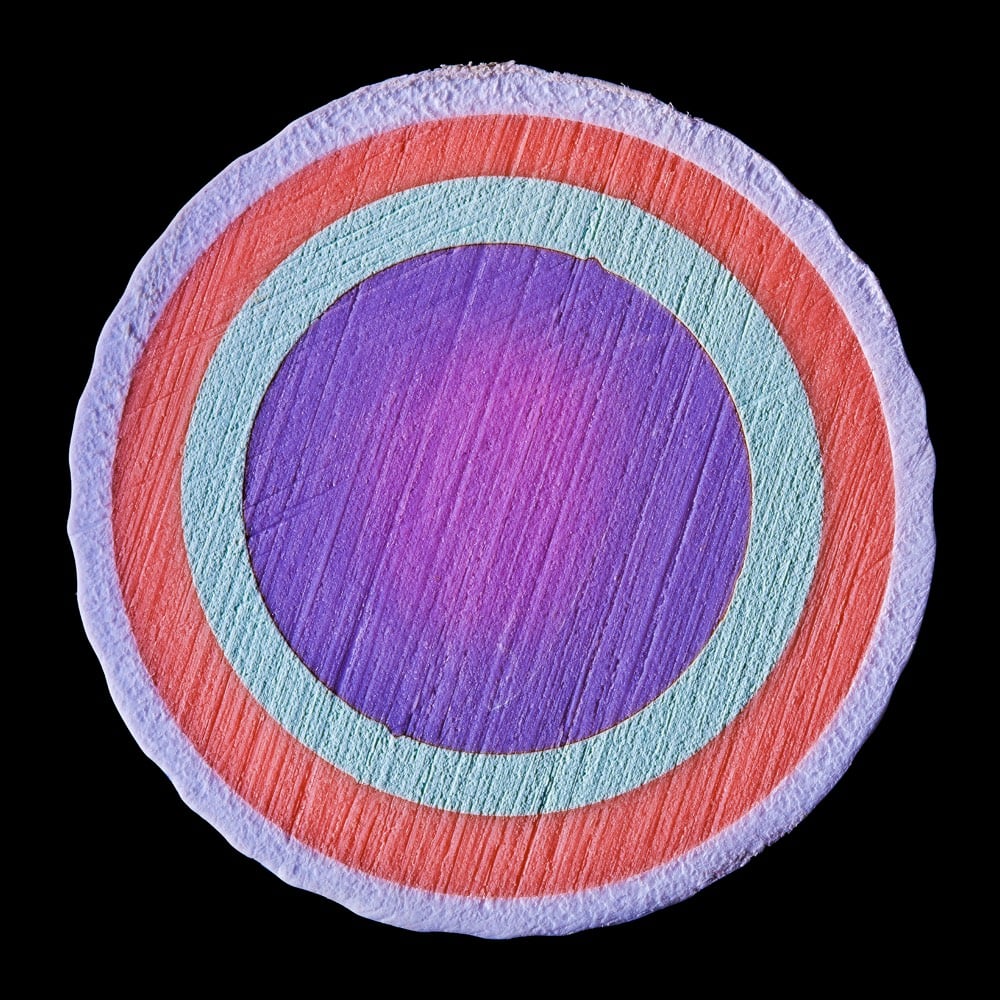
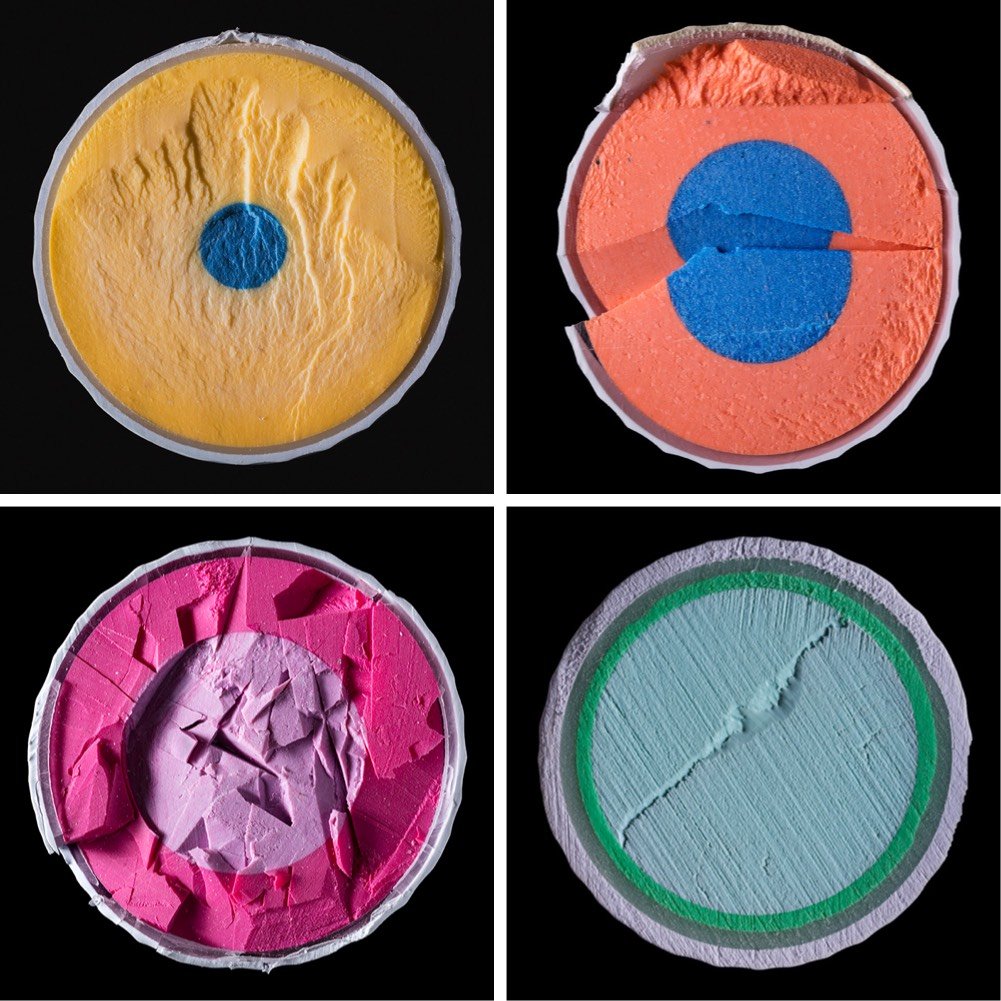
James Friedman is primarily a documentary and street photographer, but for his Interior Design project, he went abstract and captured the insides of golf balls.
For some viewers, my photographs from this series, titled Interior Design, allude to celestial bodies and the sublime. For me, their serendipitous structural exquisiteness and their subtle and passionate arrays of colors have inspired new exploration in my photography; I am particularly delighted to see the diminutive golf balls transformed into 36” x 36” prints.
Incidentally, I do not play golf.
Here’s a 1966 British Pathé film about how golf balls are made (compare w/ a more modern process):
Street photographer Patrick Barr has been out photographing NYC since the 1990s. Barr also goes by the name of Tiger Hood (or Nappy Gilmore) and when he’s out on the street selling prints of his photographs, he passes the time playing a street golf game of his own invention.
It’s a game that requires only three items: a golf club, a newspaper-stuffed milk carton, and a crate. What was initially just a way for Barr to pass time has gained traction from major news outlets and celebrities on a global scale. However, street golf seems to overshadow his true passion… photography. Barr’s archive consists of thousands of mind blowing film photographs of NYC from the 1990’s to 2000’s. His goal was to preserve a time and place that he predicted would dissolve in the coming years. With his archive as evidence, he predicted correctly.
You can find some of Barr’s photos on Flickr and Instagram but if you want to buy a print, you’ll have to catch him on the streets of lower Manhattan.
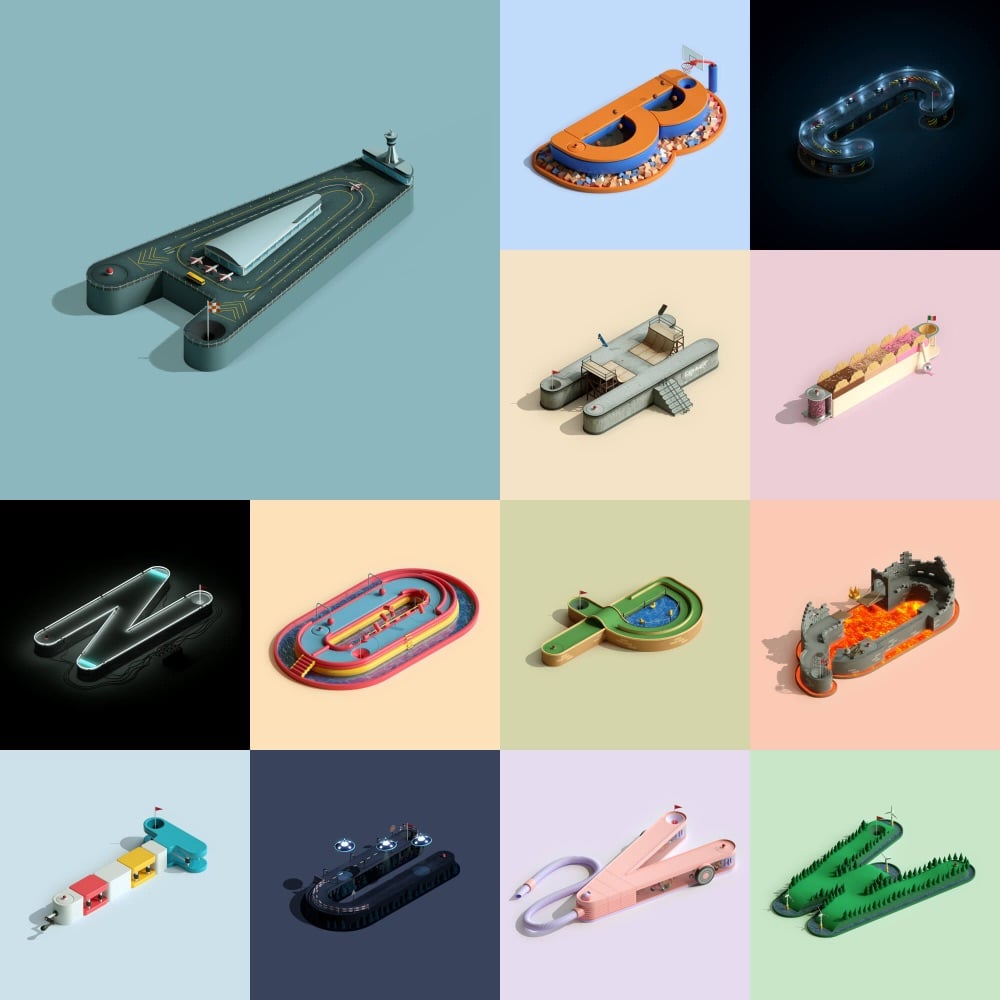
A short video look at the Master’s golf tournament. You know, the one where you get the green jacket for winning. No, not that one…the mini golf one.
True story: I have won a mini golf tournament. It was an 18-hole affair, a 4th of July tourney at a campground in northwestern Wisconsin. At 16, I was the youngest competitor in the adult competition and had never before (or since) shown any aptitude for the game of golf, mini or otherwise. Somehow I beat the defending champion on his home course by one stroke. I declined to turn pro and promptly retired from competition.
Backed up against a fence with no room to swing in a recent tournament, Matt Wheatcroft hit a shot straight out of Happy Gilmore, more miniature golf than golf.
The article about Dan McLaughlin’s quest to go from zero-to-PGA Tour through 10,000 hours of deliberate practice got linked around a bunch yesterday. Several people who pointed to it made a typical mistake. Malcolm Gladwell wrote about the 10,000 hours theory in his book, he did not come up with it. It is not “Gladwell’s theory” and McLaughlin is not “testing Gladwell”. The 10,000 hours theory was developed and popularized by Dr. Anders Ericsson (here for instance) — who you may have heard of from this Freakonomics piece in the NY Times Magazine — before it became a pop culture tidbit by Gladwell’s inclusion of Ericsson’s work in Outliers.
Dan McLaughlin read about the 10,000 hour theory in Malcolm Gladwell’s Outliers — basically that it takes someone 10,000 hours of deliberate practice to become really good at something — and decided to try it for himself. He plans to practice playing golf for six hours a day, six days a week, for six years in order to have a shot at making the PGA Tour. He’s already a year in.
Here’s how they have Dan trying to learn golf: He couldn’t putt from 3 feet until he was good enough at putting from 1 foot. He couldn’t putt from 5 feet until he was good enough putting from 3 feet. He’s working away from the hole. He didn’t get off the green for five months. A putter was the only club in his bag.
Everybody asks him what he shoots for a round. He has no idea. His next drive will be his first.
In his month in Florida, he worked as far as 50 yards away from the hole. He might — might — have a full set of clubs a year from now.
Sport Science recently tested to see whether professional golfer Padraig Harrington could drive the ball further than normal by employing a Happy Gilmore swing.
The good stuff doesn’t get going until around 3:00. The running swing technique increased Harrington’s distance by an average of 30 yards but his accuracy suffered. The split-screen view of his stationary and running swings is amazing…it’s the same swing.
Analyzing data from round-by-round scores from all PGA tournaments between 2002 and 2006 (over 20,000 player-rounds of golf), Brown finds that competitors fare less well — about an extra stroke per tournament — when Tiger is playing. How can we be sure this is because of Tiger? A few features of the findings lend them plausibility. The effect is stronger for the better, “exempt” players than for the nonexempt players, who have almost no chance of beating Tiger anyway. (Tiger’s presence doesn’t mean much to you if the best you can reasonably expect to finish is about 35th-there’s not much difference between the prize for 35th and 36th place.) The effect is also stronger during Tiger’s hot streaks, when his competitors’ prospects are more clearly dimmed. When Tiger is on, his competitors’ scores were elevated by nearly two strokes when he entered a tournament. And the converse is also true: During Tiger’s well-publicized slump of 2003 and 2004, when he went winless in major events, exempt competitors’ scores were unaffected by Tiger’s presence.
Double-blind peer review, in which neither author nor reviewer identity are revealed, is rarely practised in ecology or evolution journals. However, in 2001, double-blind review was introduced by the journal Behavioral Ecology. Following this policy change, there was a significant increase in female first-authored papers, a pattern not observed in a very similar journal that provides reviewers with author information. No negative effects could be identified, suggesting that double-blind review should be considered by other journals.
In the journal Animal Behaviour, biologist Michael Steele at Wilkes University in Pennsylvania examines squirrels’ caching of nuts. While the furry-tailed creatures made a show of digging a hole in the ground and covering it with dirt and leaves when watched, one time out of five they were faking and nothing was buried.
The squirrels’ deception increased after their nut caches were raided.
This is interesting. The PGA offers a non-traditional pension plan for their players that depends on how they perform throughout their careers. Tiger Woods, who performs quite well, could be eligible for almost $1 billion for his retirement if he keeps playing and winning. Billion. Wow.
Tiger Woods is playing the best golf of his career (and possibly anyone’s career) and he’s not getting credit for it because he’s not winning huge against a vastly improved field. “Woods of the ’90s played against great talent hindered by a lack serious training; today, Woods plays against great talent enhanced by serious training. The slack is largely gone, as is the reasonable expectation of double-digit victory.” He’s also come back after slumps due to swing tinkering, marriage, and the death of his father.
Their work, compiled in the “Cambridge Handbook of Expertise and Expert Performance,” a 900-page academic book that will be published next month, makes a rather startling assertion: the trait we commonly call talent is highly overrated. Or, put another way, expert performers — whether in memory or surgery, ballet or computer programming — are nearly always made, not born. And yes, practice does make perfect. These may be the sort of cliches that parents are fond of whispering to their children. But these particular cliches just happen to be true.
Deliberate practice entails more than simply repeating a task — playing a C-minor scale 100 times, for instance, or hitting tennis serves until your shoulder pops out of its socket. Rather, it involves setting specific goals, obtaining immediate feedback and concentrating as much on technique as on outcome.
“Deliberate practice” reminds me of a video game a bunch of my friends are currently hooked on called Brain Age. Available for the handheld Nintendo DS, Brain Age is based on a Japanese brain training “game” developed by Dr. Ryuta Kawashima. The game measures the “age” of your brain based on your performance of simple tasks like memorizing a list of words or addition of small numbers. As you practice (deliberately), you get faster and more skilled at solving these mini-games and your brain age approaches that of a smarty-pants, twitchy-fingered teenager.
Speaking of talented teenagers, this week’s New Yorker contains an article (not online) on Ivan Lendl’s golfing daughters. In it, Lendl agrees that talent is created, not born:
“Can you create athletes, or do they just happen?” [Lendl] asked me not long ago. “I think you can create them, and I think that Tiger Woods’s father proved that. People will sometimes ask me, ‘How much talent did you have in tennis?’ I say, ‘Well, how do you measure talent?’ Yeah, sure, McEnroe had more feel for the ball. But I knew how to work, and I worked harder than he did. Is that a talent in itself? I think it is.”
Translation: there’s more than one way to be good at something. There’s something very encouraging and American about it, this idea that through hard work, you can become proficient and talented at pretty much anything.









Socials & More