




When we last chatted, you and I, about RSS advertising here on kottke.org two years ago, there were only a couple of sites experimenting with advertising in RSS files. Many sites are now putting ads in their RSS/Atom files and several companies -- including Overture and Kanoodle -- are offering or partnering with companies to offer consumers the ability to put ads in their RSS/Atom files.
When banner advertising first appeared on HTML pages, it took several years before browser makers (and 3rd party toolbar makers) gave users the ability to block advertising (both popups and banners).
Given that people who use newsreaders are still of the early adopter sort who are used to blocking ads with Firefox or fast-forwarding through commercials with their TiVos, it seems likely that blocking advertising in RSS/Atom files might soon become an issue. To get the ball rolling on this issue, I asked a few of the major newsreader developers if they would build ad blocking capabilities into their software. Here's what they had to say:
Nick Bradbury, FeedDemon:
I'm not planning any features designed explicitly for blocking ads, but I am planning to add per-feed filters that could be used to filter out ads. For example, FeedDemon would enable you to filter the Boing Boing feed so that only items from a specific author, or items containing specific keywords (or negative keywords), would be shown (or not shown). So, while this is designed as a usability feature rather than an ad-blocking tool, I imagine that more than a few users would configure it to hide ads.
Brent Simmons, NetNewsWire:
The future of aggregators is, in part, about *importance*. Items most important to you should bubble to the top, and items less important should sink to the bottom or just get deleted.
This isn't a function of one specific feature but of a group of features -- smart lists, filters, scriptability, statistics, ratings, searching, and so on -- that are important even if there were no such as thing as ads in RSS/Atom.
I don't expect to get asked for ad-blocking-specific features, since I don't think ad-blocking-specific features will be needed. These already-existing and already-planned features will be highly effective at ad-blocking.
Here's a very simple example of something you can do right now with the many aggregators that let you use a custom style sheet for displaying news items. Say a feed includes graphical ads from some service. You could add a line to your style sheet that says that all graphics from that domain should not be displayed. This feature -- custom style sheets -- doesn't exist to block ads, but it can easily be used to block ads.
The whole point of aggregators is about user control and smarts. Ad blocking is, and will be, just a side effect.
I don't think that ads in RSS are a good idea, anyway. Here's why:
1. If you have a feed with summaries, and the summaries are compelling enough to cause me to go read the full entry on the site -- then I'll actually go to the site and see the ads there. If you don't have a feed, I may *never* go to your site. Even with full-content feeds I often open pages in my browser -- and, again, I end up seeing the ads.
2. Using RSS/Atom feeds increases your readership among webloggers. A weblogger will then link to stories at your site rather than stories at sites that don't have feeds. So feeds can help drive traffic to your site. Including ads in your feed increases the likelihood that people will unsubscribe, and you'll miss out on this effect.
I suspect that people link to the New York Times far more often than they link to CNN, since CNN doesn't have feeds. And I think this is significant. As a feed provider, your goal should be to get people to *link* to your pages: *that's* how you build traffic and ad views.
Erik Barzeski, PulpFiction:
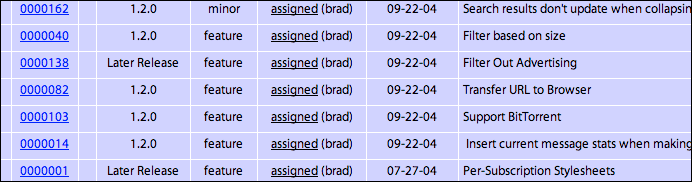
1) We filed this bug report ("filter out ads") before PulpFiction's 1.0 release.
2) there are different kinds of advertising. I've seen advertisements inside of feeds. I've seen posts that are nothing but ads (like every 10th post). And so on. PulpFiction's browser already blocks pop-up ads (optionally), and we hope to let users remove regular ads. However, how difficult this may or may not be is yet to be seen.
3) At current levels I'm seeing, advertising - and filtering them out - simply isn't worth the time. Especially as PulpFiction lets you switch over to simply using permalinks for viewing content if you wish (or switching to it with cmd-D). However, we appreciate that users have a very low threshhold for advertising tolerance, and as such we're monitoring the situation closely.
But really, we have to _see_ more ads before we know just what to filter and remove.
Thanks to Erik, Nick, and Brent for taking the time to answer. I also emailed folks from NewsGator, SharpReader, and Bloglines but got no response...perhaps they and other newsreader makers will respond in the thread.
A few questions related to this issue:
- Do you (or will you) want ad blocking in the newsreader you use?
- Will the structure of RSS/Atom files make ad blocking easier than in HTML or not?
- Newsreader makers...how will you react to pressure from feed advertising companies like Overture or Kanoodle or companies that rely on feed advertising as a revenue stream to encourage you to keep ad blocking capabilities out of your software? Are you worried about getting sued by CNN or the NY Times (for example) if you allow users to block ads in their feeds?
- In the inevitable(?) arms race between ad blockers and advertisements, what happens to the separation between editorial content and advertising? Ads disguised as content are harder to block, but how can the reader distinguish them from content? Are you folks with ads in their RSS/Atom files concerned about that?
Readers like Scott might not like it, but face facts: either you see an ad at the bottom of the post (or every 10th post or whatnot) or we can't afford to produce the content for you- and then we'll have to stop supplying the RSS. Is that what you want?
When CNN starts throwing popup ads at me, I either find another "news" source, or find a tool to block the adds.
If weblog RSS ads start to bother me, I'll say "Dude, your ads are pissing me off."
I don't mind ads if they're useful, as (rarely) they sometimes are. If a feedreader used Bayesian filtering (based on past posts I've lingered on while reading, or posts whose permalinks or content links I clicked on) to suggest to me which other posts might be useful, the question of ad blocking would be relegated to a secondary issue.
Basically, compelling content has always found a business model, either through subscription or ads or patronage. I don't mind ads in great magazines, and sometimes I really like them. Similarly, if I can just have the stuff I care about bubble up in my feedreader, I don't need to block ads.
(Disclosure: I work for a blog tool vendor, and people use our tools to publish ads in their feeds. We don't have an official company policy on the issue, but I really think it's fine.)
I'm not entirely against ads or selling a service or product to support the site, but gosh can't we think of something new besides text ads and banners?
Let's think of new ways to get the message across to the audience, there has to be some ideas out there, anybody?
If I like your content, I don't mind paying for it to get it, but I don't want to be marketed to. If it means losing the RSS feed over, oh well.
This reaction is easy to dismiss as extreme or reactionary, but I wonder if there's something more here. When you're reading 100-200 feeds a day, maybe the content in any particular feed is not worth reading if ads are getting in the way. Scott, are there any feeds you would keep even with the ads?
We'll see what happens when I encounter more.
That said, I would not tolerate "intrusive" ads in my feeds. If I have to scroll to read a feed, it's gone. If I have to put up with ANY type of ad in a summary post, that feed is also gone.
The difference between traditional advertising and internet advertising is that traditional advertising has remained seperate from content (aside from product placement), whereas internet advertising is often a barrier to reaching content. I don't particular want splash screens every X pages, but I'd like to know that I can read my content uninterrupted, even if I do have ads in my peripheral vision.
As a reader I want the best content I can find and don't mind if a content provider puts tasteful, relevant ads that don't flash, make noise, or otherwise distract me too heavily from the content I'm reading. The few RSS feeds I've seen so far with ads have done this successfully for the most part by putting text ads at the bottom of the feed/summary enclosed in colored boxes. As long as advertisers keep things reasonable I think they can achieve exposure and help content providers pay for bandwidth.
Just don't make RSS ads into the pop-up, flashing monstrosities that everyone loathes coming across on the web.
If someone offered an ad remover, I'd use it -- but I don't think it would be a major selling point for me. That is, unless ads get to an obnoxious point like the did in web browsers (hence, pop-up/ad blockers in web browsers).
Ad blocking then becomes a problem itself, because I generally use RSS feeds to browse information I find interesting, and would prefer not to impose limits on viewed content if I am going to have to filter out disguised ads. I would, however, be willing to sacrifice content for speed. Though, I wouldn’t likely be interested in a feed that inserts ads under the guise of content either.
I like my XML clean and simple. Anyone have any examples of true ads in RSS?
Note: I prefer using Firefox’s Sage Extension for RSS, and don’t have much experience with (or interest in) stand-alone readers.
Businesses putting ads in their company blog feeds (see: 37signals) is rediculous if the blog is supposed to drive sales, especially when the ads are completely irrelevant.
Btw, there's some decent discussion along the same lines at svn. So long as RSS ads are image-based, Firefox + AdBlock + Bloglines means I don't have to see them.
As a reader of lots of feeds, and a purchaser of goods, if BoingBoing (just as an example because it was used above, and because I realize they have a higher overhead than the everyday hobbyist blogger) wants to create a separate feed for ads, I'll be happy to subscribe to it, and probably even buy a thing or two or more. But, if they put ads in with their regular articles, chances are I won't click on the ad.
There are several different business models around RSS feeds, and only some of those include advertising. It's definitely too early to see how things will shake out in that regard, and we're not actually giving it all that much thought right now. We're focused on making the service as easy to use as possible and attacking what we call the 'second-order' information overload problem.
I used to subscribe to the feed of a certain magazine. I got so much excellent content from them! They were certainly doing me a favour, so I did them a favour by buying their magazine on the newsstand every month. I felt I owed them something.
Then they put ads in the feed. I no longer buy that magazine, and no longer read the feed.
Content providers want to advertise so they have a revenue stream. It doesn't matter if we want to see the advertising, and it doesn't matter if the advertising is relevant. It's a lot like television in that regard. It doesn't really matter if we don't watch commericals, or if I skip past the commercials. As long as they get paid, that's all that matters.
But honestly, isn't everyone just a little tired of being advertised to all the freaking time. I don't pay any attention to the ads that float around on most people's pages. None. And with Firefox getting rid of ads has never been easier. So on Jake's site I'm "missing" two New School ads, a Build Your Own Pop Art Tomato Table ad, a the Killers Hot Fuss ad. I dunno, I guess I'm okay with that.
So, I guess I'd like a choice on whether ads are displayed in my newsreader. If I'm not given one, at some point I'll probably roll a custom stylesheet to take care of it. Scoble reads 950+ feeds. I read 50. If one goes away, I've got hundreds of other options..
It's quite interesting you've written this post because yesterday I deleted two RSS feeds which had extremely large (approx. 500px in width) ad's at the bottom of their feeds.
But to answer your question, I'm subscribed to 100 or so RSS feeds and the only feeds I wouldn't delete (if they had advertising) would be from my ISP (advisories). I consider advertising in weblogs to be on a par with spam and quite frankly I'm getting a little tired of it. Some people are advertising because the next person is.
And this next remark may attract a little criticism however if you cannot afford your bandwidth/hosting costs then I think you should be considering other options (besides advertising) and reassessing if your primary product can cut the mustard or not.
Finally, I think Brent Simmons (NetNewsWire) is spot on with his remarks.
One thing I've noticed lately is that people are paying others to put up text links not to get the customers but to generate better Google Page Rank. I wonder how Google will treat RSS in the future.
Would you remove him from your feedreader? I bet you won't. If the content is valuable to you I assume that you'd have no problem with supporting the publisher (in-)directly by accepting advertisements.
Well, all in all, removing revenue streams from publishers reduces their work to the level of enthusiasts doing this as a hobby. But I am sure that they would appreciate financial support for their creations.
Aggregate many rss feeds (thousands) and diff them to find similar content (i.e. similar ads). Users can then subscribe to an RSS feed that contains only ads which are used as identifiers of ads in other feeds.
With such a feed you can use the functionality available in feed demon to strip out unwanted content
I understand that I'm not paying for the RSS feed itself but somewhere someone is and so a little advertising to keep it free to me isn't a problem.
In particular, you can remove the Feedburner/Overture ads from the Signal Vs. Noise feed by adding this pattern to Adblock:
http://feeds.feedburner.com/~a/*
I haven't seen any adds in my feeds the SvN crew decided to add then to their feeds. Adblock took care of removing anything coming from Feed Deamon.
Scott said:
And this next remark may attract a little criticism however if you cannot afford your bandwidth/hosting costs then I think you should be considering other options (besides advertising) and reassessing if your primary product can cut the mustard or not.
And I couldn't agree more. Your viewers and readers and troves of adoring fans have enough going on in heir own lives that they don't need you or your content. Blogging is a privileged hobby and should be treated as such. I don't think I know anyone personally who is paid to blog - they tend to have a "day job" that allows them to blog but it isn't specifically their job. So it's a little hard to be sympathetic to the crocodile tears of "but we have to pay for bandwidth - what about the bandwidth!?"
Advertising is not always the solution to every financial problem that people have. I have a question for these kids: When your mother calls you to talk to you do you make her listen to an ad before she says she loves you? I mean, it's your content and "what about the phone bills!?!"
i have real doubts that RSS readers account for 50% of our readers- in fact, I'd say they account for less than 10% right now- the high bandwidth is mainly due to a bunch of RSS software that is improperly set up to grab the same feed every minute or whatnot.
so pardon me if i don't feel like footing that RSS bill out of my own pocket. and pardon me if i think one unobtrusive text ad at the bottom of each post is perfectly just- we're not talking about 500px flash boxes here.
RSS Ads are only worth discussing if full posts are supplied in the feed. Otherwise, the excerpted post is the ad.
Nick says:
When are we actually going to start thinking about new ways of selling products and/or services to people browsing the web?
Many people don't want to sell anything. They want to provide their content, not sell it, and they look at advertising as a form of sponsorship for that content.
My suggestion to the content providers who have a large portion of their audience blocking advertising (whether it be on the web, or in a feed) is to offer a low-cost premium model with no advertising as one of the benefits (if not the only benefit).
The ads in magazines follow this rule.
also, i want to be more precise about my data points above. on gothamist.com:
- our html pages loaded 1.2 million times in november
- our RSS pages loaded 0.4m times in november
- the two types of page loads cause the same strain on the server, b/c we do full posts in our RSS with images
so it's really only about 1/3rd of the load on the server, not 1/2- but that's still pretty high. we're going to introduce very unobtrusive text ads in our rss later this week- i'll report back on the feedback.
I have bought things from email-list reviews, blog reviews, contest-prize winners telling us about their prize, and even tutorial writers/how-to writers that used a product.
I'm also more likely to purchase something from companies that donate to charities and good causes.
I block pops and animated ads; I do not block text ads or reviews.
Instead of spending money to alienate potential customers by annoying us, give your product away to trusted reviewers, contests, charities/good causes, tutorial writers, ect...
Also, I'll be the annoying person that points out that 0.4m hits out of 1.6m hits (0.4 + 1.2) is only 1/4 of the total load.
I hate annoying ads. There are better ways to market to me.
And if you're giving out a summary/excerpt feed, odds are that I will go to your site to finish reading your post and you'll get the ad impressions from that. Should you wish to subject me to ads in both places, well that's just greedy.
1. RSS adverts go the wrong way
Most people use RSS (currently) to distill information: content+stuff -> content. Injecting advertising or any other non-content info goes directly against the grain (salmon-style).
2. RSS adverts will not (most likely) be easily ignorable
What is the difference between obnoxious/non-obnoxious advertising?
Obnoxious:
- tv/radio
- naming rights (petco park/continental tire bowl)
- web (shoot the duck & win an ipod)
Non-obnoxious:
- magazine/newspaper
- billboards/signage
- direct mail
- web (visually-separate text ads)
Obnoxious advertising takes time/effort to ignore. It forces the issue even when you need/want to be focused on the real content.
Non-obnoxious advertising is ignorable. I don't have to stop and read every highway billboard if I need to give full attention to the road. Rolling Stone mag is still readable even though it's 60% adverts - the ads get their own page (usually) and are often more compelling than the actual content.
As long as ads are clearly ads, I see nothing wrong with feed providers recouping their costs.
RSS IS BEST USED AS A NOTIFICATION TECHNOLOGY, DAMNIT!
Keep your ads on your site. Keep your feeds ad-free. The feed IS the ad for the content on the site. If users are interesting in the excerpt they read in the feed, make them click over to your site and then collect all sorts of revenue there.
People need to realize that economically speaking, WHEREVER there is content, there will be ads (or subscription fees). Therefore, we must keep full content out of the RSS realm or else we will pollute it. People need to be a little less selfish with their consumption habits and realize that it isn't their right to view all the content in the world free of charge (or ad impressions).
I find Engadget's approach of a two line addition to the end of the description in the style of AdSense acceptable. But what annoys me is that the Ads have no relevance to the article. This is actually a problem with AdSense as well. Google tries hard but all too often the Ads fall back to a default for the whole site.
And getting context is particularly hard for RSS when it's being consumed within minutes of the post being made rather than days.
now this is journalism for the new millenium! we now have 'articles' as working, evolving articles (posts?-what is the nomenclature for internet/blog journalism?)
Thanks to Erik, Nick, and Brent for taking the time to answer. I also emailed folks from NewsGator, SharpReader, and Bloglines but got no response...perhaps they and other newsreader makers will respond in the thread.
http://phaedo.cx/archives/2004/12/07/rssproxy-01/
Not so much a matter of making the content into advertising or burying it, but of making it obviously advertising, and making it worth reading - ie, targeting and providing entertainment value.
To Julian Bond (sorry to single you at as most recent) and the others who are looking for the good in RSS Ads, I would like to say personally I feel that an advertisement in my feed would go opposite of the entire reason I subscribed to a feed to begin with. Newsfeeds let you quickly check dozens of sites for updates, and then quickly get to those sites to see the said update. It would only take a handful of times of an "update" being just a new ad in the feed to make me unsubscribe. Inserting advertisements into a news feed just seems opposite to the entire reason you would offer a feed to begin with.
Before popup blockers became common, I simply did not go to sites that used popups. It isn't extreme or reactionary to say "it's gone", and nobody has to accept the "inevitability" of instrusive advertising. Just don't use services that annoy you and let the market forces fix it.
People use RSS to save time and escape annoyances or limitations. Prettymuch the advertisers do not matter if the writers and readers do not find a happy medium. Larger and bigger and more annoying will not be the answer.
Most businesses have loss liters or items that they do not directly obtain adequate compensation for (example: printer companies may lose money on the printers and make money on the ink cartridges).
I think what is really lost in the idea of RSS advertising is that it forgets the value of or who the readers are.The idea that one needs to gain money from an RSS feed forgets what two most valuable thing on the web are: audience and links.
Currently many RSS subscribers probably also do a good bit of writing. If you write useful and interesting stuff you will acquire a ton of links from your RSS readers free of charge. You may think that the links are no big deal, but they do drive direct traffic, and they are amazingly powerful in search algorithms.
Consider how much link brokers (such as text-link-ads.com or textlinkbrokers.com) charge for links, then think about the fact that if your content is good and people link to it you probably do not have to spend too much on advertising.
Jeremy Zawodny recently made a joke post about getting Rolex and Viagra spam.
http://jeremy.zawodny.com/blog/archives/003052.html
Without much linking to his post it almost immediatly ranked on page 4 of Google for Viagra and it is still on the first page of Google for Rolex.
http://www.google.com/search?q=rolex
If he wanted to and asked some of his readers to link to that post it would rank even better. The links you acquire give you a powerful voice both directly and indirectly and for most people will more than pay for themselves.
If you are a business who needs to make money the link citations you get from RSS subscribers usually will more than pay for themselves.
If you are just a hobby site without a business model then you really shouldn't have that much overhead. If hosting fees are killing your hobby site ask a friend if they know any quality web hosts that want dirt cheap marketing (a friendly hosted by link on your site) and they will probably gladly host your site for free. Blogger also is free.
I totally agree with the people who say the post is the ad. I think those who feel the need to make money from the RSS readers are not considering the fact that these same readers who are not paying them anything are also providing them with a large part of their advertising free of charge.
Over time RSS will go more mainstream, but so long as you are using RSS for the summary of the posts you still are not out anything.
Maybe you get too negative reactions for ads in feeds these days.
I think that the common user will be accepting ads much more.
I do however think that the content providers needs to be very aware. Advertising can be very annoying if done wrong. This would make subscribers flee and thereby defy the whole purpose.
I think advertising is inevitable in RSS, it's as simple as serving data costs money, advertising pays for it. There will of course be a fine line between what is an acceptable amount of advertising and what isn't. Feeds that are full of 'junk headlines' are going to be quickly discarded, as are feeds that put large flashing banners into their summaries.
As aggregators evolve headlines will start to be displayed more and more based upon filtering and query matching, but as the spam problem has demonstrated there are no 100% safe ways of blocking ads and if there were, there is the risk that feeds may simply be turned off if they cost more to operate than they generate.
What I'd suggest is that the big shots in the RSS and Atom worlds get together and draw up a set of guidelines for content providers who wish to use RSS/Atom as an additional source of advertising revenue.
RSS readers could then choose to enforce those guidelines (e.g. no flash banners in summaries, no more than x number of ads per feed, per day). Something like this would give content providers a fair shot at making some money from their content without annoying their readership.
I'd rather only get teaser content in the feeds and have the ads on the site, though. It keeps the rss bandwidth down (or lowers it further) and puts pressure on the publishers to give me compelling content in their feeds. Compelling content == page view == ad view == revenue.
It also maintains the status quo for ad technology (which may or may not be good depending on your viewpoint).
I think ads become more and more intrusive, no matter what is the means to deliever it. I am very annoyed by those Flash ads that pops in the middle of web page.
This thread is closed to new comments. Thanks to everyone who responded.

