kottke.org posts about cameras
Photographer Sails Chong recorded something we don’t hear much of these days: the sounds of camera shutters. Accompanied by a song by Arcade Fire from the Her soundtrack, Chong presents the shutter sounds of 18 different cameras, from 35mm all the way up to large format cameras. Interestingly, the lineup does not include the iconic Leica shutter sound — “a photograph sounds like a kiss”. (thx, david)
The X27 camera takes videos in darkness that looks like they were shot in the daytime. And they’re in color…none of this black and white, thermal, or infrared stuff. The camera was developed for military use, has an effective ISO rating of 5,000,000, and has a comically long name: “X27 Reconnaissance Day/Night high Fidelity true real time low light/low lux color night vision Imaging Security / Multi Purpose camera system”. Pricing information is not available, but I bet you’re paying for every single one of those words. (via digg)
We’ve been using Eyefi cards to upload photos from the kids’ cameras to Flickr. Matt Haughey has a review of their newest card, the Eyefi Mobi, which automagically syncs to your phone, resulting in a 20-second DSLR-to-Instagram workflow.
In essence, the card turns any dumb camera into an outboard lens for your phone. Last week on a trip to NYC I took my new compact camera with me and could easily upload photos to Instagram and Twitter within seconds of taking the photos. I mean that literally: I can take a photo with my camera, open up my phone, touch the mobi app icon and about ten seconds later I can be saving that image to my phone’s camera roll. I could also manipulate and tweak the images in a plethora of iPhone apps like VSCOcam, Photoshop Express, etc. directly on the phone before sharing it out to the world.
This sounds amazing. Step one for me: get a camera. Any suggestions? I’ve been eyeing Fujifilm’s X100S for quite awhile…
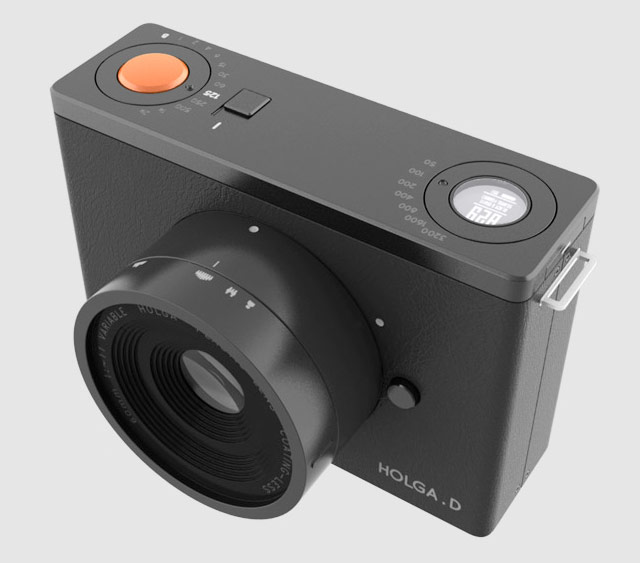
The Holga is a cheap toy camera with a simple lens that takes pictures prized by some for their happy accidents (light leaks, distortions, etc.). The Holga D is a concept that translates the Holga experience to digital.
From the front it may look like just another digital camera, may be a bit minimal, but the backside is surprising, as it does not have a display!
Even though Holga D is a digital camera, in order to achieve its simplicity, it reduces the feature set to absolute minimum.
Even the display is not there! So your photographs remain mysterious until you download the images. This makes the experience quite similar to the good old film based cameras.
(via buzzfeed fwd)
Well, not quite. But the specifications are quite impressive:
The headline specifications are a new 22.3 Megapixel full-frame sensor with 100-25600 ISO sensitivity (expandable to 102,400 ISO), 1080p video at 24, 25 or 30fps and 720p at 50 or 60fps, a 61-point AF system (with 41 cross-type sensors), 6fps continuous shooting, a viewfinder with 100% coverage, 3.2in screen with 1040k resolution, 63-zone iCFL metering, three, five or seven frame bracketing, a new three-frame HDR mode, microphone and headphone jacks and twin memory card slots, one for Compact Flash, the other for SD; the control layout has also been adjusted and the build slightly improved. So while the resolution and video specs remain similar to its predecessor, the continuous shooting speed, AF system, viewfinder, screen and build are all improved, and again there’s the bonus of twin card slots.
DP Review and the Verge also have reviews and it’s available for preorder on Amazon for, whoa, $3500 (the kit lens is $800 more)..
This handsome fellow is the Kodak Bantam Special, a limited-edition camera from 1936.
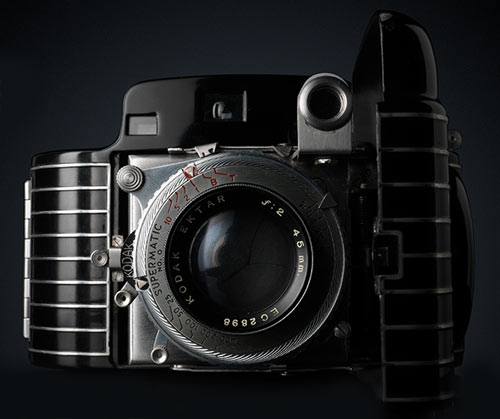
Manufactured by Kodak, designed by Teague. (via monoscope)
Now that the Flip has released their handheld digital HD video camera, here’s a little rundown of the offerings currently out there and coming soon.
Kodak Zi6 - 128MB of built-in memory, expandable to 32GB, 720p, 1280x720 at 60 fps, 2.4 in. LCD, AA rechargable batteries. $180. (Video sample.)
Flip Video MinoHD - 4GB of built-in memory (~60 min of video), 720p, 1280x720 at 30 fps, 1.5 in. LCD, very slim handheld. $229. (Video sample.)
Nikon D90 SLR - expandable SD memory, 720p, 1280x720 at 24 fps for 5 minutes at a time, 3 in. LCD, and almost every single setting and control that’s available on a SLR camera. $1200. (Video samples.)
Canon 5D Mark II SLR - expandable CF memory, 1080p, 1920x1080 at 24 fps for 30 minutes at a time, 3 in. LCD, and almost every single setting and control that’s available on a SLR camera. $2700. (Video sample.)
Red One - Not going to list the specs on this one, except to to say that you can shoot whole feature length movies on this thing at a higher resolution for less money than pretty much any other camera out there, digital or otherwise. $17500. (Gorgeous video sample.)
Lots of people love the Flip video camera for its smallness and ease-of-use but Kodak looks like they may one-up the Flip with the Zi6. The real attraction of the slightly more expensive Zi6 is that it shoots in 16x9 HD at 720p. The Kodak site says the camera is due out in August but the pre-order page at Amazon says October 1. Retail price is $180. We never pulled the trigger on the Flip so getting this to record video of Ollie is a no-brainer. (via df)
Mike Johnston on the camera he would like to own, a decisive moment digital (DMD) camera.
So there you have it: a small, light, unobtrusive carry-around camera with great handling and world-class responsiveness, capable of being used in all manner of lighting conditions and yielding DSLR-quality results on the gallery wall. The 21st-century equivalent of Henri Cartier-Bresson’s stealthy street-shootin’ Leica.
Demo film of the Polaroid SX-70 made by Charles and Ray Eames but set to a soundtrack of The Cramps performing Garbageman. Wot? (via spurgeonblog)
The sound of a Leica shutter.
When you take a picture with an S.L.R., there is a distinctive sound, somewhere between a clatter and a thump; I worship my beat-up Nikon FE, but there is no denying that every snap reminds me of a cow kicking over a milk pail. With a Leica, all you hear is the shutter, which is the quietest on the market. The result — and this may be the most seductive reason for the Leica cult — is that a photograph sounds like a kiss.
That’s Anthony Lane in the New Yorker.
Leica is offering a “perpetual update program” for its M8 digital camera.
In keeping with these proud traditions, but now in the age of digital technology, Leica introduces it’s perpetual update program which makes the LEICA M8 a digital camera in which, uniquely, owners will be able to incorporate the latest refinements and developments in technology. While other digital cameras quickly become outdated and are replaced by new models, Leica’s new concept allows it’s customers to invest in the photographic equipment they need sure in the knowledge that they will not miss out on improvements and technological developments in the future.
The first upgrade adds a hard-to-scratch sapphire glass LCD screen cover and a quieter shutter.
Update: Just to be clear, the upgrade program costs money. According to Gizmodo, the first upgrade is $1800. On the plus side, each time you upgrade, they extend the warranty on the whole camera for two years.
An examination and celebration of the Leica by Anthony Lane in this week’s New Yorker.
Asked how he thought of the Leica, Cartier-Bresson said that it felt like “a big warm kiss, like a shot from a revolver, and like the psychoanalyst’s couch.” At this point, five thousand dollars begins to look like a bargain.
Exploring the Leica web site after reading the article, I was intrigued to learn of Leica’s á la carte program for customizing an MP or M7. Tempted… There’s also a limited edition titanium M7 that retailed for ~10,000 euros.
Instead of megapixels-worth of light sensors, a new experimental camera uses a series of mirrors to focus all the light on just one sensor. Somewhat related question that I’ve been wondering about for awhile: why do digital cameras need shutters? Why can’t you just turn the sensors on and off electronically? Seems like you could then use many more arbitrary “shutter” speeds, like 5 seconds or 1/50000 of a second.
LifePixel will modify your digital camera (Nikons or Canons, mostly) to shoot in infrared. “Camera manufacturers stop infrared light from contaminating the images by placing a hot mirror filter in front of the sensor which effectively blocks the infrared part of the spectrum while still allowing the visible light to pass. We remove this hot mirror filter and replace it with a custom manufactured infrared filter.”
New Yorker piece on Clifford Ross’ new camera, a “high-resolution digital video camera that shoots in three hundred and sixty degrees”. Ross is one of my favorite contemporary photographers.
Quick review of the Nikon D80, the successor to the popular prosumer D70 SLR. 10 megapixel, but still no wifi.
Advice for cleaning the CCD image sensor on Nikon digital SLR cameras. Doesn’t look that scary….does anyone have any experience doing this? My D70 needs a little TLC in this area.
Nikon has issued a recall for certain batteries used in the D100, D70, and D50…the battery has a flaw that may cause it to overheat and melt. Check the site for your battery’s lot number to see if you’re affected.
Several companies who manufacture digital cameras have issued “silent recalls” due to a faulty chip distorts photos when it fails. Sony, Canon, Nikon, Olympus, and others are affected. Digital Photography Review has more; here’s the Nikon D2H & D70 advisory. (A “silent recall” isn’t an official recall…the companies are only repairing items in which the faulty chips fail.)
Update: Eliot sez: That’s the wrong service advisory for Nikon…it’s an unrelated problem. Here’s the related advisory…doesn’t affect any of their dSLRs.
Neat visual history of Nikon SLR cameras. It would be neat to make an animation of how the cameras changed through time.
Story of how Kodak developed the first digital camera in 1975 and then sat on the technology for years and years until they finally entered the market and, luckily for them, were able to grab the top stop from Sony and Canon.
Nikon is releasing a pair of digital cameras with built-in wifi. The cameras will only send photos via wifi to a designated Nikon application, but I wonder how long it will be before someone hacks the firmware to send those photos anywhere…like to Flickr on the fly.
Barcode tattoos + mobile phones with cameras = business card (or, say, a list of your sexual preferences) on your arm.
Older posts





Socials & More