kottke.org posts about universe
The length of a human life is around 80 years. You might get 100 if you’re lucky. The universe is about 13.7 billion years old. The vast difference between a human lifespan and the age of the universe can be difficult to grasp — even the words we use in attempting to describe it (like “vast”) are comically insufficient.
To help us visualize what a difference of eight orders of magnitude might look like, Wylie Overstreet and Alex Gorosh have created a scale model of time in the Mojave Desert, from the Big Bang to the present day. This is really worth watching and likely to make you think some big think thoughts about your place in the universe and in your life.
This is a followup of the scale model of the solar system they built and a video they made about people seeing the Moon through a telescope for the first time.
See also a behind-the-scenes: How We Built a Scale Model of Time. (via colossal)
John Boswell has made a 10-minute time lapse video showing the history of the universe, from its formation 13.8 billion years ago up to the present. Each second of the video represents the passing of 22 million years. But don’t blink right near the end…you might miss the tiny fraction of a second that represents the entire history of humanity.
See also: Boswell’s Timelapse of the Future, a dramatized time lapse of possible events from now until the heat death of the universe many trillion trillion trillions of years from now.
One of my favorite Wikipedia articles is the timeline of the far future, which details the predictions science makes about the possible futures of the Earth, solar system, galaxy, and universe, from Antares exploding in a supernova visible from Earth in broad daylight in 10,000 years to the end of star formation in galaxies 1 trillion years from now…and beyond.
In his new video, Timelapse of the Future, John Boswell takes us on a trip through that timeline, a journey to the end of time.
We start in 2019 and travel exponentially through time, witnessing the future of Earth, the death of the sun, the end of all stars, proton decay, zombie galaxies, possible future civilizations, exploding black holes, the effects of dark energy, alternate universes, the final fate of the cosmos — to name a few.
A regular time lapse of that voyage would take forever, so Boswell cleverly doubles the pace every 5 seconds, so that just after 4 minutes into the video, a trillion years passes in just a second or two.1 You’d think that after the Earth is devoured by the Sun about 3 minutes in, things would get a bit boring and you could stop watching, but then you’d miss zombie white dwarfs roaming the universe in the degenerate era, the black hole mergers era 1000 trillion trillion trillion trillion years from now, the possible creation of baby “life boat” universes, and the point at which “nothing happens and it keeps not happening forever”.
In a Twitter thread, author Oliver Morton compares the physical scale of the Universe with its age (from the perspective of humans).
If a human life is 70 years long, there has been room for 200 million lives since the big bang, but 200 million humans, end to end, would reach just a bit further than the moon. If you had started walking towards the centre of the galaxy on the day of the big bang (had there been days, you, paths & galaxies), you would have got about 20 parsecs by now: just 0.25% of the way.
Maybe walking pace is the wrong metric. A nerve impulse travels around 70 times faster than a person walks. But even at the speed of thought, the age of the universe is too small for something to have reached the centre of the galaxy.
The situation is even worse when you choose another reference object, like UY Scuti, the largest known star. The red hypergiant is nearly 1.5 billion miles across and, because of its size and position near the center of the galaxy, is probably around 13 billion years old, just a few hundred million years younger than the age of the Universe itself.
Even if you use light as a marker, the size of Universe remains unfathomably immense. Over the course of the Universe’s lifetime, a photon could have travelled 13.8 billion light-years, just 15% of the current estimate of the Universe’s diameter of 93 billion light-years. See also what are the physical limits of humanity?
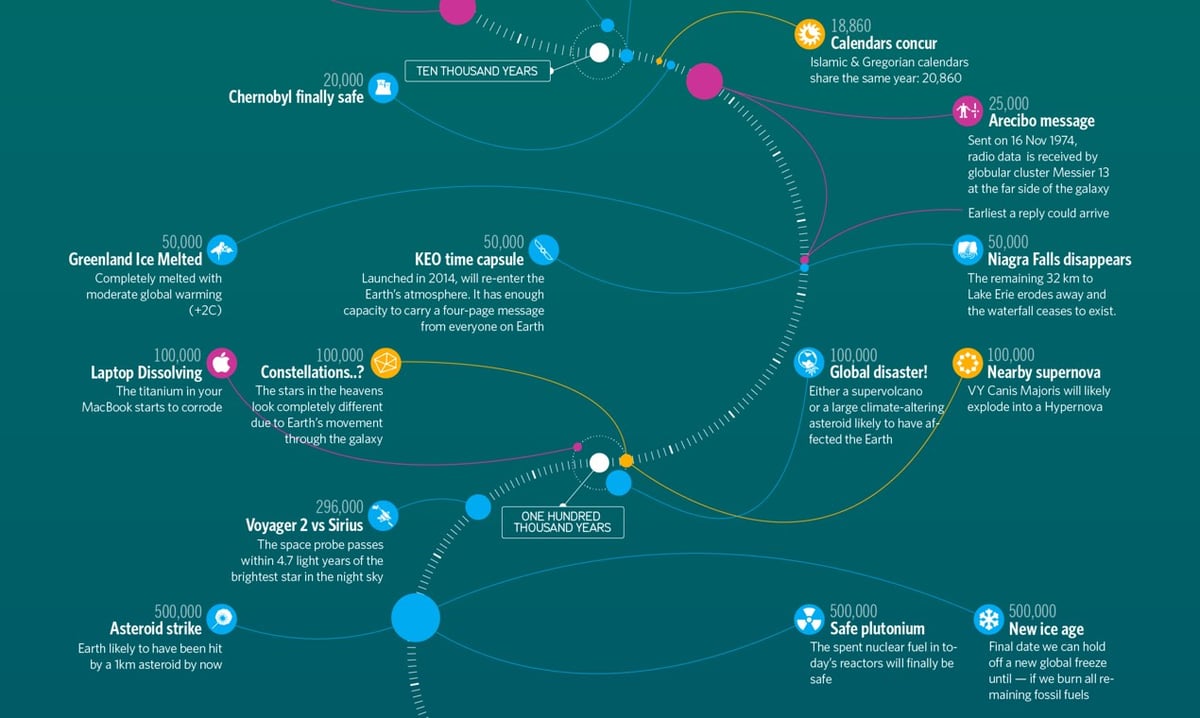
Timeline of the far future is one of my favorite pages on Wikipedia. It details what might happen to humanity, human artifacts, the Earth, the solar system, and the Universe from 10,000 years from now until long past the heat death of the Universe. Information is Beautiful has made a lovely infographic of the timeline.
Reading through the timeline is a glorious way to spend time…here are a few favorites I noticed this time around as well as some from my first post.
August 20, 10,663: “A simultaneous total solar eclipse and transit of Mercury.”
20,000 years: “The Chernobyl Exclusion Zone, the 1,000 sq mi area of Ukraine and Belarus left deserted by the 1986 Chernobyl disaster, becomes safe for human life.”
296,000 years: “Voyager 2 passes within 4.3 light-years of Sirius, the brightest star in the night sky.”
1 million years: “Highest estimated time until the red supergiant star Betelgeuse explodes in a supernova. The explosion is expected to be easily visible in daylight.”
1 million years: “On the Moon, Neil Armstrong’s ‘one small step’ footprint at Tranquility Base will erode by this time, along with those left by all twelve Apollo moonwalkers, due to the accumulated effects of space weathering.”
15.7 million: “Half-life of iodine-129, the most durable long-lived fission product in uranium-derived nuclear waste.”
100 million years: “Future archaeologists should be able to identify an ‘Urban Stratum’ of fossilized great coastal cities, mostly through the remains of underground infrastructure such as building foundations and utility tunnels.”
1 billion years: “Estimated lifespan of the two Voyager Golden Records, before the information stored on them is rendered unrecoverable.”
4 billion years: “Median point by which the Andromeda Galaxy will have collided with the Milky Way, which will thereafter merge to form a galaxy dubbed ‘Milkomeda’.”
7.59 billion years: The Earth and Moon are very likely destroyed by falling into the Sun, just before the Sun reaches the tip of its red giant phase and its maximum radius of 256 times the present-day value. Before the final collision, the Moon possibly spirals below Earth’s Roche limit, breaking into a ring of debris, most of which falls to the Earth’s surface.
100 billion years: “The Universe’s expansion causes all galaxies beyond the Milky Way’s Local Group to disappear beyond the cosmic light horizon, removing them from the observable universe.”
When I was born 35.2 years ago, a light cone started expanding away from Earth out into the rest of the universe (Minkowski space-temporally speaking, of course). Thanks to updates from Matt Webb’s fancy RSS tool, I know that my personal light cone is about to envelop the Zeta Herculis binary star system, located 35.2 light years from Earth in the constellation Hercules.
With a mass some 50 percent greater than the Sun, however, and beginning its evolution toward gianthood (its core hydrogen fusion likely shut down), Zeta Her A is 6 times more luminous than the Sun with a radius 2.5 times as large. Nevertheless, the star gives a good idea of what the Sun would look like from a great distance, in Zeta Her’s case 35 light years. The companion (Zeta Her B), a cooler class G (G7) hydrogen-fusing dwarf with a luminosity only 65 percent that of the Sun and a mass about 85 percent solar, orbits with a period of 34.5 years at a mean distance of 15 Astronomical Units (over 50 percent farther than Saturn is from the Sun). A rather high eccentricity takes the two as far apart as 21 AU and as close as 8 AU.
Hercules is of course named for the Greek hero, Heracles. Next up is Delta Trianguli, another binary star system, in about two months.
Is the universe fractal-like, even on large scales? A group of Italian and Russian scientists argue that it displays a fractal pattern on a scale of 100 million light years. Other scientists aren’t so sure.
Many cosmologists find fault with their analysis, largely because a fractal matter distribution out to such huge scales undermines the standard model of cosmology. According to the accepted story of cosmic evolution, there simply hasn’t been enough time since the big bang nearly 14 billion years ago for gravity to build up such large structures.
Are there many small galaxies, like the one just discovered just outside our own, orbiting the larger visible galaxies?
Three trillion years from now, the universe will be observably static, the Milky Way alone, and scientists of the day likely won’t be able to “infer that the beginning involved a Big Bang”.
According to the Ussher-Lightfoot Calendar, today is the 6,009th birthday of the universe. Based on James Ussher’s interpretation of the Bible, God created “the heaven and the earth” on October 23, 4004 BC. Happy birthday, everything!
Note: I’m doing Mr. Ussher’s precise chronology a disservice by fudging the Julian calendar date that he derived with the Gregorian calendar we now use. For that, I apologize.
Maybe the universe is a trillion years old and has experienced several big bangs and big collapses over the years. “People have inferred that time began then, but there really wasn’t any reason for that inference. What we are proposing is very radical. It’s saying there was time before the big bang.”





Socials & More