kottke.org posts about fractals
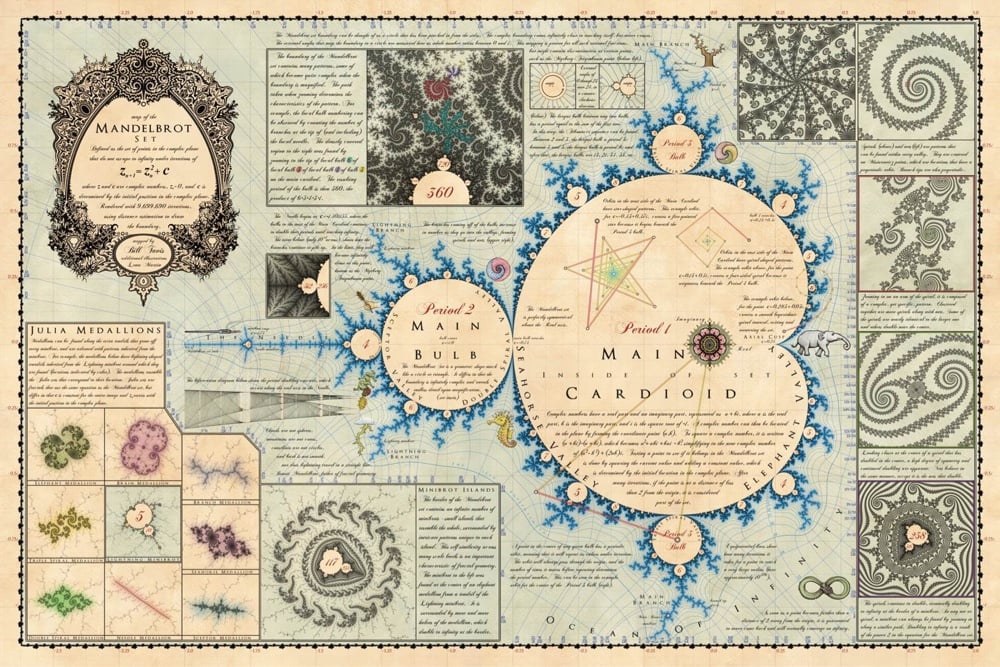
Bill Tavis designed this lovely vintage-style map of the familiar fractal shape, the Mandelbrot set. He is selling a poster version of the map, starting at the very reasonable price of $24. I don’t usually highlight the price on this sort of thing, but an unauthorized seller on Amazon was selling poor-quality counterfeits of the map and even though it wasn’t his fault, Tavis offered to replace any of the crappy maps for free. Great map, and apparently a great human who made it.
I found Tavis’s map when I was searching for the creator of this similarish map that I found on Twitter (bigger here).
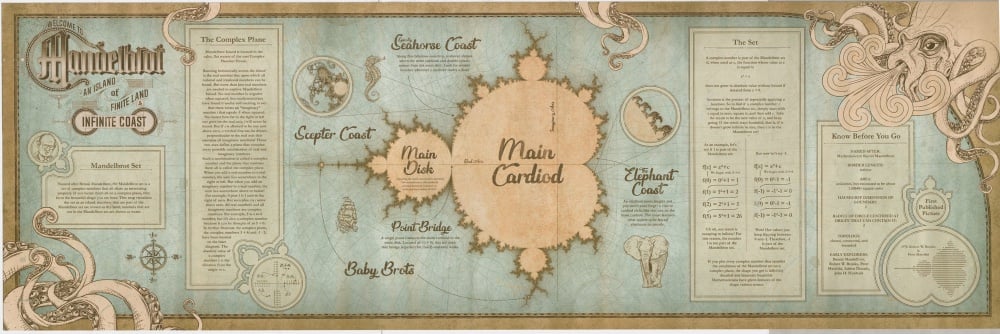
Anyone know who made this version? Jonny Laser made the map in the second image for VSauce (scroll down a bit). (thx, kirsten)
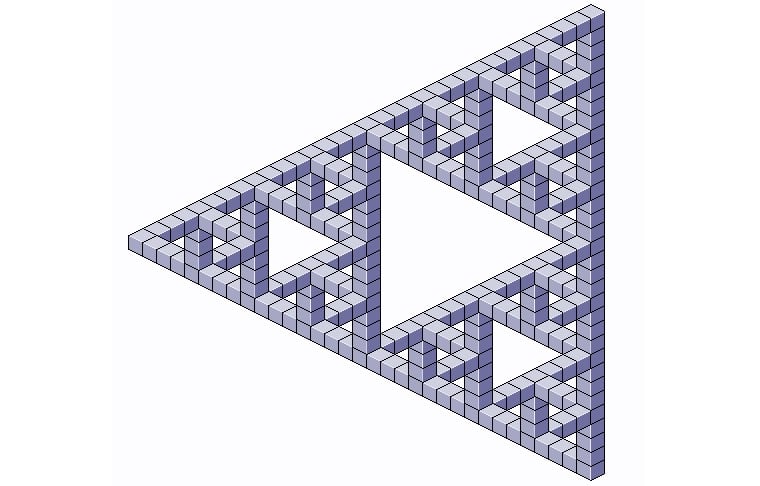
Nidhal Selmi combined the fractal Sierpinski triangle with the impossible Penrose triangle to create the M.C. Escher-like the Selmi triangle.
Adam Neely made a song that is constructed of smaller versions of itself, resulting in a musical fractal that sounds the same at full speed and at 1000 times slower. How does it work? Harmonic polyrhythms.
E=mc^2 tells us that mass and energy are the same thing, just on massively different scales. This is similar to the musician’s theory of relativity which says that rhythm, melody, and harmony are the same thing, just on similarly massively different scales.
So by slowing things way down or speeding things way up, you can convert between harmony and rhythm. (via waxy)
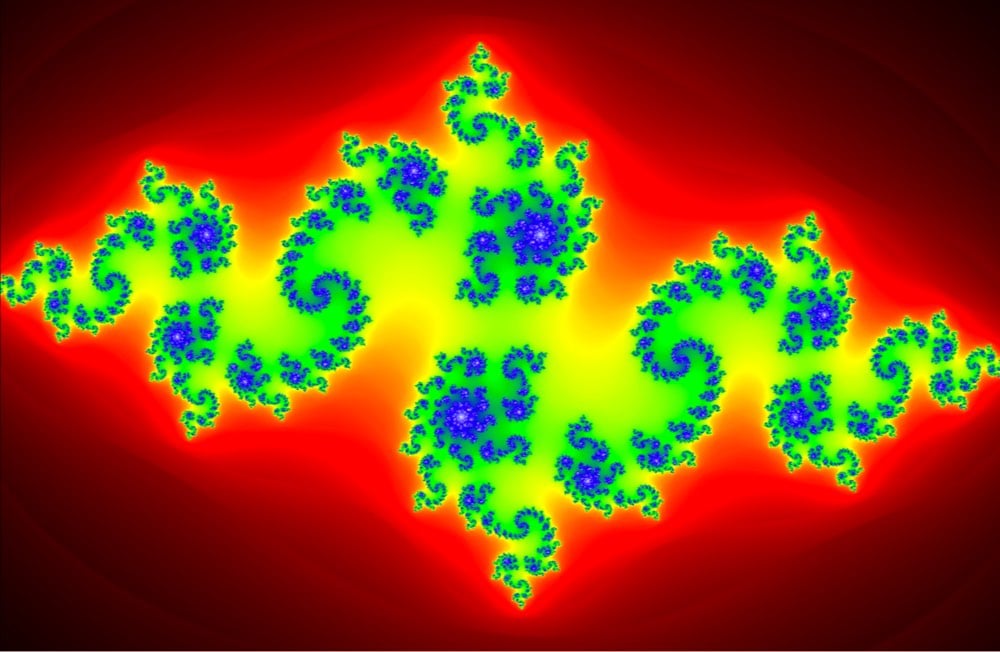
Yay! It’s Fractal Friday! (It’s not, I just made that up.) But anyway, courtesy of Christopher Night, you can play around with this Julia set fractal. It works in a desktop browser (by moving the mouse) or on your phone (by dragging your finger).
The Julia set, if you don’t remember, goes thusly: Let f(z) be a complex rational function from the plane into itself, that is, f(z)=p(z)/q(z) f(z)=p(z)/q(z), where p(z) and q(z) are complex polynomials. Then there is a finite number of open sets F1, …, Fr, that are left invariant by f(z) which, uh, is um… yay! Fractal Friday! The colors are so pretty!
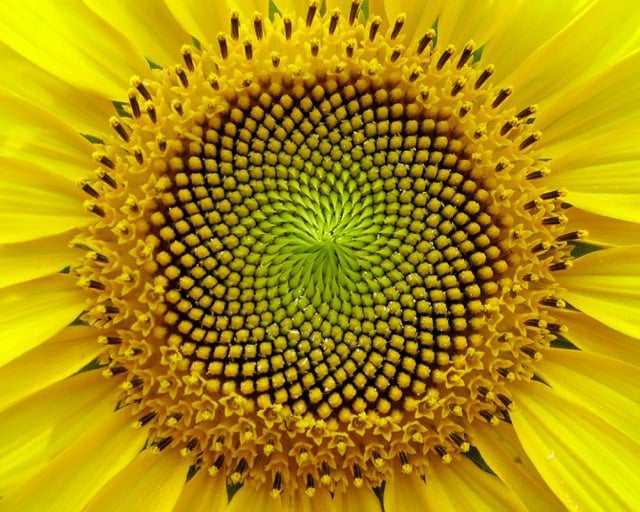
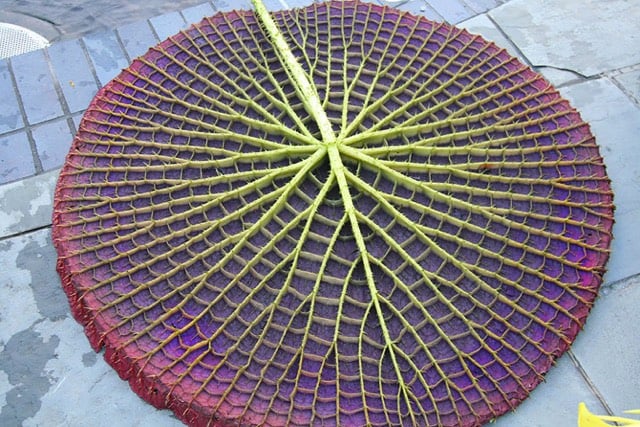

When you look at some plants, you can just see the mathematics behind how the leaves, petals, and veins are organized.
If you remember back more than 12 years ago1 to when Jared Tarbell created these beautiful Buddhabrot images using Processing, then you’ll enjoy this ultra high-resolution exploration of the Buddhabrot fractal.
This looked crazy cool on my 5K iMac. The render took 10 days! (via digg)
From 3Blue1Brown, a quick video showing some space-filling curves.

Fractal Gears is fun to play around with…just keep hitting that randomize button for Sierpinski triangle-esque gear mechanisms.
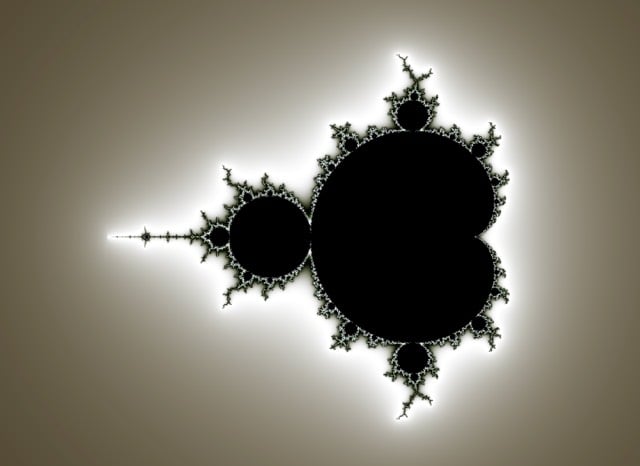
This web app allows you to explore the Mandelbrot set interactively…just click and zoom. I had an application like this on my computer in college, but it only went a few zooms deep before crashing though. There was nothing quite like zooming in a bunch of times on something that looked like a satellite photo of a river delta and seeing something that looks exactly like when you started. (via @stevenstrogatz)
Hunter Loftis has built a terrain rendering engine in only 130 lines of Javascript. Here’s what the output looks like:
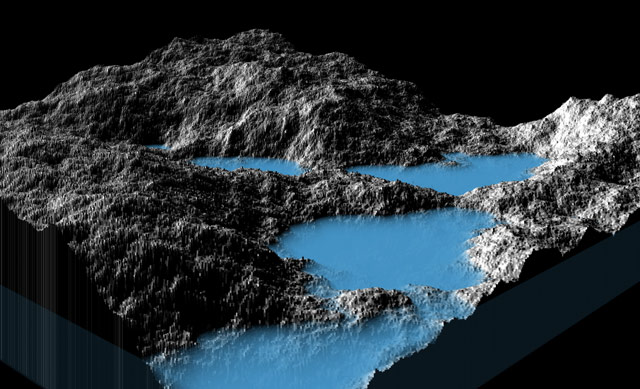
Programmers tend to be lazy (I speak from experience), and one nice side effect of laziness is really brilliant ways to avoid work. In this case, instead of spending mind-numbing hours manually creating what would likely be pretty lame rocky surfaces, we’ll get spiritual and teach the computer what it means to be a rock. We’ll do this by generating fractals, or shapes that repeat patterns in smaller and smaller variations.
I don’t have any way to prove that terrain is a fractal but this method looks really damn good, so maybe you’ll take it on faith.
You can try it out here…reload to get new landscapes. Callum Prentice built an interactive version. This obviously reminds me of Vol Libre, a short film by Loren Carpenter from 1980 that showcased using fractals to generate terrain for the first time.
A short time before his death, Benoît B. Mandelbrot filmed an interview with Errol Morris. Morris charmingly starts off my asking Mandelbrot where “the fractal stuff” came from.
Note: as always, the “B.” in “Benoît B. Mandelbrot” stands for “Benoît B. Mandelbrot”. (via @sampotts)
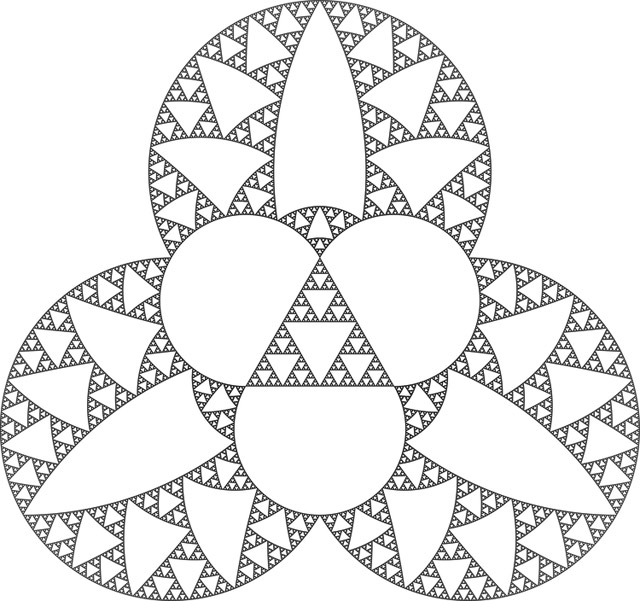
More than you’ve ever wanted to know about the Sierpinski triangle.
Throughout my years playing around with fractals, the Sierpinski triangle has been a consistent staple. The triangle is named after Wacław Sierpiński and as fractals are wont the pattern appears in many places, so there are many different ways of constructing the triangle on a computer.
All of the methods are fundamentally iterative. The most obvious method is probably the triangle-in-triangle approach. We start with one triangle, and at every step we replace each triangle with 3 subtriangles:
The discussion even veers into cows at some point…but zero mentions of the Menger sponge though? (via hacker news)
Nicholas Rougeux is building an approximation of a Menger sponge, a 3-D fractal shape with no volume and infinite surface area, out of Post-It notes.
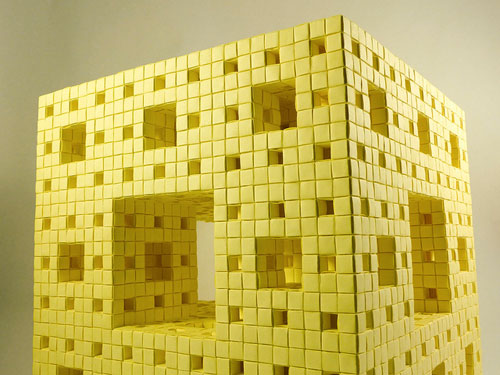
It looks about 90% complete…but as a Menger sponge, can you ever really call it finished? (thx, zach)
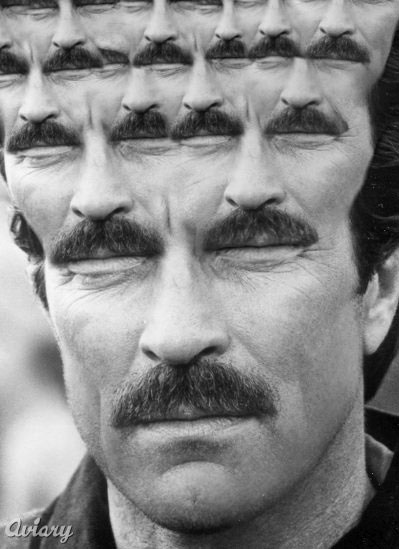
No words. They should have sent a poet. (via capndesign)
If Mandelbrot and Mondrian had a baby, it might look a little something like this:
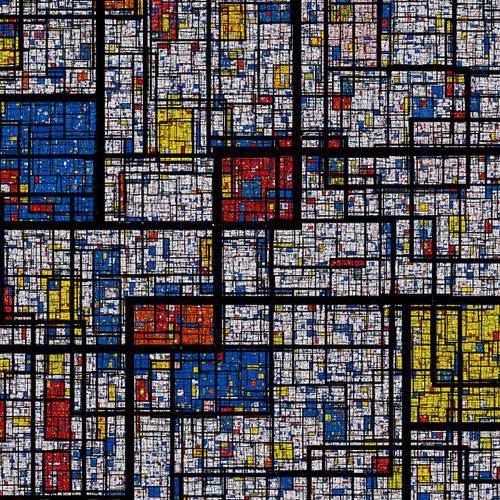
Awesome. There’s also a zoomable version but not a very deep one…would be nice to have an infinitely zoomable version in Processing or something.
Nothing in the news media yet, but many folks on Twitter and colleague Nassim Taleb are reporting that the father of fractal geometry is dead at age 85. We’re not there yet, but someday Mandelbrot’s name will be mentioned in the same breath as Einstein’s as a genius who fundamentally shifted our perception of how the world works.
Update: The NY Times has confirmation from Mandelbrot’s family. The cause of death was pancreatic cancer.
I was really into fractals in college (I know…) when I was making rave flyers (I know!) for a friend’s parties in Iowa (I know! I know! Shut up already!). Anyway, the thing that I really used to love doing with this fractal application that I had on my computer was zooming in to different parts of the familiar Mandelbrot set as far as I could. I never got very far…between 5 or 6 zooms in, my Packard Bell 486/66 (running Windows 3.11) would buckle under the computational pressure and hang. Therefore, I absolutely love this extremely deep HD zoom into the Mandelbrot set:
Just how deep is this computational rabbit hole?
The final magnification is e.214. Want some perspective? a magnification of e.12 would increase the size of a particle to the same as the earths orbit! e.21 would make a particle look the same size as the milky way and e.42 would be equal to the universe. This zoom smashes all of them all away. If you were “actually” traveling into the fractal your speed would be faster than the speed of light.
After awhile, the self-similarity of the thing is almost too much to bear; I think I went into a coma around 5:00 but snapped to in time for the exciting (but not unexpected) conclusion. Full-screen in a dark room is recommended.
Update: This 46-minute video seems to be the deepest fractal zoom out there right now, with a zoom level of 10^10000.
The magnification factor is so much less in the video above but that one’s more fun/artistic. And 10^10000 is such an absurdly large number1 that there’s no way to think about it in physical terms…the zoom factor from the size of the universe to the smallest measurable distance (the Planck length) is only about 10^60.
In 1980, Boeing employee Loren Carpenter presented a film called Vol Libre at the SIGGRAPH computer graphics conference. It was the world’s first film using fractals to generate the graphics. Even now it’s impressive to watch:
That must have been absolutely mindblowing in 1980. The audience went nuts and Carpenter, the Boeing engineer from out of nowhere, was offered a job at Lucasfilm on the spot. He accepted immediately. This account comes from Droidmaker, a fascinating-looking book about George Lucas, Lucasfilm, and Pixar:
Fournier gave his talk on fractal math, and Loren gave his talk on all the different algorithms there were for generating fractals, and how some were better than others for making lightning bolts or boundaries. “All pretty technical stuff,” recalled Carpenter. “Then I showed the film.”
He stood before the thousand engineers crammed into the conference hall, all of whom had seen the image on the cover of the conference proceedings, many of whom had a hunch something cool was going to happen. He introduced his little film that would demonstrate that these algorithms were real. The hall darkened. And the Beatles began.
Vol Libre soared over rocky mountains with snowy peaks, banking and diving like a glider. It was utterly realistic, certainly more so than anything ever before created by a computer. After a minute there was a small interlude demonstrating some surrealistic floating objects, spheres with lightning bolts electrifying their insides. And then it ended with a climatic zooming flight through the landscape, finally coming to rest on a tiny teapot, Martin Newell’s infamous creation, sitting on the mountainside.
The audience erupted. The entire hall was on their feet and hollering. They wanted to see it again. “There had never been anything like it,” recalled Ed Catmull. Loren was beaming.
“There was strategy in this,” said Loren, “because I knew that Ed and Alvy were going to be in the front row of the room when I was giving this talk.” Everyone at Siggraph knew about Ed and Alvy and the aggregation at Lucasfilm. They were already rock stars. Ed and Alvy walked up to Loren Carpenter after the film and asked if he could start in October.
Carpenter’s fractal technique was used by the computer graphics department at ILM (a subsidiary of Lucasfilm) for their first feature film sequence and the first film sequence to be completely computer generated: the Genesis effect in Star Trek II: The Wrath of Khan. The sequence was intended to act as a commerical of sorts for the computer graphics group, aimed at an audience outside the company and for George Lucas himself. Lucas, it seems, wasn’t up to speed on what the ILM CG people were capable of. Again, from Droidmaker:
It was important to Alvy that the effects support the story, and not eclipse it. “No gratuitous 3-D graphics,” he told the team in their first production meeting. “This is our chance to tell George Lucas what it is we do.”
The commercial worked on Lucas but a few years later, the computer graphics group at ILM was sold by Lucas to Steve Jobs for $5 million and became Pixar. Loren Carpenter is still at Pixar today; he’s the company’s Chief Scientist. (via binary bonsai)
Is the universe fractal-like, even on large scales? A group of Italian and Russian scientists argue that it displays a fractal pattern on a scale of 100 million light years. Other scientists aren’t so sure.
Many cosmologists find fault with their analysis, largely because a fractal matter distribution out to such huge scales undermines the standard model of cosmology. According to the accepted story of cosmic evolution, there simply hasn’t been enough time since the big bang nearly 14 billion years ago for gravity to build up such large structures.
Benoit Mandelbrot and Paola Antonelli talk about, among other things, fractals, self-similarity in architecture, algorithms that could specify the creation of entire cities, visual mathematics, and generalists.
This has been for me an extraordinary pleasure because it means a certain misuse of Euclid is dead. Now, of course, I think that Euclid is marvelous, he produced one of the masterpieces of the human mind. But it was not meant to be used as a textbook by millions of students century after century. It was meant for a very small community of mathematicians who were describing their works to one another. It’s a very complicated, very interesting book which I admire greatly. But to force beginners into a mathematics in this particular style was a decision taken by teachers and forced upon society. I don’t feel that Euclid is the way to start learning mathematics. Learning mathematics should begin by learning the geometry of mountains, of humans. In a certain sense, the geometry of…well, of Mother Nature, and also of buildings, of great architecture.
Syllabus and notes from an ITP class called The Nature of Code, which focuses on “the programming strategies and techniques behind computer simulations of natural systems”. Lots of good notes and Processing code examples.
Hmm, perhaps Richard Taylor’s fractal analysis of Jackson Pollock paintings isn’t that useful after all.
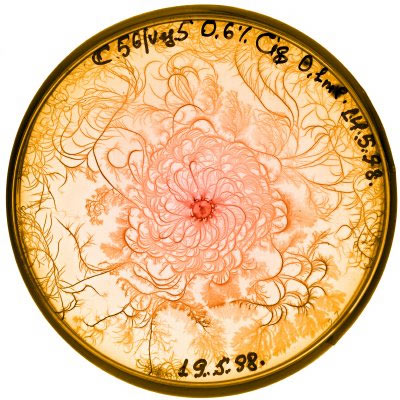
Pruned has collected some lovely petri dish scenes full of fractal patterns.
Billions and billions of bacterial landscape architects pruning — no less in environments poisoned with antibiotics — other bacterial landscape architects, dead or alive, to form dazzling arabesque parterres. The self-organizing embroidery of organisms in constant Darwinian mode.
More here. See also ferrofluid.


Socials & More