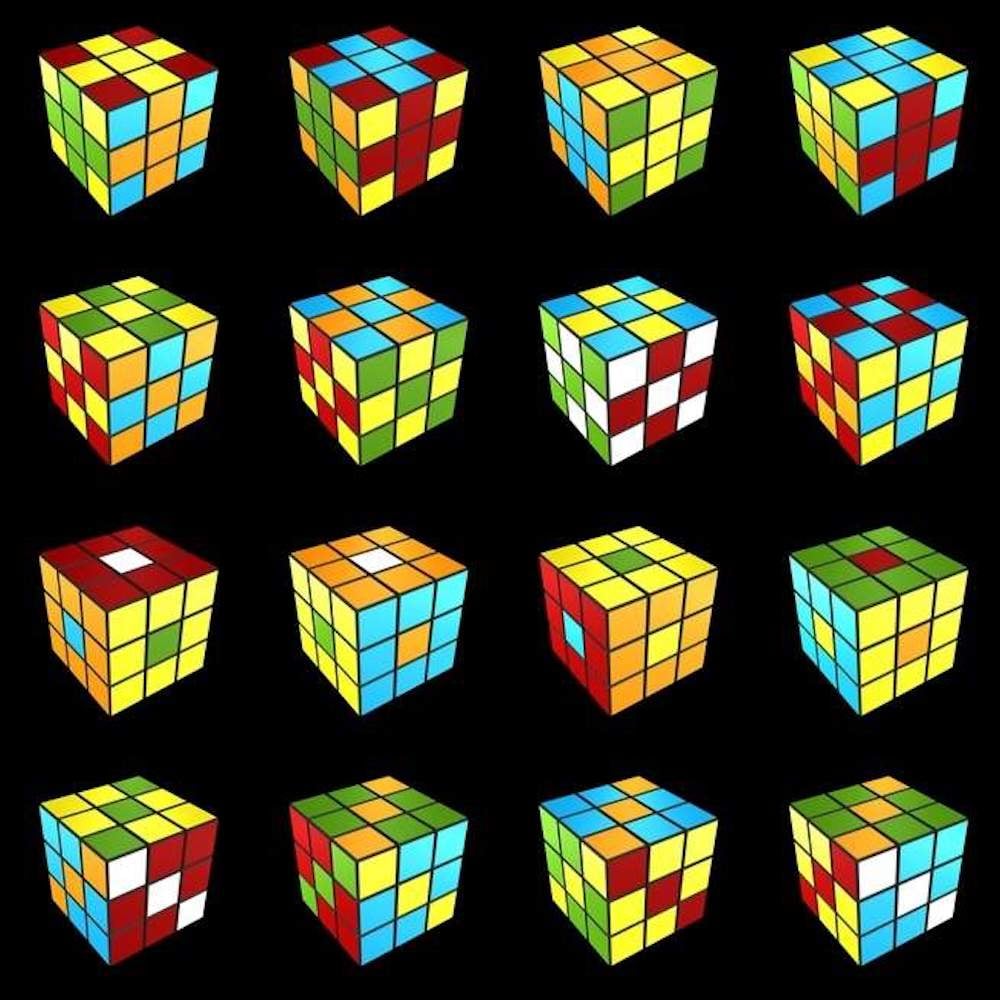
I’ve never been a great fan of Rubik’s Cubes (or chess, or crossword puzzles, or Scrabble, or most obsession-rewarding, intelligence-test-ish popular puzzle games), but it is rewarding for me to read about the cubes and the people who find themselves in solving the puzzle. (It’s still a $250-million-a-year product! The greatest selling single toy of all time.)
Once you’ve defined your goal—”I want to align this orange face with this other orange face”—you can follow a series of steps to accomplish it. An ease with algorithms, they note, is increasingly important in a world dominated by science, technology, engineering, and math, or STEM. The logic of the Rubik’s cube has, after all, been used by software developers to craft encryption schemes for software for decades. It has 43 quintillion possible combinations—and only one solution.
Puzzling out this 3-D game can also help students hone their spatial thinking skills, according to the presenters. And spatial thinking skills are intimately connected to success in any STEM field. “To think spatially,” the National Academies of Science, Engineering, and Medicine write, “entails knowing about” space, representation, and reasoning. This is the kind of knowledge we tap into every day, when timing our commutes or taking detours, reading maps, and, yes, solving Rubik’s cubes.
Maybe I should give that old cube another try.
Quantitative pedants always wince whenever anyone — usually an athlete — rattles off a phrase like “we gave 110% out there tonight.”
“It’s impossible to give more than 100%,” they’ll say. “That’s what ‘percent’ means.”
But of course percentages greater than 100 are possible. That’s how Google’s Android Market can grow by 861.5% in year-over-year revenue, just to pick one example.
It all depends on what your baseline is — x percent of what. But it’s usually easier for tongue-clicking know-it-alls to just assume athletes are dumb than to try to actually figure out what it is they might be talking about.
Here’s actually a more serious (and more mathematically precise) way to look at this. Economist Stephen Shmanske has a new paper in the Journal of Quantitative Analysis in Sports titled “Dynamic Effort, Sustainability, Myopia, and 110% Effort” that actually brings some stats and benchmarks to bear to figure this out in the context of the NBA.
For Shmanske, it’s all about defining what counts as 100% effort. Let’s say “100%” is the maximum amount of effort that can be consistently sustained. With this benchmark, it’s obviously possible to give less than 100%. But it’s also possible to give more. All you have to do is put forth an effort that can only be sustained inconsistently, for short periods of time. In other words, you’re overclocking.
And in fact, based on the numbers, NBA players pull greater-than-100-percent off relatively frequently, putting forth more effort in short bursts than they can keep up over a longer period. And giving greater than 100% can reduce your ability to subsequently and consistently give 100%. You overdraw your account, and don’t have anything left.
I haven’t dived into the paper (it’s behind a subscription wall, natch), but doesn’t this seem like a rough-but-reasonable analysis of what athletes and other people mean when they use language this way? Shouldn’t we all calm down a little with rulers across the fingers, offering our ready-made “correct” use of the rhetoric of percentages?
(Via @pkedrosky.)
I don’t know what it means, but I always get excited when a longstanding equation is solved. It’s as if another puzzle piece of how the world works has been snapped into place… What, too sappy?
Pennsylvania mathematicians have found solutions to a 140-year-old, 7-dimensional equation that were not known to exist for more than a century despite its widespread use in modeling the behavior of gases.
From Rob Cockerham’s sandwich calculations:
Dijon mustard is to yellow mustard as a Rolls Royce is to your Honda. A 454 gram bottle sells for $6.99, and that is 5 cents per serving.
He adds up exactly how much homemade sandwiches cost based on the amount of ingredients and their correlating prices. The results are revealing: 98 cents for a processed turkey sandwich, 48 1/2 cents for a grilled cheese, and 64 cents for a pb&j. If you’d like to figure out how much bread you’ll need for your picnic, try out Cockerham’s sandwich calculator. For more dizzying and delicious equations, cut the corners off the drool-inducing Scanwiches.
A pi pie. Note the edging on the crust.





Socials & More