Mary Cain was on her way — and quickly. As detailed in a 2015 NY Times piece by Elizabeth Weil, Cain ran a mile in 5:03 as a 7th grader and by the time she was a high school sophomore, ran the 1,500 meters in 4:11.01. Her high school track coach didn’t know how to coach her properly, so when Nike called, she joined a legendary coach training a team of fellow track stars to see how far she could go. And according to Cain, that’s when everything fell apart.
A big part of this problem is that women and girls are being forced to meet athletic standards that are based on how men and boys develop. If you try to make a girl fit a boy’s development timeline, her body is at risk of breaking down. That is what happened to Cain.
After months of dieting and frustration, Cain found herself choosing between training with the best team in the world, or potentially developing osteoporosis or even infertility. She lost her period for three years and broke five bones. She went from being a once-in-a-generation Olympic hopeful to having suicidal thoughts.
This May, at the age of 23, Cain ran competitively for the first time in 2.5 years and won a four-mile race in NYC.
Cain’s story might be superlatively horrifying, and her accusations go well beyond simple misunderstanding of female biology. (They include her coaches essentially ignoring her admission that she was depressed and cutting herself. The Oregon Project was shut down in October, after Salazar was banned from coaching for doping violations.) But the treatment of her weight, and the lack of understanding of how extreme workouts were affecting her body, is part of a much broader problem, and not just one that affects women with large brand partnerships. Many, if not most, female runners, from elite athletes to those training for their first 5Ks, will suffer at some point because of a lack of recognition of their physical needs, and how their bodies differ from men’s.
Amid the fallout from Cain’s comments, Sports Illustrated contacted nine former Nike Oregon Project members, including Cain, about the culture under Salazar, and their accounts, extending back to 2008, validate her claims and paint a picture of a toxic culture where female athletes’ bodies were fair game to be demeaned publicly. Multiple authority figures appeared to lack certifications. Former team members now describe it, in retrospect, as “a cult.” Now leaders from the anti-doping world and even Salazar’s de facto successor as coach are calling for a third-party investigation of The Oregon Project.
I was talking with a friend about Cain’s story and how challenging the coach/athlete dynamic is. The nature of coaching is to help athletes to achieve things they cannot accomplish on their own, to push them past what they thought was their best. Pushing boundaries implies the need to be vulnerable, to embrace the unknown, to do things that you may not understand or want to do, and to trust your coach to have you do the correct uncomfortable & seemingly impossible things that will help you excel and not the wrong uncomfortable & seemingly impossible things that will damage your body and mind. From the outside or as an athlete in the midst of training, it can be tough to tell which is which. To have that trust betrayed must be devastating.
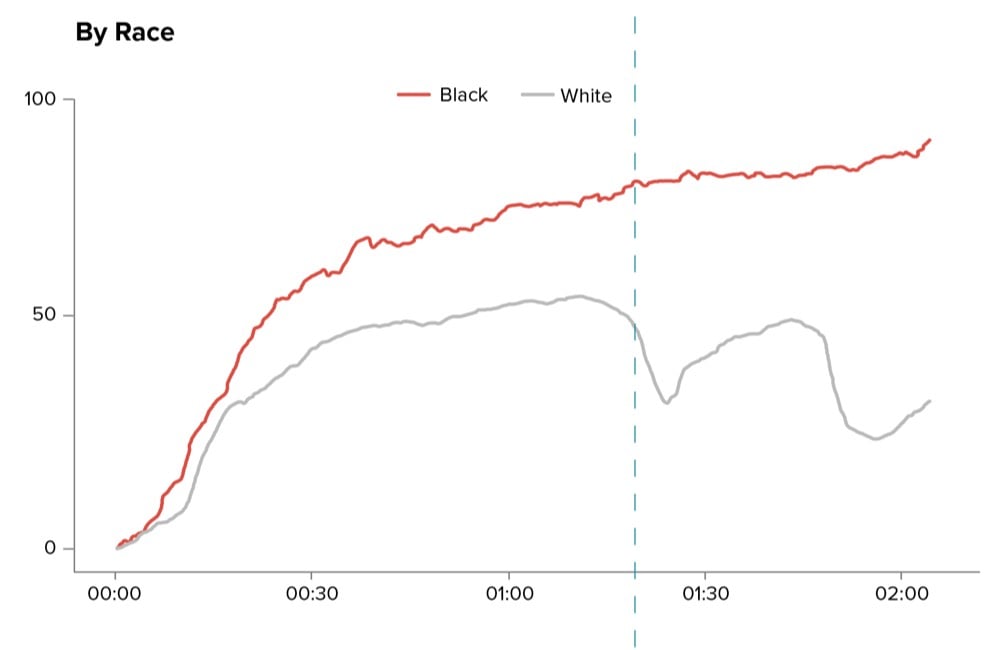
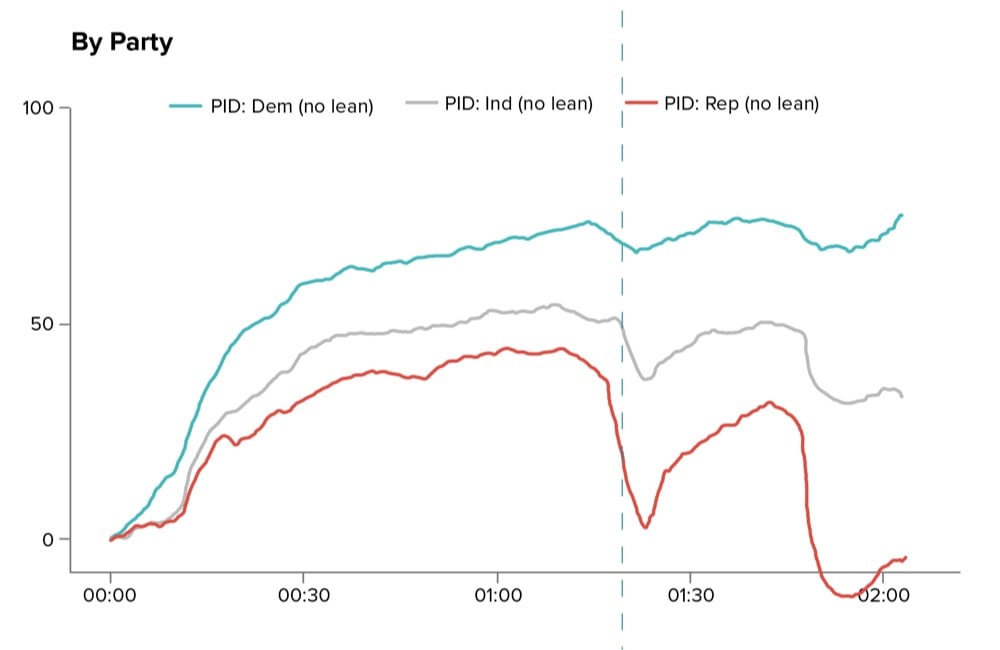
A research company called Morning Consult had 1900 people watch the new Nike commercial featuring Colin Kaepernick and record their reactions in realtime. The video above shows the commercial and the graphed reactions of four age groups: Gen Z (18-21, white line), Millennials (22-37, teal line), Gen X (38-53, yellow line), and Boomers (54-72, red line). The report also has graphs showing results by race and political affiliation (the dashed line is when Kaepernick first appears on screen).
Gen Z & Millennials rated the ad higher than the older viewers throughout and had a less negative reaction to the polarizing parts. Now, the report only mentions the effect of Kaepernick appearing on the screen, but to my eyes, there are four distinct moments when the opinions of some viewers (white, older, Republican) turn negative:
1. Right before Kaepernick is shown for the first time, ratings start to decline when the ad refers to LeBron James as “the best basketball player on the planet” and “bigger than basketball” for recently opening his I Promise School.
2. Kaepernick’s first appearance in front of an American flag with his large Afro triggers a steep decline in favorability among older viewers, particularly Boomers and Republicans.
3. Serena Williams being billed as “the greatest athlete ever” results in the steepest decline during the entire ad…and this was before the controversy at the US Open. Across all groups, only black Americans had no problem with that characterization whatsoever (Gen Z & Millennials showed only slight declines).
4. Immediately after that, Kaepernick is shown again and there’s a continued follow-on decline from Serena.
So that’s interesting! What’s going on here? [insert an entire apologist NY Times Op-Ed piece here about how famous athletes are polarizing no matter what, particularly when accompanied by best-ever proclamations, etc. etc.] But of course, it’s probably racism with a side of sexism — three outspoken black athletes, one of them a woman, are uppity. That’s the simplest explanation.
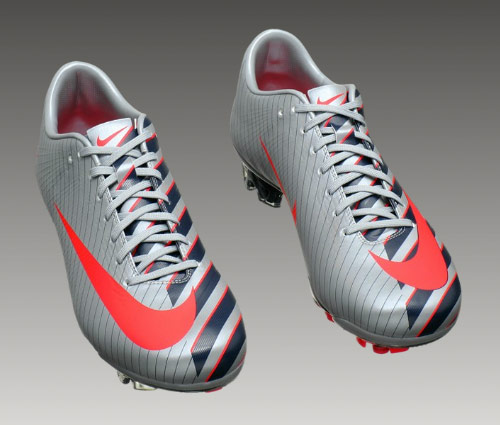
Nike has designed a soccer shoe for Real Madrid’s Cristiano Ronaldo that uses a striped pattern on one side of the shoe designed to confuse opponents as to which way Ronaldo might be moving his feet.
The cleats look remarkably different from each side of Ronaldo. From the right, they have a clean look with pinstripes. From the left, though, there are thick stripes with a red accent line. Furthermore, the asymmetrical design makes a defender’s judgment that much harder, as the visual effect of Ronaldo turning his foot in one direction may not come across exactly the same as reality.
Reminds me of the dazzle camouflage used on military ships in WWI and WWII.
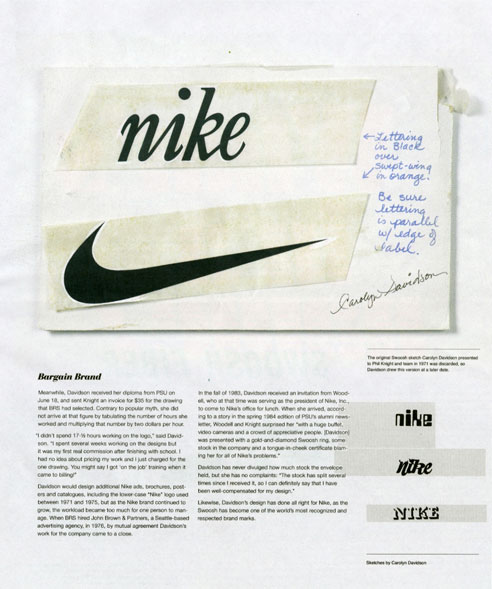
The origin of the mark goes like this: Knight wanted to differentiate BRS’s custom product from the ones they were importing from Onituska in Japan: “…so Knight turned to a graphic design student he met at Portland State University two years earlier.” One day in 1969, the student, Carolyn Davidson, was approached by Knight and offered $2 per hour “to make charts and graphics” for his business. For the next two years Davidson managed the design work on BRS. “Then one day Phil asked me if I wanted to work on a shoe stripe,” Davidson recalled. The only advice she received was to “Make the stripe supportive of the shoe.” Davidson came up with half a dozen options. None of the options “captivated anyone” so it came down to “which was the least awful.”
Cleveland’s response to LeBron James’ boner of a Nike commercial has more heart, but this mash-up of the LeBron commercial with a previous Michael Jordan Nike commercial is an absolute masterpiece.
At first, the idea was to shoot on different mediums — camera phone, 8-millimeter, 16-millimeter (the eventual choice), security footage. My idea was the city was watching me. The genesis was a lot of people film me or take a picture of me in the city on cellphones. If it’s such an appetite to see me do normal things, it was an idea to do something people like.
Around All-Star time a couple of weeks ago, Nike released a shoe called the Nike Trash Talk, “the first Nike performance basketball sneaker completely produced from manufacturing waste”. The shoe, worn by Steve Nash in a recent game, looks a bit like Frankenstein’s monster with all the exposed stitching; it’s a beautiful shoe and I want a pair. The problem is that it’s one of those limited edition deals…which means they’re already all sold out and sitting on the shelves of sneaker collectors next to hundreds of other boxes of shoes that will never be worn. I looked on eBay and found two pair but not in my size. What are my chances of getting a pair of these at approximately retail price? I’m not looking for a collectors item…I just want to wear them!
This one guy tried to get the word “sweatshop” printed on his custom Nike shoes and Nike wouldn’t let him. “The Personal iD on my custom ZOOM XC USA running shoes was the word ‘sweatshop.’ Sweatshop is not: 1) another’s party’s trademark, 2) the name of an athlete, 3) blank, or 4) profanity. I choose the iD because I wanted to remember the toil and labor of the children that made my shoes. Could you please ship them to me immediately.”
Nike is catching some shit for appropriating some imagery for one of their skateboarding events from a 1984 album cover by Dischord Records’ Minor Threat. Dischord is alledging that Nike stole the image:
No, they stole it and we’re not happy about it. Nike is a giant corporation which is attempting to manipulate the alternative skate culture to create an even wider demand for their already ubiquitous brand. Nike represents just about the antithesis of what Dischord stands for and it makes me sick to my stomach to think they are using this explicit imagery to fool kids into thinking that the general ethos of this label, and Minor Threat in particular, can somehow be linked to Nike’s mission. It’s disgusting.
Here are the images (original on the left):
Setting aside the difference in philosophy between the two parties, this is obviously an homage on Nike’s part (or rather, on the part of the designers working on this campaign for Nike…they probably love skating and that album and are paying their respects). Graphic design, filmmaking, pop culture, and music is full of stuff like this…sampling and ripping and riffing and homages are all part of the deal. Seems like a punk label like Dischord should be aware of that but in the above quote they sound more like a big company afraid of losing their intellectual property. Isn’t punk all about taking without permission? Or does that not apply when you don’t like the folks doing the taking? Lighten up, Dischord.






Socials & More