kottke.org posts about bees
Bees use polarized sunlight scattered by the atmosphere in order to navigate; they always know where the sun is, even if it’s cloudy or behind a mountain. Then they waggle dance to inform their hive-mates about food source locations.
So if a bee wants to fly straight towards the sun, it waggles straight up the hive. If the food is 30° away from that polarization line, it waggles 30° away from vertical. If the food is directly away from the sun, it waggles downward.
And the distance they should fly is encoded on how long the waggle lasts. It depends on the species of bee, but a waggle of about 1 second means about a kilometer away. So a 45° waggle for about 0.6 seconds means fly at 45° angles from the sun polarization line for about 600 meters.
The bee repeats this waggle dance over and over. And the more excited the dance, the better the food source. And if other bees verify it and perform the same dance, the signal gets amplified until the whole hive knows where to go.
As shown in this video, it’s possible to construct an optical compass using polarized filters in order to wayfind like the bees. Pretty cool! (via damn interesting)
The Hive Architect is a short documentary about honey bee conservationist Matt Somerville and the log hives he builds to house wild bees.
There is a widely held theory that our British honey bee couldn’t exist without being domesticated by beekeepers. However, for bee conservationists like Matt Somerville, this theory is ludicrous.
He has spent decades admiring free-living honey bees nesting in tree cavities and they are under increasing threats from commercial beekeeping, loss of habitat and other violences of the modern world.
So Matt decided to do something about it. For the last 14 years he has spent the winters creating his log hives before driving around all of England in the summer, erecting them as minimal intervention homes for wild honey bees.
When most people think of bees, they picture the honeybee. But the honeybee is a domesticated animal — essentially livestock — and are well taken care of. The thousands of species of wild bee are paid less attention and are no less important to maintaining healthy ecosystems (and yes, helping out with pollination).
As a group, wild bees are considered incredibly important pollinators, especially for home gardens and crops that honey bees can’t pollinate. Tomatoes, eggplants, and peppers, for example, require “buzz pollination;” bees have to vibrate their bodies to shake the pollen free — a behavior that honey bees can’t do (bumblebees and some other native species can).
Yet these free services native bees provide are dwindling. While wild bees are, as a group, understudied, existing research suggests that many species are threatened with extinction, including more than a quarter of North American bumblebees.
As a defense against predators like hornets, these wild bees flick their bodies in unison, creating these mesmerizing and shimmering waves that ward the hornets off. Watch the video…it’s a wild effect.
In the PLoS ONE study, Gerald Kastberger and colleagues focused on the shimmering behavior in giant honeybees, the intriguing, docile, nest-based trait reminiscent of the Mexican waves seen in football stadiums. It was previously known that shimmering was evoked by visual stimuli of predators-particularly hovering wasps. This highly coordinated response aligns hundreds of colony members and displays a remarkable capacity of fast communication within a society, unique in the animal kingdom.
When a giant honeybee colony shimmers, it has two potential addressees: firstly, its nest mates, which coordinate themselves to participate in the shimmering, and which possibly become aroused or alarmed. The authors posit that the members of the group, which are assembled in the dense networks of a “bee curtain” on both sides of the comb, continuously produce and receive information about the state of the colony, reflecting its day-to-day business of foraging, reproduction, reorganization and defensive actions (such as shimmering). Secondly, the potential predators such as wasps and mammals are targeted — these are thought to be influenced by the dynamic visual cues of shimmering.
This video of beekeeper Erika Thompson removing a hive of bees from the floor of an old shed was absolutely riveting! I loved every minute of it. Working without a beekeeping suit or even gloves, Thompson begins by locating the hive with a thermal imager, cuts open the floor, and gently lifts up the flooring to reveal the hive. After transferring the hive’s honeycomb to a new box hive, she cajoles the bees into their new home through the use of smoke, relocating the queen, and even scooping them in there with her bare hand. She ends the video with “and it was another great day of saving the bees” and that’s 100% right.
You can watch more videos by Thompson on YouTube, including this longer one of her removing bees from a camper. You can also check out her work on Instagram or read about how she started her company, Texas Beeworks.
“I didn’t become a beekeeper because I wanted to sell honey, and I think that’s what separates me from a lot of other beekeepers,” she says. “Whatever way you’re inspired by bees or to keep bees I think is wonderful. But in full transparency … I’d rather focus on creating more bees than having them produce more honey.”
Her videos have been going viral on TikTok lately, which led to an appearance on the Today Show, where she explained why she was working without protective gear.
“Most honey bees are very gentle. They’re docile and they don’t want to sting you. I’ve been doing this for a long time and over the years I’ve learned to read the bees’ behavior and these were just very calm, gentle bees. They were also very cooperative and got into their new hive. This was just one case where I could work without gear and it was safer for me and the bees.”
(via austin kleon)
Update: Pro tip: always have an extra queen on hand, just in case — it might just help you have another great day of saving the bees. (via @lauraolin)
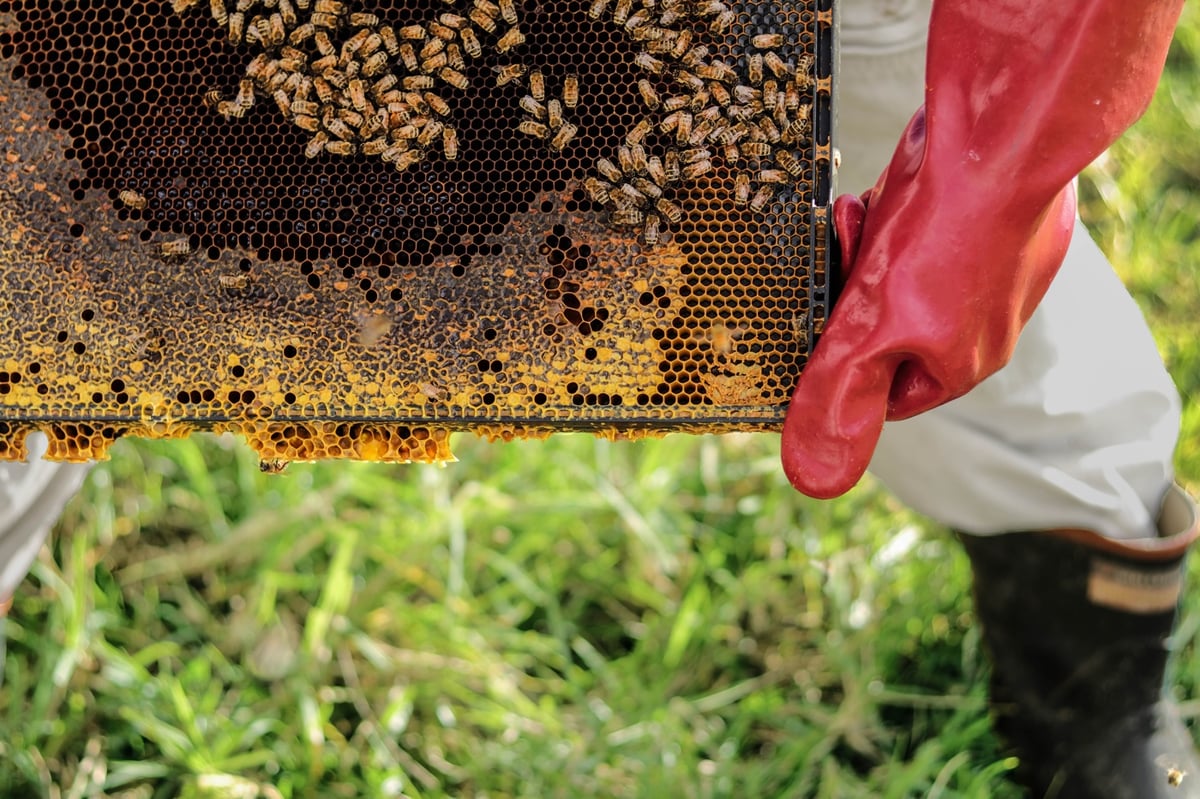
The beehive design most of us probably imagine when thinking of beekeeping are actually a relatively recent design, having been patented by the clergyman Reverend Lorenzo Lorraine Langstroth in 1852.
One of the reasons this design works is that he understood “bee space,” the gap between panels which allows bees to circulate while preventing them from filling in the whole and making the panels “stick.”
It’s because Langstroth understood “bee space.” Simply put, bee space is a gap of around 6 - 8mm. It is the space that is too large for the bees to fill with propolis, too small to fill with comb but just right for crawling around in. By designing a hive with this exact space between components - between the frames, the frames and the hive walls, and the frames and the roof - it became possible for the frames to remain unstuck and to therefore be removable. The bees built their comb inside the parameters of the wooden frame and regular inspections by the beekeeper kept the frames loose. So, modern beekeeping is premised on the very precise measurement of the body of a honeybee and how it uses space inside a hive.
The author proposes a parallel with architectural modernism, which although a bit stretched, has some value and is a good occasion to look into Le Corbusier’s unité d’habitation.
The fabrication of the hives, their replicability and ease of manufacturing is also an example of modern methods spreading worldwide and overshadowing older, often better adapted, methods.
We see this with the box hives too, as box beehives replaced traditional beekeeping practices in many cultures. In the West mass-produced beehive components are affordable but in many parts of the developing world, where development agencies push modern beekeeping, hive components can be expensive. Whereas making hives from locally sourced and affordable available materials, such a wicker, mud, plastic sheeting and dung is usually far more sustainable. In addition, traditional beekeepers selected apiary types and sites due to the success rates of hives in those locations. Traditional Ethiopian beekeepers, for example, keep hives suspended in trees and claim that there are fewer issues with diseases among the branches than in boxes on the ground. This type of beekeeping also requires healthy forests, so Ethiopian beekeepers know their forests well and are, in many cases, advocates for conservation and biodiversity.
The piece closes on a good question: is this kind of industrialized large-scale beekeeping part of the declining bee population in recent years?
B-box is a beehive designed for use in close proximity to humans, like near your house or in an urban environment. It does this by separating the honey part of the hive from the area where the bees live and limiting their access to the hive through an entrance more than seven feet above the ground. Check out this video for details:
The makers of the B-box are seeking funding for the project on Indiegogo. Very tempting! (via colossal)
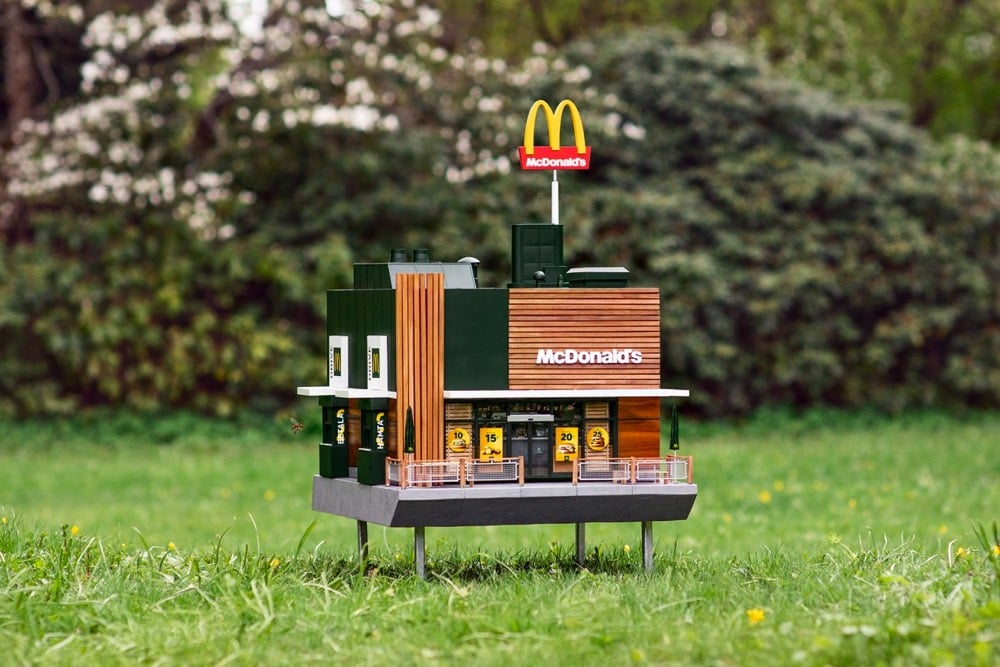
A few McDonald’s restaurants in Sweden started putting beehives on their rooftops to help save dwindling bee populations and it turned into a national sustainability effort.
More franchisees around the country are joining the cause and have also started replacing the grass around their restaurants with flowers and plants that are important for the wellbeing of wild bees.
To promote the idea, McDonald’s constructed what might be their smallest restaurant, actually a fully functioning beehive just for the bees:
Totes adorbzzzz.
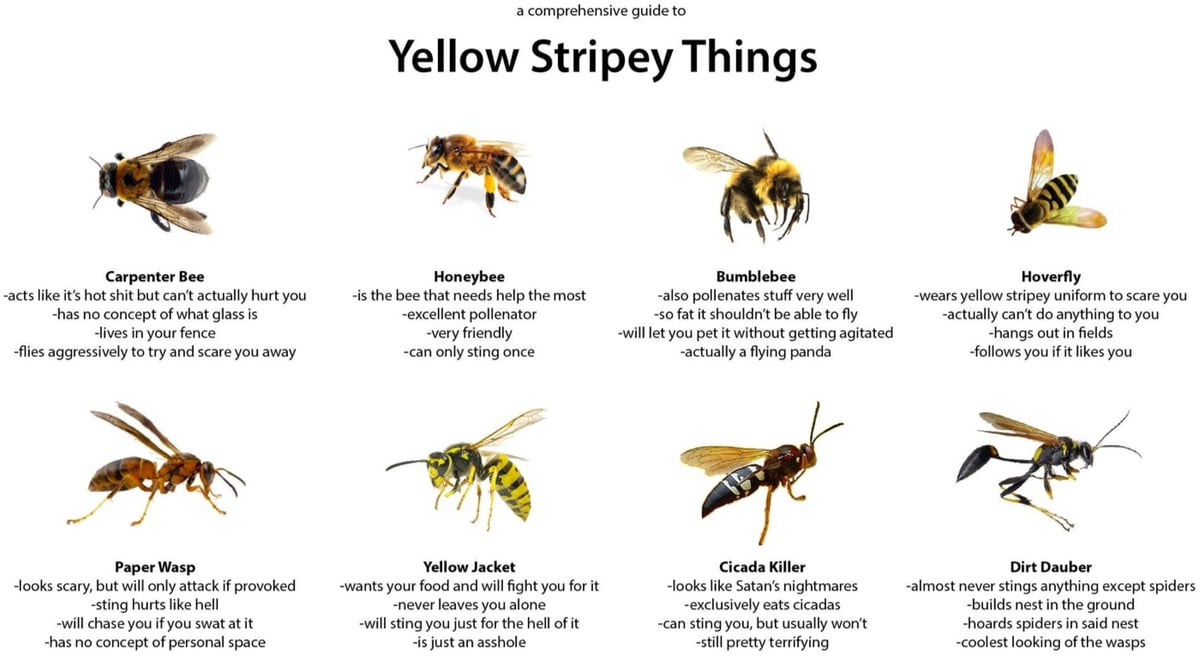
Bumblebee, honey bee, yellow jacket, paper wasp…what’s the difference? I don’t know if this comprehensive guide to Yellow Stripey Things is entirely truthful or not — a bumblebee is “actually a flying panda” and a yellow jacket “is just an asshole” — but it is pretty entertaining. Has anyone fact-checked this thing?
Ok fine, I’ll do it!1
Carpenter bees are mostly harmless:
Male carpenter bees are quite aggressive, often hovering in front of people who are around the nests. The males are quite harmless, however, since they lack stingers. Female carpenter bees can inflict a painful sting but seldom will unless they are handled or molested.
Honey bees don’t always sting just once:
A honey bee that is away from the hive foraging for nectar or pollen will rarely sting, except when stepped on or roughly handled. Honey bees will actively seek out and sting when they perceive the hive to be threatened, often being alerted to this by the release of attack pheromones (below).
Although it is widely believed that a worker honey bee can sting only once, this is a partial misconception: although the stinger is in fact barbed so that it lodges in the victim’s skin, tearing loose from the bee’s abdomen and leading to its death in minutes, this only happens if the skin of the victim is sufficiently thick, such as a mammal’s.
Bumblebees:
Queen and worker bumblebees can sting. Unlike in honeybees, a bumblebee’s sting lacks barbs, so the bee can sting repeatedly without injuring itself; by the same token, the sting is not left in the wound. Bumblebee species are not normally aggressive, but may sting in defence of their nest, or if harmed.
And yes, you can actually pet a bumblebee:
Hoverflies don’t sting. But paper wasps do and their sting can be deadly:
Unlike yellowjackets and hornets, which can be very aggressive, polistine paper wasps will generally only attack if they themselves or their nest are threatened. Since their territoriality can lead to attacks on people, and because their stings are quite painful and can produce a potentially fatal anaphylactic reaction in some individuals, nests in human-inhabited areas may present an unacceptable hazard
I couldn’t find a good all-in-one source about yellow jackets, but by all accounts, they are aggressive and easily agitated.
The cicada killer wasp look fierce but are generally only dangerous to cicadas:
Solitary wasps (such as the eastern cicada killer) are very different in their behavior from the social wasps such as hornets, yellowjackets, and paper wasps. Cicada killer females use their sting to paralyze their prey (cicadas) rather than to defend their nests; unlike most social wasps and bees, they do not attempt to sting unless handled roughly.
Mud daubers don’t sting people that often and prey on spiders:
Black and yellow mud daubers primarily prey on relatively small, colorful spiders, such as crab spiders (and related groups), orb weavers and some jumping spiders. They usually find them in and around vegetation. Blue mud daubers are the main predator of the black and brown widow spiders.
All in all, this checks out.
Bonus stinging insect fact: There’s a sting pain index that entomologist Justin Schmidt first came up with in the 80s. Schmidt has been stung by almost everything with a stinger and rated the stings on a scale of 1 to 4 (least to most painful). He has also described the stings of individual insects more colorfully:
Western honey bee (level 2) — “Burning, corrosive, but you can handle it. A flaming match head lands on your arm and is quenched first with lye then with sulfuric acid.”
Giant paper wasp (level 3) — “There are gods, and they do throw thunderbolts. Poseidon has rammed his trident into your breast.”
The Atlantic has just put up a previously unpublished short story by Kurt Vonnegut, The Drone King. It’s about bees.
He examined the card for a long time. “Yes,” he said at last. “Mr. Quick is expecting you. You’ll find him in the small library — second door on the left, by the grandfather clock.”
“Thank you,” I said, and I started past him.
He caught my sleeve. “Sir—”
“Yes?,” I said.
“You aren’t wearing a boutonniere, are you?”
“No,” I said guiltily. “Should I be?”
“If you were,” he said, “I’d have to ask you to check it. No women or flowers allowed past the front desk.”
I paused by the door of the small library. “Say,” I said, “you know this clock has stopped?”
“Mr. Quick stopped it the night Calvin Coolidge died,” he said.
I blushed. “Sorry,” I said.
“We all are,” he said. “But what can anyone do?”
An audio version of the article is available.
The story is one of five that Vonnegut wrote in the early 1950s that were recently discovered in the author’s papers. These five, plus all of Vonnegut’s other short stories, will be out in book form later this month.
A time lapse of the first three weeks of a bee’s life, from egg to adult, in only 60 seconds.
Some explanation of what’s going on can be found in this video. (via colossal)
Sometimes, bees don’t want to be domesticated. The rules of nature, laid down in genetic code and behavioral norms over hundreds of thousands or even millions of years, are difficult to bend. John Knight discovered this while exploring beekeeping as a new hobby.
While a newborn queen may seem ruthless, the success of a beehive hinges on allegiance to its queen. Though she can mate with an average of 12 different drones, there is only one queen, which makes for a hive of closely related bees. As a new queen begins to produce her own pheromones, the hive slowly aligns with her as the old bees die and new workers hatch. In a sense, the hive is genetically wired to be loyal to the monarchy. If the hive was to raise multiple queens, or if the workers were to start laying eggs, the interests of the population would slowly fracture.
Despite progress in recent years on causes and cures, colony collapse disorder has wreaked havoc on honeybee colonies across the country.
A mysterious malady that has been killing honeybees en masse for several years appears to have expanded drastically in the last year, commercial beekeepers say, wiping out 40 percent or even 50 percent of the hives needed to pollinate many of the nation’s fruits and vegetables.
Which is like, yeah, big whoop, it’s just bees, right? Except that:
The Agriculture Department says a quarter of the American diet, from apples to cherries to watermelons to onions, depends on pollination by honeybees.
Michael O’Malley is a “human capital consultant” (whatever that is) but has also been a beekeeper for the past ten years. Here’s what he’s learned about how bees organize themselves and manage risk.
Take, for example, their approach toward the “too-big-to-fail” risk our financial sector famously took on. Honeybees have a failsafe preventive for that. It’s: “Don’t get too big.” Hives grow through successive divestures or spin-offs: They swarm. When a colony gets too large, it becomes operationally unwieldy and grossly inefficient and the hive splits. Eventually, risk is spread across many hives and revenue sources in contrast to relying on one big, vulnerable “super-hive” for sustenance.
Here’s another lesson by analogy: No queen bee is under pressure for quarterly pollen and nectar targets. The hive is only beholden to the long term. Indeed, beehives appear to underperform at times because they could collect more. But they are not designed to maximize current returns; they are designed to prevent cycles of feast and famine (a death sentence in the natural world). They concentrate their foraging on the most lucrative patches but keep an exploratory force in the field that will ensure future revenue sources when the current ones run dry. This exploratory force (call it an R&D expenditure) increases as conditions worsen.
First there was the mini cannon. Now someone has built a tiny catapult to hurl 3mm-wide pies at bees and other insects. No, seriously! Here’s the slow motion evidence. (thx, liz)
Cutest thing you’ll see all day: these Turkish bees use flower petals to build colorful little nests that look like flowers themselves.
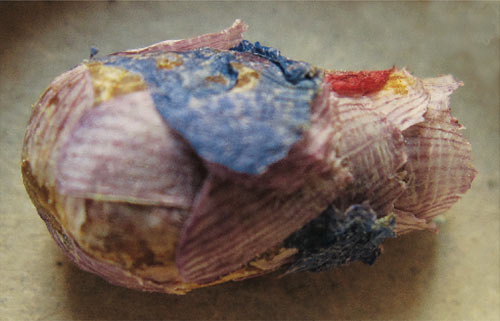
Looks like something straight out of Martha Stewart Living.
One of the vehicles involved in a deadly car crash in Minnesota today was a truck carrying bees. First responders to the scene faced what was described as a “big black cloud” of bees. Firefighters were spraying the trucks with hoses to subdue the bees because they don’t fly in the rain (the bees, not the trucks). I can only imagine a few things worse than this, one of which is an accident involving a truck full of sharks.
The truck that crashed carried upwards of 17 million bees; each of the trucks carried 700 hives, with about 25,000 bees per hive, said Dale Bauer of Bauer Honey Inc. of Fertile, Minn. The bees were being shipped to North Dakota after spending the winter in Mississippi. There was no immediate estimate of how many of the bees escaped.
NYC’s Board of Health has lifted the ban on keeping bees in the city.
The unanimous vote amends the health code to allow residents to keep hives of Apis mellifera, the common, nonaggressive honeybee. Beekeepers will be required to register with the Department of Health and Mental Hygiene and to adhere to appropriate practices. That means they must be able to control bee swarms and ensure that the hives do not interfere with pedestrians or neighbors.
Ten dollars says my wife utters the following words to me tonight: “we should raise some bees on the roof!”
A species of orchid from Israel that looks and smells like a female bee tricks male long-horned bees into pollinating them.
Update: Michael Pollan recently discussed orchids in a piece for National Geographic.
Update: There was a scene in Adaptation about the bee orchid. (thx, charley)
As reported previously, colony collapse disorder seems to have multiple causes. In the NY Times’ Room for Debate blog, several scientists and other bee experts offer their commentary on what we currently know about CCD and what’s being done about it.
Meanwhile, individual beekeeping operations have been damaged, some beyond repair because of this malady. Others have been able to recover. The overall picture is, however, not quite as bleak as the press and the blogosphere might lead you to imagine. Colony numbers in the U.S. show the resiliency of American beekeepers.
On the Zeitgedächtnis, or time-sense, of honeybees.
Flowers of a given species all produce nectar at about the same time each day, as this increases the chances of cross-pollination. The trick works because pollinators, which in most cases means the honeybee, concentrate foraging on a particular species into a narrow time-window. In effect the honeybee has a daily diary that can include as many as nine appointments — say, 10:00 a.m., lilac; 11:30 a.m., peonies; and so on. The bees’ time-keeping is accurate to about 20 minutes.
Have Spanish scientists found a cure for colony collapse disorder, which affects millions of honeybees around the world? The sole cause, according to the scientists, is a fungal parasite called nosema ceranae. This finding doesn’t jibe with the recent Scientific American article written by two American CCD investigators. They say that nosema is one factor out of many.
In the gut contents we found spores of nosema, single-celled fungal parasites that can cause bee dysentery. The spore counts in these and in subsequent samples, however, were not high enough to explain the losses. Molecular analysis of Hackenberg’s bees, performed by the other of us (Cox-Foster), also revealed surprising levels of viral infections of various known types. But no single pathogen found in the insects could explain the scale of the disappearance.
(via waxy)
Update: Some beekeepers have solved bee death problems in their hives by using comb with smaller cell sizes.
In case you weren’t aware, and I wasn’t for a long time, the foundation in common usage by beekeepers results in much larger bees than what you would find in a natural hive. I’ve measured sections of natural worker brood comb that are 4.6mm in diameter. This 4.6mm comb was drawn by a hive of commercial Carniolans and this 4.7mm comb was drawn on the first try by a package of commercial Carniolans. What most beekeepers use for worker brood is foundation that is 5.4mm in diameter. If you translate that into three dimensions, instead of one, that produces a bee that is about half again as large as is natural. By letting the bees build natural sized cells, I have virtually eliminated my Varroa and Tracheal mite problems.
The cell size in commercially available combs has been increased over the years to increase the honey yield. (thx, brian)
In an article for Scientific American, two scientists who are working on the causes of colony collapse disorder (CCD) say that they and other researchers have made some progress in determining what’s killing all of those bees.
The growing consensus among researchers is that multiple factors such as poor nutrition and exposure to pesticides can interact to weaken colonies and make them susceptible to a virus-mediated collapse. In the case of our experiments in greenhouses, the stress of being confined to a relatively small space could have been enough to make colonies succumb to IAPV and die with CCD-like symptoms.
It’s like AIDS for bees…the lowered immunity doesn’t kill directly but makes the bees more susceptible to other illness. One the techniques researchers used in investigating CDD is metagenomics. Instead of singling out an organism for analysis, they essentially mixed together a bunch of genetic material found in the bees (including any bacteria, virii, parasites, etc.) and sliced it up into small pieces that were individually deciphered. They went through those pieces one by one and assigned them to known organisms until they ran across something unusual.
The CSI-style investigation greatly expanded our general knowledge of honeybees. First, it showed that all samples (CCD and healthy) had eight different bacteria that had been described in two previous studies from other parts of the world. These findings strongly suggest that those bacteria may be symbionts, perhaps serving an essential role in bee biology such as aiding in digestion. We also found two nosema species, two other fungi and several bee viruses. But one bee virus stood out, as it had never been identified in the U.S.: the Israeli acute paralysis virus, or IAPV.
A bill sponsored by Council Member David Yassky would legalize beekeeping in NYC for license holders. David Graves must be tickled.
Scientists are still trying to figure out what’s causing CCD, or Colony Collapse Disorder, a plague that’s killing off millions of bee across the United States. Among the possible culprits are a virus, increased vulnerability to disease due to breeding, overwork (hives of bees are trucked around the country for months to pollinate crops), increased exposure to all kinds of insecticides, and perhaps even all of the above.
Whatever the cause, Aaron Hirsh says, the way to keep our crops pollinated could be simple: restore habitats for wild bees near crops that need to be pollinated.
As the swift expansion of feral honeybees across the Americas shows, they are not especially picky about their habitat; most anything outside of parking lot or vast monoculture will do. And for native bees, habitat could be restored to suit the needs of whichever species are exceptionally good pollinators of local crops. Bumblebees, for instance, are the best pollinators of Maine blueberries, whereas blue orchard bees work well for California almonds.
Hirsh’s idea is reminiscent of Michael Pollan’s proposals for decreasing the present monoculture in American agriculture outlined in his recent books.
Update: See also Beekeeping Backwards. (thx, david)
Interview with David Graves, NYC beekeeper.
For Berkshire bees, quitting time is about 5 pm. New York City bees, they work harder and longer. And as you can see, we’re here before 7 am, and these bees are already starting to work, whereas the country bees won’t be opening the doors till about 9 am. And these city bees will still be hard at work at 7 tonight! Maybe it’s because it’s warmer here or maybe it’s the city lights. Whatever it is, they definitely work longer hours.
Graves is one of a number of New York City beekeepers who defy the city health code and risk the $2000 fine levied upon its violation.
But in New York, bees are reprobate and illegal. They appear in the City Health Code’s Section 161.01, along with an enormous list of animals “naturally inclined to do harm or capable of inflicting harm,” lumped in with the truly ferocious/impractical-polar bear, cougar, alligator, whale-and a menagerie of the truly obscure. Actively encouraged by almost every other self-respecting cultural capital, the common honey bee, according to Health Department logic, must be banished along with binturongs, sea kraits, coatimundis, numbats and zorilles.
Graves has been at this awhile…a NY Times article called him the “Johnny Appleseed of New York beedom” in 1999.
All right, but why beekeeping? “After you do it, everything else in life is calm,” said Mr. Solomon, the investment banker. “Let me tell you, 40,000 bees will teach you the power of concentration and patience.”
Graves’ “Rooftop Magic” Honey is available for purchase online. Some say that eating local honey helps with seasonal allergies but evidence is scarce. Oh and you can order your own package of bees here…three pounds of Buckfast with a queen is just $130. (via clusterflock)
The NY Times Magazine is out with its annual Year in Ideas issue. 2007 was the year of green — green energy, green manufacturing, and even a green Nobel Prize for Al Gore — and environmentalism featured heavily on the Times’ list. But I found some of the other items on the list more interesting.
Ambiguity Promotes Liking. Sometimes the more you learn about a person or a situation, the more likely you are to be disappointed:
Why? For starters, initial information is open to interpretation. “And people are so motivated to find somebody they like that they read things into the profiles,” Norton says. If a man writes that he likes the outdoors, his would-be mate imagines her perfect skiing companion, but when she learns more, she discovers “the outdoors” refers to nude beaches. And “once you see one dissimilarity, everything you learn afterward gets colored by that,” Norton says.
I’m an optimistic pessimist by nature; I believe everything in my life will eventually average out for the better but I assume the worst of individual situations for the reasons proposed in the article above. That way, when I assume something isn’t going to work out, I’m rarely disappointed.
The Best Way to Deflect an Asteroid involves a technique called “mirror bees”.
The best method, called “mirror bees,” entails sending a group of small satellites equipped with mirrors 30 to 100 feet wide into space to “swarm” around an asteroid and trail it, Vasile explains. The mirrors would be tilted to reflect sunlight onto the asteroid, vaporizing one spot and releasing a stream of gases that would slowly move it off course. Vasile says this method is especially appealing because it could be scaled easily: 25 to 5,000 satellites could be used, depending on the size of the rock.
What an elegant and easily implemented solution. But Armageddon and Deep Impact would have been a whole lot less entertaining using Dr. Vasile’s approach.
The Cat-Lady Conundrum. More than 60 million Americans are infected with Toxoplasma gondii, a parasite that most people get from their cats. And it’s not exactly harmless:
Jaroslav Flegr, an evolutionary biologist at Charles University in the Czech Republic, is looking into it. He has spent years studying Toxo’s impact on human behavior. (He found, for example, that people infected with Toxo have slower reflexes and are 2.5 times as likely to get into car accidents.)
This may explain why I can’t seem to get past “Easy” on Guitar Hero.
The Honeycomb Vase is actually made by bees. One unintended consequence of having a vase made out of beeswax is that flowers last longer in it:
Libertiny is convinced that flowers last longer in them, because beeswax contains propolis, an antibacterial agent that protects against biological decay. “We found out by accident,” he explains. “We had a bouquet, which was too big for the beeswax vase, so we put half of the flowers in a glass vase. We noticed the difference after a week or so.
Prison Poker. This is a flat out brilliantly simple idea:
[Officer Tommy Ray] made his own deck of cards, each bearing information about a different local criminal case that had gone cold. He distributed the decks in the Polk County jail. His hunch was that prisoners would gossip about the cases during card games, and somehow clues or breaks would emerge and make their way to the authorities. The plan worked. Two months in, as a result of a tip from a card-playing informant, two men were charged with a 2004 murder in a case that had gone cold.
The Gomboc is the world’s first Self-Righting Object.
It leans off to one side, rocks to and fro as if gathering strength and then, presto, tips itself back into a “standing” position as if by magic. It doesn’t have a hidden counterweight inside that helps it perform this trick, like an inflatable punching-bag doll that uses ballast to bob upright after you whack it. No, the Gomboc is something new: the world’s first self-righting object.
More information is available on the Gomboc web site. You can order a Gomboc for €80 + S&H.
Update: The Gomboc is available for sale but it doesn’t come cheap. The €80 version is basically a paperweight with a Gomboc shape carved out of it. It’s €1000+ for a real Gomboc, which is ridiculous. (thx, nick)
GOOD Magazine lists seven instances in which the old-fashioned way still works best, including the use of maggots for cleaning wounds, beekeeping, and letterpress printing.
The basic idea of beekeeping is still the same as it was in the 1800s. The Langstroth hive is named after the scientist who first discovered what we called bee space-three eighths of an inch. That’s their travel space, they won’t junk it up with honey or anything. Beekeepers take advantage of that, and that’s how the hives work.
Bee space!
Langstroth’s crucial insight — “I could scarcely refrain from shouting ‘Eureka!’ in the open streets,” he wrote of the moment of revelation — was the concept of “bee space.” He realized that while honeybees will seal up passageways that are either too large or too small, they will leave open passages that are just the right size to allow a bee to pass through comfortably. Langstroth determined that if frames were placed at this “bee-space” interval of three-eighths of an inch, bees would build honeycomb that could be lifted from the hive, rather than, as was the practice up to that point, sliced or hacked out of it. He patented L. L. Langstroth’s Movable Comb Hive in 1852. Today’s version consists of a number of rectangular boxes-the number is supposed to grow during the season-open at the top and at the bottom. Each box is equipped with inner lips from which frames can be hung, like folders in a filing drawer, and each frame comes with special tabs to preserve bee space.
So says Elizabeth Kolbert in an article about colony-collapse disorder, a bee disease that’s wreaking havoc on beehives and food production around the US. Bee space! I’m unsure whether similar research has been done to determine the proper “human space”, although the placement of houses in a suburb, tables in a restaurant, blankets at the beach, or social space in elevators might provide some clues as to the proper measurement.
But returning to the bees, a coalition of scientists working on the problem has found a correlation between bee deaths and Israeli acute paralysis virus. An infusion of bees from Australia in 2004 may also have contributed to the disorder’s development. Full details are available on EurekAlert.
Honeybee populations across the US are falling due to a mysterious disease. “Almond crops are immediately vulnerable because they rely on honeybee pollination at this time of year. And the insect decline could potentially affect other crops later in the year, such as apples and blueberries.”
Older posts



Socials & More