kottke.org posts about celebrity
For his project The Disciples, photographer James Mollison took photo montages of fans outside of music concerts. See if you can guess which concerts these groups of fans attended:


Here’s Mollison on the project:
Over three years I photographed fans outside different concerts. I am fascinated by the different tribes of people that attend them, and how people emulate celebrity to form their identity.
As I photographed the project I began to see how the concerts became events for people to come together with surrogate ‘families’, a chance to relive their youth or try and be part of a scene that happened before they were born.
Fascinating! From top to bottom: Lady Gaga, Merle Haggard, 50 Cent, The Casualties, and Tori Amos. Here’s a video featuring some of the photos accompanied by music from the corresponding artists:
Mollison published a book featuring the photos; a signed copy is available from his website.
Elizabeth Spiers for the NY Times on how to apologize (given the recent spate of celebrity non-apologies): I Have a Question for the Famous People Who Have Tried to Apologize.
The first step in a good apology is acknowledging harm. The second is expressing genuine regret, and where possible, acknowledging our shortcoming. Our intentions are not always good. Sometimes we’re selfish. Sometimes we don’t know what we’re doing, and sometimes we fail to consider the consequences. If we can admit these things, it helps repair trust.
Then we vow, in good faith, to not perpetuate the same harm again.
The last step is repair. This means directly addressing the harm done — not via self-flagellation on YouTube nor with any expectation of forgiveness.
I posted about how to apologize a few years ago after reading Katie Heaney’s piece on, wait for it, celebrity non-apologies:
Here are the six components of an apology from Beth Polin:
1. An expression of regret — this, usually, is the actual “I’m sorry.”
2. An explanation (but, importantly, not a justification).
3. An acknowledgment of responsibility.
4. A declaration of repentance.
5. An offer of repair.
6. A request for forgiveness.
I think about these components whenever giving or receiving apologies — it’s a great framework to keep in mind.
At the end of each year, art director Chris Barker collects celebrities who have died in the past 12 months into a Sgt. Pepper’s album cover collage — here’s 2022’s edition.
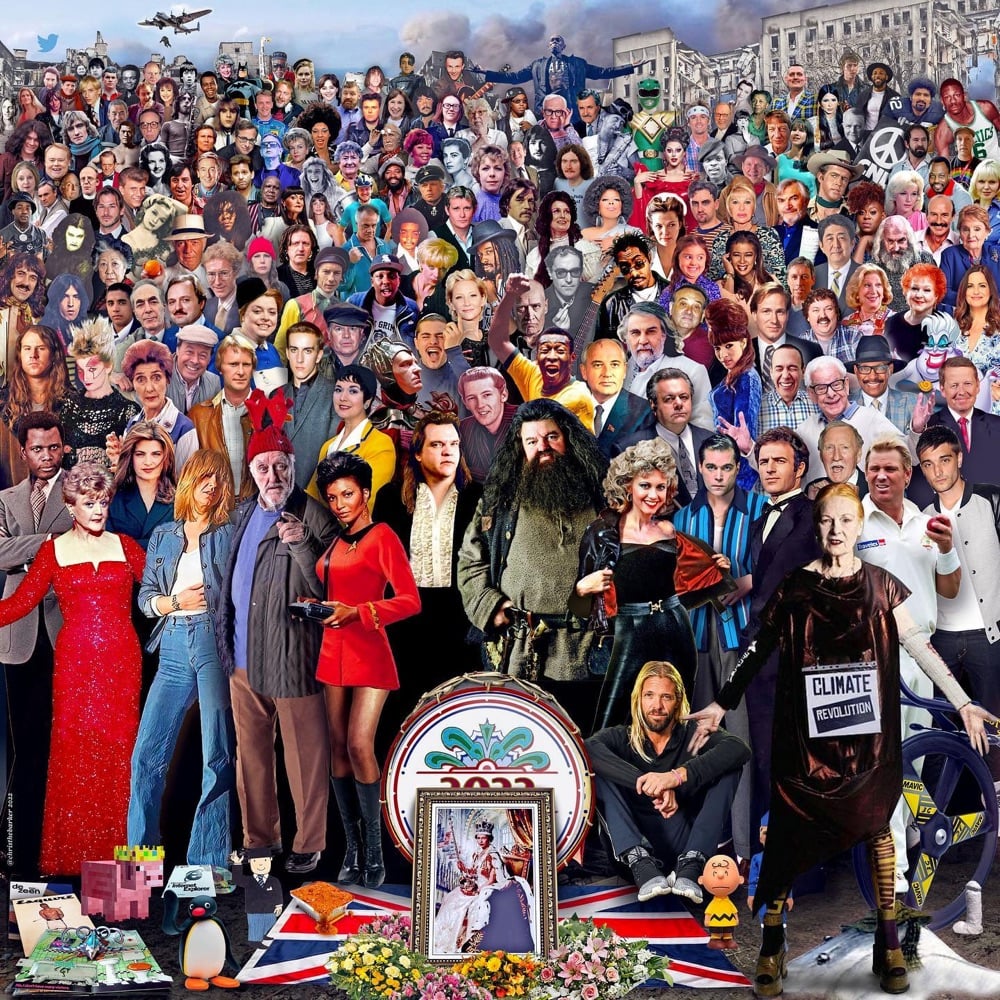
There doesn’t appear to be a complete listing of everyone pictured, but you can easily pick out Coolio, Gilbert Gottfried, Sidney Poitier, Angela Lansbury, Meatloaf, Nichelle Nichols, Pele, Mikhail Gorbachev, and Twitter.
Fueled by television, advertising, cable TV, and the internet, the post-war era saw an explosion of celebrity in America and the world. The average person today “knows of” so many more people than someone living in 1945 did, probably by a couple orders of magnitude. As Boomers and Gen X continue to age, annual displays like this of well-known people who have died will get larger and larger.
Update: An incomplete key to the image is available here. (via @matsimpsk)
From film fan Benito Mussolini and the postwar explosion of Italian filmmaking to a financial rule with big effects and Federico Fellini’s La Dolce Vita, Evan Puschak tells the story of how the paparazzi was created.
The history of celebrity paparazzi disrupted the highly manicured image movie stars had enjoyed since the golden age of Hollywood. They brought these gods of our culture down to the messy earth. Interestingly though, this didn’t dampen our obsession with fame, as you might expect. No, it turbo charged it. Something about seeing our celebrities brought low — catching a glimpse of their flaws and pains — it didn’t push the famous off these weird pedestals we put them on. It only intensified our fixation with them.
For his forthcoming book Exit Stage Left: The Curious Afterlife of Pop Stars, journalist Nick Duerden interviewed pop stars who had made it big about what happened after the bright spotlight of fame moved on. Here are a few interesting bits from an adapted excerpt in The Guardian:
“The pain I feel from the Slits ending is worse than splitting up with a boyfriend,” Albertine wrote, “This feels like the death of a huge part of myself, two whole thirds gone … I’ve got nowhere to go, nothing to do; I’m cast back into the world like a sycamore seed spinning into the wind.”
So what’s it like, I wondered, to still be doing this “job” at 35, and 52, and beyond? What’s it like to have released your debut album to a global roar, and your 12th to barely a whisper? Why the continued compulsion to create at all, to demand yet more adulation? Frankly, what’s the point?
[Suzanne] Vega’s tour, haemorrhaging money, was cut short. When she arrived back at JFK, she looked out for the car her record label would always send to collect her. But there was no car. Not any more. “I took a taxi,” she says.
When Tanya Donelly, of 90s US indie darlings Belly, quit after winning a Grammy (and promptly suffering burnout), she craved normal work and became a doula. When 10,000 Maniacs’ Natalie Merchant grew tired of being a marketable commodity, she quit for the quieter life of a solo artist, and was then duly horrified when her debut album, 1995’s Tigerlily, sold 5m copies, because “then came the treadmill again”. The next time she tried to retire, she did so more forcefully, and now teaches arts and crafts to underprivileged children in New York state. “I look at people like Bob Dylan and Paul McCartney,” she says, referring to the way both legends continue to tour, “and I think to myself: ‘If I were you, I’d just go home and enjoy my garden.’ It’s a question of temperament, clearly.”
Barack Obama’s A Promised Land comes out today and The Root’s Michael Harriot has a brief interview with Obama. The rest of the interview is meatier, but I like Harriott’s last question:
Q: You are a former president and you are unquestionably the predominant role model for a generation of Black people, both of which come with a certain amount of public scrutiny. But for one day, you get to be an anonymous, everyday American who can go anywhere you want and do anything. Describe that day.
A: You know, honestly, I’d just take a walk. Go to the grocery store. Go out to dinner with Michelle. Maybe get some ice cream. Around my second or third year in office, I’d have this recurring dream, maybe once every six months, where I’m walking down the street and head into a coffee shop or a bar or something and nobody recognizes me. It was great!
You can read the rest of his answer, including his thoughts on “the tyranny of selfie”. I watched the Pete Souza documentary The Way I See It the other day1 and the wildest scenes were the ones showing a young Obama on the Senate campaign trail just walking around with no one noticing or bothering him. He must miss those days for sure. But I bet it’s also fun to be able to get literally anyone you want on the phone in 30 seconds.
P.S. I haven’t read it myself yet, but I’ve heard from many folks that Jeffrey Goldberg’s lengthy conversation with Obama is worth checking out.
P.P.S. In their excellent 5-part series on Princess Diana, You’re Wrong About’s Michael Hobbes shared his theory that “fame is abuse” and I’ve been thinking about that in relation to every celebrity story I’ve read since.
It is an understatement to say that a lot has happened to Billie Eilish in the past three years. She has gone from being a well-regarded but little-known singer/songwriter to being Grammy-nominated and one of the biggest young stars in the world. For the third year in a row, Vanity Fair sat down with Eilish to ask her about her life and career, what being famous is like, and how she views her past selves.
As I said last year, the video is fascinating to watch, like a teen celeb version of the 7 Up film series. She seems much happier and more confident — “I want to stay happy. That’s a big goal for me.” It will be interesting next year to see how this bit ages:
I like being famous. It’s very weird and it’s very cool.
(via @fimoculous)
Remember the Broccoli Tree and its eventual fate?
For the past few years, Patrik Svedberg has been taking photos of a beautiful Swedish tree he dubbed The Broccoli Tree. In a short time, the tree gained a healthy following on Instagram, becoming both a tourist attraction and an online celebrity of sorts. (I posted about tree two years ago.) Yesterday, Svedberg posted a sad update: someone had vandalized the tree by sawing through one of the limbs.
Very soon after, it was decided by some authority that the vandalism meant the entire tree had to come down. A work crew arrived and now it’s gone.
In a short video, John Green shares his perspective on the loss of the tree and the meaning of sharing with others in the age of social media.
To share something is to risk losing it, especially in a world where sharing occurs at tremendous scale and where everyone seems to want to be noticed, even if only for cutting down a beloved tree. […] And the truth is, if we horde and hide what we love, we can still lose it. Only then, we’re alone in the loss.

For the past few years, Patrik Svedberg has been taking photos of a beautiful Swedish tree he dubbed The Broccoli Tree. In a short time, the tree gained a healthy following on Instagram, becoming both a tourist attraction and an online celebrity of sorts. (I posted about tree two years ago.) Yesterday, Svedberg posted a sad update: someone had vandalized the tree by sawing through one of the limbs.

One of the trees branches has now (a couple of days ago..?) been sawn in almost all the way through and it’s just a matter of time before it’ll fall off. I won’t be around to document it, others will for sure so I guess you lunatics who did it can enjoy every moment.
Very soon after, it was decided by some authority that the vandalism meant the entire tree had to come down. A work crew arrived and now it’s gone:

Oscar Wilde once wrote that “Each man kills the thing he loves”. I don’t know exactly what Wilde meant by that, but our collective attention and obsession, amplified by the speed and intensity of the internet & social media, tends to ruin the things we love: authors, musicians, restaurants, actors, beloved movies, vacation spots, artists, democracies, and even a tree that became too famous to live.
Update: Via the Broccoli Tree’s Instagram Story comes a pair of updates related to the cutting down of the tree that I wanted to record here for posterity.
1. Along with many other people, I wondered why the whole tree had to come down because of a single cut in one of the branches. The answer is “because they found cuts in most limbs/branches some day after so someone had gone back to ‘finish the job’”. :(
2. The tree was cut in that way and the stump left so that new sprouts might form. Life finds a way! Here’s hoping for the eventual appearance of Broccoli Tree 2.0!
A celebrity story is usually far more interesting when the person telling the story doesn’t give a shit about offending the celebs in question (or talking to them ever again). This story told by Ninja, one half of the Die Antwoord musical group, is clearly in that category. In it, he recounts hanging out at Kanye’s house, eating Kim Kardashian’s delicious banana pudding (not even a euphemism), and then wandering over to Drake’s house (with whom Ninja has a history) to play some basketball. One of the things I liked about this story is that it could have stopped in three or four different places and been a complete & entertaining story, but it just kept going.
Ezra Edelman’s fantastic documentary OJ: Made in America won the Oscar for best documentary this year. In a video for Fandor, Joel Bocko explains while the film’s focus is on Simpson, it also explores seven broader themes about contemporary America: sports, the media, Los Angeles, class, domestic abuse, policing, and race.
OJ: Made in America emerges not simply as a brilliant biography, it’s also a stunning social portrait that can stand beside any novel, epic film, or piece of longform journalism.
And in this video for The Atlantic, Edelman explains how, before murdering his ex-wife, Simpson was an advertising pioneer, the first black athlete to become a nationally known product pitchman, appearing in commercials for Hertz, Chevy, and Schick.
One of the most interesting aspects of Edelman’s film is how Simpson’s feelings about being black shifted after his arrest. For most of his life, he distanced himself from the black community, famously declaring “I’m not black, I’m OJ.” He didn’t get involved in the politics of the day or speak out like Muhammed Ali and other prominent black athletes did. He enjoyed preferential treatment by the LAPD, who help him keep his abuse of women under wraps. Black America had nothing to offer a man who enjoyed being rich and famous in white America. But then the trial happened and he hired Johnny Cochran, who made race into the central issue of the case, deftly aligning Simpson with a black community who had endured decades of racism and brutality in LA at the hands of society and the police.
Dave Pell from Nextdraft on the connection between OJ Simpson and Donald Trump and how celebrity warps American minds.
By the time OJ Simpson was arrested after the infamous ride in the White Ford Bronco, it was totally impossible to imagine he’d be found not guilty.
By the time Trump reached election day, he had broken every rule of politics. He committed more campaign-ending gaffes in a week than most losing presidential campaigns during an entire run.
Both men had a fame that completely cut across all American demographics.
I thought I’d mentioned this somewhere at the time — Twitter? kottke.org? Can’t find it… — but when I watched the excellent OJ: Made in America documentary this summer, the parallels between the OJ story and Trump made me feel very uneasy. Two men, both broadly famous, both wealthy, both charming, both outcasts from their respective social groups, both misogynist abusers, both committed crimes, both gamed the American political and legal systems to get away with something that they shouldn’t have. OJ eventually got his but will Trump? Are Americans doomed to keep repeating these mistakes when it comes to celebrity?
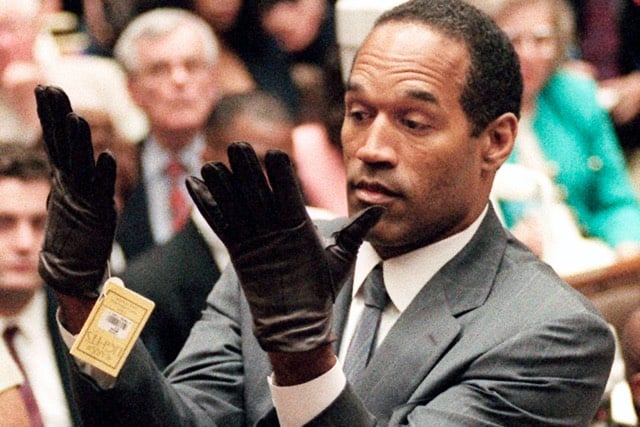
Last night, I finished OJ: Made in America, ESPN’s 8-hour documentary series about OJ Simpson. Prior to starting the series, I would rather have poked an eye out than spend another second of my life thinking about OJ Simpson; I’d gotten my fill back in the 90s. But I’d heard so many good things about it that I gave it a shot. Pretty quickly, you realize this is not just the biography of a man or the story of a trial but is a deep look at racism, policing, and celebrity in the US. OJ: Made in America is excellent and I recommend it unreservedly. From Brian Tallerico’s review:
Ezra Edelman’s stunningly ambitious, eight-hour documentary is a masterpiece, a refined piece of investigative journalism that places the subject it illuminates into the broader context of the end of the 20th century. You may think you know everything about The Trial of the Century, especially if you watched FX’s excellent “The People vs. OJ Simpson: American Crime Story,” but “OJ: Made in America” not only fills in details about the case but offers background and commentary that you’ve never heard before. It is an examination of race, domestic abuse, celebrity, civil rights, the LAPD, the legal process and murder over the last fifty years, using the OJ Simpson story as a way to refract society. Its length may seem daunting, but I would have watched it for another eight hours and will almost certainly watch it again before the summer is over. It’s that good.
The only real criticism I have of the series is that the treatment of women in America should have been explored more, on the same level as racism and celebrity. A.O. Scott picked up on this in his NY Times review:
It is hard not to notice the predominance of male voices among the interview subjects, and the narrowness of the film’s discussion of domestic violence. This is not to say that the issue is ignored: Mr. Simpson’s history of abusing Nicole is extensively and graphically documented, as is the fact that most of his friends ignored what was going on at their Rockingham estate. But the film, which so persuasively treats law enforcement racism as a systemic problem, can’t figure out how to treat violence against women with the same kind of rigor or nuance.
A fuller discussion of domestic violence in the US and misogyny in sports would have provided another powerful, reinforcing aspect of the story.
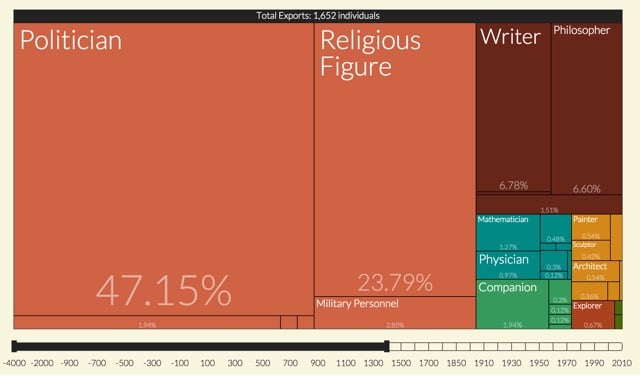
From Pantheon at MIT, an adjustable graph of which kinds of people were globally famous in different eras. Up until the Renaissance, the most well-known people in the world were mostly politicians and religious figures, with some writers and philosophers thrown in for good measure:
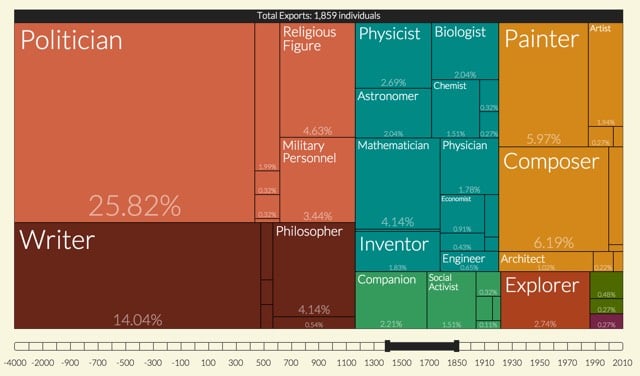
Starting with the Renaissance through the beginnings of the Industrial Revolution, politicians, writers, painters, and composers become more prominent:
For the past 50 years, athletes and entertainers dominate the list, with footballers making up almost a third of the most known. (If you only go back to 1990, actors dominate.)
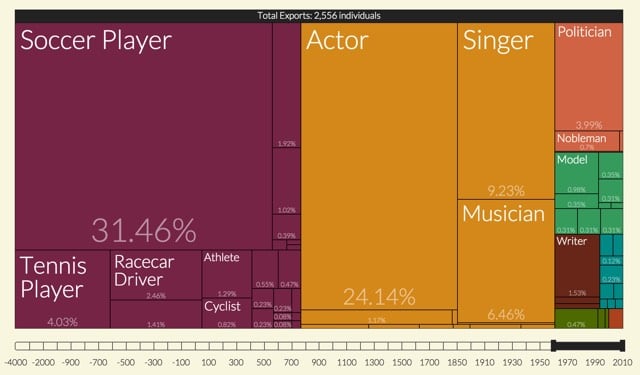
Politicians rate slightly behind tennis players (but ahead of pornographic actors) and religious figures are not represented in the graph at all.
If you’re curious about the data, you can read about their methodology and sources.
Using Phil Fish, the person responsible for critically acclaimed indie game Fez, this video by Ian Danskin explores what it means to be internet famous, something everyone who writes/creates/posts/tweets online has experienced to some extent.
We are used to thinking of fame as something granted to a person by people with media access. The reason people hate Nickelback is because of that record contract, that Faustian bargain — they bought into it. They had to be discovered; someone had to connect them to video directors, record producers, stylists, advertisers.
This is not what fame looks like on the internet. There, fame is not something you ask for. Fame is not something you buy into. Fame happens to you.
Phil doesn’t have an agent. He doesn’t have ad executives. He doesn’t tour the country on press junkets. He doesn’t have a PR department. (Obviously.)
He talked on social media. He did interviews when invited to do them. He was invited into a documentary. People read these things as shameless self-promotion or a desperate need for attention, or both, but that’s projection — nobody knows Phil’s reasons for doing them but Phil and the people who know him personally.
Phil never asked to be famous.
We made him famous. Maybe, in part, because we found him entertaining. Maybe, in part, because we found him irritating. Largely because many of us were once sincerely excited about his game. But he became a big deal because we kept talking about him.
On the internet, celebrities are famous only to the people who talk about them, and they’re only famous because we talk about them, and then we hate them for being too famous, and make them more famous by talking about how much we hate them. Could there ever be anything more self-defeating than this?
Here’s a transcript of the video. In his post about why he decided to sell Minecraft to Microsoft, Markus Persson cites This is Phil Fish as an influence:
I was at home with a bad cold a couple of weeks ago when the internet exploded with hate against me over some kind of EULA situation that I had nothing to do with. I was confused. I didn’t understand. I tweeted this in frustration. Later on, I watched the This is Phil Fish video on YouTube and started to realize I didn’t have the connection to my fans I thought I had. I’ve become a symbol. I don’t want to be a symbol, responsible for something huge that I don’t understand, that I don’t want to work on, that keeps coming back to me. I’m not an entrepreneur. I’m not a CEO. I’m a nerdy computer programmer who likes to have opinions on Twitter.
Robin Sloan connected Persson’s post with a post by Erin Kissane on how she has curtailed her use of Twitter. Here’s one of her problems with Twitter:
The first is feeling like I’m sitting at a sidewalk cafe, speaking in a conversational voice, but having that voice projected so loudly that strangers many streets away are invited to comment on my most inconsequential statements — especially if something I say gets retweeted beyond my usual circles.
Many moons ago, I was “subculturally important” in the small pond of web designers, personal publishers, and bloggers that rose from the ashes of the dot com bust, and I was nodding along vigorously with what Danskin, Persson, and Kissane had to say. Luckily for me, I realized fairly early on that me and the Jason Kottke who published online were actually two separate people…or to use Danskin’s formulation, they were a person and a concept. (When you try to explain this to people, BTW, they think you’re a fucking narcissistic crazy person for talking about yourself in the third person. But you’re not actually talking about yourself…you’re talking about a concept the audience has created. Those who think of you as a concept particularly hate this sort of behavior.)
The person-as-concept idea is a powerful one. People ascribe all sorts of crazy stuff to you without knowing anything about the context of your actual life. I even lost real-life friends because my online actions as a person were viewed through a conceptual lens; basically: “you shouldn’t have acted in that way because of what it means for the community” or some crap like that. Eventually (and mostly unconsciously), I distanced myself from my conceptual counterpart and became much less of a presence online. I mean, I still post stuff here, on Twitter, on Instagram, and so on, but very little of it is actually personal and almost none of it is opinionated in any noteworthy way. Unlike Persson or Fish, I didn’t quit. I just got boring. Which I guess isn’t so good for business, but neither is quitting.
Anyway, I don’t know if that adds anything meaning to the conversation, just wanted to add a big “yeah, that rings true” to all of the above, particularly the video. (thx, @brillhart)
Update: From the Argentinian author Jorge Luis Borges, a short essay called “Borges and I”:
The other one, the one called Borges, is the one things happen to. I walk through the streets of Buenos Aires and stop for a moment, perhaps mechanically now, to look at the arch of an entrance hall and the grillwork on the gate; I know of Borges from the mail and see his name on a list of professors or in a biographical dictionary. I like hourglasses, maps, eighteenth-century typography, the taste of coffee and the prose of Stevenson; he shares these preferences, but in a vain way that turns them into the attributes of an actor. It would be an exaggeration to say that ours is a hostile relationship; I live, let myself go on living, so that Borges may contrive his literature, and this literature justifies me. It is no effort for me to confess that he has achieved some valid pages, but those pages cannot save me, perhaps because what is good belongs to no one, not even to him, but rather to the language and to tradition. Besides, I am destined to perish, definitively, and only some instant of myself can survive in him. Little by little, I am giving over everything to him, though I am quite aware of his perverse custom of falsifying and magnifying things.
Spinoza knew that all things long to persist in their being; the stone eternally wants to be a stone and the tiger a tiger. I shall remain in Borges, not in myself (if it is true that I am someone), but I recognize myself less in his books than in many others or in the laborious strumming of a guitar. Years ago I tried to free myself from him and went from the mythologies of the suburbs to the games with time and infinity, but those games belong to Borges now and I shall have to imagine other things. Thus my life is a flight and I lose everything and everything belongs to oblivion, or to him.
I do not know which of us has written this page.
(via @ezraball)
This article by Anne Helen Petersen about how Angelina Jolie has expertly controlled her PR through several potential rough patches is way more interesting than it has any right to be.
This photo, for example, is a semiotic gold mine: Shiloh, often nicknamed “The Chosen One,” a glimmering beacon of whiteness, flanked by her racially marked siblings, one of whom seems to be protecting her from possible harm. All three are framed by their doting parents, tied to their children via skin color, head/neck scarf, hair highlighting, and physical touch. They’re a “Party of Five,” as the title of the accompanying article puts it, but they’re a distinctly global one: The photos were all shot in Cambodia, and when asked how her children manage all the traveling, Jolie says, “We’ve tried to make them very adaptable, so when we go to a country like India or certain parts of Namibia, they’re happy to play with sticks and rocks outside — they’re happy to blend.”
Taken together, these images, and the stories that accompanied them, were speaking about their relationship, even if the pair themselves weren’t offering comment. And what they were saying was that this wasn’t a story about sex or scandal; rather, it was one of family, humanitarianism, and global citizenship. Within this framework, any publication that chose to focus on sexual intrigue was effectively neglecting the most in need.
It is sad to see Gwyneth Paltrow promoting pseduoscience hucksters like Masaru Emoto in her very popular Goop newsletter. It begins:
I am fascinated by the growing science behind the energy of consciousness and its effects on matter. I have long had Dr. Emoto’s coffee table book on how negativity changes the structure of water, how the molecules behave differently depending on the words or music being expressed around it.
And later on in the letter, Dr. Habib Sadeghi continues:
Japanese scientist, Masaru Emoto performed some of the most fascinating experiments on the effect that words have on energy in the 1990’s. When frozen, water that’s free from all impurities will form beautiful ice crystals that look exactly like snowflakes under a microscope. Water that’s polluted, or has additives like fluoride, will freeze without forming crystals. In his experiments, Emoto poured pure water into vials labeled with negative phrases like “I hate you” or “fear.” After 24 hours, the water was frozen, and no longer crystallized under the microscope: It yielded gray, misshapen clumps instead of beautiful lace-like crystals. In contrast, Emoto placed labels that said things like “I Love You,” or “Peace” on vials of polluted water, and after 24 hours, they produced gleaming, perfectly hexagonal crystals. Emoto’s experiments proved that energy generated by positive or negative words can actually change the physical structure of an object.
Riiiight. Paltrow should stick to recipes, fashion, and workouts and leave the science to people who actually understand it lest she wander into Jenny McCarthy territory. There’s nothing wrong with asserting that thinking positively will improve your life, but connecting it with quantum physics and the like, without rigorous scientific proof, is dangerous and stupid.
Oh, this is the dumbest thing but it made me laugh today: Celebrities that Look Like Mattresses.
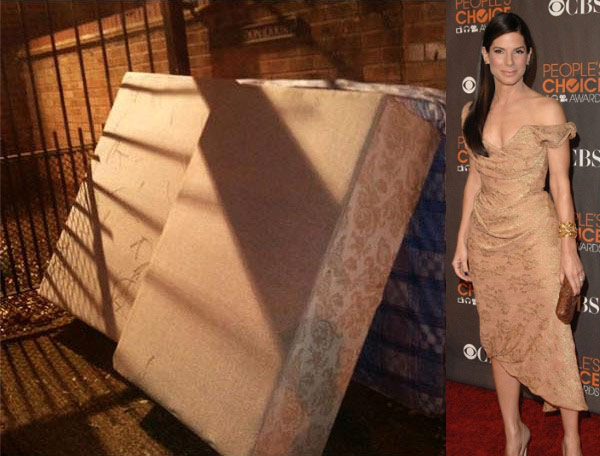
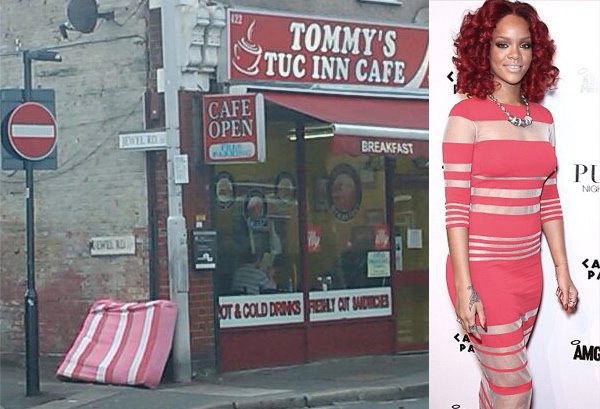
How on Earth did they find these pairings? Has Google perfected their Mattress Recognition technology? (via @Rebeccamead_NYC)
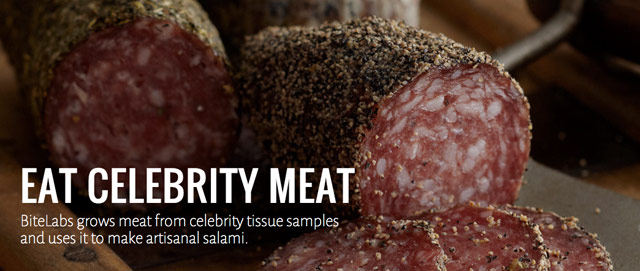
Have you ever wanted to taste Kanye West’s meat? Then what is wrong with you and what is wrong with these people?!?! They want to take tissue samples from celebrities like James Franco, Kanye, and Jennifer Lawrence and make artisanal salami out of them.
It all starts with your favorite celebrities, and a quick biopsy to obtain tissue samples. Isolating muscle stem cells, we grow celebrity meat in our proprietary bioreactors. In the tradition of Italian cured meats, we dry, age, and spice our product into fine charcuterie.
Note: BiteLabs might be completely fake. But fake is the new real so… nope, this is just fake.
From photographer Victoria Will, olde tyme tin type portraits of celebrities at Sundance. The one of William H. Macy stopped me in my tracks:

Several others are worth a look as well. (via @khoi)
Esquire has Tom Junod writing profiles of the most famous men in Hollywood: Leonard DiCaprio, Matt Damon, and Brad Pitt. This month, Junod tackles George Clooney, who despite not having a big box office hit until Gravity, is right up there with Pitt, Cruise, and Hanks in pure wattage of stardom.
He has other houses. He has one, famously, on Lake Como, in Italy, and he has built another in Cabo. In this, he is not so much of a throwback-after all, Leonardo DiCaprio has a house in Cabo. Indeed, Clooney and DiCaprio once ran into each other in Cabo and struck up a conversation based on their common interest in basketball. They each have ongoing games, and their ongoing games have attained a celebrity of their own. Clooney suggested they might play someday. DiCaprio said sure, but felt compelled to add, “You know, we’re pretty serious.”
They played at a neighborhood court. “You know, I can play,” Clooney says in his living room. “I’m not great, by any means, but I played high school basketball, and I know I can play. I also know that you don’t talk shit unless you can play. And the thing about playing Leo is you have all these guys talking shit. We get there, and there’s this guy, Danny A I think his name is. Danny A is this club kid from New York. And he comes up to me and says, ‘We played once at Chelsea Piers. I kicked your ass.’ I said, ‘I’ve only played at Chelsea Piers once in my life and ran the table. So if we played, you didn’t kick anybody’s ass.’ And so then we’re watching them warm up, and they’re doing this weave around the court, and one of the guys I play with says, ‘You know we’re going to kill these guys, right?’ Because they can’t play at all. We’re all like fifty years old, and we beat them three straight: 11-0, 11-0, 11-0. And the discrepancy between their game and how they talked about their game made me think of how important it is to have someone in your life to tell you what’s what. I’m not sure if Leo has someone like that.”
YouTuber Chase creates short videos where the faces of celebrities are swapped for other celebrity faces. The results are weird and often hilarious. The best one is probably the most recent video of Natalie Portman and Will Ferrell:
This quick Nicholson/Cruise clip from A Few Good Men is pretty good too:
Co.Create did an interview with the creator.
“When picking the celebrities, I am mainly considering two things. Their relevance and popularity, as well as the availability of unique, high-quality footage in which the actor is looking mostly towards the camera,” Chase says. “Mashing up footage in which the characters are constantly looking side to side is much more difficult and usually results in a less convincing final product.” He adds. “There have a been a few After Effects sessions that ended up in the recycle bin because of this.”
(via @daveg)
George Packer, writing for the NY Times on the subject of modern celebrity:
Our age is lousy with celebrities. They can be found in every sector of society, including ones that seem less than glamorous. We have celebrity bankers (Jamie Dimon), computer engineers (Sergey Brin), real estate developers/conspiracy theorists (Donald J. Trump), media executives (Arianna Huffington), journalists (Anderson Cooper), mayors (Cory A. Booker), economists (Jeffrey D. Sachs), biologists (J. Craig Venter) and chefs (Mario Batali).
There is a quality of self-invention to their rise: Mark Zuckerberg went from awkward geek to the subject of a Hollywood hit; Shawn Carter turned into Jay-Z; Martha Kostyra became Martha Stewart, and then Martha Stewart Living. The person evolves into a persona, then a brand, then an empire, with the business imperative of grow or die — a process of expansion and commodification that transgresses boundaries by substituting celebrity for institutions. Instead of robust public education, we have Mr. Zuckerberg’s “rescue” of Newark’s schools. Instead of a vibrant literary culture, we have Oprah’s book club. Instead of investments in public health, we have the Gates Foundation. Celebrities either buy institutions, or “disrupt” them.
Writer Tom Junod on journalism and regret:
I remember walking into a dinner party after Slate called the Angelina profile the Worst Celebrity Profile of All Time. My arrival was greeted with silence; people did not know what to say. So I brought it up, not just to ease the tension but also because I was, like my editor, perversely proud of being so honored, knowing that you can’t hope to write the Best Celebrity Profile of All Time unless you are absolutely prepared to write the Worst. I’m not in this business because I expect to be admired but rather because I want the freedom to say what I want to say and get some kind of reaction for saying it, so if I can’t enjoy the fact that Slate devoted 2,500 words to the Angelina profile then I’ve lost something of myself that I desperately need to preserve in order to write the way I want to write. The great vice of journalism in the age of social media is not its recklessness but rather its headlong rush for respectability — its self-conscious desire to please an audience of peers rather than an audience of reader — and the first step towards respectability is regret.
Here’s his profile of Jolie and the Slate takedown of it. And you can like this post riiiiight down here (God, please do):
↓↓
Up close, everyone looks a little weird. Even Anne Hathaway:
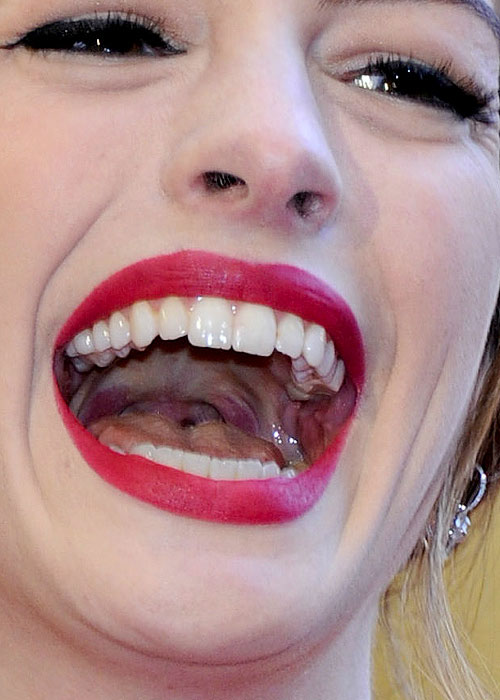
These remind me of macro photography of insects…when photographed close-up, people look like aliens too.
From Sarah Marshall, a list of celebrity fragrances that didn’t quite make it to market.
Goldbloom by Jeff Goldblum: This fragrance, meant to be drizzled down the wearer’s forearm (preferably while in a moving car) is redolent of warm eyeglasses, tanning oil, and Velociraptor musk. Perfect for work or leisure.
Wintour Harvest by Anna Wintour: Peppery, balsamic, indecisive, and fresh. Notes of warm blood and Galliano Sequin enliven this fragrance designed for the gal on the go.
Photographer Danny Evans photoshops images of celebrities so that they look like normal people. This one of Kanye and Kim is my favorite:
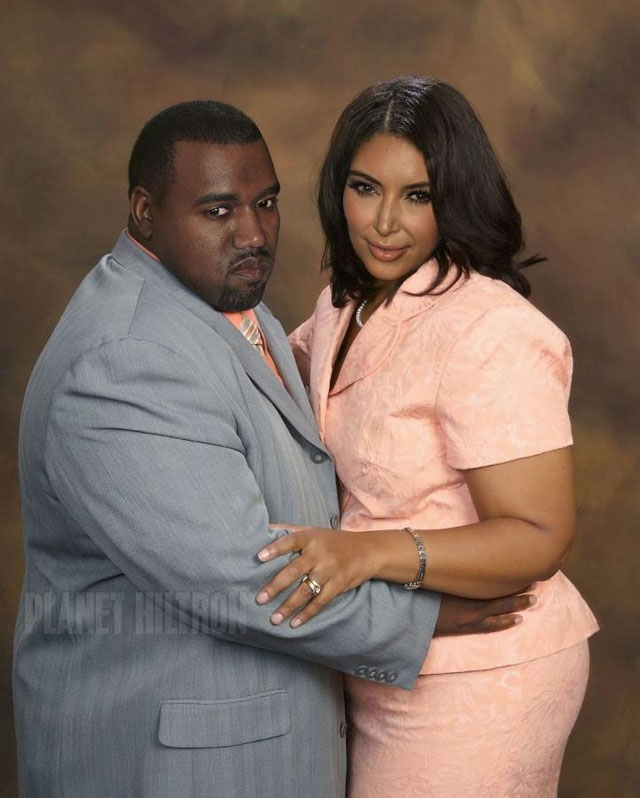
Man, I could stare at chubby Kanye all day. But the Tom Cruise one is pretty great as well:
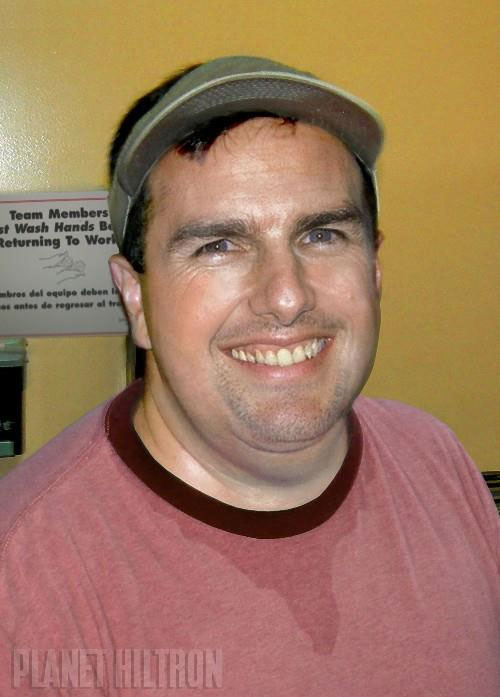
(via co.design)
Grantland’s Bill Simmons and the New Yorker’s Malcolm Gladwell had one of their epic email conversations the other day and posted it to Grantland. Topics included the NBA playoffs, sports journalism, LeBron, fame in the internet era, sports philosophers, and football concussions.
Do we really need 25 people crammed in baseball locker rooms fighting for the same mundane quotes? What’s our game plan for the fact that — thanks to the Internet and 24-hour sports stations — a city like Boston suddenly has four times as many sports media members as it once had? Why are we covering teams the same way we covered them in 1981, just with more people and better equipment? If I could watch any Celtics game and press conference from my house (already possible), and there was a handpicked pool of reporters (maybe three per game, with the people changing every game) responsible for pooling pregame/postgame quotes and mailing them out immediately, could I write the same story (or pretty close)? If we reduced the locker room clutter, would players relax a little more? Would their quotes improve? Would they trust the media more? Why haven’t we experimented at all? Any “improvements” in our access have been forgettable. Seriously, what pearls of wisdom are we expecting from NBA coaches during those ridiculous in-game interviews, or from athletes sitting on a podium with dozens of media members firing monotone questions at them? It’s like an all-you-can-eat buffet of forgettable quotes, like the $7.99 prime rib extravaganzas at a Vegas casino or something. There’s Russell Westbrook at the podium for $7.99! Feast away! We laugh every time Gregg Popovich curmudgeonly swats Craig Sager away with four-word answers, but really, he’s performing a public service. He’s one of the few people in sports who has the balls to say, “This couldn’t be a dumber relationship right now.”
Ethan Zuckerman proposes measuring attention with a unit of measure called a Kardashian. One Kardashian is equal to the amount of worldwide media attention that Kim Kardashian gets in a day.
I choose the Kardashian as a unit both because I like the mitteleuropean feel of the term — like the Ohm or the Roentgen — and because Kardashian is an exemplar of attention disconnected from merit, talent or reason. The Kardashian mentions how much attention is paid, not how much attention is deserved, so naming the unit after someone who is famous for being famous seems appropriate. Should the unit be adopted, I would hope that future scholars will calculate Kardashians using whatever public figure is appropriate at the time for being inappropriately famous.
Example usage: The crisis in Greece received 12 microKardashians of attention today.
In 2006, Garth Sundem and John Tierney published an equation in the NY Times that attempted to predict celebrity marriage crackups using a few metrics: age, fame, sexiness, etc. The pair recently modified the equation based on the evidence of the last five years and surprisingly, the equation is simpler.
What went right with them — and wrong with our equation? Garth, a self-professed “uber-geek,” has crunched the numbers and discovered a better way to gauge the toxic effects of celebrity. Whereas the old equation measured fame by counting the millions of Google hits, the new equation uses a ratio of two other measures: the number of mentions in The Times divided by mentions in The National Enquirer.
“This is a major improvement in the equation,” Garth says. “It turns out that overall fame doesn’t matter as much as the flavor of the fame. It’s tabloid fame that dooms you. Sure, Katie Holmes had about 160 Enquirer hits, but she had more than twice as many NYT hits. A high NYT/ENQ ratio also explains why Chelsea Clinton and Kate Middleton have better chances than the Kardashian sisters.”
Garth’s new analysis shows that it’s the wife’s fame that really matters. While the husband’s NYT/ENQ ratio is mildly predictive, the effect is so much weaker than the wife’s that it’s not included in the new equation. Nor are some variables from the old equation, like the number of previous marriages and the age gap between husband and wife.
Older posts





Socials & More