kottke.org posts about neuroscience
Sleeping cleans your brain. Research suggests that zoning out, daydreaming, and being bored can perform a similar function without the need for deep sleep. So put down that phone occasionally and let your brain chill for a bit.
In a recent bombshell piece for the New Yorker (archive), Rachel Aviv explored the personal journals of the celebrated neurologist and writer Oliver Sacks. What she found was shocking: he had fabricated and embellished some of his most well-known work — like Awakenings and The Man Who Mistook His Wife for a Hat. Sacks himself referred to his “lies” and “falsification” in journal entries.
But, in his journal, Sacks wrote that “a sense of hideous criminality remains (psychologically) attached” to his work: he had given his patients “powers (starting with powers of speech) which they do not have.” Some details, he recognized, were “pure fabrications.” He tried to reassure himself that the exaggerations did not come from a shallow place, such as a desire for fame or attention. “The impulse is both ‘purer’ — and deeper,” he wrote. “It is not merely or wholly a projection — nor (as I have sometimes, ingeniously-disingenuously, maintained) a mere ‘sensitization’ of what I know so well in myself. But (if you will) a sort of autobiography.” He called it “symbolic ‘exo-graphy.’”
Sacks had “misstepped in this regard, many many times, in ‘Awakenings,’” he wrote in another journal entry, describing it as a “source of severe, long-lasting, self-recrimination.”
The author Maria Konnikova discovered Sacks’ work in high school — “it blew my mind”, she writes. After the Aviv piece was published, Konnikova wrote a post about Sacks: The man who mistook his imagination for the truth.
When Joseph Mitchell invents a fishmonger, nobody gets hurt. It’s not journalism. It’s not nonfiction. But it’s not life or death. When Jonah Lehrer invents a quote from Bob Dylan, you can call him a narcissistic idiot for thinking he can get away with fabulizing a living legend whose every word has been studied. It’s not journalism. It’s not nonfiction. But, again, it’s not the end of the world. When Oliver Sacks invents an ability that does not exist or crafts a portrait of his own creation, he is hampering medical progress and tampering with the ethics of his profession. Not all journalistic malfeasance is created equal. There are plenty of shades of grey. But making up medical details is not in the gray zone. It’s malpractice.
Yesterday on her Instagram story, cognitive scientist Lera Boroditsky posted a short clip of a lecture in which she posed an intriguing question: if she switched brains with LeBron James, which of them would win in a 1-on-1 game? Some relevant facts: LeBron is 6’8”, 250 pounds, a 4-time NBA champion, 19-time All-Star, 4-time league MVP, and is the all-time NBA points leader. He also possesses a singular basketball mind:
“I can usually remember plays in situations a couple of years back — quite a few years back sometimes,” James says. “I’m able to calibrate them throughout a game to the situation I’m in, to know who has it going on our team, what position to put him in.
“I’m lucky to have a photographic memory,” he will add, “and to have learned how to work with it.”
Boroditsky is 5’3”, 105 pounds, and by her own admission knows nothing about basketball and has “no hops”. So who would win? Boroditsky’s body with LeBron’s brain or LeBron’s body with Boroditsky’s brain? And why?
Photographs have always been an imperfect reproduction of real life — see the story of Dorothea Lange’s Migrant Mother or Ansel Adams’ extensive dark room work — but the seemingly boundless alterations offered by current & future AI editing tools will allow almost anyone to turn their photos (or should I say “photos”) into whatever they wish. In this video, Evan Puschak briefly explores what AI-altered photos might do to our memories.
I was surprised he didn’t mention the theory that when a past experience is remembered, that memory is altered in the human brain — that is, “very act of remembering can change our memories”. I think I first heard about this on Radiolab more than 16 years ago. So maybe looking at photos extensively altered by AI could extensively alter those same memories in our brains, actually making us unable to recall anything even remotely close to what “really” happened. Fun!
But also, one could imagine this as a powerful way to treat PTSD, etc. Or to brainwash someone! Or an entire populace… Here’s Hannah Arendt on constantly being lied to:
If everybody always lies to you, the consequence is not that you believe the lies, but rather that nobody believes anything any longer. This is because lies, by their very nature, have to be changed, and a lying government has constantly to rewrite its own history. On the receiving end you get not only one lie — a lie which you could go on for the rest of your days — but you get a great number of lies, depending on how the political wind blows. And a people that no longer can believe anything cannot make up its mind. It is deprived not only of its capacity to act but also of its capacity to think and to judge. And with such a people you can then do what you please.
As I said in response to this quote in a post about deepfakes:
This is the incredible and interesting and dangerous thing about the combination of our current technology, the internet, and mass media: “a lying government” is no longer necessary — we’re doing it to ourselves and anyone with sufficient motivation will be able to take advantage of people without the capacity to think and judge.
P.S. I lol’d too hard at his deadpan description of “the late Thanos”. RIP, big fella.
What’s going on in the brains of people who meditate? Anecdotal evidence suggests that meditation does something to people’s minds and bodies…quiets and calms them. In this video, Daniel Goleman reports on research done by his colleague Richard Davidson, a neuroscientist at the University of Wisconsin–Madison. Davidson brought a number of “Olympic level meditators” into his lab and hooked them up to a brain scanner. He found that the brains of these expert meditators have different brain wave patterns than the rest of us.
Perhaps the most remarkable findings in the Olympic level meditators has to do with what’s called a gamma wave. All of us get gamma for a very short period when we solve a problem we’ve been grappling with, even if it’s something that’s vexed us for months. We get about half second of gamma; it’s the strongest wave in the EEG spectrum. We get it when we bite into an apple or imagine biting into an apple, and for a brief period, a split-second, inputs from taste, sound, smell, vision, all of that come together in that imagined bite into the apple. But that lasts very short period in an ordinary EEG.
What was stunning was that the Olympic level meditators, these are people who have done up to 62,000 lifetime hours of meditation, their brainwave shows gamma very strong all the time as a lasting trait just no matter what they’re doing. It’s not a state effect, it’s not during their meditation alone, but it’s just their every day state of mind. We actually have no idea what that means experientially. Science has never seen it before.
Goleman and Davidson have written more about how meditation affects the mind and body in their book, Altered Traits.
Sweeping away common misconceptions and neuromythology to open readers’ eyes to the ways data has been distorted to sell mind-training methods, the authors demonstrate that beyond the pleasant states mental exercises can produce, the real payoffs are the lasting personality traits that can result. But short daily doses will not get us to the highest level of lasting positive change — even if we continue for years — without specific additions. More than sheer hours, we need smart practice, including crucial ingredients such as targeted feedback from a master teacher and a more spacious, less attached view of the self, all of which are missing in widespread versions of mind training.
There’s that pesky deliberate practice popping up again.
Composer Max Richter released Sleep in 2015, but it only recently became available on streaming platforms: Spotify, Amazon, Apple Music, Tidal. The album is 8 hours and 24 minutes long and was designed by Richter as a sleep aid/accompaniment. The composer worked with neuroscientist David Eagleman to align the music with the brain & body’s natural sleep rhythms.
A snack-sized version of Sleep is also available: From Sleep, which clocks in at a mere hour long.
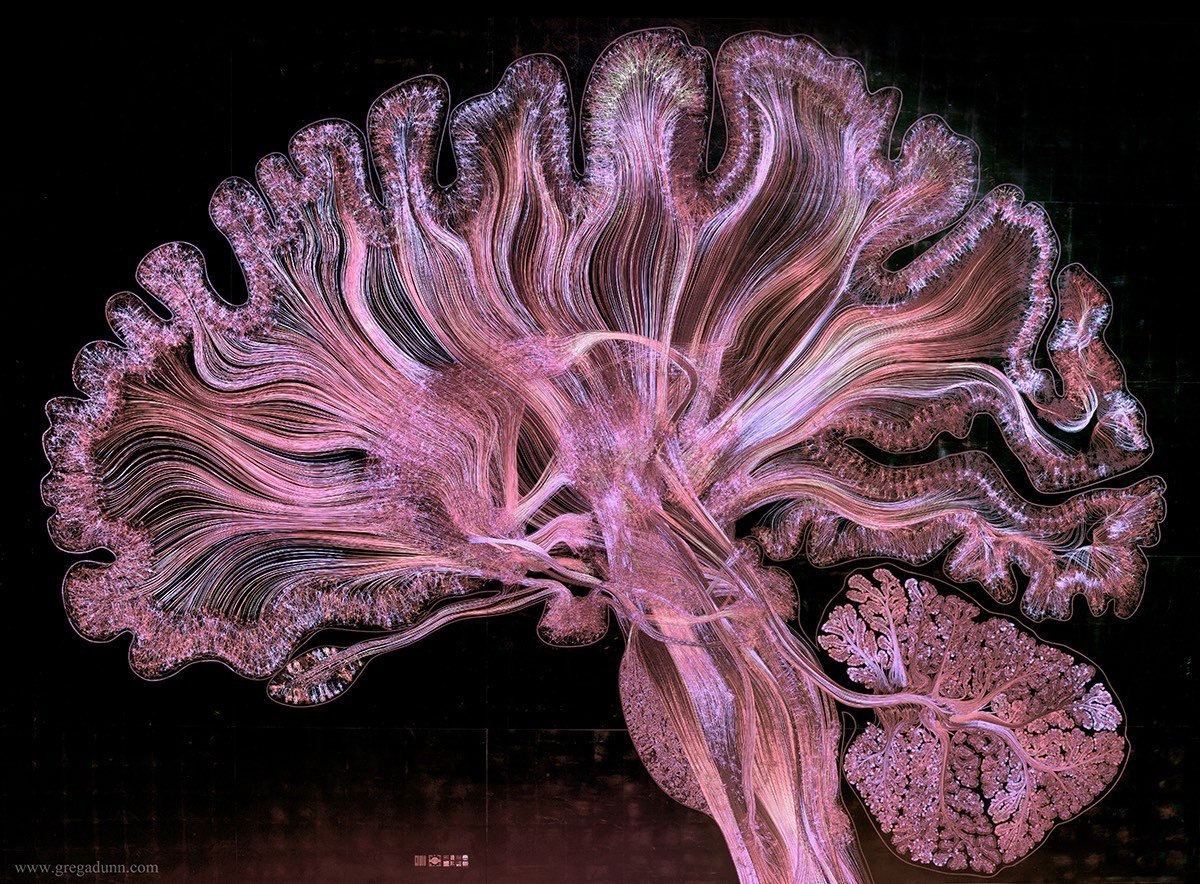
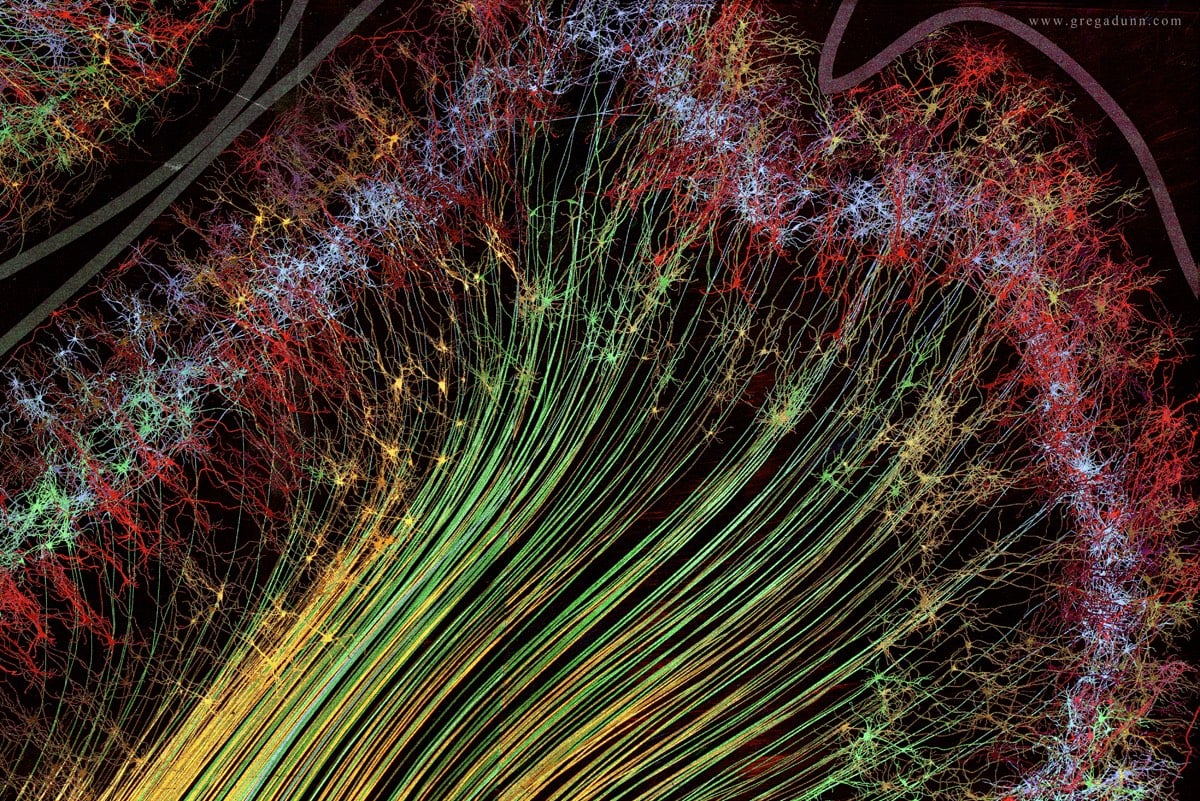
Self Reflected is a project by a pair of artist/scientists that aims to visualize the inner workings of the human brain.
Dr. Greg Dunn (artist and neuroscientist) and Dr. Brian Edwards (artist and applied physicist) created Self Reflected to elucidate the nature of human consciousness, bridging the connection between the mysterious three pound macroscopic brain and the microscopic behavior of neurons. Self Reflected offers an unprecedented insight of the brain into itself, revealing through a technique called reflective microetching the enormous scope of beautiful and delicately balanced neural choreographies designed to reflect what is occurring in our own minds as we observe this work of art. Self Reflected was created to remind us that the most marvelous machine in the known universe is at the core of our being and is the root of our shared humanity.
It’s important to emphasize that these images are not brain scans…they are artistic representations of neural pathways and other structures in the brain.
Self Reflected was designed to be a highly accurate representation of a slice of the brain and is informed by deep neuroscience research to allow it to function as a reliable educational tool as well as a work of art.
Wired recently challenged neuroscientist Bobby Kasthuri to explain what a connectome is to people with five different levels of potential understanding: a 5-year-old, a 13-year-old, a college student, a neuroscience grad student, and an expert neuroscientist. His goal: “every person here can leave with understanding it at some level”.
Watching this, I kept thinking of Richard Feynman, who was particularly adept at describing concepts to non-experts without sacrificing truth or even nuance. See him explain fire, rubber bands, how trains go around curves, and magnets.
In the New Yorker, Michael Specter writes generally about the malleability of memory and specifically about Daniela Schiller’s research on disassociating people’s memories from the feelings they have about them. Simply recalling a memory can change it, and Schiller has found evidence that process can be used to remove the feelings of stress, anxiety, and fear associated with certain memories.
Even so, Schiller entered her field at a fortunate moment. After decades of struggle, scientists had begun to tease out the complex molecular interactions that permit us to form, store, and recall many different types of memories. In 2004, the year Schiller received her doctorate in cognitive neuroscience, from Tel Aviv University, she was awarded a Fulbright fellowship and joined the laboratory of Elizabeth Phelps, at New York University. Phelps and her colleague Joseph LeDoux are among the nation’s leading investigators of the neural systems involved in learning, emotion, and memory. By coincidence, that was also the year that the film “Eternal Sunshine of the Spotless Mind” was released; it explores what happens when two people choose to have all their memories of each other erased. In real life, it’s not possible to pluck a single recollection from our brains without destroying others, and Schiller has no desire to do that. She and a growing number of her colleagues have a more ambitious goal: to find a way to rewrite our darkest memories.
“I want to disentangle painful emotion from the memory it is associated with,” she said. “Then somebody could recall a terrible trauma, like those my father obviously endured, without the terror that makes it so disabling. You would still have the memory, but not the overwhelming fear attached to it. That would be far more exciting than anything that happens in a movie.” Before coming to New York, Schiller had heard — incorrectly, as it turned out — that the idea for “Eternal Sunshine” originated in LeDoux’s lab. It seemed like science fiction and, for the most part, it was. As many neuroscientists were aware, though, the plot also contained more than a hint of truth.
Or rather, protozoan? Toxoplasma gondii is a protozoan parasite which is transmitted from rodents to cats through a crafty mechanism…it makes mice attracted to the smell of cat urine. Mouse goes near cat, cat eats mouse, T. gondii has a new host. From cats, the parasite can jump into humans, where it may be responsible for all sorts of nastiness:
Well, the behavioral influence plays out in a number of strange ways. Toxoplasma infection in humans has been associated with everything from slowed reaction times to a fondness toward cat urine — to more extreme behaviors such as depression and even schizophrenia. And here’s the kicker: Two different research groups have independently shown that Toxo-infected individuals are three to four times as likely of being killed in car accidents due to reckless driving.
And maybe makes us want to invent networking technology and share cool links? In this five-minute talk, Kevin Slavin cleverly connects viral media with T. gondii:
That video was so good, I watched the whole thing twice.
For The Verge, Russell Brandom writes about the increasing use of neural implants to control the symptoms of a variety of diseases, from depression to Parkinson’s to dystonia.
The results are as reliable as flipping a light switch, but even after decades of testing, no one knows exactly why it works. Dr. Kaplitt, the surgeon who installed Rebecca Serdans’ implant, explains it by likening the brain to a collection of electrical circuits. A disorder like dystonia is a failure of those circuits. When you install a brain stimulation device, “it’s presumably blocking abnormal information from getting from one part of the brain to another, or normalizing that information.” But Kaplitt is the first to acknowledge that this is just a theory. “The mechanism by which brain stimulation works is still somewhat unclear and controversial.”
But the lingering questions haven’t slowed down research. There are already patents that would use brain stimulation implants to enhance memory or prevent stuttering, to cure anorexia or bring a person to orgasm. Experimental studies use the device to treat Alzheimer’s disease and drug addiction. Those circuits aren’t as well understood as the circuits governing movement disorders, but the principle is no different. Once you’ve got a line into the circuitry of the brain, Parkinson’s is just the beginning.
Last week I featured a video of a man with Parkinson’s who has a brain pacemaker that allows him to function normally.
There is increasing evidence that a parasite called Toxoplasma gondii, which many humans have gotten from cat feces, can rewire our brains and modify human behavior in unexpected ways.
The parasite, which is excreted by cats in their feces, is called Toxoplasma gondii (T. gondii or Toxo for short) and is the microbe that causes toxoplasmosis-the reason pregnant women are told to avoid cats’ litter boxes. Since the 1920s, doctors have recognized that a woman who becomes infected during pregnancy can transmit the disease to the fetus, in some cases resulting in severe brain damage or death. T. gondii is also a major threat to people with weakened immunity: in the early days of the AIDS epidemic, before good antiretroviral drugs were developed, it was to blame for the dementia that afflicted many patients at the disease’s end stage. Healthy children and adults, however, usually experience nothing worse than brief flu-like symptoms before quickly fighting off the protozoan, which thereafter lies dormant inside brain cells-or at least that’s the standard medical wisdom.
But if Flegr is right, the “latent” parasite may be quietly tweaking the connections between our neurons, changing our response to frightening situations, our trust in others, how outgoing we are, and even our preference for certain scents. And that’s not all. He also believes that the organism contributes to car crashes, suicides, and mental disorders such as schizophrenia. When you add up all the different ways it can harm us, says Flegr, “Toxoplasma might even kill as many people as malaria, or at least a million people a year.”
In a 2008 paper called The Seductive Allure of Neuroscience Explanations, a group from Yale University demonstrated that including neuroscientific information in explanations of psychological phenomena makes the explanations more appealing, even if the neuroscientific info is irrelevant.
Explanations of psychological phenomena seem to generate more public interest when they contain neuroscientific information. Even irrelevant neuroscience information in an explanation of a psychological phenomenon may interfere with people’s abilities to critically consider the underlying logic of this explanation.
I don’t know if I buy this. Perhaps if the authors had explained their results relative to how the human brain functions…
This is incredible…researchers at Berkeley have developed a system that reads people’s minds while they watch a video and then roughly reconstructs what they were watching from thousands of hours of YouTube videos. This short demo shows how it works:
Nishimoto and two other research team members served as subjects for the experiment, because the procedure requires volunteers to remain still inside the MRI scanner for hours at a time.
They watched two separate sets of Hollywood movie trailers, while fMRI was used to measure blood flow through the visual cortex, the part of the brain that processes visual information. On the computer, the brain was divided into small, three-dimensional cubes known as volumetric pixels, or “voxels.”
“We built a model for each voxel that describes how shape and motion information in the movie is mapped into brain activity,” Nishimoto said.
The brain activity recorded while subjects viewed the first set of clips was fed into a computer program that learned, second by second, to associate visual patterns in the movie with the corresponding brain activity.
Brain activity evoked by the second set of clips was used to test the movie reconstruction algorithm. This was done by feeding 18 million seconds of random YouTube videos into the computer program so that it could predict the brain activity that each film clip would most likely evoke in each subject.
Finally, the 100 clips that the computer program decided were most similar to the clip that the subject had probably seen were merged to produce a blurry yet continuous reconstruction of the original movie.
The kicker: “the breakthrough paves the way for reproducing the movies inside our heads that no one else sees, such as dreams and memories”. First time travelling neutrinos and now this…what a time to be alive. (via ★essl)
Tatiana and Krista Hogan are conjoined twins who not only share a bit each other’s skulls but also parts of their brains. So are they two people with two brains & personalities or one person with one brain and two (split) personalities?
Adding to the conundrum, of course, are their linked brains, and the mysterious hints of what passes between them. The family regularly sees evidence of it. The way their heads are joined, they have markedly different fields of view. One child will look at a toy or a cup. The other can reach across and grab it, even though her own eyes couldn’t possibly see its location. “They share thoughts, too,” says Louise. “Nobody will be saying anything,” adds Simms, “and Tati will just pipe up and say, ‘Stop that!’ And she’ll smack her sister.” While their verbal development is delayed, it continues to get better. Their sentences are two or three words at most so far, and their enunciation is at first difficult to understand. Both the family, and researchers, anxiously await the children’s explanation for what they are experiencing.
Lovely long piece in the November issue of Esquire about the brain of Henry Molaison, who you may have previously heard of as Patient H.M., aka the man who lacked the ability to remember anything for more than a couple of minutes. His brain has now been sliced into thin slices in an effort to construct a map of the human brain accurate to neuron-level.
Corkin first met Henry at Brenda Milner’s lab in Montreal in 1962, and over the years, as the mining of his mind has continued, she’s witnessed firsthand how Henry continues to give up riches, broadening our understanding of how memory works. But she’s also keenly aware of Henry’s enduring mysteries, has documented things about him that nobody can quite explain, not yet.
For example, Henry’s inability to recall postoperative episodes, an amnesia that was once thought to be complete, has revealed itself over the years to have some puzzling exceptions. Certain things have managed, somehow, to make their way through, to stick and become memories. Henry knows a president was assassinated in Dallas, though Kennedy’s motorcade didn’t leave Love Field until more than a decade after Henry left my grandfather’s operating room. Henry can hear the incomplete name of an icon — “Bob Dy …” — and complete it, even though in 1953 Robert Zimmerman was just a twelve-year-old chafing against the dead-end monotony of small-town Minnesota. Henry can tell you that Archie Bunker’s son-in-law is named Meathead.
How is this possible?
The piece is written by the grandson of the doctor who removed a portion of Molaison’s brain in an effort to cure his epilepsy.
Jonah Lehrer on what our brains are up to when we’re shopping at Costco.
As I note in How We Decide, this data directly contradicts the rational models of microeconomics. Consumers aren’t always driven by careful considerations of price and expected utility. We don’t look at the electric grill or box of chocolates and perform an explicit cost-benefit analysis. Instead, we outsource much of this calculation to our emotional brain, and rely on relative amounts of pleasure versus pain to tell us what to purchase.
Using brain scanning equipment and a cleverly designed interrogation technique, scientists have been able to ask questions of so-called vegetative patients; one of them even answered yes or no questions:
Several times when Subject 23 was asked to imagine playing tennis, Monti said, the region of the brain most closely associated with complex motor planning became highly active, and stayed active for 30 seconds after researchers prompted such imagery by saying “tennis.”
Similarly, when researchers asked the patient to imagine walking through the house where he grew up and then said the word “navigate,” Subject No. 23 responded with bursts of activity in the region of the brain involved in constructing and navigating a mental map.
The young, French-speaking man was the only subject who was then trained to answer simple yes or no questions — whether his father’s name was Paul (yes) or Alexander (no), whether he had siblings and how many — using the imagery technique he had already learned.
Checking the patient’s responses for accuracy and comparing them to the yes-no brain responses of a group of healthy volunteers, researchers discerned that Subject No. 23 was not only still “in there,” but capable of purposeful thought and communication.
100 years of visualizing the brain, from the discovery of neurons in the 19th century to MRI investigations in the 1990s.
Using Michael Vick as a pivot, Malcolm Gladwell compares professional football with dogfighting and asks if the former is just as morally unacceptable as the latter. This is former NFL offensive lineman Kyle Turley:
I remember, every season, multiple occasions where I’d hit someone so hard that my eyes went cross-eyed, and they wouldn’t come uncrossed for a full series of plays. You are just out there, trying to hit the guy in the middle, because there are three of them. You don’t remember much. There are the cases where you hit a guy and you’d get into a collision where everything goes off. You’re dazed. And there are the others where you are involved in a big, long drive. You start on your own five-yard line, and drive all the way down the field-fifteen, eighteen plays in a row sometimes. Every play: collision, collision, collision. By the time you get to the other end of the field, you’re seeing spots. You feel like you are going to black out. Literally, these white explosions-boom, boom, boom-lights getting dimmer and brighter, dimmer and brighter.
Perhaps this is what Gladwell will be talking about at the upcoming New Yorker Festival?
Update: From Stephen Fatsis, a list of improvements for the NFL players union to consider to protect the health of the players.
N.F.L. players often get excellent medical treatment, but the primary goal is to return them to the field as quickly as possible. Players are often complicit in playing down the extent of their injuries. Fearful of losing their jobs — there are no guaranteed contracts in the N.F.L. — they return to the huddle still hurt.
And from GQ comes a profile of Bennet Omalu, one of the few doctors investigating the fate of these NFL players.
Let’s say you run a multibillion-dollar football league. And let’s say the scientific community — starting with one young pathologist in Pittsburgh and growing into a chorus of neuroscientists across the country — comes to you and says concussions are making your players crazy, crazy enough to kill themselves, and here, in these slices of brain tissue, is the proof. Do you join these scientists and try to solve the problem, or do you use your power to discredit them?
Update: Commissioner Roger Goodell defended the NFL’s handling of head trauma in a hearing before the House Judiciary Committee today.
Goodell faced his harshest criticism from Representative Maxine Waters, Democrat of California, who called for Congress to revoke the league’s antitrust exemption because of its failure to care adequately for injured former players. “I believe you are an $8 billion organization that has failed in your responsibility to the players,” Waters said. “We all know it’s a dangerous sport. Players are always going to get injured. The only question is, are you going to pay for it? I know that you dearly want to hold on to your profits. I think it’s the responsibility of Congress to look at your antitrust exemption and take it away.”
Update: The NFL will soon require players with head injuries to receive advice from independent neurologists.
Our brains have Oprah neurons, Aniston neurons, Eiffel Tower neurons, and Saddam neurons that fire when we see pictures or hear the names of these people and places.
Yet “Oprah neuron” might be a misnomer. The same neuron also fired, albeit much more weakly, to Whoopi Goldberg in one patient. Similarly, Luke Skywalker neurons also responded to Yoda, and those famous Jennifer Aniston neurons flashed to her former Friends co-star Lisa Kudrow. Such connections could explain how our brain relates two abstract concepts, Quian Quiroga says.
And then the Skywalker neurons said, “these aren’t the memories you’re looking for”. Ba doomp.
Humans spend a large amount of time not paying attention to what they are supposed to be doing. This might not be such a bad thing.
The fact that both of these important brain networks become active together suggests that mind wandering is not useless mental static. Instead, Schooler proposes, mind wandering allows us to work through some important thinking. Our brains process information to reach goals, but some of those goals are immediate while others are distant. Somehow we have evolved a way to switch between handling the here and now and contemplating long-term objectives. It may be no coincidence that most of the thoughts that people have during mind wandering have to do with the future.
This jibes well with the picture of the absentmindedness typical of some brilliant people.
In a bit of a sequel to Proust Was a Neuroscientist, Jonah Lehrer talks to Teller (of Penn and Teller) and learns how the tricks that magicians do can be explained by neuroscience.
Our brains don’t see everything — the world is too big, too full of stimuli. So the brain takes shortcuts, constructing a picture of reality with relatively simple algorithms for what things are supposed to look like. Magicians capitalize on those rules. “Every time you perform a magic trick, you’re engaging in experimental psychology,” Teller says. “If the audience asks, ‘How the hell did he do that?’ then the experiment was successful. I’ve exploited the efficiencies of your mind.”
Since I don’t use Adderall or Provigil, it took me a few days to get through this New Yorker article about neuroenhancing drugs. The main takeaway? Like cosmetic body modification in the 80s, mind modification through prescription chemical means is already commonplace for some and will soon be for many.
Chatterjee worries about cosmetic neurology, but he thinks that it will eventually become as acceptable as cosmetic surgery has; in fact, with neuroenhancement it’s harder to argue that it’s frivolous. As he notes in a 2007 paper, “Many sectors of society have winner-take-all conditions in which small advantages produce disproportionate rewards.” At school and at work, the usefulness of being “smarter,” needing less sleep, and learning more quickly are all “abundantly clear.” In the near future, he predicts, some neurologists will refashion themselves as “quality-of-life consultants,” whose role will be “to provide information while abrogating final responsibility for these decisions to patients.” The demand is certainly there: from an aging population that won’t put up with memory loss; from overwrought parents bent on giving their children every possible edge; from anxious employees in an efficiency-obsessed, BlackBerry-equipped office culture, where work never really ends.
The article is full of wonderful vocabulary. Like the “worried well”: those people who are healthy but go to the doctor anyway to see if they can be made more healthy somehow. Being concerned about how good you’ve got it and attempting to do something about it seems to be another one of those uniquely American phenomena caused by an overabundance of free time & disposable income and the desire to overachieve. See also the impoverished wealthy, the dumb educated, and fat fit.
Henry Molaison — more widely known as H.M. — died last week at 82. Molaison was an amnesiac and the study of his condition revealed much about the workings of the human brain. He lost his long-term memory after a surgery in 1953 and couldn’t remember anything after that for more than 20 seconds or so.
Living at his parents’ house, and later with a relative through the 1970s, Mr. Molaison helped with the shopping, mowed the lawn, raked leaves and relaxed in front of the television. He could navigate through a day attending to mundane details — fixing a lunch, making his bed — by drawing on what he could remember from his first 27 years.
Molly Birnbaum was training to be a chef in Boston when she got hit by a car and lost her sense of smell. Soon after, she moved to New York.
Without the aroma of car exhaust, hot dogs or coffee, the city was a blank slate. Nothing was unbearable and nothing was especially beguiling. Penn Station’s public restroom smelled the same as Jacques Torres’s chocolate shop on Hudson Street. I knew that New York possessed a further level of meaning, but I had no access to it, and I worked hard to ignore what I could not detect.
Update: Here’s another take on anosmia and Birnbaum’s article.
In the first year of my recovery, I regularly visited both a neurologist and neuropsychologist who both disputed this claim. They told me that smell and taste, although related, are essentially exclusive. If anything, my neuropsychologist told me, smell is more integrated with memory.
In my experience, I’ve found this to be true: I have not lost my love of food; in fact, I feel like my appreciation for flavor combinations have been heightened. Milk does not taste like a “viscous liquid” to me and ice cream is certainly more than just “freezing.” Similarly, a good wine is more than tasting the acids, a memorable dessert is more than simply sweet, and french fries do not taste like salty nothing-sticks.
Elite archers are sometimes afflicted with something called target panic.
Target panic, as the condition is known, causes crack shots to suddenly lose control of their bows and their composure. Mysteriously, sufferers start releasing the bow the instant they see the target, sabotaging any chance of a gold-medal shot. Others freeze up and cannot release at all. Target panic is akin to the yips in baseball and golf, when accomplished athletes can no longer make a simple throw to first base or stroke an easy putt.
Some researchers have asserted that there are two types of yips, neurological (when groups of neurons become worn from overuse) and psychological.
I try not to miss any of Atul Gawande’s New Yorker articles, but his piece on itching from this week’s issue is possibly the most interesting thing I’ve read in the magazine in a long time. He begins by focusing on a specific patient for whom compulsive itching has become a very serious problem. (Warning, this quote is pretty disturbing…but don’t let it deter you from reading the article.)
…the itching was so torturous, and the area so numb, that her scratching began to go through the skin. At a later office visit, her doctor found a silver-dollar-size patch of scalp where skin had been replaced by scab. M. tried bandaging her head, wearing caps to bed. But her fingernails would always find a way to her flesh, especially while she slept.
One morning, after she was awakened by her bedside alarm, she sat up and, she recalled, “this fluid came down my face, this greenish liquid.” She pressed a square of gauze to her head and went to see her doctor again. M. showed the doctor the fluid on the dressing. The doctor looked closely at the wound. She shined a light on it and in M.’s eyes. Then she walked out of the room and called an ambulance. Only in the Emergency Department at Massachusetts General Hospital, after the doctors started swarming, and one told her she needed surgery now, did M. learn what had happened. She had scratched through her skull during the night — and all the way into her brain.
From there, Gawande pulls out to tell us about itching/scratching (the two are inseparable), then about a recent theory of how our brains perceive the world (“visual perception is more than ninety per cent memory and less than ten per cent sensory nerve signals”), and finally about a fascinating therapy initially developed for those who experience phantom limb pain called mirror treatment.
Among them is an experiment that Ramachandran performed with volunteers who had phantom pain in an amputated arm. They put their surviving arm through a hole in the side of a box with a mirror inside, so that, peering through the open top, they would see their arm and its mirror image, as if they had two arms. Ramachandran then asked them to move both their intact arm and, in their mind, their phantom arm-to pretend that they were conducting an orchestra, say. The patients had the sense that they had two arms again. Even though they knew it was an illusion, it provided immediate relief. People who for years had been unable to unclench their phantom fist suddenly felt their hand open; phantom arms in painfully contorted positions could relax. With daily use of the mirror box over weeks, patients sensed their phantom limbs actually shrink into their stumps and, in several instances, completely vanish. Researchers at Walter Reed Army Medical Center recently published the results of a randomized trial of mirror therapy for soldiers with phantom-limb pain, showing dramatic success.
Crazy! Gawande documents and speculates about other applications of this treatment, including using virtual reality representations instead of mirrors and utilizing multiple mirrors for treatment of M.’s itchy scalp. Anyway, read the whole thing…highly recommended.
Rampant speculation from Jonah Lehrer on why people care so much when they watch overpaid athletes play sports. It is, perhaps, all about mirror neurons:
“The main functional characteristic of mirror neurons is that they become active both when the monkey makes a particular action (for example, when grasping an object or holding it) and when it observes another individual making a similar action.” In other words, these peculiar cells mirror, on our inside, the outside world; they enable us to internalize the actions of another. They collapse the distinction between seeing and doing.
This suggests that when I watch Kobe glide to the basket for a dunk, a few deluded cells in my premotor cortex are convinced that I, myself, am touching the rim. And when he hits a three pointer, my mirror neurons light up as I’ve just made the crucial shot. They are what bind me to the game, breaking down that 4th wall separating fan from player. I’m not upset because my team lost: I’m upset because it literally feels like I lost, as if I had been on the court.
For scientist Dr. Anne Adams (and composer Maurice Ravel), a rare disease called frontotemporal dementia caused a burst of creativity.
The disease apparently altered circuits in their brains, changing the connections between the front and back parts and resulting in a torrent of creativity. “We used to think dementias hit the brain diffusely,” Dr. Miller said. “Nothing was anatomically specific. That is wrong. We now realize that when specific, dominant circuits are injured or disintegrate, they may release or disinhibit activity in other areas. In other words, if one part of the brain is compromised, another part can remodel and become stronger.”
Some of Adams’ work can be seen here…her portrait of pi contains a touch of synesthesia. (thx, cory)
This talk by neuroanatomist Jill Bolte Taylor was universally considered the best talk at the TED conference last month. In it, she describes the lessons she learned from studying her stroke from inside her own head as it was happening.
And in that moment my right arm went totally paralyzed by my side. And I realized, “Oh my gosh! I’m having a stroke! I’m having a stroke!” And the next thing my brain says to me is, “Wow! This is so cool. This is so cool. How many brain scientists have the opportunity to study their own brain from the inside out?”
Older posts



Socials & More