kottke.org posts about radio
A Michigan ham radio operator used a homemade setup with a handheld antenna to talk to an astronaut orbiting the Earth on the International Space Station. I didn’t know this was a thing! The astronaut even sent him a QSL card acknowledging the conversation (included at the end of the video). There’s more info on Reddit about the radio, antenna, and conversation.
The ISS even has an unofficial program that allows students to talk to astronauts on the station via ham radio.
An almost-all-volunteer organization called Amateur Radio on the International Space Station, or ARISS, now helps arrange contact between students and astronauts on the space station. Students prepare to ask questions rapid-fire, one after another, into the ham radio microphone for the brief 10-minute window before the space station flies out of range.
“We try to think of ourselves as planting seeds and hoping that we get some mighty oaks to grow,” said Kenneth G. Ransom, the ISS Ham project coordinator at NASA’s Johnson Space Center in Houston.
That this is even possible with low-powered communication devices underscores just how close the ISS is to Earth: 200-250 miles above the surface. That’s the distance between Dallas & Houston or NYC to Boston.
On his YouTube channel this week, Phil Edwards explores the question of why all pop music radio stations in the US sound the same. The short answer is consolidation caused by deregulation but the longer answer is worth watching. And if you want more information, Edwards’ list of sources in the video description is pretty extensive.

One of the troubles with interviewing Ira Glass is that Ira Glass has a lot of thoughts about interviews.
Claudia Dreifus: When we first discussed doing this, you asked if I had heard a recent Terry Gross interview with Howard Stern. Why was that?
Ira Glass: Because it was an interviewer interviewing an interviewer. It was interesting to hear him appreciate her moves. He also clearly had no idea who she is. He admitted, “I sort of looked you up last night.” Whereas I know Terry has been listening for years.
To be clear: he’s an excellent interviewer. Part of the pleasure was hearing these two iconic radio voices talking to each other. Stern clearly admired the interview she was doing. She did such a good job of pointing him to things, being appropriately critical of the way that he talks about women, but also being appropriately admiring.
If I were to interview him, I’d feel intimidated.
Really?
Yeah. He’s a bossy sort of presence. I don’t like interviewing famous people. They make me nervous. I’ve always tried to avoid interviewing famous people.
Is that because they are usually over-interviewed or because they arrive at an interview with impenetrable masks?
All of these things.
It’s just more difficult. To get them to say anything real, you have to find an angle on their experience that will open them up. And there are things famous people want to keep private, things they’re tired of talking about, things they’ve told so many times that they have no interest in telling them again—but will tell again in exactly the same words they’ve used in the past…
Can I go back to something? And feel free to edit this any way you like. I’m already editing this interview in my head because I’m a crazy person and can’t stop myself. This idea of not wanting to interview famous people, that’s one of the things that led to the work I’m doing today. I knew in my twenties, while at NPR, that the thing I wanted to do was document regular people’s lives. The question then was, “How do you do that?”
It is weird to me that Ira Glass in his sixties. (He just turned 60 in March.) All this time, Ira Glass was less than a year younger than Prince.
Ira Glass has a lot of thoughts about podcasts that he doesn’t seem ready to share. You can see it, he kind of schtums up and falls back on generalities and a few broad compliments. I don’t know. Maybe that’s all he’s got, maybe that’s all we can have.
Ira Glass says he borrowed and borrows a lot from Roland Barthes’ S/Z when trying to get interviewees to structure a story, but I don’t really see it. This line made me laugh though.
At college, we were assigned Barthes’s S/Z , which made me understand what I could do in radio.
Really? How did the French semiotician help shape your journalism? Frankly, a lot of people find semiotics to be…
—this incredibly pretentious literary theory that takes as its thesis that narrative is part of the general conspiracy of language to imprison us in our place in society. I ignored that.
Ira Glass should find more ways to tell stories about what working in radio was like in the seventies. There’s something there. He doesn’t catch it all.
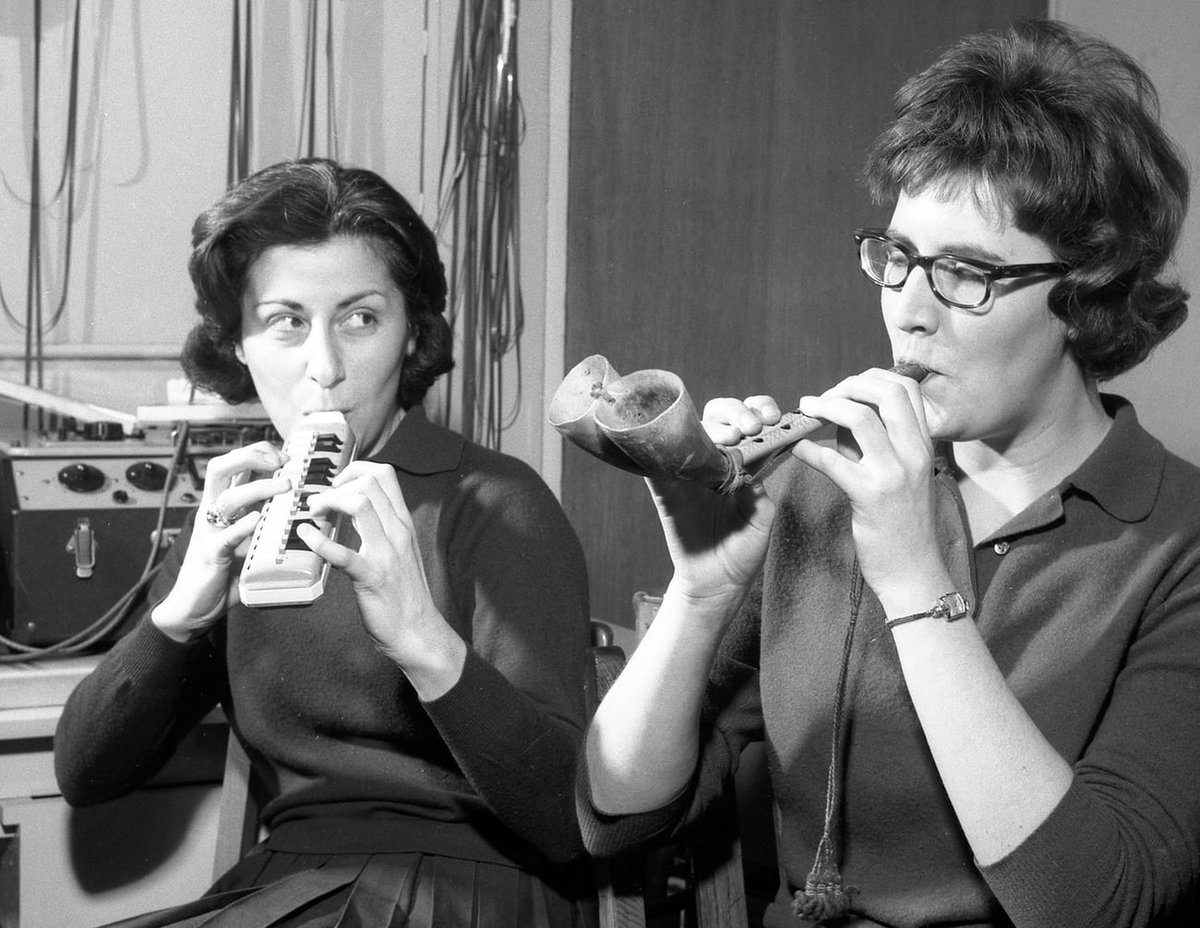
I am a sucker for high-tech analog art: magnetic tape, early wireless, punch cards, film and vinyl, the telephone, telegraph, and typewriter, and electricity before the transformation of digital technology. Consequently, and unsurprisingly, I love the BBC Radiophonic Workshop, and was delighted to read an article on its history from The Guardian.
Radiophonics owes everything to the invention of the tape recorder. Once you could capture sound, using a workable material, you could play with it: slow it down until it thundered, feed it back on itself until it shrieked and echoed, or simply slice bits out. However extreme these experiments became, there was always something eerily familiar to the ear, because they were made from real objects or events.
The term “radiophonic” came about because these mutated everyday sounds were put to the service of radio. “It is a new sound,” said the BBC, “suggestive of emotion, sensation, mood, rather than the literal moaning of the wind or the opening of a door.” Such things are now so easily achieved with digital technology that it’s hard to grasp how laborious - and groundbreaking - this all was.
The piece, riffing on a new book by does a nice job of eschewing undue nostalgia while digging into some of the Workshop’s most famous work — Doctor Who, The Hitchhiker’s Guide to the Galaxy — while also pointing out that most of the work was on simple education programs (which nevertheless introduced whole generations to new sonic possibilities). It restores the place of the many women who came through the workshop, including the inventive Delia Derbyshire, who played a huge role even as they often couldn’t get jobs at record studios or elsewhere in the recording industry.
My only complaint: it’s too darn short. I gotta read a book or something.
It’s 2008. George W. Bush is President. The Democratic primaries have just ended, and Barack Obama is the unlikely presumptive nominee. The economy is circling around the drain, and America is about to have its first black Presidential nominee by a major political party.
I don’t know exactly how you might measure and graph a country’s level of plausibly deniable racism or awkward attempts to identify or discount such racism, but if you could, summer 2008 would have to be one of its peaks.
That’s when Jay Smooth posted “How To Tell Someone They Sound Racist,” one of the greatest videoblog entries of all time.
Jay’s video turned into a TED Talk and a video series for Fusion called The Illipsis.
But mostly, he’s still hosting WBAI’s Underground Railroad (since 1991!), keeping up his site HipHopMusic.com (not much lately, but he started it in 1997!) and writing blog posts and making consistently great videos about music, race, politics, and culture at Ill Doctrine.
Watching Ill Doctrine is to feel the power and pleasure of seeing a mind at work. He’s always thinking around seven or eight sides of an issue and following them through all the way to the end. He does what you might call “explainers” but without any of the condescension to the audience or pretense to having settled an issue once and forever endemic to the form. It’s conversation.
He’s the best editor of any weblog I know — every cut is a new thought, a new idea, a new argument to hang on the thought right before it, and the cumulative effect is like a cubist painting.
He’s still experimenting with the format, adding interviews, letting his cat co-host, always oscillating between the public and the personal. Jay’s still the best at what he does.
Update: Jay just launched a Patreon campaign to keep Ill Doctrine going well into the future; if you love his work, please consider supporting it.
John Lennon died 34 years ago today. The night he died, someone made a six-minute recording of what was playing on FM radio in NYC:
Almost every station was either discussing the death or playing a Beatles song. See also the front page of the NY Times the next day and the article in the Daily News about the shooting. (via wfmu & @UnlikelyWorlds)
Update: Legendary reporter Jimmy Breslin wrote a piece shortly after the shooting about the police officers that drove Lennon to the hospital that night.
As Moran started driving away, he heard people in the street shouting, “That’s John Lennon!”
Moran was driving with Bill Gamble. As they went through the streets to Roosevelt Hospital, Moran looked in the backseat and said, “Are you John Lennon?” The guy in the back nodded and groaned.
Back on Seventy-second Street, somebody told Palma, “Take the woman.” And a shaking woman, another victim’s wife, crumpled into the backseat as Palma started for Roosevelt Hospital. She said nothing to the two cops and they said nothing to her. Homicide is not a talking matter.
And that last paragraph, wow. (via @mkonnikova)
RadioISS plays streams of the radio stations that the International Space Station passes over on its continual orbit of Earth. As I’m writing this, the ISS just floated over the southern tip of South American and RadioISS is playing Radio 3 Cadena Patagonia AM 789 from Patagonia, Argentina. Ah, it just switched to Alpha 101.7 FM out of Sao Paulo, Brazil. They’re playing One by U2.
The 500th episode of This American Life airs this weekend, and to celebrate, David Haglund picked 10 episodes you should listen to if you’ve never heard the show before.
The audio of a complete broadcast day from radio station WJSV in Washington, D.C. The day in question is September 21, 1939. A partial listing of the schedule:
12:30 Road of Life (soap)
12:45 This Day Is Ours (soap)
1:00 Sunshine Report (news)
1:15 The Life & Love of Dr. Susan (soap)
1:30 Your Family and Mine (soap)
1:45 News
2:00 President Roosevelt’s Address to Congress (speech)
2:40 Premier Edouard Daladier
3:00 Address Commentary (news)
3:15 The Career of Alice Blair (soap)
3:30 News (news)
3:42 Rhythm & Romance
3:45 Scattergood Baines
4:00 Baseball: Cleveland Indians at Washington Senators (sports)
5:15 The World Dances (music)
5:30 News (news)
5:45 Sports News (news)
6:00 Amos and Andy (comedy)
(via @ftrain)
Put in a year and hear popular songs from that year with Radio Time Machine. If you have a Rdio account, you can hear full songs. See also YouTube Time Machine. (via @fchimero)
Roger Ebert just tweeted:
Terry Gross is re-running an interview with Gene Siskel and me on NPR’s “Fresh Air” today.
The episode isn’t up on NPR’s site yet, but a search of the archives turns up only one hit for Gene Siskel on Fresh Air:
Film Critics GENE SISKEL and ROGER EBERT join Terry Gross on stage in Chicago for a “live” audience version of Fresh Air. This was recorded in February 1996. The duo began their TV collaboration in 1975 on Chicago Public Television station WTTW. After two successful season, the program became a national PBS show. In 1981 it moved to commercial television.Their show is now known as “Siskel and Ebert” and is heard in 180 markets. Gene Siskel is film colmnist for the Chicago Tribune, and Roger Ebert is critic for the Chicago Sun-Times. “Siskel and Ebert” has been nominated for five national emmy awards. Ebert has recieved a Pulitzer Prize for film criticism.
I don’t know how people in the industry feel, but for me, the internet is the best thing that ever happened to radio.
Inspired by my Apollo 11 broadcast, the folks behind Me and Orson Welles (dir. by Richard Linklater) have arranged for a “live” broadcast of Welles’ War of the Worlds 71 years after it originally aired. The broadcast begins on Oct 30 at 8pm EST. (thx, jake)
The Hidden Radio has no obvious controls…unless you count that the radio *is* the controls…it “has either no user interface…or…is all user interface”.
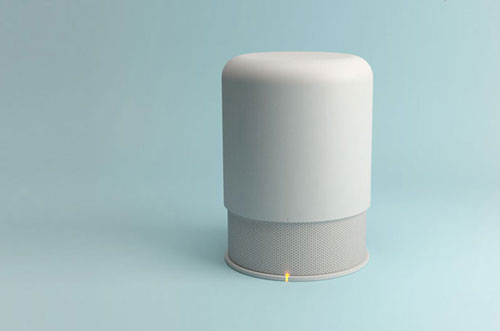
The volume is controlled by lifting the lid of the radio (which also reveals the speaker). Tuning is done by twisting the lid. Absurdly clever. (via monoscope)
Olinda is a social radio prototype comissioned by the BBC and built by Schulze & Webb.
Olinda is a prototype digital radio that has your social network built in, showing you the stations your friends are listening to. It’s customisable with modular hardware, and aims to provoke discussion on the future and design of radios for the home.
Wait, wait, wait. Bob Dylan has a radio show? Yes, he does…on XM. From the May 2008 issue of Vanity Fair, a list of the topics, movies, recipes, music, etc. that Dylan discusses on the show.
Let me give you my recipe for a rum and Coca-Cola. Take a tall glass, put some ice in it, two fingers of Bombay rum, and a bottle of Coca-Cola. Shake it up well and go drink it in the sunshine!
In the magazine, an illustration tells the tale with a clever wink to a Dylan poster by Milton Glaser.
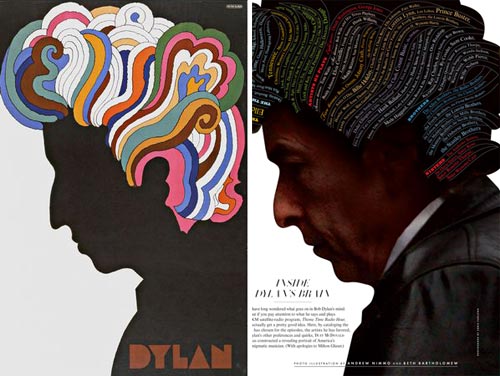
Glaser on the left, yo. (via hysterical paroxysm)
It’s been a few weeks since I saw the movie, but I still can’t get the Rhubarb Pie song out of my head:
But one little thing can revive a guy,
And that is home-made rhubarb pie.
Serve it up, nice and hot.
Maybe things aren’t as futile as you thought.
Mama’s little baby loves rhubarb, rhubarb,
Beebopareebop Rhubarb Pie.
Mama’s little baby loves rhubarb, rhubarb,
Beebopareebop Rhubarb Pie.
Related “fascinating” facts:
Garrison Keillor got the idea for doing A Prairie Home Companion (the radio show) after writing an article for the New Yorker about the Grand Old Opry in 1974.
While driving in unfamiliar territory in an episode of The Wire, Bodie Broadus ends up listening to A Prairie Home Companion on the radio when he can’t find any hip-hop.
Established TV news stars are moving to NPR. “Network news is increasingly generating prospects for NPR in part because some broadcast journalists think the networks are veering away from serious, in-depth reports.”
The story of the Hindenburg disaster. Amazingly, 2/3 of the zeppelin’s passengers survived the crash. Here’s an audio recording of the famous Herbert Morrison radio broadcast (“oh, the humanity”) of the disaster.
As frustrated as one can get with the US sometimes, it is truly a marvelous land of plenty. In the past few months, I’ve run across some remarkable consumer items which I’d like to share with you.
- A microwave oven with a radio in it. With a little tinkering, you may be able to take the FM signal coming into the radio and convert it into microwaves to cook the food. Lite jazz will cook that baked potato nice n’ slow or crank the hard rock station if you’re in a hurry to scorch your Healthy Choice.
- A mounted deer head that sings and talks. I know you’re all familiar with that mounted bass that plays music, but this is a whole deer head we’re talking about here. I was too amazed to note any of the songs or whether the deer lip-synchs along, but I’m sure that when you plug this sucker in, whatever it does is wonderful. It’s singing taxidermy fer crissakes!
- A refrigerator with a TV. For that 3-4 seconds it takes you to get a glass of orange juice when you’re away from the TV just in the other room. Oh, and if the TV part breaks, good luck getting it fixed. Also, there didn’t appear to be a Refrigerator Channel for viewing inside the fridge to avoid letting that precious cool out while your teenage son stands with the door (and his mouth) open for three minutes deciding what to eat/drink.
Convergence is grand, ain’t it?
As technology plunges ever forward (or as we perceive it doing so), it’s not often that we stop to take a look back at how people thought the future was going to unfold before them. Peter Edidin of the NY Times recently did so, reviewing prognostications about radio, films, and television. It’s fun to read the ones where people thought the new technology was going to complete overtake and eliminate an older technology (which does happen, but not as often as people expect). Bruce Bliven on radio in 1922:
There will be only one orchestra left on earth, giving nightly worldwide concerts; when all universities will be combined into one super-institution, conducting courses by radio for students in Zanzibar, Kamchatka and Oskaloose; when, instead of newspapers, trained orators will dictate the news of the world day and night, and the bedtime story will be told every evening from Paris to the sleepy children of a weary world…
D. W. Griffith, the great filmmaker of the early era, had this to say of film in 1915:
The time will come, and in less than 10 years, when the children in the public schools will be taught practically everything by moving pictures. Certainly they will never be obliged to read history again. Imagine a public library of the near future, for instance. There will be long rows of boxes of pillars, properly classified and indexed, of course. At each box a push button and before each box a seat. Suppose you wish to “read up” on a certain episode in Napoleon’s life. Instead of consulting all the authorities, wading laboriously through a host of books, and ending bewildered, without a clear idea of exactly what did happen and confused at every point by conflicting opinions about what did happen, you will merely seat yourself at a properly adjusted window, in a scientifically prepared room, press the button, and actually see what happened.
But it’s also fun to see when people got it right, more or less. In 1936, J.C. Furnas had this to say of television:
It is my hope, and I see no reason why it should not be realized, to be able to go to an ordinary movie theater when some great national event is taking place across the country and see on the screen the sharp image of the action reproduced - at the same instant it occurs. This waiting for the newsreels to come out is a bit tiresome for the 20th century. Some time later I hope to be able to take my inaugurals, prize fights and football games at home. I expect to do it satisfactorily and cheaply. Only under those conditions can a television get into my house.
Under that set of criteria, it probably took awhile for a TV set to enter the Furnas household, but by the time NBC started broadcasting sporting events in the mid-1940s, they probably had one.
Garrison Keillor’s ruminations on radio: what he likes and where he sees it going. “Clear Channel’s brand of robotics is not the future of broadcasting. With a whole generation turning to iPod and another generation discovering satellite radio and internet radio, the robotic formatted-music station looks like a very marginal operation indeed.”





Socials & More