In his ongoing series Cartoon Evolution, Dave Lee looks at how the character of Bugs Bunny has changed and evolved since his debut in 1938 as an unnamed rabbit in Porky’s Hare Hunt. It didn’t take long for the character to find its stride. From Wikipedia:
While Porky’s Hare Hunt was the first Warner Bros. cartoon to feature what would become Bugs Bunny, A Wild Hare, directed by Tex Avery and released on July 27, 1940, is widely considered to be the first official Bugs Bunny cartoon. It is the first film where both Elmer Fudd and Bugs, both redesigned by Bob Givens, are shown in their fully developed forms as hunter and tormentor, respectively; the first in which Mel Blanc uses what became Bugs’ standard voice; and the first in which Bugs uses his catchphrase, “What’s up, Doc?” A Wild Hare was a huge success in theaters and received an Academy Award nomination for Best Cartoon Short Subject.
This Instagram account posts the backgrounds of Looney Tunes cartoons with the Looney Tunes characters removed. As @presentcorrect.bsky.social remarks, these images are also a great resource for color palettes.
Well! In the Yale Review, Chris Ware (one of my favorite cartoonists) writes about Richard Scarry (one of my favorite children’s book authors) and Cars and Trucks and Things That Go (one of my favorite books).
This year is the 50th anniversary of Scarry’s 1974 Cars and Trucks and Things That Go, which strikes me as a commemoration worthy of ballyhoo, especially now that, as a dad myself, I’ve spent so much time ferrying my own daughter to and from school and birthday parties in various cars that-well, mostly goed. (I’ve owned five automobiles in my life, all of them cheap, one of which smoked and required the driver’s side door to be kept shut with a bungee cord hooked to the opposite armrest, stretched across both driver and passenger. What can I say? I was a young cartoonist on a cartoonist’s budget.)
Unlike those budget vehicles, however, the new deluxe Penguin Random House anniversary edition of Cars and Trucks and Things That Go is lavishly well-made, attentively reprinted with sharp black lines and warm, rich, watercolors. It includes an especially lively afterword by Scarry’s son Huck, in which he explains, using language even a kid can understand, how his dad wrote and drew the book, as well as hinting at what it was like to grow up as the son of arguably the world’s most popular and successful children’s book author.
(Lowly was perhaps the first children’s book animal character with a real nod to the ADA and the myth of “dis”-ability, and cheerfully makes his linear form work in all sorts of inspiring and disarmingly moving ways.)
And:
But the more one looks at his work, the more one sees how the European daily grocery trip, the walk to a nearby shop or tradesman’s guild, the tiny apple car fit for a worm are not part of the blowout-all-in-for-oneself-oil-fueled-free-for-all toward which America was barreling in the late 1960s.
This is great: a 25-minute interview with legendary animator Chuck Jones as he sits and draws some of his iconic characters (Bugs Bunny, Porky Pig, Daffy Duck). He told this anecdote about how Steven Spielberg and George Lucas were both influenced by a particular space-themed cartoon of his:
Porky was just a kind of a little third-string Boy Scout and was not very interesting to me. And then when I put him in a picture called Duck Dodgers in the 24th and a Half Century. Spielberg used that picture in Close Encounters the Third Kind - when his kids were watching television in the picture, they were watching Duck Dodgers in the 24th and a Half Century. And Lucas told me that he saw that picture when he was 12 years old and when when he opened Star Wars in San Francisco he told them they couldn’t have Star Wars in San Francisco unless they ran Duck Dodgers in the 24th and a Half Century.
In June 2021 (pre The Bear), New Yorker cartoonist Zoe Si coached Ayo Edebiri through the process of drawing a New Yorker cartoon. The catch: neither of them could see the other’s work in progress. Super entertaining.
I don’t know about you, but Si’s initial description of the cartoon reminded me of an LLM prompt:
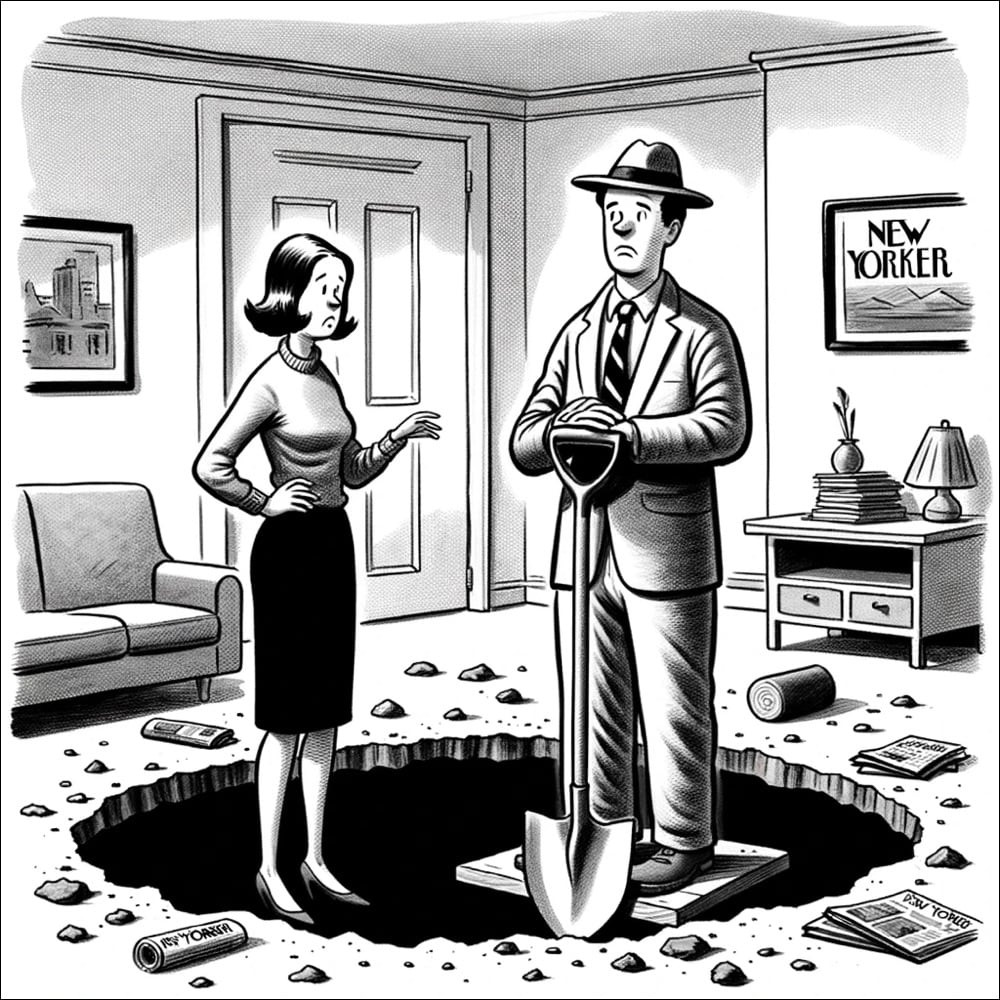
So the cartoon is two people in their apartment. One person has dug a hole in the floor, and he is standing in the hole and his head’s poking out. And the other person is kneeling on the floor beside the hole, kind of like looking at him in a concerned manner. There’ll be like a couch in the background just to signify that they’re in a house.
Just for funsies, I asked ChatGPT to generate a New Yorker-style cartoon using that prompt. Here’s what it came up with:
Oh boy. And then I asked it for a funny caption and it hit me with: “I said I wanted more ‘open space’ in the living room, not an ‘open pit’!” Oof. ChatGPT, don’t quit your day job!
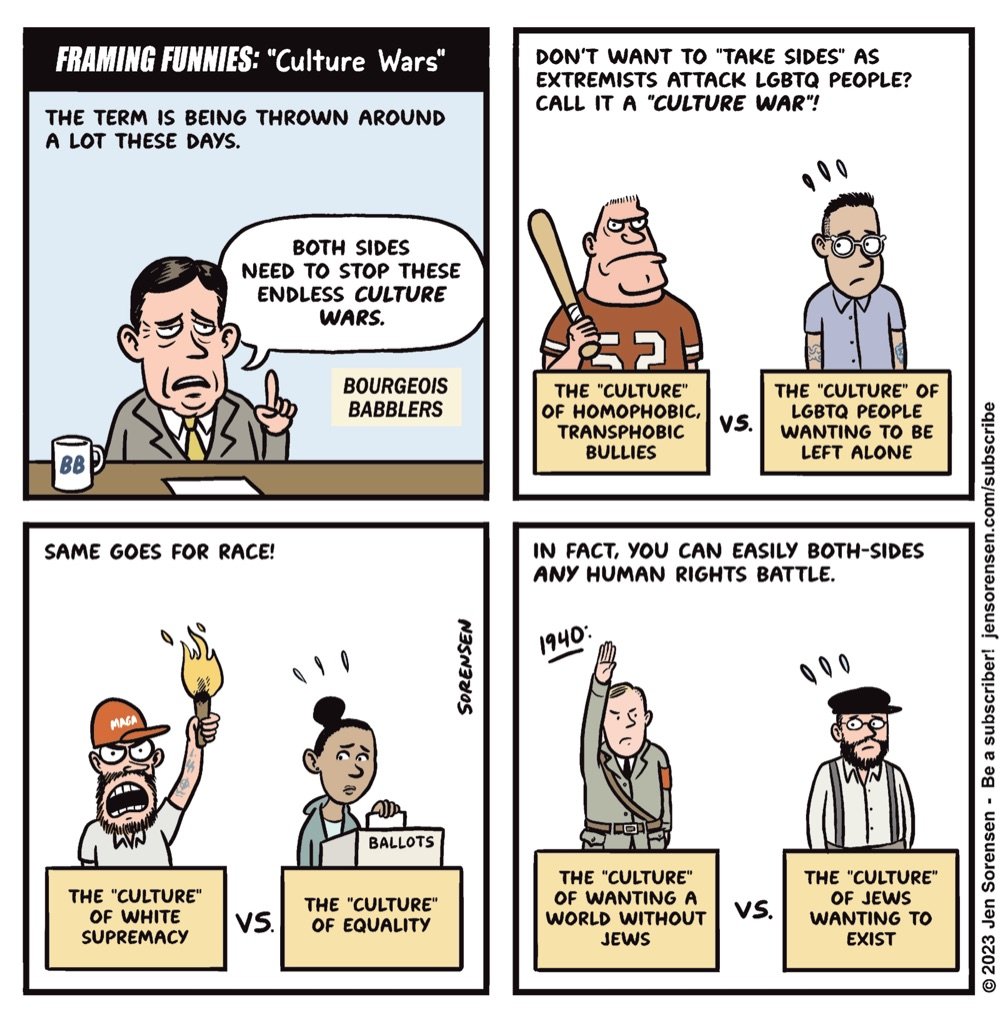
The term “culture wars” is used by many well-meaning people, including many progressive writers and activists I admire. It’s a convenient way to refer to a number of issues. But in this current political moment, I think it’s a highly misleading euphemism. What we are experiencing in America right now is an asymmetrical attack on basic freedoms — a fascist movement that thrives on targeting certain groups, erasing history, and spreading dangerous falsehoods through a vast media apparatus. To call this a “culture war” is to legitimize the contemporary GOP and its extremist counterparts as a coherent and authentic “culture” worthy of respect. This is a misuse of the concept of culture, creating a false equivalence between marginalized groups and those who would harm or eliminate them in a quest for ever more power.
You’ve probably never heard of Raymond Scott’s Powerhouse, even though it’s one of the most well-known songs of the 20th century. Powerhouse is the slapstick “the chase is on!” and relentless “assembly line” music that you’ve heard in many Looney Tunes shorts and other cartoons, including The Simpsons and Spongebob. Here it is in the 1946 ‘toon, Baby Bottleneck:
I’m sure Raymond Scott never would’ve guessed that he was sealing his legacy when he sold his publishing rights to Warner Bros. Music in 1943. This little transaction gave genius composer Carl Stalling free reign to plug Raymond Scott’s melodies into his scores for the Looney Tunes and Merrie Melodies cartoons. The propulsive energy of Scott’s quirky instrumental jazz compositions made perfect fodder for the likes of Bugs Bunny and Daffy Duck, and Stalling found immediate use for his new library; Stalling’s first quotation of “Powerhouse” appears in the Frank Tashlin classic Porky Pig’s Feat (1943).
The peculiar strains of Raymond Scott’s music and the screwball slapstick of the Warner Bros. cartoons were a match made in heaven…
That CB post has a bunch of embedded videos of different uses of the song, along with this gem of Scott and his “Quintette” playing Powerhouse on TV in 1955:
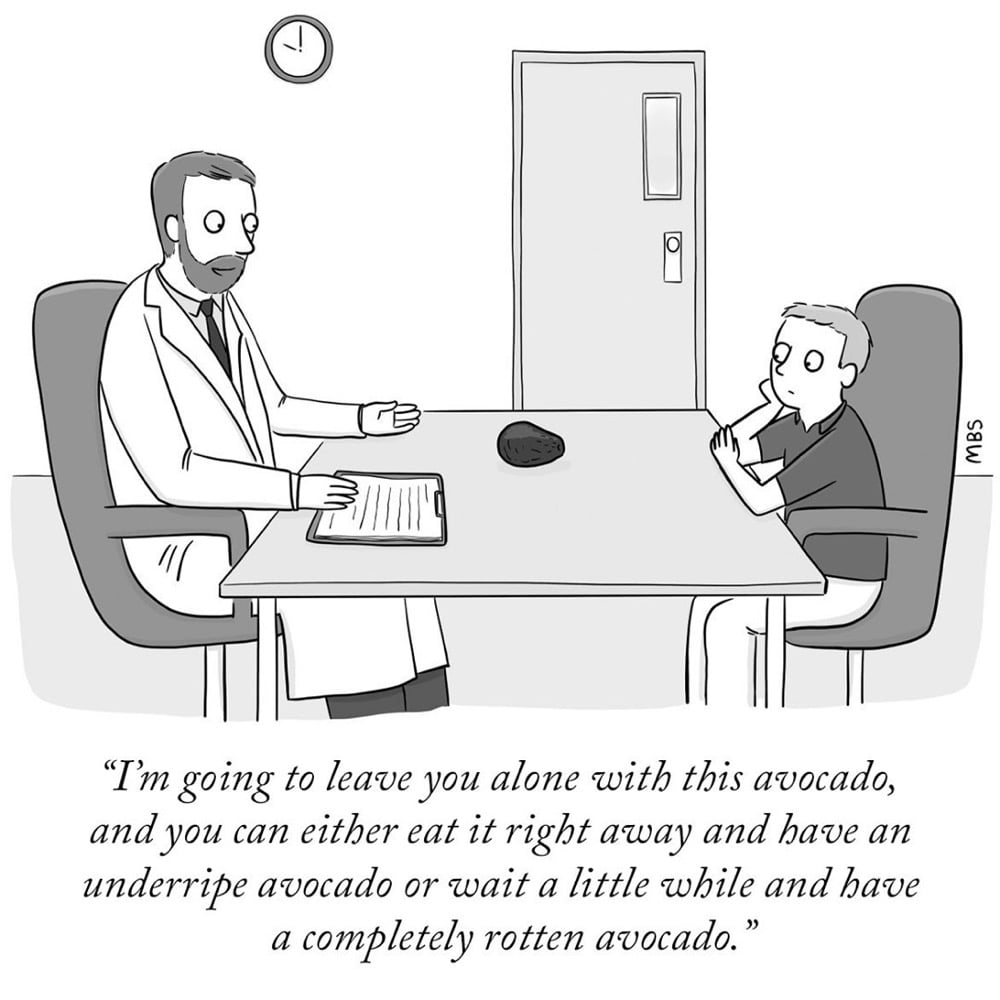
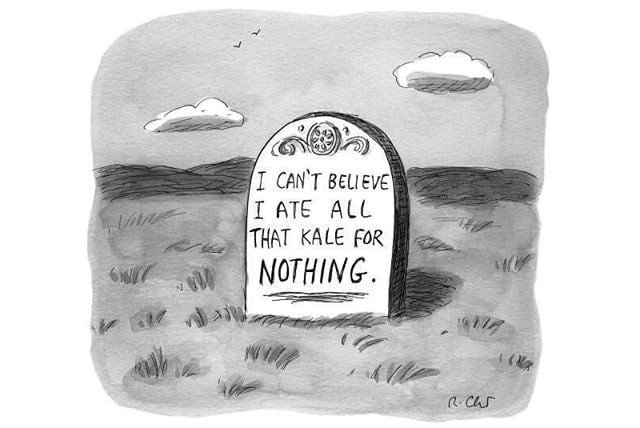
That’s Meredith Southard’s cartoon for the New Yorker, a play on the marshmallow test. It’s funny because it’s true. I have an avocado in the fridge that I’m planning on using for lunch — but maybe it’s all brown inside?! So excited to find out if I’m actually eating lunch or not in a few minutes.
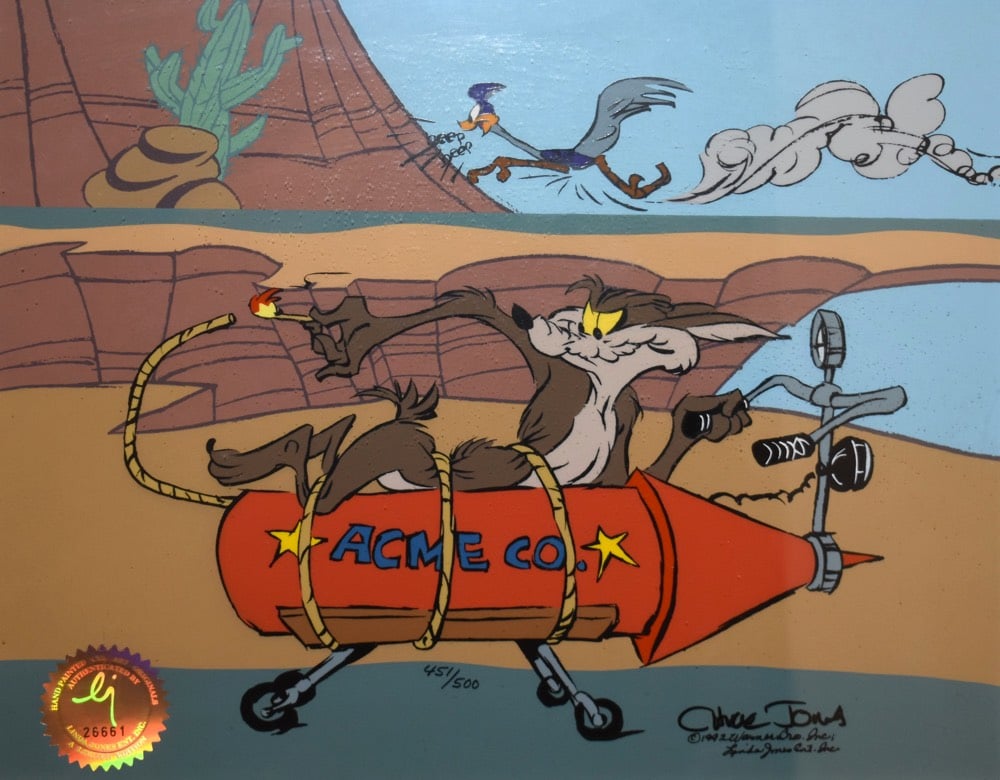
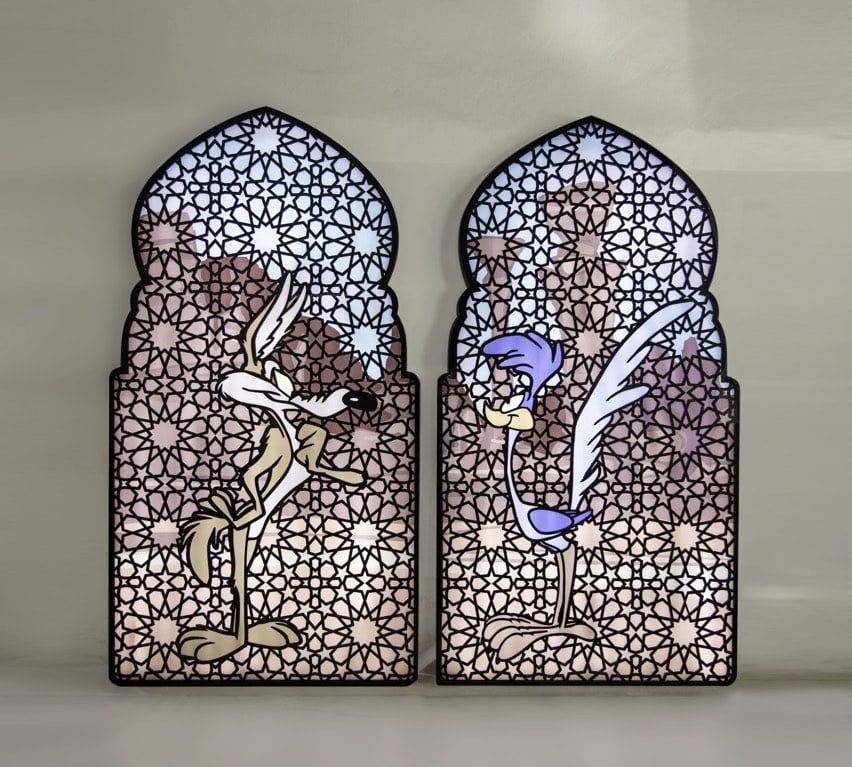
In a classic New Yorker article from 1990, Ian Frazier writes about an imagined lawsuit filed by Wile E. Coyote against the Acme Company in which he “seeks compensation for personal injuries, loss of business income, and mental suffering” due to the company’s defective products.
Mr. Coyote states that on December 13th he received of Defendant via parcel post one Acme Rocket Sled. The intention of Mr. Coyote was to use the Rocket Sled to aid him in pursuit of his prey. Upon receipt of the Rocket Sled Mr. Coyote removed it from its wooden shipping crate and, sighting his prey in the distance, activated the ignition. As Mr. Coyote gripped the handlebars, the Rocket Sled accelerated with such sudden and precipitate force as to stretch Mr. Coyote’s forelimbs to a length of fifty feet. Subsequently, the rest of Mr. Coyote’s body shot forward with a violent jolt, causing severe strain to his back and neck and placing him unexpectedly astride the Rocket Sled. Disappearing over the horizon at such speed as to leave a diminishing jet trail along its path, the Rocket Sled soon brought Mr. Coyote abreast of his prey. At that moment the animal he was pursuing veered sharply to the right. Mr. Coyote vigorously attempted to follow this maneuver but was unable to, due to poorly designed steering on the Rocket Sled and a faulty or nonexistent braking system. Shortly thereafter, the unchecked progress of the Rocket Sled brought it and Mr. Coyote into collision with the side of a mesa.
For his Cartoon Fossils series, Filip Hodas used 3D modelling software to create fossilized skulls of cartoon characters like Scrooge McDuck, Tweetie Bird, Minnie Mouse, and Goofy.
These remind me of Michael Paulus’s Character Studies, drawings of the skeletons of the likes of Lucy from Peanuts, Betty Boop, Marvin the Martian, and Pikachu. I have his Hello Kitty drawing hanging in my living room, purchased after Leslie Harpold pointed me towards his work back in the day. (via colossal)
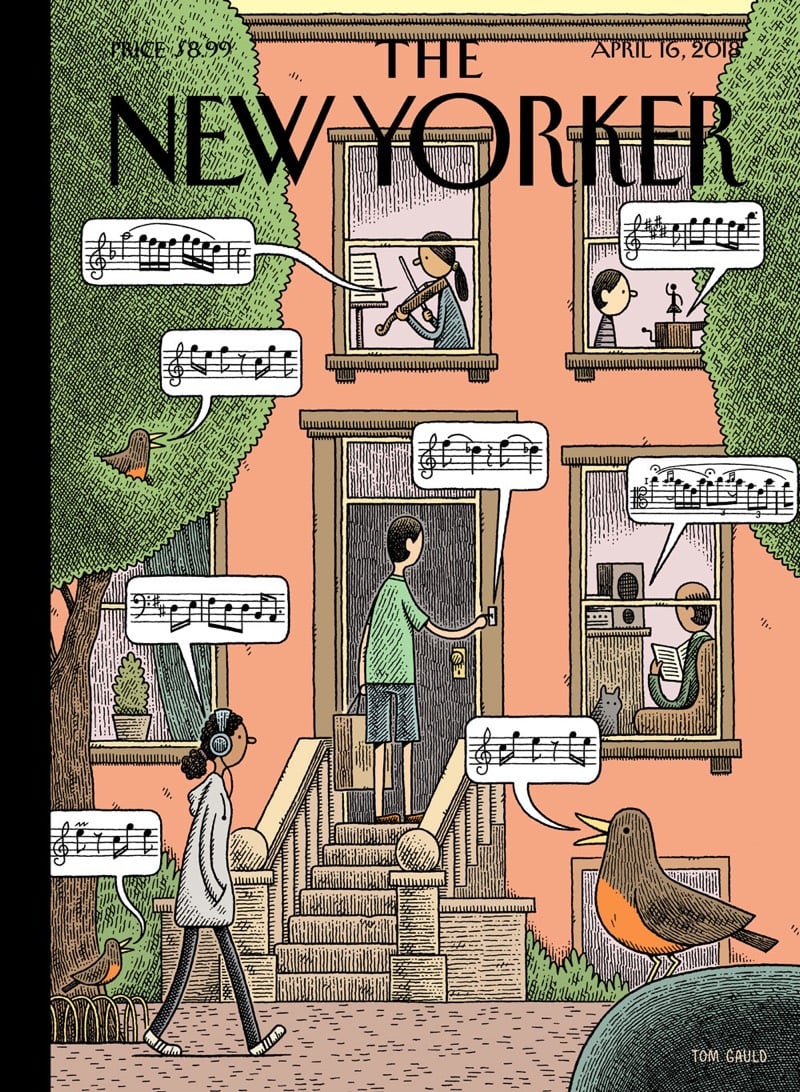
In his early sketches, Gauld had only vague notions of the music he’d like to include, and “placeholder nonsense” in the speech bubbles. “If, like me, you’re musically illiterate, then the notes give a suggestion of what’s going on sonically,” he said. “But I also wanted the scores to make sense to those who can read music.”
To achieve that goal, he enlisted the help of fact checker Fergus McIntosh, a veteran chorister. Together, the duo struck upon a repertoire that includes Vivaldi’s “Spring”; Stravinsky’s “The Rite of Spring”; Beethoven’s “Spring Sonata”; the folk song “One Morning in Spring”; and birdsong from the American robin, which tends to appear in springtime after local migration.
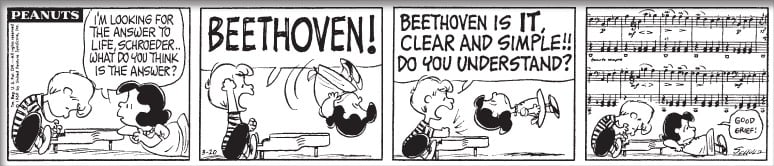
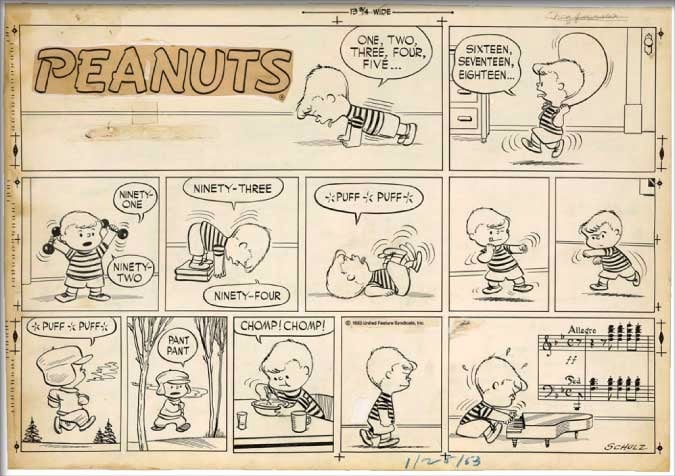
When Schroeder pounded on his piano, his eyes clenched in a trance, the notes floating above his head were no random ink spots dropped into the key of G. Schulz carefully chose each snatch of music he drew and transcribed the notes from the score. More than an illustration, the music was a soundtrack to the strip, introducing the characters’ state of emotion, prompting one of them to ask a question or punctuating an interaction.
Schulz used music so extensively in some of his strips that they didn’t really make much sense if you didn’t know how to read music:
When Beethoven gave the Hammerklavier to the publisher, he bragged, “Now you will have a sonata that will keep the pianists busy when it is played 50 years hence.” In this Sunday strip, Schulz most fully develops the idea of the preparations required to storm “Mount Everest.” Before marching to the piano with determination, Schroeder prepares himself for this mighty undertaking with seven different kinds of exercise and a “carb-loading” bowl of cereal, almost as if he were preparing to climb a mountain!
Hayao Miyazaki is our Ovid, a fluent, majestic storyteller with a gift for deep connections and sudden transformations. At the end of his career, he’s rightfully acquired a reputation as a curmudgeon, a traditionalist with a dim view of human nature and our technological prostheses. I worry that this obscures the other Miyazaki, the environmentalist pacifist, a perfectionist who nevertheless sought and found miracles in everyday life. In the 1990s and early 2000s, this was the only Miyazaki we knew. We saw him much more dimly then, but I do not know if we see him better now.
My favorite Miyazaki film is 2004’s Howl’s Moving Castle. I would not say it is his best, his most beautiful, or his most perfectly realized. Princess Mononoke is more epic, more careful in its throughlines and narrative choices. The Wind Rises is more personal, more human and moving. Spirited Away is a masterpiece of story, art, and character, every scene and frame indelible. Nausicaa: Valley of the Wind and My Neighbor Totoro will last forever in a way that Howl’s Moving Castle may not.
None of this matters: Howl’s Moving Castle is my Miyazaki film; you may choose your own.
2.
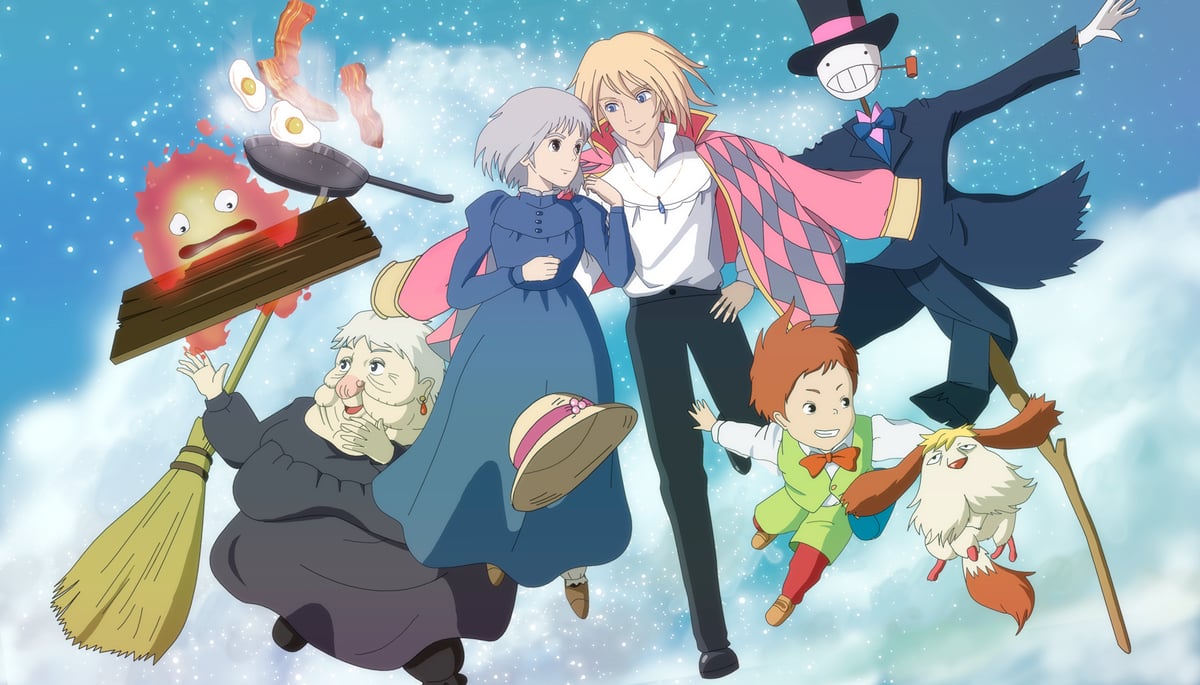
A number of Miyazaki’s films deal with fractured and unlikely families. It is probably fair to say the residents of Howl’s castle are the unlikeliest.
At the same time, despite their differences in appearance and circumstance, the characters are all so much like each other. It is as if each one stands in for different sides of all the others, like the brothers of The Brothers Karamazov.
Howl, Sophie, Calcifer, Markl, the Witch of the Waste, and Turnip-Head are all, in one way or another, shapeshifters. Some of them by choice, others by curse; the choices become curses, the curses choices. They are all orphans. Before we meet any of them, we learn that they have committed themselves to something that they did not fully understand, which they would undo if they could, but which they are powerless to speak about or tackle on their own. They are all fearless and cowardly, timid and reckless. They understand each other in ways outsiders never could.
In most Miyazaki movies, he resists turning the narrative into a love story. In Howl’s Moving Castle, he resists his own resistance. All of the characters are in love with each other. Instead, they have to learn how to accept love. There are lessons in this.
Inside each of us is a little boy, a shy, lovesick girl with a curse, a demon made of fire, and a shape-shifting wizard with no heart.
I have a friend who is an enormous fan of Morrissey and The Smiths, who collects anything and everything associated with the singer, but has refused multiple opportunities to meet him in person. “My relationship with him now, exactly as it is, is perfect,” she says. “It could only change for the worse.” This is how I feel about reading Howl’s Moving Castle.
4.
The story’s plot is about as coherent as the castle itself. It’s a dozen stories bolted together, creaking and wheezing, pieces falling off, until it collapses altogether. Like other Miyazaki films, we’re thrown into a world we don’t understand, and gradually the universe’s rules are revealed.
But the rules somehow never really pay off. Sophie’s curse is never really broken, by Calcifer, the Witch of the Waste, or anyone else. It just unwinds itself. The climactic moment, where Sophie travels into the past to see the first meeting of Howl and Calcifer, offers no attempt at explanation. (Like Dante into the Inferno, Sophie just trudges into a hole in the ground, a mute dog as her silent Virgil.) All the plot lines end simultaneously not really due to any underlying logic but because the movie simply runs out of time.
None of this matters. Like Turnip-Head, I will throw myself in front of this film’s catastrophic collapse to protect its characters, not because I am strong, but because it is my turn.
5.
I asked my friend Margarita Noriega, a digital strategist, social media genius, and Miyazaki fan, to tell me what she finds compelling in Howl:
Howl’s castle, like many of Miyazaki’s objects-come-alive, is powered by a terrific, dazzling magic that contradicts itself. It has an opalite quality, akin to a clear opaqueness. To his enemies, the magic all around Howl is a sinister curse in need of purging by the righteous. To his friends, it can heal a broken heart or give flight to the grounded.
What kind of thing can make one person see evil and good? In Howl’s world, like ours, perspective is everything. The indescribable beauty of living and loving is a contradiction to the realities of aging, death, and war. It is magic because it is a power which defies a dark reality.
The most relatable thing about Howl, Sophie, and the other residents of the castle is how they experience emotions so big and so complex that they don’t fully understand them. They don’t understand each other’s motives. They don’t understand their own. But somehow they learn to trust and care for each other anyways. And that care — not power, knowledge, or any other transaction — manages to save them.
History controls everything we do, so there is no point in observing individual actions. Let’s examine the individual actions of over 500 characters at great length.
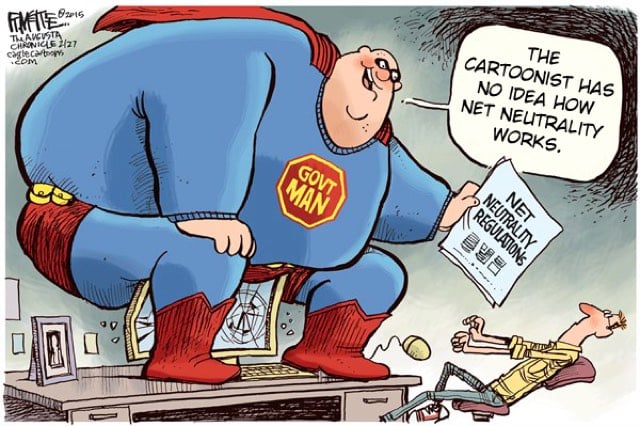
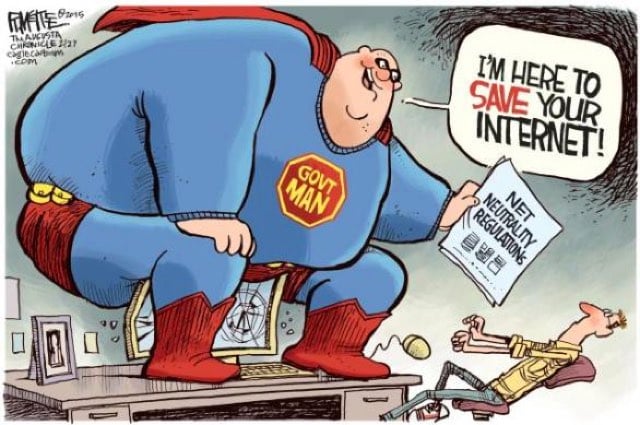
This collection of political cartoons depict the FCC’s recent ruling on net neutrality as Big Government throttling the free internet, except that every caption has been replaced with “the cartoonist has no idea how net neutrality works”. Here’s one example followed by the unadulterated cartoon:
Bill Watterson famously quit cartooning after ten years during which his Calvin and Hobbes was a critical and commercial success you could only compare to Charles Schultz’s Peanuts. (Gary Larsen, GB Trudeau, and Berkeley Breathed are great, but come on.)
You could say Watterson retreated from public view after his retirement, but he was rarely available to the public even during the height of his fame. One exception was his 1990 commencement speech to his alma mater Kenyon College.
Thoreau said, “the mass of men lead lives of quiet desperation.” That’s one of those dumb cocktail quotations that will strike fear in your heart as you get older. Actually, I was leading a life of loud desperation.
When it seemed I would be writing about “Midnite Madness Sale-abrations” for the rest of my life, a friend used to console me that cream always rises to the top. I used to think, so do people who throw themselves into the sea.
I tell you all this because it’s worth recognizing that there is no such thing as an overnight success. You will do well to cultivate the resources in yourself that bring you happiness outside of success or failure. The truth is, most of us discover where we are headed when we arrive. At that time, we turn around and say, yes, this is obviously where I was going all along.
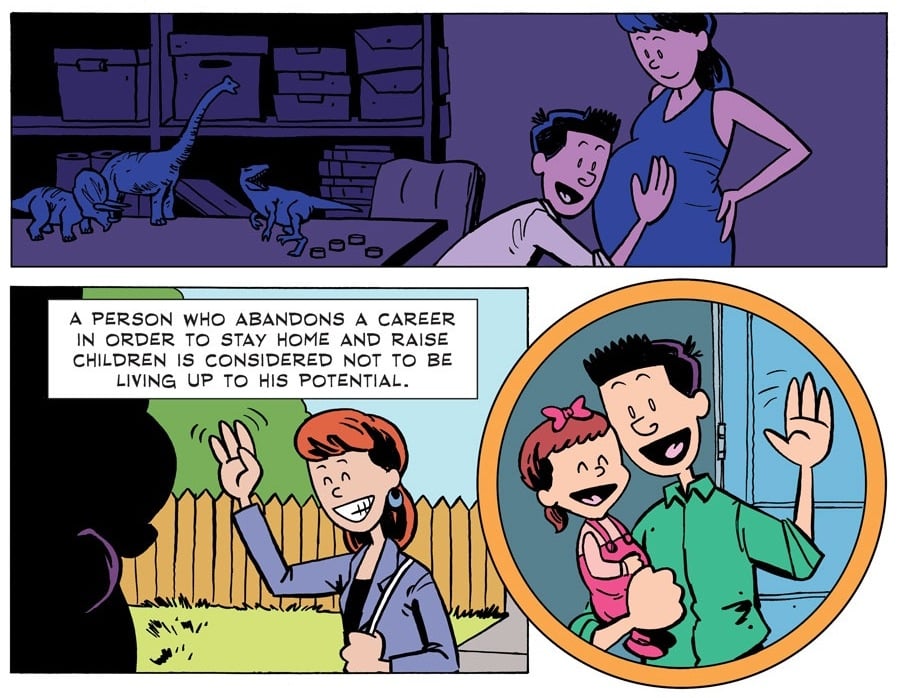
Zen Pencils cartoonist Gavin Aung Than took a series of quotes from Watterson’s speech and illustrated them, consciously imitating Watterson’s style for a new inspirational cartoon titled “Bill Watterson: A Cartoonist’s Advice.” It features a cartoonist who (like Watterson) gives up a commercial illustration job to embrace his artistic dreams and raise a family as a stay-at-home dad. Although the events and much of the scenery is inspired in part by Watterson’s story, first as a young illustrator and later as a popular cartoonist who refused to compromise, Gavin writes:
The comic is basically the story of my life, except I’m a stay-at-home-dad to two dogs. My ex-boss even asked me if I wanted to return to my old job.
My original dream was to become a successful newspaper comic strip artist and create the next Calvin and Hobbes. That job almost doesn’t exist anymore as newspapers continue to disappear and the comics section gets smaller and smaller, often getting squeezed out of newspapers entirely. I spent years sending submissions to syndicates in my early 20s and still have the rejection letters somewhere. I eventually realised it was a fool’s dream (also, my work was nowhere near good enough) and decided webcomics was the place to be. It’s mouth-watering to imagine what Watterson could achieve with webcomics, given the infinite possibilities of the online medium.
Alyssa Rosenberg writes about Watterson’s speech and Gavin’s accompanying cartoon’s implications for feminism, especially arguments over balancing life and work:
“A person who abandons a career in order to stay home and raise children,” Watterson noted,” is considered not to be living up to his potential.” I’m sure that choice of pronouns is deliberate. … [The cartoon] is a powerful alternate vision of what it might look like to have it all.
Speaking of the Road Runner and Wile E. Coyote, animator Chuck Jones and his team were said to follow these simple rules when creating the cartoons:
The Road Runner cannot harm the Coyote except by going “meep, meep.”
No outside force can harm the Coyote — only his own ineptitude or the failure of Acme products. Trains and trucks were the exception from time to time.
The Coyote could stop anytime — if he were not a fanatic.
No dialogue ever, except “meep, meep” and yowling in pain.
The Road Runner must stay on the road — for no other reason than that he’s a roadrunner.
All action must be confined to the natural environment of the two characters — the southwest American desert.
All tools, weapons, or mechanical conveniences must be obtained from the Acme Corporation.
Whenever possible, make gravity the Coyote’s greatest enemy.
The Coyote is always more humiliated than harmed by his failures.
The audience’s sympathy must remain with the Coyote.
The Coyote is not allowed to catch or eat the Road Runner.
The rules are made only slightly less interesting by their fiction; according to Wikipedia, long-time Jones collaborator Michael Maltese said he’d never heard of the rules.
By the time we were finished with Rabbit of Seville, Ollie had literally peed his pants from laughing so hard. I think I’m gonna get the Looney Tunes collection on Blu-ray so we can watch more but I’m a bit afraid of what the hijinks of Wile E. Coyote and The Road Runner might do to my boy’s pants.
I thought you may like this link, it’s my favorite rendition of “St. James Infirmary Blues,” sung by Cab Calloway in a Betty Boop cartoon (Betty is Snow White):
Cheers,
Len
PS:
Fleischer’s Snow White was animated by ONE person, produced by a Jewish animation studio, in the Depression, featuring images of gambling and alcohol, starring a jazz singer. Take that, Walt.
Calloway’s most famous cartoon appearance is probably as the voice of King Louie in Disney’s The Jungle Book (1969). This just isn’t true. King Louie is Louie Prima. I knew this.
“St. James Infirmary Blues” is based on an 18th century traditional English folk song called “The Unfortunate Rake” (also known as “The Unfortunate Lad” or “The Young Man Cut Down in His Prime”). There are numerous versions of the song throughout the English-speaking world. It also evolved into other American standards such as “The Streets of Laredo”. “The Unfortunate Rake” is about a sailor who uses his money on prostitutes, and then dies of a venereal disease. Different versions of the song expand on this theme, variations typically feature a narrator telling the story of a youth “cut down in his prime” (occasionally her prime) as a result of some morally questionable actions. For example, when the song moved to America, gambling and alcohol became common causes of the youth’s death.
The title is derived from St. James Hospital in London, a religious foundation for the treatment of leprosy. It was closed in 1532 when Henry VIII acquired the land to build St. James Palace.
The song was first collected in England in its version as “The Unfortunate Rake” by Henry Hammond by a Mr. William Cutis at Lyme Regis, Dorset in March 1906.
Part of the song’s versatility/ambiguity is that its content can also swing depending on the gender of the singer and the “baby” cut down in his/her prime.
Notable performers of this song include Cab Calloway, Louis Armstrong, Kermit Ruffins, The Preservation Hall Jazz Band, King Oliver, Artie Shaw, Big Mama Thornton, Jack Teagarden, Billie Holiday, Cassandra Wilson, Bobby Hackett, Stan Kenton, Lou Rawls, The Limeliters, Bobby Bland, Ramblin’ Jack Elliott, Doc Watson, “Spider” John Koerner, Janis Joplin, The Doors, The Animals, and more recently The White Stripes, the Triffids, the Stray Cats, the Tarbox Ramblers, Isobel Campbell, The Devil Makes Three and Mark Lanegan, and Tom Jones with Jools Holland. Jazz guitarists Marc Ribot and Ivan “Boogaloo Joe” Jones have recorded instrumental versions.
1. Road Runner cannot harm the Coyote except by going “beep, beep”. 2. No outside force can harm the Coyote — only his own ineptitude or the failure of Acme products. 3. The Coyote could stop anytime — IF he was not a fanatic. (Repeat: “A fanatic is one who redoubles his effort when he has forgotten his aim.” — George Santayana). 4. No dialogue ever, except “beep, beep”. 5. Road Runner must stay on the road — for no other reason than that he’s a roadrunner. 6. All action must be confined to the natural environment of the two characters — the southwest American desert. 7. All tools, weapons, or mechanical conveniences must be obtained from the Acme Corporation. 8. Whenever possible, make gravity the Coyote’s greatest enemy. 9. The Coyote is always more humiliated than harmed by his failures. 10. The audience’s sympathy must remain with the Coyote.
Charles Miller argues that John Hodgman’s PC character in the Mac vs. PC commercials is like Wile E. Coyote…likable but inept. (via df)
A list of Cartoon Girls I Wanna Nail. And it’s on Geocities, no less…I had no idea that was still around and operational. Maybe this is the only page left, the end result of Yahoo’s $3.6 billion investment.
Update: The site above is currently down. Fun fact: I first linked to this almost 9 years ago. (thx, everyone)
A friend of mine who works at the University of Nebraska-Lincoln emailed to let me know that they’ve posted both audio and video of a talk that Chris Ware gave at the school last week. If you’re short on time, the real meat of the video starts around 18:30 when Ware starts a slideshow that delves into his process. In addition to his series of Thanksgiving-themed New Yorker covers from last year, he also talks about some of his other work, including Rusty Brown and the strip he did for the NY Times Magazine.
Futurama tidbit: “Groening’s series Futurama is back, thanks to strong DVD sales. Four Futurama DVD movies are scheduled for release and they will be chopped into episodes for broadcast on Comedy Central in 2008.”









Socials & More