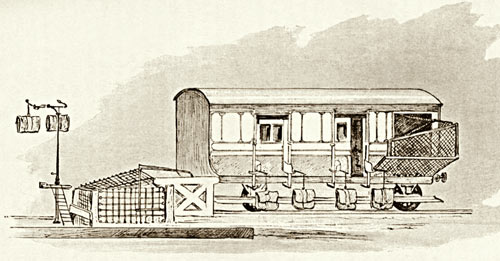
This is the Brennan Monorail, a train from the early 1900s that seemed to defy the laws of physics. Not only did it keep itself perfectly balanced on a single rail, but it mysteriously leaned into corners without any driver input.
It’s kind of incredible how well Brennan’s system worked. It’s ingenious. (via messy nessy)
One of the longest and heaviest trains in the world, the 1.8-mile beast runs from the mining center of Zouerat to the port city of Nouadhibou on Africa’s Atlantic coast. The train is the bedrock of the Mauritanian economy and a lifeline to the outside world for the people who live along its route.
The train carries iron ore but many passengers also rely on the train to move long distances:
Passenger cars are sometimes attached to freight trains, but more often passengers simply ride atop the ore hopper cars freely. Passengers include locals, merchants, and occasionally some adventure tourists. Conditions for these passengers are incredibly harsh with daytime temperatures exceeding 40°C, night-time temperatures approaching freezing, and death from falls being common.
Something I still think about is the “Can a plane take off on a treadmill,” so imagine my glee at discovering these superheroes trying to flip a bike on a moving train. Yes, it’s glee I felt. I’m gleeing all over the place right now. (Not to be violent, but I thought the plane taking off on a treadmill post was from 10 years ago, but it’s from 2006.)
In a collaboration with Red Bull & Prada (uh, ok) and with the help of the Polish State Railways, Dawid Godziek rode a mountain bike on a ramps course on top of a moving train, performing tricks & flips between cars. The train and rider moved at the same speed in opposite directions, which made it seem as though, from the perspective of someone on the ground next to the train, that the rider is nearly horizontally stationary.
The result is trippy & counterintuitive and also a demonstration of Newton’s laws of motion & frames of reference. But since Godziek was not riding in a vacuum, there were some real world details to contend with:
We observed something interesting — the lack of air resistance. In theory, this could have made it easier, but the opposite was true. The air resistance creates a tunnel that somehow keeps me in a straight line and doesn’t allow me to shift right or left. Luckily on the recordings we had, the headwind gave me artificial air resistance, which helped me to get a feel for the flight on classic hops. On the tests, the wind was blowing weaker or in a different direction, making shooting tricks difficult. Not bad, right? We’re always complaining about air resistance, and when it wasn’t there, we found that it was impossible to fly without it.
The Gyermekvasút (Children’s Railway) is a 7-mile-long rail line in Budapest that’s operated by children aged 10-14 (aside from the train’s driver).
Children’s Railway, Budapest is one of Budapest’s most unique attractions. Like any other railway, it has ticket offices, diesel locomotives, signals, switches and a timetable. Unlike other railways though, this one is run by children. The line stretches among the Buda hills from Széchenyihegy to Hűvösvölgy, crossing the Cogwheel Railway and serving Normafa as well as the highest point of Budapest: Jánoshegy.
The project, then called the Pioneer’s Railway, was started in 1947 as a part of a three-year Communist plan. This video shows how the railway operates and includes interviews with current workers as well as former workers from the Communist era:
Seems like all the kids are big train nerds…adorable.
This video from Practical Engineering offers a brief explanation of dozens of different types of railcars, from passenger train cars like the dining car & sleeper car to freight cars like the boxcar, tank car, and hopper cars (for hauling things like sand or grain) to specialized cars the rail companies use to build and maintain their routes like rail grinders, snowplows, and track geometry cars.
Trains are one of the most fascinating engineered systems in the world, and they’re out there, right in the open for anyone to have a look! Once you start paying attention, its pretty satisfying to look for all the different types of railcars that show up on the tracks.
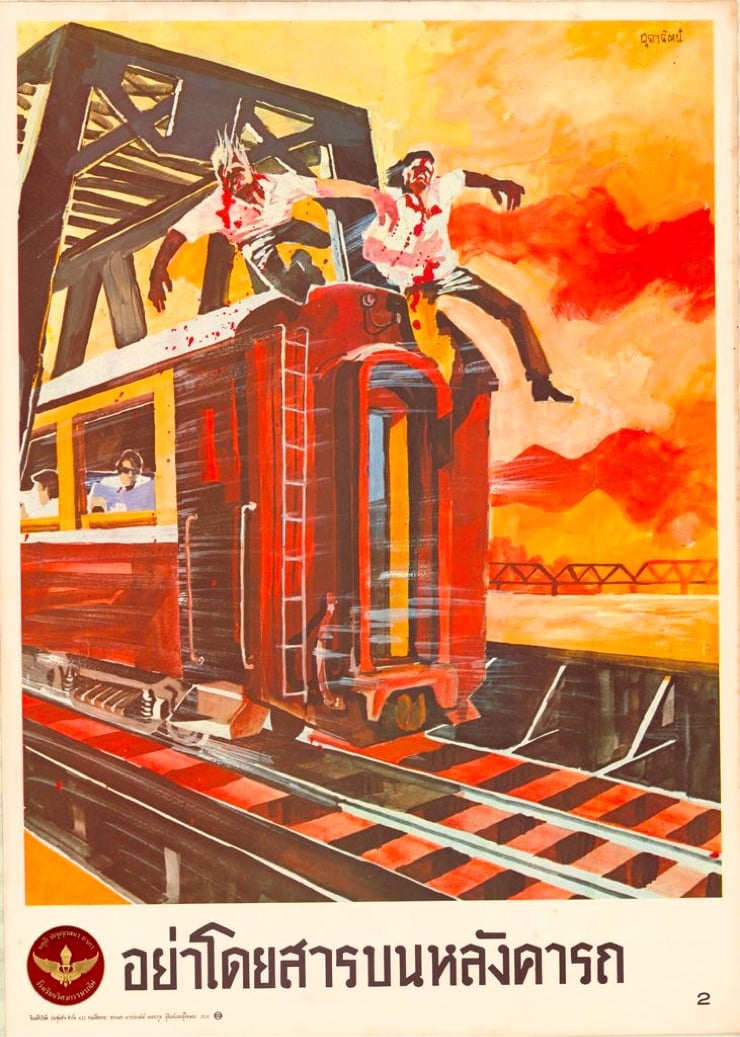
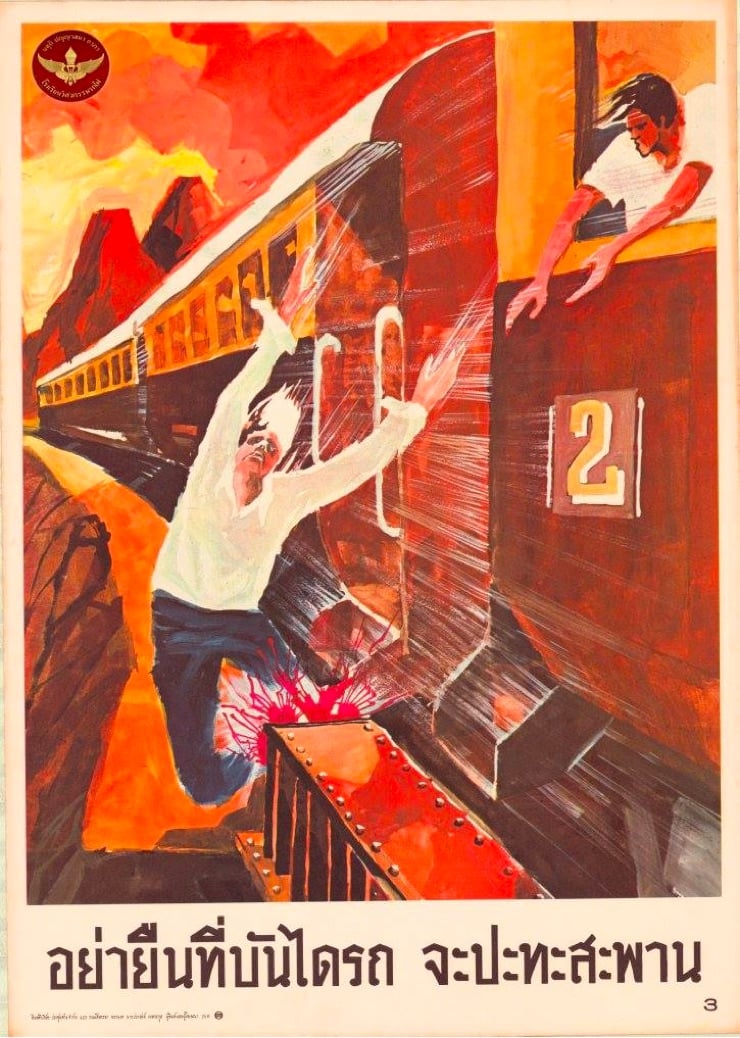
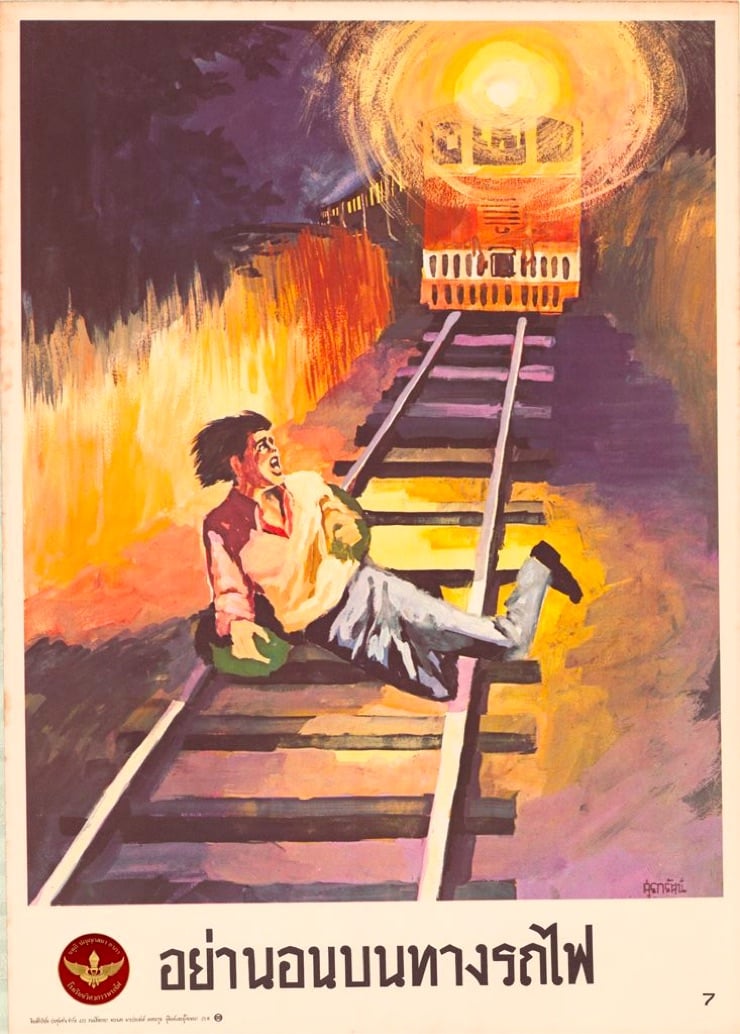
These railway safety posters from Thailand are kind of amazing — very straightforward, graphic, and often gruesome in their illustration of the dangers involved with improper train travel.
The two-storey structure was based on the design of the “traditional caboose”. A workspace sits on the first level while the second, accessible via a steel ladder, serves as a cupola for taking in views and functions as a “calmer zone for creative exploration and restoration”.
The control panel that operates the rails was taken from a Burlington Northern locomotive, while the door colour and the wood used were directly informed by colours and materials commonly found on American trains.
The railroad ties for the track were repurposed from the Great Northern Railroad line, though the studio noted the steel tracks “are a much larger gauge than is typically used”.
There’s even a Wes Anderson connection (because of course there is):
Inspired by Wes Anderson’s love of trains in cinema, Maxon Railway takes some visual cues in the form of on-board artifacts and props from The Darjeeling Limited.
You can read lots more about the house and the railway, including more than you’d probably want to know about the history of rail travel and commerce in the Pacific Northwest.
The software for running your own trainbot is available on Github and “should work with any video4linux USB cam, or Raspberry Pi camera v3 modules”. (via nelson)
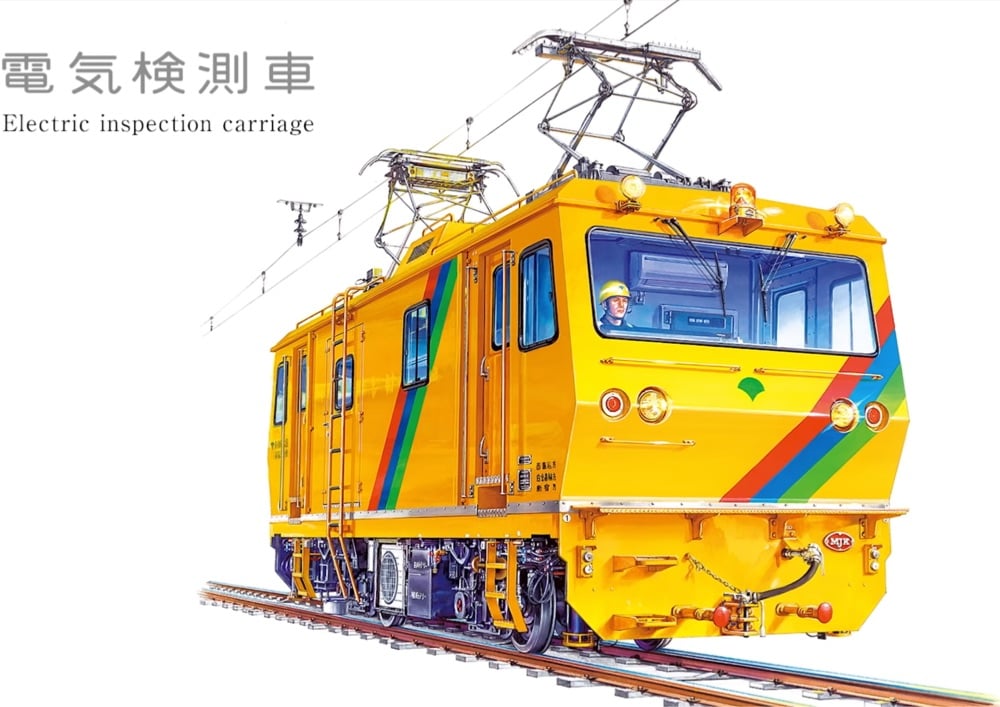
Japanese trains are renowned for their punctuality, comfort and overall reliability. But part of what makes them so reliable is an “unseen” workforce of overnight trains. These trains will be unfamiliar to the everyday rider because they only show themselves after regular service has ended for the day. Working through the wee hours of night and early morning, they perform maintenance work on tracks and electrical wires that ensures a smooth and uninterrupted ride during the day.
I randomly came across this YouTube video from an engineer (civil, not railroad) who was building virtual railroads using wooden toy tracks, you know from when you were a kid. Anyway, it turns out that he was playing an open-world game called Tracks, which is available on Steam, Nintendo Switch, and Xbox. Looks fun — if I ever get any free time again, I might give this one a shot.
MoMA has published a two-minute film from 1902 of a German suspended railway called the Wuppertal Schwebebahn. It presents an almost drone-like view of a German city at the beginning of the 20th century, in contrast to the ground-based and stationary films that were far more common in that era. The film is also extremely crisp and clear because it was shot in 68mm:
The Flying Train depicts a ride on a suspended railway. The footage is almost as impressive as the feat of engineering it captures. For many years our curators believed our Mutoscope rolls were slightly shrunken 70mm film, but they were actually shot on Biograph’s proprietary 68mm stock. Formats like Biograph’s 68mm and Fox’s 70mm Grandeur are of particular interest to researchers visiting the Film Study Center because the large image area affords stunning visual clarity and quality, especially compared to the more standard 35mm or 16mm stocks.
My favorite bit is the kid on the swing at about the 25 second mark — a casual unstaged moment that allows the viewer to imagine themselves in that place and time, almost 120 years ago.
And as the latest instance in a trend that I am increasingly irritated by, this film was immediately run through an AI program to upscale it to 4K, stabilize it, and colorize it. The result is….. I don’t know, cheesy? It just looks worse than the original, which is so vivid to begin with. And the added sound is distracting. But the worst thing is that this “restored” video has almost twice the views as the original. *shakes fist at cloud*
This video of the familiar tune of Pachelbel’s Canon being played by different clips of train horns all edited together is both funny and charming. If you need a little pick-me-up right now, this should do the trick. Watch for the celebrity cameo around the 1:00 mark. (via the kid should see this)
Nature has amassed 3.8 billion years of R&D on how to engineer and design things and systems. So when designers are looking at how to solve problems, they should pay closer attention to how the evolutionary process dealt with similar situations. For example, an engineer working on a redesign of the Japanese bullet train used his birdwatching knowledge to borrow design elements from birds like a kingfisher, an owl, and a penguin.
Japan’s Shinkansen doesn’t look like your typical train. With its long and pointed nose, it can reach top speeds up to 150-200 miles per hour.
It didn’t always look like this. Earlier models were rounder and louder, often suffering from the phenomenon of “tunnel boom,” where deafening compressed air would rush out of a tunnel after a train rushed in. But a moment of inspiration from engineer and birdwatcher Eiji Nakatsu led the system to be redesigned based on the aerodynamics of three species of birds.
I love the idea of the Shinkansen as a chimerical creature constructed from the bodies of three very different types of birds. (via the kid should see this)
In The Plot Against Trains, Adam Gopnik muses about how infrastructure in America has become dilapidated in part because we (or at least much of we) believe little good can come from the government.
What an ideology does is give you reasons not to pursue your own apparent rational interest — and this cuts both ways, including both wealthy people in New York who, out of social conviction, vote for politicians who are more likely to raise their taxes, and poor people in the South who vote for those devoted to cutting taxes on incomes they can never hope to earn. There is no such thing as false consciousness. There are simply beliefs that make us sacrifice one piece of self-evident interest for some other, larger principle.
What we have, uniquely in America, is a political class, and an entire political party, devoted to the idea that any money spent on public goods is money misplaced, not because the state goods might not be good but because they would distract us from the larger principle that no ultimate good can be found in the state. Ride a fast train to Washington today and you’ll start thinking about national health insurance tomorrow.
The ideology of individual autonomy is, for good or ill, so powerful that it demands cars where trains would save lives, just as it places assault weapons in private hands, despite the toll they take in human lives. Trains have to be resisted, even if it means more pollution and massive inefficiency and falling ever further behind in the amenities of life — what Olmsted called our “commonplace civilization.”
The way he brings it back to trains at the end is lovely:
A train is a small society, headed somewhere more or less on time, more or less together, more or less sharing the same window, with a common view and a singular destination.
Well, except when you’re on that Snowpiercer train. Although in the end (spoiler!), Curtis brought the train’s segregated society back to “a common view and a singular destination” by crashing it and killing (almost) everyone on it. Hopefully America isn’t headed toward the same end.
After the Civil War, the economic recovery of the southern United States hinged on trade with the North and moving goods westward via the railroad. But there was a problem. Tracks in the South had been built with a gauge (or track width) of 5 feet but the majority of tracks in the North had a 4-foot 9-inch gauge (more or less). So after much planning, over a concentrated two-day period in the summer of 1886, the width of thousands of miles of railroad track (and the wheels on thousands of rail cars) in the South was reduced by three inches.
Only one rail would be moved in on the day of the change, so inside spikes were hammered into place at the new gauge width well in advance of the change, leaving only the need for a few blows of the sledgehammer once the rail was placed. As May 31 drew near, some spikes were pulled from the rail that was to be moved in order to reduce as much as possible the time required to release the rail from its old position.
Rolling stock, too, was being prepared for rapid conversion. Contemporary accounts indicate that dish shaped wheels were provided on new locomotives so that on the day of the change, reversing the position of the wheel on the axle would make the locomotive conform to the new gauge. On some equipment, axles were machined to the new gauge and a special ring positioned inside the wheel to hold it to the 5-foot width until the day of the gauge change. Then the wheel was pulled, the ring removed, and the wheel replaced.
To shorten the axles of rolling stock and motive power that could not be prepared in advance, lathes and crews were stationed at various points throughout the South to accomplish the work concurrently with the change in track gauge.
As things turned out, having different gauges was advantageous to the South, since the North could not easily use railroad to move its troops to battle in southern territory during the Civil War. Noting this example, the Finns were careful to ensure that their railroads used a gauge different from the Russian railroads! The rest of Europe adopted a standard gauge, which made things easy for Hitler during World War II: a significant fraction of German troop movements in Europe were accomplished by rail.
They also describe the efforts that the South went through to support the stronger standard of the North without switching over:
In 1862, Congress specified the standard gauge for the transcontinental railroads. By this date, the southern states had seceded, leaving no one to push for the 5-foot gauge. After the war, the southern railroads found themselves increasingly in the minority. For the next twenty years, they relied on various imperfect means of interconnection with the North and West: cars with a sliding wheel base, hoists to lift cars from one wheel base to another, and, most commonly, a third rail.
At home, I have a drawer full of sliding wheel bases and third rails in the form of Euro-to-US & Asia-to-US power adapters.
In 1953, the BBC filmed a train trip from London to Brighton. Thirty years later in 1983, they filmed it again and then again 30 years after that, in 2013. Here are all three films synced up and played side-by-side:
1000 extra bonus points to the Beeb for the Star Guitar soundtrack.
This is the third part of a 1936 documentary film about a mail train traveling from London to Scotland. Be sure to watch the mail exchange process that starts about 50 seconds in.
The train doesn’t even slow down to exchange the mail…the outgoing mailbags are hung low and snared by a net near the track and incoming mailbags are collected up high using a similar net.
Drive-through fast food should work more like this. (via sveinn)
No time is wasted. The bullet train is moving all the time. If there are 30 stations between Beijing and Guangzhou, just stopping and accelerating again at each station will waste both energy and time. A mere 5 min stop per station (elderly passengers cannot be hurried) will result in a total loss of 5 min x 30 stations or 2.5 hours of train journey time!
Factor in slowdown/speedup time and it’s even longer. (thx, nick)
Watch the whole thing…there’s a nice bit at the end with tracks mounted vertically on buildings. (via cyn-c)
Popular Science published an article five years ago on the possibility of a trans-Atlantic maglev train that would travel in an airless underwater tunnel at 4,000 MPH and make the trip from New York to London in an hour.
A 4,000-mph magnetically levitated train could allow you to have lunch in Manhattan and still get to London in time for the theater, despite the 5-hour time difference. It’s not impossible: Norway has studied neutrally buoyant tunnels (concluding that they’re feasible, though expensive), and Shanghai is running maglev trains to its airport. But supersonic speeds require another critical step: eliminating the air — and therefore air friction — from the train’s path. A vacuum would also save the tunnel from the destructive effects of a sonic boom, which, unchecked, could potentially rip the tunnel apart.
A raspy-voiced woman in her 40s, one of the engineers, calls down from the cab and invites a few of us to come take a look. Without hesitation we clamber up. She tells us that they’re off duty, as her partner, a mustachioed, red-faced man with faded tattoos, nods. When engineers hit their driving quota, apparently, they’re done. It’s an unbendable rule. “They knew, though,” the woman says, speaking of Amtrak. “They should have had someone here.” So this could’ve been prevented? “Oh yeah,” the man says, “but leave it to them and they’ll fuck it up.” And so we wait, in the middle of nowhere, for new engineers. After a couple of hours a truck pulls up with the new drivers.
In 1970, the year that Congress voted to create Amtrak by consolidating the passenger operations of freight railroads, the airlines were about 17 times larger than the railroads, measured by passenger miles traveled; now they are more than 100 times larger. Highway travel was then about 330 times larger; now it is more than 900 times larger.
Today Amtrak has 632 usable rail cars, and dozens more are worn out or damaged but could be reconditioned and put into service at a cost of several hundred thousand dollars each.
Train travel, particularly high-speed train travel, should be *the* way to get anywhere on the East Coast, mid-to-southern California/Vegas, and between moderately large cities clustered together (Chicago, Indianapolis, Cleveland, Detroit; Dallas, Austin, San Antonio, Houston; Florida; Kansas City, St. Louis, Omaha, Tulsa; Portland, Seattle, Vancouver; etc.).
Could European airlines such as Air France-KLM, Lufthansa or Ryanair lose business as high-speed rail service expands? After all, the Eurostar now carries more than 70 percent of passenger traffic between London and Paris. And air service between Paris and Brussels has ended altogether now that trains connect those cities in 1 hour and 20 minutes.








Socials & More