kottke.org posts about water

Urine color is an indicator of how hydrated you are and Pantone are the color experts, so of course they’ve teamed up with a Scottish bottled water company to produce a chart with 5 color gradations that help you determine your hydration level. But 10 glasses of water a day?! I’m not sure the science supports that, particularly since we get a lot of our recommended intake from regular food & beverage consumption.
It remains unclear where the “8 x 8” water intake recommendation comes from. Perhaps, this two-liter intake threshold is derived from a misinterpretation of original recommendations offered by the U.S. Food and Nutrition Board in 1945 as well as the 2017 European Food Safety Authority, which states the daily recommended amount of water includes all beverages plus the moisture contained in foods.
This means that the moisture contained in foods, especially fresh fruits, sodas, juices, soups, milk, coffee and, yes, even beer, contributes to this daily recommended water requirement. These guidelines go on to suggest that most of the recommended water content can be accomplished without drinking additional cups of plain water.
(via print)
Mathieu Stern had an idea. He thought that if you could sculpt a piece of ultra-clear ice into the correct shape, it would function as a camera lens. To find that quality of ice, he traveled to Iceland to scavenge a chunk of an iceberg washed ashore on a black sandy beach. After some trial and error, he succeeded in making his iceberg lens and using it to shoot some photos and video. The lens lasted for about a minute before melting.
Here are some of the photos he took:
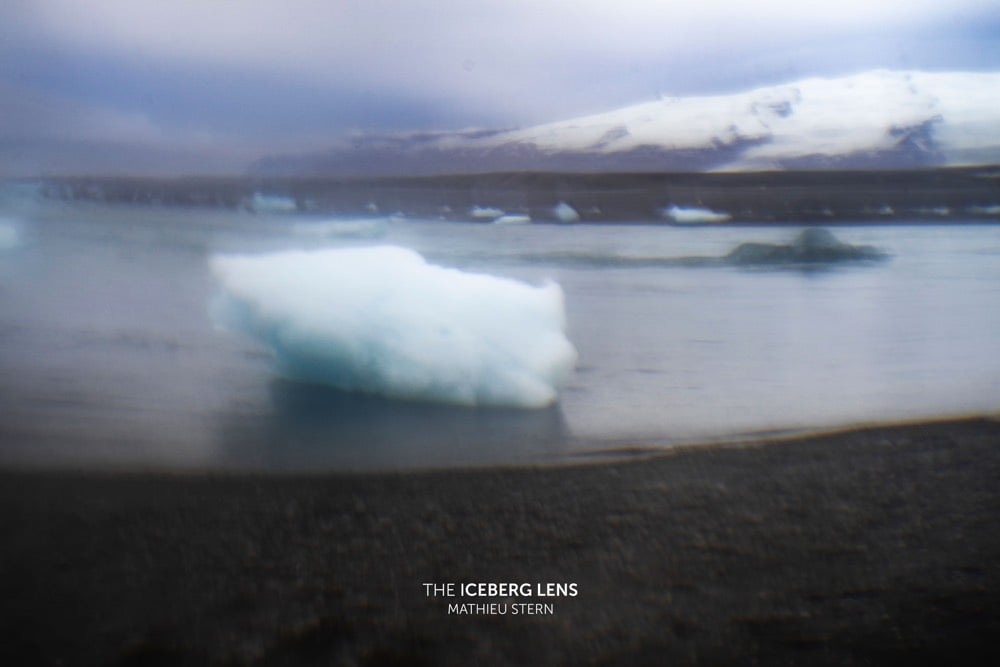

It’s a little impractical to go all the way to Iceland for iceberg ice when you can make your own clear ice at home, but Stern had this to say:
Now if people asks me “Are you happy with the result? it’s a bunch of blurry photos!?”, my response would be: “this project is a scientific, artistic and poetic project, I never imagined the result would look like the photos that comes from an ultra modern lens, but I was amazed by the strange beauty of the images I made with the first ever 10 000 year old lens.”
This is not a project for everyday photography, it was an adventure and a bet that when you have a crazy hypothesis, you should do everything to experiment it in the field.
I also wondered whether iceberg ice was actually more clear or pure than ice you could make at home. I didn’t find anything definitive but I did read this piece by Michelle Iwen about drinking single-malt scotch cooled by iceberg ice.
Our expedition leader, an Irish biologist studying southern birds, fished small chunks of clear-bubbled ice directly from the water as he worked to dislodge a sharp edged growler from beneath the propeller. He encouraged us to taste the ice, licking off the overlying salt water to find the pure, flavorless cold underneath.
“If you hold it in your bare hand long enough to speed the melting, you’ll hear it fizzle,” he told us. The fizzy pop of bergy seltzer is a familiar, yet unexpected sound. It sounds like a freshly opened can of soda, as the bubbles newly freed from the ice travel up toward the surface of the water. Yet the mundane sound of bergy seltzer belies the sinister power of melt against the bottom of the iceberg. Each bubble released scores the surface of the ice, compromising its structural integrity. We held the ice shards in our hands to make it fizz, let our skin burn against the freeze, as our expedition guide hoisted the free-floating remnants of a tiny growler into the zodiac to be chipped apart and consumed in cocktails that evening.
(via @peteashton)
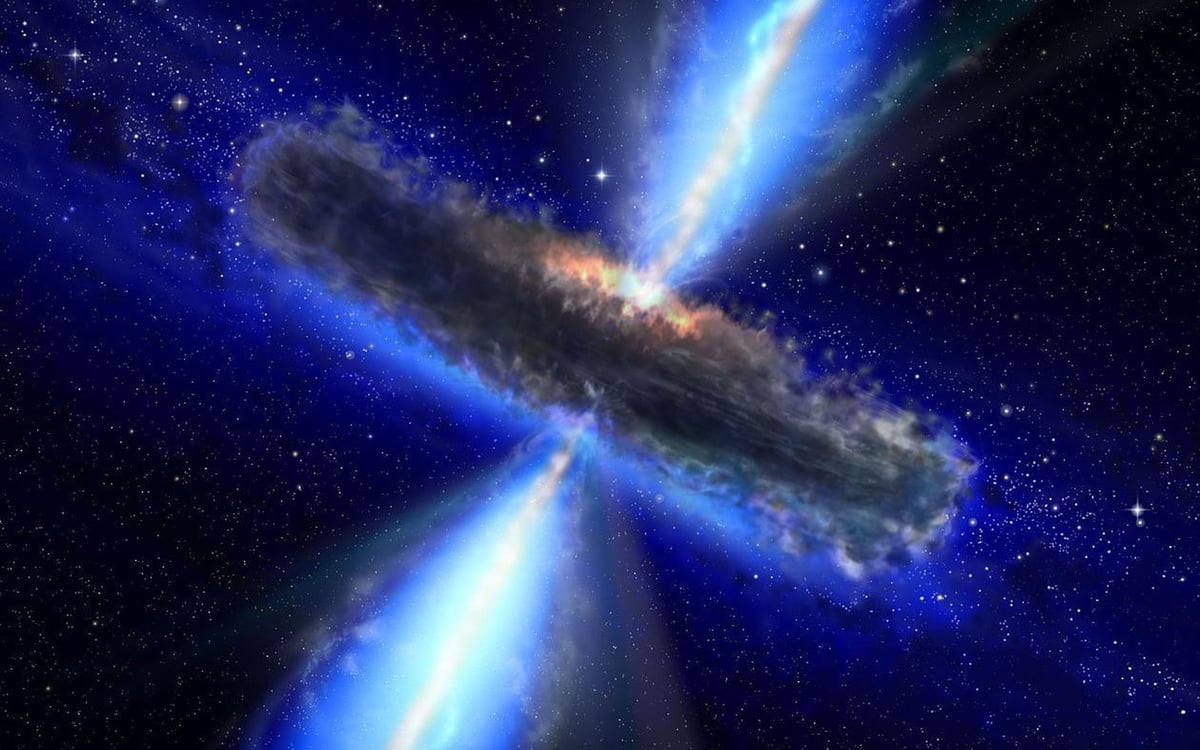
NASA artist’s conception of a quasar similar to similar to APM 08279+5255, where astronomers discovered huge amounts of water vapor. Image by NASA/ESA.
I don’t think I’m alone in saying that I’ve loved water for as long as I can remember. It was a crucial part of my life long before that. You could even say water is a huge part of everything I’ve been and will become.
Growing up in Michigan, fresh water is unusually plentiful. Even Detroit’s river is a strait between enormous lakes. Smaller ones abound. When I first visited Texas, I was told that the state had no natural lakes. It seemed impossible.
Twenty years ago, my first college research paper was for an international relations class. We had to find an international conflict and break it down with a little game theory and a smattering of other analytic perspectives we’d learned. (He really liked game theory.) I picked water rights in the Middle East. I think it was the first time I’d taken something that had always been presented as a mysterious, centuries-long, religious and tribalist conflict, and broken it down into a concrete fight over resources. No resource is more important or elemental than water.
Last year, I wrote a good-sized feature on the Flint Water Crisis and centuries of water pollution in Flint. I also wrote about a timeline put together by museum researchers in Flint. (Like I’ve everything I’ve written, the longer version of both stories is ten times as brilliant and a hundred times more insufferable.)
Anyways. Flint shows both the precarity of our water supply and how essential water is, for everything. We drink it, we bathe in it, we cook with it, we clean our clothes and dishes and almost everything. It flushes our toilets and often heats our homes. It’s essential to business and industry, for cleaning and fuel and disposing waste. It’s what grows our food, whether animal and vegetable. We can’t do anything without water. And like everything else we can’t live without, we take it for granted, finding new ways to abuse and squander it every day.
At the same time, water is terrifying. It is human and inhuman. It storms, it floods, it melts, it poisons and murders us. You don’t have to read Moby-Dick to get a sense of the sublime inhumanity of water, especially the ocean. But it does help.
Why did the old Persians hold the sea holy? Why did the Greeks give it a separate deity, and own brother of Jove? Surely all this is not without meaning. And still deeper the meaning of that story of Narcissus, who because he could not grasp the tormenting, mild image he saw in the fountain, plunged into it and was drowned. But that same image, we ourselves see in all rivers and oceans. It is the image of the ungraspable phantom of life; and this is the key to it all.
And yet:
But though, to landsmen in general, the native inhabitants of the seas have ever been regarded with emotions unspeakably unsocial and repelling; though we know the sea to be an everlasting terra incognita, so that Columbus sailed over numberless unknown worlds to discover his one superficial western one; though, by vast odds, the most terrific of all mortal disasters have immemorially and indiscriminately befallen tens and hundreds of thousands of those who have gone upon the waters; though but a moment’s consideration will teach, that however baby man may brag of his science and skill, and however much, in a flattering future, that science and skill may augment; yet for ever and for ever, to the crack of doom, the sea will insult and murder him, and pulverize the stateliest, stiffest frigate he can make; nevertheless, by the continual repetition of these very impressions, man has lost that sense of the full awfulness of the sea which aboriginally belongs to it.
The first boat we read of, floated on an ocean, that with Portuguese vengeance had whelmed a whole world without leaving so much as a widow. That same ocean rolls now; that same ocean destroyed the wrecked ships of last year. Yea, foolish mortals, Noah’s flood is not yet subsided; two thirds of the fair world it yet covers.
Water is us, and it is not us; it is a symbol of life, and it is nearly as hostile and foreign to landbound life as is outer space.
The BBC radio show “In Our Time” has a terrific episode about water, its chemical construction, and its simultaneous abundance and scarcity in the universe. I’d always thought there was something chauvinistic in scientists’ search for liquid water on other planets: sure, it’s essential to life as we know it on earth, but in all the infinite possibilities of the universe, couldn’t another molecule do the same job?
It turns out liquid water really is, at a chemical level, probably uniquely suited for generating and fostering life:
The periodic table restricts the elements available for life with carbon, nitrogen, oxygen and hydrogen being the four commonest reactive elements in the Universe. Carbon would seem to be the most important as it can produce an enormous range of compounds (organic chemistry). Other elements such as sulfur and silicon cannot form the complexity of molecules necessary for life, Silicon, in particular, tends to form stable silicates. Life on Earth contains these plus many other commonly found elements. All these elements (except hydrogen) are created inside stars and, if common, will form simple compounds in space, with dust particles in space containing up to 35% organic carbon. For forming part of life, molecules need to be relatively easy both to form and to break down and to be relatively stable within a liquid environment.
A stable liquid medium is required, such as water, with other candidate liquids such as N2, H2S, NH3 and glassy silica being liquid only at low temperatures giving slow reaction rates, or at high temperatures that are destructive and too viscous. Also many of theses putative media freeze from the bottom up that would tend to prevent the establishment of life.
Basically (and please forgive me if I screw this up), it comes back to that hydrogen bonding we kinda-sorta learned about in first-year chemistry. The structure and polarity of liquid water, with two hydrogens on one side and one oxygen on the other, and the exact strength of those hydrogen bonds, makes it uniquely suited to store energy, dissolve compounds, and transmit both of these things from place to place. Salts, enzymes, minerals, oxygen: all of these get pumped through our bodies by way of water. It is very difficult to imagine or even mathematically model any other way to do the same range of jobs.

What could Earthlings do if everyone, everywhere had an infinite supply of water?
You start to carry water with you everywhere. Sometimes after getting home from work you drink from the kitchen faucet in great, hiccuping gulps. In no time at all you’ve moved from eight cups a day to a few gallons. Anyone else might have died of hyponatremia by now, but not you. You only grow stronger and more beautiful….
Every country in the world bans the drinking of any beverage other than water. All droughts cease; deserts erupt in a riot of frondescence. You twirl in delight, slowly at first, round and round, as the entire world joins you in drinking more water. Everyone is drinking more water now. A soft, cool rain begins to fall. “She’s the one,” you hear someone whisper before you ascend to a plane of existence where human vocalizations no longer mean anything to you. “The one who drinks a lot of water.”
In just the past 10 years, the number of earthquakes in the central US (and particularly Oklahoma) has risen dramatically. In the 7-year period ending in 2016, there were more than three times the number of magnitude 3.0+ earthquakes than in the previous 36 years. Above is a video timeline of Oklahoma earthquakes from 2004-2016. At around the midpoint of the video, you’ll probably say, “wow, that’s crazy”. Keep watching.
These earthquakes are induced earthquakes, i.e. they are caused by humans. Fracking can cause induced earthquakes but the primary cause is pumping wastewater back into the ground. From the United States Geological Survey’s page on induced earthquake myths & misconceptions (a summarized version of this paper):
Wastewater disposal wells typically operate for longer durations and inject much more fluid than hydraulic fracturing, making them more likely to induce earthquakes. Enhanced oil recovery injects fluid into rock layers where oil and gas have already been extracted, while wastewater injection often occurs in never-before-touched rocks. Therefore, wastewater injection can raise pressure levels more than enhanced oil recovery, and thus increases the likelihood of induced earthquakes.
Of course, this wastewater is a byproduct of any oil & gas production, including fracking. But specifically in Oklahoma’s case, the induced earthquakes have relatively little to do with fracking:
In contrast, in Oklahoma spent hydraulic fracturing fluid represents 10% or less of the fluids disposed of in salt-water disposal wells in Oklahoma (Murray, 2013). The vast majority of the fluid that is disposed of in disposal wells in Oklahoma is produced water. Produced water is the salty brine from ancient oceans that was entrapped in the rocks when the sediments were deposited. This water is trapped in the same pore space as oil and gas, and as oil and gas is extracted, the produced water is extracted with it. Produced water often must be disposed in injection wells because it is frequently laden with dissolved salts, minerals, and occasionally other materials that make it unsuitable for other uses.
In the biggest water miracle since Christ walked on the Sea of Galilee,1 Israel has turned certain drought into a surplus of water. Conservation helped — low-flow shower heads, recycling waste water for crop irrigation — but much of the gain came from vastly improved desalinization techniques, which they hope can spread across the region and the world.
We are standing above the new Sorek desalination plant, the largest reverse-osmosis desal facility in the world, and we are staring at Israel’s salvation. Just a few years ago, in the depths of its worst drought in at least 900 years, Israel was running out of water. Now it has a surplus. That remarkable turnaround was accomplished through national campaigns to conserve and reuse Israel’s meager water resources, but the biggest impact came from a new wave of desalination plants.
Perhaps the world won’t end in water wars after all.
Update: Of course, technological advances can affect politics in many ways. Instead of sharing the tech, Israel can use their water advantage to put political pressure on their neighbors, as when Israel cut water supplies to the West Bank earlier this year during Ramadan.
Even without politics, desalinization is problematic…there’s the small matter of where to put all that salt:
Brine disposal is a big problem in much of the Middle East. The gulf, along with the Red and Mediterranean seas, are turning saltier because of desalination by-products — and the region is the epicenter of desalination worldwide, with the United Arab Emirates, Saudi Arabia, Kuwait, Qatar, Bahrain and Oman making up 45 percent of global desalination capacity. This brine is typically twice as salty as seawater, and advanced desalination plants still produce approximately two cubic meters of waste brine for every one cubic meter of clean water.
(thx, jennifer & nathan)
NYC water tastes amazing. Better than bottled. Where does the city get such great water from?
The Catskill/Delaware watershed, which extends 125 miles northwest of the city, provides more than 90 percent of the city’s supply. The rest comes from the Croton watershed.
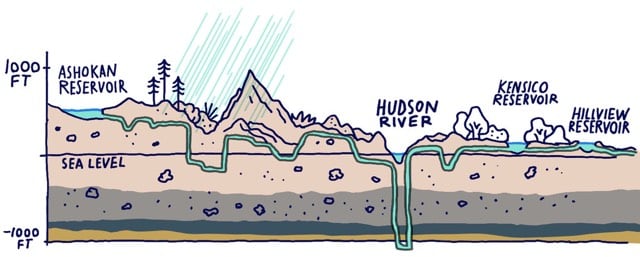
It can take 12 weeks to a year for water to wind its way to the city from the streams, tunnels, dams and reservoirs in the Catskills. All of it is delivered to the city by gravity alone.
“Gravity’s an important friend of ours,” said Mr. Rush, the deputy commissioner, explaining that it “works nonstop” and is “energy efficient.”
Whoa, I had no idea the aqueduct tunneled 1000 feet under the Hudson River. Water systems have been in the news lately, both in Flint, MI and here in NYC, where Mayor de Blasio postponed work on Water Tunnel #3 and then, a day later, responding to public concern over the postponement, announced that he was going to accelerate the work on Tunnel #3.
See also David Grann’s classic 2003 New Yorker piece about the NYC water system, City of Water.
The author accompanied a group of sandhogs and nine cases of dynamite six hundred feet down a shaft leading to a segment of the tunnel that lies below Tenth Ave. and 13th St. New York’s invisible underground empire goes as deep as the Chrysler building is high. Tunnel No. 3 has been under construction since 1969; it will extend sixty miles, from the reservoir in Yonkers to the end of Manhattan, with various redundant loops.
If you’ve been following along, various politicians at all levels of the government have basically been kicking the can down the road when it comes to taking responsibility for the water crisis in Flint, MI.
[Michigan Governor Rick] Snyder and [Environmental Protection Administrator Gina] McCarthy were both asked, strongly and repeatedly, to resign. The two officials, for their part, blamed each other: The governor faulted the EPA for its slow and “ineffective” response, while McCarthy took aim at state officials for obfuscating the poor water quality. Both also suggested they weren’t fully aware of the problem’s scope until far too late.
Dave Pell from Nextdraft says:
This is a common refrain we’ve heard from national, state and local officials. We’ve had hearings, debates, and nationally televised town halls. What we don’t have is a solution for the people bathing in bottled water. In times of war, we can get running water to the deserts of Iraq. But all we can get to Flint is politics as usual.
Also via Nextdraft, Erin Brockovich wrote about Flint and the other places around the country where similar things are happening.
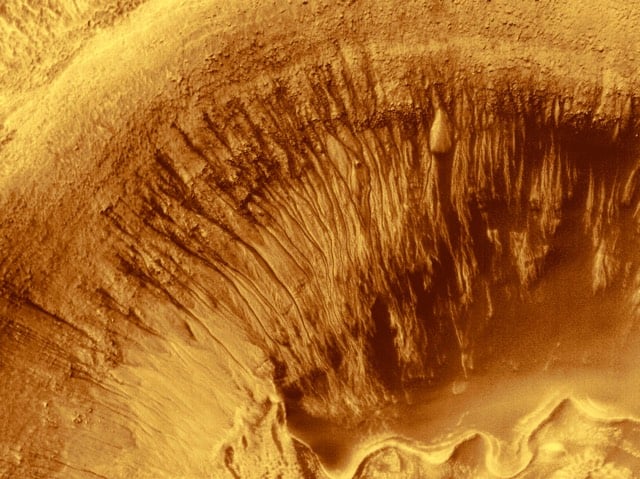
NASA’s press conference doesn’t start for a few minutes yet, but the NY Times has the scoop: NASA has found “definitive signs” of liquid water on the surface of Mars. Like, right now on Mars, not millions of years ago.
In a paper published in the journal Nature Geoscience, Dr. McEwen and other scientists identified waterlogged molecules — salts of a type known as perchlorates - in readings from orbit.
“That’s a direct detection of water in the form of hydration of salts,” Dr. McEwen said. “There pretty much has to have been liquid water recently present to produce the hydrated salt.”
By “recently,” Dr. McEwen said he meant “days, something of that order.”
This is fantastic timing for the release of The Martian movie, which comes out this weekend.
Update: And here’s the official press release from NASA.
“Our quest on Mars has been to ‘follow the water,’ in our search for life in the universe, and now we have convincing science that validates what we’ve long suspected,” said John Grunsfeld, astronaut and associate administrator of NASA’s Science Mission Directorate in Washington. “This is a significant development, as it appears to confirm that water — albeit briny — is flowing today on the surface of Mars.”
These downhill flows, known as recurring slope lineae (RSL), often have been described as possibly related to liquid water. The new findings of hydrated salts on the slopes point to what that relationship may be to these dark features. The hydrated salts would lower the freezing point of a liquid brine, just as salt on roads here on Earth causes ice and snow to melt more rapidly. Scientists say it’s likely a shallow subsurface flow, with enough water wicking to the surface to explain the darkening.
With California in the midst of a particularly intense multi-year drought and 2015 looking to be the warmest year on record by a wide margin,1 Edward Burtynsky’s “Water” series of photographs is especially relevant.
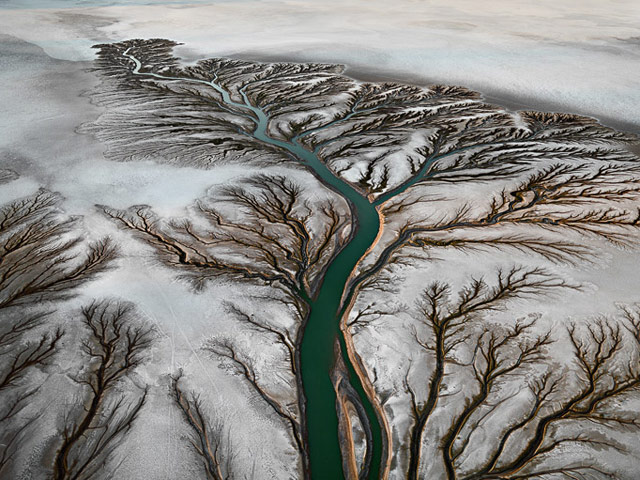
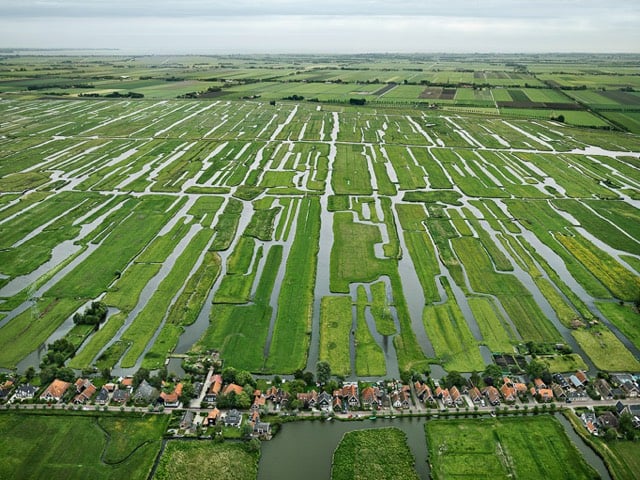


Many of photos in the series are on display in Berkeley through February and are also available in book form.
Update: Burtynsky also collaborated on a documentary about water called Watermark. Here’s a trailer:
The film is available to watch on Amazon Instant and iTunes. (via @steveportigal)
The US Navy is working on technology to convert seawater into fuel to power unmodified combustion engines. They recently tested the fuel (successfully!) in a replica P-51 and hope to make it commerically viable.
Navy researchers at the U.S. Naval Research Laboratory (NRL), Materials Science and Technology Division, demonstrated proof-of-concept of novel NRL technologies developed for the recovery of carbon dioxide (CO2) and hydrogen (H2) from seawater and conversion to a liquid hydrocarbon fuel.
Fueled by a liquid hydrocarbon — a component of NRL’s novel gas-to-liquid (GTL) process that uses CO2 and H2 as feedstock — the research team demonstrated sustained flight of a radio-controlled (RC) P-51 replica of the legendary Red Tail Squadron, powered by an off-the-shelf (OTS) and unmodified two-stroke internal combustion engine.
Using an innovative and proprietary NRL electrolytic cation exchange module (E-CEM), both dissolved and bound CO2 are removed from seawater at 92 percent efficiency by re-equilibrating carbonate and bicarbonate to CO2 and simultaneously producing H2. The gases are then converted to liquid hydrocarbons by a metal catalyst in a reactor system.
“In close collaboration with the Office of Naval Research P38 Naval Reserve program, NRL has developed a game-changing technology for extracting, simultaneously, CO2 and H2 from seawater,” said Dr. Heather Willauer, NRL research chemist. “This is the first time technology of this nature has been demonstrated with the potential for transition, from the laboratory, to full-scale commercial implementation.”
Discover has more, in slightly more accessible language.
Not to get all Malcolm Gladwell here, but it’s counterintuitive that hot water freezes faster than cold water. The phenomenon is called the Mpemba effect and until recently, no one could explain how it works. A group of researchers in Singapore think they’ve cracked the puzzle.
Now Xi and co say hydrogen bonds also explain the Mpemba effect. Their key idea is that hydrogen bonds bring water molecules into close contact and when this happens the natural repulsion between the molecules causes the covalent O-H bonds to stretch and store energy.
But as the liquid warms up, it forces the hydrogen bonds to stretch and the water molecules sit further apart. This allows the covalent molecules to shrink again and give up their energy. The important point is that this process in which the covalent bonds give up energy is equivalent to cooling.
In fact, the effect is additional to the conventional process of cooling. So warm water ought to cool faster than cold water, they say. And that’s exactly what is observed in the Mpemba effect.
(via ★djacobs)
According to climate scientist Paul Mayewski, he and his team sometimes melt down unneeded ice cores that they’ve collected in places like Antarctica and drink the resulting water. The ice, as well as the air trapped within, can be more than a hundred thousand years old.
Probably the most exciting thing about it is when you have real ice — that’s where the snow has been gradually compacted and eventually formed into ice, and the density has increased. When that happens, if the ice is old, it will often trap air bubbles in it. Those air bubbles can contain carbon dioxide from ten thousand years ago or even a hundred thousand years ago. And when you put an ice cube of that ice in a glass of water, it pops. It has natural effervescence as those gas bubbles escape. You get a little a puff of air into your nostrils if you have your nose over the glass. It’s not as though it necessarily smells like anything — but when you think about the fact that the last time that anything smelled that air was a hundred thousand years ago, that’s pretty interesting.
For his wedding reception, Mayewski had water from “Greenland ice and Antarctic ice” for his guests to drink. (thx, finn)
The US Navy is looking for a way to replace bulky antennas on warships with antennas made from seawater.
What they came up with is little more than an electromagnetic ring and a water pump. The ring, called a current probe, creates a magnetic field through which the pump shoots a steam of seawater (the salt is a key ingredient, as the tech relies on the magnetic induction properties of sodium chloride). By controlling the height and width of the, the operator can manipulate the frequency at which the antenna transmits and receives. An 80-foot-high stream can transmit and receive anywhere from 2 to 400 mHz, though much smaller streams can be used for varying other frequencies, ranging from HF through VHF to UHF.
Wow. (via bldgblog)
Things that make it seem like you don’t really care about the issue of water management & scarcity at your conference about the future: 1. provide the participants on the water scarcity panel with Fiji bottled water.
Fiji, need we remind you, is an island where water supplies are scarce and locals have struggled to find clean, reliable supplies of drinking water. Meanwhile, Fiji Water owns the rights to the island’s largest underground aquifer, drawing water into its diesel-fueled factory and bottling it using heavy-weight plastic. All this makes having Fiji Water at a panel about “the most creative solutions being attempted to meet the water challenge in the United States and around the world” hard to swallow.
NASA announced that it has found pretty hard evidence of significant amounts of water on the Moon.
“We are ecstatic,” said Anthony Colaprete, LCROSS project scientist and principal investigator at NASA’s Ames Research Center in Moffett Field, Calif. “Multiple lines of evidence show water was present in both the high angle vapor plume and the ejecta curtain created by the LCROSS Centaur impact. The concentration and distribution of water and other substances requires further analysis, but it is safe to say Cabeus holds water.”
I don’t have to tell you about the implications here. Just think of how much you could sell authentic Moon bottled water for.
Bottled water is bad but Fiji bottled water is particularly odious. For starters, the country’s military regime monitors internet usage at internet cafes in real-time for information about the popular bottled water brand:
I sat down and sent out a few emails — filling friends in on my visit to the Fiji Water bottling plant, forwarding a story about foreign journalists being kicked off the island. Then my connection died. “It will just be a few minutes,” one of the clerks said. Moments later, a pair of police officers walked in. They headed for a woman at another terminal; I turned to my screen to compose a note about how cops were even showing up in the Internet cafes. Then I saw them coming toward me. “We’re going to take you in for questioning about the emails you’ve been writing,” they said.
Then the cops threatened the reporter with prison rape. The rest of the story isn’t much better.
Update: From Fiji Water’s official response to the article:
We strongly disagree with the author’s premise that because we are in business in Fiji somehow that legitimizes a military dictatorship.
(thx, mason)
In the future, there will be sommeliers for everything from toothpaste to flip-flops. Today’s example: water.
Take Mahalo Deep Sea Water, at £20 for 71cl, which comes from “a freshwater iceberg that melted thousands of years ago and, being of different temperature and salinity to the sea water around it, sank to become a lake at the bottom of the ocean floor. The water has been collected through a 3000ft pipeline off the shores of Hawaii.” According to the Daily Mail, Mahalo has a “very rounded quality on the palate” and it “would be good with shellfish.”
There’s even a book on this “up-and-coming trend”: Fine Waters: A Connoisseur’s Guide to the World’s Most Distinctive Bottled Waters.
Update: The Grand Hyatt Sao Paulo has a cheese sommelier, a specially water menu, and “an extensive soap menu”.
Absolutely gorgeous slow motion HD video of a large wave from under the water…you can clearly see the intricate and powerful architecture of the wave.
Nice surfing shot too…but the wave is mesmerizing.
A year ago, I collected a bunch of links related to what makes NYC pizza taste like it does. New York’s fantastic tap water was a leading candidate. In a recent blind taste test of identical pies, a panel of judges — including some noted NYC pizza chefs — chose a pizza made with NYC municipal water over those made from LA and Chicago water.
Also, I just ran across this map showing NYC pizzerias which are outfitted with coal ovens. There are many more than I would have thought.
Electrolyzed water (salt water that has been run through an electrolytic process) is gaining acceptance in the US as a replacement for many cleaning agents.
At the Sheraton Delfina in Santa Monica, some hotel workers are calling it el liquido milagroso — the miracle liquid. That’s as good a name as any for a substance that scientists say is powerful enough to kill anthrax spores without harming people or the environment.
A food science professor says that electrolyzed water is “10 times more effective than bleach in killing bacteria” and it’s safe to drink. (Although maybe it would kill all the bacteria in your stomach?) But beware the phony health claims.
NY Times editorial: don’t bother with bottled water, drink tap instead.
While a lot of bottled water may be as pure as promised in those alluring commercials, the real problem is telling which is which. Public water supplies are regulated by the federal government. Not so for bottled water. The Food and Drug Administration does have some oversight, but bottled water is not very high on their long list of priorities.
Water on Mars: confirmed.
Laboratory tests aboard NASA’s Phoenix Mars Lander have identified water in a soil sample. The lander’s robotic arm delivered the sample Wednesday to an instrument that identifies vapors produced by the heating of samples.
The lander itself added, on Twitter, “FTW!”
Scientists were recently “astonished” to find water in Mercury’s atmosphere. Plus, the particles in the atmosphere were blasted off the surface by the solar wind so the atmospheric water could indicate that it can be found on the surface as well. First Mars and now this. Has The Onion done a “Scientists find evidence of water on Earth” story yet?
Why is New York-style pizza so difficult to replicate in other areas of the world? Perhaps the answer lies with NYC’s legendary tap water.
“Water,” Batali says. “Water is huge. It’s probably one of California’s biggest problems with pizza.” Water binds the dough’s few ingredients. Nearly every chemical reaction that produces flavor occurs in water, says Chris Loss, a food scientist with the Culinary Institute of America. “So, naturally, the minerals and chemicals in it will affect every aspect of the way something tastes.”
Update: That legendary tap water was supposedly responsible for NYC-style bagels as well until Finagle A Bagel founder Larry Smith drove some Boston tap water to NYC and compared bagels made with the water from the two cities.
“There was absolutely no difference between them,” Smith reported. “What makes the difference is equipment, process and ingredients.”
Well, ingredients except water. (thx, darrin)
Update: Jeffrey Steingarten, among others, believes that temperature is the key to great pizza and that coal is the key to great temperatures. (thx, hillel)
Update: I knew we’d eventually end up on Slice…the web’s premiere pizza site hosts an account of Jeff Varasano’s attempt to reverse engineer a NYC pizza, specifically from the 117th St. Patsy’s. Among his findings:
There are a lot of variables for such a simple food. But these 3 FAR outweigh the others:
1. High Heat
2. Kneading Technique
3. The kind of yeast culture or “starter” used along with proper fermentation technique
All other factors pale in comparison to these 3. I know that people fuss over the brand of flour, the kind of sauce, etc. I discuss all of these things, but if you don’t have the 3 fundamentals above handled, you will be limited.
(thx, ian)
Recent research suggests that:
There is no clear evidence of benefit from drinking increased amounts of water.
In particular, scientists found no evidence that the common recommendation of eight 8-oz glasses of water per day has any benefit. NPR busts some additional water myths.
Say this three times fast: sea shrinks foam cups. (It helps if you sing the words to the tune of Frère Jacques.)
The [styrofoam] cups were then gingerly sent into the deep. During the historic dive, led by Russian scientists, the pressure of the surrounding water crushed the cups to the size of thimbles, also squeezing their whimsies of writing and drawing. Afterward, the tiny cups became instant mementoes of the polar dive, offering striking proof of the descent into an unfamiliar zone and silent testimony to the crushing power of plain old water.
Natalie Angier’s short appreciation of water, which, before you scoff, is a pretty amazing substance despite its ubiquity. “Pulled together by hydrogen bonds, water molecules become mature and stable, able to absorb huge amounts of energy before pulling a radical phase shift and changing from ice to liquid or liquid to gas. As a result, water has surprisingly high boiling and freezing points, and a strikingly generous gap between the two. For a substance with only three atoms, and two of them tiny little hydrogens, Dr. Richmond said, you’d expect water to vaporize into a gas at something like minus 90 degrees Fahrenheit, to freeze a mere 40 degrees below its boiling point, and to show scant inclination to linger in a liquid phase.”
Compared with Snapple, whiteout, and Pepto Bismol ($123.20/gallon), gasoline is surprisingly inexpensive. “$21.19 for WATER - and the buyers don’t even know the source. No wonder Evian spelled backwards is Naive.”
Update: Rob Cockerham did a more extensive analysis of liquid pricing a few years ago.
Some back-of-the-envelope calculations about the embodied energy of bottled water: “the cost to produce and deliver a bottle of imported water is $0.22, leaving $1.28 per bottle profit for the manufacturer and the retail store”.
By subjecting ordinary water to extremely high pressure and bombarding it with x-rays, scientists at Los Alamos have formed a new hydrogen-oxygen alloy. “Given high enough pressures, even hydrogen will behave as a metal. All the other heavier elements in hydrogen’s group of the periodic table are metals.”
Older posts





Socials & More