Harvard Business Review has compiled a list of breakthrough ideas for 2007. "Our annual survey of emerging ideas considers how nanotechnology will affect commerce, what role hope plays in leadership, and why, in an age that practically enshrines accountability, we need to beware of 'accountabalism.'" The first idea on the list comes from Duncan Watts, whose research shows that it's not so-called influentials who are responsible for driving cultural trends (as argued in The Tipping Point) but the presence of many ordinary people who are able to be influenced within a given social network.
Formulas for writing reviews of music, restaurants, and boutique clothing stores (???). "What the a lacked in x, the b made up for in y. Where a = a menu item, x = a characteristic often used in conjunction with fast cars, b = a menu item, and y = an adjective generally used by Victorian novelists to describe a young woman." (via airbag)
Music industry: CD prices are being driven down by $9.99 albums on iTunes Music Store. "Physical retailers are pressuring the labels downward on price (of course, Wal-Mart is the biggest culprit) because they don't want to be undercut by iTunes 9.99 on all single albums. We're rapidly moving to a 9.99 world on the big sellers (the ones stocked in Target and Wal-Mart and Best Buy)."
A review of Nicholas Negroponte's influential Being Digital, 12 years after its publication. "Page 204: Today a game like Tetris is fully understandable too quickly. All that changes is the speed. We are likely to see members of a Tetris generation who are much better at packing a station wagon, but not much more." He wrong about Tetris *and* the future availability of station wagons. (via matt)
What's the cut-off date for wishing someone a happy new year? Is the end of January too late?
Mac geek proposes to girlfriend via F12 key and a Dashboard widget. See also Apple Store marriage proposal.
Flickr is switching their earliest members from a Flickr login to a Yahoo login and many of those folks are none too happy about it. Flickr is handling this tough situation very well, even though I'm personally disappointed at having to use Yahoo's login myself. Few sites do customer service and community management better than Flickr...it's impressive and inspiring to watch in action. They just tell people the truth, with humor, patience, and not too much spin...it's as simple as that. (via waxy)
OhMiBod is the ultimate iPod accessory: a vibrator that hooks up to the iPod and buzzes in time with the music. "I will never listen to music the same way again." Don't miss the playlists compiled specifically for OhMiBod use. NSFW. (thx, tania)
Fotolog overtaking Flickr?
Quick! Which photo sharing site community thingie is more popular: Fotolog or Flickr? You might be surprised at the answer...but first some history.
Fotolog launched in May 2002 and grew quite quickly at first. They'd clearly hit upon a good idea: sharing photos among groups of friends. As Fotolog grew, they ran into scaling problems...the site got slow and that siphoned off resources that could have been used to add new features to the site, etc. Problems securing funding for online businesses during the 3-4 years after the dot com bust didn't help matters either.
Flickr launched in early 2004. By the end of their first year of operation, they had a cleaner design than Fotolog, more features for finding and organizing photos, and most of the people I knew on Fotolog had switched to Flickr more or less exclusively. They also had trouble with scaling issues and downtime. Flickr got the scaling issues under control and the site became one of the handful of companies to exemplify the so-called Web 2.0 revitalization of the web. The founders landed on tech magazine covers, news magazine covers, and best-of lists, the folks who built the site gave talks at technology conferences, and the company eventually sold to Yahoo! for a reported $30 million.
Fotolog eventually got their scaling and funding issues under control as well, but relative to Flickr, the site has changed little in the past couple of years. Fotolog has groups and message boards, but they're not done as well as Flickr's and there's no tags, no APIs, no JavaScript widgets, no "embed this photo on your blog/MySpace", and no helpful Ajax design elements, all supposedly required elements for a successful site in the Web 2.0 era. Even now, Fotolog's feature set and design remains planted firmly in Web 1.0 territory.
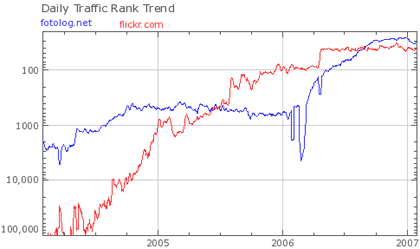
So. Then. Here's where it gets puzzling. According to Alexa1, Fotolog is now the 26th most popular site on the web and recently became more popular than Flickr (currently #39). Here's the comparison between the two over the last 3 years:
This is a somewhat stunning result because by all of the metrics held in high esteem by the technology media, Web 2.0 pundits, and those selling technology and design products & services, Flickr should be kicking Fotolog's ass. Flickr has more features, a better design, better implementation of most of Fotolog's features, more free features, critical praise, a passionate community, and access to the formidable resources & marketing power of Yahoo! And yet, Fotolog is right there with them. Perhaps this is a sign that those folks trapped in the Web 2.0 bubble are not being critical enough about what is responsible for success on the Web circa-2007. (As an aside, MySpace didn't really fit the Web 2.0 mold either, nobody really talked about it until after it got huge, and yet here it is. And then there's Craigslist, which is more Web 0.5 than 2.0, and is one of the most popular sites on the web. Google too.)
What's going on here then? I can think of three possibilities (there are probably more):
1. Fotolog is very popular with Portugese and Spanish speakers, especially in Brazil. According to Wikipedia, almost 1/3rd of all Fotolog users are from Brazil and Chile. In comparing the two sites, what could account for this difference? Fotolog has a Spanish language option while Flickr does not (although I'm not sure when the Spanish version of Fotolog launched). Flickr is more verbose and text-intensive than Fotolog and much of Flickr's personality & utility comes from the text while Fotolog is almost text-free; as a non-Spanish speaker, I could navigate the Spanish-language version quite easily. Gene Smith noted that a presentation made by a Brazilian internet company said that "Flickr is unappealing to Brazilians because they want to the customize the interface to express their individual identities".
Cameron Marlow noticed that Orkut is set to pass MySpace as the world's most popular social networking site (Orkut is also very popular in Brazil), saying that "Orkut's growth reinforces the fact that the value of social networking services, and social software in general, comes from the base of active users, not the set of features they offer". Marlow also notes that Alexa's non-US reporting has improved over the past year, which might be the reason for Fotolog's big jump in early 2006. If Alexa's global reporting had been robust from the beginning, Fotolog may have been neck and neck with Flickr the whole time.
2. Flickr is more editorially controlled than Fotolog. The folks who run Flickr subtly and indirectly discourage poor quality photo contributions. Yes, upload your photos, but make them good. And the community reinforces that constraint to the point where it might seem restricting to some. Fotolog doesn't celebrate excellence like that...it's more about the social aspect than the photos.
3. Maybe tags, APIs, and Ajax aren't the silver bullets we've been led to believe they are. Fotolog, MySpace, Orkut, YouTube, and Digg have all proven that you can build compelling experiences and huge audiences without heavy reliance on so-called Web 2.0 technologies. Whatever Web 2.0 is, I don't think its success hinges on Ajax, tags, or APIs.
Update: You can see how much Fotolog depends on international usage for its traffic from this graph from Compete. They only use US statistics to compile their data. I don't have access to the Comscore ratings, but they only count US usage and, like Alexa, undercount Firefox and Safari users. (thx, walter)
[1] Usual disclaimers about Alexa's correctness apply. The point is that among some large amount of users, Fotolog is as popular (or even more) than Flickr. Whether those users are representative of the web as a whole, I dunno. ↩
Dumb interface, but here are some neat maps of global fish catch locations, mostly tuna. For example, on these maps you can see the dramatic increase of purse seine fishing from 1964-1998. (thx, spencer)
A paper by Linda Bilmes of Harvard's John F. Kennedy School of Government concludes that in addition to the stated cost of the wars in Iraq and Afghanistan by the Bush administration, it will cost $350 - $700 billion for the US gov't to provide health benefits and care over the lifetimes of soldiers who served there. More from the Christian Science Monitor. (thx, marcus)
Antony Hare is one of the few people from the olden days (i.e. 8-10 years ago) that I still check in on regularly...I really dig his simple illustrations. For the past few months, he's been putting time-lapse videos of some of his drawings on YouTube, including a drawing of Steve Jobs, one of Robert Altman, and another of David Lynch.
Creators vs. lawyers
Here's a fun rumor. I heard that the staff of the Daily Show and Colbert Report upload the shows to YouTube as soon as they can after the shows air and then the next day, lawyers from Comedy Central hit YouTube with takedown requests for the uploaded shows. Which makes total sense...sort of. The people making the shows want them to be seen while the lawyers want to ensure that people are paying to see them. It's a crazy media world we live in.
From what looks like an informative and insightful blog on film, two posts: one on planimetric composition or "mug-shot framing" in films (you may have seen Wes Anderson using it) and the other is an update on The Hobbit movie and Peter Jackson's involvement (or lack thereof) with it. The Hobbit item is old news, but it fills in so many blanks left by traditional and typical online media coverage that it's worth the read if you're at all interested in the subject. (thx, ajit)
Some of the default Microsoft Vista wallpapers are licensed from Flickr users and Microsoft employees. Doubtful that Apple would do something like this.
Update: A former Apple employee writes: "Almost all of the photos in iLife (the ones for the themes and so on) are from employees." I was talking more about the Flickr part, but point taken.
Is it worth paying $700 for a bottle of wine? Well worth it, says Slate's wine columnist, for the right bottle. "My father took a sniff of his glass, and he immediately registered a look of shock that called to mind the expression on Michael Spinks' face when Mike Tyson first landed a glove on him in their 1988 title fight. Unlike Spinks, however, my father managed to remain upright. I took a sip of the wine and quickly pronounced the same verdict I had rendered 20 months earlier: 'Holy shit.'"
An update on Bryant Simon, the fellow who's studying Starbucks from around the world in order to write a book about the company. An observation from Britain: "Starbucks is dirtier in Britain. Americans have been taught to do part of the labour, and they clean up after themselves. In the US, part of Starbucks' appeal is its cleanness." 2006 New Yorker piece about Simon and his Temple University page. (via bb)
Map of the Land of Oz. "Oz is completely surrounded by deserts, insulating the country from invasion and discovery. The isolation may be splendid, it is not total: children from our world got through, as well as the Wizard of Oz and the more sinister Nome King. To prevent further incursions, Glinda created a barrier of invisibility around Oz."
Reggie Watts, one-man sampling human beatbox. "None of this was manipulated by editing." Be sure to catch the slow-motion bit starting around 3:18. I saw Reggie in person at PopTech 2006...very entertaining.
Update: Kid Beyond does something similar during his live performances. (thx, derek)
Top 10 most litigious US companies from 2001-2006 (based on trademark cases): 1. Microsoft. 2. Cendent. 3. Altria/Philip Morris. 4. Best Western. 5. Dunkin' Donuts. 6. Lorillard Tobacco. 7. Levi Strauss. 8. Baskin-Robbins. 9. Chanel. 10. Nike. Found in the sidebar of this article on Levi Strauss suing other jeans companies for their triangle pockets.
Nasty Nets used CSS positioning to "embed" one YouTube video into another. "Be sure to hit 'play' on both YouTubes." Reminds me of the animated GIF mashups (more).
A new form of gambling called historical racing allows people to "wager on horse races that have already taken place" and promises to be as fast & addictive as slots. (via mr)
Update: Here's a company that provides an historical racing service. (thx, sam)
In today's NY Times, Robert Sullivan argues that NYC is falling behind the rest of America in making the city hospitable for pedestrians, cyclists, and takers of public transportation. "London now charges drivers a fee to enter the core business area, but here such initiatives are branded as anti-car, and thus anti-personal freedom: a congestion fee, critics say, is a tax on the middle-class car commuter. But as matters now stand, the pedestrian is taxed every day: by delays and emissions, by asthma rates that are (in the Bronx) as much as four times the national average. Though we think of it as a luxury, the car taxes us, and with it we tax others."
Andy Warhol would have loved this round-the-clock webcam view of the Empire State Building...it's like a sequel to Empire that never ends. (via cyn-c)
Wikipedia explains R&B: "She orders a milkshake and begins to blow bubbles into it (a possible allusion to oral sex). She continues to prance throughout the restaurant and walks into the kitchen, 'helping' the chef remove biscuits from the oven as she purposely moves her buttocks (which the biscuits are shaped like) near his face to possibly make him wish to have sex with her, yet he shows no interest in her and she leaves in dismay."
Steven Shapin reviews the history of vegetarianism, from Pythagoras to Hitler to organic Zambian green beans. "Recent epidemiological studies suggest that adult vegetarians tend to have lower blood pressure, lower cholesterol levels, lower rates of obesity, and, more controversially, higher childhood I.Q.s -- though vegans tend to have lower I.Q.s than their carnivorous peers, and the nature of the links between vegetarianism, health, and I.Q. is unclear."
Hey you, web designer! Looking for a job?
Serious Eats is looking for a web designer who's familiar with blogs, isn't afraid of a little PHP code, and is located in (or is planning on relocating to) NYC. Serious Eats is a start-up that is focused on sharing food enthusiasm through blogs and online community. You'll be working with a fine group of folks. SE is headed up by Ed Levine, who Gourmet editor-in-chief Ruth Reichl calls the "missionary of the delicious" and Meg Hourihan, who co-founded blogger.com and happens also to be married to me. Alaina Browne, formerly of A Full Belly and Mule Design, and Adam Kuban, pizza and burger expert, round out SE's crew of passionate food people.
Fringe benefits: you can't imagine all the culinary goodies that make their way into that office everyday. Meg comes home and casually says things like, "oh, we had a private tasting of the new Haagen-Dazs flavors in the office today" all the freaking time. If you're a web designer with an interest in food, this is your place.
How to disable the stupid Snap Preview things that are popping up on everyone's site these days. (via df)
In this video, an autistic woman speaks in her native language and then translates it into English. But it's not really a direct translation because, as she states, her language is not limited to expressing her thoughts to other human beings...it's more about her reacting to every element of her environment. More about the video on MetaFilter (one commenter calls the thread "perhaps the most enlightening thing I've ever read on MetaFilter"), including a comment from the video's creator.
David Shenk is writing a book about genius, specifically "how science is unveiling a rich new understanding of talent, 'giftedness,' and brilliance -- and the lessons we can all apply to our own lives", and he's using a blog to help him while he researches and writes it.
Good People, new fiction by David Foster Wallace in the New Yorker.
Google mixes their chocolate and peanut butter to map out locations found in books on Google Maps. Check out the maps for Around the World in Eighty Days or War and Peace (near the bottom of the page). More information about this project here.
Some RSS and remaindered links changes
As promised, I've made some long overdue changes to the kottke.org RSS feeds and the remaindered links. I've combined the two kottke.org feeds -- previously one contained main posts, movie posts, and book posts and the other contained the so-called remaindered links -- into one feed, located here:
If you're already subscribed to the main feed, you shouldn't have to change a thing. If you're subscribed to the remaindered feed, your newsreader (if it's smart enough) should automatically and permanently redirect you to the new feed. If not, just change the subscription to point at the above feed. If you're subscribed to both, unsubscribe from the remaindered feed. The new combined feed will mirror the front page of the site...whatever appears there will appear in the feed.
Second thing: the remaindered links are dead. Long live the remaindered links. Oh, they're still here on the site, but it's been a long time since they were just links...they're more like mini posts with no titles -- some of them are actually longer than the non-mini posts. The distinction made sense when they were included in the sidebar on the front page, but not anymore. Functionally that means no separate RSS feed, no separate archives, and no separate index page...they're all gone (or will be soon). All the remaindered links posts are still available, but they're in the main monthly archives now. The point is, you don't need to worry about any of this. Just subscribe to the above feed or come to the front page each day and you'll get everything that's new on kottke.org everyday. Simple.
Things should have worked this way for, oh, the past two years, but I just never got around to changing it. What finally kicked my butt into action were two things that happened in the past two weeks. I had coffee with Cory Doctorow last weekend. He asked how things were going with kottke.org and remarked that I'm not posting nearly as much as I used to. I replied that I had been posting as much as ever, but got the feeling that Cory was only subscribed to the main RSS feed, which only accounted for about 15-20% of my total effort on the site. I wondered how many other people out there were only subscribed to the main feed and started to, oh, I guess "fret" is the right word.
Fret turned to panic when I checked my server logs. Bloglines sends along how many people are subscribed to an RSS feed in the user-agent string that's deposited in the referer logs on the server, like so:
Bloglines/3.1 (http://www.bloglines.com; 200 subscribers)
When I compared the number of subscribers to the main feed to the number subscribing to the remaindered feed, the main feed number was nearly 3 times higher. Even worse is when I looked at my server logs for the feeds (I stopped looking at my stats months ago)...visits to the main feed are outpacing visits to the remaindered feed 5:1. Which means that somewhere between 75-85% of the people who are reading kottke.org via RSS aren't even getting most of what's on the site! Which was dumb, dumb, dumb of me to let happen for all these months and why I've now corrected the situation. Interestingly, the stats from Rojo indicate the opposite situation...way more people are subscribed to the remaindered links feed than the main feed. Weird. (Another RSS stats tidbit: I've served up 58 gigabytes of RSS so far this month. That's crazy!)
As always, your bug reports, questions, and concerns are appreciated and may be directed to jason@kottke.org.
Calvin Trillin, parallel parking expert, parks a self-parking car. "As you ease up gradually on the brake, the wheel turns on its own to make one reverse swoop into the spot. Watching the wheel turn by itself is a bit like watching a player piano, except in traffic."
Lots of nice photographs on Flickr of Comet McNaught, the brightest comet seen by the earth since 1965. This one by John White is stunning.
Photos by Bill Sullivan of people going through NYC subway turnstiles. I love the moments of recognition depicted here. (via dooce)
Social network map of the New Testament. Jesus Christ, supernode. (via waxy)
A list of 16 genuinely good Oscar-winning songs. As noted in the comments, Lose Yourself by Eminem should have been included.
Ho. Ly. Shit! Muji is planning on opening "two Muji stores in New York between July and December". Anyone have a sub to WWD...email me the text of this article? Got it, thanks Nixta! (via the cap'n)
Before NBA player Jason Kidd split with his wife, his free throw routine included blowing a kiss to her. After the ugly breakup, he kisses his fingers and wipes them on his butt...kiss my ass!
Long audio interview with Michael Lewis by economist Russ Roberts on "the hidden economics of baseball and football". "Michael Lewis talks about the economics of sports -- the financial and decision-making side of baseball and football -- using the insights from his bestselling books on baseball and football: Moneyball and The Blind Side. Along the way he discusses the implications of Moneyball for the movie business and other industries, the peculiar ways that Moneyball influenced the strategies of baseball teams, the corruption of college football, and the challenge and tragedy of kids who live on the streets with little education or prospects for success."
Do The Right Thing
I don't typically write about many new Web 2.0 products, but Do The Right Thing is doing something interesting. The site works on a modified Digg model. If you see a story you like, you click a button to declare your interest in it. But then you also rate the social impact of the subject of the story, either positive or negative. Over time and given enough users, you can look at all the stories about a company like Starbucks and see how they're doing. This is something that people do when reading the news anyway -- e.g. "I feel worse about Exxon Mobil because they outsourced 20,000 jobs to India" -- and having them explicitly rate stories like this is a quick way of taking the temperature of the social climate around issues & companies and recording the results for all to see.
It would be interesting to see if people would be willing to specify some demographic information (provided that it's not sold to a third party) like sex, age, race, religion, political party affiliation, and income bracket...that would allow the social impact data to be sliced and diced in interesting ways. Even without that data, the opportunities for data analysis are intriguing...like graphs of a company's social impact over time.
Music video for Rock Me Amadeus by Falco. Not to be confused with the Dr. Zaius song from The Simpsons.
Google is now including YouTube videos in Google Video search results. I love the smell of synergy in the morning.
Chicago Bears vs. Prince rematch at Super Bowl XLI
When the Chicago Bears take the field against the Indianapolis Colts in early February for Super Bowl XLI, a former foe of the Bears will be close at hand. A kottke.org reader writes:
The "Super Bowl Shuffle" earned The Chicago Bears a [1987] Grammy nomination for best Best Rhythm & Blues Vocal Performance - Duo or Group. They lost to Prince and the Revolution's "Kiss".
Prince is headlining the halftime show at the Super Bowl this year. Will there be a battle of the bands at halftime between Prince and the '86 Bears? Come on, The Fridge needs the work! In the meantime, here's the Super Bowl Shuffle music video:
Oh, the humanity. Kiss has held up much better. (thx, m)
"Until a few decades ago, Gustav Klimt was relatively ignored by the art establishment. Now his paintings are among the most expensive ever sold. How did the Viennese painter's prices rise so high so fast?"
Smart or Stoopid is a neat quick intelligence test. (thx, mark)
kottke.org 5.0.0.1
Apologizing for not posting much lately is liable to get a fellow burned at the stake around these parts but since I'm feeling a little chilly today, I figured why not. Things outside kottke.org have been taking up much of my attention for the last week or so and they've made posting here regularly and with gusto more difficult than usual. Apologies.
But also, and more relevantly, I've been working on a number of improvements for kottke.org and I'm finally rolling some of them out. On the front-end, the part you see, the changes are relatively minor but things are working differently now on the back-end. I'm still using Movable Type to edit the site, but now there's a layer of PHP that takes what MT spits out, works some magic, and presents it to you folks, an arrangement that is probably a little nuts to anyone who knows their bangs from their octothorpes, but it promises to allow me more flexibility with how I want to present things around here.
Anyway, here's what's new:
- Slight changes on the front page, including dates for the short entries and separate listings for each movie "review".
- Monthly archives are now combined. Instead of going to separate pages to see the December 2006 entries for movies, books, remaindered links, and main entries, all entries are presented on one page. Books and movies are still available on their own pages.
- A pared down the archive page to remove the superfluous monthly archives, as well as little changes to pages here and there for the same reason.
- Something fun: a page of random posts from the kottke.org archives, featuring lots of broken links, really poor writing, but also some nice posts from back when. The posts randomize every time I update, which is every hour or two during the day.
That's it for now. There will be more over the weekend, I hope, including some looooooooooooooooooong overdue changes to the RSS feeds and remaindered links. As always, your bug reports, questions, and concerns are appreciated and may be directed to jason@kottke.org.
If Roger Federer keeps going the way he's going, he could one day be considered the greatest sportsman in history.
Update: Via email, a nomination for Pakistani squash player Jahangir Khan, who engineered a 5+ year unbeaten streak during which he won the International Squash Players Association Championship without losing a single point. (thx, abbas)
Update: Also via email, a vote for darts champion Phil Taylor, who has won 13 world titles, including 11 out of the last 13. (thx, krush)
How to photograph cool smoke pictures. Or you can skip the smoke altogther and make smoke-like images with Processing. (thx, shay)
Designers often have the design disease, where you "can't stop looking at things through your designer eyes". "But it's not just books, it's everything. You'll choose wine by the design of the label and you'd stay [at a hotel] because of the sign." (via emdashes)
Update: Bruce writes: "A parallel affliction to the Design Disease is Climber's Complaint, wherein someone who takes up rock climbing begins to see every object and architecture as potentially climbable. Similarly, Skater's Disorder afflicts those for whom every surface is seen to exhibit some measure of skate-worthiness."
Lego reproductions of some well-known photos.
Update: Another set from a different person, this time representing well-known paintings. (thx, derek)
Finally, a book unafraid to speak the truth: MySpace for Dummies. I keed, I keed.
A pair of fine sports-related headlines from The Onion: Confused Bill Simmons Picks The Departed To Win Super Bowl and Bears Lead Rex Grossman To Super Bowl. "All season long, the Bears have shown that they can win, even in the presence of Rex Grossman."
Tupper's Self-Referential Formula is an equation that when graphed, displays the formula itself.
Update: In computing, a quine is a program which "produces its complete source code as its only output". (thx, sam)
1993 New Yorker piece on Barry Diller's search for his future and that of television, cable, and technology. This article is a time capsule of the optimism surrounding technology in the early 90s. Note that no one saw the internet coming then...the word doesn't even appear in the article even though most of the things hoped for by the media barons came to pass on the web without their involvement. This interesting exchange between Diller and Steve Jobs happens about halfway through: "After studying NeXT's brilliant software and graphics -- 'It's the most magical computer,' Diller says -- he recalls telling Jobs, 'You've made this thing too hard. It shouldn't be this hard.' 'No,' Jobs answered. 'It's like learning to drive. It takes two months.' 'No, it takes very little time to drive,' Diller said. 'A computer is not that -- it's hard. Why make it harder?'"
Running the Numbers, a great new series of photography from Chris Jordan, is kind of a combination of Chuck Close and Edward Burtynsky, with a bit of Stamen thrown in for good measure. (via conscientious)
Human slingshot video. I so want a four-wheeler and a big backyard! (via cyn-c)
The top 100 fonts as determined by a panel of designers and type experts. Top 10: Helvetica, Garamond, Frutiger, Bodoni, Futura, Times, Akzidenz Grotesk, Officina, Gill Sans, and Univers. A PDF of the results (with photos, in German) is also available. (via type for you)
How to extract stem cells from a placenta and store them for possible future use, all from the comfort of your own home. The cost runs in the thousands of dollars but it's totally doable at home.
A report encompassing the work of thousands of climate experts says that "global warming will happen faster and be more devastating than previously thought". "The really chilling thing about the IPCC report is that it is the work of several thousand climate experts who have widely differing views about how greenhouse gases will have their effect. Some think they will have a major impact, others a lesser role. Each paragraph of this report was therefore argued over and scrutinised intensely. Only points that were considered indisputable survived this process. This is a very conservative document -- that's what makes it so scary."
The making of an Al Qaeda operative
One of the most interesting articles I've read in the New Yorker in recent months is Raffi Khatchadourian's piece on Adam Gadahn, an American who is a member of Al Qaeda and "one of Osama bin Laden's senior operatives". In it, Khatchadourian describes how a kid from Southern California coverts to Islam, becomes a radical activist, and ends up making anti-American videos in Pakistan for ObL. Near the end of the article, we're told about the work of forensic psychiatrist Marc Sagemam, whose study of Al Qaeda members and their motivations formed the basis of his book, Understanding Terror Networks (on Google Book Search):
Sageman discovered that most Al Qaeda operatives had been radicalized in the West and were from caring, intact families that had solidly middle- or upper-class economic backgrounds. Their families were religious but generally mainstream. The vast majority of the men did not have criminal records or any history of mental disorders. Moreover, there was little evidence of coordinated recruitment, coercion, or brainwashing. Al Qaeda's leaders waited for aspiring jihadists to come to them -- and then accepted only a small percentage. Joining the jihad, Sageman realized, was like trying to get into a highly selective college: many apply, but only a few are accepted.
Perhaps his most unexpected conclusion was that ideology and political grievances played a minimal role during the initial stages of enlistment. "The only significant finding was that the future terrorists felt isolated, lonely, and emotionally alienated," Sageman told the September 11th Commission in 2003, during a debriefing about his research. These lost men would congregate at mosques and find others like them. Eventually, they would move into apartments near their mosques and build friendships around their faith and its obligations. He has called his model the "halal theory of terrorism" -- since bonds were often formed while sharing halal meals -- or the "bunch of guys" theory. The bunch of guys constituted a closed society that provided a sense of meaning that did not exist in the larger world.
Within the "bunch of guys," Sageman found, men often became radicalized through a process akin to oneupmanship, in which members try to outdo one another in demonstrations of religious zeal. (Gregory Saathoff, a research psychiatrist at the University of Virginia and a consultant to the F.B.I., told me, "We're seeing in some of the casework that once they get the fever they are white-hot to move forward.") Generally, the distinction between converts and men with mainstream Islamic backgrounds is less meaningful than it might seem, Sageman said, since "they all become born again." Many Muslims who accept radical Salafist beliefs consider themselves "reverts." They typically renounce their former lives and friends -- and often their families.
It's easy to see the power of this approach. A recruiter only needs to use the potential recruit's own feelings of isolation, loneliness, and social alienation against him and after that it's like a stone rolling downhill. Reading this, I thought about similar the situation sounds to recruitment at college fraternities or the armed forces. Different ends of course, but the technique is similar: give a guy in a tough spot a comforting social framework, some self-esteem, and a bit of responsibility and eventually he'll go to war with you, sometimes literally. Anyway, fascinating article.
Andy Baio has a report on Oscar nominated films showing up online. Out of the 34 films nominated in one form or another, 31 have been released online. "The average length of time between a film's USA release and its first appearance online is 12 days."
Bubble Bobble street art in London. BB is one of my favorite arcade games ever. (via wonderland)
Is Food Network doing subliminal advertising during its shows? This video shows a McDonald's ad that was displayed for only one frame during a recent episode of Iron Chef America. (via the grumpiest)
Update: Additional information from my inbox: "Thank you for pointing out that Food Network one frame commercial! They do this _all the time_ and the technique was driving me batty: not only is it annoying, I didn't know if anybody noticed/cared. There is at least one other channel (either HGTV or TLC) that does that exact same thing." (thx, alex)
Update: Michael Buffington writes: "You sure the single frame ad isn't a case of local market cable ads getting dropped onto the national feed? When I had cable, I'd see this all the time. A single frame for some well known brand suddenly hijacked by Cal Worthington and his 500 used cars."
Ben Brown has a built a little site that takes the content from kottke.org's RSS feeds and adds the ability to comment on them. "Unfortunately, for a variety of reasons, Jason does not allow readers to leave comments. Kottke Komments contains the same stuff as Kottke.org, but with comments turned on!" Here's more from Ben on the why/how. "The site [...] is already built to parse, combine, and remix multiple sources of content. BoingBoingBlurbs, anyone?"
Two lists, both alike in dignity: the top 10 best best actress Oscar winners and the top 10 worst best actress Oscar winners. Anyone they missed?
The Oscar nominees have been announced. Compare with the top movies as determined by the film critics.
Photos of patterns taken from public transport vehicles. Gotta make it ugly enough to hide the stains, I guess.
Interview with Jill Youse, who started the International Breast Milk Project because she has excess breast milk that she wanted to donate to African babies in need. "Breast milk has this fascinating aspect to it. It's not something you look at in your freezer and say, 'Mmmm, boy, I'm hungry.' It's kind of gross, but it's also kind of cool, and there's this element of pride to it. It's got this ick factor and this awe factor. So I had my baby and I had my breast milk, and I thought that donating seemed like an easy thing that I could do."
Why is meat the most shoplifted item in America? "So, more innovation is required in the battle against meatlifting. Meat-sniffing dogs pop to mind, though some shoppers might object to having a Doberman nosing around their crotches in search of stolen steaks. But you know what they say about civil liberties in a time of crisis." That must have been a fun article to write.
CEOs of companies whose board members are socially well-connected get paid significantly more than those who work at companies with less connected board members. "Academics have found little evidence that higher executive pay leads to better company performance, and the recent study of three thousand companies actually found that the firms whose directors were the most well connected -- and which paid their C.E.O.s most lavishly -- in fact underperformed the market. Markets work best when people make independent decisions about how much a commodity -- in this case, the C.E.O. -- is worth. They stop working well when people simply imitate what others are doing, or when non-market factors (like how well you get along with the boss) intrude."
No nofollow
All links on Wikipedia now automatically use the "nofollow" attribute, which means that when Google crawls the site, none of the links it comes across get any PageRank from appearing on Wikipedia. SEO contest concerns aside, this also has the effect of consolidating Wikipedia's power. Now it gets all the Google juice and doesn't pass any of it along to the sources from which it gets information. Links are currency on the web and Wikipedia just stopped paying it forward, so to speak.
It's also unclear how effective nofollow is in curbing spam. It's too hard for spammers to filter out which sites use nofollow and which do not and much easier & cheaper just to spam everyone and everywhere. Plus there's a not-insignificant echo effect of links in Wikipedia articles getting posted elsewhere so the effort is still worth it for spammers.
Celine Dion singing a cover version of AC/DC's You Shook Me All Night Long. Sadly, what happened in Vegas didn't stay in Vegas. (via bitterpill)
I like these photos of humans by Mohammadreza Mirzaei. (thx, bardia)
For the Designing the City of the Future contest held by the History Channel, New York-based architecture firm ARO developed "a vision of New York recovering from massive flooding in low lying areas of New York as a result of global warming". Photos of their entry are available on Flickr. "In order to co-exist with fluctuating sea levels, ARO proposed a new building type called a 'vane.' Part skyscraper, part viaduct, 'vanes' are built in, on, and over flooded streets, reconnecting to the classic street grid and making up for lost square footage."
Here's the public's first look at the newest Pixar film (after Ratatouille): Wall-E. Looks like it's about robots and is directed by the guy who did Finding Nemo, in my estimation the best Pixar film to date. (via waxy)
Photograph of every advertisement in Times Square. Somehow I thought there would be more.
Character actors who are trapped in a leading man's body: Kevin Bacon, Johnny Depp, George Clooney, Joseph Fiennes. (via quarterempty)
Video: web designers Jeffreys Veen and Zeldman fight in Wii Boxing. More web designer Miis here and an explanation here.
I've been asked to eat crow in public on this one: "Rex Grossman, 6/19, 34 yards, 0 TDs, and 3 INTs; or why the Chicago Bears, despite their current 10-2 record and weak NFC, aren't getting anywhere near the Super Bowl this year." Mmmm, that's good crow. Still, the Bears are the worst team ever picked to go 16-0.
Choire Sicha is returning to edit Gawker. What's the line from Godfather 3? "...but they keep pulling me back in." Here's a post about it on the big G itself.
Diagram that charts instances of the "x is the new y" snowclone from 2005. See also: a list I compiled last last year.
Tremble funnyman Todd Levin dons the Non-Expert's hat over at The Morning News to explain how to buy wine. "FANCY SERIF FONT + PARCHMENT LABEL + SOMETHING YOU KIND OF REMEMBERED FROM THE MOVIE SIDEWAYS + $12-$16 PRICE TAG = SUCCESS"
Winning the Nobel Prize gets you more than $1 million...and two extra years of life.
The rate of suicides off of the Golden Gate Bridge increased sharply in 2006, in part because of the local screening of The Bridge, a documentary about Golden Gate Bridge suicides. "The Bridge premiered locally in April. In May, four people jumped to their deaths and another 11 tried to commit suicide. Normally, no more than two people succeed per month, and an average of four others attempt to jump."
Adam Gopnik on the current health of New York City. "This transformation is one you see on every street corner in Manhattan, and now in Brooklyn, too, where another local toy store or smoked-fish emporium disappears and another bank branch or mall store opens. For the first time in Manhattan's history, it has no bohemian frontier. Another bookstore closes, another theatre becomes a condo, another soulful place becomes a sealed residence. These are small things, but they are the small things that the city's soul clings to."
English Sentences Without Overt Grammatical Subjects, or the grammar of swearing. "Chomsky observes that the adverbial elements of (39)-(42) are outside of the verb phrase and that only elements within the verb phrase play a role in strict subcategorization of verbs. That principle would clearly be violated if fuck were a verb."
Rejoice, netizens! The hunt is over for the weirdest thing on the web. I give you photos of people who have gotten a piercing on their third nipple. NSFW and possibly not safe for your psyche either.
Totally crazy video of cars sliding around on an icy Portland Street. The soundtrack in my head is playing The Blue Danube when I watch this. (via bb)
From the June 2000 Esquire, what Julia Child has learned. "There is nothing worse than grilled vegetables." (via ag)
A list of Reel Pop's ten favorite dystopian films. Running Man, La Jetée, and Blade Runner all make the cut.
BET is showing season one of The Wire. Not the best way to watch the show (with commercials and edited for television), but handy if you don't have other access to it.
The upper reaches of the northern hemisphere are warming so much that new islands are being discovered, including those once thought to be peninsula. "A peninsula long thought to be part of Greenland's mainland turned out to be an island when a glacier retreated."
The best niche blog yet: it's devoted to the use of the lowercase "L" in otherwise uppercase text. "WHAT THE HEll? WHY DO PEOPlE WRITE lIKE THIS?"
Pentagram has redesigned the Doomsday Clock, which depicts the world's proximity to nuclear annihilation. The funny thing is that they designed the 12 o'clock face, which will never actually be needed because we'll all be dead before the Bulletin of the Atomic Scientists has a change to move it forward.
The web is perfect for taking jokes too far: a list of the phrase "my hovercraft is full of eels" in dozens of languages.