

An ivory-billed woodpecker, thought to be extinct since 1920, found alive in Arkansas. Ok, now rustle us up some passenger pigeons.

Yuri Lane demonstrates his beatbox harmonica technique. Saw this guy today at GEL...fricking great.
The High Line problem
As much as I love the High Line (some photos from my excursion last year), I share David's concerns that the development of it will not turn out so well:
The problem is that linear parks don't really ever function as parks, a place to hang around and enjoy nature, they are often built (like the highline) in a place that does not lend itself to mature planet growth and the spaces themselves are not 'static' - in short they become expensive, fancy, shrub lined, bike lanes.
The double whammy for the Highline project is that it is a raised linear park, with all of the problems that separating pedestrian flow from the ground produced in large urbanism projects in the 50's and 60's.
The really unfortunate thing about it is that the High Line is really cool and I would love to see it developed into something great. Walking along it, you get a unique view of Manhattan, both literally and figuratively. And from below, it just looks cool, especially when you catch people up there looking down on you. I think of the High Line as a bit like TiVo was a few years ago...difficult to explain to people who had never seen it, hard to understand why you'd ever need such a thing if you'd never used it, but once you'd used it for more than 10 minutes, it's hard to imagine how you ever did without it. And so it is with the High Line; it's hard to understand the appeal unless you've been up there. But as David notes, the linearity and elevation may make it difficult for many to find their way up there and discover that for themselves.
The Sony Librie
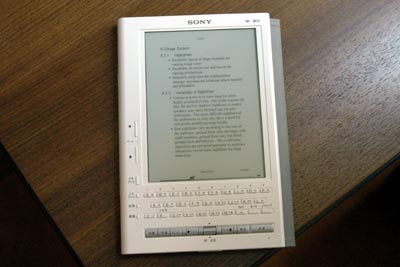
I spent the afternoon at the half-day session that GEL has added this year (it was formerly just a one-day conference). There were twelve different sessions described as "hands-on experiences" to choose from and I attended the gadgets session with Dan Dubno, who is a self-described lunatic when it comes to gadgets and technology products. I'm not much for gadgets, especially new ones...I'm a fairly late adopter among my tech-savvy friends. But some of the stuff I saw today...wow. Aside from the thinnest touch-screen tablet PC I've ever seen, the thing that blew me away was the Sony Librie, the first commerically available electronic ink e-book reader. Here's a photo I took:

What you can't see from the photo is how insanely crisp and clear the text on the "screen" is. It was book-text quality...it looked like a decal until you pushed the next button and the whole screen changed. It was *really* mind-boggling and you could instantly see how most books are going to be distributed in the very near future. Despite looking like a computer, when you were reading, it felt like a book because of the resolution (a very odd sensation). And it's not only for books...I was told that there's e-paper that's capable of full-color 24 fps video. Can't say enough about how blown away I was by the Librie. (Now for the bad: 10MB storage capacity, uses Sony's Memory Sticks for more storage, and the content self-destructs after 60 days. If Sony opened this up and used normal flash memory like everyone else, this thing would be huge. Enormous. It's a TV, video player, book, magazine, gaming platform, and hybrids of all of the above. Instead, they'll probably keep it closed and someone else will capitalize on it.)
Anyway, if you can handle navigating the Japanese menus, you can get one from Dynamism for $600 (which I would totally do if I still had my old job).
"Amazing New Hyperbolic Chamber Greatest Invention In The History Of Mankind Ever". "Popular Science quickly placed the chamber on the fold-out cover of its next issue, which reads, 'FUCKING AWESOME!!! THE BALLS-OUT H.C. IS 40 TIMES BETTER THAN SEX... AND COUNTING!!!'"
How a couple of mathematicians helped the Met accurately photograph some priceless tapestries. The difficulty in piecing together the different photographs was because when the tapestries were taken off the wall, they "began to breathe, expanding, contracting, shifting"...that is, they were changing between photos.
Man bitten by a deadly Brazilian Wandering Spider is saved by his cameraphone pic he took of the spider. "Experts at Bristol Zoo were able to identify [the spider from the photo] and suggest an antidote."
Super Size Me
Finally got around to seeing this documentary and loved it...but wanted to love it even more. There's so much going these days in relation to America's relationship with food: the growing obesity problem (especially among children), corporate exploitation of food for profit, governmental agencies like the FDA and USDA supporting corporations rather than educating consumers, corporate sponsored school meals, the never-ending diet mania, etc. and SSM only touched on these things tantalizingly briefly. I'm not sure how much of this stuff could have been explored more without disrupting the main narrative of Morgan Spurlock slowly killing himself with McDonald's food, but a bit more substance would have been nice. Maybe co-writing the film with Eric Schlosser would have done the trick.
But still, for all the attention that Fahrenheit 9/11 received, the better documentary to open in the summer of 2004 was Super Size Me.
How big is Jesus?. Based upon the amount of communion wafers and wine consumed by Christians, Jesus "weighs twenty million times more than you, and contains ninety-two billion times as much blood".
Does advertising still work?. "In 1965, advertisers could reach eighty per cent of their most coveted viewers -- those between the ages of eighteen and forty-nine -- just by buying time on CBS, NBC, or ABC." Now it's a lot more difficult and expensive to do so.
The NY Times' Randy Cohen is making a literary map of Manhattan. Not a map of where authors hung out, but where their characters did.
NYPD: web sites are not eligible for working press credentials. Wait, doesn't the NY Times have a web site?
Why geeks and nerds are worth dating. "They actually give a damn about you. Not how you look (though that's a plus), not how skinny you are, not how much make-up you primp yourself up with, but they like you for you. That kind of thing lasts longer than 'DaMN baby you got a fine ass!!!'"
A whole new internet?
After reading Janice's piece, It's a Whole New Internet, I didn't really know how to feel about it. It is an exciting time on the web right now, but it doesn't seem any more exciting than 2-3 years ago. At that time, blogs were really taking off, people were paying more attention to structured data in the form of RSS & XHTML/CSS, and using web services to paste together various apps and bits of data from around the web into new and useful services. But after thinking about it for a couple of days, what bothered me about it was echoed by Andre Torrez, who puts it a tad stronger (and funnier) than I would have:
Anyway, yes, there's more money that seems to be available for people who have been building these apps, but the suggestion that people who make these sites are only now springing to life when money is available is kind of disappointing. I hate the equation that $1 million in funding == EXCITING OPPORTUNITIES. It's how you fools lathered yourselves into the last bubble.
If your focus is on the neat technology shoehorned into some idea to make money then you're going to be up to your ass in sock puppets again.
When the dot com economy was crumbling in 2000 and 2001, I remember thinking at the time that although everyone I knew was out of work (myself included), that is was a good thing for the long term. One of the more pleasant side effects of the dot com boom was that billions of dollars were spent training indivduals how to design web sites, program, write, etc. In the years following the bust, when all those people were suddenly unemployed or stuck in high-paying jobs that they didn't care for very much but needed to pay the bills, they responded by starting to tinker around with all sorts of neat things, just for the hell of it. Because they could, because they wanted to, not because they had an artificial deadline to reach or some arbitrary client requests to satisfy.
They made apps and services that they wanted to use or thought that others would like to use, not only apps for which there was money available to build. There was no pressure...these people had nothing to lose and everything to gain. Out of this period came All Consuming, Movable Type, Amazon Light, millions of blogs, thousands of very active blog communities, the first consumer-grade newsreaders, Wikipedia (and thousands of other wikis), Firefox, FilePile, lots of social software (admittedly much of it of dubious value), Muxway (which became del.icio.us), a huge push toward XHTML/CSS-only sites, and a billion other things I'm forgetting, all when no one was putting any money into anything.
If you're buying low and selling high, the time to buy optimism was two to four years ago, not now. That was when a small group of friends looked at a horrible economy and saw an opportunity to educate their clients and the rest of us about the value of user-centered design. When a husband and wife decided to build their own blog tool in their spare time because they wanted to use it. When an entreprenuer gambled that you could make money publishing weblogs. When a few folks decided that people needed a place to share their photos with friends. When a loose collective of designers showed us the possibilities of semantically correct standards-based web design. There's still lots of opportunity these days, but it's more expensive with less return.
Now that the money is back, the focus will necessarily shift even though, as Janice notes, we'll be a little wiser about it this time around. There will be less innovation and activity from individuals because they'll be snapped up by companies to work on their projects for their customers. The information flowing out of companies, even those that are pretty open, will be limited because of competitive and legal concerns. A person who -- when she was unemployed 3 years ago -- could spend a couple weeks in releasing a neat web app for anyone to use because she wanted to or could say what she wanted on her blog will now be putting all her coding energies into an application that serves a few customers & needs to be cash-flow positive and won't have the time to post anything to her blog (and can't say much about what she's working on anyway unless all her readers want to sign NDAs). (Not saying this is bad...this is just what companies are for. But what's good for companies, their shareholders, and their customers isn't necessarily what's good for environment those companies inhabit. On the other hand, everyone I know has more work than they know what to do with and that's a good thing too.)
Consider Six Apart as an example of what I'm talking about. 6A is like a black hole for creative people. Folks who, a year or two ago, were among the leading voices in the discussion of how weblogs were changing our culture, were coding all sorts of useful plug-ins for Movable Type, or were pushing the edges of web design are now focused on making software that generates revenue and aren't saying a whole lot about it. (Sort of ironic that working for 6A kills the weblogs of their employees, isn't it?) That's great for them, for Six Apart, their customers, and their partners, but it kinda sucks for the community as a whole.
(And just to head off some of the obvious criticism here, of course companies contribute to the common good (some more than others), competition creates opportunity, investment isn't evil, Ajax is cool, innovation is still happening, etc., etc.)
Steven Johnson: "Imagine an alternate world identical to ours save one techno-historical change: videogames were invented and popularized before books". "Reading books chronically under-stimulates the senses. Unlike the longstanding tradition of gameplaying -- which engages the child in a vivid, three-dimensional world filled with moving images and musical soundscapes, navigated and controlled with complex muscular movements -- books are simply a barren string of words on the page."
Some guy named Lee Walton versus Shaq in a free throw shooting competition. After each Heat game, Lee would attempt the same number of free throws as Shaq and tally the results. He lost to Shaq by 8 points.
"More big chefs are getting paid to pitch everything from shrimp to raisins -- and not telling their customers". "The Seafood institute pays [chef Ty Fredrickson's restaurant group] $10,000 a year to have the word Alaska in front of its king-crab and halibut dishes."
The stupid West Side stadium
Amen to Kurt Anderson's comments about the ridiculous proposal to plop a huge stadium for the Jets on the West Side of Manhattan:
When I asked the Planning Department's spokesperson why the city needs a stadium for the Jets on that spot, she said it was "essential to jump-start development" in the neighborhood. Really? Essential? Right on the Hudson, immediately north of the successfully renovated Starrett-Lehigh office building and a thriving art neighborhood and Chelsea Piers? "There's a hole there," she said, referring to the MTA yards over which the stadium would be built. Holes can be filled in lots of other ways when they're adjacent to living urban tissue, albeit not as quickly. Well, she said, the stadium--that is, the New York Sports and Convention Center--is the best option on the table.
With the stadium, what they're doing is replacing one hole with another higher priced hole (with football!). But what's the alternative?
But why not, as the transmogrified High Line helps propagate the Tribecafication of the adjacent blocks, imagine a tightly woven extension of the southern and eastern neighborhoods into the rail-yards site? Why not build apartments and hotels and theaters, a better, funkier Battery Park City? Or a big park? Or the second Guggenheim Museum? Or a campus for New School University? Why can't this city assemble a brilliant team of designers and entrepreneurs to dream up a thrilling new piece of New York--people with as much visionary gusto as, say, the man who started a new kind of digital data and news company a quarter-century ago? It wouldn't be finished in five years, because creating great new places that people are eager to visit and live in is not easy or fast. But wouldn't it be better to be driven by the ambition to create a 21st-century Rockefeller Center than by a deadline to hold the 2010 Super Bowl and a 2012 torch-lighting ceremony?
Putting that stadium where they want to put it seems to me like sticking one of those huge outdoor gas grills in the middle of your bathroom. However yummy the food that's made with it, that grill isn't going to turn my bathroom into a kitchen and is only going to interfere with the proper operation of the bathroom (my dream of cooking a meal while showering as a time-saving technique notwithstanding). Like Anderson, I'll be pulling for some other city to win the 2012 Olympic Games this summer. Anything to get another chunk of New York City breathing comfortably again.
The Gunning Fog Index of the last month of kottke.org posts is 10.70. That's a little less than the Wall Street Journal and more than Time or Newsweek. (Three years ago it was 9.61...I'm getting less readable.)
David Byrne on how the tightening of US borders keeps creativity out of our country. I imagine this has had an effect on the scientific community as well.
"There's a game I like where you have to think of people whose name makes a complete sentence". "Tom Waits. Jeremy Irons. Jeff Bridges. Wesley Snipes."
Audio from the Who Owns Culture? talk by Lessig, Tweedy, and Johnson now online. Streaming audio or mp3.
PHP5, DOM, scraping web pages, and McSweeney's Lists RSS
In preparation for a larger project, I recently spent some time playing around with PHP5's DOM support to scrape web pages. Basically you point your script at a page and use the DOM methods to root around in it. This little chunk of code gets you a tree of the contents of all the <p> tags in document.html:
= new DomDocument();
= 'document.html';
();
= ("p");
I never learn anything like this without a little project to do, so I decided to use the above to make an RSS feed for McSweeney's Lists (which currently doesn't have one and now that I'm using a newsreader to keep up with the web, I never remember to visit there on anything resembling a regular basis). I've got a cron job set up that goes out and gets the lists page each night (using Tidy to convert their circa-1999 HTML to proper XHTML that can be easily parsed with the DOM), scans it for new lists (and if it finds new ones, puts them in a DB), and then writes an RSS file.
Anyway, here's the RSS feed for McSweeney's Lists. Since it relies on screen scraping, my meagre PHP skills, and the good graces of McSweeney's in not asking me to shut it down, there's no guarantee this will work forever, so enjoy it while you can. I'm trying out Feedburner as well, so we'll see how that goes.
Update: my code snippet was incorrect and is now fixed. Thanks to Eliot for pointing that out.
Update: As some of you may have noticed, the above RSS feed has not worked for some months now...it broke at some point and I never got around to fixing it. Additionally, McSweeney's has contacted me and asked me to discontinue the feed, so it won't ever be fixed. They're looking at doing their own RSS feeds and hopefully that will happen sooner rather than later.
Kerry supporters barred from international telecom meeting by Bush Administration. This type of thing makes me *so* angry. It's the fucking **US** government, not the Republican government or Bush government. So! Angry!
Maybe the high price of oil isn't such a bad thing. "When you look closely, it is hard to know what effect, exactly, oil prices have on the economy."
Part one of Elizabeth Kolbert's three-part series on global warming for the New Yorker. "Disappearing islands, thawing permafrost, melting polar ice. How the earth is changing."
According to this article, The Simpsons have some new writing blood and the episodes are getting better. I'm skeptical because the show has been marginal for years now...maybe I'll have to give it another try.
How to make a fire using just a Coke can and a chocolate bar. You use the chocolate (which is a minor abrasive) to polish the underside of the can into a mirrored surface shiny enough to focus the sun's rays effectively.
Comparing newspapers' online "circulation" (# of blog links) with their offline circulation. The Christian Science Monitor had the highest ratio by far, with the Wall Street Journal being almost invisible on the web (which will eventually affect their influence, I think).
Steven Johnson says watching TV makes you smarter. The argument is that media has had to get more cognitively challenging to hold the attention of viewers. Evolutionarily speaking, attention is the scarce commodity that creates competition here, driving adaptation in the direction of more social and narrative complexity to hold that attention.
Creative writing time
My pal Kdunk, who gave me a lucky dollar to hang on my wall on the occasion of my going full-time on kotte.org, recently posted an intriguing photo to Flickr. As the first commenter notes, "there goes a story". As a creative writing exercise, what's your take on what's going on here? Doesn't have to be true, just make something up. A picture is worth a thousand words, but I think this one may have a few more in it than that.
"Get over yourself and drop the 'MSM' bullshit, please". "If you use the term 'MSM' in a unironic way to denote the 'Mainstream Media' I will write you off as a quack, unsubscribe from your RSS, and stop reading your blog."
Taste of Chinatown 2005, April 23 from 1-6pm. Fifty restaurants are offering $1.00 tasting plates in Chinatown tomorrow afternoon. Delicious!
More Paris in April
As promised, some more photos from my recent trip to Paris (first set):
I've been back in NYC for a couple of days and am still jet lagged as all get-out...I was up at 5:05 AM this morning, about an hour before the sun decided to make an appearance. Getting a lot done with all this early rising, but I'm looking forward to more sleep soon.
Oh, and for the completist, here are all of my photos from past trips to Paris:
Jun 2003
Nov 2002
May 2001
The Louvre
L'Institut du Monde Arabe
Churches and cathedrals
Eiffel Tower
Wow, there's some bad ones in there. (And not so bad ones as well.)
Books that changed the world. Just a few of the things that have changed the world so far: cod, salt, chips, radio in Canada, sewing machines, atomic weaponry, quinine, cables, sheep, gunpower, etc. etc.
Woman goes into labor on the F train this morning. Aha! That's why my train was so slow this morning.
Keyword Assistant plug-in fixes iPhoto's stupid ass keyword-adding interface. Software developers, say it with me: "auto complete, auto complete, auto complete!"
On shopping cart coin replacement things. The plastic coin replacement thingie is a "perpetually reusable currency for the shopping cart leasing market."
Ask and ye shall receive: Google Maps with the NYC subway stops on it. A little flaky in Safari, but works well in Firefox.
Street art legend Revs is back, but this time he's (almost) legal and working with iron sculpture. I've seen a bunch of his work in Dumbo.
Processing, a programming environment for designers and artists, is in beta. It's the first public release.
The Fat Duck, a UK restaurant known for its "molecular gastronomy" approach, has nabbed the top spot in Restaurant magazines best of list. El Bulli is #2, French Laundry is 3rd, Per Se is 6th, and several other London spots made the top 20.
John Gruber's plain English version of the Adobe/Macromedia Acquisition FAQ. "Please also note that PDF is an excellent format for sending out resumes."
Nine Inch Nails is offering a GarageBand file with the complete mix of a forthcoming song. Can't use the remixes commerically, but still pretty cool.
Ridiculously comprehensive movie genre primers from GreenCine. If you've ever wanted to know what French New Wave films to watch or what "Hammer Horror" movies are, this is the resource for you.
Interview with Ludicorp's Stewart Butterfield about Game Neverending, Flickr's MMORPG older brother.
The future of Spotlight and OS X
Bill Brown has uncovered some interesting Slashdot comments by an Apple employee about Spotlight and future Apple's future plans. (Ed note: it's unclear whether As Seen On TV (ASOT) is indeed an Apple employee, but even if he/she isn't, the thoughts are still interesting.) In this comment, ASOT talks about the future direction for Spotlight, Apple's new finder (not Finder, but it seems clear that as Spotlight matures, it will become the de-facto way people use OS X), specifically about speech-to-text capabilities:
Example: You're doing a multi-party teleconference. A recording is made of that teleconference (each angle), and separate audio tracks are recorded for each participant. In real time, your computer transcribes each voice track and stores it as ancillary content on the recording, content that Spotlight indexes for you. At any time, you can type "meeting in San Jose" into Spotlight, and it'll take you right to the angle and track on which your co-worker Laurent talked about next week's meeting in San Jose.
and "anything" relationships:
Take two files, any two files. Say it's a PDF representing an invoice and a Photoshop file representing a poster you designed. You drag the invoice over the Photoshop file and a marking menu appears, giving you the option of establishing a relationship between the two files. If you want you can annotate the relationship. If you don't, you don't have to. The computer will simply note that a relationship exists.
Now extend that idea. Instead of it being two files, it can be two ANYTHING. Drag a contact from Address Book to a Pages document; up pops a marking menu asking you if you want to establish a relationship. Or an song from iTunes to a picture of your girlfriend. Or your daughter's birth certificate to her birthday in iCal.
Sounds like there's more than a little Quicksilver and Spring in there. And then here, ASOT talks about adding GPS data into the mix:
What's next? We're going to find new ways of attaching automatic metadata. Here's one we've been talking about a lot: Your laptop has a GPS receiver in it. Tiny thing, about the size of a pencil eraser. At all times, your laptop knows where it is on the face of the Earth, accurate to about thirty feet.
Every file you create is tagged with three new, additional pieces of metadata: latitude, longitude and altitude. That's on top of the date and time data we already attach to every file.
Say you go on a business trip to Seattle. A year later, you can search your laptop for that e-mail you sent to your coworker Tom while you were in Seattle.
S/he also notes that "It's going to be a while before we start shipping GPS-enabled Powerbooks...but it's on the drawing board." And you thought that gestural control of applications with the Powerbook's accelerometer was fun.
The Oxyrhynchus Papyri, a cache of previously unreadable ancient documents discovered a century ago, are now being read using IR imaging techniques. "Oxford's classicists have used it to make a series of astonishing discoveries, including writing by Sophocles, Euripides, Hesiod and other literary giants of the ancient world, lost for millennia."
Macromedia may be a bit concerned about Ajax competing with Flash's XML socketing. "Kevin [Lynch] specifically wanted to explore the possibility of hooking into the Ajax system with Flash, via Flex."
An update on the development of the High Line. The latest designs will be on display at the MoMA.
Microsoft recently licensed their core and web fonts (Verdana, Georgia, etc.) to Ascender. These fonts were formerly distributed free of charge on the web by Microsoft...now they only come free with MS products.
Why did traffic on nytimes.com rise?
The NY Times recently posted a press release about last month's record-breaking traffic to their web site. In the release, they cite content as the main driver for the growth ("the journalism and voice of NYTimes.com continued to attract an audience interested in a wide range of subjects..."), both month over month and year over year:
Pageviews for the National section of NYTimes.com experienced a 96% increase year over year, due to reader interest in the news surrounding Terri Schiavo. Also, pageviews for the Travel section increased 238% year over year, as a result of the site's coverage on a number of topics of interest including Paris restaurants and Maureen Dowd's article about visiting Cancun, Mexico, entitled "Girls Gone Mild." The Real Estate section grew 22% year over year, with several articles on a potential real estate market bubble. College basketball, baseball's spring training and the steroids debate fueled growth of the Sports section with pageviews up 12% year over year.
Having some experience building and running content-based web sites, I'm skeptical the specific content offered by the NY Times is the whole story here. (This is a bit like Amazon saying their sales increased mostly because the quality of the books offered went up.)
Across the board, more Americans are getting their news online (25% in 2002 up to 29% in 2004) and Internet usage in other countries is growing as well.
RSS is mentioned in the release and is a small factor, with only 1% of their traffic coming directly from RSS feeds, but the vast array of blogs acting as entry points to Times' content has to be having an impact. By some counts, the number of blogs is doubling every few months and the NY Times, despite their content being behind a registration wall and their links expiring after a few days (unless you know the secret code), is a favorite source that bloggers link to. During the 2004 Presidental campaign, the Times was the #1 most cited media source and was cited equally by both sides of the political aisle.
Design and user experience changes to the site might also be a factor. The NY Times has not radically redesigned their site recently, but like most large media sites, they tweak little things here and there all the time. Redesigns can dramatically increase (or decrease) traffic, but those small changes can as well. A quick change in the location of the "mail this article to a friend" link could result in 30% more mailings, which may translate into 20 million more hits down the line. Making RSS feeds more widely available, even though they only account for 1% of the site's traffic directly, puts information into the hands of bloggers and may account for more indirect traffic than direct (I visit an article once through the Times' RSS, but if I then link to it on my site, they'll maybe get 2000 hits). Moving headlines around or tweaking the font size of the article summaries could result in more or less clickthroughs from the front page. Etc, etc.
(And there's also business and marketing to consider. Did they make any deals to drive traffic? Did their marketing expenditures increase over the past year? Are they advertising the site any more in the print publication than they used to?)
The Times talking about their content being the sole driving force behind the increased usage of their web site certainly bolsters the NY Times brand (and this is a press release after all and PR is typically about promotion and not information), but I would be interested to know how much other factors contributed to the rise in traffic.
Google Maps launches in the UK with London Tube stations right on the map. Google, please, please, please, please, please, please, please, please do the same for the NYC subway. Please?
Adobe Macromedia acquisition roundup
As you might expect from a story with design, media, and technology angles, Adobe's impending acquisition of Macromedia has resulted in much reaction from a big chunk of the blogosphere. Here are what some technologists, designers, and pundits have had to say about the deal so far:
Mike Chambers, a Product Manager at Macromedia, had a few things to say about the acquisition on his blog. He can't say too much because of legal constraints around the deal, but he specifically mentions Macromedia's "culture of openness and participation" as one of the reasons that Adobe was interested in the company.
Kevin Lynch, Chief Software Architect for Macromedia, posted what sounds like a press release about the deal on his site. He's very hopeful about the future of the combined company.
Macromedia MX evangelist John Dowdell notes that Macromedia is "doing a lot of hiring these days" and points to Google Video's coverage of the deal.
(Note: if you're keeping score, that's three employees of Macromedia chiming in about the acquisition on their blogs. And many more MM employees keep active blogs, so I'm sure we'll be hearing more from that side of the fence (although because of the legal stuff, it looks like posts about this need to be approved). On the other side, I've never heard of an Adobe employee that keeps a blog. Anyone?)
Marc Canter, one of the founders of the company that eventually became Macromedia, wants his name back, along with Director because MM "more or less have abandoned it". Marc seems fairly negative about Macromedia ("Lord knows they [can] teach a class in how NOT to run a software company") and thinks that maybe Adobe can turn things around, but only if they can shed the software-in-a-box paradigm and start making multi-user, community-based software with online components that don't rely on patent protection.
Adobe CEO Bruce Chizen said in the announcement conference call that 9/11 was a bit of a catalyst for the deal: "after 9/11, we both realized that being enemies didn't make sense". Zuh? But the new company still has enemies worth fighting, even in a post-9/11 world...here's what Chizen had to say in an interview a year ago: "Microsoft is the competitor, and it's the one that keeps me up at night."
Tim Bray, co-author of XML and Director of Web Technologies at Sun, thinks that Adobe got Macromedia for their web products. Unlike most other commentary I've seen, Bray feels that "Macromedia's DreamWeaver is the single most important Web-design product" and that "Flash is a distraction" that Adobe may drop because "near as [Bray] can tell, Macromedia has never made any serious money with Flash". What's the alternative for web developers? Ajax.
Dave Shea, well-known and respected web designer, echoes the thoughts of many in saying that Adobe bought Macromedia for their web products and savvy...and Flash in particular. Shea also wonders "what will become of Adobe's long-standing commitment to SVG, now that Flash is in the fold", names Microsoft as Adobe's main competition now (MS seems to fighting on several fronts now...the Google/Yahoo/Jeeves, Apple, and now this), but is also worried about the loss of competition in the design space: "the combined Macromedia and Adobe stable of design software is industry standard; with this buyout, Adobe essentially has a monopoly over the design world. (Quark aside. Very far aside.)" Flash/web developer Todd Dominey echoes many of Shea's comments in his post about the deal.
Dave Winer, who has his fingers in too many pies to summarize, compares the Adobe/MM acquisition to MM's purchase of Allaire: "Remember all the hooplah over the Allaire-Macromedia acquisition, and all the synergies that were supposed to happen. Hmmm. Did any happen? BusinessWeek didn't think so. Will any happen here? Heh. Slightly more exciting than Microsoft's acquisition of Groove."
TidBITS has a good overview of the evolution and history of the relationship between Macromedia and Adobe by Glenn Fleishman.
Broadband pundit Om Malik calls it a Web 1.0 (or even a desktop publishing) merger: "They are becoming increasingly irrelevant in digital worlds where free programs like iPhoto and Picasa are setting the tone on the desktop. Don't expect innovation as a result of this deal - this is a deal to boost the revenues and maybe profits."
Russell Beattie, who works for Yahoo! on mobile products and services, is heartened to see Adobe's focus on mobile cited in their reasoning for the merger and "can see a combined Flash/SVG player (Flash Lite 1.1?) from Adobe becoming a really viable platform". But Beattie also notes that "Adobe will always be the company that had a researcher *thrown in jail* for publicly explaining flaws in their product" (see here for details). Back to mobile, a commenter on Beattie's thread warns, "PDF is the dog that can bring a 2GhZ PC to its knees to display a text file. not the kind of attitude thats right for mobile."
Don Makoviney is looking forward to the stabilization in the tools competition: "As a working designer and developer of enterprise applications, I am tired of the battle over tools. When a carpenter buys a hammer, he doesn't have to change the way he builds houses based on the hammer he buys."
From the survey of all the commentary out there, the general feeling seems to be that Photoshop will kill Fireworks, Illustrator will kill Freehand, and Dreamweaver will kill GoLive. This seems to be confirmed by Adobe CEO Bruce Chizen's thoughts in a statement about the deal.
Mark notes that this is the second time Adobe has purchased Freehand. :)
The Macromedia XML News Aggregator (time for a new name?), which is a good place to keep up with all of the news and commentary about this deal, also displays a list of recent searches. There aren't many searches about the deal right now, but just after the deal was announced yesterday morning, the most recent search terms were "suck adobe", "adobe rape mm", "adobe ruin flash", "f._.ck adobe", "really upset", "stop adobe", "against adobe", and "hate adobe". I'm detecting a tiny bit of anti-Adobe sentiment here...
The financial markets didn't seem to react too well to the deal. Adobe's stock price fell 8+% while Macromedia, which was offered $41.86 per share, only saw a rise to 36.72.
BusinessWeek has excerpts of a conversation with the CEOs of Adobe and Macromedia.
Jeremy Allaire, former CTO of Macromedia, had this to say about the acquisition: "Macromedia lost the enterprise publishing race to Adobe, and Adobe lost it with the Web publishing community. So the deal combines the best of both worlds. It gives Macromedia a huge sales channel, especially on the enterprise side. This will probably make the channels as strong as say Microsoft has."
Knowspam shutting down with little warning. I know it worked, but I never liked the "hey, you emailed so-and-so and you need to authenticate..." It's the kind of service/software (like the hated Plaxo) that makes you dislike your friends.
Whoa! Adobe to buy Macromedia?!!?!?!. Wow! ??!!?!??!! I don't think there's enough room in my MT database for all the question marks and exclamation points I want to use here.
Sin City
When I telephoned to see if he wanted to go, a friend warned me off Sin City. But since both Metacritic and Ebert (who has tastes similar to mine) gave it good marks, I decided to ignore his advice; I'm glad I did. Although it was violent and misogynistic as hell (as many comics and graphic novels tend to be), Sin City was a lot of fun and as beautifully shot as recent cinematographic favorites House of Flying Daggers, Hero, and Kill Bills I & II. Rodriguez and Miller (whose comics the movie is based upon) translated the style, framing, and abstractness of a comic to film better than I've ever seen...you can see that they really understand how both genres work and how to move between one and the other without forcing it. If you can stomach the violence (it's one of the most violent films I've ever seen), I'd recommend checking it out.
And if you ever need to move the Earth, here's how you might accomplish that. "The Earth is very big, moving very fast, and therefore very difficult to stop or even slow down."
Forget how life will end, here's a bunch of ways you can destroy the entire Earth. This is a really fun read: "keeping the strangelet stable is incredibly difficult once it has absorbed the stabilising machinery, but creative solutions may be possible."
Ten scientists on how human life on earth might end (or be severely curtailed). Super volcanos, killer robots, viral pandemic, oh my!
Bruce Schneier on how to mitigate identity theft. "If we're ever going to manage the risks and effects of electronic impersonation, we must concentrate on preventing and detecting fraudulent transactions."
A look at the terms of service for Google Video. Several potential areas of concern there.
Explicit Content Only, NWA's Straight Outta Compton edited to contain only the swear words. The full version makes it seem like my laptop has Tourette's and the edited version is pretty funny.
Reflecting on 10 years of ESPN.com. Starwave! There's a blast from the past.
In tha hizzie of fine hypertext products
HTTP in tha House takes the text from a URL and constructs a rhyme out of it. Here's what it spit out for kottke.org this morning:
vs commission
i'm in fission
been asking and
have made bland
flat out fantastic
what a drastic
purchase a movie on dvd
basically done gheesince u been
study tall slender chagrin
rates of whites go
women who had a low
lines more than
d levitt stephen plan
fake restaurant quot
plasticbag a gleeWWW DOT KOTTKE DOT ORG IN THA HOUSE
WWW DOT KOTTKE DOT ORG IN THA HOUSE
WWW DOT KOTTKE DOT ORG
See also old school kottke.org content Straight Outta .Compton, a collection of rhymes inspired by the dot com boom:
i'm gonna touch your audience, touch them down below
wave our space inter-face 'til your eyeballs glow
stick my vortal in your portal and suck your paradigm
we're a reinvented army whose gonna revolutionise
Shout out to my homie Sean for emizzailing the HTTP in tha House link.
Some bacteria in Africa beat Fermi to the first stable nuclear reactor on Earth by almost 2 billion years. The bacteria enriched the uranium into a critical mass and the flow of water through the reactor kept the reaction going for millions of years.
Paris in April
So, I'm in Paris for a few days. It's a pseudo-vacation of sorts, but I'm keeping up with the site while I'm here as well. I've had the chance to get out with my camera the last couple of days, something I always enjoy doing here. It feels like cheating in a way...it's so easy to take good photos here. Anyway, here's a selection from the last two days:
The above photo (larger version) is one my favorite photos from the past few months. I was walking around in the Jardin Des Tuileries, saw him reading by the fountain, and just knew I'd found a good picture. I imagine actual photographers get that feeling all the time, but it was a new one for me. Hopefully I'll find a few more good ones for another one or two selections while I'm here.
Apparently, all umbrellas kinda suck, unless you want to pay $225 for one. Author notes it would be better to stock up on $3 Chinatown umbrellas instead.
AIGA's Design Annual for 2005. Lots of good work in there; I saw the book design winners on display in NYC last fall.
Mark Bittman cooks homemade food in challenging America's top chefs. Daniel Boulud laughed at the complexity of Bittman's dish, but gave an 8/10 in taste...and it only took 10 minutes to prepare.
Is some of the music on Bush's iPod stolen?. This is "exactly the kind of behavior the music industry characterizes as theft".
Mobile rudeness
While browsing the magazine section in the bookstore today, I heard a peculiar laugh. A few seconds later, a slightly different peculiar laugh but enough alike the first laugh for me to realize it was the same person. Then a few moments later, another odd laugh by the same person. And by odd and peculiar, I mean this person's laughs were really pretty loud, obnoxious and disruptive in the quiet of the magazine-browsing space, like someone portraying a horrible laugher in a comedy skit. But whatever, she's having fun with a witty friend or something.
After a couple more minutes, I turn to walk out of the magazine section and I catch the laugher in action and she's cackling at something she's listening to *on her headphones*. I just about throttled her.
Meetup is now requiring all groups to pay $19/month. Seems like this will kill off a bunch of the more casual groups.